




Abstract
Background:
Differences in social gaze are part of the diagnostic criteria for autism spectrum condition (ASC), but most studies examining gaze in individuals with autism or high autistic traits use computerized methods that bear little resemblance to authentic conversations. Progress in eye tracking now allows the use of live interaction paradigms. We report a systematic review of this emerging literature.
Methods:
Using a combination of academic search engines (Google Scholar, OVID, Connected Papers) and backwards citation searches, we identified fourteen studies that explored social gaze in adults and adolescents with autistic traits or an ASC diagnosis, using a live or believed-to-be-live interaction and modern eye-tracking technology.
Results:
Studies showed mixed results: when gaze is localized to broad regions (face, body, and background), patterns appear similar in all participants. However, when gaze is localized to precise regions (eyes, mouth, and nose) more group differences exist. Specifically, gaze to the eyes seems somewhat consistently reduced in individuals with autism or autistic traits. However, these participants appear to modulate their gaze according to contextual factors, similar to typically developing individuals (e.g., looking less toward the face when speaking than listening).
Conclusion:
We discuss these results in relation to two dominant theories of autism: low social motivation and aversion to the eyes. The finding that individuals with autism or autistic traits seem to specifically avoid the eyes but show facial orienting and gaze modulation similar to typically developing individuals lends supplemental support to aversive rather than motivational theories of ASC.
Community Brief
Why is this an important issue?
The idea that autistic people make less eye contact than non-autistic people is very common, but it has not often been studied in detail. Most research on the subject has recorded people’s gaze when they see photos and videos, not when they see real people during a real interaction. Gaze during a real interaction might be different, because it allows people to send social signals with their eyes. In fact, non-autistic adults often look at their partners’ eyes and face less during a real interaction compared with a video. This means researchers should study autistic individuals’ eye contact during real interactions, because it may be different compared with looking at photos and videos.
What was the purpose of this study?
In this article, the researchers review recent studies that use modern eye-tracking technology to explore eye contact in adults and adolescents with an autism diagnosis or with autistic traits during a real (or believed to be real) conversation.
What were the results of the study?
The researchers found that existing studies use many different kinds of methods and measures, too many to be able to compare them directly. It is therefore difficult to draw very strong conclusions, but they suggest that autistic individuals seem to look specifically less toward the eyes of the people they are speaking with, when compared with non-autistic individuals. However, it appears that autistic and non-autistic people look at the faces of their conversation partner to a similar extent. Furthermore, both groups seem to adjust where they look based on context, looking less at their partner when talking than when listening.
What do these findings add to what was already known?
There is an ongoing debate regarding whether autistic individuals’ reduced eye contact is better explained by (1) not being motivated to look at their conversation partner or (2) being overwhelmed when making direct eye contact specifically. This review supports the second explanation, since autistic individuals seem to look at the face of their conversation partner just as much as non-autistic individuals.
How will these findings help autistic adults now or in the future?
Eye contact is an important social tool that allows people to communicate and collect information from the people they speak to. Understanding if autistic individuals differ in their eye contact can help with understanding how autism works and whether autistic or non-autistic people should try to learn to use eye contact differently in conversations.
Introduction
Gaze is a key tool for communication in social interactions, and social gaze is often assumed to be impaired in individuals with autism spectrum condition (ASC) or high autistic traits. 1 Many scientific studies of gaze have used computerized stimuli in carefully controlled laboratory settings to explore differences in gaze to social images in autistic infants, 1 children, 2 and adults. 3 However, it is increasingly clear that gaze behavior in the laboratory does not necessarily match gaze in real-world situations4–6 ; much more complex and dynamic patterns of gaze can be found during real, face-to-face, social interactions. Few studies have tracked real-world social gaze in participants with high autistic traits, so it is not yet clear if gaze differences exist in this context or what this may mean for theories of autism and potential therapies. This article aims to provide a systematic review of this emerging field and guide future research on individual differences in gaze behavior during real social interactions.
Why does real-world gaze matter?
Eye gaze is an unusual social behavior in that it allows us to simultaneously gather information about the social world (perceive) and communicate with others (signal). 6 Before discussing autistic gaze, it is important to clarify what gaze in typically developing behavior looks like and what theories can account for this. When typically developing participants view humans in photographs and videos, they show preferential attention to faces and eyes over objects, regardless of saliency, 7 suggesting that these features are processed as important social stimuli. This prioritization probably arises because faces provide useful social information about a person’s identity, emotional state, attention, and even social status.8,9 In other words, preferential attending to the eyes and face serves a crucial perceptual role, allowing a person to gain social information about others.
Recently, the development of robust wearable eye trackers has made it possible to track gaze patterns during real, interactive conversations. During a live interaction, gaze is used for more than perception; it is also deployed as a communicative tool (e.g., looking intently at someone’s eyes to signal interest in initiating a conversation 10 ). Together, these perceptual and communicative roles are known as the dual function of gaze. 11 Classical studies on gaze to photos or videos fail to elicit the signaling role of gaze and therefore neglect a large portion of social gaze behavior. 6 Studies that directly compare live interactions to viewing videos show that people look more to video faces than to live faces.4,5 While laboratory studies might suggest a simple rule that more gaze to face relates to better social skills, the finding of lower gaze to face in live interaction implies that this rule does not directly translate to real-world contexts. Similarly, findings from studies of passive face viewing in autistic participants may also fail to apply in the context of a dynamic face-to-face interaction.
In typically developing individuals, conversational gaze appears to, among other things, regulate conversational turn-taking: people tending to avert their gaze when speaking and gaze more toward the eyes and face when listening.10,12–15 Gaze can also be deployed to signal internal states such as attraction, 16 embarassment, 10 or dominance. 11 However, it remains unclear which of and how these communicative functions may differ in individuals with high autistic traits.
Social gaze in ASC
ASC is a neurodevelopmental disorder primarily characterized by issues in social communication and interaction, accompanied by restricted and repetitive behaviors and interests. 17 It is a particularly heterogeneous disorder with a range of clinical presentations and secondary conditions, making research on ASC particularly challenging. Unusual gaze is part of the diagnostic criteria in the Autism Diagnostic Observation Schedule, Second Edition, and Diagnostic and Statistical Manual of Mental Disorders, Fifth Edition,17,18 but it is not specified in what manner this gaze is “unusual” nor is it clear how this behavior—based on clinical observations—can be captured in the laboratory. The majority of research on social gaze in ASC has used computer-based eye-tracking methods where participants view static images or videos of faces on a screen. Formal meta-analyses on such studies suggest that autistic children 2 and adults 19 show reduced gaze toward the eyes when compared with typically developing peers. However, it should be noted that these results are in no way systematic. Furthermore, these studies—by using noninteractive stimuli—suppress the signaling function of gaze, which is a communicative behavior of particular interest in autism. Additionally, live interactions may engage the senses in a heightened manner relative to prerecorded videos. Sensory differences in ASC—which can manifest as both hypostimulation and hyperstimulation 20 —may cause autistic individuals to show considerably different gaze behaviors under the increased sensory load of live interactions. Using new wearable eye trackers, it is possible to track real-world gaze behavior and link clinical observation to laboratory studies. Thus, a new body of research on real-world social gaze in ASC is developing, which this article aims to critically review.
This review will be focusing on adults and adolescents with high autistic traits (both with and without diagnoses) rather than young children for two main reasons. First, there is reason to suspect that at least some clinically relevant behaviors in ASC may present differently across the lifespan.21–23 Notably, eye gaze may be one of these evolving behaviors. 24 Second, there exist very little data on autistic children’s gaze during live conversation collected via eye trackers, so a review with our eligibility criteria cannot yet be conducted.
Despite inconsistent evidence concerning whether and how autistic individuals show different social gaze patterns, three major theories exist to make light of this. The first is the social motivation theory, 25 which posits that individuals with ASC show reduced social orientation in their gaze due to diminished motivation to attend to socially relevant areas (people, faces, and eyes). Thus, they are simply indifferent to social stimuli and are roughly as likely to look at or engage with objects. A second contrasting theory suggests that autistic individuals are not insensitive to all social stimuli, but rather find the eyes in particular to be aversive. 26 These two theories oppose each other as the latter supposes that autistic individuals actively avoid the eyes, while the former states that they are indifferent to all social stimuli, including both faces and eyes. Studies using fine-grained gaze tracking to the eye region may be particularly useful to experimentally confront these theories. A third, more recent theory, known as the dialectical misattunement hypothesis, 27 states that differences in autistic gaze may arise from interactive and dynamic mismatches between individuals. Testing this requires tracking both conversation partners’ gaze. We identified only one article that reports data to this effect. 28 Thus, the studies reviewed in this article will be discussed only in relation to aversion versus social motivation theories.
Why study social gaze in ASC?
The relevance of studying social gaze in autism is twofold. First, this research domain can help explain some of the social difficulties encountered by autistic individuals in live social interactions. Two alternatives exist: either individuals with high autistic traits are shown to have different patterns of social gaze relative to allistic individuals, or, no difference is found. As stated above, gaze serves a perceptual and communicative role during a live interaction. Thus, if social gaze behavior is different in autistic relative to allistic individuals, it can be inferred that some social challenges experienced by autistic individuals may be due to mutual misunderstandings in nonverbal communication If, instead, no difference in social gaze is found, then alternative explanations for communication difficulties should be considered. Second, and at a more general level, gaze research can serve to support or challenge contrasting theories of ASC, specifically the aforementioned aversion and social motivation theories. Both theories would be challenged if autistic individuals’ social gaze is found to be indistinguishable from allistic individuals. If differences are found, the manner in which they arise can help distinguish between either theory. Crucially, if differences are found, this research must not serve to catalog autistic “deficits.” For example, it must not be immediately assumed that interventions must target this. Beforehand, research should clarify whether this reduced gaze is indeed related to missed nonverbal cues and to what extent misunderstandings occur reciprocally (i.e., allistic individuals misinterpreting the nonverbal communication of their autistic interlocutors rather than or additionally to the opposite).
Methods for tracking social gaze
Before reviewing results from studies on social gaze in individuals with high autistic traits, it is important to understand the methods used to track gaze in more detail. In recent decades, eye-tracking technology has developed substantially, from invasive methods 29 to desktop eye trackers that require participants to keep their head steady in a frame, to new wearable eye trackers embedded in a pair of glasses.30,31 While wearable eye trackers typically have lower temporal and spatial resolution compared to head-fixed eye trackers, they allow participants to engage in natural conversation and other social behaviors, which is critical if we wish to understand real-world gaze patterns. With the introduction of more affordable and accurate systems, there is now a clear increase in studies using eye tracking in live social interactions.32,33 Eye tracking is particularly suitable for autism research as it can measure subtle spontaneous social behaviors and is not reliant on language skills.
Analyses are usually based on areas of interest (AOIs), which are zones in the participant’s visual field that have been selected as relevant. They can range in size from small (e.g., the nose) to large (e.g., the background or whole screen) according to research interests and available technology. A simple and common variable extracted from eye-tracking data is the proportion of time a person spends gazing at a particular AOI within a trial. We summarize common methodological variations in Figure 1 and describe them in more detail below.
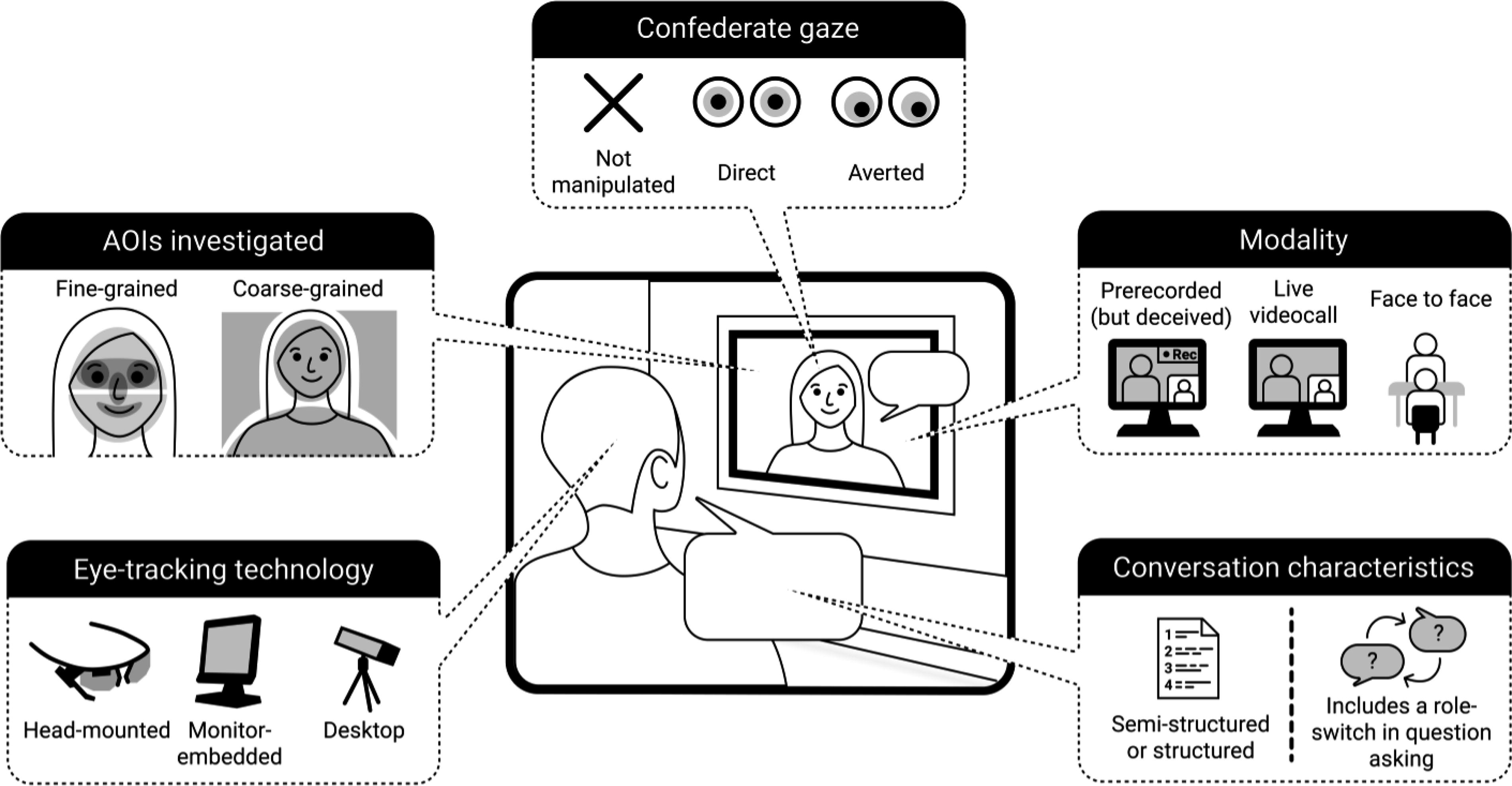
Summary of the different methods and experimental manipulations available for tracking gaze in real-world social interaction, as used in the articles reviewed in this study. Articles can use a variety of different technologies to track gaze and can analyze data according to fine or coarse AOIs. They can manipulate the gaze of the confederate, the physical presence of the confederate or belief that someone is present, and the type of conversation that takes place. AOIs, areas of interest.
First, the AOIs that are selected in a research study are an important factor. Some studies may use large coarse-grained AOIs, for example, distinguishing only face, body, and background. Others might use fine-grained AOIs that distinguish eyes from mouth. There is no standard for defining AOIs in social interaction research, and the possibilities will depend on both the research question to be answered and technology available. Furthermore, AOIs can be defined in different manners. Studies might use a large rectangular area over both eyes, including the bridge of the nose, or smaller ovals that cover only the eyes themselves. Some studies include a “nose” AOI, and others leave it out. Some use automated face detection tools such as OpenFace 34 to define AOIs, and others use manual labeling. All these factors may impact the research results.
Second, studies using different conversation paradigms may have unique behavioral results related to this. It is possible that highly structured conversations in which one person always asks questions and the other gives short answers may produce different gaze patterns than more free-flowing conversations characterized by speech overlaps. Also, the conversation partner’s perceived gaze is a manipulable variable, which is likely to impact participants’ behavior. Indeed, sustained direct gaze is known to be much more arousing than averted gaze. 35 Finally, some studies measure gaze in live face-to-face interactions, while others use interactions mediated by a video call system. In the latter, true eye contact is not possible because the webcam location does not match the eyes on the screen. Other studies implement a “fake” conversation between a participant and a video clip where the participant believes they are speaking to a live human. Each of these paradigms provides a different balance between ecological validity and experimental control, thus potentially leading to different patterns of gaze behavior.
This review
The brief outline above shows that gaze patterns in live social interactions are important in autism and recent technological advancements allow us to study this. This article therefore aims to provide a systematic review of current studies on social gaze in adults and adolescents with high autistic traits. We aim to understand (1) do gaze patterns differ between these individuals and their typically developing peers? (2) how do they differ? and (3) can this give us insight into the gaze indifference/gaze aversion theories about autism? To our knowledge, most existing reviews of gaze in adults and adolescents with high autistic traits using eye-tracking technology predominantly focus on gaze to passive stimuli and/or during nonconversational tasks.19,36–38 One review 39 focuses on live interactions, but this article includes studies with children and excludes nonclinical studies, resulting in an overlap of only four studies between this review and theirs. Our choice to include nonclinical studies was made in line with the modern conceptualization of autism as a continuum, where subclinical autistic traits are thought to be continuously distributed among the general population, 40 rendering the general population a relevant sample in the research on social gaze in ASC.
Methods
A general search on Google Scholar, an advanced search on the APA PsycInfo database using OVID (with key search terms related to ASC, communication, and gaze [see Table A in the Supplementary Data S1]), backward citation searches, and ConnectedPapers were used independently by both authors to identify relevant studies. Each study was then jointly discussed to ensure compliance with eligibility criteria. We did not encounter any uncertain case.
Both clinical (participants with an autism spectrum disorder diagnosis) and nonclinical studies (participants from the general population with autistic traits) exploring social gaze behavior in relation to autism or autistic traits were included. Studies were excluded if they (a) recruited young children, (b) measured gaze without eye-tracking technology, or (c) did not include an interaction with a person at least believed to be live. Because of methodological heterogeneity, results were categorized by AOI (body, background, whole face, eyes, mouth, and nose) and modulatory patterns (gaze modulation according to conversational phase, conversant gaze, and belief in social presence). As methods and data were not consistent enough for a formal meta-analysis, we provide a narrative review of our findings.
Results and Review
Results
Figure 2 shows the selection process for articles included in this review. The advanced search on OVID resulted in an output of 193 articles. By checking titles and abstracts, 9 studies were selected. A more detailed reading of these led to the exclusion of 3 articles (for lack of eye-tracking technology). In addition to the remaining 6 studies, 5 articles were found through ConnectedPapers and 3 were found by examining reference lists. This resulted in a total of 14 articles tracking gaze in adults and adolescents with high autistic traits during a live (or believed to be live) interaction, of which 5 were nonclinical studies and 9 were clinical. Summaries of these studies are available in Table B of the Supplementary Data S1.
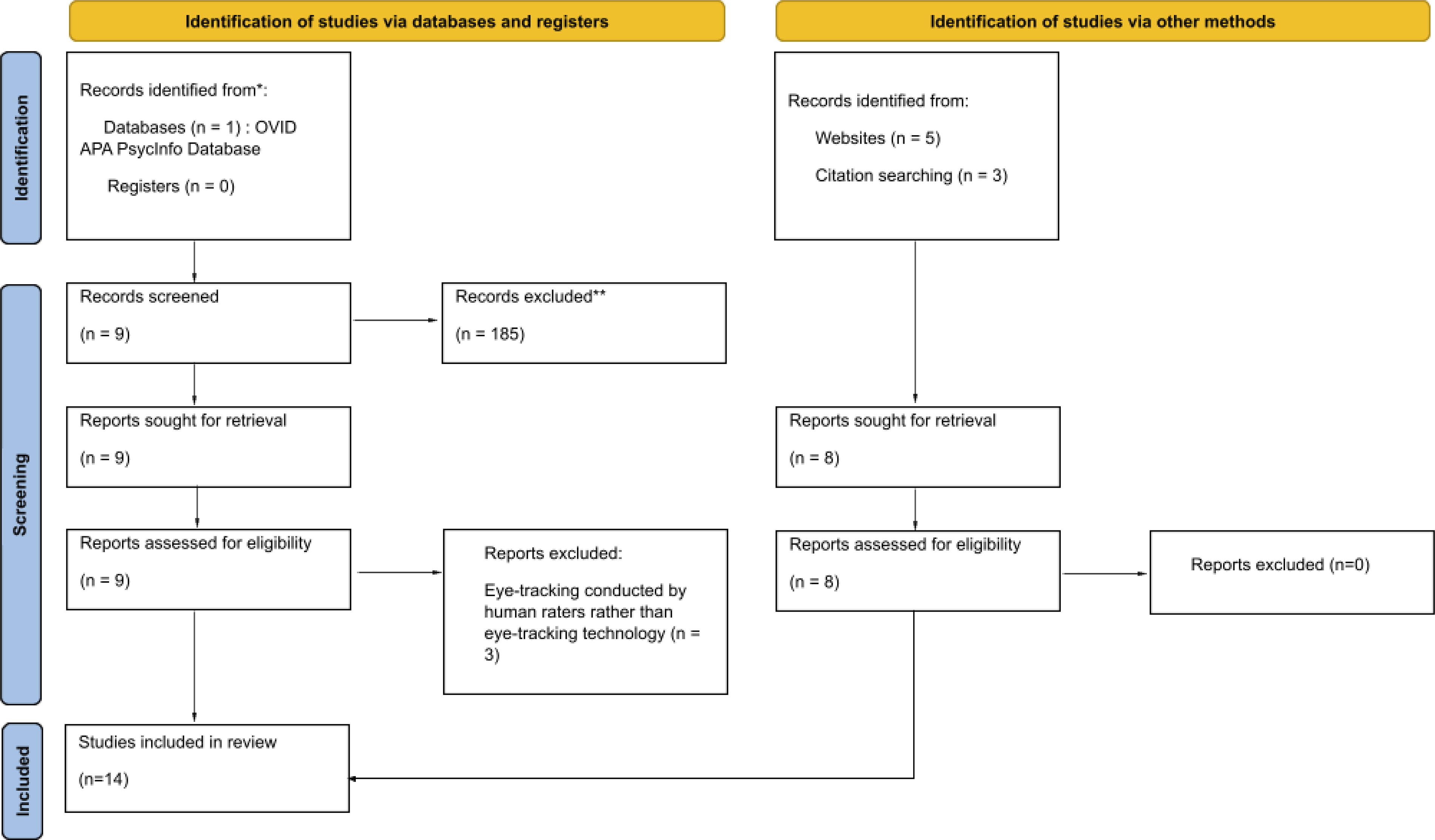
PRISMA flow diagram illustrating the article selection process. PRISMA, Preferred Reporting Items for Systematic reviews and Meta-Analyses.
Review
Findings from studies involving a nonclinical sample
First, studies using a nonclinical sample (members of the general public) will be reviewed. These studies measure autistic traits using validated scales (most often the Autism-Spectrum Quotient, or AQ 41 ). They permit larger sample sizes but are limited in that findings cannot be directly applied to the clinical population in question. For demographic information about the participants in these studies, please see Table C in the Supplementary Data S1.
In a seminal study, Freeth, Foulsham, and Kingstone 42 conducted an experiment in which 30 participants took part in a face-to-face structured interview with a confederate, whose gaze was manipulated to alternate between direct and averted. Gaze was tracked to three broad AOIs (face, body, and background.) Results showed gaze to face was stronger during the question phase, in line with older findings. 10 However, AQ showed no relationship with viewing patterns.
In a video-mediated interaction, Von dem Hagen and Bright 43 found contrasting results. In experiment 2 of this study (experiment 1 did not meet eligibility criteria), 45 participants took part in a live conversation with an experimenter over a video connection. The high-AQ group was found to look less toward the eyes and mouth of the confederate than the low-AQ group.
Mansour and Kuhn 44 found a more ambiguous relationship between AQ and social gaze. Their study exposed 68 university students to a prerecorded interactive video, which participants were either deceived into believing was live or knew was prerecorded. They found no relationship between overall AQ score and dwell time to the face and eyes of the confederate in either condition. They did, however, find that scores on a subset of the AQ were positively related to reduced gaze to eyes, regardless of condition and conversational phase. These findings point to the possibility that only certain autistic traits may be related to gaze differences.
So far, all the studies reviewed used a one-sided interactive task in which the confederate led the conversation by telling a story or asking questions. Vabalas and Freeth 45 designed a study that included a role switch where the participant could ask questions and take on a different conversational role. For this study, 36 student volunteers underwent a live, face-to-face structured conversation with an experimenter who held a direct gaze throughout the interaction. In line with Freeth and colleagues, 42 scores on the Broad Autism Phenotype Questionnaire (BAPQ) showed no effect on proportions of fixations to the face AOIs. However, BAPQ scores (especially the rigid subscale) were related to reduced visual exploration.
Hessels and colleagues 28 conducted the only study included here which examines gaze between two participants (rather than participant and confederate). This added complexity reflects the interpersonal approach outlined in the dialectical misattunement hypothesis. Ninety-six participants were put into pairs and instructed to look at their partner for 5 minutes (with no speaking) through a Skype-like 2-way-mirror setup, which simulated eye contact. On an individual level, AQ (specifically the social skills and communication subscales) was negatively correlated with dwell time to the eyes (specifically the right eye) and positively correlated with dwell time to the nose. On an interpersonal level, pairs with relatively high AQ scores were engaged in 2-way gaze for less time yet engaged in 1-way gaze for more time than pairs with low AQ scores. This study stands out due to its novel and creative approach, which may better represent some of the awkwardness of real encounters. However, with two participants in every interaction, it may be hard to disentangle which behaviors are intrinsic to each individual person and which are specific to each pair in the study.
In addition to the variation in methods across these five nonclinical studies, there is little consistency in AOIs selected. To help make sense of the heterogeneity, we organized results by AOI (see Table 1). We also organized the results by contextual manipulation to establish whether participants high in autistic traits show the same patterns of adjustment according to context as individuals low in autistic traits.
Summary of Results by Area of Interest for the Nonclinical Studies, Showing if Autistic Traits were Related to Gaze Toward Each Specific AOI
Bolded text indicates that autistic traits are related to atypical gaze behaviors. Nonbolded text indicates that autistic traits are not related to atypical gaze behaviors.
AOIs, areas of interest; AQ, Autism-Spectrum Quotient.
Findings from studies involving a clinical sample
Studies that directly compare diagnosed autistic adults and adolescents with typically developing individuals provide a stronger way to examine social gaze behavior in autism. We identified nine eligible studies of this type, for which we will provide a narrative review. For demographic information about their participants, please see Table D in the supplementary materials. First, Wilkinson 46 recruited 19 males with ASC and 19 male controls to take part in a video-mediated interaction, which participants were deceived into believing was live. Results showed an overall slight reduction in gaze to AOIs in the ASC group. The most robust differences were concentrated in listening portions and on the nose AOI (with a reduced dwell time to the nose in the ASC group). Wilkinson also found that these differences may have been triggered or exacerbated by contextual factors such as expression of negative affect and disfluent or densely informative speech.
Auyeung and colleagues 47 designed their study around a live, video-mediated interview with a confederate who maintained direct gaze. Thirty-two males with ASC and 34 male controls took part in this study, which aimed to evaluate the effect of oxytocin on gaze behavior in ASC. Results from the placebo group showed that the ASC group looked less at the eye region than controls. No group differences were found for the other AOIs. It is important to note that the medical context of the study may have impacted gaze behavior.
A study by Yoshikawa and colleagues 48 was able to manipulate the variable of social presence without resorting to a screen-based prerecording. This is of interest because screen-based interactions typically have an offset between webcam placement (above the screen) and the face of the conversation partner (in the center of the screen), which could disrupt natural gaze behavior patterns. In this pilot study, four male adolescents with ASC and six male controls undertook five structured interviews alternating between a human conversant and a humanistic android. Results showed the ASC group spent less time gazing at the eye AOI of the human compared with the android and the control group. No group differences were found in gaze to the whole face, although this remains only a pilot study.
More recently, Cañigueral and colleagues 49 studied 26 autistic and 26 typically developing adults performing a question-answer task face-to-face, over a live video call, or with a prerecorded video. They found no overall differences in gaze to the eyes or to the mouth, and both groups looked more to the face when listening than when speaking. Surprisingly, the allistic participants were less likely than the autistic participants to look to the eyes at the start of the question phase. This study has the advantage of using a well-controlled design and a professional actor who was able to maintain very consistent behavior as the conversation partner. However, the conversation was highly structured with no opportunity for the participants to ask questions.
Freeth and Bugembe 50 examined gaze patterns in typically developing and autistic participants in a conversation task, which included a role switch in asking questions to further resemble real conversations. Twelve autistic adults and 13 typically developing controls participated in a live, face-to-face structured conversation with an experimenter whose gaze alternated between averted and direct. Autistic participants were found to spend less time gazing to the face, specifically during direct-gaze conditions (but not during averted conditions). In direct-gaze conditions, ASC data were significantly more variable than controls, suggesting the possibility of underlying subgroups. Furthermore, controls showed a preference for the eye region, but the ASC group did not.
Despite a very similar design, Grossman and colleagues’ 51 study from the same year had contrasting results. Like Freeth and Bugembe, they included a structured interaction with a role switch in question-asking, but this came after the passive viewing of a prerecorded video. They found, in 12 adolescents with ASC and 19 controls, no significant difference in dwell time to the face or background in the live interaction. Perhaps the inconsistencies between this study and the previous one arise from the difference in sample age (adolescents versus adults).
In contrast, Barzy and colleagues 52 did find similar results to Freeth and Bugembe, that is, reduced gaze to the face in autistic participants. In their study, 24 autistic adults were compared with 26 controls in their gaze behavior during a semi-structured face-to-face conversation with a confederate. Results suggested that autistic participants gazed less to the face and more to the background, especially when the topic of conversation involved heightened mentalizing (talking about the preferences of an unfamiliar other as opposed to the self or a familiar other). Interestingly, this reduced gaze to face was not explained by a reduction in gaze to eyes; there was no group difference for this variable.
However, in a highly powered study, Clin and Kissine 53 failed to find this effect of reduced gaze to the face in autistic participants. They explored the gaze behavior of 40 autistic individuals (versus 40 controls) in a face-to-face paradigm requiring participants to explain the meaning of various words to a confederate whose gaze was either direct or averted. Between-groups analyses revealed no significant differences between autistics and their typically developing peers in the proportion of fixations to the eyes, mouth, face, or whole body of the experimenter.
All the studies mentioned up to this point (including the nonclinical articles) used conversation paradigms that were highly structured, which reduces their ecological validity, but allows strong experimental control. Hanley and colleagues 54 cleverly elicited a more natural conversation. Through a complex deceptive procedure, 11 individuals with ASC and 11 controls believed they were undertaking a color perception task (hence the head-mounted eye trackers). An issue with the tech was staged and participants were instructed to speak to an experimenter, while it was being “resolved.” No group differences were found in gaze to the whole face. The ASC group spent significantly less time looking at the eye AOI, and significantly more time looking at the mouth AOI than controls. Unfortunately, there was also a non-negligible confound of belief in the deception introduced, with 7/11 controls not believing the deception against 1/11 autistic participants.
Identical to the nonclinical studies, we organized all these results by AOI and contextual manipulation (see Table 2).
Summary of Results by Area of Interest for the Clinical Studies
Bolded text indicates that autistic diagnosis is related to atypical gaze behaviors. Nonbolded text indicates that autistic diagnosis is not related to atypical gaze behaviors.
ASC, autism spectrum condition.
Discussion
In this study, we provided a systematic review of 14 studies of real-world social gaze behavior in adults and adolescents with ASC or high autistic traits. In this small but growing research domain, we find that results are mixed, but we can draw conclusions about differences between groups in terms of coarse-grained social orientation, fine-grained social orientation, and gaze modulation. We consider the limitations of these findings and wider implications for future research.
Do individuals with high autistic traits gaze less to faces and bodies?
Several studies of gaze behavior used coarse-grained AOIs, dividing the visual scene into face, body, and background. These analyses overwhelmingly showed no relationship between autism and gaze toward the body or background. Six out of nine studies that included a “whole face” AOI found no group differences in gaze onto this region. In the three studies that did find effects, one found that differences were only marginal 46 and another found that they related only to a subset of autistic traits, 50 while the third found a straightforward reduction in gaze to face in the ASC group. 52 Overall, these results suggest that there is little relationship between autism and gaze to face and body, implying that coarse-grained social orienting is similar between autistic and allistic individuals. This is surprising as both aversion and indifference theories for gaze in ASC posit that autistic individuals should show more gaze to the background and body as a result of omitting or avoiding the face. However, it is still possible that differences in gaze behavior arise at a more subtle level, which is lost when considering only large AOIs.
A more precise analysis of facial AOIs reveals stronger evidence for differences in gaze behavior between individuals low and high in autistic traits. The most consistent result was difference in gaze to the eye region. Some form of difference, even if only slight or restricted to a specific timeframe, was related to autistic traits in all, except 345,52,53 of 12 studies, which included this AOI. Furthermore, out of the nine studies that found differences, seven showed reduced gaze toward the eyes by individuals with ASC/high autistic traits. These results suggest that high-resolution eye-tracking data in live interaction contexts align with the common clinical observation that reduced gaze to eyes is associated with autism. However, this finding is not clear-cut; a similar review (albeit focusing on clinical studies) by Laskowitz and colleagues found that five out of nine included studies measuring gaze to eyes found comparable patterns between autistic and allistic groups. Differences in results may be partially related to our choice of including nonclinical studies, one possible explanation being that individuals with high autistic traits, but no diagnosis, may have never received explicit instruction or therapies to increase eye contact. More work is needed to strengthen the evidence base and allow for robust meta-analyses.
If some people gaze less to the eyes, we might expect them to gaze more to other facial AOIs, notably the mouth. However, only 2 out of 10 studies, including the mouth AOI, found a positive relationship between autistic diagnosis/traits and gaze to the mouth. This may be because gaze away from the eyes is evenly distributed onto other AOIs, so any group difference becomes too small to detect with the sample sizes currently used. More research is needed to verify such an interpretation. The nose AOI may be a key region of interest. Only two studies have included this area, but both have found gaze differences associated with autistic diagnosis/traits, although in opposite directions. It is possible that gaze onto the nose has been included in the eye or mouth AOIs of past studies. 46 More work using high spatial resolution would be required to disentangle gaze data in these areas.
Modulation of gaze
Beyond the analysis of AOI fixation times, it is of interest to investigate whether individuals with high autistic traits modulate their gaze differently according to conversational roles and other contextual factors. This could give insight into how autistic people use gaze in real conversations and which theories best explain the reduced gaze to eyes found in autistic individuals. First, all six studies that examined the effect of conversational phase found that all participants modulated their gaze according to whether they were speaking or listening in a similar manner, with more gaze to face when listening than speaking. This implies that the conversational conventions of gaze and the use of gaze to gather additional information when listening, as widely reported for allistic participants,10,12,55 are present in people with high autistic traits.
For conversations implemented over a computer interface, it is possible to manipulate participants’ beliefs in whether they are seeing a video recording or a live person, that is, their belief in social presence. Four out of the five studies that included the effect of belief in social presence in their analysis found main effects of this variable on gaze data, regardless of group attribution. Indeed, both experimental groups were found to gaze less toward the eyes and/or face of their conversant when they believed the conversant to be live (i.e., able to see them). This is in line with the dual function of gaze theory 11 ; participants show more gaze aversion in the live condition to avoid signaling too much interest or staring during a neutral conversation with a stranger. Participants with high autistic traits appear sensitive to these belief manipulations, similar to allistic participants.
Three studies explored the effect of confederate gaze as part of their experimental design. They found contrasting results; von dem Hagen and Bright 43 and Clin and Kissine 53 found no effect of conversant gaze in either group, while Freeth and Bugembe 50 found that only the ASC group reduced their gaze to face in response to the experimenter making direct eye contact. Overall, studies that manipulate confederate gaze seem to yield ambiguous results, possibly because this factor is very hard to experimentally control in a realistic manner.
Theories of gaze in autism
We can consider these results in relation to two major theories of social gaze in autism. The social motivation theory 25 suggests that autistic individuals are not motivated to attend or orient toward other people, whether eyes or face or body, but are just as likely to look at nonsocial points of interest. Thus, autistic participants might be predicted to show reduced gaze across all social AOIs. The gaze aversion theory, 26 on the contrary, posits that autistic individuals find direct eye contact to be too arousing, thus aversive, and will show less gaze to eyes in order to avoid the induced arousal. Our review suggests that coarse-grained social orienting appears to be present in autistic participants, and this is not compatible with the social motivation theory. Furthermore, participants with autistic traits modulated their gaze according to conversational phase and belief in social presence in a similar manner to typically developing participants, which suggests that they are sensitive to the signaling function of gaze. Again, this is suggestive of social motivation. In contrast, the specific differences found in the analysis of fine-grained AOIs centered on the eyes match the predictions of the gaze aversion hypothesis. If individuals with autistic traits find the eyes to be particularly aversive but still want to gain social information during an interaction, it would make sense for them to gaze toward the face and modulate their overall gaze patterns similar to their allistic peers, all while avoiding the eyes. However, avoidance of eyes was not found to be universal in all studies, so more work is needed to understand when and how it occurs. In addition, other explanations of the data could still be possible. For example, it may be that unique gaze behavior in ASC is a result of decreased social awareness, increased cognitive demands for social interactions, or interpersonal mismatches.27,52–54 Finally, it is also crucial to consider that the equivocal results found in these studies suggest that there simply is no significant and reliable difference in gaze behavior between people high and low in autistic traits, at least in the specific samples included in this study (which were matched in IQ and verbal skills). In the same vein, it is possible that behavioral differences are masked by compensatory strategies such as looking near the eyes. This would explain the mixed results, given that each study delineated the eye region differently, some including more space around the eyes than others.
Limitations and future directions
There are still some important limitations in our understanding of real-world social gaze in autism, which are reflected in this review. Only a small number of published studies examine this topic, and the clinical samples were primarily composed of male individuals without intellectual or verbal disabilities (see Tables C and D in the Supplementary Data S1). It is possible that gaze behavior varies across the spectrum, as well as according to gender and secondary conditions. Second, it is possible that some form of stereotype threat relative to autistic individuals’ presumed social incompetence may have been activated, 56 causing biased results, In the future, experimental designs could attempt to control for this. Additionally, new interaction paradigms offering different degrees of experimental control and ecological validity should be considered in the aim of minimizing the gap between laboratory interactions and authentic conversations. Virtual reality may be an avenue of progress in this aim. 57 On a more technical level, future research should strive to use high spatial resolution to precisely track gaze to eyes and nose. Obtaining robust measures of an individual’s propensity for gaze to eyes with quantification of test-retest reliability would also be a valuable step toward understanding how differences in real-world gaze behavior relate to other clinical symptoms and personality traits.
Finally, there is a dearth of ecologically valid research examining the impact of reduced gaze to the eyes on conversation quality in autistic adults. It may be that gaze to eyes is reduced in ASC, but that this has no ramifications on communicative competence or information exchange due to compensatory strategies. 58 Indeed, mutual gaze to the face is often perceived as mutual eye contact, 59 meaning that interlocutors may not be able to subjectively distinguish gaze near the eyes from gaze to the eyes. It is also possible that conversations between two autistic individuals, presumably with less gaze to eyes overall, are as communicatively effective as allistic conversations. 60 As the specific impact of autistic gaze behavior on conversation quality is currently undefined, critical caution should be taken before designing interventions. It may be that teaching “typical” gaze to autistic individuals leads to excessive cognitive load or discomfort. In parallel, explicit instruction of such an implicit social behavior may only serve to generate further differences (e.g., unusually long fixations). Future research should therefore investigate the effects of gaze differences on communication, as well as whether interventions might be hindering autistic individuals and/or causing additional challenges.
Conclusion
In summary, this review found that results from studies of live social gaze in adults and adolescents with high autistic traits are often mixed and scarce due to a lack of studies using ecologically valid paradigms. By analyzing results from both clinical and nonclinical studies, we suggest that similar coarse-grained social orienting appears to be present in adults and adolescents with and without high autistic traits, but fine-tuned social orienting potentially differs. Specifically, a negative relationship between ASC and gaze to eyes seems to be somewhat consistently found, although the strength and context of this relationship vary considerably. However, it is also found—quite consistently—that individuals with ASC or high autistic traits show modulation of their gaze according to contextual factors akin to controls. Two main interpretations are possible. First, the equivocal nature of the results may suggest that there simply is no consistent difference in gaze behavior between autistic and allistic individuals, at least in samples matched in IQ and verbal abilities. Alternatively, the few differences found were confined to gaze to the eyes, suggesting that potential gaze differences in ASC are not a result of low social motivation but rather reflect an aversion to the eyes. Future research should aim to strengthen this evidence base by diversifying samples, increasing ecological validity, and examining more precise AOIs, notably the nose. In parallel, more work examining the specific effects of reduced gaze to the eyes on communicative efficiency should be conducted before considering interventional approaches.
Authorship Confirmation Statement
L.B. conducted the initial search for eligible studies. Study inclusion was jointly discussed by both authors. L.B. wrote the first draft of this narrative review, which was then iteratively improved by discussions with and edits from A.F.d.C.H.
The article had been submitted solely to Autism in Adulthood.
Authors Disclosure Statement
All authors declare that they have no conflicts of interest to disclose.
Footnotes

References
Supplementary Material
Please find the following supplemental material available below.
For Open Access articles published under a Creative Commons License, all supplemental material carries the same license as the article it is associated with.
For non-Open Access articles published, all supplemental material carries a non-exclusive license, and permission requests for re-use of supplemental material or any part of supplemental material shall be sent directly to the copyright owner as specified in the copyright notice associated with the article.
