




Abstract
Background:
Sensory hypersensitivity, a potential challenge in autistic individuals, has gained attention in recent decades. The Sensory Perception Quotient (SPQ-10) was one of the tools developed for assessing sensory hypersensitivity in autistic adults, demonstrating adequate construct validity. However, it was unavailable in Asian languages. This study aimed to contribute to the autistic community by validating the Mandarin version of SPQ-10 to enhance the evaluation of sensory hypersensitivity in Mandarin-speaking autistic adults.
Methods:
We recruited 129 autistic adults (mean age 28.1 ± 7.68; female 35, 27.1%) in this study. Participants completed a comprehensive set of assessments, including the SPQ-10, the Adolescent/Adult Sensory Profile (AASP), the Autism Spectrum Quotient (AQ), the Social Responsiveness Scale (SRS), and the Empathy Quotient. Subsequently, we examined the psychometric properties and clinical correlates of the SPQ-10 thoroughly.
Results:
The Mandarin SPQ-10 total scores had satisfactory test–retest reliability (intraclass correlation coefficient = 0.762, df = 44, p < 0.001) and internal consistency (Cronbach’s α = 0.877) and had significant correlations with AASP-overresponsivity (rs = 0.341), AQ subscale Attention to Details (rs = 0.424), and the SRS total scores (rs = 0.213). In terms of sex, autistic females exhibited significantly higher AASP-overresponsivity scores but comparable SPQ-10 scores to autistic males. The SPQ-10 total scores in autistic females significantly correlated with AASP-overresponsivity (r = 0.501), Attention to Details (r = 0.545), and SRS (r = 0.394). For autistic males, SPQ-10 total scores were only correlated with AASP-overresponsivity (rs = 0.249) and Attention to Details (rs = 0.320).
Conclusion:
The Mandarin SPQ-10 possesses satisfactory psychometric properties for effectively screening sensory hypersensitivity and overresponsivity in autistic adults. Sensory hypersensitivity measured by the SPQ-10 was correlated with various autistic features, including restricted and repetitive behaviors and interests and social communication difficulties. Autistic females may experience more emotional and behavioral reactivity to sensory hypersensitivity. Consequently, a more nuanced evaluation of sensory features in this population is necessary. With adequate support, sensory hypersensitivity could be a lesser challenge for emotional well-being and social adaptation.
Community Brief
Why is this an important issue?
Some people, especially in the autistic community, are gifted with sensitivity in senses, such as hearing soft sounds or seeing slight color differences that others might miss. While this brings strengths, it may also affect mental health and interpersonal relationships. To help autistic individuals handle potential stress and find fulfillment, we need a quick, consistent, and accurate way to assess sensory sensitivity.
What was the purpose of this study?
This study aimed to ensure the Mandarin Chinese Sensory Perception Quotient (SPQ-10) is a suitable tool for measuring sensory sensitivity in autistic people. Researchers also aimed to clarify how sensory sensitivity connects to other common autistic features and affects people of different sexes in the autism community.
What did the researchers do?
Researchers invited 129 autistic adults from the Department of Psychiatry, National Taiwan University Hospital, to join this study. Participants filled out surveys, including the SPQ-10, the Adolescent/Adult Sensory Profile, the Autism Spectrum Quotient, the Social Responsiveness Scale, and the Empathy Quotient, to quantify their unique features of different domains. The researchers then examined whether the SPQ-10 related to standard scales testing sensory hyperreactivity, whether the SPQ-10 scores correlated with other autistic features, and whether the correlations differed between sexes.
What were the results of this study?
For autistic adults, SPQ-10 is an effective tool for measuring sensory sensitivity and examining how autistic individuals emotionally and behaviorally respond to sensory experiences. Autistic men and women had similar sensitivity in senses, but women tend to react more to sensory inputs. In women, the SPQ-10 scores connected to communication challenges, repeating actions, and focused interests. For men, the SPQ-10 scores were only linked to extra attention to details.
What do these findings add to what was already known?
This study is the first to use the Mandarin Chinese SPQ-10 in autistic adults and examines its psychometric properties. Compared with autistic men, autistic women are more likely to feel anxious and struggle in social situations when there are too many sensory inputs, so they might cope with avoiding or repetitive behaviors and focused interests to decrease sensory stimulation in their surroundings.
What are potential weaknesses in the study?
This study did not include non-autistic individuals to see if SPQ-10 differentiates autistic and non-autistic people. Instead, our data was compared with the dataset in a previous study. Also, there were fewer women (n = 35) in the study than men (n = 94), which might affect how accurately the findings represent the entire autism community. Additionally, this study did not look into the gender identity of the participants and did not recruit nonbinary individuals, which limited the exploration of the effect of gender identity.
How will these findings help autistic adults now or in the future?
The findings support that the Mandarin Chinese SPQ-10 can help clinicians and researchers examine sensory sensitivity in Mandarin-speaking autistic adults. Our findings also highlight the importance of recognizing sensory sensitivity in autistic women since this feature affects them more often than autistic men. We stress on early support for sensory-sensitive autistic women to learn the way of handling intense sensations. By doing so, there might be less impact on mental health and better utilization of sensitivity in senses, leading to better quality of life and self-fulfillment.
Background
People on the autism spectrum experience social communication difficulties, focused interests, and repetitive behaviors, as well as hyper- or hyporeactivity to sensory input or focused interests in sensory aspects of the environment. 1 Evidence has suggested that sensory differences are as common as 95% in autistic children and adults2–5 across sensory modalities, including vision, 6 hearing,7,8 touch,9,10 smell,11,12 and taste. 13 Among the sensory dimensions, autistic individuals often suffer from overwhelming sensory inputs, leading to anxiety and avoidance of external stimuli.14,15 A recent meta-analysis indicated that overresponsivity (i.e., sensory avoiding and sensory sensitivity), or increased behavioral responsivity and affective reactivity to sensory input, 16 is more likely a cardinal sensory characteristic of autism than underresponsivity. 17 Sensory overresponsivity also contributes to other core autistic characteristics more than underresponsivity does. Both behavioral overresponsivity and affective overreactivity in autistic people may stem from the unique feature secondary to a lower threshold of sensory detection, that is, sensory hypersensitivity. 16
The impact of sensory hypersensitivity on autistic individuals’ daily lives has long intrigued researchers. Numerous studies explored the relationship between sensory hypersensitivity and other domains of autistic traits. Sensory hypersensitivity was proposed to contribute to the restricted and repetitive behaviors and interests (RRBIs) in people on the autism spectrum. The superior discrimination toward certain sensations may lead to a passionate interest in specific sensory stimuli, for example, pitches.8,18 This interest can result in continuous and repetitive practicing, training the area of interest to expertise.19,20 Also, RRBIs can make the interaction with environment more predictable by limiting sensory input. 21 This is evident in autistic children with clear boundaries in tactile interaction, who may exhibit more inflexible behaviors, repetitive verbalization, and visual stereotypes. 22 In contrast, sensory hypersensitivity may also cause challenges in social communication. Previous studies have revealed that autistic individuals, in social tasks under noise disturbance, require extra voice-selective and speech-processing compensation and other brain area activation different from non-autistic people. 23 Although not a direct cause, distinct sensory experiences may contribute to different patterns of social interactions and communication in autistic individuals compared with non-autistic people. 24 In summary, understanding the picture of sensory neurodiversity in autistic individuals may help explain the clinical heterogeneity in this population, clarify the challenge they face, and thereby provide insights into their needs.
To better assist autistic individuals with sensory hypersensitivity, researchers have applied or developed various measures for the quantification of sensory neurodiversity, including the Adolescent/Adult Sensory Profile (AASP), 3 the Sensory Processing Scale and its subscale Sensory Overresponsivity (SensOR), 25 the Glasgow Sensory Questionnaire (GSQ), 26 and the Sensory Experience Questionnaire. 27 Among these measures, the AASP remains the most widely used tool in adults. The AASP comprehensively assesses four domains of sensory experiences, that is, low registration, sensation seeking, sensory sensitivity, and sensation avoiding. As AASP helps differentiate between autistic and non-autistic groups,3,28–30 it was the gold standard for sensory overresponsivity assessment in studies about people on the autism spectrum. However, there is a need for a shorter screening tool to capture the unique sensory experience for autistic individuals in clinical settings.
The Sensory Perception Quotient (SPQ) is a self-rating scale designed to assess sensory perception for adults. 31 This 92-item scale involves five primary sensory modalities, that is, vision, hearing, touch, smell, and taste. Unlike other scales for sensory neurodiversity assessment with constructs of behavioral overresponsivity and affective overreactivity, the SPQ excluded attention, emotional, and behavioral factors and purely focused on sensory perception experience (i.e., sensory hypersensitivity and hyposensitivity). Researchers have developed several short versions of the SPQ, including the 35-item short version (SPQ-35), 31 the 10-item short form (SPQ-10), 32 the revised scoring of the SPQ, 33 and the 33-item short version. 34 Among all, the SPQ-10 is the most simplified version, which was extracted from the SPQ-35. The SPQ-35 was a simplification of the full version through principal component analysis. The SPQ-35 had good internal validity (Cronbach’s α = 0.93) and a significant correlation with the Sensory Overresponsivity (r = −0.20, p = 0.0001). 31 Greenberg et al. further shortened the SPQ-35 into a 10-item version, SPQ-10, 32 by selecting two items with the highest discrimination index from each of the five modalities of the SPQ-35. This short version coincidentally includes hypersensitivity items exclusively. It was highly correlated with the original full version (r = 0.828, p < 0.01, sample n = 1,711) and the SPQ-35 (r = 0.920, p < 0.01) and significantly differentiated autistic and non-autistic individuals. 32 Also, sensory hypersensitivity revealed by the SPQ-10 was significantly correlated with the overall level of autistic traits measured by the 10-item version of the Autism Spectrum Quotient (AQ) and the Empathy Quotient (EQ). 32
Emerging research sheds light on the distinct characteristics exhibited by autistic females. 35 Considering that autistic females tend to experience more depressive symptoms 36 compared with their male counterparts, partly due to better self-reflection,37,38 a comprehensive understanding of the autistic presentation is essential in females. Compared with autistic males, autistic females may exhibit less typical RRBIs 39 with focused interests often centered around people and animals, 40 a feature frequently unnoticed. Additionally, they demonstrate more interpersonal interest, 41 more articulate linguistic expression, 42 more experience of being overlooked rather than being rejected, 43 and more compensation for social communication difficulties as well as RRBIs.44,45 Autistic females are also found to manifest more extensive neurodiversity in sensory reactivity,46,47 warranting further exploration of its impact on other autistic features.
This study pursued three aims. First, it sought to establish the psychometric properties of the Mandarin Chinese SPQ-10 in autistic adults. The assessment of concurrent validity involved evaluating correlations with sensory neurodiversity across various sensory modalities. Second, we also explored the correlation with specific domains of autistic traits, encompassing challenges in social communication, preoccupation with patterns, attention to details, attention switching, social responsiveness, and empathy. We hypothesized that sensory hypersensitivity, as measured by the SPQ-10, may show correlations with RRBIs and several domains of social reaction. Third, we investigated the sex difference in sensory hypersensitivity and its relation to other autistic features among autistic adults. Given the recognized sex difference in the presentation of autistic traits, we also expected sex-related variations in the correlation patterns between SPQ-10 total scores and other autistic traits. By identifying the impact of sensory hypersensitivity on autistic individuals, sensory hypersensitivity may be more than a challenge for emotional health or interpersonal interaction but likely optimized for self-fulfillment. 20
Methods
Participants
This study recruited 129 autistic adults (aged 28.1 ± 7.68 years, birth-assigned females n = 35 [27.1%]) from the Adult Autism Clinic of the Department of Psychiatry, National Taiwan University Hospital. Forty-five participants successfully repeated the SPQ-10 again one month later. Board-certified psychiatrists made the diagnosis of autism spectrum disorder based on the diagnostic criteria in the Diagnostic and Statistical Manual of Mental Disorders, Fifth Edition, Text-Revision. 1 We excluded autistic participants with current or lifetime co-occurring psychiatric or neurological conditions from this study, including schizophrenia, bipolar disorder, substance use disorder, major depressive disorder, intellectual disability, and so on. Specifically, hallucination in co-occurring schizophrenia may interfere with sensory perception, and irritability in co-occurring mood disorder may contribute to sensory overresponsivity.
The average full-scale Intellectual Quotient (IQ) was 101.8 ± 16.5. The total scores of the AQ and EQ were 105.0 ± 13.8 and 21.7 ± 10.0, respectively, which were significantly different from the norm based on the previous non-autistic cohort from Taiwan (mean AQ: 76.03 ± 9.51 [males], 74.20 ± 10.41 [females], p < 0.001 48 ; mean EQ: 42.1 ± 10.6, p < 0.001). 49 The Social Responsiveness Scale (SRS) total score was 102.2 ± 26.7, which was significantly higher than the non-autistic samples in Taiwan (mean 42.82 ± 20.33, p < 0.001). 48
This research was approved by the Research Ethics Committee (ID: 201903126RINA) of the National Taiwan University Hospital. After a detailed explanation of the study objective and procedures, written informed consent was obtained from all participants. All participants received IQ assessments using the Wechsler Adult Intelligence Scale 50 in the hospital and completed all questionnaires at home.
Instruments
Sensory Perception Quotient
The 10-item short SPQ, 32 SPQ-10, is a self-reported questionnaire to examine sensory hypersensitivity. It comprises two items for each of the five sensory modalities (i.e., vision, hearing, touch, taste, and smell), with responses rated on a 4-point Likert scale ranging from 0 to 3. The summation of all items provides an overall measure of sensory hypersensitivity. The SPQ-10 total score displayed a strong correlation with both the full version (r = −0.828, p < 0.01) and the 35-item short version (r = −0.920, p < 0.01) of the SPQ. 32 Higher SPQ-10 total scores indicate increased sensory hypersensitivity.
For this study, Y.-L.C. translated the SPQ-10 into Mandarin Chinese, and Y.-N.C. ensured the face validity of the translation. We also combined the paired items within each modality to assess the level of sensory hypersensitivity for each modality.
Adolescent/Adult Sensory Profile
The AASP 51 is a 60-item self-rating scale to examine sensory-related features, including preference, emotional reactions, or behavior changes prompted by perceptions. It measures six modalities: taste/smell, movement, visual, touch, activity, and auditory processing. It adopts a 5-point Likert rating scale with “1” for never (0%), “2” for seldom (25%), “3” for sometimes (50%), “4” for frequently (75%), and “5” for always (100%). Aligned with Dunn’s four-dimensional model of sensory functioning,52,53 the scoring system includes Low Registration (AASP-LR), Sensation Seeking (AASP-SSk), Sensory Sensitivity (AASP-SS), and Sensation Avoiding (AASP-SA) subscales, where higher scores indicate greater sensory reactivity. The Mandarin version of AASP was proved reliable with acceptable internal consistency (0.71–0.80) and test–retest reliability (intraclass correlation coefficients [ICC], 0.80–0.86)]. 54
Within Dunn et al.’s sensory processing model, 53 AASP-SS and AASP-SA both reflect low perceptual threshold or overresponsivity.53,55 We therefore summed up these two subscales as the sensory overresponsivity score (AASP-overresponsivity).17,55 For each sensory modality, we summed up items for the AASP-SS and AASP-SA subscales, respectively, to evaluate the overresponsivity.
Autism Spectrum Quotient
The AQ (Baron-Cohen et al.) 56 is a 50-item self-report questionnaire to quantify autistic traits in typically developing adults. Each item is rated on a 4-point Likert scale to indicate the statements’ agreement, including “definitely agree,” “slightly agree,” “slightly disagree,” and “definitely disagree.” It has five subscales, including Communication, Social Skills, Attention Switching, Imagination, and Attention to Details.
For the Mandarin Chinese version of AQ, 48 each item is scored 1–4 on a 4-point Likert scale, and a higher score indicates a greater level of autistic traits. The Mandarin Chinese AQ total score and the five subscales all possess favorable psychometric properties; the Cronbach’s α was 0.836 in the total score and ranged from 0.543 to 0.880 in the subscales. For test–retest reliability, the intraclass correlation was 0.647 for the AQ total score and ranged from 0.400 to 0.724 for the AQ subscales. Of note, the 5-factor structure of the Mandarin Chinese AQ is partly different from that of the original AQ. 48 The Socialness, Mindreading, and Attention Switching subscales include most items from the Social Skills, Communication, and Attention Switching of the original AQ. Both Attention to Details and Patterns Preoccupation subscales comprised items from the original Attention to Details.
Empathy Quotient
The EQ (Baron-Cohen et al.) is a self-administered 60-item questionnaire measuring empathy in adults. 49 It applies a 4-point scaling system to rate each item from “strongly disagree” to “strongly agree.” The score was rated “0” for “disagree” and “strongly disagree,” “1” for “agree,” and “2” for ‘strongly agree,” while rated oppositely in the reversed items. It was proved to possess good test–retest reliability (r = 0.97, p < 0.001), high internal consistency (Cronbach’s α = 0.92), 49 and moderate concurrent validity with subscales of the Interpersonal Reactivity Index. 57 The psychometric properties of the Mandarin Chinese 40-item version of EQ are satisfactory (Huang HY and Gau SS, unpublished conference poster).
Social Responsiveness Scale
The SRS (Constantino and Gruber) 58 is a self-reported 65-item scale evaluating autism-related social behavioral features in the past 6 months. It adopts a 4-point Likert scale ranging from “0” (not true) to “3” (almost always true) in each item. The assessment of the original scale revealed good internal consistency, interrater reliability, test–retest reliability, and concurrent validity with both Autism Diagnostic Interview-Revised and Autism Diagnostic Observation Schedule. Using the cutoff of 70 in males and 65 in females, the discriminative validity of SRS was satisfactory.59,60 The scale can be divided into five subscales including Social Awareness, Social Cognition, Social Communication, Social Motivation, and Autistic Mannerism. 58
The Mandarin Chinese version of the SRS48,61 demonstrated a unique four-factor structure after excluding five items with low correlation with the whole scale, including Social Communication, Autistic Mannerism, Social Awareness, and Social Emotion. The Social Communication subscale of the Mandarin Chinese SRS includes items mainly from the Social Communication of the original version. The Autistic Mannerism subscale focuses on unique autistic behaviors. The items in the Social Awareness subscale demonstrated the level of awareness in a social context. The Social Emotion subscale reflects the variability in the expression of emotion during social interaction. Each subscale has a high internal consistency (Cronbach’s α = 0.94–0.95). 61
Statistical analysis
We conducted statistical analysis using the SPSS Statistics for Macintosh, Version 26.0. (IBM Corp. Released 2019). The missing rate of the data was around 0.11% (missing items/total items) regarding all measures. For missing data, we averaged the scores of the remaining items and multiplied by the number of items to obtain the adjusted total scores for the participant. To decide between parametric and nonparametric analysis, we performed the Shapiro–Wilk test to examine normality for each variable (Supplementary Table S1). For group comparisons, we applied the Student’s t-test to compare normally distributed variables and the Mann–Whitney U test for nonnormally distributed variables. We also used the Student’s t-test to compare our samples to the norm dataset. The Varimax rotation was adopted for the factor analysis. We performed Pearson correlation analysis (correlation coefficient, r) between pairs of normally distributed variants and employed the Spearman correlation analysis (Spearman’s rho, rs) when one of the variants for the correlation pair was not normally distributed, and multiple testing was adjusted by the Benjamini–Hochberg method. To evaluate the significance of the difference between the two correlation coefficients, we performed Fisher Z-transformation to convert the correlations to Z scores, thereby acquiring the p-value through the ΔZ score. A two-tailed p-value <0.05 indicated statistical significance.
Results
Our samples exhibited a mean SPQ-10 score (15.7 ± 6.98; males: 15.2 ± 6.89; females: 17.1 ± 7.16) significantly higher than the non-autistic groups in Greenberg et al. (males: 14.0 ± 5.51, p = 0.032; females: 14.8 ± 5.74, p = 0.019; Table 1, Supplementary Table S2). The averaged SPQ-10 total scores in autistic males (or autistic females) were nearly identical between the two studies (males: 16.3 ± 6.27, p = 0.084; females: 17.6 ± 6.16, p = 0.997).
Demographics, Autistic Features, and Sensory Features of the Samples
Two-sample t-test for normally distributed variant comparisons with degree of freedom and ranges of 95% CI of mean difference; Mann–Whitney U test for nonnormally distributed variant comparisons (no range of the mean differences).
The sum of AASP-Sensory Sensitivity and AASP-Sensation Avoiding.
IQ by Wechsler Adult Intelligence Scale-III or IV.
p < 0.05.
p < 0.01.
AASP, Adolescent/Adult Sensory Profile; AQ, Autism Spectrum Quotient; CI, confidence interval; EQ, Empathy Quotient; IQ, Intellectual Quotient; SPQ-10, Sensory Perception Quotient 10-item reduced version; SRS, Social Responsiveness Scale
The AASP subscales significantly differed from the norm of non-autistic Taiwanese adults 54 across four domains, that is, AASP-LR (ours: 42.1 ± 8.67 vs. norm: 34.7 ± 6.90, p < 0.01), AASP-SSk (37.3 ± 7.73 vs. 43.4 ± 6.29, p < 0.01), AASP-SS (46.5 ± 9.42 vs. 37.9 ± 7.10 (male)/39.0 ± 7.27 (female), both p < 0.01), and AASP-SA (47.7 ± 10.5 vs. 39.6 ± 6.89, p < 0.01; Table 1, Supplementary Table S3).
Test–retest reliability and internal consistency
The test–retest reliability for the SPQ-10 was medium level (ICC = 0.762, df = 44, p < 0.001). Internal consistency was satisfactory for the SPQ-10 (Cronbach’s α = 0.877).
Factor structure
Based on the scree plot, a two-factor model fits the data most with a borderline eigenvalue of 1.009 on factor 2 (Supplementary Fig. S1). Employing the Varimax rotation method, a set of items, namely items 3, 5, 6, 7, 8, 9, and 10, exhibited higher factor loadings on factor 1, while items 1, 2, and 4 displayed higher factor loadings on factor 2 (Supplementary Table S4). After Varimax rotation, factor 1 explained 34.59% of the variance, and factor 2 explained 23.15%, totally explaining 57.74% (Supplementary Table S5). The Spearman’s correlation between the sums of factor 1 items and that of factor 2 items was rs = 0.612 (p < 0.001). Despite the anticipation that the cluster of items with higher loading on the same factor might possess superior homogeneity than the SPQ-10 total scores, we found that neither cluster surpassed SPQ-10 in terms of internal inconsistency, as the Cronbach’s α was 0.850 and 0.721 for the items with better loadings on factors 1 and 2, respectively, but 0.877 for SPQ-10. Therefore, we chose the SPQ-10 for further analysis.
Correlations with AASP
The SPQ-10 total scores were moderately correlated with AASP-SS (rs = 0.302, p < 0.001) and AASP-SA (rs =0.346, p < 0.001) but not with the AASP-LR and AASP-SSk (Supplementary Table S6).
The correlation of the SPQ-10 total scores to AASP-overresponsivity (rs = 0.314, p < 0.001) was similar to the correlations with AASP-SS and AASP-SA shown above. Notably, the correlations between the SPQ-10 total scores and AASP-overresponsivity subscales varied by sensory modalities (Supplementary Table S7), with moderate correlation in visual (rs = 0.328, p < 0.01) and auditory modalities (rs = 0.393, p < 0.01), low correlations in taste/smell (rs = 0.183, p = 0.038 and rs = 0.262, p < 0.01), and no correlation in the tactile modality (rs = 0.081, p = 0.335).
Correlations with age, full-scale IQ, and autistic features
There was no significant correlation between the SPQ-10 total scores and age (rs = 0.004, p = 0.773), full-scale IQ (rs = −0.101, p = 0.441), or EQ (rs = 0.027, p = 0.691). There was no significant correlation between SPQ-10 and the AQ total scores, either (rs = 0.127, p = 0.18) (Table 2). However, the SPQ-10 score moderately correlated with the Attention to Details subscale (rs = 0.424, p < 0.001) of the AQ. As for SRS, the SPQ-10 total score had a low but significant correlation with the SRS total scores (rs = 0.213, p = 0.03) (Table 2), Social Communication (rs = 0.258, p = 0.012), Autistic Mannerism (rs = 0.235, p = 0.021), and Social Emotion (rs = 0.222, p = 0.026) but not Social Awareness (rs = −0.165, p = 0.092).
Correlations Between the SPQ-10 and AASP-overresponsivity, AQ, and SRS
p-Values were adjusted by Benjamini–Hochberg method owing to multiple comparisons; italics: Pearson correlation [otherwise Spearman’s ρ (rs)] if both variants were normally distributed.
Adjusted p < 0.05.
Adjusted p < 0.01.
The sum of the subscales Sensory Sensitivity and Sensation Avoiding from the Adolescent/Adult Sensory Profile.
Sex difference
There were no significant differences in mean age, EQ, or full-scale IQ between the male and female participants. Autistic females had significantly higher SRS total scores and Social Communication and Social Emotion subscales, AQ total scores and Socialness, Mindreading, and Attention to Details subscales, as well as AASP subscales including AASP-SS and AASP-SA than autistic males (Table 1). Autistic females exceeded autistic males in the SPQ-10 total scores, but the difference was insignificant (Z = −1.334, p = 0.182). In contrast, AASP-overresponsivity was significantly higher in autistic females than males (t = −3.105, df = 51.6, 95% confidence interval of the difference = −20.28 to −4.36, p = 0.003).
The SPQ-10 total scores were correlated with the AASP-overresponsivity in both sexes. The correlation in autistic females was moderate to high (r = 0.501, p = 0.012) and was nominally higher than that in males (rs = 0.249, p = 0.048), though the sex difference of correlation coefficients did not reach statistical significance (ΔZ = −1.44, p = 0.075) (Fig. 1a, Table 2).
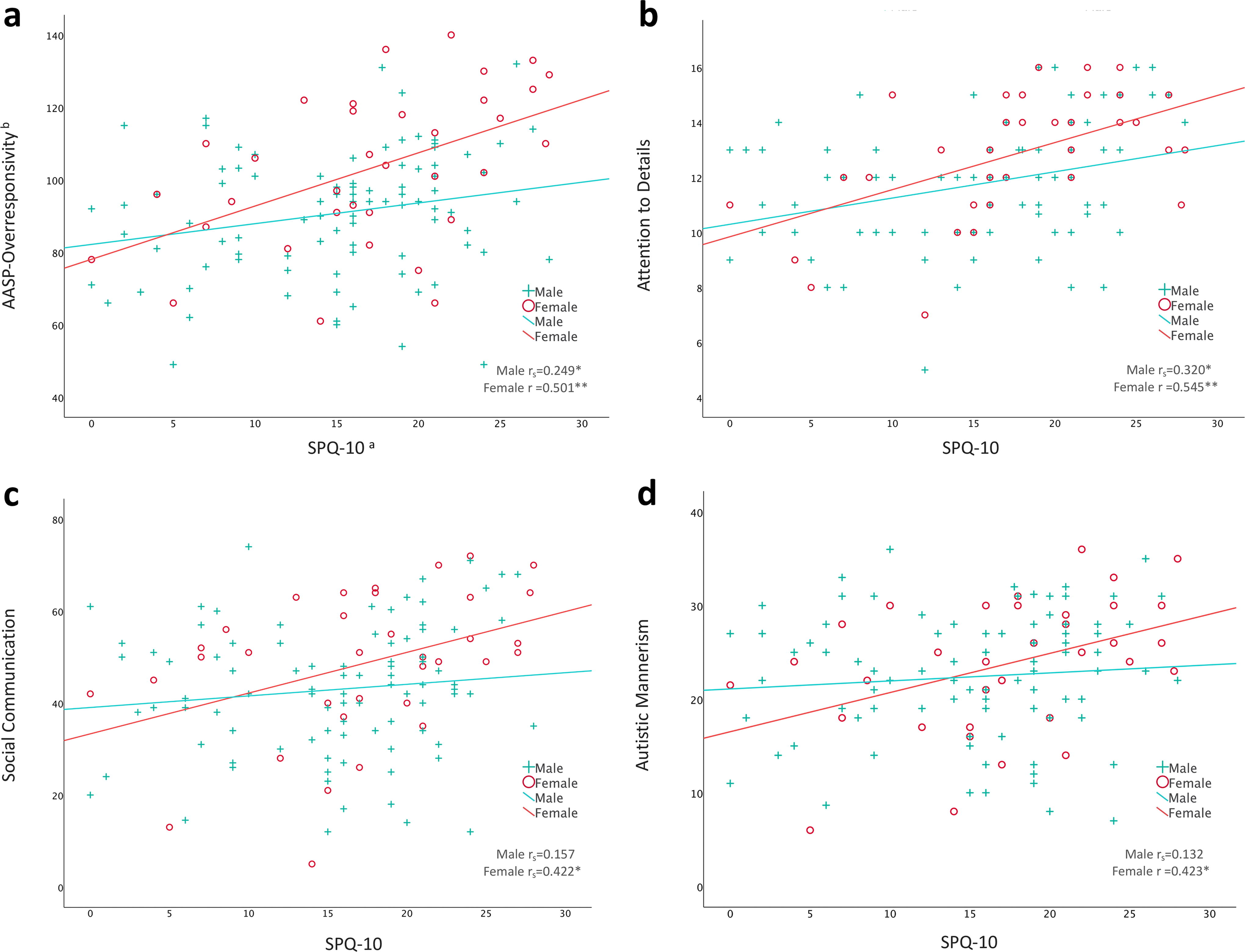
Correlation between the Sensory Perception Quotient (SPQ-10) and Adolescent/Adult Sensory Profile (AASP)-overresponsivity, Autism Spectrum Quotient (AQ) subscale Attention to Details, and Social Responsiveness Scale (SRS) subscales Social Communication and Autistic Mannerism in males and females; p-values were adjusted by Benjamini–Hochberg method. aSensory Perception Quotient 10-item reduced version; bthe sum of the subscales Sensory Sensitivity and Sensation Avoiding from the Adolescent/Adult Sensory Profile; *p < 0.05; **p < 0.01.
The subscale Attention to Details was moderately correlated with SPQ-10 total scores in both sexes (males: rs = 0.320, p = 0.012; females: r = 0.545, p = 0.006) (Fig. 1b). About the correlations between the SPQ-10 and SRS total scores, we found a significant correlation in autistic females (r = 0.394, p = 0.023) but observed no such significance in males (rs = 0.11, p = 0.289) (Table 2). Concerning the correlations between the SPQ-10 and the SRS subscales, autistic females had moderate correlations between the SPQ-10 and Social Communication (rs = 0.422, p = 0.018) (Fig. 1c) and Autistic Mannerism subscales (r = 0.423, p = 0.018) (Fig. 1d). In contrast, autistic males demonstrated no significant correlation between the SPQ-10 total scores and SRS or its subscales.
Discussion
This study identified several key findings. First, the Mandarin Chinese SPQ-10 possessed psychometric properties in terms of adequate reliability, internal consistency, and satisfactory concurrent validity to AASP-overresponsivity. Second, sensory hypersensitivity measured on the SPQ-10 was closely correlated with core autistic features including RRBIs (Attention to Details subscale of the AQ and Autistic Mannerism subscale of the SRS) and social communication difficulties (Social Communication and Social Emotion subscales of the SRS). Third, the SPQ-10 total scores were significantly correlated with RRBIs (Attention to Details subscale of the AQ and Autistic Mannerism subscale of the SRS) and social communication difficulties (Social Communication subscales of the SRS) in autistic females, while the correlation was only found in Attention to Details in autistic males. These findings provide evidence to support the use of SPQ-10 in assessing sensory neurodiversity in autistic adults. The results also highlight relevant clinical correlates of sensory hypersensitivity, particularly in autistic females.
This study is the first to demonstrate a significant correlation (rs = 0.341) between the SPQ-10 total scores and AASP-overresponsivity. Previous studies had revealed high correlations between the SPQ-10 and SPQ-92 total scores (r = 0.828, p < 0.01) 32 and between the SPQ-92 total scores and the Sensory Overresponsivity Scale. 31 Hence, the SPQ-10 may reliably capture the sensory neurodiversity within the autistic population as the AASP. Previous studies that examined correlations between sensory reactivity measures in autistic populations showed significant correlations between AASP and GSQ (r = 0.64) 62 and between full SPQ and SensOR (r = −0.49), 31 which exceeded our correlation findings. This may be attributable to the essential difference between sensory hypersensitivity (of the SPQ-10) and overresponsivity (of the AASP, GSQ, or SensOR), 16 as well as observation of smaller correlation in Chinese versions of measures compared with their English versions. 63 Another study reported a low correlation between SPQ-35 and SensOR (r = −0.20), 31 which was even lower than our result. Furthermore, we observed significant correlations in almost all sensory modalities (i.e., auditory, visual, taste, and smell), which signified the value of SPQ-10 in the evaluation of different senses. The exception was the tactile modality. Previous studies disclosed no correlation between light touch sensory threshold and AASP subscales 64 but decreased gamma-aminobutyric acid (GABA) signal in primary sensorimotor cortex under vibrotactile stimuli in tactilely overresponsive individuals. 65 In contrast to previous studies, the tactile items in the SPQ-10 focused on temperature and weight identification of objects, which warrant further investigation into the correlations between hypersensitivity and overresponsivity specific to tactile subtypes.
Our finding that SPQ-10 significantly correlated with several domains of autistic features, including RRBIs (Attention to Details of the AQ and Autistic Mannerism of the SRS) and social communication difficulties (Social Communication subscale and Social Emotion subscale of the SRS), is noteworthy. Previous studies have suggested an association between sensory hypersensitivity and RRBIs.15,66–69 They proposed that autistic individuals employ RRBIs as a coping strategy to alleviate anxiety secondary to sensory hypersensitivity by creating a predictable environment,15,21,70 given that the correlation between sensory hypersensitivity and RRBIs may be mediated by intolerance of uncertainty and anxiety.70–73 Our findings generally supported the relationship between sensory hypersensitivity and RRBIs. There was also evidence supporting the correlation of social communication difficulties to sensory hypersensitivity 72 and sensory overresponsivity.5,68,74 Our finding concerning the association between sensory hypersensitivity (SPQ-10) and emotions related to social context (Social Emotion subscale of the SRS) is of particular interest. Sensory hypersensitivity is likely to generate additional stress during social interaction and communication for autistic individuals, which was reflected in elevated cortisol levels after social interactions.75,76 Moreover, autistic individuals with sensory overreactivity were found to be attentionally overfocused, 77 posing a challenge for them to identify emotions that require the integration of multiple external information sources, especially in the presence of background noise distraction.20,73
Regarding the sex effect, autistic females demonstrated more sensory overresponsivity than autistic males in several AASP domains (i.e., Sensory Sensitivity and Sensation Avoiding). Although we did not find a significant sex difference in the SPQ-10 total scores like in previous SPQ studies,31,32,34,74 the average SPQ-10 total scores in our sample were indeed two points (12.5%) higher in autistic females (17.1) than males (15.2). The correlations between the SPQ-10 total scores and AASP were significant in both sexes, supporting the application of SPQ-10 in assessing sensory hypersensitivity in both sexes. For other clinical correlates, the associations with SPQ-10 were generally more robust in autistic females than males. Additionally, certain variants solely exhibited a significant correlation with SPQ-10 in autistic females, such as SRS total scores, Social Communication, and Autistic Mannerism subscales, implicating a more pronounced association between sensory hypersensitivity and the core autistic characteristics in autistic females than in males. Under sensory stimuli, autistic females may experience heightened emotional discomfort, manifesting in increased avoidance behaviors, more disturbance during social interaction, and adoption of RRBIs as adaptive strategies. Furthermore, they tend to be more aware of their differences from non-autistic individuals in their reactions compared with autistic males.38,78 On the contrary, sensory hypersensitivity in autistic males contributes to overresponsivity to a lesser extent, with fewer reliance on RRBIs as a coping mechanism. Autistic males also perceived themselves as less overresponsive to sensory stimuli. Such different responses to sensory overstimulation between sexes were compatible with one previous study whereby autistic females exhibited greater differences in sensory responses from non-autistic people compared with their male counterparts. 46 Previous studies proposed several theoretical models that may explain the autistic sensory response. The Bayesian theory hypothesized that autistic individuals demonstrate relatively fixed responses to sensory input despite repetitive exposure. In contrast, non-autistic individuals had more prominent top-down regulation of the same sensory stimuli. 79 A functional MRI study showed lower GABA signaling in the primary sensory cortex in response to visual stimuli in autistic individuals than in their non-autistic counterparts. 80 Whether autistic females exert different activation in the sensory cortex than autistic males is worth further investigation.
In our study, sensory hypersensitivity measured on the SPQ-10 was independent of full-scale IQ, consistent with previous studies.31,34 Likewise, the SPQ-10 was shown to be unrelated to age, in line with most previous SPQ studies31,33,74 except one that showed increased hypersensitivity when aging. 34 Sensory hypersensitivity on the SPQ might be a relatively stable trait from childhood to adulthood in people on the autism spectrum. The absence of correlation between the SPQ-10 and EQ was consistent with earlier findings in the autistic group 34 but different from those in the non-autistic group, which revealed a low-grade correlation between the total scores of the SPQ-10 and the 10-item version of EQ. 32 These findings suggest that empathy and sensory hypersensitivity may represent two independent dimensions within the spectrum of autism presentation.
Several limitations require addressing in this study. First, this study did not include non-autistic samples. Instead, we compared our findings with the controls of the original study of the SPQ-10 32 and the Taiwanese norm of AASP. 54 Second, in contrast with autistic males, the autistic female sample in this study was relatively small. Our findings necessitate further validation in larger samples with a more balanced sex distribution. Third, although none of the participants reported a history of gender dysphoria, we did not employ standard tools to assess gender dysphoria or identity, which limited the exploration of the impact of nonbinary gender identity. Further studies may be considered to address the influence of gender dysphoria. Fourth, using self-report questionnaires, this study may inevitably exclude autistic people who require substantial support, limiting the generalizability of our findings to the whole spectrum. Nevertheless, this study supported the psychometric properties of the Mandarin Chinese SPQ-10 as a rapid screening tool in clinical settings for evaluating sensory hypersensitivity. It exerted satisfactory concurrent validity to the standard AASP in assessing sensory hypersensitivity and correlated with autistic core features. As one of the first studies to compare sex differences in both sensory hypersensitivity and overresponsivity in the autistic population, this study provides new insight into the possible sex difference in sensory hypersensitivity modulating mechanisms. Given the heightened susceptibility of autistic females to sensory hypersensitivity, early intervention and support may allow for the cultivation of coping skills for the emotional discomfort arising from excessive sensory input, alleviating the negative influence on mental well-being, and potentially facilitating the utilization of sensory hypersensitivity to enhance certain adaptive skills. 20
Conclusion
In conclusion, the Mandarin Chinese SPQ-10 emerges as a reliable and valid screening tool for sensory hypersensitivity in autistic adults. The manifestation of sensory hypersensitivity in autistic females appears to have a closer association with autistic traits, specifically in the domains of social communication difficulties and autistic mannerisms. These findings imply potential divergences in the modulations of sensory hypersensitivity between autistic males and females. Consequently, it might be essential to offer autistic females a comprehensive assessment and individualized support for sensory hypersensitivity. Through these efforts, autistic people may suffer less from the challenges sensory hypersensitivity brings and lead a life with enhanced quality.
Footnotes
Authorship Confirmation Statement
Y.-L.C. translated the SPQ-10 into Mandarin Chinese, and Y.-N.C. reviewed the face validity of the translation. Y.-L.C. recruited the clinical sample and collected the data. Y.-C.C. carried out the statistical analyses and drafted the article. Y.-N.C., W.-C.T., S.S.-F.G., and Y.-L.C. critically reviewed the study article. All authors approved the final version. The article has been submitted solely to Autism in Adulthood.
Author Disclosure Statement
All authors declare no conflicts of interest.
Funding Information
This work was financially supported by research grants from the

References
Supplementary Material
Please find the following supplemental material available below.
For Open Access articles published under a Creative Commons License, all supplemental material carries the same license as the article it is associated with.
For non-Open Access articles published, all supplemental material carries a non-exclusive license, and permission requests for re-use of supplemental material or any part of supplemental material shall be sent directly to the copyright owner as specified in the copyright notice associated with the article.
