




Abstract
Background:
While many studies aim to address social communication differences between autistic and non-autistic individuals, little is known about the real-world impact on the quantity and quality of social relationships that develop across their lifespan. Social network analysis captures the size and connectedness of one’s social network and offers insight into one’s social connectivity with other people either within one (e.g., school, workplace) or multiple social settings.
Methods:
Following Preferred Reporting Items for Systematic Reviews and Meta-Analyses guidelines, we searched across PubMed, PsycINFO, and Web of Science to identify articles that examined how the social network structure is measured among autistic individuals and the characteristics of social network structure across the lifespan.
Results:
After removing 308 duplicates from 4177 identified studies, we screened titles and abstracts for 3869 articles and full texts for 70 articles. Twenty-five studies met the eligibility and led to 4 additional relevant studies identified from reference lists, with a total of 29 studies included for narrative synthesis. Most studies were U.S.-based (n = 19) and included children and young people (n = 21) recruited from local schools (n = 20). Many studies (n = 17) used the Friendship Survey to assess peer relationships within classroom settings, with social networks that reflect peer acceptance, rejection, and reciprocal friendships. Results indicate that autistic children experience greater isolation with more peripheral status and lower peer acceptance compared with their neurotypical peers. Other social network mapping tools in adults captured both social network structure (e.g., number of network members and their connections with each other), and some captured support provided by network members, with family members often cited as providing the most frequent and best quality support across a range of life domains.
Conclusion:
There is limited knowledge about social network structure for autistic individuals beyond childhood in classroom settings. Social network analysis may provide a valuable snapshot into the types of social connections an autistic individual may have in one or more settings. However, we emphasize the need to work together with autistic individuals to understand how they perceive their social network structure to be meeting their social need.
Community Brief
Why is this topic important?
Many interventions aim to improve social inclusion for autistic individuals in different social settings. However, there is a risk of imposing the neurotypical assumption that not only quality but also the number of social relationships may reduce isolation and improve availability of support to autistic individuals. Social network analysis is a methodology that can create personalized maps that show how an autistic individual is connected to other people within one or multiple social settings. Social network map can explore the most important relationships to an autistic individual and spark conversations around how their social network can best meet their social and nonsocial needs.
What is the purpose of this article?
We want to explore how social networks are currently measured in autistic individuals across the lifespan and key features of social connections across the lifespan.
What did the authors do?
We designed a search strategy that focused on autism and social network characteristics such as number of social network members involved and their connections with each other and identified relevant literature across three academic databases. We reviewed published studies to look at different ways of measuring social network characteristics in literature and different features of social networks across autistic individuals’ lifespan.
What did the authors find about this topic?
We found 29 studies that measured social network characteristics in autistic people. Most studies looked at social connections between autistic children and classmates in U.S. school settings. Autistic children are more isolated and found on the edge of social groups in classrooms. Few looked at social network characteristics in adulthood and through life transitions. Social network sizes vary significantly depending on the measurement used. Autistic young adults perceive family to provide more frequent high-quality support during transition to university. Autistic adults perceive family to provide more practical support, and partners to provide more emotional and social participation support.
What do the authors recommend?
We highlight that interpretation of social networks needs to be done collaboratively with the autistic individuals to understand from their perspective: (1) how they are getting their social needs and goals met within their existing network and (2) plan with the autistic person on what meaningful changes (if any) they may wish to see in their social network. We also highlight that future research can explore how different people seen as important by the autistic individual can provide insight into how the autistic individual is accepted by different people within their network.
How will these findings help autistic adults now or in the future?
We hope generating social network maps along with the autistic individual can help practitioners better understand and support autistic individuals to explore and consolidate their social connections in a way that is meaningful to them. We hope social network measures can become a more meaningful outcome measure that incorporates autistic individuals’ perspectives and captures real-life changes in social relationships when evaluating interventions that aim to improve social inclusion for autistic individuals across the lifespan.
Introduction
Social isolation and exclusion can have a detrimental impact on quality of life and mental health in autistic1–4 and non-autistic individuals. 5 Navigating a social world and communicating with neurotypical individuals, autistic people may often experience negative social experiences that arise from the double empathy problem,6,7 where social communication differences across neurotypes can create difficulties in reaching a shared understanding that facilitates social connections. 8 Many childhood interventions focus on social skills development and imply that social communication differences reside within autistic individuals, and not enough emphasis on the importance of environmental influence on addressing the double empathy problem. 8 The perceived pressure to appear “normal” and “fit in” with neurotypical peers in everyday social spaces may result in autistic individuals masking their autistic traits and social communication differences.9–11 Prolonged masking is also associated with poorer mental health outcomes in autistic young people and adults.12–14 Sinclair 8 highlights the importance of having shared autistic space where autistic people are in charge and can determine what their needs are and how best to meet them. However, the need to respect individual differences in autistic individuals’ desire for social connection in such spaces is crucial for creating networks that suit each individual’s needs. 8
Social network analysis is an important methodology for capturing individual differences in the quantity and quality of social connections that are either available to or perceived to be meaningful by a person. Social network studies with non-autistic people have revealed the important role of size and density in creating interpersonal relationship, employment, and community participation.15–17 Social network measurement (see a list of key terms and definitions for social network research in Table 1) usually focuses either on understanding all of the interpersonal relationships between all individuals in a defined space (sociomap) or by understanding the relationships between individuals that are significant to one individual (the reporter) across all walks of life (ecomap). 18 Sociomap can help understand any individual’s social acceptance and rejection by a well-defined social group (e.g., in a school classroom setting) when combining multiple reporters’ nominations within the same social circle. 19 Ecomaps can provide a better understanding of how individuals perceive the quality of their relationships with people across different social spheres, such as family, friends, colleagues, and other people who may not know each other directly. 20 Both types of network measurements offer valuable information to gather insight into how an individual interacts with one’s social environment and provide tangible and quantifiable metrics to show the degree of social connectedness or social isolation experienced over time.
Social Network Structural Characteristics and Key Terms
Compared with structural components, how one draws on the function of their own social network tends to be more subjective and can change across the lifespan. For example, the Socioemotional Selectivity theory21,22 suggests that individuals’ need and motivation for social relationships can change across the lifetime. During adolescence and young adulthood, individuals seek new information and opportunities through establishing new relationships, reflected by a large and loosely connected social network. In contrast, during older age and stable phases of one’s life, individuals maintain smaller and well-connected social networks to support emotional well-being.21,22 A similar pattern is observed for autistic individuals. The frequency of socializing with friends and neighbors peaks during adolescent and early adult years but decreases significantly during older age. 23 The smaller social network for older autistic individuals is likely due to a lack of social support 24 for developing friendship rather than a deliberate choice by autistic individuals. However, research in this area remains quite limited.
When evaluating individual differences in social network structure and function, it is particularly important to account for how life stage transitions may affect the quantity and quality of social relationships maintained by an individual at a given time. For example, young people going to university may be leaving home for the first time, and close friends who used to be the center of one’s network may choose to go to a college in a different city. Using social network analysis can offer a visual representation of one’s current state of social connections and offer scope for having more concrete and structured conversations with individuals to plan for upcoming life transitions. Planning for upcoming social network changes may encourage autistic individuals to create a social network that will meet their needs. This self-driven planning process of assessing the changes and needs and seeking out relevant support is key to successful transition experienced by all adolescents and young adults and their quality of life, including those on the spectrum.25,26
Capturing the diversity of social network structures reported by autistic individuals may also provide important information for normalizing different ways of connecting with other people in one’s social sphere and improve understanding of the association between quantity and quality of relationships from autistic individuals’ perspectives. Given that no reviews to date have examined social network structures among autistic individuals, the current review aims to provide a comprehensive understanding of autistic individuals’ social networks with the following two questions:
What measures have been used to assess the structural characteristics of social networks in autism? What are the characteristics of social networks among autistic individuals?
Methods
Search strategy
This review followed the Preferred Reporting Items for Systematic Reviews and Meta-Analyses (PRISMA) 2020 Checklist
27
(see Supplementary Appendix SA1). We conducted a search of all peer-reviewed journal articles across PsycINFO, Web of Science (WOS), and PubMed and dissertations and theses via ProQuest. Search terms included the following:
AND AND AND
To increase the scope of the review, we adopted a lifespan perspective and did not set any parameters on age and did not set parameters for date of publication. We conducted the initial search in July 2021 and four subsequent searches in December 2021, June 2022, October 2023, and July 2024. We identified 5428 articles (PsycINFO = 1698, WOS = 1693, PubMed = 1937, ProQuest = 100) and screened reference lists of selected full texts for additional articles (see Fig. 1 for PRISMA flowchart).
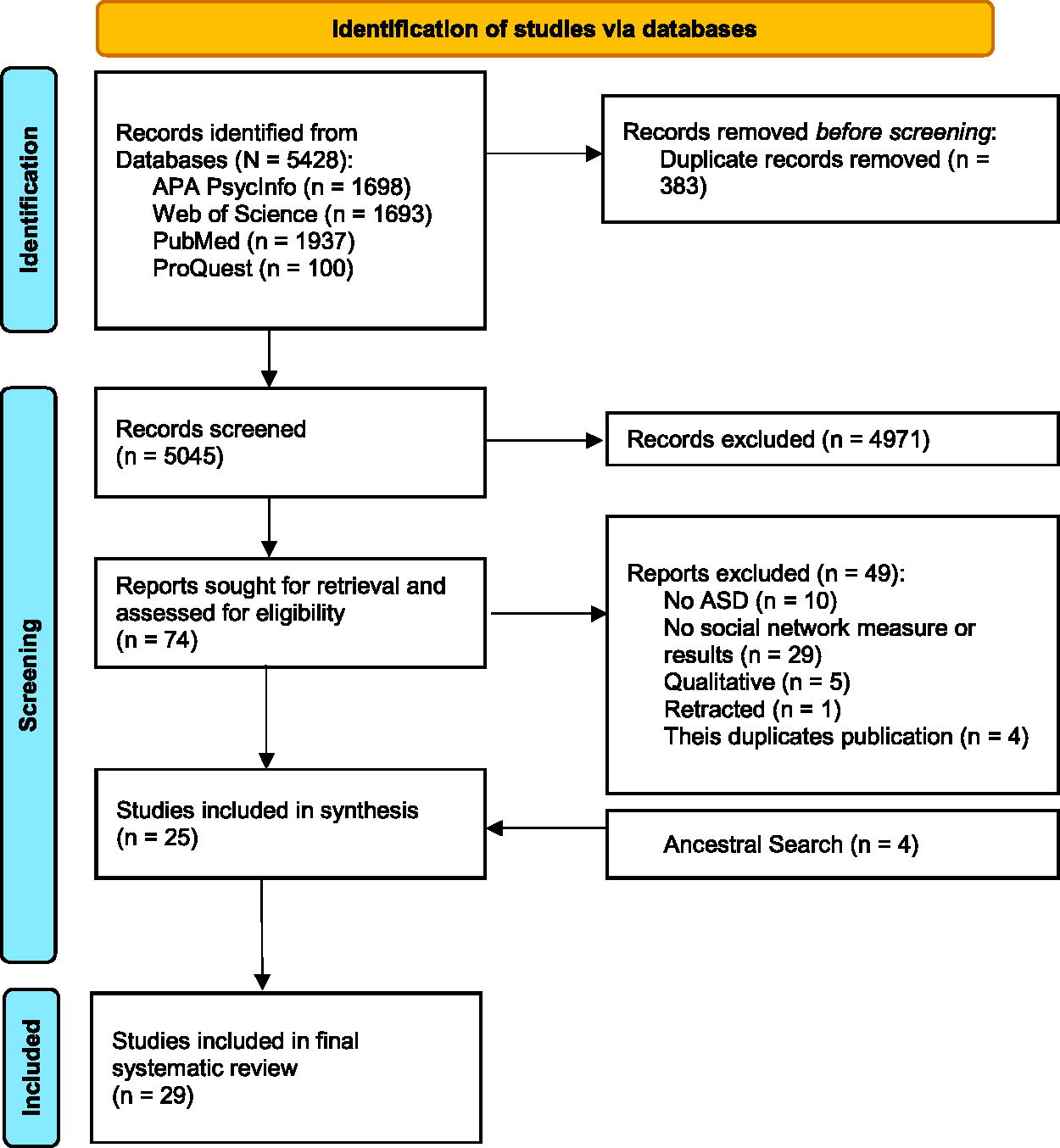
PRISMA flowchart showing selection of studies included in narrative synthesis.
The search process included three stages. We first collated results in Excel before we removed duplicates and completed title and abstract screening. We excluded articles if they (1) had a title or abstract irrelevant to the purpose of the review, (2) were not in English, or (3) were not peer-reviewed (except for dissertation/thesis work). Next, we conducted a full-text review to include articles that met the inclusion criteria. We excluded nonjournal articles, systematic review/meta-analyses, opinion and commentary articles, qualitative studies, and case series. Finally, we did an ancestral search (i.e., search through full reference list) of the 25 articles found during the second search phase. This process identified four more articles that met the inclusion criteria. In total, 29 studies were included for narrative synthesis.
Inclusion and exclusion criteria
To determine the inclusion criteria, we followed the Population, Intervention, Comparison, Outcome, and Study Design guidelines. 28 We included published peer-reviewed articles and unpublished dissertation/thesis in English (published since 2000) up to July 2024. We excluded systematic reviews/meta-analyses, case series, opinion articles, non-English publications, articles that do not have a social network measure, and dissertations/theses that used data that have since been published as peer-reviewed articles that met the full inclusion criteria (this was identified through looking at research group affiliations, study recruitment, and participant information).
Population
We included participants who have a clinical, educational, or self-diagnosis of autism, and autistic individuals who have co-occurring conditions if social network structure measures are delineated across comparison groups to allow clear identification of the impact of autism on social network structure per se.
Intervention
Intervention studies were included in the review if they met all other inclusion and exclusion criteria stated under Population, Comparison, and Outcome.
Comparison
Studies may include a comparison group, such as non-autistic participants or participants with other disabilities, to understand the differences in structure and function of social networks between autistic individuals and peers.
Outcome
Studies must include at least one social network structural measure as an outcome measure and define components of social network structure as variables listed in Table 1.
Quality indicator appraisal
To measure study quality, we used the quantitative scale of the QualSyst. 29 This quality indicator has been used previously to review autism literature. 30 For quality appraisal, we coded 14 dimensions of quality indicators assessing study objectives, study design, participant selection, random allocation (if applicable), outcome measure, sample size, analytic method, estimate of variance, controlling for confounding, reporting results, and conclusion. A final score was calculated based on the formula described by Kmet and colleagues. 29
Inter-rater reliability and coding
Intercoder agreement for quality appraisal was calculated in all three phases of coding. Prior to coding, we trained all three coders by using randomly selected articles to reach 100% agreement on screening titles/abstracts, coding study variables and quality indicators. Training was completed via discussing any discrepancies in coding across the three coders to resolve disagreements. All three coders have extensive research experiences in the field of autism and intellectual disability. Following this procedure, we randomly selected 20% of the articles to be coded by all coders to calculate inter-rater reliability on study variables and quality indicators.
Data extraction
Study variables included the following: (1) the name of the country where the participants were recruited, (2) sample size, (3) diagnosis information, (4) age, (5) IQ (if reported), and (6) gender identity or biological sex as reported by article. For social network measures, we coded network characteristics such as network centrality, size, density, and types of connection (e.g., family, peer, professional), relationship quality (acceptance, rejection, reciprocity, contact frequency, mode of contact, length of relationship), and perceived social support from social network members.
Results
Search results
The PRISMA diagram (Fig. 1) 27 summarizes the literature search process. After removing duplicates, the first author completed the title, abstract, and full-text screening. We selected all 29 studies for quality assessment. For the 17 studies that used the Friendship Survey as the social network measure, study quality ranged from 0.73 to 0.95. For the 12 studies that used alternative tools to capture social networks, study quality ranged from 0.5 to 0.94.
A second coder independently screened 20% of abstracts and full-text articles to assess interobserver agreement on study variables and quality indicators. We calculated the percentage agreement scores by dividing the total number of agreements by the total number of agreements plus disagreements and multiplying the quotient by 100. Agreement is 78% (n = 27; Kappa coefficient = 0.71) for abstract screening and 82% (n = 27; Kappa coefficient = 0.92) for full-text screenings, and 74% for quality appraisal variables across all 14 dimensions of quality indicators.
Study characteristics
Tables 2, 3, and 4 summarize the characteristics for the 29 included studies. A total of 1820 autistic individuals (n = 1219 male) took part in the studies, with most studies completed with children and young people younger than 18 years, and only eight studies with adults (number of participants = 650, mean age = 32.42 years). The majority of studies were U.S.-based (n = 19), with only four studies based in the United Kingdom,31–34 two in Spain,35,36 two in the Netherlands,4,37 one in France, 38 and one in China. 39 Most participants came from local schools (n = 20), with a few from universities (n = 3) and local communities (n = 3),4,38,40 one from government data and charities, 41 one from an existing research database, 42 and one from a clinic. 37 Only five studies reported the socioeconomic status of participants, ranging from 49% to 66% of autistic adults being in part- or full-time employment,4,38,42 young people from advantaged families, 40 and one study with 50% of children receiving free school lunch. 43 Seventeen studies reported information about race, with most participants being White (including Caucasian) (30.7%–100% across studies).
Information Captured by Different Instruments Used to Measure Social Networks (n = 29)
Summary of Studies (n = 17) That Used the Friendship Survey to Capture Social Network Metrics in Individuals with Autism Spectrum Disorder
Indicates study included an intervention and used social network measure as outcome variable (see Supplementary Appendix SA2 for intervention components).
ADI-R, Autism Diagnostic Interview-Revised; ADOS, Autism Diagnostic Observation Schedule; ASD, autism spectrum disorder; DAS-II, Differential Abilities Scale-2nd Edition; KBIT-Kaufman Brief Intelligence Test; M, mean; NT, neurotypical; SB-5, Stanford-Binet Intelligence Scale-fifth edition; SD, standard deviation; SES, socioeconomic status; SNC, social network centrality; WISC-IV, Wechsler Intelligence Scale for Children, fourth edition.
Summary of Studies (n = 12) Using Alternative Measures to Capture Social Network Metrics in Individuals with Autism Spectrum Disorder
ADHD, Attention-Deficit/Hyperativity Disorder; AQ-10, Autism Quotient-10; BD, Behavioural Disorder; CAST, the Childhood Autism Spectrum Test; FSIQ, Full Scale Intelligence Quotient; KABC, Kaufman Assessment Battery for Children; LD Learning Disability; TONI, Test of Nonverbal Intelligence; SRS-A, Social Responsiveness Scale-Adult; WPPSI-III, Wechsler Preschool and Primary Scale of Intelligence.
Quality appraisal findings
Tables 2, 3, and 4 summarize the quality scores of each reviewed study. There is a wide range in study quality, ranging from 0.5 to 0.95, with most of the studies scoring above 0.80. The wide range underscores the need to consider the study quality when interpreting findings. In addition, the Friendship Survey used in most studies has not been validated with autistic individuals, and none of the reviewed studies reported psychometric properties of the measure. Finally, it is worth noting that the quality ratings did not include qualitative reviews, which could provide valuable information into autistic individuals’ perceived satisfaction with their social network structure and its functional values.
Social network measure characteristics
We identified several social network mapping tools across the 29 studies, with details summarized in Table 2. The majority of studies done in classrooms with children (n = 17 studies) employed the Friendship Survey, 44 where all children within a classroom rated their relationships with each other. One can use this information to generate a sociomap, including individuals’ network centrality, network density, and degree of social connections. Relationship quality includes peer acceptance, rejection, and degree of reciprocity (see Table 1 for definition).
We identified four additional measures that were used to generate ecomaps (i.e., individuals are asked to name social network members and rate the perceived quality of their relationship with each member), including the Maastricht Social Network Analysis (MSNA), 45 Network in Action Questionnaire (NiA), Arizona Social Support Interview Schedule (ASSIS), 46 and Social Network and Perceived Social Support (SNaPSS) 32 tools. Compared with the Friendship Survey, both MSNA and SNaPSS ecomap tools rely only on subjective ratings from the autistic individual to name up to 20 network members that they perceive to be important in their lives and can capture network size and density, frequency and mode of communication, and length of relationships. Both ecomap tools asked individuals to rate their perceived social support from each network member, thus capturing social capital available to an individual within their reported social network. In contrast, the NiA and ASSIS asked participants to reflect on several areas in their daily lives and name network members they perceived to provide them with some level of support in each area. The final network structure included only network members who provide some degree of support and are perceived important to the individuals.
Bespoke social network measures were identified in a number of studies that captured social reciprocity among friendship and clusters (e.g., nominating the number of peers in a classroom each person most and least liked to play with 41 ; how close you are to that friend) 42 through both questionnaires and observation scales (e.g., rating degree of intensity in social interaction to code social reciprocity during play time at school). 35 One study explored the use of duocentric networks 40 by matching the networks between an autistic young person and that of their parent, to explore the degree of overlap for social network members named by both young person and parent in their respective social network maps.
Characteristics of social networks: Summary of Friendship Survey-based results
A total of 17 studies used the Friendship Survey to capture social network structure in autistic children in relation to their neurotypical peers in the same classroom (Table 3). For social network centrality, autistic children are reported to be more isolated and more likely to be found on the edge of social networks compared with their neurotypical peers47–52 and peers with other disability, 50 and few autistic children have central status. The relationship between age and network salience showed some mixed results, with one study showing that older autistic and neurotypical children had lower social network centrality compared with younger peers, 48 while another suggested that social network salience increased for children across the grades 3–6 years old over the school year. 50
Five studies involved a range of interventions (see Supplementary Appendix SA2 for summary of interventions) delivered by school personnel and peer-mediated models to support autistic children in classrooms.43,53–56 Researchers employed two main approaches: adult-mediated interventions, which involved providing autistic children with instructions on social rules, role-playing, and practice, and a peer-mediated approach, where trained peers engaged autistic children using taught strategies across school settings. Peer-mediated interventions were more effective than adult-mediated interventions in improving social network connection. 53 In addition, researchers have compared two interventions, a didactic approach with a more naturalistic intervention in which a group leader facilitated activities based on the preference of the autistic children and faded out supports as soon as children could play independently. The two interventions also varied in group composition (all autistic students vs. mixed group of autistic and non-autistic students). There was no group difference between the two approaches in social connections from the peer nomination measure.53,54 Overall, peer-mediated interventions and adult-mediated programs resulted in higher social network centrality compared with adult-facilitated strategies and inclusive classrooms with no additional social skills interventions. 56 In addition, autistic children who received support from school staff who were trained to recognize children’s social communication needs, sustain their engagement, and facilitate peer interactions showed significant improvement in network centrality over the academic school year. 43
Regarding peer acceptance and number of received nominations from peers in the classroom, autistic children had lower peer acceptance compared with neurotypical peers47,49–52 and children with other disability. 50 One study found that all children received more friendship nominations over the course of one academic year, 50 and another found that those who received peer-mediated interventions also received more friendship nominations compared with other forms of treatment groups. 53
Regarding peer rejection, social reciprocity decreased between peer nominations for older autistic and neurotypical children, 47 and autistic children nominated fewer peers as friends, and were nominated fewer times by other classmates as friends. 48 Autistic children received more nonpreferred nominations over one academic year compared with neurotypical peers and peers with non-autism disability, 50 and were more likely to be rejected by peers. 52 One study found that autistic boys were more socially excluded compared with autistic girls. 57 Only one study found that autistic adolescents did not differ from their neurotypical peers in number of peer rejections received at various time points during the academic school year, and this may be related to the study having a slightly older adolescent age group compared with elementary school-age children. 51 Overall, autistic children showed lower social reciprocity in best friend nominations compared with neurotypical peers,47,48,51,52,57 although both autistic and neurotypical children were more likely to report reciprocal network connections with other girls in their classrooms. Finally, researchers in one study found that the number of received friendship nominations and network inclusion partially contributed toward the amount of time autistic children spent in joint engagement with peers. 58 In contrast, number of rejections was not associated with joint engagement, suggesting that the impact of rejection on social exclusion may be less visible during playtime. 58
Characteristics of social networks: Summary of studies that use alternative tools
Twelve studies used alternative measures other than the Friendship Survey to capture social network metrics (see Table 4). The majority of studies in this group recruited from the community, with two studies recruiting from universities,33,34 three from schools,35,39,41 and one from an existing research database. 42
Social networks in autistic adults
Regarding older participants recruited from the community, researchers assessed social network size by asking participants to name up to five people who are important to their lives 40 or answering the question “how many friends do you have right now (people you spend time with)?” 42 Findings reported different results depending on the number of network members capped within the measure. When being asked to name up to five people, the average network size for autistic young adults was 4.88. 40 For social network site users, when being asked how many friends one has, 42 the average size of network friends is 219, with median of 142. Autistic individuals who used social network sites reported to have met 56.7% of their social network in person, although information about the perceived quality of support provided by their network was unclear. 42
Two studies made use of social support network measures, including the ASSIS 38 and NiA Questionnaire, 37 both asked autistic adults to name individuals within their social network who provided support in at least one area of their lives, ranging from physical and material assistance, to emotional and guidance support. Both studies found that on average, participants consistently named between 4 and 5 people who supported them in their daily lives, although some reported up to 21 people in their social network. 38 Both studies found that family members were often cited to form the majority of individuals’ social networks and were perceived to be more available than other types of social network members (e.g., partners, friends) for material and physical assistance, although partners were rated as most available for providing emotional support such as the need to confide in, guidance, feedback, and social participation. 38 Autistic adults also perceived themselves to be helpful for 1–2 social network members. 37 Regarding frequency of contact, one study found that between 19% and 21% of social network members named by autistic adults were seen either daily or at least once per week. 37
Social networks in autistic youths transitioning to university
A series of studies used the SNaPSS to understand the social network structure and perceived support among autistic students in their first year of university.32–34 Researchers asked autistic young people to “name up to 20 people with whom they have been in contact with over the past three months, and whose relationships were perceived to be particularly important” to the individual. Individual differences in self-reported network size ranged from 2 to 20 members. On average, participants reported family members to provide better quality support compared with friends and others in the network. For autistic students, no change was found in network size, density, or the change in the makeup of their social network across the first year of university. However, the non-autism group showed a decrease in both network size and density and an increase in the proportion of friends (relative to family and other types of social network members) within their reported social networks across the first year of university. 34
Social networks in school-age autistic children
Regarding studies that recruited school-age participants,35,41 one study used Behavior Rating Profile 59 and did not find any difference between children on the spectrum and the peers without disabilities in social preference, social impact, social network affiliation, acceptance, visibility, and social network affiliation. 41 In the second study that included a school-age participant (10 years of age), the researchers asked the target child and his classmates to list classmates that they have “a friendship relation with.” Results from this study suggest that the target child received fewer friendship nominations on average than peers without disabilities. There is no relation between nominations and social interactions on the playground. 35 The third study was in a classroom setting in China, 39 where authors asked students to nominate three peers they liked and three peers they disliked in the class to measure social acceptance and rejection. Authors found that autistic children were more likely to be rejected or rated with an average degree of acceptance (i.e., neither liked nor disliked by other students) compared with neurotypical peers in the class. 39
Discussion
What measures have been used to assess structural characteristics of social networks in autistic individuals?
This is the first systematic review to evaluate the measurement of social network structure among autistic individuals. Seventeen of the 29 included studies generated sociomaps in school classroom settings using the Friendship Survey, 44 3 studies used the SNaPSS32–34 tool to generate ecomaps among autistic students transitioning to first year of university, and other studies used a range of network analysis tools, including bespoke social network measures that are summarized in Table 2. The Friendship Survey is relatively user-friendly and fast to administer, as it directly collected only five questions from students. The advantage of involving all students allows an objective social network to be constructed based on observable behavioral differences across social groups within a predefined social sphere and enables the quantification of a child’s network centrality. A few limitations exist when interpreting this body of research. The majority of the studies came from one research group working with elementary school children in public schools in the United States43,53 and findings may be limited in cultural sensitivity and can benefit from replication from outside of the United States. Second, the feasibility of measuring sociomaps within a predefined social sphere becomes much more limited across the course of development. As individuals leave a structured school classroom setting, they may begin to form relationships in multiple settings outside of one’s main work and school environment, and the scale of how many informants are required to create a synthesized sociomaps may become more difficult.
To account for the increasing complexity in one’s social network structure, ecomaps are more appropriate for adolescence and adulthood, as it enables the individual to recall network members from different walks of one’s life that may be perceived to be important to that individual. Both SNaPSS 32 and the MSNA 45 relied on self-report to generate a single ecomap summarizing relationships between network members across different social settings, and can include both online and offline social networks. Ecomaps provide a visual prompt for individuals to explore the availability and flow of social capital within their existing social network relationships that an individual may or may not be explicitly aware of if one were to recall perceived social support in the absence of this visual map. For example, an individual may have a clear preference to go to the same person for different types of support and may become stuck if that person were to suddenly become unavailable. Ecomaps allow one to visualize and contemplate whether other existing network members may be able to serve a similar function to that of the preferred individual and may enhance an individual to make use of their social networks in a more flexible, adaptive, and purposeful way. However, the reliance of ecomaps mostly on self-report may be subject to reporter bias. McGhee Hassrick and colleagues 40 have begun creating duocentric network maps from both autistic young people and their parents’ accounts, and such inclusion of multiple informants to generate more reliable ecomaps is an important future direction to explore.
What are the characteristics of social networks among autistic individuals?
Resonating with the social communication challenges faced by autistic individuals, studies using the Friendship Survey with elementary school students have yielded several important findings, such that autistic children are more socially isolated, receive lower peer acceptance and greater peer rejection from others, and nominate fewer peers as friends. Currently, the field of social networks among autistic individuals remains largely descriptive, with very few intervention studies conducted by independent researchers to provide effective means to change the social network structure.
This review highlights that knowledge about how social network structure changes across the lifespan is lacking. No studies adopted a longitudinal design across different developmental stages. The functional impact of social network structure is likely to be different depending on the developmental context. For example, in neurotypical individuals, although family networks are stable in size from adolescence to older age, networks with coworkers or neighbors were important only in specific life stages. 60 A large social network size is neither necessary nor sufficient to maintain well-being across development. For example, as one ages, people may intentionally seek a decreased network size to maintain stable emotional well-being. 61 However, little research is available on how patterns of social networks may change across development, and whether a consistently small social network profile may exert a similar impact on one’s quality of life over time for autistic individuals.
A few studies provided preliminary evidence to suggest a sex difference among social networks of autistic children, such that younger autistic boys showed better social connectivity than autistic girls, although this effect lessened across age and autistic girls fared better in larger classroom sizes compared with autistic boys. 62 Differences in social connectivity may be associated with sex differences in social camouflaging (i.e., actively “hiding” one’s social communication differences in an attempt to fit in), 9 such that girls are more sensitive to and use a range of strategies to negotiate the changing social dynamics across development, and may be better able to do so when there are more alternative social groups in a larger classroom setting. However, the success of social camouflaging can vary greatly, especially in mainstream classrooms, and can come at a significant cost to the young person’s mental health when their sense of belonging is challenged. 63 Maintaining increased social connectivity in a larger social network may be negatively associated with quality of life and mental well-being for autistic individuals who engage in high levels of social camouflaging. 64 Furthermore, it is important to consider how gender identity across development may influence social network structural changes above and beyond that of sex differences, and no studies to date have distinguished between the impact of sex and gender on changes in social network structure over time. Future studies can benefit from exploring the intersection between camouflaging, social network structure, gender identity, and perceived well-being among autistic individuals to understand the impact of gender and gender identity on social network changes across development.
Finally, only five of the included studies were intervention studies. This is consistent with previous systematic reviews 65 that found that not many social skills intervention studies examine social network changes as an outcome measure. Only one of the five intervention studies found that autistic children who received support from school staff showed significant improvement in social centrality. Thus, there is no evidence to suggest that these interventions have an impact on peer acceptance indicated by the likelihood of being nominated as friends. One area targeted by interventions is the percentage of time an autistic child initiates a conversation and sustains the play with their peers. However, our findings seem to suggest that teaching social skills, using directive or peer-mediated interventions, may not lead to peer acceptance. 58 In other words, social skills training that solely focuses on skill acquisition may not lead to changes in the perception of neurotypical individuals regarding their autistic peers. Rather, efforts at a system level (e.g., classroom, workplace) teaching others to understand and respect autistic individuals are equally important. 66 Furthermore, no intervention studies looked at social network changes beyond elementary school age. Given that many major life events and transitions happen during the periods of adolescence and young adulthood, it is important for future research to focus on social network structural changes during such transitions and understand the implications on autistic individuals’ ability to access instrumental, emotional, and informational support from their support networks. 34
Clinical implications
Our review has several important clinical implications in both assessing social network characteristics and intervention services for autistic populations. For assessment, practitioners in education and clinical settings may consider adopting a social network measurement to capture real-time changes in structure and function of different social relationships that are meaningful to the autistic individual. We recommend education practitioners to consider the value of adopting a sociomap measure such as Friendship Survey when working with younger children in structured classroom settings, to understand network size, centrality, and peer acceptance and rejection of the autistic child through their own eyes and that of their peers. The Friendship Survey is easy to administer, consisting of only five questions, but yields important information regarding social relationships of autistic children in the context of schools. When working with autistic adolescents and adults who may have more complex social environments across multiple settings, we recommend practitioners to consider adopting a sociomap measure that allows easy quantification and visualization of meaningful relationships to that individual in daily life, to develop a holistic understanding of social resources that may or may not be available to that individual to meet different demands in life. We highlight the strength of social network maps being highly person-centered. Given that little is known about the relationship between social network structure and function, it is important for clinicians to work together with autistic individuals to understand the extent to which they feel able to draw on existing relationships in a meaningful way. Identifying social network structure enables practitioners to understand the complexity of systemic influences within an autistic individual’s environment and extend work into the community to promote understanding and acceptance of neurodiversity. Understanding how an autistic individual is currently embedded within their social network may enable practitioners supporting autistic individuals to consolidate and potentially expand their social connections in a way that is meaningful to them. Proceeding from the autistic individual’s perspective of their social network might also help address the double empathy problem.6,7 The double empathy problem highlights that social communication differences between autistic and non-autistic individuals extend both ways, and there is a need for non-autistic individuals to take ownership and foster curiosity to explore communication differences and improve mutual understanding. Understanding an autistic individual’s social world from their own perspective and scaffolding meaningful social opportunities may contribute toward improving their quality of life through person-centered care and shift away from focusing solely on quantity of social connections.
Limitations and future research directions
The current systematic review highlighted several limitations in the field of understanding the social network structure in autistic individuals. First, most studies used the “Friendship Survey” to generate sociomaps in the elementary school setting, and the generalizability of using this measure across later stages of development when complexities of social relationships increase across home, work, and recreational domains is much more limited. Second, as the current study chose to focus on identifying social network structural changes across the lifespan, we found that few studies examined co-occurring changes in perceived social support that would provide insight into the functional utility of one’s social network over time. Future research may also consider the value of using ecomaps to capture social connections more accurately across different settings and environments for autistic children and young people. Given that many families of autistic young people may scaffold social opportunities outside of education/classroom settings that may be better tailored toward the young person’s focused interests and strengths, ecomaps may accurately reflect meaningful social connections across a young person’s social sphere that is not limited to one setting. For autistic adults, sociomap may also be beneficial to understand the nuances of social connections within a defined social setting, such as in the workplace or in higher education. Understanding social connections in well-defined social settings can help identify both established connections and access to support and highlight gaps where reasonable adjustments may be needed to enable the autistic individuals to participate and contribute to their social environment.
The current review highlights the utility of social network analysis as a descriptive tool that can visually capture the current state of an autistic individual’s social connections. The interpretation of social network metrics needs to be carefully done together with the autistic individual to understand the following: (1) what are their social needs and goals; (2) the extent to which those goals are met by their current social network; (3) and if not—what are some ways to improve social connections in a way that is most meaningful to the autistic individual. We place greater emphasis on the double empathy problem, 6 highlighting the caveats of imposing social network theories largely based on neurotypical populations to autistic individuals’ social networks. The focus on size, density, and network centrality metrics from social networks may not linearly correlate with relationship satisfaction for autistic individuals. For example, the degree of autism acceptance modeled in each social connection by the social partner may influence an autistic individual’s felt need to mask differences, and the ability to thrive in an authentic manner within that relationship. Such qualities of social networks may not be reflected by metrics such as size and density per se.
Taken together, this article highlighted the need for future research to conduct more cross-sectional and longitudinal observational studies to investigate changes in one’s sociomap and ecomap structure across development, and how changes in social network structure may correlate with perceived loneliness, social support, and individual well-being, including mental health outcomes over time. Quantitative data on social network structure alone will not be able to offer insight into the quality and meaning of those social connections for autistic individuals in terms of meeting their social needs. 31 Triangulating data collection across multiple observers within one’s social network may offer valuable insight into the perceived quality of social relationships within one’s social network from multiple perspectives to be considered alongside the view of autistic individuals themselves. Synthesizing information from multiple perspectives can potentially highlight relationships that are more accepting and foster a positive autism identity for autistic individuals, versus other relationships that may be characterized by potential misunderstanding or miscommunication between the autistic individual and their social partner. We therefore advocate for more mixed-methods studies that incorporate social network structure as well as qualitative components to gain insight into how autistic individuals interpret their social connections. For example, exploring the relationship between social network metrics such as size and density, alongside social camouflaging and autistic identity may be important to understand the social burden for autistic individuals. Understanding the degree to which autistic individuals feel accepted by and can express their authentic self within social networks is crucial. Given recent literature on the importance of autistic identity to support well-being at both the individual and community level, understanding different neurotype representations within autistic individuals’ networks may provide insight into their connect with the wider autistic community. Practitioners need to scaffold social opportunities that strengthen existing relationships and/or foster new ones in a way that is personally meaningful to the autistic individual, rather than being imposed based on neurotypical social norms. Understanding the functional correlates of individual differences in social network structural changes across development can allow both professional stakeholders to identify sources of social resilience that may buffer against stressful life events such as transitioning to a new school or work environment and anticipate potential ruptures and losses of social relationships that may negatively impact an individual’s well-being over time.
The current study highlighted that despite the widespread prevalence of intervention targeting social skills with the implicit goal of improving social initiation and connection for autistic young people, there is limited use of social network metrics to evaluate the longitudinal effectiveness of social skills training on the development and maintenance of social relationships across development. Given recent literature around the potential negative impact of social camouflaging on mental health in autistic adolescents and adults,14,67 it is difficult to know how social skills taught at a younger age may interfere with the development of self and autism identity across the course of development and maintenance of social relationships in the context of one’s social network. Future research and clinical work may benefit from explicitly monitoring changes in social network structure among autistic individuals over time, especially around major life transitions (e.g., changing schools, starting university or a new job). Social network maps provide valuable information in formulating whether the individual has any support needs that are not met through their current social network and problem solve how best to address that unmet need through intervention.
Conclusion
Meaningful social connections and social participation contribute toward quality of life for autistic individuals. Social skills intervention studies often include outcome measures such as autistic traits and social competence. Although these outcomes are important, they do not reflect autistic individuals’ day-to-day life, nor do they capture who autistic individuals hang out with and whether they feel their needs being met through their social network. Our review reveals the importance of future research efforts to incorporate social network measures as a study outcome, to consider the validity of social skills goals in the long term and how meaningful they are to the autistic individual, and to develop instruments that can measure both structural and functional aspects of social networks, especially for autistic adolescents and young adults.
Footnotes
Authorship Confirmation Statement
J.L., X.Q., and K.M.K. conceptualized and coauthored the article. All authors contributed toward data screening and extraction. J.L. and X.Q. led the data synthesis and initial drafting of the article. K.M.K. participated in narrative synthesis, review, and revision of the article. The article has been submitted solely to Autism in Adulthood.
Author Disclosure Statement
The authors declare no conflicts of interests.
Funding Information
No funding has been received or used for this systematic review.

References
Supplementary Material
Please find the following supplemental material available below.
For Open Access articles published under a Creative Commons License, all supplemental material carries the same license as the article it is associated with.
For non-Open Access articles published, all supplemental material carries a non-exclusive license, and permission requests for re-use of supplemental material or any part of supplemental material shall be sent directly to the copyright owner as specified in the copyright notice associated with the article.
