




Abstract
Background:
Thinking in pictures is a distinct cognitive style characterized by the dominant use of visual thinking. Temple Grandin’s autobiographical account is the best-known description of visual thinking but there are few first-person accounts of this inner experience. The aim of this article was to gain further insight into the lived experience of a “thinking in pictures” cognitive style among autistic individuals.
Methods:
We collected posts from the Wrong Planet forum containing descriptions of visual thinking by self-declared autistic individuals. We then conducted a content analysis to identifying recurring themes. To guide this analysis, we created a codebook based on the themes found in Temple Grandin’s description, as well as themes that emerged directly from the posts themselves.
Results:
We identified three key themes related to the experience of thinking in pictures among self-declared autistic individuals. The first theme, termed “Phenomenological Characteristics,” described the main aspects of this type of thinking such as vivid imagery, photographic memory, and image manipulation. The second theme, called “Cognitive Functioning,” explored the cognitive processes related to the ability to think in pictures, including concrete and associative thinking, and how this relates to language. The third theme, termed “Verbal Communication Issues,” highlighted the difficulties faced by autistic individuals who think in pictures when it comes to oral communication, primarily because they must translate their mental images into words.
Conclusions:
These results allow us to better characterize this particular cognitive style, and also to better understand its involvement in learning situations and social interactions. The findings are discussed in light of studies on visual processing in autism and the relationship with the language dimension.
Community Brief
Why is this an important issue?
People who think in pictures rely more on mental images than words or other ways of thinking. Thinking in pictures is often described in autistic individuals. Apart from Temple Grandin’s book, there are n’t many personal stories that talk about this from the inside. These accounts are important because they give us a direct view of what it’s like to be autistic, showing us things about autism that haven’t been looked at much.
What was the purpose of this study?
The aim of this study was to understand better what it’s like for autistic people who say they think mainly in pictures.
What did the researchers do?
We collected and analyzed posts written by individuals who identify as autistic on the WrongPlanet forum. Specifically, we focused on posts where people discussed their experience of thinking in pictures. Then, we conducted an analysis to identify recurring themes. To guide this analysis, we created a codebook based on the themes found in Temple Grandin’s description, as well as themes that emerged directly from the posts themselves.
What were the results of the study?
We found three key themes related to the experience of thinking in pictures in autism. The first theme, called “Phenomenology Characteristics,” describes the main aspects of this type of thinking: when people hear or read words, it automatically creates clear mental images or movies, they can remember and recall details exceptionally well, and they’re skilled at manipulating these mental images. The second theme, called “Cognitive Functioning,” describes the cognitive processes related to the ability to think in pictures (concrete and associative thinking) and how it relates to the language dimension. The third theme, called “Verbal Communication Issues,” highlights the difficulties experienced by autistic individuals who think in pictures when it comes to oral communication, primarily because they must translate their mental images into words.
What do these findings add to what was already known?
Some of our findings match Temple Grandin’s description of her ability to think in pictures, as well as other studies on visual abilities in autism. However, we also discovered new information about problems with verbal communication. Our results suggest that thinking in pictures might play a role in the verbal communication difficulties often seen in autism.
What are potential weaknesses in the study?
First, we couldn’t confirm the autism diagnosis of the participants. Also, the stories we gathered might not offer as much detailed information as face-to-face interviews typically do. In addition, there’s a chance that people might exaggerate or say things to fit in with the online community on social media, which could introduce some biases. Nevertheless, we regard this exploratory study as a crucial initial step in advancing our comprehension of the lived experiences of individuals on the autism spectrum who think in pictures.
How will these findings help autistic adults now or in the future?
These findings may help autistic adults who think in pictures to better understand their particular functioning and how it can influence different facets of their daily life.
Background
“Thinking in pictures” is a distinct cognitive style characterized by the predominant use of visual thinking and mental imagery to make sense of and engage with the world. Although thinking in pictures is not restricted to autistic people 1 and it is not the sole cognitive style described in the population, 2 it has traditionally been discussed in relation to autism and has served to raise the awareness of cognitive diversity. While several findings in the literature support this cognitive style in autism, there are few first-person accounts of this inner experience. The aim of this article was to gain further insight into the lived experience of a “thinking in pictures” cognitive style among autistic individuals.
Several empirical findings have been taken as support for a “thinking in pictures” cognitive account of autism. 3 For example, studies on the integrity of inner speech (i.e., the little voice in one’s head involved in many cognitive functions 4 ) in autism seem to demonstrate the use of nonverbal strategies. In dual-task situations, preventing the use of a verbal strategy by articulatory suppression had no significant impact on the performance of autistic people compared with non-autistic people.5–7 Other behavioral findings suggest that autistic individuals tend to rely more on nonverbal (potentially visual) strategies than non-autistic individuals: for instance, they exhibit difficulties in a verbal problem-solving task, 8 a smaller word length effect during a serial recall task, 6 but intact comprehension in language tasks involving a visual component. 9 In addition, enhanced visuospatial 10 and mental imagery abilities11–13 in autistic participants have been reported. Furthermore, some neuroimaging results indicate the enhanced involvement of posterior and parietal brain regions when autistic individuals process verbal content,14–16 or solve complex problems, such as matrix reasoning,17,18 suggesting that autistic individuals rely more on visuospatial strategies.
It remains unclear, however, whether the findings from laboratory settings accurately capture the day-to-day inner experiences of autistic individuals. This has prompted several studies to adopt a more direct approach. In a questionnaire-based study, Bled et al. (2021) asked a group of autistic and non-autistic adults about the nature of their mental representations in seven common real-life situations (e.g., decision-making, problem solving, planning). Participants had to indicate whether they think in “words only,” “images and words,” or “images only” in those situations. Autistic participants reported a more frequent (but not necessarily exclusive) use of visual mental representations across the situations compared with non-autistic individuals. Moreover, when asked to characterize their visual mental representations, they reported a more detailed mental representation than non-autistic participants. In another questionnaire-based study including non-autistic adults only, Orm et al. (2021) found that participants reporting high levels of autistic traits tended to report thinking more in mental images than participants showing no or few autistic traits. 19 Similar results have been found using more intensive methodologies that aims to capture people’s real-time experiences and thoughts as they occur throughout the day. Hurlburt et al. (1994) asked three autistic participants to write down what they were thinking and feeling every time a device they carried beeped throughout five days. After each day, the authors reviewed with the participants their notes about the details of the inner experiences they reported. The authors found that all three participants reported thoughts primarily or exclusively in the form of mental images. More recently, Hare et al. (2015) used a similar experience sampling approach. They asked participants to report their thoughts, feelings, and activities on a 13-item questionnaire through a mobile app that randomly beeps 10 times a day over a period of three days. The questionnaire included a question adapted from Hurlburt et al. (1994) asking about the form of thoughts participants have when they hear the beep (such as “written symbols,” “talking to myself,” “mental images,”). The study found that while both the autistic and non-autistic groups reported similar levels of inner speech (talking to oneself), individuals in the autistic group more frequently reported having thoughts in the form of mental images compared with those in the non-autistic group.
While these questionnaire and experience sampling studies provide valuable information into the daily inner experience of autistic individuals, they do not capture what people with a visual cognitive style feel or experience. To gain a more complete understanding of this cognitive style, it is necessary to use qualitative approaches that probe into the individual’s lived experience and subjective perceptions. The value of first-person narratives (i.e., autobiographical accounts) in autism research has been increasingly acknowledged in recent years.20–22 Such narratives are typically produced and shared publicly to express personal experiences and perspectives with no predetermined research objectives. They offer invaluable insights into the lived experiences of individuals and can shed light on important aspects of being autistic that have not yet or few been explored.23,24
Thinking in pictures is perhaps best known through Temple Grandin’s autobiographical account. 25 In her book, “Thinking in pictures: my life with autism,” as well as in various interviews, articles, and presentations, Temple Grandin, an autistic researcher and author, provides an in-depth account of her way of understanding the world through visual thinking. Although her visual cognitive style is sometimes experienced as a strength, as in her work in designing equipment for livestock (“Every design problem I’ve ever solved started with my ability to visualize and see the world in pictures” p.4), it also presents a number of challenges, such as comprehending abstraction (“As a teenager and young adult I had to use concrete symbols to understand abstract concepts” p.17). Her account makes it clear that thinking in pictures impacts various dimensions of her daily life.
The present study
The primary aim of this study was to gain further insight into the lived experience of a “thinking in pictures” cognitive style among autistic individuals. We collected and analyzed firsthand narratives shared by self-declared autistic individuals in the form of written posts on a popular website hosting an online discussion forum. By using forum discussions as a source of firsthand accounts, our objective was to collect a variety of experiences to capture the nuances, challenges, and strengths associated with thinking in pictures.
Methods
Study design
We used a directed content analysis approach to examine the contents of online discussion threads related to a visual cognitive style among individuals who self-identify as autistic. We chose this approach because we aimed to explore the experience of thinking in pictures in reference to Temple Grandin’s account. This approach is particularly suitable when researchers have initial hypotheses about the content likely to emerge from the data. Importantly, directed content analysis allows for the identification of new categories that may arise from the data 26 and cannot be coded within the predefined categories. This method is especially useful for preliminary research on phenomena where there is some initial background knowledge, but further detailed description is required.
Data source, collection, and cleaning
We collected firsthand accounts from WrongPlanet.net, a publicly accessible website hosting online discussion threads with over 80,000 registered users, the majority of whom self-identify as autistic. We entered the keywords thinking in pictures and visual thinking into the website’s search query box and selected 25 discussion threads from the returned lists based on the relevance of their titles to the research question (e.g., “What is it like to think in pictures?” “Do autistic people think in pictures?”). We automatically extracted thread posts from the WrongPlanet website and organized them into a spreadsheet. We arranged each post in a single row, and if users shared it on the discussion thread, we also reported their age and gender. The 25 threads yielded a total of 888 separate posts from 504 independent WrongPlanet users. We then carefully review each post to exclude posts that did not describe a personal experience of thinking in pictures. This process involved identifying and filtering out posts that (1) did not match our research question, (2) were minimal contributions, (3) were just facts without personal experiences, or (4) focused on a different way of thinking (e.g., verbal thinking) or were undefined. The final corpus comprised 101 posts from 77 independent users (age M = 42.3, SD = 12.2, women = 45, men = 26, NA = 6). We uploaded the corpus into MAXQDA software for further analysis.
Ethical considerations
We reached out to the site administrator of the Wrong Planet forum regarding our research. Following their instructions, we posted a message in a specific thread within the General forum to inform the community about our research. In this message, we explained the purpose and the methodology of the study. We also specify that, in accordance with the user’s term of the forum, we collected age and gender when publicly available, and that members could contact us to withdraw their posts from the data collection. We received comments from 9 users, mainly to describe their own experiences regarding the thematic, nobody contacted us to redraw theirs posts from the corpus. We did not collect user-names to preserve confidentiality and anonymity. Instead we attributed a code to each user to identify their contributions (Indiv1 to Indiv77). This research obtained the approval of the Research Ethics Committee of Toulouse University (project ID 2023_762).
Data analysis
Prior data analysis, L.B. developed a code-book using Temple Grandin’s description of her visual cognitive style. This code-book outlines the coding system we used for analyzing the data and includes a list of categories with their operational definitions (Table 1). These categories represent various experiences related to thinking in pictures and help group together similar instances of a specific experience under a single, common category.
Codebook with Source Code, the Number of Segments Coded, and Their Definition
Indicates that the code was not included in the analysis as few or no segments were coded.
We began the analysis by carefully reading through each post and coding segments (sentences or parts of sentences) using the predefined codes from our codebook. To ensure intercoder reliability, we regularly met to discuss and compare coded segments. Any discrepancies were resolved through discussion until consensus was reached. During this process, we observed that some data, although clearly referring to thinking in pictures, could not be coded with our predefined categories. Recognizing the importance of these data for our research question, we set them aside for further analysis after completing the initial coding. Next, we independently reviewed the uncoded posts or segments, highlighting words that captured key experiences associated with thinking in pictures. Based on this information, we developed new codes to group content reflecting similar experiences. Each new code was iteratively discussed, compared, and revised until we reached mutual agreement on the codes and their operational definitions. This process resulted in a total of 199 coded segments from 95 unique posts. We then grouped and organized these codes into broader themes based on their relationships and connections to thinking in pictures. The Results section describes the final themes and subthemes, accompanied by illustrative quotations. We did not correct spelling errors to preserve the authenticity of the quotations.
Results
Our analysis of the personal experiences of thinking in pictures revealed 3 main themes and 10 subthemes (see Fig. 1). Each theme and subtheme is described later in the text. Direct quotations (italicized) are incorporated throughout to exemplify each subtheme. For each theme and subtheme, we indicated the number of coded segments (n).
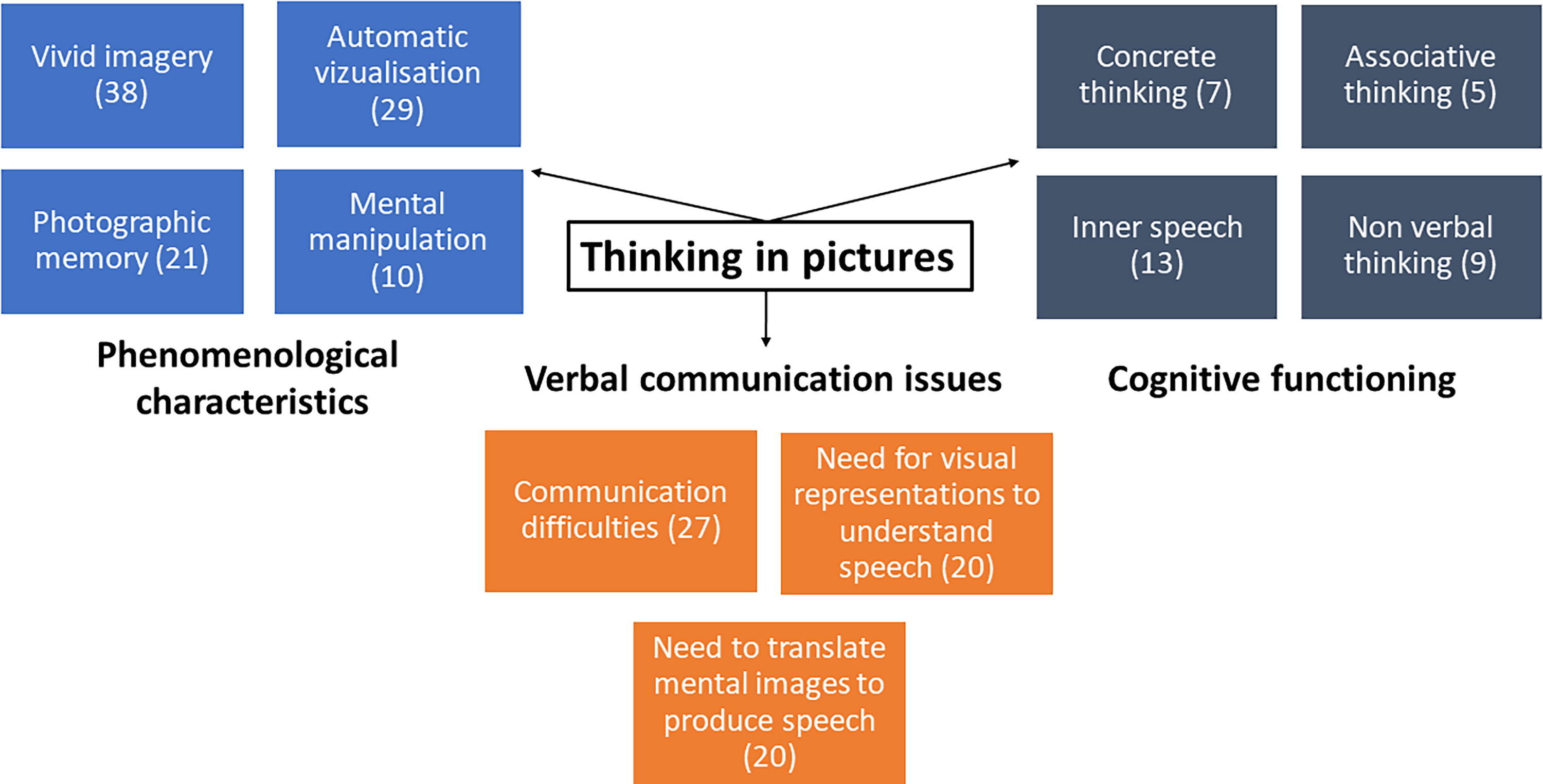
Main themes and subthemes related to thinking in pictures. Numbers in brackets indicate the number of coded segments in each subtheme.
Phenomenological characteristics
This theme was defined as “phenomenological description of the ability to think in pictures.” This theme included subthemes related to the following: (1) vivid imagery, (2) automatic visualization, (3) photographic memory, and (4) manipulation of the mental image. The data on this theme largely corroborate Temple Grandin’s description of her visual cognitive style, but also highlight other aspects. Each subtheme includes descriptions of the characteristics, as well as consequences or examples of their manifestation in daily life.
Vivid imagery (n = 38)
This subtheme includes descriptions of the vividness of the mental images as well as other sensory components. It also includes consequences of this vivid imagery on perception of the external world but also the cognitive support that it can brings when performing cognitive tasks that require mental imagery.
Many people reported the ability to generate highly detailed and accurate mental images. They described their mental images as dynamic, as in videos, as if there were inwardly seeing something (n = 21). Some of them also described that mental representation was not uniquely visual but also involved a multisensory dimension (sounds, touch, smell) (n = 6). Some individuals mentioned the impact of this vivid imagery on the perception of the outer world (n = 4). This intense imagery can be invasive, dominating the visual field and causing difficulties in maintaining contact with the external world. However, for some others, while still experiencing vivid images, the ability to distinguish inner perception from the real world remains intact, as the two types of images (inner and outer) are perceived in different ways. On the contrary, this vivid imagery can provide cognitive support to perform tasks that rely on mental imagery such as performing mathematics (n = 7). Indeed, some researches highlighted the link between visualization and performance in mathematics. 27
“To recall yesterday, it’s a bombardment of different images, (like as in video playback) also smell, sounds. All my senses contribute, mainly my visual ones”—Indiv23
“I can vividly see my thoughts it pictures while simultaneously being able to see the realistic world around me. Both are equally as vivid, but I can distinguish between what is thought and what is reality no problem and I can tell which one is coming from inside my head–I see them two different ways.”—Indiv44
“Math would be a good example. I have to see the things I am solving and get the picture. Then cut it up and rearrange it into something coherently extrapolatable. Shapes, numbers and arrangement is all a visual construct”—Indiv72
Automatic visualization (n = 29)
This subtheme includes descriptions of the automatic dimension of mental visualization as well as example of this characteristic during daily life. This visualization can take the form of mental images and also of written words.
The automatic visualization can be triggered by a heard word or a thought and it cannot be controlled (n = 12). Individuals experienced instantly the evoked images, with no conscious effort, and it cannot be restrained. It can take the form of figural representations when people are having a conversation. People can also visualize automatically dynamic processes when they are explained (orally or in writing). Reading is the main activity cited as an example of this ability to visualize automatically (n = 9). Each word or sentence is transformed into an image or a scene. Certain individuals reported that reading can be like watching movies in their head. This automatic visualization can also take the form of written words (n = 8). This phenomenon has been described as the tickertape experience. 28 When people hear or thoughts words, they instantly see these words in their written format. People reported that words are written like on a chalkboard, a typewriter, or a scroll bar.
“If someone tells me ‘it’s cold so I’ll be wearing a coat,’ I instantly have a picture in mind of them wearing a coat. The images just appear in my mind, it’s not a conscious thing.”—Indiv32
“I’d often visualise my thoughts as writing on a chalkboard, or on a typewriter. As I’d think something, it would be ‘written’ or ‘typed’.”—Indiv22
Photographic memory (n = 21)
This subtheme includes descriptions and explanation of the functioning of the photographic memory. It also includes daily life situations in which photographic memory can provide support.
Several people reported a photographic memory (n = 11), which can be defined as the ability to remember and recall information with exceptional details, akin to photographic images or videos. Individuals can summon images on demand. They can explore the images or the videos to recall specific details (places, colors, patterns). Some of them describe the ability to play, rewind, slow down their inner films as film-editing program. This photographic memory is not limited to images as it also provides support to remember verbatim conversations. This photographic memory operates with everything perceived visually, such as daily life events and also movies, documentary, TV programs, and books. Thus, this photographic memory contributes to the episodic memory (i.e., memory system in charge of personally experienced events) and also to the semantic memory (i.e., general knowledge) as knowledge can be extracted from the perceived visual information. Individuals also evoked daily-life situations in which photographic memory can provide support. A situation that was often highlighted is scholar examinations (n = 6), in which individuals only have to convoke the picture of a lesson, notes, or a diagram presented in class to respond. Another situation often evoked is spatial orientation (n = 4) in which individuals use memorized details of their paths or maps to orient themselves.
“I do have the photographic memory thing, I can purposely recall it and I can see it exactly in color and detail, and movies are like a series of stills they don’t really move like a movie unless I kinda flip through the snapshots quickly, or cut to a scene and it moves like a short clip. with sound in fact that is how I remember verbatum conversations, or events”—Indiv7
Mental manipulation (n = 10)
Some individuals reported the ability to manipulate mental images by rotating them in different directions, such as viewing an object from various angles, positioning oneself above or below it, and rotating it simultaneously (n = 4). This ability to manipulate mental images can help to perform mental simulation (n = 6) in which individuals engage in thought experiments of mentally trying out or testing ideas, concepts, or machine designs without the physical construction of the object.
“In this I will have an image of an object. I can zoom in, remove or hide pieces of the object, and view from any angle. I can also see cutaway views. It is very similar to a CAD program.”—Indiv58
Cognitive functioning
This theme was defined as “the description of general cognitive functioning related to the ability to think in pictures.” This theme included subthemes related to: (1) concrete thinking, (2) associative thinking, and (3) inner speech.
Concrete thinking (n = 7)
This subtheme underscores the notion that individuals who think in pictures tend to think concretely. Indeed, their thinking heavily relies on mental imagery, drawing upon vivid mental representations of objects or scenes. Thus, they can represent with great detail concrete objects or scenes but they have much greater difficulties to represent abstract concepts or ideas. This challenge arises directly from the thinking in pictures ability, as abstract concepts or ideas rely less on tangible, visible elements. Consequently, individuals who think in pictures may struggle to grasp abstract concepts or ideas due to their reliance on mental imagery.
“If I’m thinking about abstract ideas and data, I can’t picture anything most of the time, nor do I see words; it’s just a blank image.”—Indiv34
Associative thinking (n = 5)
This subtheme highlights the fact that individuals who think in pictures tend to have a nonlinear and nonsequential thinking (by opposition of a linear thinking). This nonsequential thinking is directly related to the ability to think in pictures as an evoked image triggers other images. Their thinking is guided by vivid mental images, interconnected from the individual’s perspective, that impose themselves on them. For example, the evocation of the dog can bring the image of their grandparent’s dog and then the image of the grandparent’s house and then images of the last Christmas together. This leads people to jump from one idea to another during conversations (e.g., when talking about a dog they will suddenly bring the subject of the last Christmas) and their thread can be hard to follow as the connection between images may not be readily accessible to an external observer. This type of thinking can also be a source of creativity as unique connections are made between ideas.
“I also frequently ‘jump’ from one thought to another, switching between the things I am describing, returning suddenly to something I had been talking about earlier, then going forward just as unexpectedly. It happens because I will suddenly feel that something is really relevant and must be mentioned, - usually it’s something that ‘flashes’ especially vividly in my mind’s eye at that moment, - so I will skip to it.”—Indiv33
Nonverbal thinking (n = 9)
This subtheme includes statement made by individuals in which they describe a way of thinking dominated by images, where words are secondary. They reported thinking primarily in pictures and experiencing words as a secondary form of communication, akin to a second language. They expressed surprise at the idea that not everyone thinks in pictures and difficulties with verbal thinking.
“Language isn’t my first language-my inner language is made up of pictures, colours, movement, and concepts (fully formed ideas which are neither verbal nor exactly visual, but are just ‘there’.”—Indiv36
Inner speech (n = 13)
This subtheme refers to inner speech, which can be described as internal language, the little voice in one’s head, without vocalizing the words aloud. Inner speech plays an important role in the self regulation of cognition and behavior, but a great interindividual variation is reported in adulthood (for a review see Alderson-day, 2015). In her testimony, Grandin reported the presence of inner speech only to narrate or to describe mental images. In our results, we observed diverse manifestations of inner speech to a complete absence to presence as part of their cognitive functioning at the same level than mental images. Most of times, inner speech never occurs alone and it always accompanies mental images.
“Words and sentences do come up in my thinking processes from time to time, but are always accompanied by images and colours and very much secondary to them.”—Indiv36
Verbal communication issues
This thematic was defined as “the interference of thinking in pictures on verbal communication.” This theme included subthemes related to: (1) communication difficulties and (2) the need for visual representation to understand speech, the need to translate mental images to produce speech.
Communication difficulties (n = 27)
Many people reported that the ability to think in pictures led to difficulties in communicating verbally with others. The precision of their mental imagery makes it difficult to describe their mental images in a synthetic way. They describe difficulties to find the adequate words and to explain their mental image properly. Either their description is full of details and unstructured, causing their interlocutor to lose track, or it lacks details and generates frustration in the person. They often report the desire to project their idea directly to their interlocutor. Some suggest that the rapid and dynamic dimension of oral communication makes difficulties more prominent, as written communication can compensate for them. Indeed, this type of communication gives more time to formulate thoughts and to find the correct word.
“I often feel frustrated with my thinking in pictures, because I feel that I cannot adequately communicate the pictures in words, and I wish that I could just project the pictures out of my eyes for other people to see.”—Indiv21
Need to translate mental images to produce speech (n = 21)
To communicate, thus to produce speech, most people reported the need to translate their mental images into speech (n = 14). This activity of translation is not automatic and requires cognitive resources (n = 7). Some individuals reported that this translation process causes them to pause frequently or hesitate when speaking. Some other reported that they rehearsed some conversations to anticipate this cognitive cost. The cognitive resources engaged in this translation process can cause fatigue in individuals and sometimes makes it difficult for them to sustain a conversation.
“[…] translating what I ‘see,’ whether that be what I see with my eyes or in my mind, into words, is definitely NOT intuitive, but is rather an extremely intelectual and time consuming process.”—Indiv50
Need for visual representation to understand speech (n = 20)
Many people reported that visual representation was necessary to understand what is being said whether it is conversation, instruction, class lesson… In contrast to language production, the process of translation for concrete information is automatic (as mentioned in the subtheme automatic visualization). However, for more complex or abstract verbal information, individuals have to build a visual representation. Individuals highlighted that without visual representation they experienced difficulties to understand what is being said. This need to have a visual representation to access meaning can pose difficulties at school, where abstraction notion is taught and learning is generally word-oriented. Some of them used drawing to build a visual representation.
“Complicated verbal information just passes me by unless I can build a picture in my mind to help understand it better.”—Indiv25
“My teachers like to yell at me for drawing my notes, but it’s the only way I’ll understand them.”—Indiv64
Discussion
The aim of this study was to explore the lived experience of a “thinking in pictures” cognitive style among autistic individuals. To this end, we used a qualitative approach to explore the accounts of individuals, self-identified as autistic, who described this visual cognitive style. The themes that emerged from the data drawn from 77 distinct individuals are related to the phenomenology, the cognitive style, and verbal communication issues. Some of our results are in line with the description made by Temple Grandin of her ability to think in pictures, especially those related to the phenomenological dimension, but some others, in particular those related to verbal communication issues, shed a new light on this dimension. In the following, we discuss our results in the context of studies on visual abilities in autism. However, it should be noted that this article specifically focuses on individuals who reported a visual cognitive style, whereas general studies often include autistic individuals with various cognitive styles.
First regarding the phenomenology of the visual cognitive style, some of our results related to the mental imagery dimension are in line with results reported in the literature: superior visuospatial abilities 10 as well as superior abilities in mental rotation.11,29 Moreover, descriptions regarding the presence of a photographic memory support results from studies that evidenced superior precision of visual long-term memory in autism 30 but also self-report of more detailed mental representations. 1 Interestingly, our results also highlight some other aspects that have not been investigated in relation to autism. Indeed, some individuals of our corpus described the experience of the automatic visualization of spoken words, also called the ticker tape phenomenon. 28 This phenomenon is often associated with synesthesia and its prevalence is estimated at about 7% in the general population. The fact that some of the individuals who reported experiencing a visual cognitive style also experience a ticker tape phenomenon suggests that it might be a manifestation of vivid imagery rather than an isolated phenomenon.
In addition to these phenomenological manifestations, we also evidenced a specific cognitive functioning related to this visual cognitive style: concrete and associative thinking as well as specific relation to the verbal dimension, notably inner speech. In our results, diverse manifestations of inner speech were reported, ranging from complete absence of inner speech to presence as part of general cognitive functioning, independent of visual thinking. However, most of participants indicated that inner speech is only present to narrate images, as Grandin described it. These results support research that suggests that inner speech might be used differently in autism (for a review, see Alderson-Day B and Pearson 31 ) This raises questions about the relationship between inner speech and mental imagery as one can think that a reduced use of internal language might lead to a greater reliance on mental imagery. The relationship is certainly not that straightforward, as these processes are both connected to other cognitive dimensions such as executive functions and memory. However, as inner speech can be seen as a truncation of overt speech, 4 studies highlighting discrepancy between verbal and nonverbal (perceptual) abilities 32 in autism offer some ideas for consideration. Thus, autistic individuals who are visual thinkers might represent a distinct subgroup potentially characterized by unique language development patterns. 33
The theme that was the most frequently discussed is the verbal communication issues that arise from a visual cognitive style. Individuals reported difficulties communicating with other people due to their visual thinking. Conversely, a visual representation is often needed to understand adequately what has been said. For abstract concepts, it is often difficult to call up a visual representation, which may explain the difficulties with abstraction reported in our sample. This result support the findings that indicated difficulty in conceptual reasoning in autism. 34 The main difficulty reported was translating mental images when producing speech, which requires cognitive resources. Recently, we documented a case study of a synesthete who thinks in pictures and reported these difficulties of communication due to the process of translation. 35 We interpreted these difficulties in translating nonverbal to verbal information and vice versa using Paivio’s dual coding theory.36,37 Indeed, general psycholinguistic theories presuppose that our mental lexicon, which contains semantic, syntactic, morphological, phonological, and orthographic properties of words, is an obligatory passage for all information. Paivio’s dual coding theory, 36 however, posits that verbal and nonverbal information is processed through two distinct but interconnected systems. Thus, Paivio’s model suggests that it is possible to access meaning without using verbal representations. The fact that individuals who reported thinking in pictures also reported these difficulties of translation lends support to Paivio’s model. Moreover, and above all, these results suggest that a visual cognitive style may contribute, in part, to the verbal communication difficulties reported in autism.
An obvious limitation of this study is that the diagnosis of autism could not be verified. Although WrongPlanet is an online community for autistic individuals, it is likely that not all users meet the diagnostic criteria for autism, although many are likely part of the broader autism phenotype. Therefore, the results of the study should be viewed as preliminary. Furthermore, the narratives we collected may not offer the same level of in-depth detail as those in more traditional qualitative studies. They may also be subject to potential biases caused by individuals’ inclination to exaggerate or go along with the group to fit in on social media. Nevertheless, we regard the study as an important first step in understanding the experience of thinking in picture among autistic individuals. Further research in a different format is needed and may uncover new information. It should also be mentioned that during our data collection, we encountered descriptions from individuals who reported types of thinking other than visual. These descriptions, which were not included in the study, related to verbal, pattern-based, multimodal, or undefined thinking. Some individuals also described themselves as aphantasics (i.e., unable to create mental imagery). Thus, visual thinking should not be considered emblematic of autism since a diversity of thinking exists in this condition, as in the general population. 38
To conclude, our results highlight that individuals who reported thinking in pictures reported phenomenological characteristics described by Temple Grandin. Our results also highlight that a visual cognitive style impacts many aspects of daily life such as learning or communication. Given the methodological limitations of this study, further research might explore these themes in greater depth to better apprehend this particular cognitive style.
Footnotes
Acknowledgments
The authors thank Clara Bled for her help during the data analysis. The authors also thank the contributors to Wrong Planet.
Authorship Confirmation Statement
L.B.: Conceptualization, methodology, data curation, formal analysis, writing, and funding acquisition. Q.G.: Methodology, investigation, data curation, and writing. The article has been submitted solely to Autism in Adulthood.
Author Disclosure Statement
The authors have no conflict of interest to declare.
Funding Information
This work was funded by the French National Research Agency (ANR-19-CE28-0012).