




Abstract
Background:
Sensory and restorative rooms provide environments that promote relaxation through sensory experiences. These rooms contain a variety of sensory-engaging equipment and materials that facilitate relaxation, emotional regulation, and sensory integration. However, researchers have limited understanding of which specific relaxation techniques and essential elements create effective, calming spaces for autistic adults. This study seeks to bridge this gap by analyzing the sensory preferences and needs of autistic adults to inform the design of sensory and restorative rooms.
Methods:
We conducted an online mixed-methods survey, divided into three parts. In Part One, we utilized the Autism Spectrum Quotient (AQ-50) to screen for autistic traits and we invited participants scoring 26 or above to complete Part Two of the study. In Part Two, we utilized a survey incorporating open-ended and closed questions to assess participants’ sensory and relaxation preferences. We then invited the participants from Part Two who indicated that they had previous sensory room experience to complete Part Three, which assessed their experiences with these spaces. We analyzed the qualitative results using content analysis.
Results:
We Screened 150 participants in Part One, of whom 96 and 13 completed Part Two and Three, respectively. Our analysis revealed that while we could identify general categories, autistic adults use a diverse range of methods and sensory modulation techniques to facilitate relaxation. When we asked about preferred relaxation activities, analysis of the participants’ responses revealed categories, including active or passive media use, spending time outdoors, seeking solitude, and engaging in creative activities. The participants showed considerable diversity in how they interacted with items within each category. Regarding specific sensory modalities, we identified visual, auditory, and somatosensory as the primary senses affecting relaxation, particularly through customized lighting or sounds, however, these preferences remained highly person specific.
Conclusions:
Our findings emphasize the importance of taking an individualized approach when designing calming spaces for this demographic. Our study reveals a wide range of methods autistic adults use to self-regulate, spanning customized environmental changes, sensory stimulation, engagement with nature, media engagement, and internal coping strategies. In addition, we found that suggestions for improving existing spaces focus on increasing personalization and control to better meet individual sensory needs. Future studies could investigate the practicality and efficacy of incorporating a broader spectrum of engaging sensory stimuli within sensory rooms, tailored to the diverse needs and preferences of autistic adults.
Community Brief
Why is this an important issue?
Autistic individuals can experience over or under responsiveness to sensory stimulation, which can negatively impact several aspects of their daily life. Without research into the sensory preferences and experiences of autistic adults, we risk creating spaces that are suboptimally designed for them and without their input for preferences. In extreme cases, these spaces may even be detrimental.
What was the purpose of this study?
The purpose of this study was to identify the preferred methods that autistic adults like to use to relax, as well as answer the question of what is required to create an effective calming space or sensory room for autistic adults.
What did the researchers do?
We asked 96 autistic adults from English-speaking countries around the world to complete a survey on their sensory experiences, preferences, and preferred methods of relaxation. We also asked them to rate common sensory room features based on how important they feel they are. In addition, we asked the participants some questions regarding what features they would include in a calming space for themselves as well as what kind of environment they seek out when they feel overwhelmed.
What were the results of the study?
We found that autistic adults use a wide range of various methods and sensory techniques to help facilitate relaxation. When we asked about their preferences, we found some trends such as engaging with different forms of media, spending time outdoors, seeking solitude, or engaging in creative activities. However, although we noticed some trends, there was a wide range of individual preferences and behaviors within those trends, highlighting the need for a person-centered approach to designing calming spaces for this population. We also found that specific sensory experiences can play a large role in mediating relaxation, particularly when it comes to sight, hearing, or touch. We also found a general preference for customized lighting and sounds; however, preferences were very person specific and varied considerably between responses.
With regard to answering the question of what is required to create an effective calming space, we found a general preference for smaller, warm spaces, opposed to large open spaces. We also found a preference for quiet and isolated spaces, free from unwanted noises, distractions, and people. The results of our study also stressed the importance of giving autistic adults control over various aspects of the environment due to the high amount of variability in personal preference for various features such as lighting or sound. In addition, the results stress the need for a sensory room to be better equipped with a wider range of equipment to meet the individual needs of its users.
What do these findings add to what was already known?
Our findings highlight the need for a person-centered approach when creating spaces that are designed for autistic adults and emphasize the need for flexibility in how sensory rooms are utilized. Although we were able to identify overarching categories within the data, the variability within those categories was substantial and highly dependent on individual preferences. In addition, the categories and subcategory we identified suggest that autistic adults may benefit from more engaging forms of stimulation than what is typically found in a sensory room.
What are potential weaknesses in the study?
A potential weakness of our study is that all participants required the ability to sign up and complete the experiment without any assistance from the researchers, because of this, we cannot make the assumption that the findings are representative for all autistic people.
How will these findings help autistic adults now or in the future?
Our findings can help autistic adults by informing the design and creation of spaces intended for autistic adults. The findings from our study also help highlight the need for a person-centered approach when designing sensory or calming spaces.
Introduction
Studies suggest that 90%–95% of autistic 1 individuals process sensory information in ways that diverge from neurotypical experiences.1,2 These differences can pose challenges for some individuals and may negatively impact various aspects of daily life.3–5 However, much of the existing literature on autism and sensory interventions is focused on children and there is a clear need for further research with adults as sensory processing difficulties often persist into adulthood.4,6,7
Sensory processing differences can significantly impact various areas of an adult’s daily life, with both negative and positive consequences. On the negative side, these differences can affect education, work, and navigation in public spaces.8–13 However, research also indicates potential positive experiences associated with these differences. 14 For instance, some autistic adults report that hypersensitivity can lead to enjoyable sensory experiences, such as finding comfort in tight hugs from significant others during times of distress 13 or listening to music.15,16 Importantly, studies highlight the crucial role of personal control over sensory stimuli in determining whether an experience is perceived as positive or negative. 16 Research suggests that access to a form of quiet space in challenging environments can make settings more accessible, with autistic individuals emphasizing the value of having spaces to escape when needed.13,17
While the level of control over sensory stimuli is a significant factor, individual sensory profiles play a crucial role in determining sensory experiences. These profiles reflect a wide range of individualistic sensory preferences, leading to diverse outcomes where a single sensory input can elicit positive experiences for some individuals and negative ones for others.14–16,18 Such variability in experiences is often attributed to individual differences in hypo- or hypersensitivities to certain stimuli.1,15 Importantly, these differences in sensory profiles can influence an individual’s daily choices and experiences. 6 For instance, sensory sensitivities may lead some individuals to avoid certain environments or activities that they find overwhelming or exhausting. One reason they may find them exhausting is due to the cognitive demands of processing and managing challenging sensory experiences, however, some environments have been reported to provide a relaxing or restorative effect.
Research into restorative environments gained significant momentum in the 1980s. Ulrich 19 provided support for the restorative effects of exposure to natural environments, while Kaplan and Kaplan 20 developed the “Attention Restoration Theory.” The theory proposes that attention is a limited resource that can become fatigued, and that exposure to certain environments, such as natural environments, can provide a restorative effect. 20 More recent research has expanded the scope of restorative environments beyond purely natural settings, with promising results when natural aspects were introduced or mimicked in both urban and virtual environments.21–24 While research on restorative environments has focused on non-autistic experiences, studies involving autistic children have also demonstrated positive effects and associations with nature.25,26 Beyond nature settings, several researchers have explored the potential benefits of man-made sensory environments designed specifically for autistic individuals.
Sensory rooms are constructed multisensory environments designed to provide stimulation to a range of senses in a controlled environment, often with the intent of either relaxing the user or facilitating sensory development via exposure.27–29 However, there is mixed evidence for the effectiveness of sensory rooms, which may be, in part, due to individual sensory needs not being met. 30 Generally, sensory rooms have equipment such as music players, bubble tubes, projectors, and adjustable lighting, but the rationale for including specific equipment is rarely reported. 27 Furthermore, there are very few, if any, studies that ask autistic adults what kind of environment and equipment would best facilitate relaxation for them.
The current study aims to address this gap in the literature by surveying a group of autistic adults about their sensory experiences and preferences, as there is a need to better locate the characteristics, preferences, needs, and requirements for restorative spaces and sensory rooms aimed at this population. To better understand this, and place autistic voices central, we recruited 150 self-identified autistic adults to address the following two research questions:
What are the preferred methods of relaxation for autistic adults? What is required for an effective calming space or sensory room for autistic adults?
By not limiting our inquiry to traditional sensory rooms, we will be able to gather a broader range of insights into the diverse preferences and needs of autistic adults when it comes to relaxation. This unconstrained approach will allow participants to freely share their experiences and strategies without being confined to a specific context or setting. The value of this approach lies in its potential to inform the design of restorative spaces and sensory rooms that are more inclusive and adaptable to the varied needs of autistic individuals. This approach ensures that the resulting spaces are effective in promoting relaxation and better aligned with the diverse needs and preferences of the autistic community.
Method
Design
An online mixed-method survey design with three parts and a multistep screening process was used. Part One screened participants for autistic traits, Part Two assessed the participant’s sensory and relaxation preferences and enquired about the stimuli and experiences they find calming or relaxing, both in terms of environmental features and objects. Part Three involved returning participants who indicated they have experience with sensory rooms to answer additional questions regarding their experiences.
Participants
Part one
One hundred and fifty participants were recruited through the online crowd-sourcing research platform, Prolific. 31 Only individuals with a self-reported diagnosis of autism were able to view the study advertisement. Due to the online nature of the study, the AQ-50 was used as a screening tool to identify participants who reported autistic characteristics. One hundred and four of these participants scored above the used cutoff criteria for autism (see the Measures section for details). Of those, two declined further contact and the remaining 102 were invited to the second part of the study.
Part two
Of the 102 invited participants, 99 completed Part Two. Before data collection, participants were asked to report their diagnostic status (formal diagnosis, self-diagnosis/identifies as autistic, or no diagnosis). Three participants indicated at this stage that they were not autistic, these participants were excluded from further analyses.
Part three
Fifteen of the 96 participants indicated that they had experience with sensory rooms and registered an interest in participating in the third part of the study. Thirteen of the 15 responded to the study invite and completed the third part of the study.
An overview of the participants across the three parts of this study is provided in Table 1. Figure 1 presents a flowchart of the study design and participant numbers at each stage. In addition, Supplementary Table S1 demonstrates each study part and stage, and their alignment with the research questions. Informed consent was obtained from all participants. Ethics approval was provided by the University of South Australia Human Research Ethics Committee (approval number: 205297).
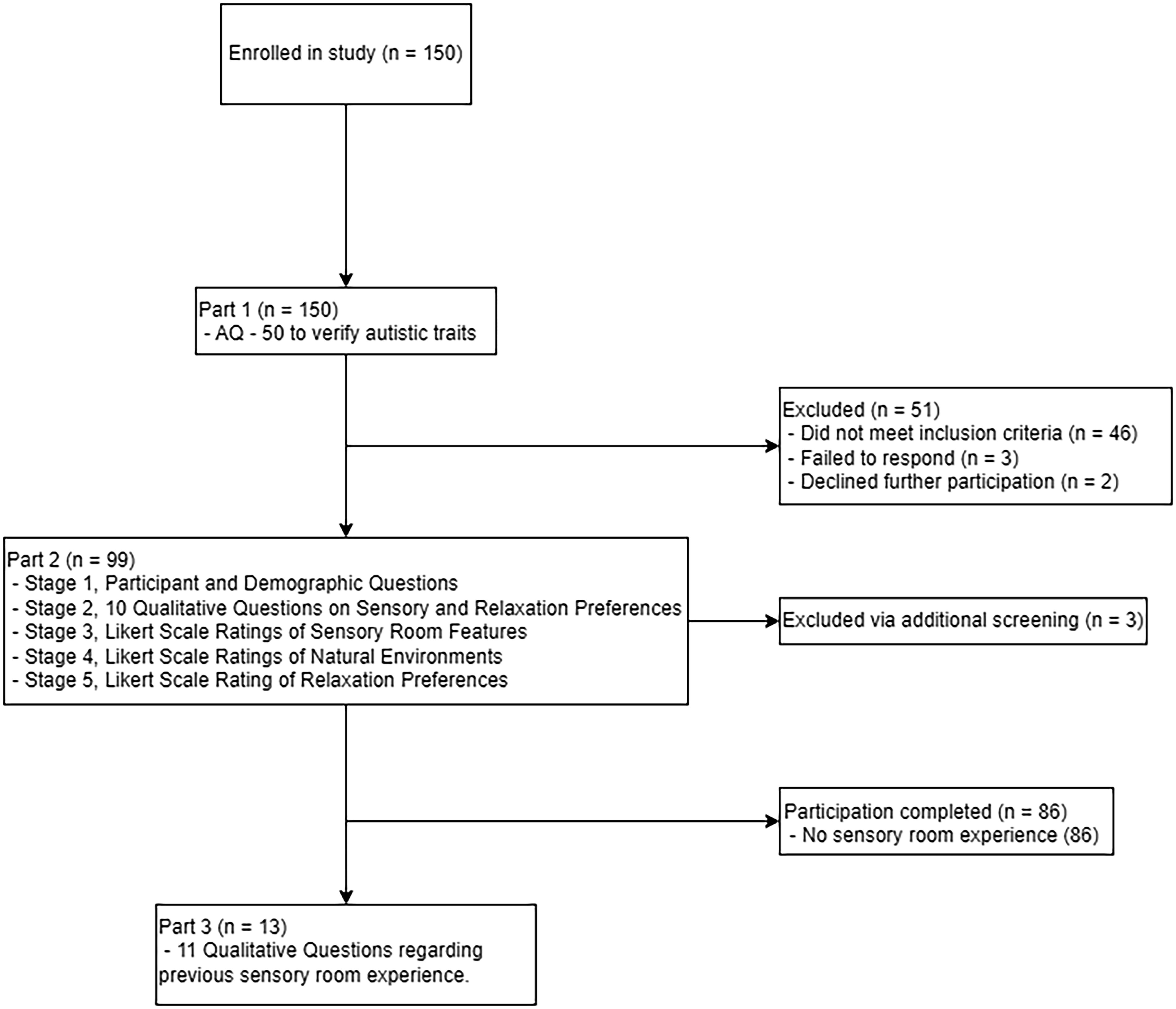
Flowchart showing participant study journey. A total of 150 participants were recruited for initial screening, 51 of these participants were excluded, leaving 99 participants to participate in Part Two of the study. Part Three of the study invited back 13 participants from Part Two who indicated previous sensory room experience.
Demographic Stats for Participants Across All Three Parts
ADHD, attention-deficit/hyperactivity disorder; ADD, attention-deficit disorder.
Measures
Part one
AQ-50. The Autism Spectrum Quotient (AQ-50) is a self-reported measure used to assess autistic traits in people older than 16 years. 32 The AQ-50 is considered a reliable and robust self-reported measure of autistic traits.33,34 Using a cutoff point of 26, the questionnaire has a high sensitivity score of 0.95 for screening autistic individuals, a specificity of 0.52, a positive predictive value of 0.84, a negative predictive value of 0.78, and good test–retest reliability in Australian adults after 6–12 months (r = 0.95).33,34 The AQ-50 was used to confirm autistic traits in the participants.
Part two
Survey on sensory and relaxation preferences
The survey was split into five different stages. Stage one involved asking the participants about their previous experience with sensory interventions and sensory rooms. These questions were presented in a closed format (yes/no). If the participants indicated they did have previous experience, they were asked an open question (“Can you please state which sensory-based therapies or interventions you have participated in, and if you found these useful?”). Subsequently, we obtained information regarding co-occurring conditions, including intellectual disability, attention deficit/hyperactivity disorder, depression, and anxiety, using multiple-choice questions.
Stage two included 10 open questions (Q1–Q10) (see Supplementary Data) about the participants’ sensory preferences, their preferred calming environments, and methods of relaxing. These questions were designed to capture as wide a range of answers as possible to obtain a comprehensive overview of the participants’ sensory and relaxation preferences. The questions were designed to cover both common sensory elements found in sensory rooms (such as lighting and tactile features) and restorative environmental features such as nature. Some questions were very general (“Generally speaking, what sensory experiences or activities make you feel calm or relaxed?”), whereas others focused on specific sensory modalities “(What visual features make you feel relaxed?” e.g., dim lights, lava lamps, bubble tubes, nature…). The combination of general and specific questions was chosen as the general questions are useful for obtaining a broader understanding of how sensory experiences can relax the individual and cover experiences that act upon multiple sensory inputs at once (such as time in nature), while the specific questions prompt the participant to reflect on specific modalities and provide a detailed, targeted response.
Stage three asked the participants to rate preselected sensory room features on a 5-point Likert scale. For example: “For each of the following features, please rate how important it is to you on a scale of 1–5, with 1 being ‘Not at all important’ and 5 being ‘Extremely important’.”. The purpose of this question is to obtain information relating to how the participants feel about typical features in sensory rooms. The features included the following:
Adjustable lighting levels Background music or white noise Sensory toys and objects Vibration or motion-based stimulation Projected visuals Access to nature or outdoor views
Stage four asked participants to rate how visually calming they found 10 different natural environments. These questions were unrelated to this study’s research questions and aimed to inform the design of a future VR application, and as such, the results will not be reported.
Stage five concluded the survey with a final 5-point Likert scale question regarding relaxation preferences. Participants were asked to rate nine different statements based on how much they agreed with them, from “I strongly disagree” to “I strongly agree.” Given the lack of conclusive evidence about what autistic adults prefer in calming or sensory spaces, we started with fundamental aspects (e.g., indoor/outdoor) while also incorporating elements common in current practices, such as using music or breathing exercises to help the individual relax.
I find it easy to relax inside. I find it easy to relax outside. I find it easy to relax in large open spaces. I find it easy to relax in small cozy spaces. I like to listen to music to calm down. I like to do breathing exercises to calm down. I like being active to calm down. I like visual reminders of calming techniques. I like auditory reminders of calming techniques.
Participants who indicated they had previous experiences with sensory rooms were additionally asked if they would be interested in participating in Part Three of the study.
Part three
Survey on personal sensory room experiences
The first question was a multiple-choice question to determine the frequency with which the participants used sensory rooms. The response options were daily, weekly, monthly, and rarely. The participants were then asked, “Where is the sensory room located?” as accessibility was of interest. Following this, nine questions were asked regarding their usage of the sensory room, and covered topics such as the type of equipment they use, how they feel before, after, and during usage, and the challenges they face while using the sensory room. For example, the participants were asked “Are there any specific pieces of equipment or activities that you particularly enjoy using in the sensory room?” The participants were also asked, “How effective is the sensory room in helping you manage your sensory needs?” The final question asked to the participants, “Is there anything else you would like to add about your experiences with sensory rooms?” This question was included in case the participants felt as though they had something to add that was not applicable to the previous questions.
An autistic adult was consulted regarding the design and layout of all questionnaires before opening them to the participants of this study. This input helped to reframe some phrases and ensured we adopted an appropriate tone and language in all our materials.
Procedure
The study was advertised on Prolific. 31 Interested participants were directed to the survey website Qualtrics, 35 where they first completed the consent form, followed by the AQ-50. Participants who scored 26 or above were invited for Part Two of the study.
Eligible participants were invited for the second part via Prolific and then directed to Qualtrics to complete the survey on sensory and relaxation preferences. Participants were invited to participate in Part Three if they had experience using sensory rooms.
Analysis
NVivo R1 (version 1.7.1) 36 was used to conduct a qualitative content analysis of the free-text. 37 While we initially aimed for a thematic analysis, our data and analytical approach align more closely with summative content analysis. 37
The lead author reviewed the participants’ responses multiple times to achieve familiarity of the data. The data were then coded. Initial codes were generated on a question-by-question basis, identifying key features, items, or concepts mentioned by participants. Through a hierarchical process, we categorized the codes into subcategories based on similarities and relationships, which we further grouped into overarching categories that represented broader concepts. For example, if participants expressed that dimmable lighting was important to them, each mention was coded and then identified as a subcategory, falling under the broader category of lighting. The generation of both the categories and subcategories was discussed between the researchers until a consensus was reached.
While we have provided counts of the aggregated cases, it is important to note that the formation of subcategories and categories was not determined solely by the quantitative counts. We have provided the frequency of categories and subcategories for insight and transparency into their occurrence across participant responses. As the sample size in this study can be considered large, we felt that “quantitizing” the qualitative data would be beneficial as terms such as “few” or “most” would not be concise enough to accurately convey how frequently particular features might be sought out in sensory rooms. Furthermore, providing the frequencies can facilitate pattern recognition across the categories.38,39 The numbers we present represent the aggregated cases, which refer to the number of participants who provided data that could be categorized into a particular category or subcategory.
The quantitative data were uploaded to JASP (Version 0.17.3). 40 A one-sample t-test was run for each of the quantitative question blocks where the participant’s Likert ratings were compared against the midpoint of the scale to determine whether there was a significant deviation from the neutral point (M = 3). This analysis was run for all the Likert ratings obtained from stages three and five of Part Two of the study. Cohen’s d was used as a measure of effect size; typically, an effect size of around 0.2 is considered small, 0.5 is medium, and 0.8 or greater is a large effect size.
Results
Results part one
Our screening process using the AQ-50 was successful in identifying a pool of participants demonstrating a high likelihood of autism. This process was crucial in ensuring the validity of our subsequent analysis, as it allowed us to focus on individuals with confirmed autistic traits. The proportion of participants meeting the cutoff criteria (104 out of 150) suggests that our recruitment strategy through Prolific was effective (see also Table 1 for an overview of participants across the different parts of the study).
Results part two
This section presents findings organized around our two primary research questions. The analysis primarily relies on qualitative data, with quantitative data included where available.
Research question 1: What are the preferred methods of relaxation for autistic adults?
Our analysis revealed four main areas of focus related to relaxation methods: (1) relaxation activities, (2) calming techniques in overwhelming situations, (3) effects of specific sensory modalities on relaxation, and (4) the effects of simultaneous sensory stimulation on relaxation.
Focus area 1.1: Relaxation activities
Qualitative findings
We identified five main categories related to relaxation activities (see Table 2). Dominating the responses was the category of media consumption, with 53 participants favoring passive forms and 46 preferring active forms. These numbers highlight a lack of unanimous preference for either active or passive media consumption. Within passive media consumption, the leading subcategory was listening to music, followed by watching TV. One participant shared, “It kind of depends on my mood. I almost always like to listen to music, but sometimes I enjoy just laying around and scrolling through my phone, watching YouTube videos, or watching informative TV shows.” Conversely, the leading subcategories for active media consumption were playing video games and reading. Following media consumption, the next prevalent main category was “Nature and Outdoor Activities,” with 39 participants expressing a preference for engaging in outdoor relaxation. One participant nicely illustrated this sentiment by stating, “sometimes I like to just spend some time outside when I want to relax.”
Categories and Subcategories Related to Research Question 1
Occasionally contrasting with the preference for outdoor activities, we identified the category of “Solitude and Downtime,” with 29 participants reporting that they value personal space and time away from stimuli, as captured succinctly by one participant’s preferred method to relax: “hide away from everyone and everything.”
Lastly, we identified “Creative or Hands-On Activities” as a mode of relaxation, although less commonly preferred, with 12 participants mentioning activities in this category. Examples included diverse creative outlets such as Woodworking and Drawing faces.
Quantitative findings
The results of the rating statements assessing relaxation activities appear to complement our qualitative findings. The statement related to media consumption, “I like to listen to music to calm down” was rated significantly higher than the neutral point of the scale [M = 4.07, SD = 1.09, t(95) = 9.66, p < 0.001, Cohen’s d = 0.99]. The mean ratings for the statements on being active [M = 2.81, SD =1.2, (t(95) = −1.53, p = 0.129, Cohen’s d = −0.16] and doing breathing exercises to calm down [M = 3.10, SD = 1.33, t(95) = 0.77, p = 0.443, Cohen’s d = 0.08, respectively] were not significantly different from the neutral point of the scale, suggesting that participants had varied individual preferences for these approaches rather than a strong overall group preference.
Focus area 1.2: Calming techniques in overwhelming situations
Qualitative findings
Regarding the techniques the participants reported using in response to an overwhelming situation, there appeared to be three main categories as follows: Escapism, sensory input control, and the use of internal coping mechanisms. “Escapism” was the most common category, with 31 out of 96 participants indicating that is how they would likely respond in an overwhelming situation. A participant illustrated this clearly by stating,” leaving the situation that has caused me to feel overwhelmed.”
However, leaving the situation may not always be possible for an individual, as they may need to cope with the demands of an environment such as a workplace. The categories we identified here suggest that an alternative strategy could be to assert control over sensory inputs. Twenty-five of the 96 participants reported that they often exert control over their auditory sensory stimuli, such as by using noise-canceling headphones, or listening to music or nature sounds. One participant conveyed this by saying “I drown the sounds of the world out, sometimes with music but more often with nature sounds such as jungle rainfall. Not bloody waves or whales!” In addition to controlling auditory stimuli, tactile and vestibular stimulation was also reported as means of controlling sensory input, primarily through the act of “stimming.”
While some participants required an external source of stimulation to provide comfort, others reported success by using internal coping mechanisms, such as breathing exercises, self-talk, or practicing mindfulness. Twenty-eight of the participants expressed a reliance on breathing exercises to cope with overwhelming situations. A participant described this by saying “I close my eyes and take a few deep breathes.” Similarly, 14 participants expressed a preference to engage in “Mindfulness or meditation.” One participant gave examples of visualization they practice: “try my very hardest to imagine a peaceful atmosphere, such as a beach type area, or my ‘happy place’ which has a hamster and lots of stuffed animals.”
Focus area 1.3: Effects of specific sensory modalities on relaxation
Qualitative findings
Several questions enquired about how different sensory stimuli can affect the participants’ ability to relax. In response to this, we identified two overarching categories, the participants often chose methods that either honed in on a specific sensory sensation, or they chose to experience stimulation from multiple inputs simultaneously. In relation to the category of using a specific sensory sensation to facilitate relaxation, we found several subcategories, these were as follows: Somatosensory stimulation, visual stimulation, and auditory stimulation. Each of the subcategories comprised further, more specific, subcategories.
Our analysis of the category of using somatosensory stimulation to facilitate relaxation reveals that the subcategories include the use of soft toys, blankets, or pillows (13), the use of temperature control (13), and through exercising (15). As one participant described “[I] like laying under heavy things, especially blankets or someone else when I am cuddling them.” While some participants preferred weight or touch, others gave an example of how they prefer to contrast different temperatures “I like to feel warm/different temperatures, so I like the electric blanket and the fan.” In contrast to these somewhat stationary methods of somatosensory stimulation, other participants preferred physical exercise (15), such as walking (12). One participant summarized their preference concisely by saying “I really enjoy long distance walking.” However, not all participants reported using somatosensory stimulation to facilitate relaxation, several participants opted to utilize visual stimulation instead.
Our analysis also revealed that the use of visual stimulation to aid relaxation was common in the participants’ responses. Seventy-two participants expressed that changes and control over lighting conditions can have a positive impact on their ability to relax. Upon further inspection, we found the category of “lighting” to have several subcategories. The most prominent subcategory was to use “dim” or “low lighting “conditions to create a relaxing ambience, this was reported among 56 of the participants, for example, a participant stated that they like to use “Interesting lamps, ones that are dim and cast interesting patterns and shadows. Have to be warm white, preferably 2700K or warmer.” On the contrary, some preferred lights with different tones and hues “I have Hue smart lights throughout my house and have them gently changing through colourscapes.” In contrast to the previous subcategory, 10 participants reported that a complete lack of light can foster feelings of relaxation, stating that they prefer darkness instead. A participant explained how this can help with their excerpt: “no light makes it easier to close my eyes and relax.” In addition to these subcategories, 13 participants also specified that the use of specific types of lamps such as “lava lamps” can be beneficial in relation to relaxation. The subcategories we identified in this section underscore the idea that, although there is some commonality in the visual features participants find contribute to relaxation, the optimal configuration and utilization of these features still rely on the individual’s specific needs and preferences.
In addition, our analysis revealed participants’ tendencies to use auditory stimuli for relaxation. “Music” was identified as the leading subcategory, and although 61 participants agreed that music is an auditory feature that can facilitate relaxation for them, different people spoke of preferences for different genres, including “melodious music from a wide range of genres-classical, jazz, folk, reggae etc.” or “Guided meditation music and metal.” In contrast to the melodic variance that is typically found within music, some participants reported a preference for the consistent droning sound of “white noise” (24), as simply described by a participant, “Sometimes though I just prefer white noise.” Conversely to the former, 14 of the participants articulated a preference for listening to people talking or reading: We identified “talking, commentary, or reading” as a subcategory of auditory stimulation, and this subcategory further comprised two smaller categories, “audio books” (6) and “podcasts” (6).
Focus area 1.4: Effects of simultaneous sensory stimulation on relaxation
Qualitative findings
Our analysis of the participants’ responses revealed that experiences that act upon multiple senses simultaneously can also facilitate relaxation, such as time spent in nature. Fifty-two participants expressed that views of nature can help them to relax and calm down, whereas 41 participants stated that sounds from nature are beneficial for promoting relaxation. We found that specific experiences of nature were categories as well, such as a desire for both being physically present in nature (17) and hearing nature sounds (17). Some participants conveyed how elements of nature can act upon multiple senses simultaneously, for example, one participant stated: “[I like] Visiting arboretums to see and smell the plants. Nurseries and greenhouses too, I enjoy the smell of the damp soil.” This sentiment toward nature was further expressed by other participants who made statements, such as “[I like]being near water, forest or hills (sound and smell of).” Although over 50% of the participants included a reference to using nature as a mediator of relaxation in their responses, as with previous categories, individual preferences and needs varied considerably across the responses. Some participants expressed a fondness for “long-distance walking,” whereas others reported a preference for “Sitting in the garden and reading.”
Research question 2: What is required for an effective calming space or sensory room for autistic adults?
Our analysis revealed four main areas of focus related to creating a relaxing environment: (1) key features for sensory rooms and calming spaces, (2) traditional sensory room features, (3) qualities of relaxing environments, and (4) suggestions for improving sensory rooms.
Focus area 2.1: Key features for sensory rooms and calming spaces
Adjustable lighting levels
In response to Q6 (see Table 3), “Lighting” was commented on by 60 of the participants. In the words of one participant, “Its essential i am able to adjust the brightness.” This finding was also supported by the categories we identified in response to Q7, with 32 of the participants specifying the need for adjustable lighting levels. Our qualitative findings suggest this is a highly relevant feature, with diverse uses. Some participants expressed a preference for, “Somewhere quiet and dark,” whereas others may benefit from additional visual stimulation and prefer an environment that is “completely lit with colour controllable led’s.”
Categories and Subcategories Related to Research Question 2
Our quantitative findings appear to align with the qualitative results as adjustable lighting levels were rated as the most important feature based on effect size [M = 4.27, SD = 0.91, t(95) = 13.66, p < 0.001, Cohen’s d = 1.39] (Supplementary Fig. S1).
Access to nature or outdoor views
A total of 29 participants expressed a desire to include elements of nature in their ideal calming space in response to Q6. We identified several subcategories, including the accompany of “animals or wildlife” (17), the inclusion of “trees or greenery” (13), or the possibility of using a “garden” (5). We found a similar category in response to Q7, where 16 participants stated they would seek a natural or outdoor environment in response to feeling overwhelmed.
The quantitative results echoed the prominence of nature-related categories in the qualitative responses, with participants rating “access to nature or outdoor views” as the second-most important common sensory room feature (based on effect size) [M = 3.93, SD = 1.25, t(95) = 7.27, p < 0.001, Cohen’s d = 0.74].
Background music or white noise
Participants’ written responses emphasized the importance of background music or white noise, with 58 participants expressing the need to have choices for auditory stimulation (“sound”) in response to Q6. A look into the subcategories that we developed from the data reveals that a variety of preferences exist, with some participants preferring “music” (23) and others potentially preferring “white noise” (9) or “nature sounds” (8).
The quantitative findings highlight the importance of providing individuals with a choice of auditory options, with “background music or white noise” being rated as the third-most important feature by effect size [M =3.60, SD = 1.128, t(95) = 5.25, p < 0.001, Cohen’s d = 0.54].
Entertainment
Our results suggest that the participants may prefer a range of “entertainment” options, as expressed by 26 participants. A range of preferences were identified within this category, some participants preferred analogue or puzzle games (9), whereas others preferred using technology to watch TV (7) or play video games (6). One participant described their ideal entertainment options as “a wall dedicated to my guitars and my computer near some windows.”
Furniture
Although “sensory swings” were identified as a subcategory of “furniture” in response to Q6, these were only mentioned by five participants. Further insights from the qualitative analysis suggest that the participants in our study either preferred, or were satisfied with using, common furniture items such as a bed or large couch. One participant described the furniture they would like as, “Something with a comfy seat big enough for me to put my feet up underneath me and curl up.” In contrast, another participant expressed a desire to use the furniture to help manage their sensory needs but by using it to facilitate sensory deprivation rather than vestibular stimulation: “I’d also have a sensory deprivation bed.” The qualitative findings suggest that for regulating somatosensory stimulation, participants may have preferred other methods, such as being submerged in water (7) or by using soft items (27). For example, one participant stated they would want “A big jacuzzi that i could lie down and fully submerge in.”
Focus area 2.2: Traditional sensory room features
The qualitative findings suggest that the participants may prefer more engaging forms of stimulation over traditional sensory room features. The quantitative ratings of common sensory features can provide evidence for this with participants rating “Sensory toys and objects” [M = 2.64, SD = 1.32, t(95) = −2.72, p = 0.008, Cohen’s d = −0.277], “Projected visuals” [M = 2.48, SD = 1.24, t(95) = −4.12, p < 0.001, Cohen’s d = −0.42], and “Vibration or motion-based stimulation” [M = 2.17, SD = 1.16, t(95) = −7.05, p = 0.001, Cohen’s d = −0.72] significantly lower than the neutral midpoint of the importance scale. The findings thus suggest that traditional sensory room features may not effectively cater to the preferences and needs of autistic adults.
Focus area 2.3: Qualities of relaxing environments
Qualitative findings
In response to being asked what kind of environment participants would seek out if they began to feel overwhelmed (Q7), we identified six main categories. The most prevalent category was to seek out somewhere “quiet or silent,” with this kind of environment being selected by 62 of the 96 participants. One participant described their ideal relaxing environment as, “A dark, quiet environment with nobody else around.” Similarly, “isolation and solitude” was also a strong category among the participants’ responses, with 48 of the participants identifying it as something they would seek out. This can be exemplified by the quote: I usually seek somewhere without anyone around.”
In addition, we found a category of using dim/controllable lighting or darkness when creating a relaxing environment. Participants often described relaxing spaces as, “Somewhere quiet and dark or somewhere I could be totally alone, with limited lighting.” This was expressed by 32 of the participants.
Although the question (Q7) was asked with the intention of gathering information on the qualities or physical attributes of the spaces the participant would seek when feeling overwhelmed, some interesting insights emerged from the category “bedroom.” Several participants expressed feelings of “safety” associated with their bedroom and would seek to use it as a buffer from whatever is making them feel overwhelmed. For example, one participant answered the question by saying “Usually my bedroom is my safe space,” similar preferences were expressed by 17 other participants.
While most of the categories identified in response to this section are congruent with one another, the remaining two contrast somewhat. Themes of both “nature/outdoor spaces” and “enclosed spaces” were identified in the participants’ responses to Q7. Sixteen participants expressed a desire to get outside and use nature to help them cope with feelings of being overwhelmed, whereas 13 participants expressed that they would seek out enclosed spaces, however, both categories were tied to the previous categories of “solitude” and “quiet or silent.” For example, a participant stated they would seek somewhere with “not many other people there, a place with nature and peace,” whereas under the category of enclosed spaces, another said they prefer “Dark and small spaces like a closet.”
Quantitative findings
The positive attitudes toward indoor spaces seen in the qualitative results are echoed in the quantitative findings, where participants rated the statement “I find it easy to relax inside” significantly higher than the neutral point [M = 3.37, SD = 1.05, t(95) = 3.41, p < 0.001, Cohen’s d = 0.35]. Furthermore, the quantitative results support the notion that both enclosed spaces and the outdoors can facilitate relaxation depending on the individual and their unique preferences. Participants rated the statements “I find it easy to relax in small cosy spaces” [M = 3.99, SD =0.90, t(95) = 10.77, p < 0.001, Cohen’s d = 1.099] and “I find it easy to relax outside” [M = 3.25, SD = 1.08, t(95) = 2.276, p = 0.025, Cohen’s d = 0.23] significantly higher than the neutral point, respectively. In addition, the statement “I find it easy to relax in large open spaces” was the only statement that did not differ significantly from the neutral point [M = 2.97, SD = 1.26, t(95) = −0.24, p = 0.809, Cohen’s d = −0.025], indicating that in general, participants did not strongly agree or disagree with this statement.
However, the statements, “I like visual reminders of calming techniques” (M = 2.73, SD = 1.16) and “I like auditory reminders of calming techniques” (M = 2.64, SD = 1.11) were both ranked significantly lower than the midpoint [t(95) = −2.30, p = 0.024, Cohen’s d = −0.23 and t(95) = −3.23, p = 0.002, Cohen’s d = −0.33, respectively]. This suggests that irrespective of whether participants find these techniques useful, they may not necessarily want explicit reminders of these techniques within these spaces.
The findings here further echo and emphasize that while common categories of relaxation can be identified, the way the items that comprise these categories are used can differ significantly from person to person, and occasionally can be seemingly at odds with one another due to differences that can exist within individual personal preferences and sensory experiences.
Focus area 2.4: Suggestions for improving sensory rooms
Suggestions for improving sensory rooms
The last open question the participants were asked was concerned with how sensory rooms and their equipment could be improved. The most prominent category in the participants’ responses was the call for customization and personalization of sensory rooms to cater to the unique needs of individuals using them, rather than adhering to a one-size-fits-all approach. This sentiment was communicated clearly by a participant who suggested: “Make(ing) them customisable for the individuals as everyone is so different, so being able to include things that are personal or specific to someone’s needs.” This opinion was voiced by 33 of the 96 participants.
Another recurring category in response to this question was participants expressing uncertainty or a lack of suggestions. However, it became evident that these responses were primarily rooted in a lack of experience with sensory rooms, rather than implying that the rooms were beyond improvement. A participant responded, “Not sure as I have never been in one but I would like to try.” Answers of this nature were found in 32 of the responses.
An additional trend in the data was the participants’ requests for specific pieces of equipment. This further underscores the argument for a person-centered approach, as it is evident that different individuals may benefit from various forms of sensory stimulation.
Lastly, participants articulated a desire for increased privacy and solitude within sensory rooms. For instance, when asked about how sensory rooms can be improved, a participant replied, “One at a time, too many build these and just think you can put a few people inside at once. I struggle with people.” A subcategory of solitude was identified, suggesting the need to create separate spaces for children and adults. As one participant stated, “Make it feel relevant to us autistic adults and not belittling with childlike decorations and décor.”
Results part three
Part Three of the study engaged a specific subset of participants from Part Two—those who reported direct experiences with sensory rooms. Despite this focused approach, the qualitative analysis of Part Three did not reveal additional insights beyond those already identified in Part Two. This lack of new information, despite the targeted participant selection, indicates the comprehensive nature of the categories captured during Part Two. As no additional insights were derived from Part Three, the categories and subcategories that arose from the thematic analysis are shown in the Supplementary Data (Supplementary Table S2), and not in the main article.
Discussion
This study explored the sensory and relaxation preferences of autistic adults. The findings suggest that while general categories of relaxation exist, autistic adults utilize a diverse range of methods to facilitate relaxation, which may be influenced by individual differences in sensory preferences and needs. Regarding the first research question, we identified several categories when the participants were asked about their preferred relaxation methods, including making use of active and passive media, spending time outdoors, being alone, or engaging in creative activities. However, there was a considerable amount of diversity among participants regarding how they chose to interact with the items that comprise each category. Participants reported that in response to feeling overwhelmed, they typically aim to escape the situation causing discomfort, enact control over their sensory inputs, or utilize a form of internal coping mechanisms, such as mindfulness. With regard to specific sensory modalities, visual stimulation, auditory stimulation, and somatosensory stimulation were the primary senses that were reported to aid relaxation, with lighting and music being especially popular. “Spending time in nature” was also highly referenced by the participants as a preferred method of relaxation.
The second research question was concerned with what is required to create an effective calming space or sensory room for autistic adults. Regarding this, we found that the participants generally found small and warm spaces to be relaxing. Participants also reported that spaces that are designed to be relaxing for autistic adults should aim to provide the user with a quiet and isolated environment, free from unwanted sounds and people. The space should ideally also provide the user with control over various aspects of the room, including lighting, and the option for outdoor views. The category of control over environmental aspects was also present when the participants were asked how sensory rooms could be improved, as was the category of having a stronger focus on meeting individual needs. Furthermore, the participants suggested that a broader range of equipment is required and that their privacy is respected when using the room. In addition, some participants expressed annoyance and dissatisfaction toward sensory rooms typically being geared toward children highlighting that traditional sensory room features may not be effective at catering to the preferences and needs of autistic adults.
The results of this study complement and align with existing literature. For instance, our findings suggest that autistic individuals use a diverse range of methods and activities to help regulate their mood and sensory experiences ranging from engaging in restorative experiences, such as time in nature, to utilizing man-made features such as customizable lighting. This aligns with the work of Ashburner et al., 41 who reported that autistic individuals use a range of strategies to manage their sensory experiences, including increasing control and meta-cognitive strategies such as self-talk. Interestingly, while Ashburner et al. 41 reported that autistic adults preferred expected, predictable, and controllable sensory inputs, our study found that participants frequently spoke about how nature facilitates relaxation, despite its often variable and less controllable characteristics compared with man-made environments. Examining recent research by Friedman et al42,43 reveals that autistic adults have reported that they felt as though they could find “respite in nature” and that “Nature doesn’t judge, but other people do,” additionally, nature can provide an “escape” to a nonjudgmental space. Taken together, these studies highlight the complex nature of sensory experiences, regulation, and relaxation while encouraging designers and creators of calming spaces for autistic individuals to consider how to incorporate natural elements in a predictable manner suited toward the individual users’ preferences.
Beyond the natural environment, our study also highlighted the importance of various entertainment options for autistic individuals’ relaxation and sensory regulation. Participants frequently mentioned engaging with different forms of media and creative activities as means of unwinding and managing sensory input. This aligns with studies that have reported that activities such as playing video games and/or consuming screen media in general to be a relaxing and an enjoyable experience for autistic individuals.44,45 In addition, the strong prevalence of “music” as a tool for relaxation in our study is congruent with research demonstrating that calming music accelerates stress recovery. 46 Interestingly, studies have reported that autistic individuals exhibit a heightened physiological reaction when listening to music compared with matched controls, including a reduction in biomarkers of stress, suggesting that it may be even more effective as a means of relaxation for this population.47,48
Regarding the findings on creating an effective calming environment, it may be insightful to compare them with literature that focuses on architecture, autism, and autistic people’s experiences with the built environment. A recent review that focused on the experiences of autistic people concerning the built environment reported that “lighting” was explored in 23 of 28 studies they reviewed. 49 The authors reported that sensitivity to lights was common, both in terms of intensity and brightness and it was not uncommon for lighting to impact mood and arousal. 49 This is congruent with the findings of our current study, as lighting was identified as a key element that can affect an individual’s ability to relax. In addition, a qualitative study that investigated the sensory experiences of autistic adults reported that emotions and mental states could be impacted by sensory stimuli, and that these stimuli can elicit uncomfortable physical responses. 16 The authors concluded that providing an autistic individual with control over their sensory experiences is of high importance, which is consistent with the categories identified in the current study. 16
Limitations
While our study offers important insights into the sensory and relaxation preferences of autistic adults, we acknowledge that it does not provide a complete understanding of autistic relaxation. The scope of our research was primarily focused on exploring these preferences in the context of sensory experiences and their potential implications for the design of restorative spaces. Another key factor to consider is that the sample in this study is unlikely to be representative of the full spectrum as not only did the participants require the ability to register themselves for Prolific and fill out the necessary details, but they also completed the study with no assistance from the researchers. Finally, future research should aim to include a more diverse population of autistic individuals, varying in autistic traits, language abilities, and age, as well as consider the role of gender differences, as this may contribute to more informed practices for a broader range of individuals.
Implications
The diversity of relaxation needs and sensory preferences found among autistic adults emphasizes the importance of taking an individualized approach when designing calming spaces for this demographic. This study reveals a wide range of methods autistic adults use to self-regulate, spanning customized environmental changes, sensory stimulation, nature, media engagement, and internal coping strategies. In addition, suggestions for improving existing spaces focus on increasing personalization and control to better meet individual sensory needs. Together, these findings indicate that a flexible, tailored approach is vital when creating spaces intended specifically for autistic adults to unwind in. Standard one-size-fits-all designs are unlikely to be effective across the spectrum. Developing calming spaces for autistic adults should emphasize multimodal sensory options, access to nature, avoiding sensory reminders, respecting solitude, and embedding user control of key features such as lighting and sound. Most critically, the spaces should be adaptable to accommodate personal preference and enable self-regulation. Future work could also further explore the use of virtual reality to achieve customizable and person-centered sensory rooms that are free from physical and space constraints. Recent research that has investigated the use of virtual reality sensory rooms has reported positive results, such as improvements in anxiety, depression, and sensory processing following their use, however, more research is required 50 Lastly, these findings could potentially be applicable to the design of calming spaces for autistic students in classroom settings, although this warrants further research.
Footnotes
Authorship Confirmation Statement
C.M.: Conceptualization, methodology, software, investigation, data curation, and writing—original draft. N.N.: Conceptualization, methodology, and writing—review and editing. A.H.: Conceptualization and writing—review and editing. T.L.: Conceptualization, methodology, data curation, and writing—review and editing. All authors have read and agreed to the published version of the article.
Author Disclosure Statement
The authors declare no conflicts of interest.
Funding Information
C.M. was supported by an Australian Government Research Training Program Scholarship. This research received no other funding.

References
Supplementary Material
Please find the following supplemental material available below.
For Open Access articles published under a Creative Commons License, all supplemental material carries the same license as the article it is associated with.
For non-Open Access articles published, all supplemental material carries a non-exclusive license, and permission requests for re-use of supplemental material or any part of supplemental material shall be sent directly to the copyright owner as specified in the copyright notice associated with the article.
