




Abstract
Background:
Previous research has shown that, when presented with brief samples of behavior, non-autistic university students judge autistic peers less favorably than non-autistic peers on measures of academic experience (e.g., motivation to study, academic success, average grades). The current research aimed to determine whether these judgments accurately reflect the academic experiences of the autistic students, or represent a bias of non-autistic perceivers. We also investigated whether autistic students are aware of how they are perceived by their peers.
Methods:
Nineteen autistic and 19 non-autistic students (stimulus participants) were video recorded while completing a questionnaire about their academic experience. They self-reported their level of academic success, motivation to study, happiness at university, and average grades. They also reported their meta-perceptions about the same measures. Recorded videos were presented to 30 new non-autistic students (perceivers), who were asked to judge each stimulus participants’ academic success, motivation to study, happiness at university, and grades.
Results:
Autistic stimulus participants were rated less positively than non-autistic stimulus participants on all measures except motivation to study. Comparison with participants’ self-reports showed that perceivers’ judgments had a strong negative bias for ratings of autistic stimulus participants, but this bias was also present for non-autistic stimulus participants on some measures. Comparison of perceiver perceptions with stimulus participants’ meta-perceptions showed that neither group of participants was aware how they were perceived, and the autistic group expected to be perceived in an overly positive way.
Conclusions:
We replicated previous research showing autistic people are perceived less favorably by non-autistic others in relation to their academic experience. As the perceptions were not accurate, we suggest this reflects a persistent bias in the perception of autistic people. Nevertheless, over time this bias could genuinely impact academic outcomes of autistic students, if it leads to exclusion from social and peer learning opportunities.
Community Brief
Why is this an important issue?
Recent evidence suggests that autistic university students’ academic outcomes are poorer than those of non-autistic students. Other research has shown that autistic students tend to be judged more negatively by their non-autistic peers based on brief samples of behavior, including in relation to their academic experience. Therefore, it is not clear whether these perceptions accurately reflect the reality of academic experience for autistic students, or whether they constitute a persistent bias.
What was the purpose of this study?
This study aimed to determine whether the less positive perceptions of autistic students’ academic experience are accurate, or whether they reflect a bias on the part of their non-autistic peers.
What did the researchers do?
The researchers video recorded autistic and non-autistic students while writing about their academic experience. The students reported various aspects of their experience, including their levels of academic success, motivation to study, happiness at university, and their average grades. They also reported how they thought their peers would rate them on the same measures. The video clips were then shown to a new group of non-autistic student participants, who were asked to judge them on the same measures.
What were the results of the study?
Autistic students were judged more negatively than non-autistic students for all judgment types, apart from motivation to study. Comparisons with the students’ own reports showed that judgments were not accurate: they substantially underestimated the academic experience of autistic students. This bias was also apparent for perceptions of non-autistic students for some measures. The autistic students expected to be perceived positively by others so apparently were unaware of the negative bias.
What do these findings add to what was already known?
The results suggest that the less positive perceptions do not accurately reflect the autistic individuals’ experience but instead represent a bias on the part of the perceivers. The finding highlights an important social barrier that might impact autistic student success at university insofar as these negative perceptions could lead to exclusion from opportunities to socialize and learn with peers.
What are potential weaknesses in the study?
Autistic and non-autistic participants in our study reported relatively positive experiences at university, including high average grades, which contrasts with previous research suggesting that autistic students may have poorer outcomes at university. This means that we do not know how the findings translate to autistic students who have poorer experience at university. Nevertheless, it is striking that even in our sample, for those who appear to be coping well at university, the less positive peer perceptions did persist.
How will these findings help autistic adults now or in the future?
These findings help raise awareness of the negative social judgments operating within university settings, revealing them to be rooted in bias rather than accurate. Further work is needed to identify ways of altering biased perceptions to promote inclusion in university settings.
Introduction
Humans rapidly form first impressions about one another and frequently use these judgments to guide their subsequent behavior. 1 In some instances, these initial impressions may be remarkably accurate. 2 For instance, participants accurately judged the personality characteristics of strangers depicted in video clips that were only of 5-second duration. 3 In addition, there are positive consequences to being and feeling like you are perceived accurately for personal and social well-being.4,5 These processes have been extensively studied within neurotypical groups, but a growing awareness of the importance of these processes for autistic people has recently been identified.6,7
An established body of research has demonstrated that non-autistic people show a clear propensity to view autistic individuals less favorably than non-autistic individuals on a wide range of social characteristics and personality dimensions, based on very short (1 to 7 seconds) samples of behavior.6–13 More specifically, a recent study highlighted that these negative perceptions extend to judgments about the academic experience of autistic students in higher education. 14 Short video clips of autistic and non-autistic students were rated for academic success, motivation to study, happiness at university, and average grades. Across all dimensions, non-autistic perceivers consistently judged the autistic academic experience more negatively than the non-autistic academic experience, despite having no knowledge of the diagnosis of the people depicted. This stark differentiation might have important consequences for autistic students in higher education.
Higher education is a domain where autistic students are presented with a range of new academic and nonacademic challenges.15,16 The transition to university is a time where autistic students can develop their independence, self-identity, and self-advocacy skills. 17 The university context also provides broader opportunities for autistic students to socialize with like-minded people who hold similar interests. 18 In addition, autistic strengths such as intense interest in the subject of study, persistence, and diligence are qualities that are esteemed within higher education that could help autistic students to thrive. 19 However, a systematic review of autistic student experiences at university reported that autistic students were more likely to experience stress, anxiety, social isolation, and loneliness than their neurotypical peers. 16 Indeed, building and maintaining social relationships were the most commonly reported challenges across many of the reviewed articles. 16
Social relationships are particularly important for success at university. Supportive relationships enable autistic students to thrive, but when stigmatizing attitudes characterize relationships, then greater difficulties emerge. 18 Unfortunately, autistic students are often stigmatized by their non-autistic peers20–22 and they report hiding their autistic traits, adopting neurotypical behaviors, and avoiding disclosure in order to avoid stigma. 23 Such camouflaging behaviors have been associated with poor mental health 24 and low self-esteem. 25 Academic outcomes tend to be poorer for autistic students compared with their non-autistic peers. For instance, autistic students are less likely to complete their studies, 26 and receive lower grades than their non-autistic peers.16,27,28 Given this context, it is unclear whether the negative perceptions of autistic university students are actually a true reflection of their academic experience, or whether these ratings reflect a persistent bias that could ultimately contribute to the difficulties that autistic students experience. Negative peer perceptions may impact the academic experience of autistic students via direct and indirect routes. Directly, negative peer perceptions may result in autistic students being discriminated and excluded from learning (class discussions, study groups, group assessments) and social opportunities (living arrangements, extracurricular activities). Indeed, previous qualitative work has documented how being a social outsider puts autistic students at a disadvantage to other students as they noticed other students would be “crowdsourcing their understanding” by taking it in turns to ask questions in class and discussing their understanding together. 29 Additionally, the “hidden curriculum” of unwritten social and cultural rules that students are expected to adhere to can pose a significant challenge to autistic students’ peer relationships. This can impact the success of group work and can have consequences for autistic student’s feelings of inadequacy. 30 Autistic university students frequently report challenges with group work, 31 and non-autistic students deemed it acceptable to exclude autistic students when grades were at stake.32,21 Research in high school has highlighted that peer relationships can have an important influence on motivation, academic performance, and school adjustment33–35 and arguably the influence of peers at university might be even greater, given that the majority of UK university students live away from home and among their peers.36,25 Thus, negative peer perceptions could invoke discrimination behaviors, which result in poor academic experiences for autistic students.
Negative peer perceptions could also have an indirect influence on the academic experiences of autistic students. If autistic students are aware of these negative perceptions, or believe that they are perceived negatively, this can impact their self-efficacy and self-esteem, 37 which, in turn, could lead to poorer academic experiences. Indeed, in neurotypical university students, high self-efficacy strongly correlates with improved academic performance 38 and intrinsic motivation, 39 although this relationship is yet to be identified in autistic students.
The extent to which autistic people are aware of the perceptions of others is an open question. Meta-perception refers to the ability to perceive what another person perceives about them 40 and is an important skill that enables individuals to shape their behavior to improve their reputation.41,30 Research has demonstrated that autistic children are aware of, 42 and will work to manage their reputation in the eyes of others.33,43,44,32 However, when considering meta-perceptions directly, evidence is mixed. Autistic adults correctly reported that they would be negatively perceived by their family members, 45 and autistic adolescents were actually more accurate than their typically developing peers when reporting how much they were liked by an unfamiliar peer following a social interaction.46,35 Thus, it seems that autistic individuals are adept at extrapolating accurate meta-perceptions from their social experiences. However, conflicting findings were reported when autistic adults were asked to provide hypothetical reports of how a stranger might rate their personality after a brief meeting. 12 Autistic participants believed they would be perceived more favorably than they actually were, and they had less accurate meta-perceptions when compared with the non-autistic group. 12 Therefore, it is not clear whether autistic people are aware of the pervasive negative biases that have been documented in research, or whether they hold protective, positive beliefs about how they will be perceived.47,36
This study seeks to replicate previous findings 14 that non-autistic peers perceive autistic university students more negatively than non-autistic students. To further unpack this finding and ascertain the potential ways that this might impact autistic university students, we also ask whether the negative perceptions of autistic students are accurate or biased, whether autistic students are aware of how they are perceived, and whether they believe they will be perceived without bias, or positively or negatively. To do this, we recorded short video clips of autistic and non-autistic stimuli participants while they completed an online questionnaire about their perceptions and meta-perceptions of their academic experience (success, motivation, happiness, and grades). These videos were then rated by a group of non-autistic perceivers on those same dimensions. Finally, we compared the self-perceptions, meta-perceptions, and perceiver judgments to identify sources of bias.
In line with previous work, 14 we hypothesized that non-autistic perceivers would rate the autistic stimuli participants less favorably than the non-autistic stimuli participants across all academic dimensions. With regard to accuracy, we hypothesized that the ratings would reflect a negative bias where perceiver perceptions were more negative than the autistic stimuli participants’ perceptions. 12 However, given the evidence that first impressions can sometimes be remarkably accurate, 3 we were open to the possibility that perceivers might genuinely be able to detect these dimensions accurately, at least in the non-autistic stimuli participants. Given the mixed evidence about meta-perceptions in autism, we did not have a directional prediction about whether stimuli participants would be aware of how they were perceived. However, it was important to understand this, as awareness of such biases might have negative consequences for autistic students’ self-esteem or self-efficacy. We also make no directional prediction about how autistic students believe they will be perceived, as there is some evidence to suggest that autistic individuals may hold a protective positive belief about how they will be perceived 47 but other evidence indicating that autistic individuals believe they will be perceived negatively 45 in some contexts.
Method
Author positionality
All three authors are non-autistic females. Two authors are employed as lecturers in psychology within higher education in the United Kingdom, while the lead author was a PhD student under the supervision of the other two authors at the time of completing this research. The research team collectively has significant experience in supporting autistic students who are studying at undergraduate or postgraduate levels. The last author runs an autism social network for students at their academic institution. These experiences will have had some impact on the direction of this research in that we hope to understand better reasons why some autistic students have difficulty at university.
This procedure was approved by the School of Psychology Ethics Committee at the University of Nottingham. The study comprised two phases, a stimuli generation phase and a perceiver judgment phase.
Stimuli generation phase
Stimuli participants
Thirty-eight university students (19 autistic and 19 non-autistic) were recruited via email and social media (including Facebook, Twitter, and LinkedIn), advertisements distributed at the University of Nottingham, and a local autism support group affiliated with the university. Additionally, individuals who had previously expressed interest or agreed to participate in a separate study were invited to participate in this research. A sensitivity analysis revealed that this sample size is powered to detect a moderate effect at 80% power (critical t = 2.10), using one-sample t-tests. Autistic and non-autistic participants were matched for age (Mautistic = 21.8 years, Mnon-autistic = 22.36), gender (autistic = 12 women, 5 men, 2 nonbinary, non-autistic = 12 women, 7 men) and level of study (16 undergraduate, 3 postgraduate). All participants were fluent in English and were enrolled on a taught course at a university in the United Kingdom. The autistic group verbally confirmed that they have an autism diagnosis, and they all scored above the autism threshold on the AQ-10 (Autism Spectrum Quotient-10; mean [M] = 8.36, standard deviation [SD] = 1.70). The non-autistic group verbally confirmed that they did not have a diagnosis of autism and all scored below threshold on the AQ-10 (M = 2.36, SD = 1.70). Participants attended a range of universities across the United Kingdom (n = 17). The autistic group included students from Psychology (n = 4), Physics (n = 3), English (n = 2), and Mathematics (n = 2), and one each from Chemistry, Digital Healthcare Science, Graphic Arts and Design, Hispanic, Linguistics and Social Anthropology, MEd Autism, Media, and Veterinary Medicine and Science. The non-autistic group exhibited similarly diverse academic disciplines: Microbiology and Psychology(n = 3 each), Biotechnology (n = 2), and one each from Business Management, Chemical Engineering, Chemistry, Computer Science, Fine Art and Contemporary Critical Studies, Food Sciences, Law with Spanish, Medicine, Politics and International Relations, Public Policy, and School of Medical Sciences.
Stimuli recording procedure
All stimuli were recorded via Microsoft Teams. Participants were instructed to read an online information sheet and sign a consent form. At this stage, participants consented to have the meeting recorded for quality and training purposes. Many autistic adults adopt camouflaging behavior to avoid negative impressions about them.48,49 Thus, this small deception was necessary to record their natural behavior and to avoid participants intentionally trying to present themselves in a different way. However, participants were informed about the true purpose of the video recordings at the end of the experiment (i.e., to show them to neurotypical participants in the perceiver phase). Once this information was shared with participants, they were given the option to delete the recordings and withdraw from the study. To ensure similarity across the video stimuli, participants were asked to position themselves so that their faces and upper bodies were fully visible on the screen.
After the participant consented to take part, the researcher started the video recording and sent a link to an online questionnaire, which included the AQ-10 50 and a self- and meta-perception questionnaire. This questionnaire asked participants to report their perceived levels of success, motivation, and happiness at university on a scale of 1–6, as well as their average academic grade on a numeric scale (0–100). They were also asked how they thought others would perceive them on the same measures (meta-perceptions). Afterward, the researcher sent a link to a debrief video explaining the purpose of the study and why the video recordings were taken. Participants were then asked to give further consent for the use of their videos, once they were fully informed. The whole procedure took ∼30 minutes, and participants were compensated with a £5 Amazon voucher for their time.
Camtasia and Windows Live Movie Maker software were used to edit the recorded videos into a 7-second clip of each participant while they were completing the online questionnaire. Clips were taken from 10 seconds after the participant started writing. They depicted the head and shoulders of the participant displaying natural behavior but with very little movement or expressivity. Videos of two targets were excluded because their faces were not fully visible on the screen during the procedure.
Perceiver phase
Perceiver participants
Thirty non-autistic participants (5 males, 25 females) aged between 18 and 33 (M = 22.84 years, SD = 5.30) took part. A sensitivity analysis revealed that this sample size is powered to detect a medium effect at 80% power (critical t = 2.05), using within-subjects t-tests. Participants were recruited through advertisements distributed at the University of Nottingham. Included participants were studying a taught program at university (6 postgraduates, 24 undergraduates) and included students from Psychology (n = 23), Industrial Engineering (n = 2), and one each from Clinical Nutrition, Law, Natural Sciences, Physiology and Pharmacology, and Public Health. All participants verbally confirmed that they did not have or suspect they have a diagnosis of autism. An additional 2 participants were tested but excluded because they were in their first year of study (and could not provide an estimated grade) and research students. Participants provided written consent to participate.
Design
The study used a within-subjects design, in which the independent variable was the diagnosis of the stimuli participant (autistic, non-autistic) and the dependent variables were the stimuli participants’ self- and meta-perceptions and the corresponding perceiver participants’ judgments about the academic experience of stimuli participants (success, motivation, happens, and grades).
Procedure
Each participant was tested individually in-person in a quiet laboratory on a 15-inch MacBook Air. Participants were told that they would watch video clips of students writing about their academic experiences and answer some questions about them. They were naive to the diagnostic status of the stimuli participants, and the fact that this was a study about perceptions of autism. Participants rated each of the 34 video clips 4 times and were asked to rate a single academic dimension each time (success, motivation, happiness, grades). Thus, a total of 152 trials were presented in random order using PsychoPy3.
On each trial, participants were provided with the academic dimension they would need to rate, followed by a 7-second silent video clip of a single stimuli participant. After the video disappeared, the response options were presented on the screen. Participants responded by clicking on the most appropriate answer. Participants were asked to rate how much they agreed with one of the following statements (order randomized): This person is successful in their academic life; This person is motivated to study; This person is happy at university; What average mark do you think this person has last semester? The first three statements were answered on a 6-point scale from Strongly Disagree to Strongly Agree. The grades question allowed participants to input a number between 0 and 100. Trials were divided into four equal blocks, with the opportunity to have a break between each. The entire procedure took a maximum of 45 minutes, and each participant was compensated with a £5 Amazon voucher for their time.
Data scoring and analysis
Self-reports, meta-perceptions, and perceiver judgments were scored identically. Judgments of academic success, motivation, and happiness were numerically coded from 1 to 6, with higher scores indicating positive judgments. We also applied a numerical scale to grade judgments that ranged from 1 to 8, with a higher score indicating higher performance. These numerical codes corresponded with the grade boundaries applied in UK university settings (i.e., 70+, 69–67, 66–64, 63–60, 59–57, 56–54, 53–50, and 49 and below) and provided a simple way to equate performance across different courses and universities.
We performed initial analyses to check whether there were differences in self-reports or meta-perceptions between autistic and non-autistic stimuli participants. Independent-samples t-tests compared the ratings of success, motivation, happiness, and grades between groups.
To replicate previous findings 14 and establish that autistic students were viewed less favorably with this new stimulus set, the researchers conducted a perceiver-level analysis. Specifically, we calculated the mean ratings of autistic and non-autistic stimuli for each perceiver, and compared them using paired-samples t-tests. We performed this analysis for each academic attribute (success, motivation, happiness, and grades).
The remainder of our research questions were addressed using a stimuli-level analysis. Specifically, we calculated the mean perceiver judgment for each stimuli participant and compared these with the self- and meta-perceptions provided by those participants. To examine whether perceiver perceptions were accurate, we calculated a difference score by subtracting stimuli participants’ self-reports from mean perceiver judgments. To examine whether stimuli participants were aware of how they are perceived, we calculated a difference score by subtracting stimuli participants’ meta-perceptions from mean perceiver judgments. Finally, to examine whether stimuli participants believe they will be perceived negatively, regardless of how they are actually perceived, we subtracted the stimuli participants’ self-reports from their meta-perceptions. Thus, these comparisons yielded the following three indices, Accuracy, Awareness, and Belief, which were calculated for each academic attribute and each diagnostic group. These indices could range from −5 to +5, with negative scores indicating a negative bias, and 0 indicating no bias (alignment between the two ratings). We removed outliers from these indices if data points fell outside median ±1.5* interquartile range (see Supplementary Data S1). These indices were analyzed using one-sample t-tests and Bayesian one-sample t-tests.
Results
Stimuli participant reports
Autistic and non-autistic stimuli participants self-reported equivalent success, motivation, happiness, and grades at university. There were also no group differences in their meta-perceptions of these attributes (see Supplementary Table S1).
Perceiver-level analysis
Numerically, perceivers judged autistic stimuli participants more negatively than non-autistic stimuli participants on all measured dimensions, and this difference was statistically significant in 3 out of 4 measures (see Fig. 1). Specifically, this negative bias was robustly observed for judgments of academic success [t(29) = 3.30, p = 0.003, d = 0.60, BF10 = 14.51] and grades [t(29) = 4.29, p < 0.001, d = 0.66, BF10 = 153.21]. Autistic stimuli participants were also judged to be less happy at university [t(29) = 2.285, p = 0.030, d = 0.417, BF10 = 1.82], although the Bayesian evidence for this effect was anecdotal. There was no difference in the perceptions of motivation of non-autistic and autistic stimuli participants [t(29) = 1.01, p = 0.321, BF10 = 0.31].
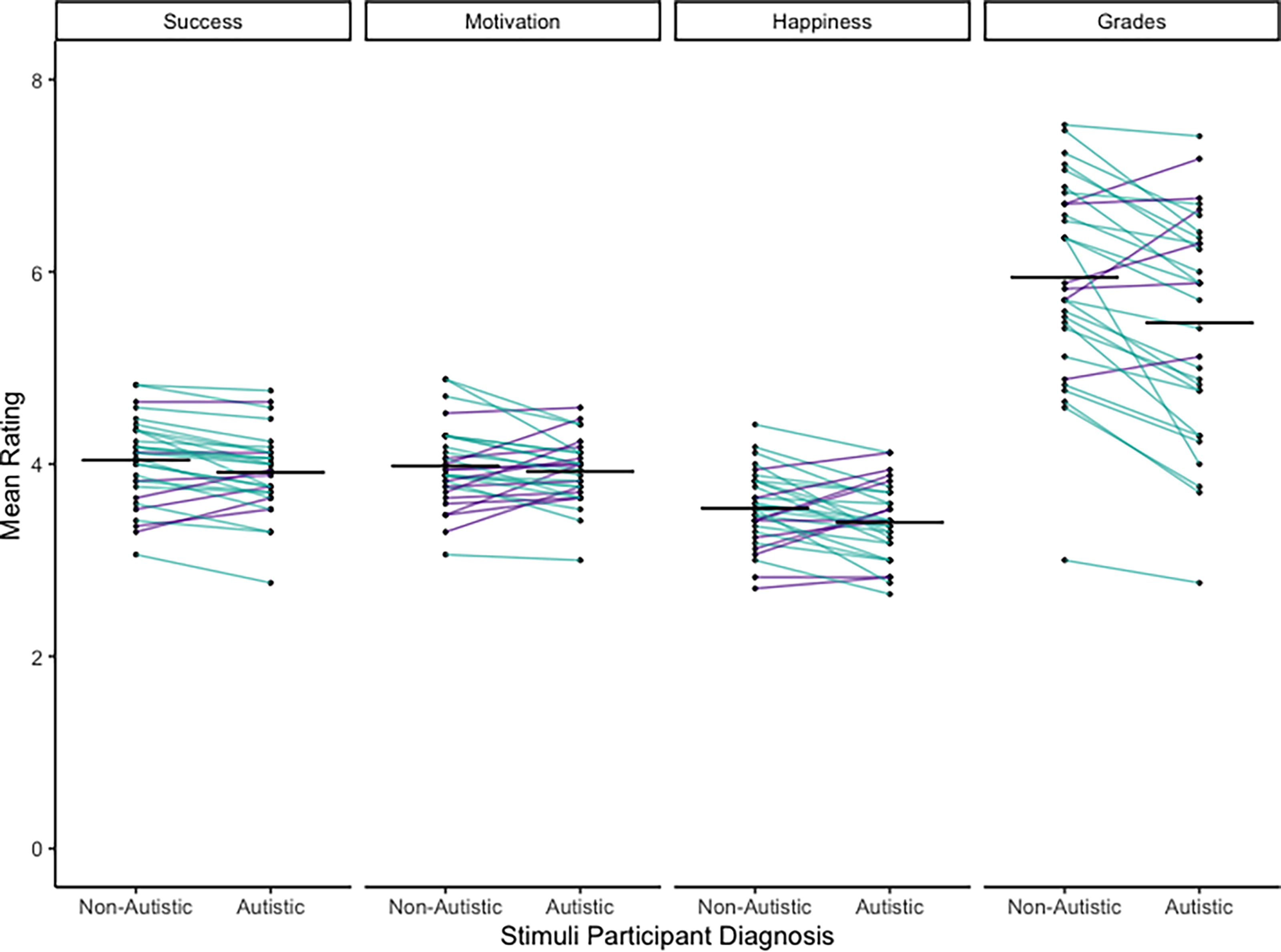
Mean perceiver judgments of academic success, motivation, happiness, and grades at university as a function of stimuli participant diagnosis. Individual perceiver data are represented by black points and colored lines. Colors differentiate the slopes (green = non-autistic > autistic, purple = autistic > non-autistic). Black horizontal bars indicate group means.
Accuracy of perceivers’ judgments
There was a general tendency for perceiver participants to rate stimuli participants more negatively than the stimuli participants rated themselves, although there were some instances of perceiver accuracy (see Table 1, Fig. 2A, and Supplementary Fig. S1). Specifically, there was strong evidence that non-autistic stimuli participants were underestimated on the dimensions of Success and Grades and moderate evidence that they were accurately perceived on the dimensions of Motivation and Happiness (see Table 1 for statistics). Similarly, there was strong evidence that autistic stimuli participants were underestimated on the dimensions of Success, Happiness, and Grades and weak evidence that they were perceived accurately on the Motivation dimension.
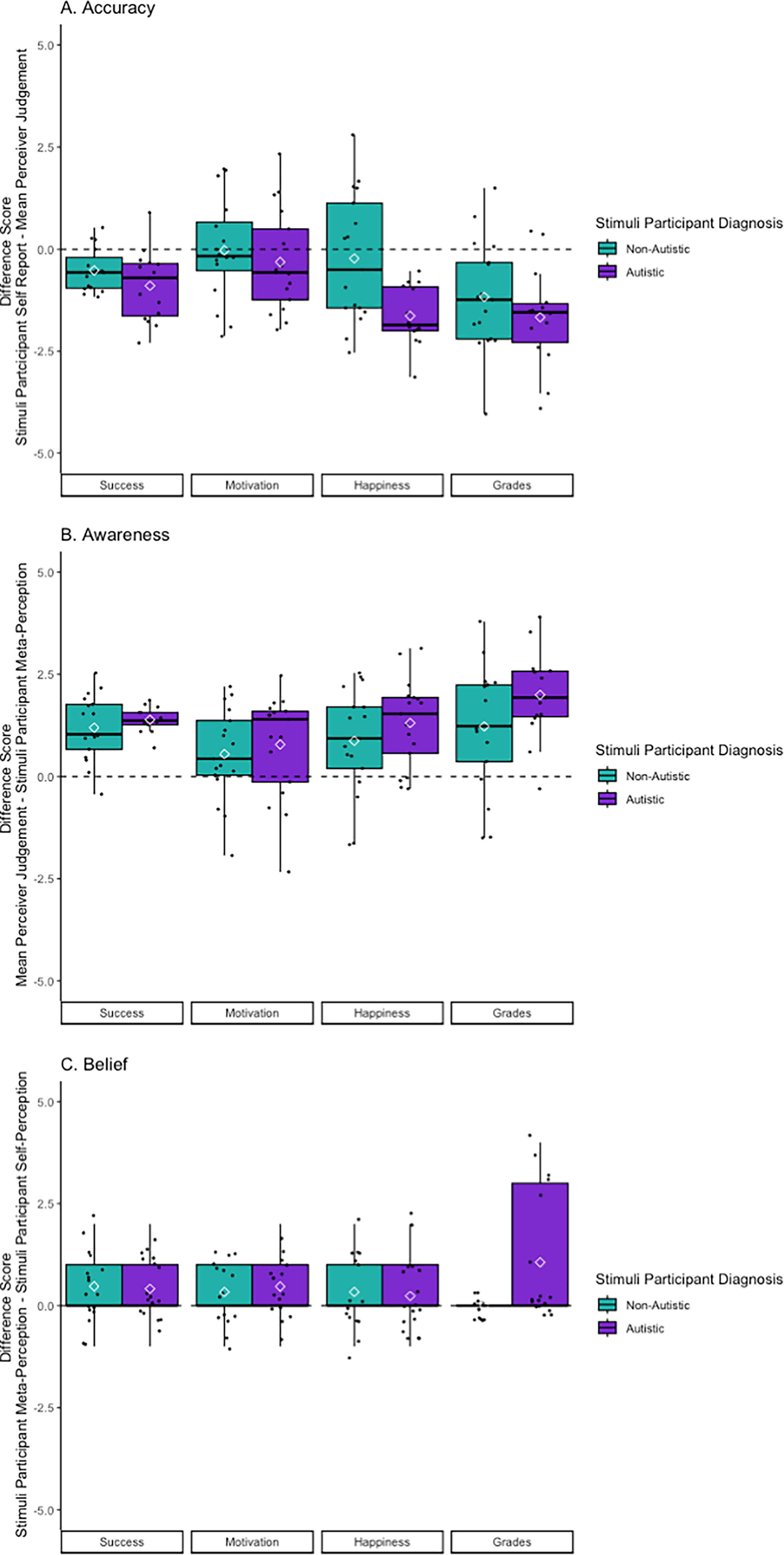
Boxplots showing the Accuracy (panel
Statistics from One-Sample and Bayesian One-Sample t-Tests
Bold p-values indicate where mean Accuracy, Awareness, or Belief scores differ from 0, and bold BF01 values indicate where there was moderate evidence of no bias.
After outlier removal, all values were 0.
Awareness of others’ perceptions
Generally, stimuli participants were unaware of how they would be perceived and provided more positive meta-perceptions compared with the perceiver judgments (see Table 1, Fig. 2B, and Supplementary Fig. S2). Specifically, non-autistic stimuli participants thought they would be perceived more positively than they actually were on all dimensions, with strong evidence for this bias in Success and Grades, moderate evidence for Happiness, and weak evidence of this bias for Motivation. Similarly, autistic stimuli participants also held this positive bias, with strong evidence of positive bias for Success, Happiness, and Grades and moderate evidence for Motivation.
Belief about others’ perceptions
Both groups of stimuli participants had a slight tendency to report more positive meta-perceptions compared with self-perceptions, indicating that they believed they would be perceived positively or accurately (Table 1, Fig. 2C, and Supplementary Fig. S3). However, in most cases, this evidence was weak. Specifically, there was weak evidence that non-autistic stimuli participants believed their Success would be perceived positively and weak evidence that they believed their Motivation and Happiness would be perceived without bias. In contrast, there was strong evidence that autistic stimuli participants believed their Grades would be perceived positively and weak evidence that they believed they would be perceived as more Successful and more Motivated. On the contrary, there was weak evidence that they believed their Happiness would be perceived without bias.
Discussion
Previous research has established that when perceivers make judgments based on brief “thin slices” of behavior, autistic people tend to be perceived less favorably than non-autistic people on a range of social favorability traits.6–8 These less positive impressions also apparently extend to perceptions of academic experience in higher education, 14 with non-autistic students rating their autistic peers as being less successful, less motivated, less happy at university, and even having lower grades in their studies, after viewing brief samples of their behavior. In the current research, we aimed to determine whether these negative perceptions are accurate, or whether they reflect a bias in the judgments of non-autistic peers. Furthermore, we aimed to understand how autistic and non-autistic students believe that their academic experiences are perceived by others and whether they are aware of how they are perceived by their peers.
Largely replicating previous research, 14 we found that non-autistic participants judged autistic stimuli participants less favorably on three of the four dimensions that were assessed. Specifically non-autistic individuals were judged to be more academically successful, happier at university, and having higher average grades. The exception to the pattern was that autistic stimuli participants were not perceived as less motivated in their studies than their non-autistic peers. While we are not aware of any other research that has specifically investigated perceptions of motivation, previous research has shown that autistic people may not be perceived less favorably on all traits. 6
Having established that autistic students were perceived less favorably than non-autistic students, we then aimed to determine whether participants’ judgments were accurate by comparing the perceiver judgments with the stimuli participants’ own self-reports about their academic success, motivation, happiness at university, and their average grade. Overall, the analysis presented a picture where perceivers tended to be negatively biased in their judgments, giving lower ratings on the majority of measures than participants’ self-reports. For autistic stimuli participants, this negative bias was evident across the three questions on which they were judged more negatively than their peers (academic success, happiness at university, and average grades), but was not apparent for judgments about motivation. The non-autistic stimuli participants were also subject to this bias for judgments about academic success and average grades, but their motivation and happiness at university were judged accurately.
Thus, it seems that non-autistic students have a relatively good sense of how motivated their peers are but tend to systematically underestimate their peers’ academic outcomes (academic success and grades) in comparison with their peers’ own self-reports. As these effects were present for both autistic and non-autistic stimuli participants, they cannot be construed as a specific bias against autistic peers but reflect a more general answering tendency. When asked to make these judgments, it is likely that participants anchor their judgments to what they assume would be an average score for the population on these dimensions, which might be close to the numerical average. The stimuli participants from both groups’ average self-reports in relation to academic success and grades were toward the higher end of the scale. Therefore, the underestimation may reflect an expectation about numerically average performance as opposed to an expectation of poor performance.
The only dimension on which there was a discrepancy in the accuracy of judgments about autistic and non-autistic peers was in relation to judgments about happiness at university, with bias only being evident in judgments about autistic stimuli participants. Specifically, perceivers judged the happiness of their non-autistic peers accurately but underestimated the happiness of their autistic peers. It is not clear why this bias was shown particularly in relation to the happiness question, but one possible explanation is that non-autistic participants may produce behavioral signals that indicate their level of happiness at university, while autistic participants do not. There is considerable evidence that non-autistic people find the emotional expressions of autistic people more difficult to interpret than the emotional expressions of non-autistic people,51,52 and this could have impacted accuracy of judgments for the happiness question in particular.
Comparison of the perceiver judgments and stimulus participants’ meta-perceptions (how they believed others would rate them) allowed us to address the question whether stimuli participants were aware of how they are perceived by others. The results provided a clear picture by which stimuli participants from both groups were unaware of how they were perceived by others. Stimuli participants expected to be perceived more positively by others than they actually were on all four dimensions that they were asked about. Thus, there was no evidence to suggest that the autistic students expected to be perceived negatively by others. This finding is in line with previous research which found that both autistic and non-autistic people expected to be perceived more positively by others than they actually were on a range of social favorability traits. 12 This self-enhancement bias is well established in relation to meta-perception, 53 and we demonstrate that it does extend to the academic context.
Examination of the third metric, which reflected stimuli participants’ beliefs about how they would be perceived (comparing stimuli participants’ self-reports and their meta-perceptions), demonstrated that the autistic participants expected perceivers to show a positivity bias. In other words, autistic participants believed that other people would rate them more positively than they self-reported for academic success, motivation, and average grades, while they expected judgments about their happiness at university to be accurate. In contrast, the non-autistic participants largely expected perceiver judgments to be accurate, that is, in line with their self-reports, although there was some sign of a positivity bias for judgments in relation to academic success.
It is not clear why autistic participants, in particular, believed that others would perceive them more positively than they perceive themselves. Notably, this finding contrasts with previous studies showing that both people with low self-esteem 54 and narcissists 55 tend to believe that others will perceive them less positively than they self-report (i.e., their meta-perceptions are lower than their self-perceptions). One possibility is that this finding relates to a kind of “imposter syndrome” where autistic students feel that they are wrongly perceived to be more able and successful than they really are. This positive expectation might reflect a protective mechanism that prevents autistic students from feeling discouraged. 47 However, further research is needed to understand why autistic people thought that others would perceive them in an overly positive way.
Implications
There is growing evidence that autistic students experience a range of negative outcomes at university. For example, they receive lower grades than their non-autistic peers, 27 are often stigmatized by their non-autistic peers, 20 and are less likely to complete their studies.26,15 Autistic students also report that their social relationships at university are crucial for their success 18 but that this is a persistently reported challenge. 16 A key aim of the current research was to shed light on whether negative perceptions of autistic university students accurately reflect their academic experience, or whether they represent a bias that could ultimately contribute to the difficulties that autistic students experience. The results mainly support the latter interpretation given that (1) the two groups did not actually differ in their self-reported academic success, motivation to study, happiness at university, or average grades; and (2) the research emphatically demonstrated that the perceptions of autistic stimulus participants were not accurate for all dimensions apart from motivation to study. This suggests that it is unlikely that perceivers are picking up on genuine differences in academic experience for the two groups and are instead making their judgments based on other considerations.
The tendency for autistic students to be perceived more negatively could nevertheless have unfavorable consequences for the academic experience of autistic students over time. At the start of this article, we outlined two potential routes via which negative perceptions of peers might influence academic outcomes for autistic people. First, influence could occur via a direct route through which non-autistic students may be less willing to collaborate, study, or even socialize with their autistic peers. This could lead to autistic students missing out on learning opportunities and other valuable experiences in higher education due to lack of inclusion. A second indirect route by which negative perceptions might impact outcomes proposes that if autistic students are aware of being perceived less favorably, this could impact their academic self-efficacy, their self-esteem, and ultimately their mental health. 56 This could, in turn, impact their entire academic experience, even their grades. 57 As the current research suggests that the autistic stimulus participants were not aware of how they were perceived and even anticipated a positivity bias in others’ judgments, we conclude that it is very unlikely that negative perceptions impact academic outcomes via the indirect route. Therefore, if peer perceptions have any impact on autistic students’ academic outcomes, it is more likely that this is via the direct route outlined above.
This work narrows down the potential mechanisms through which peer perceptions may impact student outcomes, but it is important to note that it does not provide causal evidence for any such impact. As the nature and extent of any impact of negative peer perceptions on outcomes for autistic students at university are still to be established, it would be premature to make significant recommendations for changes to practice until these impacts are better known. Nevertheless, educators should be aware that these less positive impressions exist in academic contexts, particularly when managing peer learning or group activities involving autistic students.
Limitations
A limitation of this study is that both groups of stimuli participants reported fairly positive experiences of university, including, on average, relatively high grades. We did not find differences between the autistic and non-autistic stimuli participants on any of the self-report measures, which contrasts with prior research suggesting less favorable outcomes for autistic students at university.27,31 It is possible that we have sampled a subgroup of autistic students who were coping relatively well at university, and indeed it would not be surprising if such a group was more likely to have the capacity to volunteer to participate in research. It is striking that even so, the autistic participants were perceived to be having less positive academic experiences than their peers. However, a priority for future research would be to examine the perceptions of autistic students who self-report having less positive academic experiences.
Another limitation is that the study relies on self-reports as the “ground truth” against which the accuracy of perceiver judgments is calculated. While stimuli participants arguably are the best authority to judge how happy or motivated they are at university (and to some extent, how successful, as success may mean different things to different people), their average grades are a matter of objective truth. Potentially, future research could use alternative methods to ensure the accuracy of participants’ actual grades, such as asking participants to upload a transcript or by obtaining direct access to student records. However, there are drawbacks to such an approach. Participants may be deterred from participating if required to supply a written transcript, and it would be very logistically difficult to access student records for students from multiple different universities.
A further limitation is the nature of the perceiver group, a large proportion of whom were psychology students. We might expect that psychology students will have greater knowledge about and perhaps less stigma toward autism than students in general, 58 and there is some evidence that the positivity of first impressions of autistic people correlates with autism knowledge and stigma.11,13 This means it is possible that we have underestimated the level of negative bias that is present in the student population as a whole. We also did not collect judgments from autistic peers. Our study focused on judgments of non-autistic students as they are usually in the majority at university and so their judgments are more likely to have an impact on academic experience. Nevertheless, future research could determine whether negative biases are attenuated in autistic peers, 59 which could help provide an evidence base for autistic support communities at university. 60
To conclude, we replicated previous research showing that non-autistic students tend to judge their autistic peers’ academic experience more negatively. Comparison with the autistic students’ self-reports about their experience showed that these judgments were not accurate (apart from judgments about motivation to study). The autistic participants’ meta-perceptions suggested that they were not aware about how they were perceived and in fact expected to be perceived positively by their peers. Negative peer perceptions could impact autistic students’ academic outcomes if they lead to exclusion from opportunities to learn from and with others.
Footnotes
Authorship Confirmation Statement
A.A.: Methodology, investigation, and formal analysis. E.S.: Conceptualization, writing—original draft, review and editing, and supervision. L.M.: Conceptualization, formal analysis, writing—original draft, review and editing, and supervision.
Author Disclosure Statement
The authors declare no conflict of interest with respect to this research, authorship, and/or the publication of this article.
Funding Information
Afaf Alhusayni received PhD funding by the Government of the Kingdom of Saudi Arabia to complete this work.

References
Supplementary Material
Please find the following supplemental material available below.
For Open Access articles published under a Creative Commons License, all supplemental material carries the same license as the article it is associated with.
For non-Open Access articles published, all supplemental material carries a non-exclusive license, and permission requests for re-use of supplemental material or any part of supplemental material shall be sent directly to the copyright owner as specified in the copyright notice associated with the article.
