




Abstract
Background:
There is substantial literature on neurotypical mothers’ parenting practices and beliefs. Researchers find that certain parenting practices, such as use of infant-directed speech (IDS or “motherese”) and shared book reading, promote children’s language development. However, little is known about parenting practices among autistic mothers. In this study, we examine autistic mothers’ communicative interactions and parenting practices with their infants and young children using both quantitative and qualitative approaches.
Methods:
Thirty-three mothers who self-identified as having autism participated in the study and completed a survey. Ten of these mothers helped to develop the survey. To further understand the mothers’ responses, we conducted one-on-one interviews with a subsample of our participants.
Results:
Only 44% of the autistic mothers indicated using IDS with their children—a rate that is lower than what has been reported in samples of neurotypical mothers. On the contrary, over half of mothers (58%) read to their children 10 or more times a week, and all read at least 3–4 times. Furthermore, most mothers were confident in their ability to engage in literacy activities with their children.
Conclusion:
Our findings show that autistic mothers interact with their children in similar and different ways than neurotypical mothers. The results enhance our understanding of various parenting behaviors among autistic mothers and challenge the prevailing notion that IDS is universal. Research that uncovers autistic parents’ parenting behaviors and views will help us support autistic mothers’ parenting styles and their children’s learning and development.
Community Brief
Why is this an important issue?
There is substantial research on neurotypical parenting practices that support children’s early language development. For example, research shows that using infant-directed speech (IDS), or acoustically exaggerated, clear, and higher-pitched speech (also known as “motherese”), with infants promotes language learning, as does reading books frequently with young children. Research about autism tends to focus on autistic children. There is a large gap in the research when it comes to addressing the needs of autistic mothers. It is important to uncover the parenting practices, challenges, and strengths of autistic mothers so that we can identify strategies to better support their parenting styles while promoting their children’s development.
What was the purpose of this study?
The purpose of the current study was to survey autistic mothers about their communicative interactions and parenting practices with their infants and young children. Our goal was to better understand their strengths and challenges related to parenting and their role in promoting their children’s language development.
What did the researchers do?
We collaborated with a small group of autistic mothers to develop a questionnaire about parenting practices related to children’s language development. We administered the questionnaire to 33 mothers who identify as autistic. Some of the mothers (n = 17) chose to complete the survey as an interview rather than doing it online. For these mothers, we asked follow-up questions as to “why” they chose certain responses. Those responses were analyzed qualitatively.
What were the results of the study?
Fewer than half of the autistic mothers used motherese with their children when they were infants—a rate that is lower than neurotypical mothers. The mothers provided reasons for not using motherese that indicated they consciously chose not to use it, or it did not feel natural to do so. On the contrary, over half of the autistic mothers read to their children 10 or more times a week, and all read at least 3–4 times. Most mothers found shared book reading enjoyable and were confident in their ability to read with their children.
How do these findings add to what was already known?
Our findings add to our understanding of parenting behaviors among autistic mothers, for example, challenging the prevailing notion that motherese is universal.
What are potential weaknesses in the study?
We relied on the mothers’ reports of their activities with their children rather than observations, and we recruited a relatively small sample of only mothers and not fathers. We encourage future work with larger samples and broader methods.
How will these findings help autistic adults now or in the future?
The natural parenting approaches of autistic mothers are important to understand, as it may be more relevant for autistic children than the practices of neurotypical mothers. Autistic mothers’ lived experiences can make them particularly useful sources of information about how to successfully engage with autistic children. Through engaging autistic parents to understand their parenting practices and challenges, we can better identify ways to support autistic parents’ parenting styles and their children’s learning and development.
Background
There is a robust literature on neurotypical mothers’ parenting practices and beliefs, with academic journals as well as many popular press books dedicated to the topic. Indeed, certain parenting practices promote child development and learning in young children more than others. In the realm of child language development, practices, including using infant-directed speech (i.e., IDS, motherese/baby talk) with infants and reading books to young children often, are prevalent and consistently positively associated with neurotypical children’s vocabulary growth and later academic success.1,2 However, little is known about how autistic mothers interact with their infants and young children.
Understanding autistic mothers’ parenting practices is important for several reasons. This population is understudied and may be experiencing unique challenges and expressing unique strengths that are unknown. Indeed, existing research suggests that autistic mothers report greater difficulty than neurotypical mothers with some of the demands of early parenting, including multitasking, domestic responsibilities, and finding inclusive social opportunities for their children. 3 However, we do not know much about how autistic mothers report interacting with their children on a day-to-day basis. Furthermore, because of the genetic nature of the condition, many autistic mothers have autistic children 4 and are involved in implementing intervention techniques at home for their children. When embarking on interventions, if we knew the parents were autistic, then we could create an intervention that leveraged their parenting strengths 5 rather than imposing practices from neurotypical parents that may or may not seem natural to autistic mothers. For example, in a study of autistic mothers, 6 some expressed that they are not sure they know how to play properly with their infants, yet we do not know what types of interactions they do engage in or feel confident about.
Verbal delays are common in autistic children, 7 with many early interventions focusing on communication skills. 8 Thus, a better understanding of how autistic mothers interact communicatively with their young children will contribute to intervention development. The purpose of the current study was to survey autistic mothers about their communicative interactions and parenting practices with their infants and young children to better understand their strengths and challenges related to parenting and their role in promoting their children’s language development.
We focus most specifically on IDS and reading for the following reasons. In the literature, IDS is the term that describes acoustically exaggerated, clear, and higher-pitched speech produced by adults to infants. 1 It is important to note that IDS differs from “talking like a baby” where the pronunciation would not be articulated clearly. The higher and exaggerated pitch of the IDS speech register signals to the infant that it is intended for them, and neurotypical infants are found to pay extra attention to IDS. 9 Thus, with neurotypical samples of parents, researchers find that variation in this type of speech with infants predicts infant language development, 9 and encouraging parents to use more IDS is a focus of intervention research to promote language development. 1 Similarly, shared book reading is a practice that is strongly positively associated with language development, particularly vocabulary, in young children,10,11 and is thus a focus of many effective parenting interventions in neurotypical populations. 12
Methods
We used an inclusive research model 13 and designed the study as a collaboration between autistic mothers and parenting researchers. The first author, who identifies as an autistic mother, and the last author initially drafted approximately 40 questions drawing from existing questionnaires and their own interests in parenting practices related to child language development. Then, in collaboration with the first 10 recruited mothers, the researchers narrowed the survey questions and revised them for clarity and relevance. The researchers and participating autistic mothers agreed on the final set of questions, which was administered to a broader sample of mothers who identify as autistic. Thus, the first 10 participants and the remaining participants had different length questionnaires. However, the responses reported on here are on a subset of the questions that were answered by both groups and deemed appropriate by the autistic mothers. Nonetheless, it is possible that we could see differences in responses based on whether the participant had access to the initial longer version of the questionnaire. Thus, we investigate this further in our analysis.
Participants
The Harvard University Institutional Review Board reviewed and approved all procedures. We recruited autistic parents through announcements via social media and a community website for autistic women between July and September 2023. Thirty-five parents participated in the study, but two of them were excluded from the analysis because they failed to complete the questionnaire. The final sample consisted of 33 autistic mothers.
Table 1 provides demographic information about mother and child. The age of the mothers ranged from 25 to older than 64 years. Most mothers (94%) had at least a 4-year bachelor’s degree, and 88% of them had a household income above $60,000 per year. Most (85%) mothers reported that they were married or in a domestic partnership. Their children ranged in age from 1 to older than 31 years, with 82% of children ages 6–25. Fifty-eight percent of the mothers reported that they had a child diagnosed with autism.
Participant Characteristics (N = 33)
We did not collect information about the mothers’ ethnicity in this sample, nor did we recruit any fathers, so these are limitations of our sample and important directions for future research. We comment on these limitations and others in the discussion.
Procedure and measures
Participants completed a consent form via Qualtrics followed by the survey related to parenting practices and beliefs. We gave the mothers the option of doing the questionnaire on their own via Qualtrics or over the phone through discussion with the first author. Seventeen mothers chose to do the whole questionnaire or parts of the questionnaire via phone. For those mothers we added some open-ended questions to better understand their survey responses (e.g., “Why did you choose that option?”) and coded them as described below. It is possible that parents who do the survey over the phone versus online may respond differently; thus, we do investigate this in our analyses.
All participants self-identified as having autism. Approximately one-third reported having a clinical diagnosis, yet we included autistic mothers who believe they are autistic but do not have the formal diagnosis following protocols established in other similar studies3,6 and because of growing evidence of autistic adults camouflaging their symptoms during professional evaluations. 14
Our survey included the 10-question version of the Autism Quotient test in which parents self-reported autistic traits (AQ-10).15,16 Scores range from 1 to10 with a 6 or higher indicating that a clinical assessment may be warranted. Sixteen mothers (48%) in our sample scored below 6.0, but the average score of our participants was 5.52, which is much higher than typical averages in samples of non-autistic individuals, which have been reported at 1.95. 3 Figure 1 shows a histogram of the AQ-10 scores.
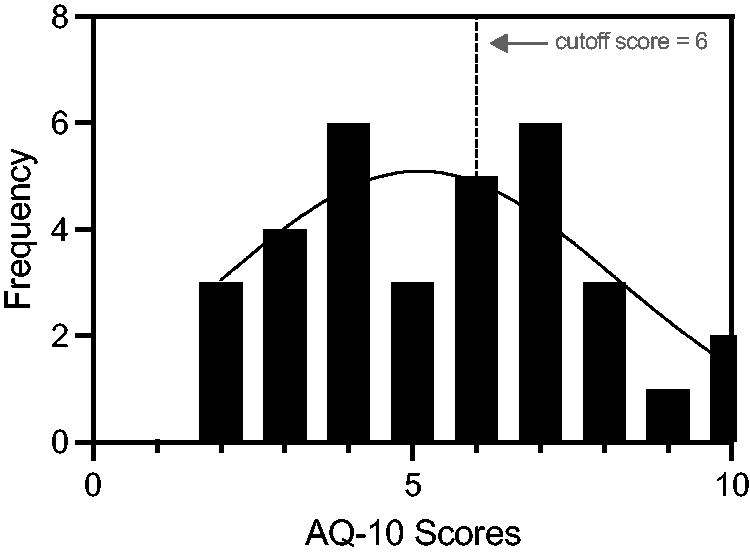
A histogram of the participants’ AQ-10 scores. AQ-10, 10-question version of the Autism Quotient test.
In addition to the demographic factors and the AQ-10 questions, we asked mothers about several behaviors that are found in the literature to promote young children’s language development. In particular, we asked about IDS: “Did you use motherese or babytalk with your child when they were an infant?” The mothers who helped pilot the questionnaire thought this question was clear, and the responses of those who were interviewed confirmed that they could distinguish between the use of IDS and “talking like a baby.” We also asked mothers at what age they started reading to their child, how many times a week they read to their young child (1 = “less than once per week” to 5 = “10 or more times per week”), whether they thought it was helpful to point at objects and name them for their child (yes/no), whether they sang to and/or listened to music with their child, whether they thought it was their role and/or the school’s job to teach their child to read, and how confident they felt when reading with their child and supporting their child’s literacy development.
As noted, parents who were interviewed were asked “why” follow-up questions to help understand their responses. For example, if the parents reported not using IDS/baby talk with their children, we asked them “why not?”. We also asked “why” they read to their children often. We conducted a content analysis of the responses as follows: First, we transcribed the responses verbatim and then coded each response for the content of the “reason.” If multiple reasons were mentioned by one parent, they were coded separately as non-mutually exclusive. We describe the primary codes/reasons that surfaced and include some quotes as qualitative data in the results.
Results
We first present the descriptive analyses for each question. We then examine whether there are differences in the responses to the questions about IDS and book reading for mothers who reported having a child with autism spectrum disorder (ASD) or not or for mothers who were interviewed versus doing the questionnaire online. Finally, we highlight the primary reasons mothers in our subsample who were interviewed (N = 17) provided for their responses and include some quotes as examples of their perspectives.
In this sample of autistic mothers, only 44% indicated that they used IDS at all with their children, and those who did used it infrequently. When examining the correlations between IDS and demographic variables (income, education level), AQ-10 score, or the child’s autism status, we found no significant correlations. Most (94%) of the mothers reported reading to their children before they were 1 year old. When asked how many times a week they read to their children, more than half the mothers (58%) responded “10 or more times a week,” and all mothers reported reading at least 3–4 times per week (Fig. 2). We also examined the responses for different groups of mothers based on whether they had helped narrow down the questions on the questionnaire and whether they completed the questionnaire on the phone versus online. These results can be found in Supplementary Table S1. We ran Fisher’s exact tests to check for any group differences in IDS and reading frequency based on how moms completed the questionnaire or whether they helped develop it. For IDS, there were no differences between moms who helped develop the questionnaire and those who did not, p = 0.283, or between phone versus online, p = 0.732. Similarly, reading frequency showed no group differences between moms who helped develop the questionnaire and those who did not, p = 0.228, or between moms who did the survey by phone versus online, p = 1.000.
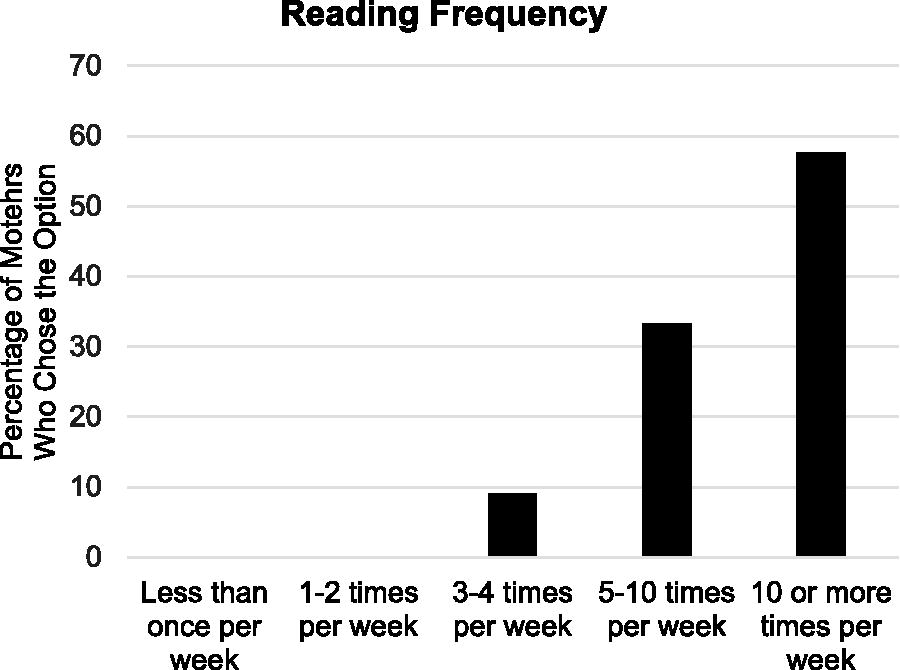
A histogram of the participants’ responses to shared book reading with their child per week.
Regarding other activities shown to be helpful for language development in neurotypical samples, most autistic mothers thought it was helpful to point and label objects for young children (94%) and reported singing to (82%) and listening to music with their children (85%). When asked whose role it is to teach a child to read, most autistic mothers thought it was their role and the school’s (67%), and most mothers reported very high efficacy around literacy activities in that they were confident they could find time to read with their child and keep their child’s interest while reading.
We further examined whether there was any difference in parenting behaviors, specifically IDS and shared book reading, between mothers who reported that their child has a diagnosis of ASD and those who did not or were unsure. Regarding IDS, 37% of mothers who indicated their child has ASD used IDS, compared with 50% of mothers who reported their child does not have ASD and 63% of mothers who were unsure. In addition, 74% of mothers who reported their child has ASD read to their children 10 or more times a week, while only 33% of mothers who reported their child does not have ASD and 38% of those who were unsure did the same. Although the proportions of mothers engaging in these behaviors differed based on the autism status of their child, these differences were not statistically significant.
Our content analysis of the open-ended responses from the 17 participants who were interviewed and asked follow-up questions about their use of IDS and reading with children provides some useful context for the above findings. For the mothers who did not use IDS with their children, 11 of the 14 mothers provided a response that we coded as consciously avoiding IDS. For example, one participant answered, “Because I felt stupid doing it,” and another mother associated the vocal modifications of IDS with autistic masking: “I camouflaged all day at work. When I came home, I wanted to just be me.” A few mothers (3 of 14) provided reasons we coded as not natural to use IDS because they stated that it never crossed their minds to talk like that. The mothers who did say they used IDS (3 of 17) were not asked for reasons but were probed as to how frequently. When we asked them how often they did it each day, all three said they did not use IDS each day.
Reasons that emerged when mothers talked about reading were very consistent across the respondents. Most mothers (15 out of 17) provided responses we coded as reading was enjoyable for themselves as well as for the children, especially compared with other activities (e.g., playing). For example, one mother stated that “reading was easier and more fun than unstructured time or the park.” Several mothers explained reading was less triggering of sensory overload than other parent–child activities: “Reading felt less chaotic than other activities because there was a beginning, middle, and end.” Mothers found they could control themselves better if they were reading: “Other activities that we did like camping and hiking but sometimes I’d get overstimulated and freak out and yell at her. But it was never like that with the reading.” Finally, mothers recall reading as special and as a time to connect. One mother described the time as “cozy and snuggly and one of my best parenting memories.” Despite most mothers finding reading enjoyable, two mothers did not think so and provided comments that we coded as difficult to keep the child engaged during reading.
An additional point that became evident in the interviews was that a few autistic mothers commented about reading the text only. That is, they did not tend to use books as jumping off points for discussions with their child, but to focus solely on the text. One mother said, “It’s not a conversation! It’s a book! My kids always want to talk to me. We read a book when I need a break from talking.” We encourage researchers to directly probe this issue more, as it came up naturally in a couple of our interviews but was not a question on our questionnaire.
Discussion
Our results in many ways mirror previous results with neurotypical samples. The most notable differences are in two areas. First, a smaller percentage of the autistic mothers in this sample reported using IDS or motherese with their infants than is reported in samples of neurotypical mothers. 17 Researchers claim that use of IDS is an inevitable 18 or universal human trait in neurotypical samples, 19 yet studies show cross-cultural differences in the prevalence of IDS, with urban, higher socioeconomic parents using IDS up to 4 times as frequently as parents from less urbanized, more agricultural communities. 20 Yet, in the current sample of American educated mothers with autism, fewer than half report using this type of speech register at all with their children when they were infants, a much lower percentage than found in samples of neurotypical parents from the same demographic background.21,22
On the contrary, the autistic mothers in this sample report reading with their children as often, if not more frequently, than the literature shows with neurotypical mothers, where frequencies average 6.8 times per week for educated parents. 23 More importantly, the autistic mothers displayed high confidence or efficacy in their ability to read to their children and keep their children’s attention while reading (Table 2). These results are important in light of research showing positive effects on joint book reading on language development for autistic children. 24 We expand on our findings in these two areas below, in turn.
Descriptive Statistics on Parents’ Confidence on Literacy Activities with Children
Parents were asked to rate how confident they were that they could do each of the literacy activities when their child was 5 years old or younger on a scale of 0–10.
Infant-directed speech
Autistic mothers in this sample were familiar with the concept of IDS/motherese, and most of them reported not using it with their child. In fact, some reported using it with pets but not with their children. Most mothers who were interviewed and reported not using IDS gave reasons we coded as either consciously avoiding IDS or IDS not being natural for them. It is important to note that studies show that autistic children do not attend to IDS in the same way that neurotypical children do,25–27 and therefore, IDS may not have the same benefits of capturing the attention of autistic children and might not promote language development in this population as effectively as in neurotypical infants.22,28 Furthermore, some studies of parental use of IDS with autistic children show similar frequency as with parents of neurotypical children, yet the quantity of IDS decreases when parents report their children as having more autistic symptoms. 29 The nature of what parents say during IDS to autistic children also differs from that to neurotypical children. 29 Thus, we need to learn more about parents with autism and their use, or lack thereof, of IDS. This is especially true because some intervention programs for autistic children promote parental use of IDS,30,31 yet it may not feel natural for autistic parents and may not help autistic children in the way it helps neurotypical children.
Shared book reading
The mothers reported very high efficacy scores when asked about shared reading, suggesting that, on average, they were confident in their ability to engage their child in shared book reading. The autistic mothers also reported reading very frequently with their children and when asked why, the reasons that arose were coded as it was enjoyable for both them and their children, especially compared to other activities. One additional point of interest that became evident in the interviews was that a few autistic mothers commented about reading the text only. It is not clear how widespread this viewpoint is; however, future research may want to probe this issue further. That is, in neurotypical samples, researchers emphasize the usefulness of the dialogic nature of reading and the extratextual talk during book reading interactions between parents and children for language development and comprehension. 10 Yet, if autistic parents approach book reading as a break from conversations per se and more as a task to experience the book, this information would be relevant to intervention approaches for both populations. That is, perhaps it makes more sense to encourage autistic parents to read books with diverse topics, sentence structures, and vocabulary—all types of input that can promote language development even without extended conversations. 32
Limitations
This study has several limitations worth noting. First, we do not have detailed information about the race/ethnicity of the participants, and the participants, on average, have higher socioeconomic status than the general population and are all mothers (no fathers). Therefore, these results might not generalize beyond this sample, and future research should try and reach autistic parents from more diverse backgrounds. Second, we only had qualitative data from a subset of the sample, and thus, our limited coding and conclusions from those interviews may not represent the whole sample and should be interpreted with caution. The participating mothers were also of different generations, which may have affected their responses, with some reporting on past experiences as their children are now grown, and others who are currently in the thick of parenting young children. Relatedly, we relied on parent report and not observations of use of IDS or book reading. While research shows significant correlations between mothers’ reported use of “motherese” and actual use based on recordings, 1 prior questionnaires measured frequency of motherese not necessarily whether or not parents use motherese at all, as measured here. Finally, we were interested in learning about autistic parenting and purposefully did not collect data from a control group; this limits our ability to make direct comparisons with neurotypical parents.
Conclusions
Our findings demonstrate that autistic mothers interact with their children in similar and different ways than neurotypical mothers. Most autistic mothers reported not using IDS yet reported reading as frequently if not more frequently with their young children than neurotypical mothers. Furthermore, reading is an activity they feel confident engaging in with their child. The current findings challenge claims of IDS as “universal” and highlight autistic mothers’ unique motivations for reading and intentions behind their choices of activities with their children.
We believe these findings and further work in this area will have important implications for intervention programs for autistic children that involve parents. For example, interventions that exist for neurotypical parents to boost the use of IDS and child language development 1 might not be appropriate for autistic parents (at least those who are not comfortable using IDS with children) and might not be ideal for neurotypical parents of autistic children, as researchers find that autistic children do not tune in to the IDS in the same ways as neurotypical children,25–27 whereas interventions that capitalize on autistic parents’ confidence and efficacy around reading aloud to children, especially if encouraged to just read the text rather than to use the text to start conversations, could have better implementation results. While dialogic reading with conversation interspersed (i.e., extratextual talk) positively predicts language and literacy development in neurotypical children, 11 for autistic parents just reading the text of the book while keeping the child’s attention and directing their attention to print 33 may provide positive exposure to vocabulary and complex syntax for the child to grow their language and literacy skills. Indeed, greater shared book reading between parents and autistic children is related to increased language growth. 24 Finally, autistic mothers’ lived experiences can make them particularly useful sources of information about how to successfully engage with autistic children. If we can engage with autistic parents and tailor interventions to their strengths, we will have better opportunities for successes for their children.
Footnotes
Acknowledgment
We thank the participating mothers for sharing their perspectives with us, and we thank Yefet Rodriguez for technical/analytical assistance.
Authorship Confirmation Statement
P.T.: Conceptualization, methodology, data collection, and writing—original draft. B.C.: Data curation, formal analysis, and writing—review and editing. M.L.R.: Conceptualization, supervision, writing—review and editing, and funding acquisition. The article has been submitted solely to Autism in Adulthood.
Author Disclosure Statement
All authors declare that they have no conflicts of interest to disclose.
Funding Information
This research was funded by M.L.R.’s endowed professorship funds (Saul Zaentz Professor of Early Learning and Development) through the Harvard Graduate School of Education.

References
Supplementary Material
Please find the following supplemental material available below.
For Open Access articles published under a Creative Commons License, all supplemental material carries the same license as the article it is associated with.
For non-Open Access articles published, all supplemental material carries a non-exclusive license, and permission requests for re-use of supplemental material or any part of supplemental material shall be sent directly to the copyright owner as specified in the copyright notice associated with the article.
