




Abstract
Background:
Autistic people are more likely to experience intimate partner violence (IPV) than non-autistic peers, but our knowledge about how they recognize abuse and make sense of what has happened to them is sparse. The aim of this study was to explore how autistic people recognize and make meaning after experiencing IPV.
Method:
We recruited 21 autistic adults to take part in a semi-structured interview about the experience of IPV. We asked questions about how they had made sense of their experiences and how it had impacted them. We analyzed the data using reflexive thematic analysis. One author coded all data, engaging in reflexive discussion with the whole team. They organized codes into themes in collaboration with a second team member.
Results:
We developed three themes from the data, which focused on understanding and sense-making after intimate violence. Theme 1, “Power,” focused on the role that power dynamics had played in sense-making. Theme 2, “Disruptions of self,” explored the feeling of dehumanization, objectification, and stigmatization among participants that led to them feeling like they were worth less than others and that they had to mold themselves to fit perpetrator expectations. Theme 3, “‘Now, with hindsight,” focused on how survivors had struggled to recognize the violence, with a sense that it could “always be worse” and that they needed clearer understanding of what “red flags” look like in a relationship.
Conclusions:
Our findings suggest that making sense of the experience of intimate violence among autistic adults is shaped by individual, interpersonal, and societal factors, which normalize violence against autistic people, making it difficult to leave abusive relationships. By highlighting the factors that shape understanding, we can explore how to prevent these occurrences in future (e.g., better early education about neurodiversity and relationships).
Community Brief
Why is this an important issue?
Autistic people are more likely to experience intimate partner violence (IPV) than non-autistic people. Currently we know very little about how autistic people recognize that they are in an abusive relationship and how they make sense out of what has happened to them. Understanding this can help us to find ways to help autistic people recognize abuse and prevent them from entering abusive relationships.
What was the purpose of this study?
The purpose of this study was to explore how autistic people recognize IPV and how they make sense of what has happened to them.
What did the researchers do?
We interviewed 21 autistic adults about their experiences, using semi-structured interviews. We gave people the option to do a spoken interview (n = 16) or to write down their answers (n = 5). We made sure that they felt safe to take part and that we knew what to do if they became upset. We analyzed the data using reflexive thematic analysis, which involved looking for patterns in what people had said and then organizing these patterns to identify common themes across all the participants.
What were the results of the study?
We developed three key themes. Theme 1, “Power,” showed that autistic people felt like they had never been in control of their own lives and that they had to do what other people told them. They said that the abuser took advantage of this. They also did not feel like anyone would believe them if they talked about being abused, so they kept it to themselves for a long time. Theme 2, “Disruptions of self,” showed that autistic people felt like they had always been treated less like a human than other people and this had made them feel like they had to hide their true selves to stay safe. Theme 3, “Now, with hindsight,” showed that it had been really hard to recognize abuse because being treated badly seemed normal. It was hard for people to recognize warning signs from their partners and took a lot of courage to leave the abusive relationship.
What do these findings add to what was already known?
Our findings help us to understand how autistic people recognize abuse and what might make it harder for them to do so.
What are potential weaknesses in the study?
All of the people who took part in this study were White, and most were women. It is likely that autistic people from other groups might experience other things that make it hard to recognize abuse.
How will these findings help autistic adults now or in the future?
Our findings show that we need to address lots of different things (e.g., early life relationships, negative social judgments of autistic people) if we want to prevent abuse and help autistic people to recognize when a relationship might be abusive.
Introduction
Relationships can play an important part in a fulfilling life for autistic people. 1 Healthy relationships are underpinned by a sense of safety and respect; however, for many autistic people, relationships are a source of trauma.2,3 Autistic people are more likely to experience interpersonal (poly)victimization across the lifespan than non-autistic people. 4 During adulthood alone, figures suggest that between 40% and 70% of autistic people have experienced sexual violence (such as coerced sexual activity, actual or threatened rape and assault), physical abuse, and emotional abuse (such as cyberbullying, bullying, harassment, or humiliation). 5 There is an emerging body of literature focused on understanding the impact of interpersonal forms of violence and abuse (or abuse from familiar others) among autistic people.2,3,6–8 However, one specific form of interpersonal violence that has received less attention so far is intimate partner violence (IPV).9,10
The World Health Organization defines IPV as “behaviour within an intimate relationship that causes physical, sexual or psychological harm, including acts of physical aggression, sexual coercion, psychological abuse and controlling behaviours (e.g., coercive control). This definition covers violence by both current and former spouses and partners.” 11 U.K. statistics on IPV show that disabled adults are more likely than nondisabled adults to report experiencing IPV (including disabled men, who are more likely to report IPV than nondisabled women).12,13 When disability is broken down by type, autistic people constitute the group with highest prevalence.12,13
Understanding what underpins this heightened prevalence among autistic people is crucial in prevention and intervention. While several studies have explored lived experience of IPV among disabled people more broadly (including autistic people),14–16 only one study 17 has focused explicitly on understanding firsthand accounts of IPV among autistic people. 17 This study found that being autistic adds a layer of complexity to IPV experiences that should be considered in addressing heightened prevalence. Their participants reported partners using their autistic characteristics against them, for example, to trigger meltdowns or gaslighting them about their interpretations of what was happening.
Preventative work with communities at high risk of IPV may need to target such complexity to reduce risk. While it is likely that broader factors that contribute toward risk of experiencing IPV also apply to autistic people (e.g., issues around gendered violence 9 ), the increased prevalence across autistic people of all genders suggests that there may be different or unique issues to consider. Autism is (often wrongly18–20 ) associated with impaired social connection, disinterest, and dysfunction, emotional dysregulation and instability, and an egocentric perspective.18,21,22 As such an increased risk of victimization has previously been attributed to autistic social skills, 23 which can (often unintentionally) blame the autistic victim. More recent work on victimization has highlighted risk factors at varying levels of an autistic person’s social ecology2,3,24 that can include difficulty in reading social intentions2,6 but importantly also includes factors driven by the wider social, cultural, and political context that we inhabit.
A social–ecological approach24,25 recognizes that as a minority group, autistic people experience a range of negative life events (including IPV) that perpetuate a cycle of minority stress. 26 Autistic people experience social stigma regardless of whether they are openly autistic. 27 We are also more likely to experience isolation, which can contribute toward the risk of IPV 28 and make it harder to exit the situation. Indeed, Rothman 29 found that autistic students who did have lower social resources (i.e., lower social belonging) experienced higher rates of sexual and physical assault compared with those who reported higher social belonging. Autistic people in the UK display higher rates of social isolation (i.e., marginalization) and precarity (e.g., un/underemployment 30 and/or homeless 31 ), which can leave them more vulnerable to forms of violence such as financial abuse and coercion. Violence against marginalized people is frequently tolerated and/or justified due to their stigmatized social status rendering them less human in the eyes of others. 32
Unsurprisingly then, autistic people are more likely than non-autistic people to experience violence in interpersonal relationships (including with caregivers and peers) prior to ever having romantic or sexual relationships.17,33 Exposure to previous victimization can put people at risk of further violent experiences through a process of intergenerational transmission of violence and normalization. 34 It can also contribute to heightened compliance in social relationships leading to cycles of polyvictimization. 3 Overall autistic people are more likely to have lower social capital, fewer social relationships, and the relationships that they do have often have a higher risk of victimization than those of non-autistic people.
Bearing these complexities and the high prevalence of IPV among autistic people in mind, further research into the IPV experiences of autistic people is desperately needed. That way we can start to tease apart unique and overlapping (with other populations) factors that contribute toward heightened prevalence among autistic people. It is essential that such work is grounded in autistic firsthand accounts, given previous arguments that autistic people lack epistemic authority to report on their lives or inner worlds. 35
Thus, the aim of this study was to contribute toward an emerging understanding of IPV among autistic people by explicitly examining how autistic people understand and make sense of their own experiences of IPV.
Methods
Participants
We recruited 21 autistic adults (see Table 1) from the United Kingdom to take part in this study. We excluded people from outside of the United Kingdom as the study was part of a funded project to explore ways to improve intervention for victim-survivors of intimate violence in the UK context. We put out a call for participants across social media (e.g., X) and third sector organizations (e.g., Somerset and Avon Rape and Sexual Abuse Support, Mankind), linking interested parties to a website, which hosted information about the project and a link to express interest in taking part (https://intimateviolenceandautism.my.canva.site).
De-identified Participant Demographics
Columns indicate in order: age, gender, sexuality, socioeconomic status, diagnostic status, age at diagnosis.
SES, socioeconomic status.
A total of 137 people responded to this call, and research assistants (RAs) were instructed to prioritize contacting people with a variety of different genders and races/ethnicities. Despite this, the final sample of people who responded to the follow-up invitation were all White and primarily female (n = 18), although two non-binary people and one man also took part. One additional man took part in an interview but was excluded from the analysis as he had witnessed parental IPV but had not experienced it within his own intimate relationships. Fifteen participants had a clinical diagnosis of autism, and six self-identified as autistic or were awaiting diagnosis. All but one of those with a formal diagnosis were diagnosed in adulthood. Of the participants, 11 were heterosexual, 5 were queer or pansexual, 2 were asexual, and 3 were unsure. All but one had a co-occurring physical disability (e.g., fibromyalgia) or co-occurring form of neurodivergence (most commonly ADHD, n = 9), and several reported unreliable speech. The majority described their current socioeconomic status as comfortable. We compensated all participants for their time at £25 per hour in line with UK National Institute for Health Research (NIHR) guidance on participant involvement. The study received ethical approval from the University of Sunderland Research Ethics Committee (011391).
Methodological approach
Research question
The findings described in this article were gathered as part of a larger project funded by the Violence, Abuse and Mental Health Network that had two overarching research questions as follows:
How do autistic adults recognize and make sense of their experiences of intimate violence and abuse? What are the recovery and support needs of autistic adults who have experienced intimate violence and abuse?
The data were extensive, and to explore each question with the detail and nuance it deserves, we have split the analysis into two connected articles. This article addresses question 1. The findings of question 2 are described in Pearson et al. 36
Interviews
We offered both spoken (n = 16) and written (n = 5) interview formats to our participants, using the same semi-structured interview schedule for each. Where the participant chose a written interview, we established that we might follow up with them if we needed them to provide further explanation. One person who chose to write their account did this synchronously with an RA over Microsoft Teams. RAs W.J. and A.M. conducted all interviews. Both RAs had experience with interviewing and counseling skills such as active listening. The spoken interviews lasted between 54 and 117 minutes (M = 79 mins).
Positionality
This project was a collaboration between a group of academic and community coresearchers. The team included autistic people and people with lived experience of IPV. The study was autistic led, and as such we sometimes use the term ‘we’ throughout the article when talking about autistic people. We developed the entire project (including the grant) as a team, sharing power and making decisions as a group (see Fig. 1, step 1). Community coresearchers (K.R. and S.D.) were compensated for their time across the project in accordance with UK NIHR guidance on participant and patient involvement.
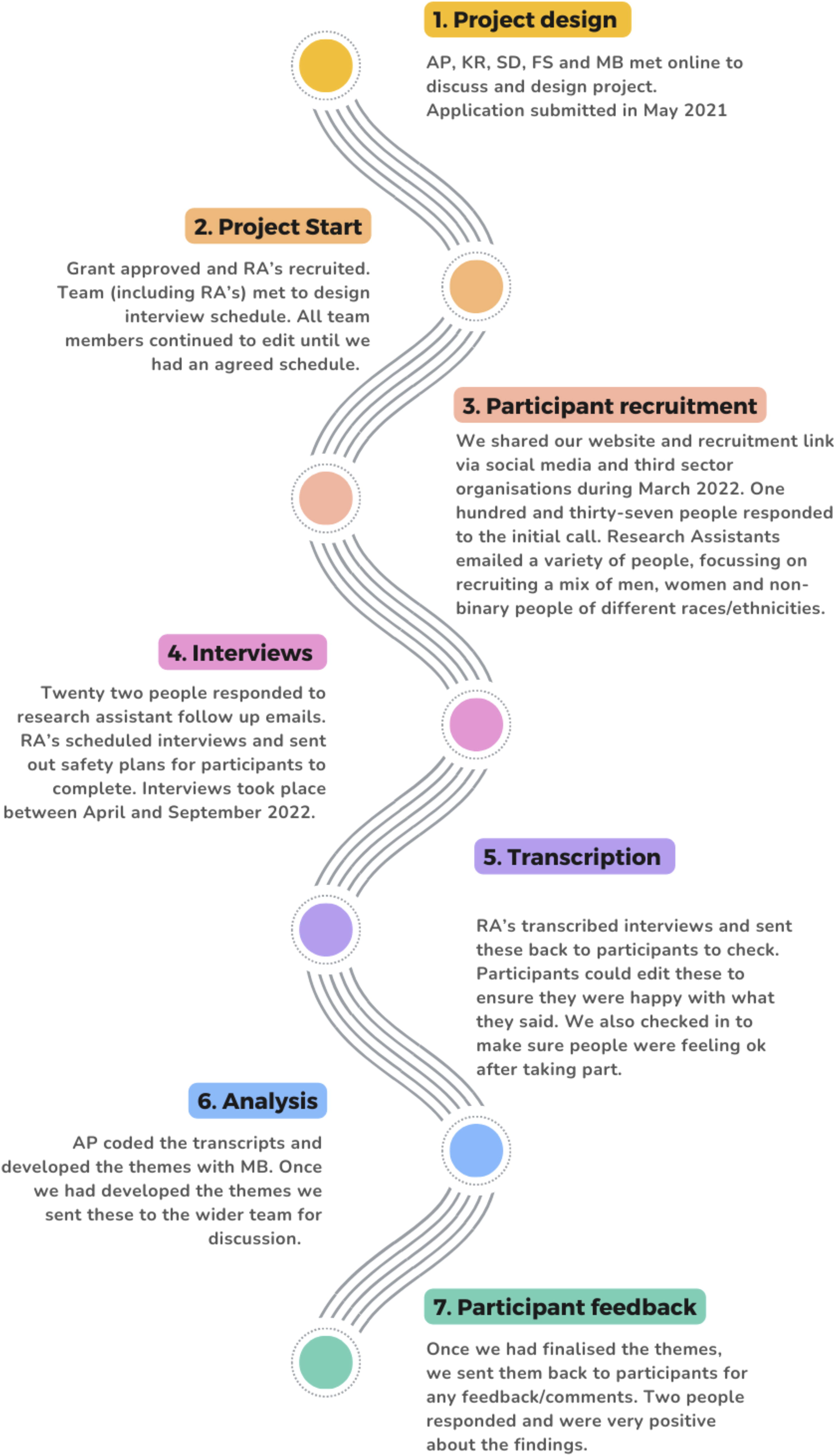
Project road map displaying participatory research approach.
Procedure
Prior to interview, we contacted all participants to establish a safety plan 37 that included a range of information, including how to know if they were distressed or whether they had any specific interview needs (e.g., having a friend with them). We told them the questions in advance, who would be interviewing them, and details for various support organizations and resources. For written accounts, we sent the questions in a document which participants completed and sent back. For spoken accounts, one (or both) RAs met with participants on Microsoft Teams and used the record and transcribe function to record the interview. After the interview, the interviewer checked the transcription for accuracy and edited accordingly. They sent this transcript to the participant, who had the option to expand on or amend anything they had said prior to coding (see Fig. 1, step 5).
Analytic approach and reflexive practice
We analyzed the data using reflexive thematic analysis38,39 with an inductive approach, coding in an open and organic manner. We followed the six steps outlined by Braun and Clarke. 39 A.P. started with data familiarization and annotation and then coded the data independently using NVivo 12 based on both semantic and latent content. Throughout the coding process, she kept a reflexive diary, noting emotional responses, potential biases, and how her experience as an autistic adult with lived experience of IPV may have influenced her interpretations, drawing upon standpoint epistemology. 40 She discussed these interpretations and the coding process with the wider team. After coding the data, A.P. refined the codes and met with M.B. to organize these codes into initial themes. We sent these themes, example codes, and associated quotes to the wider team to refine into the final set. Once we finalized the themes, we sent findings back to the participants to give them the opportunity to comment on the findings as a form of triangulation (Fig. 1, step 7). Given that autistic people frequently experience epistemic injustice within the research process, 41 we wanted to ensure that our interpretations accurately represented their experiences.
Results
We developed three main themes from the dataset (see Fig. 2), centered around the process of identifying and making sense of the experience of intimate violence and abuse. Pseudonyms are used to identify participants throughout.
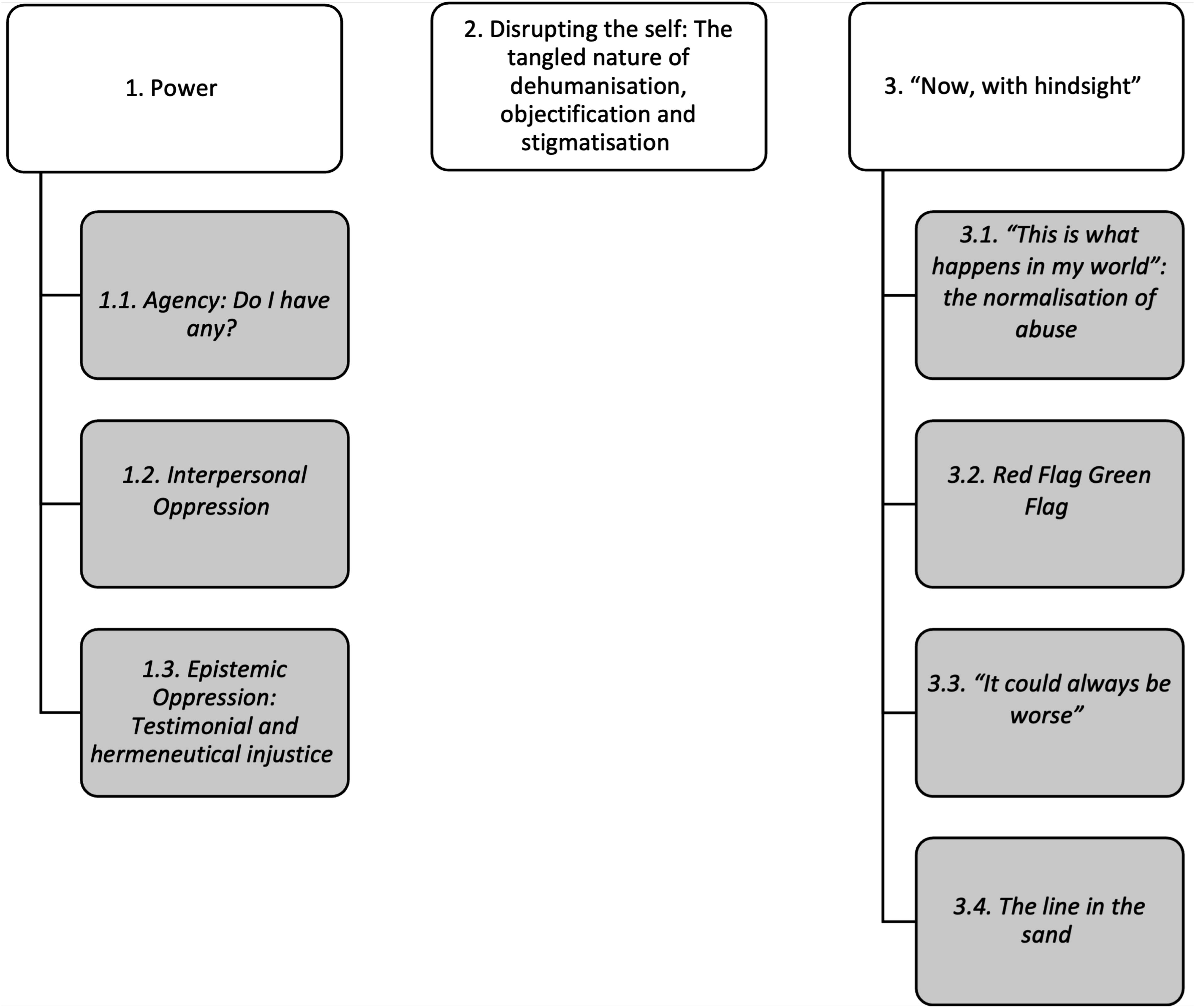
Final themes and subthemes identified from the thematic analysis.
Theme 1. Power
Power played a central role in the experiences of our participants across multiple levels. There was a sense among our participants that having access to choices (see Theme 1.1, Agency: Do I have any?) was either limited or impossible, which was compounded by the oppressive actions of their partner (see Theme 1.2, Interpersonal oppression). Epistemic injustice was impacted (see Theme 1.3, Epistemic oppression: Testimonial and hermeneutical injustice) through a lack of access to meaningful language and concepts with which to understand their own experiences and a sense of being discreditable or less worthy of being believed.
Theme 1.1. Agency: Do I have any?
Participants grew up feeling a distinct lack of agency and the ability to make choices about their own lives, noting that “when you’re younger a lot of choices are made for you” (Catherine). The lack of agency experienced was complex and impacted by home lives (e.g., an abusive family environment), school (particularly the experience of being bullied and feeling powerless to stop it), socioeconomics (e.g., not being able to afford to pursue further education), and the broader social environment (e.g., having few friends to speak to about any problems). For some, this led to a sense of being a passive passenger in their own lives, as described by Charlie: “I don’t think I realized I had choices in my life till I was about 27…I just never felt like I had free agency over anything. I felt like I had to just let things happen to me.” This lack of felt agency across different aspects of everyday life carried over into the romantic relationships of the participants, as outlined by Izzie:
In school, like a lot of the stuff around either not being able to do things I should be able to do and feeling limited through that, or being bullied and then having no choice and…through that experience the abusive relationship sort of just carries on through. (Izzie)
Where participants did describe their limited choices, these were heavily shaped by the situation and a strong feeling that compliance was necessary to survive as Lucy described: “There was no other way but to comply. It was safer to … Shut down and dissociate. I mean, not like it’s a choice, but I do believe that was more way of getting through it as safely.” Participants described the process of “compartmentalisation” (Allison), of attempts to “avoid conflict” through any means possible (James) even if it seemed “bizarre” (Olivia). Boundaries were viewed as something that other people got to have, with their own boundaries pliable and shifting to accommodate their partner.
Theme 1.2. Interpersonal oppression
The notion of lacking choice within relationships was reinforced by the behavior of the perpetrator. Although not all our participants had experienced physical violence, all had experienced coercive and controlling behavior. This started early in the relationship, as described by Lydia:
The violence doesn’t come on day one, you see. The coercive control comes on day one. They do it very slowly and insidiously so by the time that the violence comes, you can’t do anything about it…“It’s all right”, he used to say, “I haven’t really hurt you because you’ve never ended up in hospital”. Which again are words of control…”Be grateful I’ve only hit you a bit. Not a lot”.
The coercive control described was widespread and included being told who they could spend time with, what they could talk about, whether they could spend money, and being forced to engage in sexual activity. Some coercion occurred through attempts to instill feelings of guilt, as described by Hannah: “‘you can’t go out with your friends, what about me’…So then I’d feel guilty and be like, oh yeah, maybe I am being selfish. I was so young, vulnerable, you know? Other methods of coercion included making the participants feel like the perpetrator was more knowledgeable about social relationships, tapping into self-doubt around their social ability, as outlined by Charlotte: “you’re not understanding your friends don’t actually like you. You just don’t realize. You said the wrong thing at that party…I’ll tell you because I want you to get better at saying the right thing.”
Perpetrators also sought to manipulate the participant’s sense of what was going on in the relationship, either by denying the abuse (e.g., “I’m not abusing you,” Charlotte) or framing it as a mutual argument (e.g., “don’t tell people about these kinds of arguments,” Rowan), or by blaming the victim-survivor for what was happening to them (e.g., “You’re the reason this has happened. You’re the reason I behave this way,” Lydia). This experience of the perpetrator controlling the narrative and gaslighting contributed toward a sense of helplessness among participants, interacting with the lack of felt agency described in Theme 1.1, Agency: Do I have any? and explained by Lydia: “It’s control. They put you in a prison. It’s not a physical prison but you can’t get out.”
Finally, it is important to note that several participants expressed knowing or suspecting that the perpetrator was “neurodivergent as well” or had struggled with their mental health. However, the participants acknowledged that this did not make them less responsible for their behavior: “it was my husband’s responsibility to get support and find ways to manage his feelings in a safe way” (Rachel).
Theme 1.3. Epistemic oppression: Testimonial and hermeneutical injustice
Participants felt that others viewed them as an unreliable narrator to their own experiences. Throughout their lives, they had been made to feel “wrong” (Helen) and that their viewpoint wasn’t “correct” (Izzie). Some participants like Faye had experienced invalidation or dismissal of their testimony during earlier experiences of disclosure: “I was sexually assaulted at 16. By someone who went on to become a predator…and no one believed me. Until he did it to someone else.” Allison also outlined how invalidation intersected with her queerness, when attempting to disclose how her female ex-partner had abused her: “I do honestly feel if I was talking to the same people about a man doing this stuff, they would react very differently…I felt discredited by that because [a friend] seemed to be saying to me, ‘oh, that’s really awful’, but then being really friendly with her [ex].” These experiences made participants less willing to disclose in future or trust others to take them seriously.
For others feeling like an incredible witness led to avoidance of help seeking at all, as outlined by Charlie: “for a really long time, I would not talk to people about the fact that I’d been in more than one abusive relationship because people think I must be making it up because there’s no way it can happen more than once.” This invalidation was also enacted through perceptions of sexual understanding, with both Sophie and Helen describing how disclosure of sexual assault was met with the suggestion that maybe they had just misinterpreted the situation.
Feeling empowered in their own interpretations was reliant on participants having access to self-understanding and the correct terminology to describe what had happened. This provided a sense of “reassurance” that what they had experienced had indeed been abuse (Catherine). Some people engaged in research (reading academic articles or blogs) to gain insight into their own experiences. They described how this led to a sense of “clarity” (Allison) and made them realize that they were “not the only person” it was happening to (Lucy). However, these realizations did not necessarily lead to changes in circumstance. Lucy recalled telling her partner about the research that she had been doing, thinking it might lead him to change his actions:
I remember trying to talk to him about it like “my God, guess what I’ve learned today” [laughter] do you know what I mean?…I remember just feeling really like “my god, this will change my life, this this information now he knows of course he’s gonna stop”. So then I felt really ridiculous after that.
Regardless of how it had impacted at the time, developing the conceptual toolbox to describe their experiences not only empowered participants through self-understanding but also gave them the tools to explain their situation to others. Lydia described how the development of the term “coercive control” allowed her not only to say it “wasn’t my fault” but also fostered the ability to explain to other people why she “couldn’t leave” and have them say “ooh we get it now.” In addition, for some people it also meant being able to potentially spot similar behavior in future: “gas lighting and love bombing, like now that I’ve words for those things, I think it’s much easier for me to notice them” (Rowan).
For many, realizing that they were autistic had a profound impact. Almost all our participants were diagnosed as adults. There was a sense among the late identified that knowing they were autistic might have meant that they had “more support” and that they might have been “protected” by others. However, the participant who did receive a childhood diagnosis also grew up lacking support, feeling stigmatized and worthless compared with their peers. This suggests a complex relationship between self-understanding, outsider perceptions, and systemic influences (see theme 2, “Disruptions of self”).
Theme 2. Disrupting the self: Tangled in a web of dehumanization, objectification, and stigmatization
Participant understanding of the self both shaped and was shaped by the pervasiveness of violence and abuse. Participants recounted how from an early age, they were not “treated like a person” (Helen), which led them to feel like they were “lesser” (James), “supposed to be abused” (Charlie), and “did not have the same rights as others” (Sophie). This was true of both early and later identified participants. While James described his father wanting “nothing to do with me anymore” after his diagnosis as a child, others spoke of how even without a label, they were shamed as “being ‘stupid’, ‘slow’, ‘pathetic’, ‘not good enough’ etc” (Susan).
The experience of being stigmatized and dehumanized led participants to view themselves through a self-objectifying lens. Both Olivia and Jessica recounted being “whatever somebody wanted me to be,” seeing the self as malleable—an object that could be molded to meet the desires and expectations of others. Several participants “masked” as a response, not feeling safe to be who they really were. Some people felt like masking fed directly into behavior that put them at risk of others taking advantage, for example, Lucy described using “sex…and sexualisation” to mask and please others.
The sense of dehumanization and self-objectification was exacerbated not only by the actions of the perpetrator (see Theme 1.2, Interpersonal oppression) but also by the self-stigma that arose out of self-blame from those who saw masking as something that had put them at risk, leading to a “source of terrible shame and embarrassment” (Susan). It was also compounded by the response of friends, family, and support services. Several people spoke of experiencing victim-blaming attitudes upon disclosing to others, such as being told that it was “their fault.” Grace recalled being described as “a ‘slag’, and you know that I was ‘easy,’ and I was all these things” during court proceedings, demonstrating how embedded victim blaming and testimonial injustice can be within systems that victim-survivors encounter if they attempt to seek formal justice. These comments suggested that participants were damned either way—masking didn’t keep them safe and neither did being themselves.
Theme 3. “Now, with hindsight”
While participants could look back and pinpoint the particulars of their relationships, they acknowledged (a) how hard it was to recognize abuse and believe what was happening was abusive and (b) that being able to identify abuse in retrospect did not make them feel confident that they would be able to preemptively recognize it in future. It had taken the participants a long time to recognize what had happened to them, with some citing it taking months and even years to realize that the behavior had been truly “unreasonable” even if they knew it was hurting them. Rachel and Jessica reflected that it could be difficult to work out whether they had all the information needed to make a decision at the time, experiencing a delay in processing.
Theme 3.1. “This is what happens in my world”: The normalization of abuse
The normalization of poor treatment started early in life. In addition to the dehumanization and stigma described in theme 2, many participants described growing up in a family home witnessing abuse or experiencing abuse and bullying in the wider community (e.g., school). Both Helen and Imogen described experiencing “boundary violations” from others at a young age, and Lucy recounted “growing up, my dad was physically violent to my mom and emotionally and financially controlling. So a lot of experiences were quite normalised.” The experience of growing up in an unsafe home led to violence and abuse being somewhat expected, as Olivia explained, “I never really looked out to the world and thought any different. I just thought, well, this is my world. This is what happens in my world. There’s nobody really telling me that it’s wrong.” These perceptions were also reinforced by professionals and outsiders. Michelle recalled disclosing that her father was abusing her and her mother to a nurse aged 14, to be told “well, that’s what happens sometimes.”
The normalization of abuse also pervaded other relationships, with Allison outlining how she had experienced manipulation and exploitation from multiple friends prior to being raped, and Elizabeth recounting her experiences leading her to being drawn into a religious cult where she was financially exploited and controlled. Allison said that it was “very hard to separate” the trauma of abuse from other negative events, leading to difficulties in processing what had happened because of how intermingled it was with her own “self-loathing.”
The relationship between normalization and polyvictimization was insidious and reciprocal, with abusive experiences feeding into a sense that victimization was typical within close personal relationships and reinforcing the idea that it should be expected. For many of the participants this made it difficult to recognize abuse for what it was, leading to multiple abusive intimate relationships. For some it led to protracted and ongoing realizations about what happened—both Charlie and Rachel spoke about the slow realization that things “were not the norm” and how disorienting this could be, with Rachel describing that she felt “lost in the middle of that shift” of perspective.
Theme 3.2. Red flag green flag
Participants spoke about the difficulty recognizing “red flags” or negative signs at the start or during a relationship, stating that these were easier to identify in retrospect. Several people spoke of “love bombing” or periods of intensity at the start of a relationship, such as new partners moving to be with them. Charlotte reflected on how this could appear romantic at the time, but that “if somebody had just gone’ actually Charlotte, that’s a little bit weird…there were multiple things looking back where you think if you’d have been alert this sort of stuff, you’d have gone hang on a minute.” Participants also highlighted controlling behavior (see Theme 1.2, Interpersonal oppression), with partners taking control of their finances or who they could speak to. While some felt that having knowledge of these red flags could help them in future, others did not feel so confident.
Green flags or signs of a healthy relationship were something that participants could identify in contrast with the abusive situation. While many of the green flags might appear like baseline relationship expectations, for those who have been in an abusive relationship, small things could signal safety: “We argue, and I’m not scared. We argue because everyone argues” (Faye). Participants highlighted the importance of a partner who “accepted” them for who they really are and a “balanced” (Charlie) or “50/50” (James) relationship. They also spoke about the importance of consent. Much like boundaries, many of the participants had spent a great deal of their lives feeling like consent was something that other people got to experience. However, they could recognize that consent should be “active,” “freely given,” “mutual,” and “enthusiastic.” Importantly, consent was seen as something that should be “collaborative” and “not fixed”, acknowledging that consent is coconstructed, not simply given, taken, or assumed.
Theme 3.3. “It could always be worse.”
There was a sense among participants that things could always be worse and that this had made it hard to formulate a black-and-white rule for what met the criteria for IPV. The people who had primarily experienced emotional violence and coercive control felt that physical violence would have been a clear sign: “My first thought was that I wished he’d hit me because then I would have figured it out sooner” (Charlotte). However, those who had experienced physical violence also expressed feeling like the violence wasn’t bad enough to warrant clear recognition of abuse. Both Hannah and Grace described experiencing extreme violence but being unsure whether this was abuse because their partner had “never punched” them. Likewise, Catherine recounted:
But I think there was times where I wasn’t sat there black and blue. … because I wasn’t sat with broken bones, I wasn’t deserving of it [support].
The lack of clarity around escalating violence and what constituted abuse led to sense of confusion about what was happening. Participants described feeling like they were in a constant state of confusion, unable to “make sense of anything” or work out “what was going on.” Izzie and Hannah described wondering if they were “insane” or “making it up.” Participants described their fear that they would be “unsuccessful in trying to leave the relationship,” feeling “in shock,” and “shut down.”
Theme 3.4. The line in the sand
Parallel to the sense that things could be worse was the small notion that things could also be better. Allison described “seeds of hope” at the thought of freedom, and Michelle spoke of visualizing a better life for her and her children:
Can you imagine a life right, where you wake up and you don’t feel afraid, you haven’t got that knot in your stomach?…I’d do a visual imagery thing…I would give them the freedom…I would show them.
Many of the participants spoke of the impact on their children being the catalyst to leave the abusive relationship. Michelle and Elizabeth spoke of professionals who voiced concerns about the impact that witnessing violence might have on their children’s mental health, which spurred them on to leave. Lydia recounted her own parental loss and how she wouldn’t allow that to happen to her children:
I knew at that crunch point, getting out in a box was either he did it, or I took my own life, because I couldn’t take it anymore. And I don’t say that lightly. But that was the point where I was like OK, there isn’t a choice here, because I knew what it was like to have lost a parent, and I wasn’t doing that to my children.
Likewise, Hannah spoke of violence during her pregnancy being the final straw: “He went to hit me and something snapped in me. He wasn’t going to hurt my baby.”
Others spoke of seeing a partner attack a friend (Faye) or trying to stop them from seeing their family (Izzie) as being their limit. Susan and Rowan spoke of realizing that their partners actions were having an impact on their career and how the vision of a better future helped them to gather the courage to end the relationship.
Importantly, Lucy spoke about how terrifying finally leaving could be and how drawing one’s own line in the sand did not mean that it would be respected: “He stalked me for a long time as well. He didn’t just go away because I left and in fact the most scary part was leaving” (Lucy).
Discussion
The aim of this study was to understand how autistic people recognize and make sense of the experience of IPV. Our findings highlight the importance of considering personal, interpersonal, and epistemic factors in understanding why autistic people are at a higher risk of IPV and what might prevent them from leaving an abusive relationship.
Power played a key role in the sense-making process of our participants at an individual and relational level, which was, in turn, influenced by systemic biases experienced among those bothered by society. Our participants reported the experience of early life abuse and being dehumanized, objectified, and stigmatized by others from childhood onward. Early life experiences of abuse normalize expectations of abuse in later relationships and are a risk factor for polyvictimization among both autistic 17 and non-autistic 42 people alike. However, the dehumanizing and objectifying treatment that autistic people experience reports experiencing from childhood an increase in this extant risk through the internalization of a lesser status.43,44 Nuassbaum 45 highlights that objectification, particularly instrumentality (i.e., being used for someone else’s purposes), leaves a person “ripe for other abuses…” (p. 265). This may be because of the way epistemic oppression operates. Autistic people (including those without a diagnosis) experience imperialism. Imperialism asserts that the inherent ways of being within a minority group are wrong and that makes them less human than the dominant group, contributing to lower social capital or power. 32 Violence against people in lower status groups is not only normalized but also often tolerated and justified as a result of transgressing social norms. 32
For our participants, the normalization of violence also led to a feeling of powerlessness and passivity in interpersonal relationships, which was reinforced by the experience of coercive control. Dutton and Goodman conceptualize the use of control in IPV as grounded in the exploitation of existing vulnerabilities. 46 In our study participants outlined perpetrators exploiting their (perceived lack of) social understanding to distort the situation and assert power. 47 Distortions are a key feature of IPV, 48 with both (higher power) perpetrators and (lower power) victim-survivors engaging in minimization, rationalization, and denial of violence, with both parties often blaming the victim-survivor for the abuse. All of these distortions were featured in our participants’ commentary, including where victim-survivors felt that the perpetrator may also be neurodivergent, supporting recent calls for tailored IPV intervention programs aimed specifically at perpetrators in this group. 47 Our findings align with previous suggestions that distortions increase self-doubt regarding abuse and contribute toward damaged self-concept and further appeasement/compliance as a coping mechanism. 48 However, accounts from our participants suggest that these distortions were also influenced by previous experiences of invalidation and dehumanization, which are rife among existing autistic accounts of interpersonal violence.2,3,17 Our findings suggest that autistic people may experience unique forms of rationalization and victim-blaming that focus on their social understanding as a way to convince them that they are in the wrong.
Our findings are consistent with understanding the relationship between agency/power in IPV as a dialectical process 49 shaped through individual instances of meeting external constraints and “periods of acquiescence and action.” 50 Perceptions of victim-survivors as continually “helpless” reinforce the unhelpful stereotype of an “ideal victim.” 51 This stereotype disproportionately disadvantages minority victim-survivors, including autistic people, whose stigmatized status inherently frames them as “falling short” 51 of this ideal while also positioning them lower in terms of sociopolitical and interpersonal power. 50 This means that when minority victim-survivors do attempt to express the (limited) agency that they have, they are often met with an exacerbated victim-blaming response. 52 It can also lead to violence being taken less seriously, as seen in Allison’s comments around the intersectional injustice she experienced as a queer victim-survivor. 51 Donovan and Barnes 51 found that violence within LGBTQ+ relationships is often taken less seriously than violence within heterosexual relationships due to perceptions of the ideal victim. These intersectional issues are likely applicable to a large number of autistic people given the likelihood of autistic people being LGBTQ+. 53
Consistent with a “lesser” social status was the experience of testimonial and hermeneutical injustice. 54 Some participants hesitated to disclose for worry of being disbelieved, and others spoke about how they did indeed experience invalidation and accusations of misinterpreting a situation upon disclosure. These findings are consistent with recent work exploring autistic women’s experiences of reporting sexual violence 55 and broader work on testimonial injustice in autistic victimization. 2 These experiences highlight how stigma and dehumanization lead to autistic people not only being perceived as discreditable by others but also internalization of these perceptions leaving victim-survivors stuck between a rock and a hard place when deciding whether to disclose. Hermeneutical injustice impacted on access to the concepts needed for participants to understand their own experiences. For some this was about knowing terms like ‘coercive control’ so that they could accurately describe what had happened to them. For others it was about having insight into their own autistic ways of being and thinking. For all of our participants, their self-knowledge across the lifespan was shaped by their perceived otherness. The late-diagnosed participants spoke of the self-knowledge that came from realizing that they were autistic, and interestingly, they felt that knowing they were autistic might have formed a protective factor against abuse. However, this had not been the case for the participant who had received an early diagnosis, who also experienced a lifetime of stigma. More research is needed into how age at diagnosis relates to risk of IPV. However, our findings corroborate previous research showing that autistic people experience ableist violence regardless of diagnostic status and that self-knowledge is not always protective. 3
Limitations and Future Directions
The sample was limited in its representativeness. While the aim of qualitative research is not representativeness, we aimed for a diverse sample because we felt that it was important to try and capture potential intersectional issues among autistic people (e.g., issues related to gender or sexuality 53 ). Despite the conventional characterization of IPV as gendered violence, U.K. prevalence data suggest that intersectional characteristics are incredibly important to consider as they increase risk.12,13 The queer participants in our study did discuss intersecting oppression as part of their IPV experience (i.e., their experiences being invalidated because their partner was a woman), 51 and thus, future research should try and capture this with a more diverse sample than we had here.
While we had more diversity in the study interest submissions, this did not translate into active participation in the study, resulting in our sample being exclusively White and predominantly comprising cisgender women. While there is an established link between gender and IPV (with higher prevalence of IPV among women), 46 U.K. statistics show that intersectional issues mediate this relationship (i.e., disabled men are more likely than nondisabled women to experience IPV). Our limited sample could be argued to represent those most likely to experience violence in the community; however, they may also reflect the characteristics of the research team. It would be understandable that men and people who are racially minoritized may have a distrust of a mostly female, all-White team seeking to understand such a delicate topic. Men often feel excluded from research on IPV due to language around “violence against women and girls,” 56 and racially minoritized people (e.g., Black women) can be mistrustful of researchers due to a long history of unethical research in these communities. 57 However, racially minoritized people (and people from gender/sexual minorities) represent a disproportionately large proportion of IPV victims 12 and also experience significantly more barriers to appropriate support services, reporting, and the criminal justice system due to intersectional issues. 58 Thus future research needs desperately to address intersectional issues in sense-making and access to support and recovery.
Actions for change
Our findings have several important implications for policy and practice, and as such we would like to provide some recommendations for people and services that work with victim survivors as follows:
Recognize the impact that power differentials may have on autistic victim-survivors and work to minimize these in your practice. Seeking to empower autistic people can have an immensely positive impact on their ongoing recovery from the experience of IPV. Acknowledge how your biases may shape how you treat someone else’s testimony. Autistic people are frequently disbelieved when disclosing traumatic events—taking a validating and open approach can help foster a sense of safety and mutual respect. Be proactive in reducing the normalization of violence against autistic people. Taking an anti-ableist approach (where normality is decentered as the ideal) is needed to prevent harm. This includes learning about, and respecting, communication differences.
Conclusion
This study is the first to explore how autistic people recognize and make sense of the experience of IPV. We found that recognizing and leaving abusive situations is impacted at multiple levels of experience. A lack of felt agency within interpersonal relationships emerges in interaction with a broader normalization of dehumanization earlier in life. This interpersonal oppression is used by perpetrators, who often seek to control and coerce the victim-survivor to gain power. Abuse becomes hard to identify, and harder to leave, exacerbated by worries around being believed. It is crucial that we use a social–ecological approach to find ways to increase autistic understanding of what healthy relationships look like and how to identify abuse, in conjunction with finding ways to reduce stigma against people who do not meet normative social expectations. Our findings underscore calls 17 for relationship and sex education that have a particular focus on coercive control and self-advocacy among autistic young people in order to reduce risk of violence through preventative action.
Footnotes
Acknowledgments
The authors would like to thank everyone who gave their time to take part in this research and for trusting them to hold their stories with the respect that they deserve. The authors would also like to thank Ami Ingham and Erin Macdonald for their assistance in preparing transcripts for submission to the U.K. data sharing service.
Authorship Confirmation Statement
A.P., M.B., F.S., S.D., and K.R. designed this study. W.J. and A.M. contributed toward interview design and project organization. A.P., W.J., and A.M. collected the data. A.P. and M.B. analyzed the data, and K.R., S.D., and F.S. provided discussion and contributed to final theme organization. A.P. and M.B. wrote the first draft of the article. F.S., S.D., K.R., W.J., and A.M. provided feedback and edited the article. The article has been submitted solely to Autism in Adulthood.
Data Availability Statement
Anonymized and safeguarded project data are available via the U.K. data service https://dx.doi.org/10.5255/UKDA-SN-857139. All requests must be submitted directly to A.P. for approval. You can also access the open project documentation (e.g., interview questions) via this link. You can also access our open source resource on healthy relationships for autistic people via the following link: 
Author Disclosure Statement
The authors declare the following potential conflicts of interest with respect to the research, authorship, and publication of this article: A.P., K.R., M.B., S.D., and F.S. have accepted speaker fees to discuss their work on autism, neurodiversity, relationships, and inclusivity at conferences and training events. K.R. has received fees for the delivery of training and consultancy on autism through his business The Autistic Advocate. A.P. and K.R. have received royalties from Pavilion publishing for a book on autistic masking and stigma. S.D. and F.S. have received royalties from Routledge Publishing for a book on autistic relationships, and F.S. has received royalties from Jessica Kingsley Publishing for a book on autistic masking. None of the other authors had a conflict of interest to declare.
Funding Information
This work was funded by the UKRI Violence, Abuse and Mental Health Network (Grant ref: