




Abstract
Background:
Autistic adults are at disproportionate risk for developing depression compared with the general population. Social camouflaging of autistic traits is a unique risk factor for depression among autistic people; however, the mechanisms of this association are still unclear. An additional potential risk factor for depression in this population is autistic burnout. The goal of the current study was to examine the role of burnout-exhaustion as a risk factor for depression among autistic adults and its potential role as a mediator in the association between camouflaging and depression.
Method:
We designed an online survey in partnership with autistic adults measuring camouflage (The Camouflaging Autistic Traits Questionnaire), depression (Patient Health Questionnaire-9), and burnout-exhaustion (adapted version of the exhaustion subscale of the Parental Burnout Assessment). We posted an invitation to take part in this study through autistic-led groups and forums, targeting autistic adults. We calculated correlations between the study variables and conducted a series of regression analysis to test mediation. We included the analysis of the responses of 92 autistic adults.
Results:
Over 70% of participants scored within the clinical range of depression. Social camouflaging and burnout-exhaustion positively correlated with depression. Burnout-exhaustion partially mediated the association between camouflage and depression.
Conclusion:
Burnout is probably a risk factor for depression and may play a role in the association between camouflaging and depression in autistic adults. These findings highlight the importance of assessing the toll of camouflaging and burnout as risk factors to prevent potential escalation to depression and to develop targeted interventions aimed at preventing depression in this population.
Community Brief
Why is this an important issue?
Autistic individuals are at elevated risk of experiencing depression throughout the lifespan. This underscores the need to better understand which factors contribute to depression symptoms in autistic individuals.
What was the purpose of this study?
The purpose was to examine the role of camouflaging (hiding one’s autistic traits and trying to act in a neurotypical manner) and burnout-exhaustion (a sense of mental and physical exhaustion due to depletion of resources) as risk factors for depression in autistic individuals.
What did the researchers do?
Ninety-two autistic adults living in Israel completed an online self-report questionnaire on their depressive symptoms, camouflage, and autistic burnout.
What were the results of the study?
Over 70% of the participants scored in the clinical range of depression. We found that camouflaging and burnout-exhaustion are positively associated with depression. Burnout-exhaustion partially mediated the association between camouflage and depression.
What do these findings add to what was already known?
These findings suggest that burnout-exhaustion is a risk factor for depression, and that it plays a role in the connection between social camouflage and depression.
What are potential weaknesses in the study?
This study had a relatively small number of participants whom we recruited online. More studies are needed to replicate these findings with a more representative sample.
Introduction
Autistic adults are at disproportionate risk for developing depression compared with the general population, with an estimated pooled current and lifetime depression prevalence of 23% and 37%, respectively. 1 In addition to its considerable impact on functioning and well-being, depression is considered a key risk factor for suicidal ideation and behavior, thus placing autistic individuals at risk of premature death. 2 Previous studies indicate that autistic individuals without intellectual disabilities have a higher risk of depression and suicidal ideation and behavior, 3 highlighting the urgent need to explore the mechanisms underlying depression in the autistic population.
Autistic individuals encounter numerous challenges throughout their lives and often have to cope with an unaccommodating environment. Autistic individuals often employ social camouflaging strategies to conceal or compensate for their autistic traits in social situations.4–6 Thus, to comply with social norms and expectations, avoid negative responses from others, and alleviate emotional strain, autistic people may consciously or unconsciously camouflage their autistic traits in social situations by imitating neurotypical behavior or hiding their spontaneous autistic body language.4–6 Camouflage efforts may include forcing oneself to make eye contact or look at the tip of the interlocutor’s nose or introducing a list of “appropriate” conversation topics during a social conversation.4,7 Camouflaging efforts aimed at concealing autistic body language can include the inhibition of repetitive moves and hand flapping. There are several approaches to measuring camouflaging; some are based on quantifying the discrepancy between the internal status and overt behaviors. Other methods adopt an observational/reflective approach to identify camouflaging using observations or self-report to directly tap levels of camouflage.
Although autistic individuals report that camouflage can promote a sense of achievement, facilitate task completion, reduce stigma, and increase the likelihood of social acceptance,4,7 in the long run it can contribute to the depletion of coping resources and heighten burnout and stress.7–12 Several qualitative and quantitative studies reported associations of camouflage with diminished well-being, anxiety, suicidal thoughts, and depression.12–14 Several quantitative studies found an association between camouflage and depression,15,16 although one study found this association only in autistic men. 17 Qualitative studies examining the impact of camouflage also indicate that camouflage has consequences that increase the risk of depression over time.4,18 Thus, further research into the mechanisms and complexity of the association between camouflage and depression is needed. 14
In recent years, autistic people started to use the term “autistic burnout” to characterize the intense stress autistic individuals experience.19,20 Traditionally, literature used the term burnout to describe occupational exhaustion 21 and more recently to parental overload. 22 Researchers have suggested different definitions of occupational burnout, leading to the development of various measures. For example, Maslach 21 included exhaustion, depersonalization, and reduced personal accomplishment in his definition of burnout, whereas Shirom and Melamed 22 suggested using a single core dimension of exhaustion as the most accurate definition. The latter posited that the burnout definition should not include depersonalization and reduced personal accomplishment because these constructs refer to possible strategies to cope with exhaustion and the possible long-term consequences of exhaustion. 22
Parental burnout refers to the specific stresses associated with parenting and intensive parenting demands, as well as the acknowledgment that parenthood entails deep emotional investment and responsibility. Parental burnout is characterized by overwhelming exhaustion related to one’s parental role, emotional distancing from one’s children, and a sense of ineffectiveness in parenting. The Parental Burnout Assessment (PBA) 23 scale, the most widely used questionnaire for measuring parental burnout, covers four dimensions: exhaustion from parental role, emotional distancing from children, parental inefficacy, and loss of pleasure in parenting. Roskam and colleagues, who developed the PBA, reported in a recent study that exhaustion was a key symptom in parental burnout, that this dimension was the first phase in the course of parental burnout, and that it predicted increases in emotional distancing. 24
Although occupational and parental burnout influenced the investigation of autistic burnout, the latter differs in several ways. 25 Despite the fact that the experience of exhaustion and loss of functioning characterize all three conditions, autistic burnout has unique features related to the context of autism, such as heightened sensory sensitivity and/or impairment of cognitive capacities. In addition, the stressors and triggers of autistic burnout differ from the other forms. Whereas occupational and parental burnout occur in the context of a partial identity developed in adulthood related to the work of parenthood, and as these parts may play a key role in one’s identity, autistic burnout is imbedded in the individual’s core self-identity from an early age as part of the experience of a neurodivergent identity. Thus, autistic burnout has more profound manifestations and effects.
The term autistic burnout also emerged from the discourse on autistic-led online platforms and qualitative studies amplifying this community voice. 19 An exemplary quote that captures the essence of autism burnout in Raymaker’s study is: “Having all of your internal resources exhausted beyond measure and being left with no clean-up crew,” which reflects a state of chronic exhaustion. Authors put forward a definition of autistic burnout that is structured similarly to occupational burnout but differs in content: “Autistic burnout is a syndrome conceptualized as resulting from chronic life stress and a mismatch of expectations and abilities without adequate supports. It is characterized by pervasive, long-term (typically 3+ months) exhaustion, loss of function, and reduced tolerance to stimulus.” 19 As research in this field evolved, scholars have suggested other definitions of autistic burnout, 26 and self-report measures are under development. 27 In all of these studies, mental and physical exhaustion constitute the core characteristics of autistic burnout. However, researchers have suggested additional features such as cognitive disruption, increased sensory sensitivity, heightened autistic self-awareness, and social withdrawal. 20
Autistic burnout is undoubtedly a multifaceted and complex concept. Multiple studies are needed to grasp its many facets and diverse effects. Since autistic burnout is still a relatively new concept in research, there is greater consensus on the exhaustion dimension as compared with its other dimensions.26,28 This is also consistent with feedback from the advisory board, which consisted of autistic adults who provided consultation on all stages of the current study in accordance with the principles of participatory research. Therefore, the current study focused on the central dimension of burnout, which reflects a state of emotional and physical exhaustion.
Few studies explored the effects of burnout in autistic individuals. Qualitative studies reported the negative impact burnout has on their daily functioning, quality of life, and mental health including self-injury and suicidal thoughts and behaviors.19,29 Three recent quantitative studies found autistic burnout to be associated with depression.27,28,30 Burnout is characterized by ongoing physical, mental, and emotional exhaustion, hence diminishing coping capacities and undermining functioning. This exposes autistic individuals to the risk of a sense of incompetence, which may elevate depressive symptoms or erupt into a full-scale depressive episode.28,30 Taken together, as camouflage requires significant coping efforts (e.g., controlling, suppressing, or hiding autistic traits), it may contribute to depletion of coping resources and increase the risk of reaching extreme exhaustion and overall burnout. Thereafter, high levels of burnout-exhaustion may undermine functioning and the ability to meet life’s demands, which may lead to depression.
Following, the current study tested the assumption that although camouflaging may have some short-term benefits to cope with social differences, the effort of camouflaging, such as when autistic individuals must adapt to neurotypical communication patterns, takes a toll on physical and mental resources. This, in turn, increases the risk of extreme exhaustion in the form of burnout, which may contribute to depression. Specifically, this study examined whether and the extent to which autistic burnout mediates the association between the use of camouflage strategies in social situations and depression. The findings are likely to contribute to a new perspective on the co-occurrence of depression and autism.
Method
Participants
A total of 103 autistic adults (mean age 33.43, standard deviation = 10.07, range 19–70) completed the study’s survey. We excluded 11 autistic adults who did not meet autism quotient (AQ) cutoff, leaving 92 participants in the final analysis. Eighty-five percent of participants reported a co-occurring condition. The most prevalent conditions were anxiety, depression, obsessive compulsive disorder, and attention-deficit hyperactivity disorder. Table 1 lists the participants’ other demographics.
Participant Demographics (N = 92)
BA, bachelor of arts; MA, masters of arts; PhD, doctor of philosophy.
Measures
We measured Autism using the short version of the AQ to screen for participants with high autistic traits.31,32 We used a cutoff of 6 to screen for high autistic traits. 32
We measured Depression using the Patient Health Questionnaire-9 (PHQ-9). This scale consists of 9 items scored on a 4-point scale ranging from “not at all” to “nearly every day” aimed at detecting major and subthreshold depressive disorder. 33 Items 1–8 (range 0–24) provide a reliable measure of depression with a cutoff ≥10. 24 Item 9 reflects the presence of suicidal ideation or self-harm. Items are summed to obtain the total score. A recent study reported that a two-factor model (somatic and affective-cognitive) for the PHQ-9 had a better fit for an autism sample, although researchers also considered the overall scores to be useful. 34 In addition to the PHQ-9 total scores, we calculated the depression somatic symptoms (items 3–5) and depression cognitive-affective symptoms (items 1, 2, 6, 7, and 8) subscales and found them all to have good internal consistency with a Cronbach’s α of 0.86, 0.76, and 0.81, respectively.
We measured Camouflage using the Camouflaging Autistic Traits Questionnaire, which has optimal psychometric properties. 35 This measure is composed of a 25-item scale that assesses respondents’ experience of camouflaging autistic traits. 10 The measure has three subscales: assimilation, masking, and compensation. We calculated the total score by averaging the items. The internal consistency in the current sample was good (Cronbach’s α = 0.94).
We measured Burnout-exhaustion using an adapted scale of burnout-exhaustion based on the PBA. When we planned the study, there were no published self-report measures for autistic burnout. Thus, we presented the autistic community experts with prominent self-report parental and occupational burnout measures, namely, the Maslach Burnout Inventory (MBI), 36 the Shirom-Melamed Burnout Measure (SMBM), 22 and the PBA. Due to its clearer and more straightforward wording, the autistic community experts recommended using the PBA and adapting its items to address a more general context rather than parental burnout. As shown in Supplementary Table S1, the adapted scale measures burnout from coping with life’s demands in general and may be applicable to neurotypicals as well. The autistic community experts preferred this wording and argued that although autistics are at higher risk of burnout, this condition is not exclusive to them. Community experts rejected other measures of burnout due to complex wording (e.g., SMBM: “I feel like my batteries are dead,” a metaphoric statement that may trigger anxiety or confusion), or problematic items (e.g., MBI: “working with people all day long requires a great deal of effort,” where the community experts argued that this was a default behavior for autistics and hence not adaptable and not a definite sign of elevated burnout), or inappropriate wording (e.g., MBI: “I really don’t care about what happens to some of my clients/patients,” regarding which the autistic community experts expressed concern that this could be perceived as denigrating autistic individuals). It should be noted that community experts found the final adapted measure to be sufficiently clear and valid but stressed the need to develop a better measure from scratch based on qualitative research.
As mentioned above, we measured burnout-exhaustion using a 9-item scale adapted from the exhaustion subscale of the PBA. 23 An example item is “I am worn out from the tasks in my life” (for the full adapted subscale, see Supplementary Materials). Participants rated the frequency of each item in their experience on a 7-point Likert scale ranging from never (0) to every day (6). The internal consistency for the burnout-exhaustion scale was high (Cronbach’s α = 0.92). We averaged the items into a mean score.
Statistical analyses
To compare the study variables, we applied Pearson correlations. To test for differences between the correlation coefficients of burnout-exhaustion, the somatic subscale of depression, and the cognitive-affective subscale of depression, we used Fisher’s r and its z transformation. We also used Model 4 in the PROCESS macro for SPSS, 37 which utilizes ordinary least squares regression with bootstrapping (5000 samples), to test for mediation.
Procedure
This study used an online survey, distributed with the assistance of community experts and autistic activists. First, we submitted an ethical approval application to the Ethics Committee of the University of Haifa. Upon receiving their approval, we recruited participants by posting ads about the study on several Israeli autistic-led forums: “ACI” (Activists of the Autistic Community in Israel; WhatsApp group and mailing list), “On the spectrum” (Facebook autism group), and “Autistics and other vegetables” (Facebook autistic-run mixed group). The ad stated that the study was designed to learn more about the mental health of autistic adults and asked autistic adults (18+) to take part in the study and share their experiences. Participants signed informed consent. At the end of the survey, we provided participants with information and links on available mental health and emotional first aid services in Israel. In addition, due to the researchers’ clinical or educational experience, we provided our emails and personal phone numbers in the survey and encouraged participants to contact us in case they needed to or if they had questions regarding the study.
Community involvement
We conducted this study according to participatory research principles, involving community experts throughout every stage as part of a long-running research group that brings together autistic and non-autistic researchers, clinicians, educators, social activists, and family members, with some of the members identifying with more than one of these roles. The current study worked closely with a steering group of six autistic adults (community experts) who provided consultation and advice throughout all the study’s stages.
Results
Descriptives and correlations
Sixty-eight (73.3%) participants scored within the range of clinical depression (≥10) based on PHQ items 1–8, and 65 (70%) responded positively on item 9 for suicidal ideation or self-harm.
We found camouflage to have a weak correlation with burnout-exhaustion (r = 0.26, p = 0.015) and a moderate correlation with depression (r = 0.45, p = 0.0001). Burnout-exhaustion had a moderate correlation with the overall depression score (r = 0.59, p = 0.0001). When comparing the strength of the burnout-exhaustion correlation with the depression-somatic (r = 0.49, p < 0.0001) versus depression-cognitive-affective (r = 0.62, p = 0.0001) correlations, the correlation with the latter was slightly higher (z = −1.82, p = 0.02). The full matrix correlation is available in the Supplementary Materials (see Supplementary Table S1).
Mediation model
The mediation model explained 45.71% of the variance for depressive symptoms (F(2,89) = 34.10, p = 0.01). The total effect model for the independent variable on the dependent variable when controlling for the mediator accounted for 20.17% of the variance. There was a direct effect of camouflage on depression levels, suggesting that individuals who tended to camouflage their autistic traits to a greater extent manifested more depressive symptoms (total effect; B = 4.54, t = 4.55, p = 0.0001; confidence interval [CI]: 2.55–6.51). The inclusion of burnout-exhaustion in the analysis as a mediator partly mediated the link between camouflage and depression (direct effect; B = 3.14, t = 3.66, p = 0.0004; CI: 1.44–4.85). The direct link between camouflage and burnout-exhaustion was positive and significant (B = 0.56, t = 2.47, p = 0.015, CI: 0.11–1.01), suggesting that when the tendency to camouflage autistic traits was high, so was the experience of mental and physical exhaustion. Burnout-exhaustion is directly linked to depression symptoms (B = 2.49, t = 6.17, p = 0.0001, CI: 1.69–3.30), presenting an association between mental and physical exhaustion and increased depressive symptoms. Finally, the indirect link between camouflage and depression via burnout-exhaustion was significant (B = 1.39, p = 0.02, CI: 1.62–3.29) (see Fig. 1 and Supplementary Table S2).
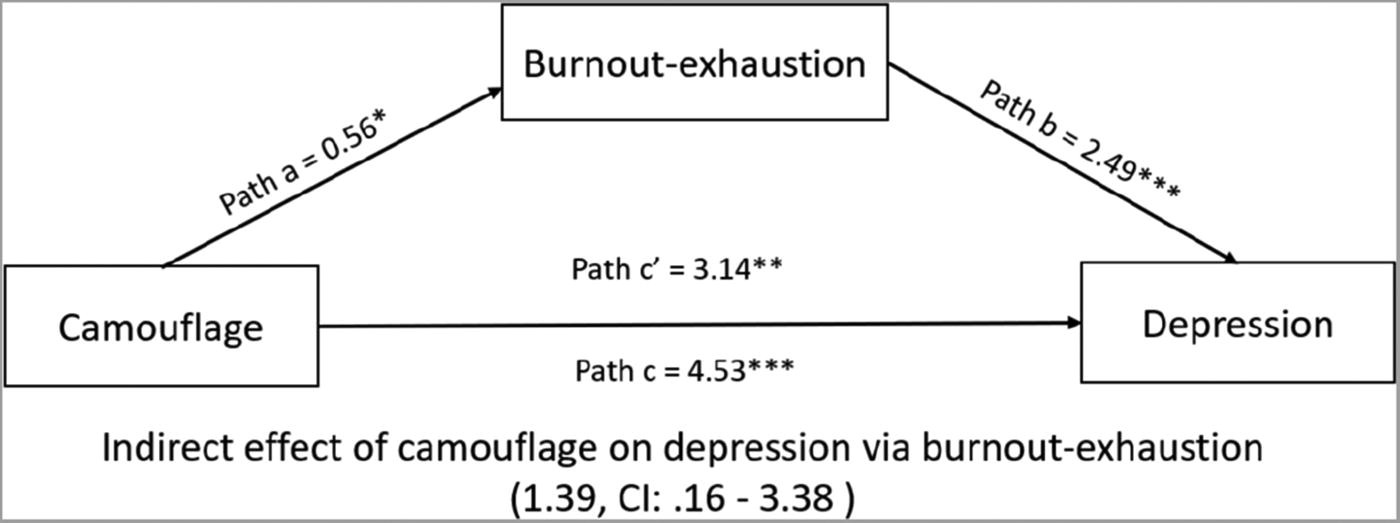
The mediating role of burnout-exhaustion in the link between camouflaging autistic traits and depressive symptoms.
Discussion
This study examined the relationships between camouflage, burnout-exhaustion, and depression in autistic adults. The concept of autistic burnout has recently emerged as a focal point in autism research and sheds light on a previously underexplored dimension of the lived experiences of autistic individuals.19,20 The current study contributes to this emerging discourse by demonstrating the mediating effect of burnout-exhaustion on the link between camouflage and depression. The results suggest that at least one of the possible paths between camouflage and depression is via burnout. Camouflage often requires significant physical and mental efforts, such as controlling, suppressing, or hiding emotional expressions or gestures that might be considered atypical. While camouflage may have some immediate benefits, it is nonetheless associated with mental and physical exhaustion 4 since continuous efforts to monitor and adjust one’s behavior may build up to a level of exhaustion and overall burnout. Following continued high levels of burnout-exhaustion may undermine individuals’ ability to cope with life’s demands, leading to depression. It is important to note that the findings indicated partial mediation, suggesting the existence of additional pathways between camouflaging and depression. For example, self-image may be an additional mediator in this association, as camouflage may directly affect self-image.11,9 Another potential way camouflage may impact depression is through “thwarted belongingness,” a well-known risk factor for depression and suicide ideation.38,39 Further research is needed to establish whether these are significant paths.
In the current study, we defined burnout as a state of emotional and physical exhaustion related to the demands of daily life. We measured burnout using a burnout-exhaustion scale tapping a general sense of burnout. We adapted this scale according to recommendations from autistic community experts for the purpose of this study. Researchers are developing other measures of autistic burnout that include further dimensions, such as “heightened autistic self-awareness.” 19 This dimension taps to what extent “repetitive behaviors increase” or “loss of ability to hide that I am autistic” occurs. 26 However, researchers have yet to validate such multidimensional measures. For example, the dimension of “heightened autistic self-awareness”19,20 may partly overlap with camouflage, which is not necessarily a default aspect of autistic burnout but a separate construct. Clarifying the debate over the definitions of autistic burnout is hence imperative for a better understanding of this term and for the advancement of this field. An array of measures for autistic burnout would support doing so. For example, comparing the Autistic Burnout Severity Items developed by Arnold and colleagues 19 and the Autistic Burnout Measure developed by Mantzalas and colleagues 28 may point out which dimensions are more robust.
In the current study, we chose the PBA after consulting with autistic community partners, since its wording was straightforward and clearer than other potential measures. Straightforward and clear wording can make measuring more accurate, especially when conducting research that primarily relies on self-reporting and focuses on the autistic population, who often exhibit enhanced attention to detail and lower tolerance for ambiguity. Future studies could replicate findings by using longitudinal design, and studies using multidimensional measures of burnout could further advance the field by providing insight into additional aspects of the associations reported in this study. For example, the linkage between sensory sensitivity and burnout and how dominant they are in the mediation process is still to be explored.
Burnout-exhaustion is strongly correlated with depression, aligning with the findings reported by Arnold et al. 26 This raises the question as to the potential overlaps and differences between these concepts. From a theoretical standpoint, we consider depression and autistic burnout to be separate concepts. The defining symptoms and clinical picture of depression include a significant impairment of self-image, which may manifest in feelings of guilt and inadequacy and may even give rise to suicidal ideation. Burnout reflects the extreme depletion of mental or physical resources as a result of overload, and its neglect over time may impair individuals’ self-image consecutive to impaired functioning, as reported by Higgins and colleagues, 20 and give rise to depression symptoms. These mechanistic differences between depression and burnout are critical because they may affect intervention efforts. For instance, cognitive-behavioral interventions are known to effectively treat depression 40 but may be ineffective or even harmful for managing burnout.
The autistic community’s emphasis on the distinction between burnout and depression also supports the separation of the two concepts. Nonetheless, in the literature on occupational burnout, there has been an ongoing debate about this distinction or lack thereof. Some argue that burnout is part of depression, 41 while others claim that the antecedent factors, namely, the primary symptom of anhedonia and impaired self-image, differ between depression and burnout. 42 Findings based on factor analysis supporting the latter claim that occupational burnout is distinguished from depressive symptoms.43–45 In addition, researchers conducting longitudinal studies on the associations between occupational burnout and depression endorse and reconfirm the notion that burnout and depression are two different entities.46–48 Researchers need to further examine these questions in the context of autistic burnout. The current study also found that burnout-exhaustion is slightly more strongly correlated with the cognitive-affective symptoms of depression than the somatic symptoms of depression, suggesting a stronger link between burnout-exhaustion to some aspects of depression than others, which points to the need to further examine the relations between these constructs.
Limitations
The current study has several limitations. Its cross-sectional design prevents inferring causality. Future studies should implement a longitudinal design to further confirm the findings. Longitudinal studies would also make it possible to test for a potential bidirectional association between burnout and depression, that is, that burnout may increase the risk for depression but depression may contribute or co-occur with burnout as well, as reported in a qualitative study by Hull and colleagues. 4 In addition, we did not independently confirm the diagnosis of autism apart from self-reports on the AQ-Short. We used a convenience sampling method that mainly recruited participants via autism forums on social media. Thus, the study did not tap a representative sample of autistic people. Furthermore, the sample size was small due to the outbreak of a war in Israel that prevented further recruitment. This may also explain the high rates of depression we found in the current study compared with previous studies, 1 although the estimated prevalence of depression in autistic adults varies considerably between samples, with some studies reporting rates as high as 70%1,49 and other reports <1%. 50 Finally, we focused on a single factor of general burnout centered on the experience of exhaustion. Future studies should explore other dimensions of autistic burnout beyond mental and physical exhaustion, such as detachment and heightened sensory sensitivity.
Conclusion
The path between camouflage, burnout-exhaustion, and depression sheds light on the mental strain of camouflage and the ways it can increase the risk of depression in autism. The potential implications for treatment and prevention include the need to identify when camouflage is excessive and whether burnout is present, to prevent downstream deterioration to major depression. Moreover, clinicians should consider burnout a risk factor when assessing depression in autistic individuals. Interventions such as affirmative therapy, which affirms the experience of autistics living in a world mainly adapted to neurotypicals and provides them with coping strategies, could help prevent depression. We hope to replicate these preliminary findings with a larger, more representative sample in a longitudinal design.
Footnotes
Acknowledgments
We wish to thank Tal Alon Mann, Michal Berkovich Bar, Ella Kurilan, Shai Laadan, and the other members of the Collaborative Lab for Mental Health and Suicide Prevention among autistic people for their valuable advice during the research process.
Authorship Confirmation Statement
J.B. was responsible for conceptualization, methodology, data analysis, and writing and editing. E.S.M. was responsible for conceptualization, methodology, and editing. S.B.Y. was responsible for conceptualization, methodology, and editing.
Author Disclosure Statement
The authors have no conflicts of interest to declare.
Funding Information
This study received no funding.

References
Supplementary Material
Please find the following supplemental material available below.
For Open Access articles published under a Creative Commons License, all supplemental material carries the same license as the article it is associated with.
For non-Open Access articles published, all supplemental material carries a non-exclusive license, and permission requests for re-use of supplemental material or any part of supplemental material shall be sent directly to the copyright owner as specified in the copyright notice associated with the article.
