




Abstract
Research has indicated persistently high rates of loneliness among autistic adults that can have marked negative effects on both mental and physical health. To synthesize existing evidence and provide a foundation for future research on this topic, we have proposed an empirically informed Autism and Loneliness Theoretical Framework that depicts possible contributing factors to the emergence and persistence of loneliness in this population. Our proposed framework integrates autism research with models of loneliness in the general population to illustrate that certain characteristics (including, but not limited to, autistic traits) may be linked with unsuccessful social interactions in a non-autistic majority world (Individual Barriers). This occurs within the context of Social Environment Barriers, which may further exacerbate social disconnect for autistic adults due to limited social opportunities, bullying, and/or lack of acceptance. The potential correlates of loneliness may exist on biological, behavioral, cognitive, and emotional levels for autistic adults (Empirically Supported Correlates of Loneliness). Based on this framework, we identify areas for future research, including directionality, mechanisms, moderators, longitudinal patterns, and clinical practice. Expanding autism research within each of these areas will have far-reaching impacts for autistic adults.
Community Brief
Why is this topic important?
The topic of loneliness in autistic adults is important because recent research tells us that loneliness is a common problem for autistic adults. Feelings of loneliness may cause and/or worsen physical and mental health challenges.
What is the purpose of this article?
The purpose of this article is to create a new framework to help identify things that may explain why some autistic adults are lonely for a long time. This framework was created by using models of loneliness that already exist in the general population combined with information from research studies on autism and loneliness. No new data were collected or analyzed to develop this framework.
What does the framework show?
The framework we propose suggests that autistic adults may experience multiple types of barriers to desired social connection in a non-autistic majority world, including personal characteristics (including, but not limited to, autistic traits; we call these Individual Barriers) and other experiences within the social world (e.g., limited social opportunities, bullying, and/or lack of acceptance; we call these Social Environment Barriers). In addition, loneliness is likely related to biological, behavioral, and cognitive differences, all of which may make the desired social connection even harder for autistic adults.
What personal or professional perspectives do the authors bring to this topic?
The authors of this article include two people who work with autistic children and adults in clinical practice and have years of research and clinical training related to autism.
How will this article help autistic adults now or in the future?
This article will guide future research that wants to figure out why so many autistic adults feel lonely, why loneliness tends to persist or get worse over time, how it affects autistic adulthood, and what can be done to help. Answers to these questions are important because the consequences of loneliness can be so serious.
Overview: Autism and Loneliness Theoretical Framework
Among autistic people who seek social human connections, some indeed have successful and fulfilling relationships—with family members, friends, and romantic partners.1,2 However, autistic people oftentimes desire more or higher-quality relationships3,4 and therefore experience loneliness—a perceived mismatch between actual and desired social connections. 5 A growing body of autism research has indicated high and persistent rates of loneliness that increase in adulthood,6,7 a particularly challenging time for autistic people involving social restructuring and frequent loss of services and supports.8,9 Given that loneliness is thought to have marked negative effects on both mental and physical health,10–15 a comprehensive understanding of the emergence and persistence of loneliness among autistic adults can have far-reaching implications.
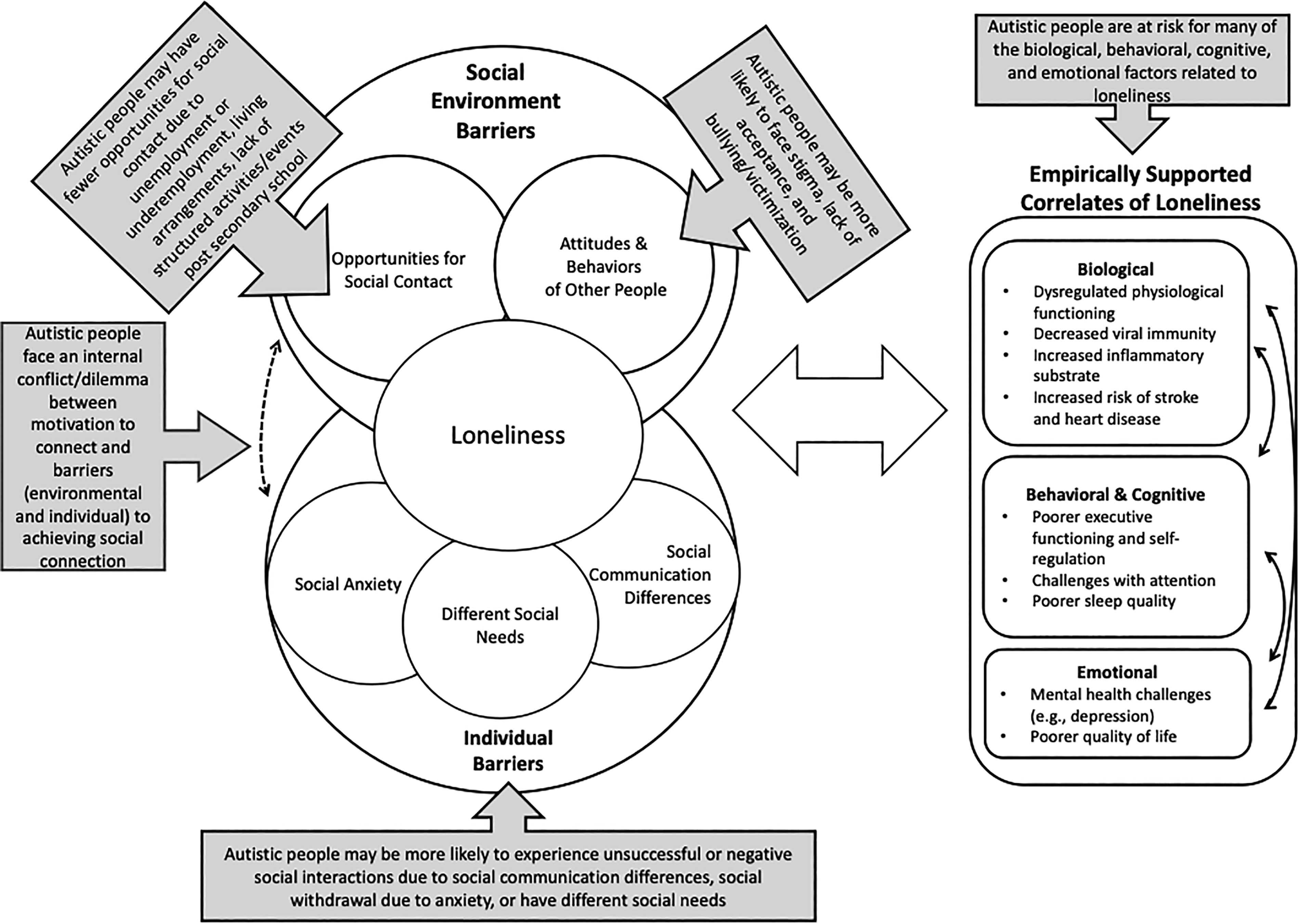
We propose the Autism and Loneliness Theoretical Framework to provide direction for advancing autism research on this topic (Fig. 1). Leveraging loneliness models in the general population16–18 and the current literature base on loneliness in autism, our proposed model offers empirically informed and testable hypotheses about why this population is at such a high risk for loneliness and why loneliness seems to persist or increase over time. Many, although not all, autistic adults desire social connection 19 and can be characterized as “socially motivated.”20,21 Achieving desired levels of social connection, however, is often thwarted by a multitude of barriers (Individual and Social Environment, described below). Because of this, loneliness for autistic adults involves a complex internal tension between their desire for social connections and the barriers they encounter in achieving these connections (see “Paradoxical Loneliness Loop” 22 )—resulting in the perception of unmet social needs. As such, the theoretical model and framework we propose for autism and loneliness (Fig. 1) expand upon this idea by identifying multiple interconnected barriers and correlates. One component depicts personal characteristics that may be linked with unsuccessful social interactions in a non-autistic majority world (e.g., social communication differences, social anxiety; Individual Barriers). These within-person barriers occur within the context of a social environment—another model component—which may further exacerbate isolation and disconnect for autistic adults due to limited social opportunities, bullying, and/or lack of acceptance (Social Environment Barriers). The potential correlates of loneliness for autistic adults may exist on biological, behavioral, cognitive, and emotional levels (Empirically Supported Correlates of Loneliness), all of which may feed back into the barriers described above. We note that the empirical evidence that informed this model is primarily focused on autistic adults who communicate verbally, which does not include all autistic adults (i.e., those who are nonspeaking and/or have intellectual disability). We are hopeful this model can be a starting place for future research and model iterations. Below, we provide the following: (1) a description of each model component, 1 (2) synthesis of how autism in adulthood intersects with the respective model component, and (3) further in-depth analysis of each dimension related to autism.
Author Positionality and Community Involvement
It is important to acknowledge the positionality of the authors of this framework. All authors acknowledge their position as highly educated cis-gendered women in academia in the United States with extensive expertise on this topic as the result of research experiences and training. The authors work with autistic children and adults in clinical practice as psychologists. This expertise was critical for developing the framework and interpreting existing research.
Individual Barriers to Social Connection
The loneliness models of Cacioppo16,17 and de Jong-Gierveld 18 were developed based on people in the general population and identify factors that may predispose someone to loneliness—here termed Individual Barriers (Fig. 1). These may include “personality characteristics,” such as concept of self, social anxiety, and introversion/extroversion, that can impact loneliness 18 as well as social needs. 23 These effects are thought to occur both directly (e.g., social anxiety leading to avoidance of social situations) and indirectly (e.g., through impacting living arrangements). We analyze potential Individual Barriers (Fig. 1) relevant for autistic adults in the section below.
Autism and individual barriers
Autistic people may be more likely to experience unsuccessful or negative social interactions in a non-autistic majority world due to a number of Individual Barriers such as social communication differences, social withdrawal due to anxiety, or different social needs.
Social communication differences
Social communication differences are a core component of autism 24 and have been directly linked with loneliness. 14 This includes difficulties with social–emotional reciprocity (e.g., back-and-forth conversations) and limited use of nonverbal communication (e.g., less eye contact or gesture use). Because of these differences, autistic people often face challenges in cultivating social relationships. This is particularly true between different neurotypes (i.e., when there is a mismatch of autistic traits between two social partners or between neurodivergent people and neuromajority25–28 ).
High rates of anxiety
Anxiety—commonly experienced by autistic adults29,30—can set the stage for loneliness.6,18 A common behavioral manifestation of anxiety is avoidance. 24 In the case of social anxiety—marked persistent anxiety surrounding multiple social situations that almost always provoke fear—social withdrawal is a behavioral response that becomes negatively reinforced over time. As such, autistic adults with social anxiety may be more likely to feel lonely due to social avoidance.
Different social needs
Autistic adults may have different social needs compared with non-autistic adults, which may increase the likelihood for loneliness. For example, there is some evidence that loneliness is less tightly linked with friendship 31 and autistic traits 3 among autistic youth and adults, respectively, compared with those who are not autistic. That is, while having friendships and fewer autism characteristics seems to be protective against loneliness in non-autistic adults, the same may not be true for autistic people. 32 In addition, it is not merely the existence of friends but also the quality of those relationships that seems to matter. For example, friends who appreciate social differences and do not expect adherence to social norms seem to lead to the most successful autistic friendships, according to qualitative descriptions from autistic young adults. 4 Notably, friendship expectations and relational schemas have long been known to be shaped over time by multiple influences, including societal (and most likely neurotypical) messages.33–36 Thus, ideas of what relationships “should” look like may play a role here, as well.
Moreover, qualitative evidence suggests that social isolation may sometimes serve as an important respite from the strain of everyday activities (i.e., “restorative respite”) for autistic adults.3,37 As such, the complex social needs of autistic youth and adults—including both a need for respite and for supportive and accepting social relationships—require sophisticated navigation between social worlds.
Social Environment Barriers to Social Connection
The Social Environment consists of experiences of repulsion/isolation or attraction/connection16,17 that are involved in the etiology of loneliness.17,38 These include interpersonal dyadic processes, environmental and cultural factors (e.g., living far from friends/family, chronic work stress), and “background variables” (e.g., employment status, housing/living arrangement, relationship status, and community size. 18 ) As de Jong-Gierveld explains, “in our society, social structural characteristics… organize the opportunities that people have to create and maintain on optimal network of social relationships.” 18 As such, the Social Environment influences the quantity and quality of social network connections—elements related to loneliness.
Autism and social environment barriers
Autistic adults may be at increased likelihood to encounter Social Environment Barriers that interfere with social connection—on large-scale societal levels (e.g., hiring practices that influence employment) and smaller-scale interpersonal levels (e.g., bullying). This may include fewer opportunities for social contact (e.g., due to unemployment or underemployment, structure of living arrangements, lack of structured activities/events postsecondary school) and negative behaviors and attitudes of other people (e.g., stigma, lack of acceptance, and bullying/victimization).
Limited social opportunities
For autistic adults, the frequency and availability of social opportunities may be limited due to a confluence of factors. In particular, once autistic students exit high school, and sometimes college, there is often a drastic decline in structured supports 8 and social opportunities. 39 In addition, autistic adults are more likely to be either unemployed or underemployed than non-autistic adults.40–42 The work environment offers opportunities not only to interact with colleagues as acquaintances but also to form deeper relationships and coworker friendships.43–45 As such, autistic adults who are unemployed are unable to leverage the social opportunities afforded by work environments. Social opportunities may also be limited by practical barriers such as financial constraints, living situations (e.g., living with parents), and sensory overstimulation in noisy communal areas. 3
Negative behaviors and attitudes of other people
Moreover, autistic adults are at higher likelihood than the general population to experience bullying and victimization—intentional physical, verbal, relational, or cyber behavior meant to cause harm that is related to a real or perceived imbalance of power.46–48 In addition, studies find that perceived lack of acceptance and stigma toward autistic adults in society more broadly can have significant implications for the well-being of autistic adults.37,49,50 Therefore, a combination of direct victimization and real and perceived lack of acceptance from other people and society may contribute to or exacerbate existing challenges forming and maintaining social connections for autistic adults. These experiences may bring up acute feelings of loneliness “in the moment” and may also lead to more trait-like loneliness due to social withdrawal.
Connections Between Individual and Environmental Barriers
The interplay between Social Environment Barriers and Individual Barriers is likely complex. That is, while these factors are described separately in the sections above, the reality is that people exist within different contexts; the environment and personal experiences are inherently connected. For example, external experiences of ostracism and rejection (Social Environmental Barriers) may lead to a tendency to withdrawal socially and worry about the perception of others (i.e., social anxiety as a learned response; Individual Barriers), which may influence living situation decisions (e.g., living alone; Social Environmental Barriers), and so forth. As another example, the level of social communication difficulty or autism traits (Individual Barriers) is related to the likelihood of bullying and victimization47,51 (Social Environmental Barriers). Moreover, people who feel lonely may also struggle to successfully socially engage (Individual Barriers) in contexts that offer opportunity for connection (Social Environmental Barriers). As such, at this time, our model does not pose clear unidirectionality between Individual Barriers, Social Environmental Barriers, and Loneliness but instead depicts interconnected circles and a dashed bidirectional arrow with Loneliness situated at the center. It is the tight intertwining of these model components that we suspect maintains experiences of loneliness over time.
Empirically Supported Correlates of Loneliness
Research in the general population has identified a combination of biological, behavioral, cognitive, and emotional factors that are linked with loneliness. Evidence indicates that perceived social isolation (i.e., loneliness) is related to neurobiological and physical health factors, particularly those that increase the risk for premature mortality, including physiological dysregulation, lower viral immunity, and increased risk of stroke and heart disease. 52 In addition, behavioral and cognitive factors such as challenges with self-regulation or executive functioning are associated with higher rates of loneliness.53–56 Lastly, mental health and quality of life have also been linked with loneliness. 13 For example, there is compelling evidence that depression and loneliness are highly correlated.57–59 Thus, we have integrated three sets of empirically supported correlates (biological, behavioral/cognitive, and emotional) into our framework (Fig. 1) and described why these are particularly salient to autistic experiences in the section below.
Autism and empirically supported correlates of loneliness
Many of the correlates of loneliness identified by studies of the general population are found to be areas of difficulty for autistic adults. Notably, directionality is unclear; it may be that experiencing loneliness yields poorer mental and physical health outcomes for autistic adults, yet it may also be that autistic people with poorer mental and physical health are more likely to feel disconnected from others. Moreover, both scenarios could be true. Regardless of directionality, the clear elevation in these factors highlights the need to further explore how loneliness intersects across biological, behavioral/cognitive, and emotional domains.
Higher rates of correlates of loneliness
Regarding emotional correlates of loneliness, studies indicate that compared with non-autistic adults, autistic adults experience greater emotional challenges, including anxiety, depression, 29 emotion dysregulation,60,61 and quality of life.62,63 In terms of behavioral and cognitive correlates of loneliness, for example, autistic adults are also at high likelihood for executive dysfunction. 64 Related to biological correlates of loneliness, autistic people are found to experience high rates of physical health conditions65–68 and differences in neurobiological functioning. 69
Future Directions for Research
Based on our proposed loneliness and autism framework (Fig. 1), we identify key directions for future research on this topic, including directionality, moderators, mediators, longitudinal patterns, expanded sample characteristics, and clinical practice. Focusing on these areas of research will have direct applicability for improving the quality of life of autistic adults.
Directionality
Given the robust links between all model components (Individual Barriers, Social Environment Barriers, Loneliness) along with aspects of well-being (physical and emotional), there is a need for a clearer understanding and testing of directionality of effects. As described above, we suspect that bidirectional influences may be at play, especially between Individual Barriers and Social Barriers, yet this needs to be tested empirically. It is also unclear whether mental and physical health outcomes are the result of loneliness, cause of loneliness, or both. Answering these types of questions requires longitudinal data, large samples, and advanced statistical approaches. A statistical technique that can examine directionality is the cross-lagged panel model (or random-intercepts cross-lagged panel model) and its extensions.70,71 In brief, these statistical approaches allow testing of autoregressive effects (i.e., impact of a variable on that same variable at a later time point) and cross-lagged effects (i.e., impact of one variable on a different variable at a later time point). As such, a minimum of two time points of longitudinal data are required. Determining directionality can have direct implications for clinical practice. For example, will targeting loneliness lead to future improvement in symptoms of psychopathology, or will targeting psychopathology lead to future improvement in loneliness, or both?
Longitudinal patterns of loneliness
The proposed loneliness model identifies factors that may cause loneliness to emerge and persist over time. However, only one study to date that we know of has tracked patterns of loneliness across time in autistic people. 7 Additional longitudinal studies are needed to investigate whether these identified factors indeed predict how loneliness unfolds over time.
Longitudinal data would also help capture whether certain life events (e.g., high school or postsecondary school exit, moving out of parental home, marriage, parenthood) may be tied to changes in loneliness. Research in the general population suggests that major life events may trigger acute increases in loneliness. 72
Furthermore, longitudinal data can also serve to characterize long-standing chronic loneliness (trait-like) as well as more “in the moment” loneliness (state-like) in autistic adults. Repeated sampling over a specified window of time, for example, using the ecological momentary assessment (EMA), would yield the type of fine-grained data needed to capture daily experiences of loneliness in this population, similar to studies in the general population. 73
Protective and risk factors (moderators)
Given the early stages of research on loneliness and autism, there is not enough evidence to identify potential moderators of effects. It is likely that some autistic adults may be more or less susceptible to loneliness when encountering the identified Social Environment Barriers and Individual Barriers. In other words, the impact of barriers may differ across people. For example, one study suggests that social and nonsocial hedonic capacity moderates the connection between autism characteristics and loneliness among autistic and non-autistic adults. 74 Other potential moderators may include degree of social motivation, coping capacity, or expectations for relationships (e.g., frequency or mode of social contact). As an example, encountering barriers to connection in the social environment may not be as detrimental for someone with highly effective coping skills.
Mechanisms (Mediators)
Another limitation of current research on loneliness among autistic adults relates to underlying cognitive and behavioral mechanisms (i.e., mediators). It is possible that a third variable exists that explains the connection between the identified barriers and loneliness. For example, perhaps it is through eliciting feelings of “otherness” or “difference” that barriers cause loneliness in this population. In addition, within non-autistic populations, a series of cyclical processes—Cacioppo’s Loneliness Regulatory Loop Model16,17—are thought to perpetuate loneliness over time. More specifically, it is suggested that the perception of social isolation can paradoxically elicit a combination of hypervigilance for social threat (i.e., to boost self-preservation) and increased motivation to connect with others (i.e., to solve the problem of loneliness). Cognitive biases then also negatively color the social experiences of a lonely person, which can result in lonely individuals engaging in behaviors that make them feel more lonely. 16 In addition to the utility of EMA described above, this approach could also support this type of mechanistic and cyclic exploration (i.e., what kinds of thoughts and behaviors are triggered by loneliness that, in turn, predict future loneliness?).
Expanded sample characteristics
As mentioned previously, current research on loneliness and autism is primarily limited to samples of autistic adults without intellectual disability who communicate verbally. It is unclear the extent to which the proposed model applies to autistic adults with intellectual disability and/or people who do not communicate verbally. Future research on this topic should expand to include this underrepresented group. 75 We are hopeful that later versions of our proposed model will be able to empirically integrate the experiences and needs of less verbal people who often have quite different options for social environments. 76
Autistic adult review of model
Given the benefits of participatory autism research to the community partners, researchers, and research itself,77,78 review of this framework by autistic adults will be critical to the potential impact of this work. As such, future studies should involve autistic adults in evaluating the model to inform future model iterations.
Clinical practice: Assessment and interventions
A critical limitation to this area of research is the lack of available measures that have been validated for use with autistic people. 15 Adaptation and/or development of loneliness measures and rigorous psychometric testing in autism are needed to provide a solid basis for future scientific inquiry and use in clinical practice. This is particularly important in the context of emerging evidence that the psychometric performance of questionnaires in autistic samples is different compared with the general population. 79 More specific to loneliness, qualitative data indicate issues with existing loneliness tools. These data call into question the validity of typical constructs in autism, including failing to distinguish between the characteristics of loneliness and the experiences of autism (e.g., being “in tune” with people) and assumptions regarding experiences of loneliness (e.g., being alone is inherently a negative experience that contributes to loneliness). 80
Given the close links between loneliness, mental health, and social functioning, we also recommend assessing loneliness as an outcome of interventions designed to target related constructs (e.g., social competency, social anxiety, depression). Finally, interventions are needed that address the complexities of loneliness in autistic adults, which may involve targeting barriers to social connection that exist at the individual and environmental levels. This may include, for example, leveraging a person’s interests to identify contexts or activities that bolster social identity and thus increase opportunities for social contact and connection (Social Environment Barrier). 81
Conclusion
Our goal in creating the Autism and Loneliness Theoretical Framework (Fig. 1) is to synthesize existing theory and evidence to provide a foundation for future research seeking to identify how loneliness emerges, persists, and impacts the lives of autistic adults. We have identified key areas for future research on loneliness in autism, including directionality, moderators, mechanisms, longitudinal patterns, expanded sample characteristics, and clinical practice. Expanding autism research within each of these areas will have far-reaching impacts for autistic adults.
Footnotes
Acknowledgment
The authors thank the members of the Lord Lab for their ongoing support and feedback on ideas discussed in this article related to loneliness and autism.
Authorship Confirmation Statement
H.S.: Conceptualization, writing—original draft, visualization, and funding acquisition. C.L.: Writing—review and editing, supervision, and funding acquisition. The article has been submitted solely to Autism in Adulthood.
Author Disclosure Statement
The authors have no conflicts of interest to report relevant to the content of this article.
Funding Information
This work was supported by the Autism Speaks Postdoctoral Fellowship (P.I.: H.S.) and the National Institute on Aging [R01AG080599] (PI: C.L).