




Abstract
Background:
With growing visibility of adult autism in society, understanding how autistic adults are characterized in public discourse is paramount for anticipating dynamics of inclusion/exclusion. Media content can reflect and shape cultural stereotypes about social groups. Especially potent mechanisms for expressing and reinforcing stereotypes are “generic statements,” that is, generalizations about a group’s traits or behavior. This article reports an analysis of generic statements made about autistic adults in British newspapers across a 10-year period.
Methods:
We electronically searched six national UK newspapers for articles discussing adult autism, which were published between 2014 and 2023. We extracted for analysis 251 articles that contained at least one generic statement about autistic adults. In total, this dataset contained 622 generic statements, which were subjected to content analysis to determine the content and relative frequency of the characteristics ascribed to autistic adults.
Results:
The analysis identified 26 attributes ascribed to autistic adults, which were organized into two overarching categories of generic statements: deficit-focused and diversity-focused. Deficit-focused generic statements emphasized impairments in social skills, cognitive/behavioral rigidity, or vulnerability/dependency. Diversity-focused generic statements emphasized difference and heterogeneity, highlighted distinct strengths of autistic adults, or challenged specific deficit-focused stereotypes. Deficit-focused generic statements significantly outnumbered diversity-focused statements in the dataset as a whole. However, the dominance of deficit-focused statements primarily applied to the earlier years analyzed (2014–2018), with diversity-focused statements drawing level as the decade progressed.
Conclusion:
Results suggest that diversity-focused narratives have gained relative strength in recent years but that deficit-focused stereotypes retain strong residual presence. By establishing the specific components of the most prevalent stereotypes of autistic adults, results offer evidence-based targets for public information or destigmatization campaigns.
Community Brief
Why is this an important issue?
Despite growing awareness of adult autism, autistic adults still often face stigma, that is, social disapproval or disrespect. The stereotypes that circulate about any social group influence how that group is perceived and treated in real-world situations. Understanding what stereotypes are attached to autistic adults in popular media can give important insights for efforts to anticipate and reduce stigma.
What was the purpose of this study?
This study aimed to answer two questions. First, how are autistic adults characterized in the British press? Second, have media representations of autistic adults changed across the past 10 years?
What did the researchers do?
Researchers used an electronic database to find articles discussing adult autism, which were published in six British newspapers between 2014 and 2023. They identified 622 “generic statements” about autistic adults, that is, claims that made generalizations about autistic adults’ traits or behaviors. Using specialist software, these generic statements were classified to establish the range of characteristics that the media attributed to autistic adults.
What were the results of the study?
The analysis identified 26 attributes that the media associated with autistic adults. These fell into two overarching categories: deficit-focused and diversity-focused. Deficit-focused generic statements emphasized autistic adults’ difficulties with social skills, cognitive/behavioral rigidity, or vulnerability/dependency. Diversity-focused generic statements emphasized difference/heterogeneity, highlighted autistic adults’ strengths, or challenged negative stereotypes. Overall. there were more deficit-focused than diversity-focused statements in the articles analyzed. However, the number of diversity-focused statements grew as the decade progressed.
What do these findings add to what was already known?
As the first dedicated study of how stereotypes of autistic adults circulate in popular media, this study pinpoints the specific characteristics commonly ascribed to autistic adults. It also supports previous suggestions that positive diversity-focused narratives about autism are gaining strength in mass media.
What are potential weaknesses in the study?
The analysis only explored written text from a limited number of British newspapers. In addition, the study does not illuminate how autistic or non-autistic audiences might respond to this media content.
How will these findings help autistic adults now or in the future?
The findings suggest that autistic advocates’ efforts to promote diversity narratives are resonating in mass media, but deficit-focused narratives remain strong. By identifying the most common stereotypes of adult autism, the results can inform efforts to reduce stigmatization and promote inclusion of autistic adults.
Background
Traditionally considered a disorder of childhood, there is growing recognition among clinicians and health authorities that autism represents a lifelong form of neurodiversity, evidenced by increasing rates of adult diagnosis.1,2 However, autistic people still face high levels of stigma throughout the lifecourse. 3 As autistic adults become more visible in wider society, understanding how they are represented in public discourse is key to anticipating dynamics of social inclusion and exclusion. 4 This article reports an empirical analysis of the characteristics attributed to autistic adults across 10 years of British news media.
Social categories and stereotypes
While adult autism is clinically defined as a psychiatric diagnosis, in wider society it also functions as a social category. A fundamental aspect of the formation of a meaningful social category is the attribution of defining characteristics to that category, that is, characteristics understood to be shared by all or most members of that category. 5 Social understandings of psychiatric categories can include the symptoms or diagnostic criteria that define that clinical diagnosis but may also incorporate nonclinical characteristics. 6 For example, lay understandings of people with psychotic disorders characterize them as hostile and incompetent. 6 Such ascriptions represent stereotypes, defined as generalizing beliefs about a particular group of people, which are widely circulated and endorsed across society. 7 Stereotype exposure can negatively affect the thought, emotion, and behavior of minority group members.8,9 Stereotypes can also entail a “self-fulfilling prophecy” mechanism of stereotype threat, through which anxiety about the risk of confirming a negative group stereotype impairs performance in related behavioral domains.10,11 For instance, awareness that others stereotype autistic adults as socially inept could increase their nervousness or awkwardness in social situations, thereby reinforcing the stereotype.
Understanding the content of prevailing stereotypes about social groups—that is, the characteristics ascribed to a group—is critical for predicting emotional and behavioral responses toward members of those groups. 12 Stereotypes can cultivate prejudice and justify discrimination against certain groups by disparaging their behavior, character, or capacity. However, stereotypes are not exclusively pejorative in content, due to contemporary social norms that discourage the expression of overt hostility toward disadvantaged groups.13,14 Positively valenced stereotypes, which assign a group favorable characteristics, are pervasive across society and can boost the performance, self-esteem, and empowerment of group members. 14 However, positive stereotypes can also harm group members by homogenizing and depersonalizing them, establishing unrealistic expectations, and legitimizing the social hierarchy that places them in a subordinate position. 14
Research that has surveyed neurotypical populations to elicit their stereotypes about autism has identified predominantly negative content, such as associations with poor social skills and difficult personalities.15,16 This is tempered by certain positive associations, particularly in the notion that autistic persons are “geniuses” and “savants” or universally have “special talents” in which they excel. 17 Some in the autism community have raised concerns about this tendency to construe autism in terms of “superpowers.”18,19 Although superficially positive, such stereotypes are unrepresentative of the wider autistic population (fewer than 10% of autistic people are classed as savants 20 ), downplay the challenges faced by many autistic persons, impose a burden of unrealistic expectations, and can be patronizing in tone. Research that elicits autistic people’s perspectives on stereotypes indicates they are conscious of the content of stereotypes about their group, sensitive to the negative consequences of stereotypes for their lives, and dislike the presumed homogeneity of autistic people inherent in prevailing stereotypes.4,21,22
In the public mindset, autism has traditionally been associated with children, and limited research has investigated stereotypes specific to autistic adults. One study found that while neurotypical people may explicitly profess positive attitudes to autistic adults, their implicit or unconscious associations remain negative. 23 This discrepancy represents a challenge for stereotype research using self-report data, suggesting that participants may adjust their responses when aware that their attitudes to autistic adults are being examined. In such cases, exploring naturally occurring public discourse, such as media content, offers a valuable opportunity to tap the stereotypes about autistic adults that circulate in a society.
Media representations of autism
Numerous studies of autism coverage in entertainment media, such as film and television, indicate that inaccurate and/or limited portrayals of autistic people are commonplace. 24 Portrayal of autism in entertainment media often characterizes autistic individuals as geniuses, usually with a severely restricted emotional experience. 25 Exposure to such fictional representations can shift public attitudes. 24 For example, one study found that showing participants an episode of a television show depicting a highly skilled autistic doctor led to more positive associations with autism, 26 while another reported that viewing a fictional autistic character describing their experience of autism weakened agreement with negative stereotypes. 27
Such findings confirm the importance of media content as an influence on public understandings of autism. However, due to the contrived narratives and self-selected audience of film or television shows, entertainment media do not directly illuminate how autism is represented in everyday discourse across society. Mass news media, such as national newspapers, arguably offer closer insight into the common understandings that percolate in a particular time and place. While news media content does not fully reflect or determine lay understandings, it can express widely shared views and partially shape public opinion, particularly regarding more abstract topics with roots in scientific or medical categories.28–30
Coverage of autism in news media has increased in recent decades. 31 A scoping review of research on media coverage of autism found several common trends in newspaper content internationally: most coverage addresses children, with the voices of autistic people themselves largely absent, and is negatively valenced with plentiful stereotypes. 32 However, minimal research has itemized the exact content or relative prominence of the stereotypes contained in newspaper coverage. A study of Australian print media between 1996 and 2005 found that autistic people were represented as dangerous/uncontrollable and unloved/mistreated, 33 while an analysis of Chinese newspapers between 2003 and 2012 found dominant images of autistic people as children, patients, or savants. 34 Similarly, a study of 255 British newspaper articles published between 1999 and 2008 found that most content focused on children, with autism predominantly portrayed in terms of suffering/burden or extreme/sensationalized traits. 35 A study of US and UK newspapers between 1998 and 2012 found over two-thirds of articles contained stigmatizing cues such as reference to psychiatric symptoms or social skill deficits, with significantly more focus on negative than positive outcomes. 36 However, a study of one US newspaper (the Washington Post) suggested references to neurodiversity and autistic strengths increased between 2007 and 2016. 37 Most recently, an automated analysis of a large corpus of British newspapers between 2011 and 2020 identified prominent associations of autism with adversity, comorbidities/medical model, negative language, disabilities/needs, savant/genius stereotypes, and children (especially boys); this analysis also indicated a slow temporal shift toward more positive associations. 31
In prior analyses of media coverage of autism, which predominantly cover the early 2000s, most of the content analyzed pertains to autistic children. 31 There is some evidence that in the past decade, adults have become more visible in public representations of autism, for example, in autism society websites. 38 Thus, an up-to-date analysis that specifically explores media representations of autistic adults is imperative. Moreover, an analysis that maps the range and relative prominence of stereotypes of autistic adults that circulate in mass media is needed to identify the specific conceptions that could predict social inclusion versus exclusion. In textual data, stereotypes are most clearly operationalized through “generic statements,” defined as generalizations about members of a category (e.g., “autistic adults can’t understand other people’s emotions”). For a lay audience, generic statements require little factual evidence to be judged credible 39 yet are highly influential in the development of concepts. 40 For instance, exposure to generic statements about a social category encourages essentialist beliefs that portray membership of that category as innate and homogeneous. 41 Generic statements about autistic adults in media text therefore offer a window into the prevailing cultural stereotypes that influence how autistic adults are treated in real-world social situations.
The current study
With societal awareness of adult autism and numbers of diagnosed adults rising, examination of how autistic adults are characterized in public discourse is timely. This article reports an analysis of the stereotypes of autistic adults that circulated across 10 years of British newspaper discourse. Since generic statements communicate and reinforce stereotypes,
42
the analysis focused on extracting such statements to determine their content and frequency. The intent was not to appraise statements’ factual accuracy: many cultural stereotypes have a “grain of truth” in reflecting aggregate group differences, but this is immaterial to determining their social implications.
43
Rather, the study aimed to shed light on the social meaning of claims made about autistic adults, by exploring how they naturalistically occurred in real-world discursive contexts. The analysis was guided by the following research questions:
What are the most common characteristics ascribed to autistic adults in the British press? How did representations of autistic adults develop across the 10-year period of 2014–2023?
Methods
Data collection
Keyword searches identified articles containing the terms autis* and adult* in the Nexis database, which stores the content of a comprehensive range of print media. The search covered six UK national daily newspapers: The Daily Mail, Guardian, Independent, Mirror, Sun, and Times. In line with previous research with UK newspapers, 44 these represent a diverse cross section of broadsheets (The Guardian, Independent, Times) and tabloids (The Daily Mail, Mirror, Sun), which broadly align with both left-wing (The Guardian, Independent, Mirror) and right-wing (The Daily Mail, Mirror, Times) political orientations. We restricted the search to articles published between January 1, 2014, and December 31, 2023.
This search retrieved 2589 articles (Table 1). Researchers carefully read all articles to identify the presence of generic statements about autistic adults. Due to the study’s focus on stereotypes, generic statements had to refer to internal or behavioral attributes of autistic adults and did not include statements about physical, medical, situational, or policy issues (e.g., that autistic adults receive inadequate services or are prone to diabetes). Also excluded were generic statements specific to autistic children or statements about how autism manifests in particular individuals. References to autistic children or individuals could be present elsewhere in the article; however, only generic statements that directly pertained to adults were extracted for analysis. The pertinence of a statement to autistic adults could be either explicit or implicit; for instance, if the statement referred to “autistic people,” but the surrounding article text made clear that the focus was on adults, this was included as a generic statement about autistic adults.
Number of Articles and Generic Statements by Newspaper
A so-defined generic statement was identified in 9.7% (n = 251) of articles; within these, the average number of generic statements expressed per article was 2.5 (Table 1), giving a total of 622 statements. As evident from Table 1, approximately two-thirds of statements came from two broadsheet publications (The Guardian and Independent). The 251 articles were downloaded and imported into NVivo 20 for analysis.
Data analysis
Data were analyzed via content analysis. 45 Content analysis is a technique that bridges the quantitative–qualitative divide; indeed, it has been argued that in relation to content analysis, the qualitative–quantitative distinction is a mistaken dichotomy, with both facilities indispensable to the analysis. 45 Frequency information illustrates the relative prevalence of particular patterns in the data, which is enriched by a qualitative interrogation of the meanings those concepts hold within their surrounding context. In this analysis, initial quantification of the manifest content of the dataset was followed by a more interpretative analysis of the latent meanings that underlay these numbers.
After reading all generic statements present in the dataset, we inductively developed an initial list of 37 codes to capture the range of attributes ascribed to autistic adults. We used NVivo’s frequency and matrix tools (which, respectively, identify the prevalence and co-occurrence of specific codes) to iteratively refine the coding frame, with low-frequency codes removed, overly broad codes split or redefined, and overlapping codes merged. The final coding frame comprised 26 codes, which were inductively grouped into two higher-order code families: deficit-focused and diversity-focused (Table 2). These categories were not dichotomous or mutually exclusive, since a single generic statement could be coded with multiple codes if it mentioned multiple attributes.
Coding Frame with Code Frequencies
Note that some example generic statements quoted here are truncated and do not explicitly contain the term “adults”; however, in the context of the article in which they were situated, the focus on adults was clear.
Frequency figures indicate the total number of generic statements coded with this code.
To ensure consistent application of codes, two researchers independently coded a randomly selected 20% of articles. Their coding patterns were compared using NVivo’s coding comparison tool. According to accepted standards for interpreting reliability statistics,46,47 approximately two-thirds of codes recorded “substantial” agreement (κ > 0.6). The remainder showed “moderate” agreement (κ > 0.4), and their definitions were tightened before final coding. No code generated a reliability figure sufficiently low (κ < 0.4) to require exclusion from the coding frame.
In NVivo, one coder then applied the coding frame to the entire dataset, with each generic statement highlighted and assigned any relevant code. If a single statement ascribed multiple attributes to autistic adults, multiple codes were assigned. Once all data were coded, NVivo’s query function was used to explore the content contained under each code, while the crosstabs tool was used to chart codes’ frequency across publications and years. These quantitative data were exported to SPSS 27 for frequency analysis. Chi-square tests compared the prevalence of deficit- and diversity-focused statements in the dataset overall; in the earlier (2014–2018) versus later (2019–2023) years of media content; and in different categories of newspapers (tabloid vs. broadsheets and left-wing vs. right-wing).
The research was approved as a low-risk study by the University College Dublin Human Research Ethics Committee.
Results
In total, 65.9% (n = 410) of generic statements in the dataset referenced deficit-focused attributes (e.g., “People with the condition can suffer from crippling obsessions and repetitive behaviour” [The Daily Mail, May 1, 2016]), and 53.2% (n = 331) referenced diversity-focused attributes (e.g., “there are loads of autistic women and we're as different and diverse as neurotypical—or ‘normal’—people are” [The Mirror, April 11, 2017]). Nearly one-fifth (19.1%; n = 119) of statements simultaneously referenced both deficit- and diversity-focused attributes (e.g., “Although this is related to the difficulties they experience in social situations, this different way of thinking may sometimes be advantageous in situations where it is it better to follow your head and not your heart” [The Independent, October 14, 2016]).
Excluding the statements that simultaneously referenced both deficit- and diversity-focused attributes, a chi-square test confirmed a significantly higher proportion of deficit-focused (n = 291; 57.9%) than diversity-focused (n = 212; 42.1%) generic statements in the dataset overall, χ2(1, N = 503) = 12.41, p < 0.001.
Deficit-focused generic statements
The full range of codes classified as indicating a deficit focus is presented in Table 2, with their relative frequencies (i.e., number of generic statements coded with this code) and illustrative quotes. The most prominent claimed area of deficit was social interaction, with autistic adults characterized as having social/relationship difficulties (n = 113) and communication difficulties (n = 101). Other attributes that contributed to this purported social deficit were difficulty adapting to social norms (n = 52), a propensity to behave in antisocial or unpleasant ways (n = 29), and an inability to empathize or understand others’ perspectives (n = 21). For instance, the following quote itemizes specific difficulties that disadvantage autistic adults’ social interactions, which leads to misunderstanding or rejection:
The NAS [National Autistic Society] states that autistic people may feel as though others “don’t understand them” and often have difficulty “recognising or understanding others’ feelings and intentions.” As a result, autistic people can appear to be insensitive, seek out time alone and behave in a way thought to be socially inappropriate. (The Independent, November 15, 2021).
Other codes characterized autistic adults as rigid and narrow in focus. Autistic people were characterized as obsessive or fixated on special interests (n = 51), inflexible adherents to routine and structure (n = 46), and inclined to restricted or repetitive behavior (n = 28), as in the following quote:
They also get caught up in repetitive behaviours, have a rigid need for routine, struggle with change and show hyper-focus around specific interests. (The Times, February 21, 2022).
The content of other codes characterized autistic adults as sensitive and vulnerable. Sensory challenges (n = 69) were frequently mentioned, contributing to an emotional volatility involving meltdowns, outbursts, or intense anxiety (n = 21) (e.g., “People with autism have meltdowns when their environment overwhelms them” [The Guardian, September 9, 2014]). Autistic adults were portrayed as prone to mental health difficulties, including depression, eating disorders, or suicidality (n = 50), with autism itself sometimes defined as a disability or disorder (n = 28). Autistic adults were frequently spoken of in terms of their dependency on others or need for support (n = 46) or their inherent vulnerability to abuse or manipulation (n = 33). This risk of abuse was typically attributed to the traits of the autistic victims rather than perpetrators, for example:
[A]dults are in many ways ripe targets for bullies, because their difficulties picking up on social cues, coupled with the strength of their emotional reactions, makes many of them easy to aggravate. (The Guardian, March 20, 2017).
Diversity-focused generic statements
Diversity-focused generic statements often emphasized differences of autistic adults, both from each other and from the neurotypical majority. The heterogeneity of the autistic experience was emphasized through reference to variability between autistic adults (n = 74), in statements such as “every person with autism is different” (The Sun, April 11, 2018). Nonspecific statements that autistic adults were “different” from neurotypical populations (n = 52), or experience the world in a distinctive way (n = 30), were also common, often with specific reference to the concept of neurodiversity, for instance:
Being on the autistic spectrum (ASD) is to be neurodiverse, ie different from those who are neurotypical. (The Times, October 11, 2021).
Further codes focused on distinct advantages that autistic adults hold. Descriptions of autism as involving inherent strengths, sometimes characterized as “gifts” or “superpowers,” occurred relatively frequently (n = 69). While characterization of all autistic people as geniuses or savants was not prominent in the data, numerous articles did state that autism involved cognitive advantages in domains such as attention, memory, and reasoning (n = 48). Articles also characterized autism as a source of creativity or original thinking (n = 19). As in the following quote, this was often framed in terms of its economic or occupational advantages:
Far from being a condition to be pitied or considered a burden, Asperger’s, a form of autism, can bestow exactly the super-skills—original thinking, attention to detail and plain speaking—needed to thrive in business or science. (The Sun, May 13, 2021).
Finally, the content of other codes directly disputed traditional deficit-focused stereotypes of autism. Numerous articles argued that far from being asocial or antisocial, autistic people had profoundly prosocial characteristics such as heightened empathy and concern for injustice (n = 48). Communication styles perceived as inappropriate were recast as reflecting autistic adults’ honesty and directness (n = 16). Regular explanation of adults’ tendency to mask or camouflage autistic traits (n = 33) challenged stereotypical views of autistic people as oblivious or indifferent to social norms, by highlighting the effort autistic adults invested to fit in with neurotypical expectations (e.g., “autistic women are incredibly sensitive to social situations and the fact that they know they have to mask suggests that they are very sensitive to people’s cues” [The Guardian, April 28, 2019]). Reference to empowerment of autistic adults or pride in autistic identity (n = 40) contradicted views of autistic adults as passive victims, while invoking their shared desires or wishes (n = 20) positioned them as actively engaged with decisions about their own lives. The following quote reflects this view of autistic adults as purposeful, agentic actors:
Autistic people wanted to have conversations about their rights, their struggles to find employment, and their struggles in a neurotypical world. And the neurodiversity movement is only now beginning to claw back control of its autonomy. Conversations are increasingly being led by autistic people. (The Guardian, August 23, 2018).
Distribution of generic statements across newspapers
Figure 1 shows how deficit- and diversity-focused statements were distributed across the six newspapers. In most newspapers, except for The Sun and Independent, which contained approximately equal numbers of diversity- and deficit-focused statements, deficit-focused statements outnumbered diversity-focused statements. The Guardian, a politically left-leaning broadsheet, contributed the largest number of generic statements to the dataset and also showed the largest disparity between deficit- and diversity-focused statements.
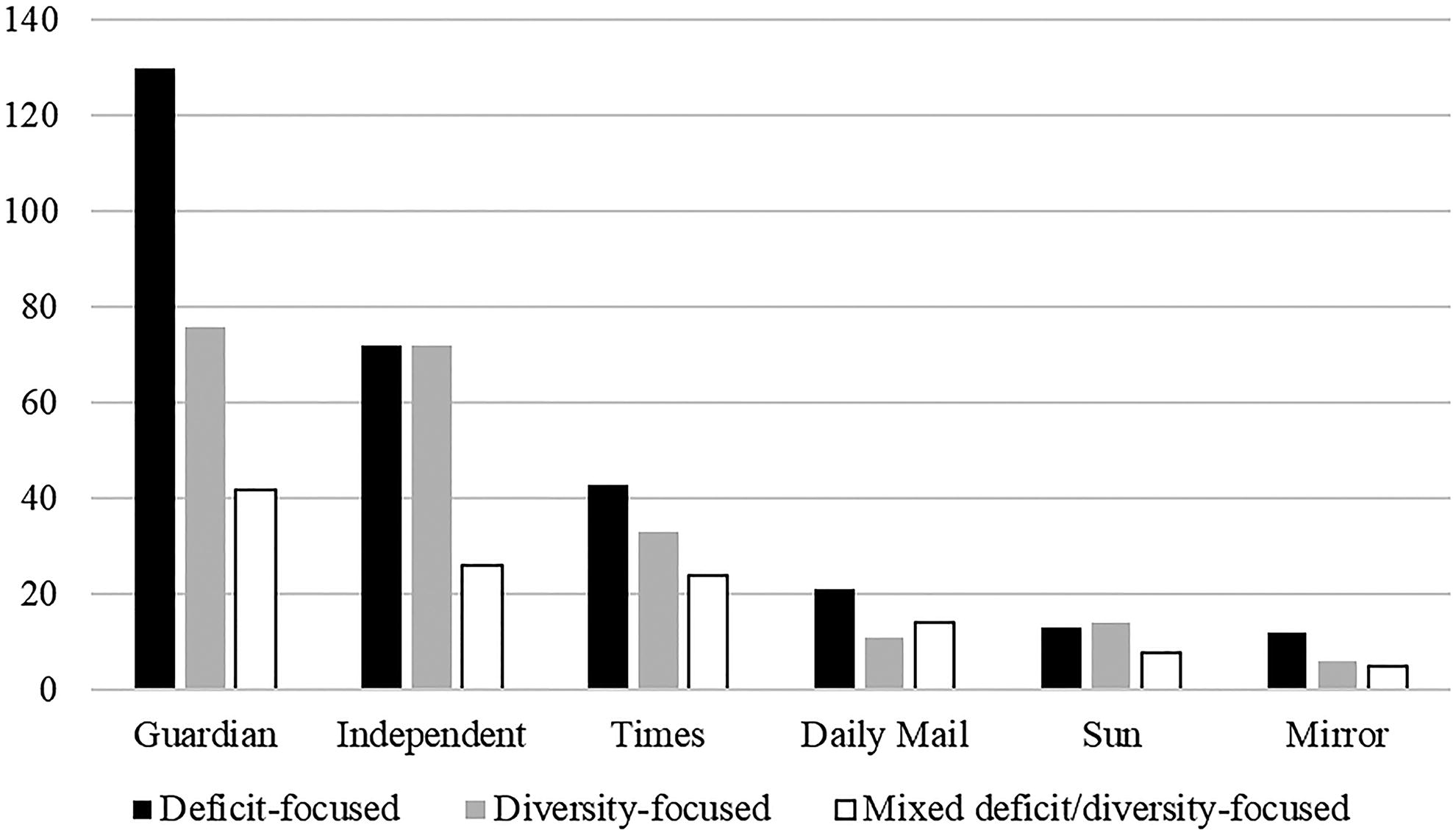
Number of deficit-focused, diversity-focused, and mixed deficit/diversity-focused generic statements by newspaper.
Excluding the 119 statements that referenced both deficit- and diversity-focused attributes, a chi-square test identified no significant difference between the proportion of deficit- and diversity-focused statements in left- versus right-wing publications, χ2(1, N = 503) = 0.05, p = 0.82, with diversity-focused statements comprising 41.8% (n = 154) of left-wing and 43.0% (n = 58) of right-wing content. Similarly, the balance of deficit- and diversity-focused statements did not significantly differ between broadsheets and tabloids, χ2(1, N = 503) = 0.13, p = 0.72, with diversity-focused statements representing 42.5% (n = 181) of broadsheet and 40.3% (n = 31) of tabloid data.
Distribution of generic statements across time
Figure 2 charts the frequency of deficit- and diversity-focused generic statements across the 10 years analyzed. Deficit-focused statements consistently outnumbered diversity-focused statements between 2014 and 2018. Diversity-focused statements slightly overtook deficit-focused statements in 2019, then leveled off to an approximately equal proportion between 2020 and 2022, before deficit-focused statements regained relative prominence in 2023.
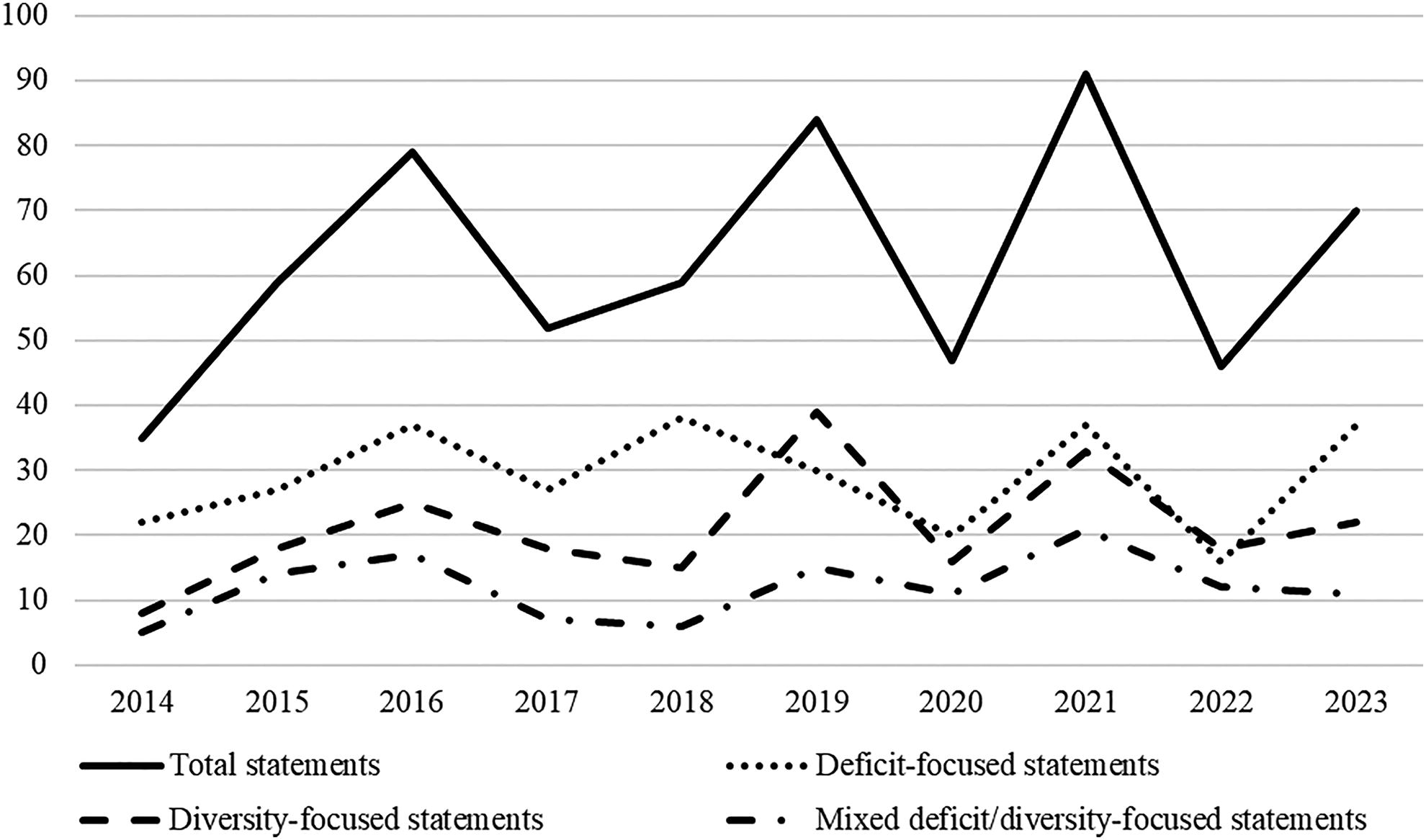
Number of total, deficit-focused, diversity-focused, and mixed deficit/diversity-focused generic statements by year.
Excluding the mixed statements that referenced both deficit- and diversity-focused attributes, a chi-square test confirmed that articles published between 2019 and 2023 had significantly greater prevalence of diversity-focused statements (n = 128, 47.8%), compared with articles published between 2014 and 2018 (n = 84, 35.7%), χ2(1, N = 503) = 7.41, p = 0.006.
Discussion
Awareness of the components of the stereotypes attached to autistic adults is key to understanding and predicting their treatment in social situations. The current study represents the first attempt to determine the content and frequency of the characteristics attributed specifically to autistic adults in popular media. Through systematic examination of 10 years of British newspaper content, the analysis identified 26 attributes commonly ascribed to autistic adults. These attributes collectively formed two overarching narratives, which characterized autistic adults in terms of either deficits or diversity. While deficit-focused statements numerically dominated the earlier years analyzed, diversity-focused statements drew level as the decade progressed.
The finding that deficit-focused statements significantly outnumbered diversity-focused statements in the dataset as a whole corroborates previous international evidence that news coverage of autism is predominantly negative in tone. 32 The current study advanced understanding of these dynamics by itemizing the specific constituents of negative stereotypes of autistic adults. The analysis suggested that negative stereotypes of autistic adults emphasize deficits in three main areas: social skills, cognitive/behavioral rigidity, and vulnerability/dependency. There is notable overlap between this stereotype content and medical definitions or diagnostic criteria, such as the “autistic triad” that presumes impairment in communication, social interaction, and behavioral flexibility. This is consistent with prior indications that media representations of autism are highly medicalized48–51 and extends previous evidence that Diagnostic and Statistical Manual of Mental Disorders criteria for autism spectrum disorder diagnoses are well represented in media portrayals of autism generally to an adult autism context. 52 These findings point to the key role played by the medical and scientific establishments in furnishing the bedrock content from which cultural stereotypes grow. 53
In counterpoint, the diversity-focused generic statements in the dataset emphasized difference and heterogeneity, highlighted distinct strengths of autistic adults, and inverted specific deficit-focused stereotypes. The numerical balancing of deficit-focused with diversity-focused statements as the years progressed is consistent with prior UK and international evidence, suggesting that positive media coverage of autism generally has gradually increased since the turn of the century.31,37,54,55 The current analysis confirms that this trend also applies to autistic adults. This notwithstanding, there was no absolute decline in deficit-focused statements across the decade, and further follow-up is required to determine whether the relative fall in diversity-focused statements in 2023 was an anomaly or beginning of a downward trend.
Optimistically, the shift toward stronger parity of positive stereotypes of autistic adults may reflect a societal movement, driven by advocacy efforts of the autistic community and their supporters, toward greater inclusion and acceptance. 56 In a “virtuous circle,” increased exposure to positive media content could reinforce and fuel such attitudinal shifts. 24 However, it should be acknowledged that positively valenced stereotypes do carry risks, such as making group members feel objectified or depersonalized, imposing the pressure of narrow and/or unrealistic expectations, and minimizing the challenges faced by a marginalized group. 14 This resonates with ongoing tensions within the autism community regarding the degree to which the principles of neurodiversity represent the totality of the autism spectrum, particularly those with high support needs.57,58 Moreover, just as positively valenced stereotypes can carry risks, so too can deficit-focused stereotypes entail benefits. For instance, discussing autistic adults’ vulnerability to abuse acknowledges the real repercussions of marginalized social status and could alert autistic adults and those around them to pertinent risks. Adding further nuance, social psychological research shows that positive and negative stereotypes often co-occur in “ambivalent” or “complementary” stereotypes that combine disparaging aspersions with superficially favorable ascriptions. 59 By packaging criticism within the guise of balance and positivity, complementary stereotypes aid the dissemination of derogatory representations, and indeed are more effective than uniformly hostile stereotypes in reinforcing social inequalities.60,61 In this context, the finding that one-in-five generic statements simultaneously referenced a deficit- and diversity-focused attribute is notable.
The range of potential consequences of positive and negative stereotypes makes empirical evidence of their societal effects a research priority. The current study sheds no light on how neurotypical or autistic audiences might respond to the content analyzed. Understanding the impacts of stereotype exposure on neurotypical attitudes is key to designing effective public information or stigma reduction initiatives. Intuitively, including some celebratory information about autistic adults’ strengths would seem a promising way to destigmatize adult autism, but comprehensively testing lay responses to such messages is crucial to avoid unintended counterproductive effects. Beyond public stigma, exposure to autistic adult stereotypes could have numerous other implications. For instance, further evidence is required to establish whether encountering deficit- or diversity-focused stereotypes could either encourage or discourage autistic self-identification and assessment-seeking. For autistic adults themselves, stereotype exposure imposes a heavy burden of stigma management, which may involve both internalization of negative stereotypes and proactive resistance through reframing unfavorable characterizations and reclaiming negatively valenced language. 22 Further research is required to identify ways of supporting the latter route and amplifying such discourse within the wider public sphere.
Strengths and limitations
As the first dedicated analysis of cultural stereotypes of adult autism, this study provides valuable data to inform efforts to understand and ameliorate the stigma faced by autistic adults. The analysis covered 10 years of content from six national newspapers, extending the time range covered by previous media analyses.31,33,34,37 Other novel aspects included the specific focus on generic statements, which represent potent mechanisms for expressing and reinforcing stereotypes, and the use of a content analysis technique that merged fine-grained qualitative analysis with frequency analysis. In this manner, the analysis bridges and complements previous automated analyses of large media corpuses 31 and purely qualitative analyses of smaller-scale datasets. 35
However, inevitable restrictions on the breadth of data limit the study’s scope. First, results pertain only to the UK context, with no claims for generalizability elsewhere. Second, the reliance on newspaper text excludes trends from audio, visual, or social media, which are important avenues for further research, particularly given the declining newspaper readership in the UK and many other jurisdictions. Third, the six newspapers represent a cross section of political alignments and tabloids/broadsheets but do not reflect the entirety of the British media landscape. One newspaper (The Guardian) contributed a particularly high number of generic statements to the dataset, consistent with prior evidence that a rise in British newspaper coverage of autism in the 2010s was particularly strong in left-leaning broadsheets. 31 This newspaper could have exerted a disproportionate influence on analytic trends, such as the overall outnumbering of diversity-focused by deficit-focused statements. While the dominance of deficit-focused statements in a politically left-wing newspaper may be viewed as surprising, it is consistent with prior evidence that left-wing British newspapers are no more likely to reproduce difference versus deficit/disability frames of autism than right-wing publications, 31 underlining the complexity of this discursive space.
Limitations also pertain to data extraction and analysis. Selection of broad keywords came at the cost of specificity: the proportion of retrieved articles that included a generic statement about autistic adults could be interpreted as low (10%). This partly resulted from the wide parameters of the keyword search; many articles included the terms “autism” and “adult” but not in connection with each other (e.g., topically irrelevant articles that referenced a person’s autistic relative or employment in autism services). Equally, it is possible that some articles containing generic statements about autistic adults did not include the word-stem “adult” and were therefore missed by the search, which could have produced biases. For instance, it is conceivable that tabloids were less likely to use the term “adult” than alternatives such as “men”/“women,” leading to lower representation in the dataset, or that “adult” was more likely to be used in relation to topics associated with more deficit- than diversity-focused frames. Furthermore, other research with British newspapers indicates autism coverage is dominated by narratives focused on specific individuals 31 ; the inclusion criteria for this analysis excluded such articles, unless they extrapolated from the focal individual to a claim about autistic adults generally. This raises a further limitation of the current analysis: the exclusive focus on generic statements may have excluded ways in which stereotypes are more subtly conveyed. However, since generic statements are especially powerful vessels for propagating stereotypes,40–42 this analytic focus was theoretically well-grounded.
Finally, generalizability was not an aim of this content analysis. With a large automated analysis of a vast corpus of British newspaper coverage of autism recently completed 31 ; the current analysis instead complements and extends existing research with a fine-grained analysis of the stereotype content specific to autistic adults. While implementation of intercoder reliability analysis provided reassurance that coding was executed consistently and rigorously, 47 the content analysis involved a high level of researcher judgment and interpretation. Classification of individual codes as reflecting “deficit” versus “diversity” frames was based on the researchers’ analytic interpretation of code content rather than objective standards and remains open to alternative interpretation. Moreover, the analysis did not include a formal consultation process with community members. Systematically incorporating autistic input into the analysis, as in recent participatory research where coding of media sentiment was completed by a panel of autistic adults, 62 may have yielded greater sensitivity in analytic design or interpretation.
Conclusion
At a time when media coverage of autism is increasing, 31 and growing numbers of adults are attaining autism diagnoses,1,2 understanding how autistic adults are characterized in public discourse is paramount. This article reports the first dedicated analysis of the stereotypes ascribed to autistic adults in mass media. It suggests that diversity-focused narratives have gained relative strength against deficit-focused discourse but cautions that deficit-focused stereotypes retain strong residual presence. The analysis also establishes the specific components of the most prevalent stereotypes of autistic adults, which supplies evidence-based targets for public information or destigmatization campaigns. Building on this evidence to determine the effects of stereotype exposure on neurotypical and autistic populations is a crucial next step, to ensure stereotype research generates actionable insights that improve the lives of autistic adults.
Authorship Confirmation Statement
O’Connor: Conceptualization (lead); writing—original draft (lead); data curation (lead); formal analysis (lead); methodology (lead); writing—review and editing (lead). Downey: formal analysis (supporting); methodology (supporting); writing—review and editing (supporting). The article has been submitted solely to Autism in Adulthood.
Funding Information
This research was supported by
Footnotes
Author Disclosure Statement
No competing financial interests exist.