




Abstract
Background:
Autistic individuals have intense interests in which they invest a significant amount of time and energy. Intense interests (i.e., passions) and their impact on optimal functioning were investigated for the first time using the Dualistic Model of Passion (DMP). The DMP posits that harmonious (HP) and obsessive passions (OP) can predict optimal functioning (well-being, contribution to society, and performance). Whereas HP is described as a balanced and flexible form of engagement toward a topic or an activity, OP is defined as a rigid form of engagement that negatively impacts optimal functioning.
Methods:
Autistic individuals aged 14–33 (n = 108) participated in an online quantitative study and completed self-report measures relating to their favorite interest of the moment (i.e., HP, OP, emotions, flow, conflict, rumination, and optimal functioning). Aims were to characterize passion and to determine whether HP and OP predicted emotions, flow, conflict, rumination, and optimal functioning. Descriptive analyses (means, standard deviations, and pairwise correlations) and a path analysis model were performed to answer these aims.
Results:
Results revealed that participants were highly passionate for their favorite interest, showing relatively high levels of HP and OP for activities such as video games, knowledge acquisition, and creative arts. Structural equation modeling showed that, as predicted by the DMP, HP was associated with positive emotions and flow. In turn, OP was positively associated with conflict, rumination, and negative emotions. Finally, HP and OP were positively and negatively associated with optimal functioning respectively.
Conclusion:
Findings suggest that intense interests can be defined as passion using the DMP. The DMP offers a theoretical framework that can account for the duality of intense interest and predict psychological and functional outcomes. Learning to foster higher levels of HP for intense interests can improve well-being and promote positive psychological experiences.
Community Brief
Why is this an important issue?
Autistic individuals have several passions that shape how they spend their time and what activities they engage in. Research and interventions in autism have historically focused on problematic aspects of passionate interests, often omitting the positive and motivational aspects of passion. Understanding the role that passion plays in their lives and how it relates to their well-being can inform clinical and research practices.
What was the purpose of this study?
Our goal was to study the intensity and the types of passion that autistic individuals showed for their passionate interests and how it related to their well-being. Using a well-established passion theory brought a new understanding to the field of autism research and passionate interests.
What did the researchers do?
We asked autistic teenagers and autistic young adults to fill out an online questionnaire about their current and most important passionate interest. They were asked to rate how passionate they felt about their interest, what emotions were associated with this interest, and how much they thought that passion conflicted with other aspects of their life. They also rated their global well-being and the quality of their relationships.
What were the results of the study?
We found that most autistic teenagers and young adults were highly passionate about their interest. We found evidence for high levels of both types of passion depending on the individual (obsessive and harmonious passion). Having more obsessive passion was associated with having lower well-being, and similarly more harmonious passion was related to greater well-being.
What do these findings add to what was already known?
We now know that passionate interests in autism can be defined as passions according to the Dualistic Model of Passion theory. Both positive and negative impacts of passionate interests can coexist in one person. Passionate interests in autism are an important part of well-being, and the type of passion is related to either greater or lower well-being.
What are potential weaknesses in the study?
The study used multiple-choice questionnaires designed for the general population, which may not fully capture the lived experiences of autistic participants. Also, our study does not represent the entire spectrum of autism, as we excluded participants without reading and writing language skills.
How will these findings help autistic adults now or in the future?
Autistic individuals can evaluate their own passionate interests to better understand how different aspects of their passion are connected to their well-being. Also, we hope our results can help redefine passionate interests and bring empowerment, documenting the positive and motivational aspects of interests in autism.
Introduction
“It is a real obsession, which paradoxically, is also essential to maintain a good mood and to control my anxious thoughts associated with leading various aspects of my adult life.”
21-year-old autistic woman who has a passion for education.
The time and energy that autistic individuals invest in their passionate interests are substantial, holding its similarities to a passionate athlete’s rigorous workout schedule. In contrast to athletes, autistic individuals are not always valued for their interests, and some are discouraged from engaging in them through behavioral interventions.1–4 Interventions aimed at diminishing or changing interests in autistic children are often motivated by the disruptions caused by the interest in everyday life and family functioning.2,5–7 While autistic interests may come with insistence on sameness or adhering to routines, they have also been associated with positive emotions, intrinsic motivation, and well-being for autistic individuals over different age groups.7–9 Interventions targeting interests have therefore been criticized, 10 namely for having failed to consider the positive aspects of interests and their functions for autistic individuals such as self-regulation and emotions.11,12
Intense interests, or restricted interests in the Diagnostic and Statistical Manual, Fifth Edition, (DSM-5), are present in a majority of autistic individuals.13–15 These interests can span from subjects such as music, history, and algebra to video games. Some interests are known for being similar to those in the neurotypical population, with greater intensity.8,16 Intense interests are reported as being more frequent in boys compared with girls17–19 and are typically attributed to autistic individuals without intellectual disability or language barriers. 15 They develop as early as 3 years of age and intensify throughout adulthood, along with other interests.14,20–22
Most of the existing measures assess negative aspects of interests (e.g., disruption, frequency, and intensity of observed behaviors). 26 For example, diagnostic tools for autism such as the Autism Diagnostic Observation Schedule 23 and the Autism Diagnostic Interview 24 rate the intensity and the disruption caused by these interests. While more measures now assess strengths and interests in children25,26 and adults, 9 research contributing to an integrated conceptual understanding of motivational processes involved in interests and their impact on functioning is needed.
Interests: Positive and negative aspects
Positive impacts of intense interests range from social inclusion to learning and positive emotions in autistic children (parent report) and in autistic adults (self-report).27–35 Interests also serve as a coping strategy for autistic individuals when they experience negative emotions (e.g., in stressful situations) and can provide meaning to their environment.11,36 A qualitative study interviewing autistic adults between the ages of 35 and 55 reported that some participants mentioned feeling at ease and confident in conversations when their area of expertise and interest was concerned. 37 Other studies also report that intense interests are part of autistic individual’s identity and contribute to building self-confidence.33,38 Finding peers who have similar interests is known as an easier way of making connections with others and developing friendships.35,39,40
According to research with autistic children and their parents, interests however can impede various aspects of daily functioning and social skill development.7,22,27,32,41,42 Autistic children’s interests were shown to be more intense and disruptive of family activities compared with non-autistic children.5–7 During adolescence, intense interests have been shown to interfere with personal short- and long-term goals, for example, limiting choices having to do with a future career orientation. 44 Furthermore, some authors proposed that intense interests may explain the lack of social interactions and interest toward other activities.7,43,45 In Collis et al., 12 autistic adults were asked to describe their interest, and one of the emerging themes were negative aspects relating to social inclusion, namely because of stigma and others’ perception. Some participants also reported having difficulties balancing their intense interest with other activities in their personal life, such as personal hygiene, sleep, or social demands. 12
Passion and optimal functioning
The Dualistic Model of Passion (DMP) is a theoretical model that has led to a greater understanding of adaptive aspects of passion in the general population and specific groups of individuals (e.g., athletes, nurses, students).46,47 As there is evidence for both beneficial and detrimental characteristics of intense interests in autism, the DMP framework could contribute to understanding and predicting the impacts of interests on an individual level. According to the DMP, the type and level of passion endorsed for activities or topics will predict positive and negative impacts on well-being and, more largely, optimal functioning. 46
Passion is a strong interest for an activity or topic that becomes part of one’s identity and toward which substantial time and energy are invested.46,48 Two types of passion are described by the DMP: harmonious passion (HP) and obsessive passion (OP). Individuals will express both types of passion at varying levels for one or more activities and topics. These two passions exist on different continua. HP is a flexible and willful engagement in an activity, free from external pressures (e.g., an activity practiced for its inherent benefits). HP is associated to intrinsic motivation and positive psychological experiences. OP is described as a strong need or an urge to engage in an activity, often in a rigid and compulsive manner.46,48 It is associated with environmental control (e.g., practicing an activity for feelings of social acceptance or self-worth). Although OP may be associated with a greater sense of competence and expertise in an activity, it can also lead to lower well-being by fostering negative psychological outcomes (i.e., negative emotions, conflict).46,49,50 Variable levels of HP and OP are found across individuals, and according to findings in the general population, having high levels of HP can be protective against the negative impacts of OP. 51
Emotions, flow, rumination, and conflict are psychological processes that unfold when a person is pursuing a passion. 46 Specifically, positive emotions such as enthusiasm and pride are associated with a passion that has high levels of HP, whereas negative emotions such as irritability and anxiety are typically associated with OP.50,52,53 Experiencing a state of flow (i.e., being completely immersed in the activity and having a sense of control) 54 is associated with HP. 55 In contrast, experiencing conflict and rumination is associated with OP.50,56 Conflict arises when someone’s passion interferes with important life engagements such as work, school, or relationships on a regular basis. 56 Rumination is the presence of thoughts related to the passionate activity outside of the activity practice. 57 These are nonintentional and recurrent thoughts that represent a person’s preoccupations and unattained goals.57,58 The abovementioned psychological processes have an impact on optimal functioning, a multidimensional measure of happiness and functioning in the general population.59,60 Specifically, optimal functioning comprises five dimensions: subjective well-being, physical health, quality of interpersonal relationships, performance in school or work, and contribution and implication to society via work, school, or other means. 49 HP, positive emotions, and flow positively predict optimal functioning, whereas OP, negative emotions, conflict, and rumination negatively predict optimal functioning.46,50,59,60,62
Bridging the gap
Previous studies in autism have established a connection between intense interests, flow, and well-being.8,63–66 However, further exploration is needed to understand flow in the context of intense interests, as well as how it might be maintaining well-being. Measuring HP and OP and other variables within the DMP can serve to capture the duality of autistic adults’ lived experiences of intense interests, without neglecting the positive aspects of flow and emotions. As mentioned by Champan and Carel, 67 autistic individuals are oftentimes victims of systemic discrimination and are seen at odds with conceptions of well-being or thriving. The concept of optimal functioning is based on societal expectations and might not capture aspects of autistic flourishing or thriving concerning intense interests. Nonetheless, optimal functioning steps away from measures of “severity,” “frequency,” and “disruption” and is interested in subjective well-being and other indicators of functioning in society (relational and physical health, performance, contribution to community). Understanding the role of autistic interests in emerging adults’ optimal functioning remains relevant in the actual context, as autistic adults are at greater risk for discontinuing an academic program, have greater difficulty finding/maintaining stable employment and reaching parental independence, as well as experience lower social participation and quality of life.68–73
The present study
The research objectives for this study were twofold. The first goal was to characterize passion in a population of autistic participants. Given that autistic individuals are known to have intense interests, were likely to be passionate about an activity or a subject, although it was yet to be determined whether their interests are more harmonious or obsessive. We expected passion levels to be high and hypothesized that high levels of obsessive passion would be present given the diagnostic criteria and measurement tools that insist on disruptiveness and rigid routines. 13 Concurrently, we expected levels of harmonious passion to be high given the flow and intrinsic motivation associated with intense interests in previous studies.8,35
The second aim was to determine whether HP and OP could predict emotions, flow, conflict, rumination, and optimal functioning. Based on the existing literature in non-autistic samples, we expected HP would be positively whereas OP would be negatively associated with optimal functioning (well-being, physical health, quality of interpersonal relationships, performance, and contribution to society). Similarly, HP was expected to be positively associated with positive emotions and flow and negatively associated with negative emotions. OP was expected to be positively associated with negative emotions, conflict, and rumination.
Materials and Methods
Participants and procedure
The present study is a cross-sectional online study with a final sample of 108 autistic individuals (43 men, 57 women, 7 non-binary, 1 missing), with a mean age of 23.66 years (standard deviation [SD] = 5.11 years; 14–33). Because participants’ diagnosis could not be verified, researchers recruited via organizations working directly with autistic people in French-speaking communities in Canada and France (e.g., Fédération québécoise de l’autisme). We provided a link in the advertisement and redirected participants to an online consent form and survey. Study materials were in French, and participants completed the survey without financial compensation. All surveys were completed anonymously on an online platform provided by the Université du Québec à Trois-Rivières (Chopin). Questionnaires were presented in the same sequence for all participants, and total duration of the study was approximately 30 minutes. Participants were asked to report various information concerning their autism diagnosis (professional, age of diagnosis, etc.). We excluded participants reporting a self-diagnosis of autism (n = 2). Co-occurring conditions were documented but did not represent an exclusion criterion. This study was approved by the Université du Québec à Trois-Rivières ethics board (CER-17-237-07.14).
Participants reported having been diagnosed by a medical doctor (63; 58.33%), or a psychologist (45; 41.67%), at a mean age of 17.60 years (SD = 8.31). Participants’ diagnoses were autism spectrum disorder (ASD; 26; 24%), Asperger’s syndrome (50; 46.3%), pervasive developmental disorder (5; 4.6%), autism (2; 1.9%), or ASD and Asperger’s (25; 23.2%). Reported co-occurring conditions were common, with only 22% of the sample not reporting any other condition than autism (n = 24). In the current sample, 28.4% of participants reported having only one condition other than autism (n = 31), 21.1% reported having two (n = 23), and 28.5% reported having from three to five co-occurring conditions (n = 31). Of these, anxiety disorders, attention-deficit hyperactivity disorder, and depression were the most reported, with 46, 35, and 22 participants, respectively (see a detailed list of co-occurring conditions in Supplementary Table S1). For additional demographic information, see Table 1.
Demographic Characteristics (n = 108)
M, mean; SD, standard deviation.
Measurements
A sociodemographic questionnaire assessed age, gender, occupation, and other information related to the participants’ autism diagnosis. Ethnicity was not measured to limit the duration of our online study. Unless otherwise specified, all variables were then measured using a 7-point Likert-type scale (scores ranging from 1 to 7). Higher scores indicated higher levels of the construct. Reliability coefficients were measured with Cronbach’s alpha.
Passion for an activity
Passion was measured using the Passion Scale, in which participants were asked to name and describe an activity that they loved, that they found important, and in which they invested time and energy (i.e., their passion).48,74 This scale measures harmonious passion with six items (e.g., “My activity is well integrated in my life”) and obsessive passion with six items (e.g., “I have difficulties controlling my urge to do my activity”). The Passion Scale has been used in the general population and was used for the first time with a sample of autistic individuals in this study. Satisfactory reliability was found for the HP (α = 0.74) and OP (α = 0.80). Five additional items serve to determine the presence of passion (i.e., passion criteria, e.g., I spend a lot of time doing this activity) (α = 0.65).
Positive and negative affect
The Positive and Negative Affect Schedule was used to measure positive and negative emotions during the activity. 75 Five positive emotions (interested, determined, alert, enthusiastic, active) and five negative emotions (anxious, upset, hostile, irritable, nervous) were measured. Participants were asked to indicate how much they feel each of these emotions while doing their activity. This scale has been used in prior studies with samples of autistic individuals (alphas between 0.64 and 0.93).76,77 Reliability in the current sample was adequate for negative emotions (α = 0.78) but not satisfactory for positive emotions (α = 0.49). Removing emotions “alert” and “active” increased reliability for positive emotions, although reliability for this scale was still poor (α = 0.58).
Flow
The Jackson and Marsh 78 flow scale was adapted to measure the flow during the activity and was used for the first time in an autistic population. Twelve items were selected for the study. An example item is: “When doing my favorite activity … I feel in total control of what I am doing.” The scale showed satisfactory reliability (α = 0.86).
Conflict
Developed by Vallerand et al., 48 this scale assesses the level of conflict between the favorite activity and other daily life activities. It comprises five items and shows excellent psychometric properties in the general population.46,48,72 A sample item is: “My activity conflicts with the other activities in my life.” The scale showed satisfactory reliability in the current sample (α = 0.85).
Rumination
A 6-item scale was used to measure rumination outside of the favorite activity. Thinking about this activity while doing something else was measured with items such as: “When doing something outside of my favorite activity … I am constantly analyzing and thinking of my activity.” This scale was adapted from the Rumination on Sadness Scale, 79 was used in previous studies in the general population, 54 and showed excellent reliability in the current sample (α = 0.90).
Optimal functioning in society
Optimal functioning was assessed using the Optimal Functioning In Society (OFIS) scale. 60 With 35 items, the scale measures five different dimensions: psychological well-being, physical health, performance at work or school, contribution to society, and interpersonal relationships. Four types of interpersonal relationships were measured and combined to form an average composite score: family, friendship, romantic, and an activity partner, if the participant’s favorite activity was practiced with another person. For each relationship type, four items with a 5-point Likert-type scale were used (0 = not at all; 4 = extremely) to evaluate how satisfying, harmonious, rewarding, and trustworthy the relationship was. Validation studies in the general population support OFIS scale’s factorial structure (McDonald’s Omega between 0.82 and 0.93 for each dimension) and show moderate to high item correlation for each dimension.49,59 All five subscales showed good to excellent reliability in the current sample (performance, α = 0.87; well-being α = 0.93; physical health α = 0.86; contribution α = 0.97; interpersonal relationships, α = 0.94). Reliability for the overall optimal functioning construct was excellent in our sample (α = 0.95).
Statistical analyses
All analyses were performed in R version 4.0.5 80 at a significance criterion of p < 0.05. Preliminary analyses were conducted to examine outliers, missing data, and statistical assumptions (i.e., scale reliability, homoscedasticity, and univariate and multivariate normality). Descriptive analyses for aim 1 consisted of means, SDs, and Pearson correlations (pairwise). To answer the second aim, a path analysis model was performed using the Lavaan package. 81 Specifically, paths were specified from both HP and OP to optimal functioning, conflict, rumination, flow, and positive and negative emotions. Full information maximum likelihood was used in the model to account for patterns of missing data. The χ2 statistic, the robust Comparative Fit Index (CFI), robust Tucker–Lewis Index (TLI), robust Root Mean Square Error of Approximation (RMSEA), Standardized Root Mean Square Residual (SRMR), Goodness-of-Fit Index (GFI), and Adjusted GFI (AGFI) were used to evaluate model fit. A statistically nonsignificant χ2 statistic indicates that the model has a good fit. Furthermore, a CFI/TLI >0.90 indicates an acceptable fit and a CFI/TLI >0.95 indicates a good fit. The RMSEA was expected to be ≤0.6 for a good model fit. Finally, a SRMR <0.10 indicates a good fit. GFI > 0.9 indicates a good fit, and the AGFI, adjusted for model parsimony, is expected to be >0.5.
Results
Preliminary analyses
There were missing data for a total of 20 participants. Four variables had more than 5% missing data (positive emotions = 8%; negative emotions = 8%; rumination = 9%; optimal functioning = 15%). Visual inspection of missing data suggested that this was due to attrition, as variables toward the end of the survey had more missing data. Further analyses on missing data indicated that they were missing completely at random (Hawkins test p = 0.048; nonparametric test p = 0.110). 81 Univariate skewness and kurtosis indices were within the ±2 margins, and all but two variables had indices within ±1, indicating univariate normality. 82 Multivariate normality was not respected, as indicated by the Mardia skewness and kurtosis tests (p < 0.05). The Maximum Likelihood Robust estimator MLR was used for all path analyses because of the absence of multivariate normality in the sample. Variance inflation factor was satisfactory, indicating no multicollinearity issues (<2.50).83,84
Descriptive analyses
Participants were passionate about various activities (see Table 2). They reported spending on average 25.34 hours per week (SD = 16.67) doing their favorite activity and have been practicing it for the last 10.58 years (SD = 6.63). Nearly half participants reported doing their activity alone (n = 53; 49.1%), or occasionally sharing this activity with another person (n = 52; 48.1%), and a minority always practiced their activity with other people (n = 3; 2.8%).
Interest Category and Examples
One participant with missing data for gender was in this category.
HP, harmonious passion; M, men; NB, non-binary; PC, passion criteria; OP, obsessive passion; W, women.
Two independent researchers categorized activities based on previous work from Vallerand et al. (study 1), 48 showing satisfactory interrater reliability (kappa = 0.83). Categories were adapted to the current sample of participants, as the types of interests varied significantly from Vallerand and colleagues’ 48 passion categories (e.g., gaming). Eight categories were created: active arts (n = 22), knowledge acquisition (n = 26), gaming (n = 26), television (n = 11), reading (n = 11), sports (n = 6), animals (n = 4), and passive arts (n = 2). The most common categories in the present sample were gaming, knowledge acquisition, and active arts (see Table 2). The most common interest for men was gaming (n = 20), whereas women more commonly endorsed knowledge acquisition (n = 16) and active arts (n = 14). The category knowledge acquisition was defined as having a passion for a specific topic and accumulating facts and reading/researching on this topic. Within the category of knowledge acquisition, topics were classified under social sciences (n = 19, 10 men; sociology, philosophy, psychology, linguistics, history, education, politics) and sciences (n = 7, 1 man; medicine, biology, astronomy, neurology, physics, mathematics) in line with previous work in the field.7,85–88
All participants were highly passionate for their activity according to the passion criteria subscale (scores >4/7; mean = 6.31), which is a greater prevalence of passion than in the general population, characterized by 15%–30% of non-passionate individuals.48,50 Harmonious and obsessive subscales revealed higher levels of HP (5.41/7) compared with OP (4.31/7; see Fig. 1). Levels of HP are comparable with those found in previous studies, whereas OP levels are higher compared with the general population (see Supplementary Table S2). Means and SDs for study variables are reported by gender in Supplementary Table S3, and items means and SDs for each measure are available in Supplementary Tables S4–S9.
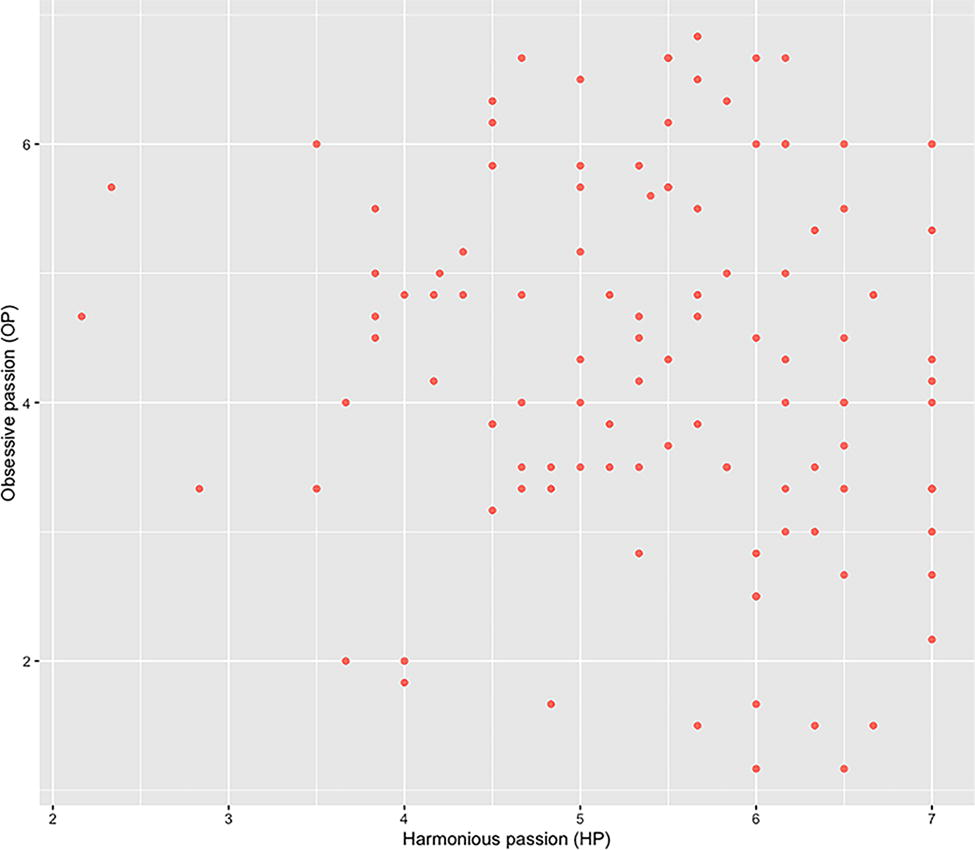
Characterizing passion in autism. Each data point represents a participant and its respective levels of HP and OP (n = 108). HP, harmonious passion; OP, obsessive passion.
Means, SDs, and correlations between variables are reported in Table 3. As expected, HP was positively and moderately associated with optimal functioning (r = 0.35, p < 0.001), whereas OP was strongly negatively associated with optimal functioning (r = −0.44, p < 0.001). Moreover, HP was associated with experiencing flow (r = 0.26, p = 0.008) and positive emotions (r = 0.32, p = 0.001) during the activity but also negatively associated with experiencing negative emotions (r = −0.35, p < 0.001). Otherwise, OP was associated with experiencing greater negative emotions (r = 0.21, p = 0.041) during the activity, conflict (r = 0.79, p < 0.001), and rumination (r = 0.70, p < 0.001) outside of the activity. None of the variables were significantly related to the number of hours spent on the activity per week.
Descriptive Statistics and Correlations (n = 108)
p < 0.1; *p < 0.05; **p < 0.01; ***p < 0.001.
Main analyses
With 40 parameters and 28 degrees of freedom, the model was underidentified. Paths were specified from HP and OP to optimal functioning, conflict, rumination, flow, and positive and negative emotions (Fig. 2). It was expected that HP would be positively whereas OP would be negatively associated with optimal functioning. Similarly, HP was expected to be positively associated with positive emotions and flow and negatively associated with negative emotions. OP was expected to be positively associated with negative emotions, conflict, and rumination. The model supported the hypotheses and yielded an acceptable fit to the data (χ2 test: p = 0.291; CFI = 0.995; TLI = 0.962; RMSEA = 0.055; SRMR = 0.048; GFI = 0.999; AGFI = 0.992). Specifically, HP was positively associated with positive emotions (β = 0.347, p = 0.001), flow (β = 0.250, p = 0.005), and optimal functioning (β = 0.336) and negatively associated with negative emotions (β = −0.390, p = 0.001). OP was positively linked to conflict (β = 0.780, p < 0.001), rumination (β = 0.702, p < 0.001), and negative emotions (β = 0.158, p = 0.051) but negatively associated with optimal functioning (β = −0.430, p < 0.001). Overall, the present results support the DMP in a sample of autistic participants. 46
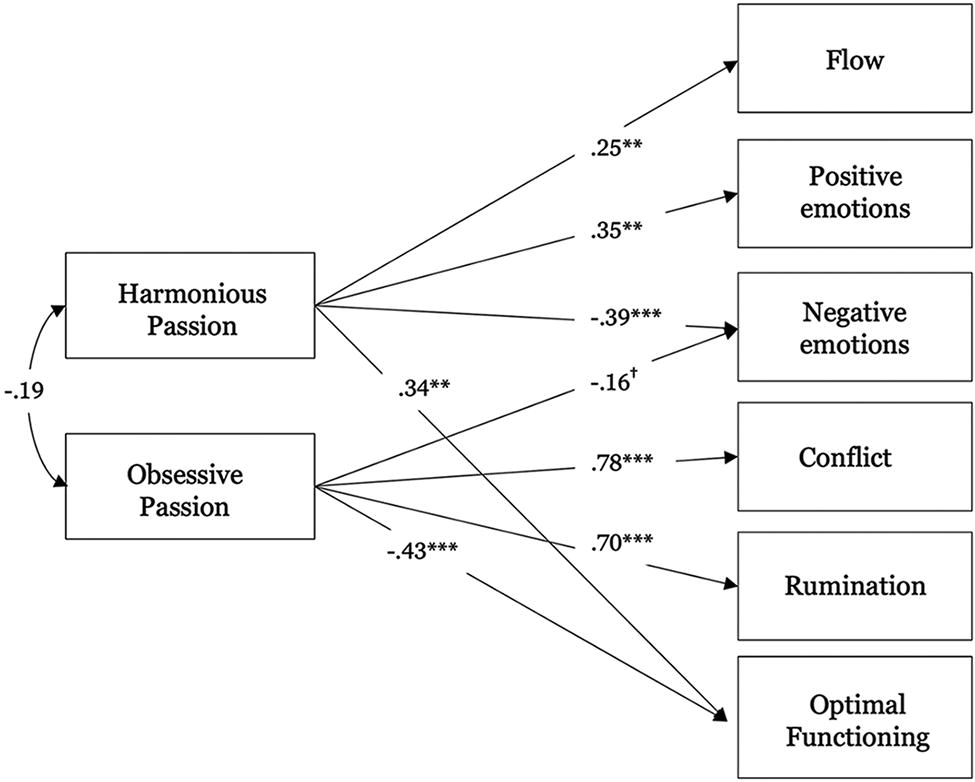
Structural equation modeling results (n = 108). Path coefficients are presented as standardized coefficients. †p < 0.1; *p < 0.05; **p < 0.01; ***p < 0.001.
Discussion
The present study investigated passion and optimal functioning in autism for the first time using the DMP.46,48 The first research objective was to characterize intense interests by measuring HP and OP in autistic teenagers and young adults between ages 14 and 33. The second objective was to determine whether the two types of passion (i.e., HP and OP) were related to positive and negative emotions, flow, conflict, rumination, and optimal functioning (well-being, physical health, quality of interpersonal relationships, performance, and contribution to society). Based on the existing literature in non-autistic samples, it was expected that the type of passion would predict levels of optimal functioning, such that HP would be positively whereas OP would be negatively associated with optimal functioning. Similarly, HP was expected to be positively associated with positive emotions and flow, and OP was expected to be positively associated with negative emotions, conflict, and rumination.
Results indicated that autistic individuals are highly passionate for their interest, showing both high levels of HP and OP. As posited by the DMP, the type (i.e., HP and OP) and intensity of passion were predictive of optimal functioning and of the cognitive and emotional experience of intense interests in autism. HP positively predicted optimal functioning, flow, and positive emotions while negatively predicting negative emotions. OP negatively predicted optimal functioning while positively predicting conflict and rumination. These results are discussed in the light of current findings in the passion and autism literatures.
Describing passions in autism
All participants in the sample were passionate for their interest, with HP being more present than OP (means of 5.41 vs. 4.31, respectively). Similarly, studies measuring passion using the Passion Scale48,74 in the general population find higher levels of HP compared with OP.50,88 HP levels found in the current sample are similar to those found in the general population (5.26–5.92).58,84 In contrast, OP levels are typically lower in the general population (3.10–3.69).88,89 To note, OP levels found in the present study resemble those of elite athletes 90 (i.e., 4.78 for OP), which are higher than most samples from the general population. Moreover, autistic individuals were found to spend more time on their passion (25.5 hours/week) compared with the general population, typically spending on average from 8 to 15.5 hours/week on their interest.48,50,74,91 As such, passions in autism are as harmonious as passions in the general population and can be described as more obsessive and intense in terms of time investment. Accordingly, past research with autistic participants has found positive experiences are tied to passions, but these experiences can come at a cost for general well-being in certain situations or individuals. Specifically, in Rapaport et al., 64 semi-structured interviews with 24 autistic adults indicated that although practicing the interest is pleasant, exhaustion or losing oneself in the activity was a frequent experience. Losing control over one’s activity and having difficulty disengaging from the task are compatible with descriptions of OP. Both types of passions help understand the different lived experiences of autistic adults and their intense interests, as one can simultaneously experience the benefits of harmonious passion and endure the consequences of obsessive passion. Impacts on well-being and optimal functioning will therefore depend on the level of both types of passion within one individual at a given time.
Previous research on interests in autism has described an “autistic flow” and mentioned that positive emotions were commonly experienced.9,38 Adding to the literature, current findings suggest that within an autistic sample, flow and emotions will vary according to the type of passion which is most endorsed. Specifically, flow states and positive emotions are associated with the presence of HP and not merely the presence of passion, as OP was not found to correlate with flow states nor with positive emotions. As HP is characterized by a nondefensive form of engagement that comes with openness to experience, a secure self-esteem, and mindfulness, it can lead to a state of flow more readily than OP. 46 High levels of OP lead to lower levels of flow and more negative emotions because the passion is internally controlled. It leads to a person having an eye on the task but the other on external elements or self-evaluation (e.g., the expected outcomes). 46 What remains uncertain is whether OP can account for certain aspects of intense interests that are reported in the literature (e.g., having trouble disengaging from a pleasant task). 64 Namely, the autistic tendency to selectively focus on one thing at a time (i.e., monotropism) can induce hyperfocus states or autistic flow states, which differ from the classical definition of flow and could correspond with OP.65,66 For example, having difficulty disengaging from a task is not associated with flow but more likely attributable to other cognitive (e.g., monotropism, executive functioning) or possibly motivational factors (e.g., OP). Typically, flow states are not compatible with descriptions of individuals losing track of time to a point where basic needs (e.g., eating, sleeping) conflict with the interest. 54
The current study suggests that HP could account for some of the adaptive consequences of intense interests, whereas OP would account for less adaptive outcomes. Namely, previous findings in autism found that conflict and interference with daily activities or family activities were characteristic of intense interests.5,6,12,14 While conflict or interference may vary with topics for example, it may also vary according to OP levels. The current study found negative impacts related to intense interest but also considered individual differences in passion levels. Higher levels of OP were positively associated with negative emotions, conflict, and rumination. According to the DMP, OP is characterized by rigidity and persistence and will lead to conflict with other areas of a person’s life. 46 It is also accompanied by a contingent self-esteem, which entails that a person’s self-esteem and emotions will fluctuate according to how well their passion is progressing (e.g., winning a game, reaching a target). As a result, individuals with high OP tend to ruminate more on their passion compared with those with high HP.
A diversity of topics was found in the sample, with video games, active arts (e.g., painting, singing, acting), and knowledge acquisition (learning things about a specific topic) being the most common themes. These categories differ from the ones identified in the general population, which were commonly sports and music. 48 Potentially, as described in the monotropism theory, 66 autistic people would be more easily drawn toward less social endeavors, where things are more predictable. Additionally, having an area of expertise provides a sense of control and can help feel secure when talking about the topic of expertise to other people. 12 Interests are commonly used by autistic individuals to form social bonds. 63 In Turner-Brown et al., 7 autistic children also strived for peer acceptance by showing off their knowledge and hoped their expertise would be recognized by others.
Women in the sample were more drawn to knowledge acquisition and active arts, and men reported their main interest as being video games more than any other activity. The category of knowledge acquisition was subcategorized into topics of the social sciences (e.g., history, politics, linguistics) and the sciences (e.g., physics, mathematics, biology), following previous work in the field.85,86 Social sciences were more commonly endorsed in the present sample, although gender was equally distributed across social sciences and sciences topics. This replicates more recent work in children with autism, in which autistic girls and boys did not show a gender difference. 86
Does passion lead to optimal functioning?
The current study showed that autistic individuals’ passions were related to the five dimensions of optimal functioning (i.e., psychological well-being, physical health, relationship quality, contribution to society, performance at work or school). In agreement to Vallerand’s perspective, the quantity and quality of passion (HP or OP) predicted psychological well-being in autistic individuals. 46 Engaging in pleasant activities is not sufficient to encourage optimal functioning; rather people need to pursue their interests out of HP rather than OP. 47 Higher levels of HP were associated with greater optimal functioning, whereas higher levels of OP were related to lower optimal functioning in autistic young adults and teenagers. In contrast with Grove et al.’s 8 findings in the autism literature, the time invested in the activity itself (i.e., number of hours per week) was not associated with well-being or other components of optimal functioning. Therefore, the present results suggest that finding a balance between HP and OP may have a greater influence on well-being compared with the amount of time spent on the interest.
Even though OP was associated with lower optimal functioning than HP, it nonetheless has been found to positively relate to basic psychological needs. 91 Because of this, even reducing a highly obsessive interest would reduce a person’s satisfaction in life and would potentially decrease their optimal functioning. Holding et al. 92 hypothesized that behavioral addiction could develop when a person’s needs in the rest of one’s life (outside one’s major interest) are not satisfied. OP would represent a compensatory mechanism for the person to fulfill one’s needs within the passionate activity. 92 Coutelle et al. 93 argue that intense interests in autistic individuals “should be preserved,” even in cases of video gaming, where the line between addiction and interest is unclear. Coutelle et al.’s 93 recommendations include limiting and monitoring usage of video games in cases of addiction and investing time in other activities outside of gaming. Thus, the addiction and passion literature recommend finding new activities. Consequently, the passionate activity would seem like less of a necessity (i.e., less obsessive).
Passionate people generally have greater optimal functioning, particularly those with high HP.50,51 Paradoxically, although autistic adults were found to be highly passionate, they generally have lower well-being and quality of life compared with non-autistics. 94 This well-being gap between autistic and non-autistic adults has been shown to occur in varying degrees depending on factors such as intellectual functioning, presence of other diagnoses, or experiencing social stigma.67,92 Specific aspects of everyday life need to be considered when measuring well-being or quality of life in autistic adults (e.g., sensory issues, stigmatization),95,96 and available measures may not capture aspects of autistic thriving that are not valued or attended to in the general population. 67 Having a harmonious or obsessive passion could be one of those contributing aspects, as harmonious passion contributes both to hedonistic well-being (i.e., having positive emotions) and eudaimonic well-being (i.e., finding meaning in life). 50
Limitations
This study has several limitations. First, this study was conducted online which limits the scope of generalizability of results. Second, a disproportionate amount of women are present in the sample as compared with clinical samples of autism, which refer to 1:4 girls and boys. 97 Third, self-report questionnaires were used, and they limit the participation for individuals with intellectual disabilities or communication barriers. Furthermore, they are subjective in nature and should be corroborated in future research while using objective measures or through observation. Our study invited participants to select only one of their favorite activities, which can limit the representativeness of the findings, and which could also have biased participants toward choosing a favorite interest that was more harmonious. Additionally, ethnicity data were not collected in the current study, which can also limit the generalizability of the findings. Finally, the present study used a cross-sectional design, and it cannot lead to causality inferences.
Future directions
Considering current limitations, it would be important to investigate passion using different designs and methodologies. First, interviews with autistic adults could be conducted to gain deeper insight into the nature of their passion and its consequences on optimal functioning. Second, a longitudinal design would help to understand the directionality of the relations found between passion, the different psychological processes associated with passion, and optimal functioning. Lastly, positive psychology can offer relevant theoretical models for investigating the processes through which passion leads to well-being and quality of life in autism.98
Conclusion
Investigating passion in autistic individuals can contribute to a better understanding of the duality of psychological impacts associated with intense interests. Using the DMP to study intense interests revealed that autistic teenagers and young adults’ interests can be described by measuring levels of harmonious and obsessive passion. The most common interests were gaming, knowledge acquisition, and artistic pastimes. Importantly, the number of hours spent engaging in their passion was substantial (25 hours) but was not associated with either harmonious or obsessive passion. Harmonious passion was associated with positive emotions, flow, and optimal functioning, whereas obsessive passion was positively related to negative emotions, rumination, conflict, and lower levels of optimal functioning. The current study suggests that the duality of intense interests can be measured using the DMP, which can help predict impacts on well-being and optimal functioning in emerging autistic adults. Future research on the role of passion in autism seems promising as to reverse the stigma associated with intense interests and promote positive perspectives.
Footnotes
Acknowledgments
The authors thank research participants for their time and essential contribution to this research project. They would also like to thank Delphine Périard-Larivée for her assistance with data collection, Marie-Pier Vaillancourt-Morel and Hugues Leduc for their guidance with statistical analyses, and Audrée-Anne Dumas for the revision of the final draft.
Authorship Confirmation Statement
A.M. ran the data collection, analyzed the data with N.C., and wrote the original article. E.-L.B., I.S., and R.J.V. took part in conceptualization and designed the methodology of the study. N.C., R.J.V., M.C., and E.G. contributed significantly to revisions of the article, and E.-L.B. and I.S. offered supervision of the research activities. All authors confirm their original contributions to the article and reviewed and approved the full article before submission. The article has been submitted solely to Autism in Adulthood.
Author Disclosure Statement
The authors have no relevant financial or nonfinancial interests to disclose and no competing interests to declare.
Funding Information
The research leading to these results received funding from the Social Sciences and Humanities Research Council (SSHRC) under Grant Agreement No

References
Supplementary Material
Please find the following supplemental material available below.
For Open Access articles published under a Creative Commons License, all supplemental material carries the same license as the article it is associated with.
For non-Open Access articles published, all supplemental material carries a non-exclusive license, and permission requests for re-use of supplemental material or any part of supplemental material shall be sent directly to the copyright owner as specified in the copyright notice associated with the article.
