




Abstract
While traditional deficit-based biomedical accounts of autism have viewed autism itself as an obstacle to thriving, recent discussions based on social/relational models of disability argue that this pathologizing rhetoric perpetuates stigma and negative views of autism, which, in turn, create social and environmental challenges that hinder autistic people’s ability to thrive. In that sense, this critical review aimed to analyze how the current academic literature approaches the construct of autistic thriving, using techniques of critical discourse analysis. We found two broad categories that depict a contrast between studies that (1) viewed thriving as a process that looks the same to autistic and non-autistic people alike and perceived autism as a “problem” to be addressed and (2) articles that, alternatively, described autism as a natural difference and attempted to understand autistic thriving, to some extent, from an autistic perspective. We recommend future research that meaningfully and directly engages autistic people in expressing what thriving means to them and what factors facilitate it.
Community Brief
Why is this topic important?
Autistic people have shown worse mental health and well-being than non-autistic people in many studies. For a long time, researchers thought that autism was an obstacle to a good life, but recent ideas and research have said that many of the challenges autistic people face are because of external issues, such as discrimination. Researchers also began to think more about what makes a “good life” for autistic people specifically, as it may look different to what non-autistic people think.
What is the purpose of this article?
This article looked at studies about autistic thriving; we looked at what researchers believed autistic thriving means. We also looked at how the articles talked about autism and how much autistic people were involved in the research.
What did the researchers do?
We read six research articles and used techniques of critical discourse analysis (CDA) to look at how these articles studied and talked about autistic thriving. CDA techniques look at how people use language and words to build meaning in the world, such as what people think is “good,” “adequate,” “desirable,” or the opposite.
What were the results of the study?
We found that there were two different ways research spoke about autistic thriving. The first one includes articles where thriving was the same process for both autistic and non-autistic people, autism was seen as a problem, and autistic people were not at all involved in the research. The second one includes articles where the researchers tried to understand autistic thriving from an autistic point of view, and autism was seen as a natural difference, but only one article said that autistic people were directly involved in the research.
What do the authors recommend?
We need more research on autistic thriving, and this research should be guided by autistic people. Future studies should focus on asking autistic people what thriving means to them and finding the things that may help autistic people thrive.
How will these recommendations help autistic adults now or in the future?
The way research talks about autism influences how people act toward autistic people. Our findings help researchers think about how their work may impact autistic people’s lives, encouraging them to seek autistic people’s perspectives instead of making assumptions. Understanding what thriving means for autistic people helps researchers, professionals, and families foster a happier life for them.
Introduction
Autism is defined within the scientific establishment as a lifelong neurodevelopmental disability that influences the way people communicate, socialize, pursue interests, and process sensory information. 1 However, there is significant variation in how scholars and people make sense of autism as phenomena; for example, while it has been traditionally interpreted as a “disorder” that requires intervention, more recent scholarship and advocacy movements perceive autism as a natural difference in human cognition. 2
A growing body of autism research is focusing on how we can promote better lives for autistic people, 3 emphasizing the significance of constructs such as well-being, quality of life, flourishing, and thriving. However, the lack of thorough conceptualization and distinction of these constructs within the autism literature is problematic. 4 Thriving, specifically, despite being a current “buzzword” in autism research, often lacks a clear definition and theoretical framing. This may be due to interlocking bias in research, which assumes that autistic thriving looks the same as neurotypical thriving, or because, to date, there is not enough research on what constitutes thriving for autistic people specifically, with researchers recurring to existing conceptualizations and measures elaborated for neurotypical populations.
A literature review on the construct of human thriving 5 highlights that its conceptualizations vary significantly across populations and domains. Within the domain of developmental psychology (e.g., positive youth development), thriving is often defined as a growth-oriented process. 6 Even though there were exercises at defining thriving within the broader psychological literature and clearly distinguishing thriving from other constructs related to living a happy life, 5 the extent to which those discussions account for autistic experiences is not yet clear. Research has demonstrated that related constructs such as well-being and quality of life present unique distinctions for autistic people,7,8 but no published studies to our knowledge have defined thriving from an autistic perspective, despite recommendations. 9 Thus, this study aims to critically analyze and discuss how the current autism literature constructs the term “autistic thriving,” using Gee’s techniques of critical discourse analysis (CDA) 10 as our analytical framework.
Conceptual models of autism within research
Autism is not necessarily a natural category but a diagnostic status constructed by scholars who hold power to generate its meaning 11 —known as “epistemic power.” Historically, autistic people have not held epistemic power to generate knowledge about their own disability, and conventional scientific knowledge was mostly formulated by non-autistic researchers/practitioners within a biomedical model. The biomedical model of autism operates in a binary dichotomy that classes people as “normal” versus “abnormal” 12 and where autistic traits are seen as deficits compared with neurotypical functioning, requiring intervention. 2 This conceptual framework is rooted in the idea that neurotypical functioning is the ideal standard for the human species, which has contributed to the wide dissemination of stereotypical and dehumanizing accounts of autism in research and broader social conversations. 13 Within the biomedical model, autism is also widely considered incompatible with a good human life, with poor outcomes such as mental ill-health 14 getting reduced to inherent features of autism and not social and environmental circumstances. 4
Recent debates focus instead on social and relational models of disability, arguing that some of the “poor” outcomes and challenges faced by autistic people originate in oppressive societal practices.4,15 These arguments were posed, in part, by scholars from emergent autism advocacy movements, such as critical autism studies (CAS) 16 and the neurodiversity movement. 17 By situating autistic distress within a sociopolitical context, they highlight that autistic well-being may be impeded by contextual factors and harmful social relationships (e.g., inaccessible environments, discrimination, and stigma), as opposed to autism itself being an intraindividual obstacle to well-being. From a neurodiversity perspective, autism represents value-neutral, naturally occurring variability within human cognition. 18 Furthermore, CAS scholars have illustrated how contemporary knowledge about autism is not value-free but constructed by social agents who share preconceptions of what constitutes dis/ability, normality, and “good” outcomes. Often, the possibility of autistic people thriving in different ways may be dismissed by non-autistic people, including researchers and practitioners, because of bias and prejudice. 4 Autistic people have reported in research that the neurodiversity movement promotes thriving for them, 19 highlighting that different ways of understanding autism may have real-life repercussions.
Very little autism research has focused on autistic thriving, and where it has, it mostly used the reports of parents or caregivers of autistic people as opposed to autistic people themselves. Moreover, like most autism research in general, studies that investigate thriving and other related concepts have largely focused on researchers’ ideas around outcomes without input from autistic people. 3 This illustrates, once again, autistic people’s general lack of epistemic power. 4 Researchers and scientists partly mediate the production of knowledge about autism by maintaining and/or transforming research practices, which may impact the lives of autistic people in potentially harmful ways, 20 such as perpetuating damaging rhetoric that can ultimately limit their rights. 11 Scholars have reflected on the consequences of the lack of interpretive frameworks to account for “the richness and diversity of autistic experience,” 4 leaving autistic people “epistemically adrift.” 4 They highlight that not having concepts to describe your experience leads to lower well-being by further silencing minority groups. 4
This study
Lam and colleagues 20 used CDA 10 to conduct a critical review of how autistic well-being is approached within autism research. They aimed to identify and critique the role of psychological institutions and discourses in the re/production of oppression by challenging the values, assumptions, and positionalities underlying research processes. CDA is an analytical tool that allows the researcher to investigate connections between language and society, highlighting that power inequalities can be maintained and reinforced through one’s choice of rhetoric—as it reflects assumptions that are socially, politically, and culturally situated. Critical reviews, in turn, are different from other literature reviews in that the aim is not to create a theory by gathering and analyzing existing evidence. Instead, they aim to provide a critical evaluation and interpretive analysis of the existing literature on a given topic, revealing “strengths, weaknesses, contradictions, controversies, inconsistencies, and/or other important issues with respect to theories, hypotheses, research methods or results.” 21 In critical reviews, researchers act as research instruments by using their perspectives to appraise and interpret the literature rather than primarily acting to summarize it. 22
Following Lam and colleagues’ example, 20 we also conducted a critical review of the literature on autistic thriving and used CDA to analyze how this construct is being approached within autism research. This is in line with autistic people’s research priorities in Scotland, as one of the top five priorities is “knowledge and attitudes towards autistic people/how we talk about autism.” 23 This critical review attends to this priority by looking at how the choice of rhetoric in research impacts knowledge constructed around autistic thriving and autism itself. Elucidating potential biases and assumptions present in the young but growing research corpus on autistic thriving allows us to understand how this construct has been approached, in the hope that this critical exercise will invite researchers to reflect on how their positionality and rhetoric impact the generation of scientific knowledge of autism and, consequently, autistic people’s lives.
We do not aim to propose or create a conceptual model of autistic thriving but to critically examine and discuss the purpose (teleology) and value (axiology) of existing research on autistic thriving. Thus, the purposes of this study are to critically analyze and discuss (1) how the term “autistic thriving” is approached and conceptualized in autism research, (2) how autism itself is conceptualized in research about autistic thriving, and (3) the role of autistic peoples’ input in the research process.
Methods
Data sources and search criteria
We conducted a literature search to identify articles with an explicit and central focus on the construct “autistic thriving.” As recommended by Kahle and colleagues, 22 we used multiple approaches, including hand-searching reference lists and using search engines. Initially, we searched for articles containing the following keywords in the titles: (1) autis*, Asperger, developmental disorder, ASD, neurodiver* and (2) thriv* in Google Scholar, Semantic Scholar, and the databases PsycINFO, ERIC, and Web of Science. We also studied relevant article reference lists to identify other pertinent studies. This diverse approach in data collection is recommended for critical reviews, as this method often requires researchers to use nuanced and individualized discernment to appraise the literature, with the quality and value of the information being more important than its quantity. 22
Our inclusion criteria comprised studies using any research methodology, which aimed to investigate, evaluate, discuss, and/or measure autistic thriving and that presented some level of distinction/definition of thriving. Studies that talked about autistic thriving but did not define or indicate a conceptual model for this construct were not eligible for inclusion. Research involving data collected directly from autistic participants and/or through the reports of stakeholders (e.g., parents, carers, clinicians, and teachers) was eligible for inclusion, as the level of autistic people’s involvement in the research, if any, is central to our discussion. Six articles fulfilling these criteria were identified, including three empirical studies,9,24,25 one review article, 3 one perspective article, 26 and one case study. 27 A description of these studies is included in Table 1.
ID, intellectual disability.
Positionality statement
The theoretical views of all authors are aligned with the social model of disability, in that we acknowledge that the concept of disability is socially situated, and we are critical of singularly deficit-based views of autism. We believe that autism research should prioritize autistic voices and views, fostering epistemic justice. Despite these similar views, the diversity in our backgrounds, positionalities, and expertise helped bring nuance to our analysis and facilitated bias mitigation. Our team is composed of both autistic and non-autistic members, with M.B. and K.S. being mixed-methods researchers, S.D.’s expertise lying in qualitative and arts-based methodologies, C.G. being an expert in quantitative and experimental designs, and C.J. being a social psychologist with qualitative expertise.
Analytical framework
We utilized Gee’s techniques of CDA 10 to analyze textual data from research articles. CDA is a form of discourse analysis that engages with the concept of “politics,” which involves looking at ways of speaking, writing, or acting that imply what is socially deemed “normal,” “desirable,” “good,” or “appropriate.” Gee’s techniques for CDA understand that people use language to build “significance, relationships, politics, connections, and to build sign systems and claims to know, as well as to privilege certain sign systems and ways of knowing.” 10 Language is also important within the field of autism research, as discourse both reflects and cocreates social constructions of dis/ability, influencing how disabled people are viewed and treated in society. 12
CDA’s techniques guide the researcher in asking questions about how language was employed in a piece of text to build seven areas of reality, which the author defines as seven building tasks. To analyze those building tasks, Gee 10 also prescribes six tools of inquiry, which assist the researcher in uncovering what a text is attempting to enact/build in the world. Gee’s CDA model is flexible, with researchers being able to privilege the use of tools that are more relevant to their research question. Thus, we specifically utilized the “Identities” building task to uncover how the rhetoric in the selected articles evaluated and positioned the identities and roles of autistic people; the “Signs, Systems, and Knowledge” building task to identify which ways of “knowing” autism were privileged; and the “Politics” building task to understand how autistic functioning and thriving were constructed. The analysis was guided by questions related to how language used in the studies attempted to build identities for the subjects involved, to indicate whose views were sought and deemed valuable, and to imply what (e.g., behaviors and dispositions) and who (e.g., autistic people and neurotypical people) was deemed “normal,” “good,” “adequate,” or the opposite. Table 2 illustrates this coding process.
Demonstration of the Coding Process using Critical Discourse Analysis
ASD, autism spectrum disorder.
The analysis was carried out by the first and second authors (S.D. and K.S.), who initially analyzed each article individually and then discussed their analyses in weekly meetings. Furthermore, the statistical measure called Cohen’s Kappa, which is used in research to assess levels of agreement in how two researchers analyze and categorize texts or discourses, was also used to assure validity in this study. We carried out a Cohen’s Kappa analysis with 80% of the data, with an agreement rate of 92.68% and a Kappa of 0.853 (k = 0.853, p < 0.001), indicating an almost perfect agreement. The analysis notes and results were shared, discussed, and agreed upon with all other authors.
Findings
Our analyses, carried out using CDA’s techniques, 10 yielded two broad categories. These categories indicate fundamental differences in how articles conceptualized autism and autistic thriving, as well as the level of input from autistic people in the research process. These categories, namely “Thriving as a species-standard outcome” and “Thriving as a variable construct,” are described and detailed below. It is important to note, however, that the criticisms raised and issues discussed in our findings were not aiming to make assumptions of authors’ intentions but to offer a possible interpretation of what was said. We are aware that research on this topic is very limited and, given the lack of conceptual and empirical models focusing on autistic thriving specifically, researchers may have used established general frameworks available to them without reflecting on or acknowledging that these frameworks can be, in themselves, harmful. We raise these criticisms, instead, to highlight the importance of prioritizing, rather than disregarding, such critical reflections in research.
Category 1: Thriving as a species-standard outcome
This category discusses three quantitative studies9,24,25 that, overall, treated autistic people as passive data-givers and approached thriving as a measurable process leading an individual toward the attainment of pre-established outcomes, which were deemed as a universal standard within the human species. The overarching goal of these studies was to quantitatively explore associations between thriving and other constructs in autistic people and other disabled groups through parent or caregiver reports.
All articles were rooted in a biomedical model of disability and autism, operating in a “normal” versus “abnormal” dichotomy where disabled groups were treated as a juxtaposed, homogenous “other.” Autism was described as a fixed disorder, and autistic people were introduced, overall, as a group that has difficulties and problems in their functioning in comparison with an ideal. Accordingly, neurotypical functioning was viewed as the species-standard ideal from which autistic people deviated in negative ways. Such descriptions of autism included the terms “pervasive,” “problem behaviors,” and “weakness.” There was no disclosed autistic input or involvement, with all three articles exclusively seeking the reports of parents or caregivers in their data collection and using scales validated for parent/caregiver report. Thus, autistic testimony was not actively sought or utilized in constructing autistic thriving in these studies, and autistic experiential expertise was dismissed and devalued throughout. However, it is worth noting that all articles in this category pertain to youth, in that the lack of autistic participation may be due to researchers’ assumptions that young people are less able to describe their thriving than adults, therefore requiring proxy-report, or because researchers may be hesitant to include children and youth as participants due to ethical considerations (e.g., issues surrounding informed consent).
Person-first language (PFL; e.g., person with autism/autism spectrum disorder [ASD]), as opposed to identity-first language (IFL; e.g., autistic person), was adopted throughout the articles, which does not reflect the current majoritarian language preference of English-speaking autistic communities, who largely prefer IFL. 28 Recent research, 29 however, highlights the variability in autism language trends across journals over time, indicating that the use of PFL and IFL has shifted according to journal guidelines and emerging social conversations. The study by Weiss and Burnam-Riosa 24 was published before most of the literature indicating the preference for IFL by the autistic community, and the use of PFL was significantly predominant in the journal where the study was published. 29 The studies by Sellitto and colleagues 25 and Simpson and colleagues, 9 however, were published amid the recent “boom” of discussion and research on the preference for IFL, which was also accompanied by a significant increase in IFL across journals. 29 This language choice was not discussed or clarified by the authors.
In all three articles, autistic thriving was conceptualized and measured within a pre-existing framework derived from positive psychology, namely, positive youth development. 6 This model, originally developed with and for neurotypical youth, posits that thriving involves the growth of positive attributes that can be broken down into six dimensions, known as “the six Cs” (competence, caring, confidence, connection, contribution, and character). The growth of those attributes is facilitated by both individual strengths and ecological resources, with the process of thriving ultimately leading the person toward an idealized personhood comprised of “socially or structurally valued behaviors.” 24 Overall, this framework was readily presented to the reader without discussing its theoretical underpinnings and how those may impact the model’s suitability for autistic people specifically.
In all three studies, thriving was measured through a scale where parents or carers of autistic people reported their agreement with statements concerning autistic participants’ display of the “six C” attributes. The statements included in this measure implied a sense of universal truth around what constitutes a “good,” “appropriate,” or “desirable” outcome across different life domains (e.g., relationships and school) and personal qualities (e.g., notions of justice, morality, and empathy). For instance, the attributes competence and connection included, respectively, the statements “(the participant) knows how to behave” and “(the participant) has positive relationships with their parents, siblings, and other family members, and with friends, teachers, coaches, or mentors,” 24 indicating a presumed consensus around what “good behavior” or “positive relationships” look like to anyone.
Despite adopting a framework where the development of attributes fostering thriving involves both internal qualities and external resources, the only variables accounted for as “external resources” were reported family income9,25 and a measure of involvement in home, school, and community. 24 This measure comprised a scale 30 where caregivers assessed the frequency of participation (daily to never) and level of involvement (very involved to minimally involved) of disabled individuals in different activities and events (e.g., “neighborhood outings,” “field trips and school events,” and “homework”). The scale, however, did not contemplate ecological aspects such as the environmental accessibility and social acceptance of those individuals in the activities/places in question, in that the frequency of participation and level of involvement could be evaluated simply based on individual initiative—which is, arguably, an internal disposition as opposed to an “external resource.” Accordingly, the difficulties faced by autistic people and other disabled groups, such as worse rates of mental health,31,32 were almost exclusively framed on an intraindividual level, with little discussion of broader environmental, social, cultural, and/or political barriers that could impact autistic people’s ability to thrive. This further emphasized the idea of autism itself as a “problem,” which is illustrated in the following excerpt: “Challenges with home participation may be related to the higher levels of restricted interests and behaviors (…), emotional and behavioral problems (…), and parental stress and mental health problems (…) found in individuals with ASD and their families compared to those with ID without ASD.” 24
In that sense, the measurement of autistic thriving and other constructs (e.g., sociocommunicative ability and adaptive behavior) included in these studies did not account for potential variability, nuance, or complexity across individuals and communities. The statements presented to the parents/carers for assessment did not incorporate elements unique to the experiences of autistic people and other disabled groups in the samples. For instance, research published before the publication of the three articles in question indicated that autistic people may experience sensory overload in certain social events 33 and that there are mutual communication gaps in cross-neurotype interactions. 34 One article, 9 however, discussed this neurotypical focus as a potential limitation in their study, indicating concerns that the measures used may not capture the uniqueness of autistic experiences and recommending future research on what autistic thriving looks like to autistic people themselves. Similarly, Weiss and Burnam-Riosa 24 and Selitto and colleagues 25 recommended that future research utilizes self-report, indicating the sole use of caregiver report scales as a potential limitation as well.
The definition of thriving as a process conducting an individual toward behaviors that are “socially or structurally valued” indicates the presumed existence of a structural/societal consensus, and in a society built by and for neurotypical people, the standard in question arguably relates to neurotypical dispositions. Hence, the articles are not contradictory in their theoretical premises and choice of measurement, for if autistic people are placed in a binary paradigm where they are seen as deficient compared with neurotypical people, then a “better” outcome will naturally reflect closeness to neurotypical functioning. In fact, one of the articles expressly hypothesized that participants who had an intellectual disability would thrive more than participants who, in addition to their intellectual disability, were also autistic. 24 In that sense, participants were generally expected to embody a more neurotypical disposition, or to be less disabled, to attain higher rates of “thriving.” However, as they were likely to perform poorly in proxy-reported measures based on a neurotypical ideal, the results served to further corroborate the idea that autism is something to be intervened with.
In that sense, the articles operated within a kind of “Catch-22” cycle as discussed by Chapman and Carel, 4 where the theoretical framework—in this case, a deficit-based view of autism and disability—informed methodological choices that guaranteed inevitable results. This process is visually illustrated in the flowchart in Figure 1.

Flowchart depicting the findings discussed in Category 1.
Category 2: Thriving as a variable construct
The three articles included in this category were (1) a psychotherapist’s reflections and recommendations for working with autistic women and promoting their thriving within therapeutic practice, 26 (2) a review article 3 using Martha Nussbaum’s 35 capabilities approach to identify areas where autistic people thrive or struggle, and (c) a case study that proposes a theology-informed model of autistic thriving. 27 All articles perceived thriving as a variable, nuanced, and complex construct overall, indicating some level of dedication to understanding autistic thriving from an autistic perspective. The models of thriving presented by these articles’ accounts did not prescribe specific outcomes to be attained by a thriving person but instead situated thriving within both personal and ecological dimensions. Although all authors acknowledged that thriving may look different across individuals and populations, they differed considerably in the level of autistic involvement/input in how they chose to approach and conceptualize this construct.
All three studies described autism with nuance, indicating neutrality toward autistic people’s differences, acknowledgment of their support needs and contextual barriers, as well as a positively framed recognition of their strengths—with autistic people being described as capable, 26 creative, 3 and contributors to the health and diversity of communities. 27 All authors also elaborated on their intentional language choices and clarified to the reader how those were reflected upon. Zener 26 opted for both IFL and PGL throughout the article, explicitly intending to reflect the different preferences of the author’s clients. Both Pellicano and colleagues 3 and Leidenhag and King 27 used IFL, reflecting the current preference of most autistic people in English-speaking countries. 28
These studies also discussed broader contextual factors that impact autistic people’s lives and ability to thrive, highlighting cultural and environmental barriers they frequently encounter and calling attention to the responsibility of external people, institutions, and environments in this dynamic. Pellicano and colleagues, 3 for instance, discussed how despite generalized beliefs that autistic people inherently lack social skills, non-autistic people also interact less successfully with autistic people. Zener, 26 in turn, emphasized the importance of workplaces and community settings being informed about autism, accommodating autistic people’s needs, and fostering their acceptance. Leidenhag and King 27 emphasized that accounts of autistic thriving demand awareness of contextual factors, acknowledging the need for accessible environments and positive relationships.
In terms of the studies’ conceptualizations of thriving, Zener 26 argued that autistic thriving comprises “living a meaningful life consisting of pursuing passions, finding their tribe and accepting their differences,” 26 explaining that this model was shaped by their experience working as a psychotherapist for autistic women. When describing the therapeutic dynamic, the author depicts a relationship of overall cooperation and shared decision-making power. However, although this model of thriving was presumably oriented by collaborative interactions with autistic women, no mention of direct input from autistic people is mentioned. Similarly, Leidenhag and King 27 proposed a model of neurodivergent thriving that is guided by the premises of the neurodiversity movement and the work of autistic scholars. The authors defined neurodivergent thriving as the “adaptive growth towards purpose which requires ongoing individual, relational, and aspirational development,” 27 arguing that this conceptualization is aligned with the notion of neurodiversity as a nonpathological difference and is therefore suitable to account for autistic experiences. Even though this model was oriented by the work of autistic scholars in its theoretical underpinnings, there is no mention of direct input from autistic people either. The literature review by Pellicano and colleagues, 3 in turn, borrowed the capabilities model of Martha Nussbaum 35 and framed the 10 capabilities it prescribes as essential preconditions for autistic people to build thriving lives “in their own terms.” 3 This article directly criticized biomedical views of autism and highlighted the importance of participatory autism research that meaningfully involves autistic people. Accordingly, the review was expressly authored by a team of both autistic and non-autistic researchers, indicating direct autistic involvement in how autism and autistic thriving were approached.
Despite different levels of autistic involvement, all three articles indicated an alignment with social models of disability and the neurodiversity view of autism. This was illustrated, at times, through direct criticisms of the traditional deficit-based rhetoric or by the explicit statement of the authors’ positionality. Zener, 26 for instance, stated that the clinical framework conceptualized in the article embraces neurodiversity. Similarly, Pellicano and colleagues 3 included a critical discussion of mainstream autism research that is rooted in researcher-established outcomes, which devalues autistic accounts of their priorities and goals. Finally, Leidenhag and King 27 explicitly condemned the biomedical rhetoric that pathologizes autistic behavior and promotes interventions aimed at “normalization,” arguing that this ultimately attempts to eradicate autistic personhood. In summary, these studies acknowledged that different people may thrive in different ways, defending accounts of autistic thriving that are rooted in autistic experiences and that acknowledge broader ecological factors in which autistic people are embedded. A visual summary of this analysis is illustrated in Figure 2.
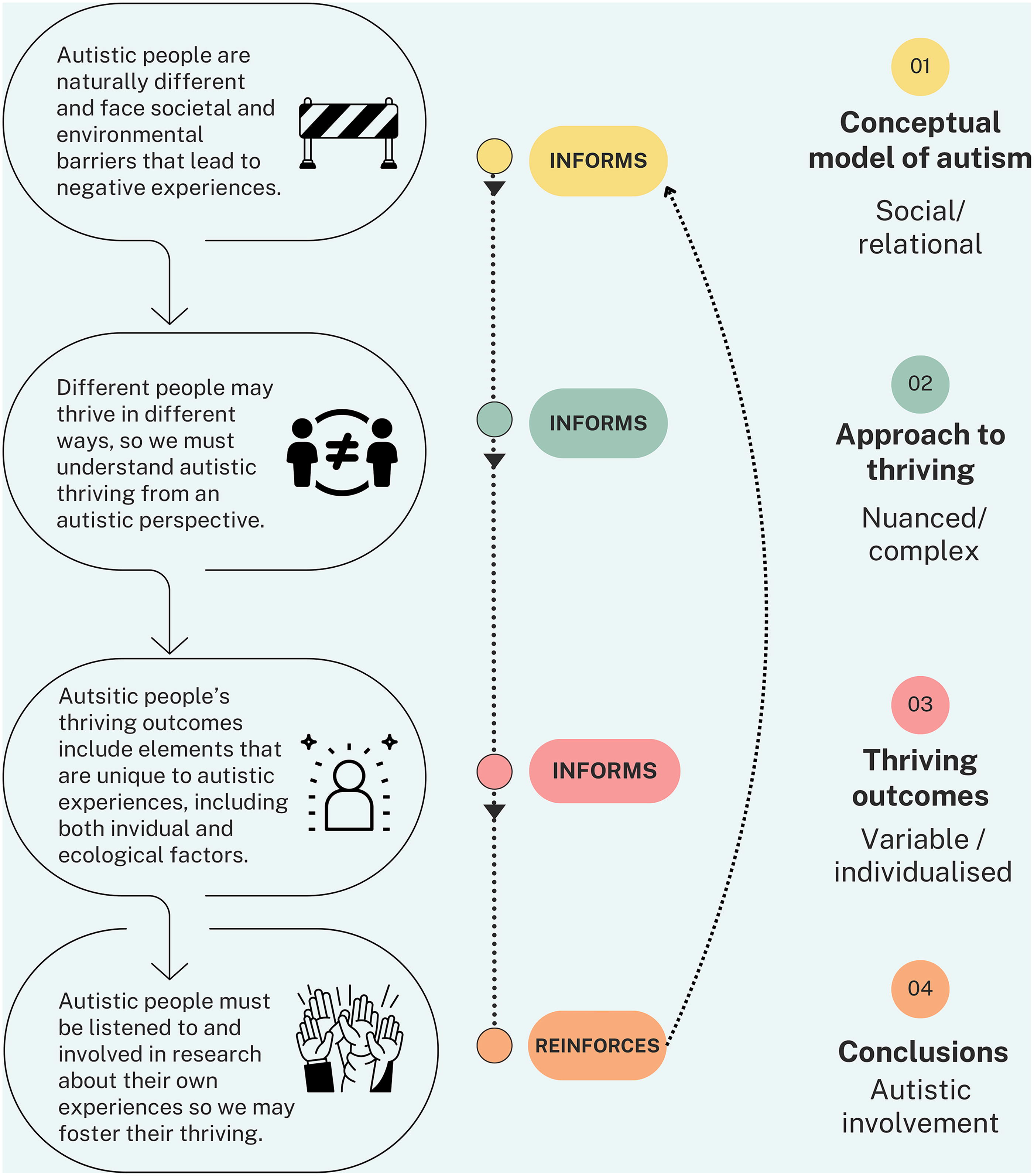
Flowchart depicting the findings discussed in Category 2.
Discussion
In this article, we used Gee’s 10 techniques of CDA to critically analyze and discuss the current literature on autistic thriving, aiming to uncover the value and purpose of language employed in research to talk about autistic thriving and autism itself. Our results yielded two broad categories that described a contrast between (1) studies that treated autistic people as passive subjects and defined thriving as a measurable, standardized construct in the human species and (2) articles that, alternatively, discussed autistic thriving as a complex and nuanced construct and had some level of autistic perspective.
The first category (“Thriving as a species-standard outcome”) included three empirical studies9,24,25 adopting the positive youth development model, 6 which views thriving as a quantifiable process leading an individual toward the attainment of socially valued behaviors. This process is facilitated by the growth of six personal attributes, which are presumably universally valued and experienced similarly. Articles in this category used a biomedical model approach that grouped disabled individuals as a homogenous other, in opposition to the nondisabled, “normal” individual. This dynamic is akin to Radulski’s 36 discussion of the “neuroarchy,” a concept depicting the social hierarchy of neurotypes where neurotypical people, a social “neuromajority,” hold privilege and hegemony over “neurominorities,” including autistic people. In that sense, the medical model relies mostly on intraindividual factors to describe differences in societal participation between neurotypes, with little acknowledgment of how shared expectations of “functionality” may be contextually situated and socially constructed. Instead, Radulski proposes that neurotypes operate as social identities, where the majority/minority neurotype dichotomy describes “social groupings of privilege and marginality of those who either adhere to or violate cultural norms for neurocognitive development, functioning, and behaviour.” 36
The positive youth development 6 framework adopted in these articles is described as a “strength-based” approach, enabling young people to thrive by developing and building personal strengths and assets. Even though this presumably allows for a subjective account of thriving, as each person has different strengths to be developed, Leidenhag and King 27 call attention to the fact that studies operating within this framework have often employed one-size-fits-all methodologies, where the imagined participants setting the parameters for assessment are most often white, neurotypical, middle-class individuals from the Global North. Accordingly, studies in this category stated researcher-established outcomes and utilized scales developed for neurotypical youth and validated for parent/caregiver report, without seeking input from autistic people. The disregard for social, cultural, and environmental factors that directly impact autistic people’s lives and ability to thrive, as well as the dismissal of variability between neurotypical and autistic people, served to perpetuate the idea of autism being at odds with a good life and to corroborate the biomedical argument for interventions/practices aimed at normalization. Thus, we argue that this model, within the context of autistic thriving, cannot be considered a “strengths-based” approach.
The second broad category (“Autism as a variable construct”) included three articles3,26,27 that attempted to approach autistic thriving, to some level, from an autistic perspective. Only the review by Pellicano and colleagues, 3 however, had direct autistic input, while the other two studies stated that their conceptualizations of autistic thriving were built upon collaborative therapeutic relationships with autistic women 26 or a theoretical alignment with autistic scholars’ views. 27 All three articles within this category described autism in a more value-neutral and ecologically situated way, depicting it as a natural difference as opposed to a pathology and indicating accounts of autistic thriving that consider both individual and ecological components. The authors discussed autistic people’s unique strengths and contributions in a positive light and situated autistic people’s real-life challenges and support needs within broader contexts, describing the barriers and obstructive factors that contribute to negative experiences. In that sense, these studies also indicated an alignment with the neurodiversity view of autism, including direct criticisms of the dominant deficit-based rhetoric present within the autism research and practice establishment.
Even though these are important debates, research on autistic thriving still has a long way to go in terms of directly involving the autistic community in expressing what thriving means to them and which factors may contribute to or hinder their ability to thrive. Pellicano and colleagues’ literature review 3 looking at the areas in which autistic people thrive or struggle constituted an important first step in understanding autistic thriving from an autistic point of view, with the authors describing a complex picture in their findings. The results indicated that, within Martha Nussbaum’s 35 capabilities model, there are both capabilities in which autistic people have the potential to excel despite mainstream beliefs to the contrary and, at the same time, capabilities in which autistic adults may often struggle—especially due to a range of constraining social, economic, and environmental factors. The capabilities model used in this review, 3 however, has been viewed by other autistic scholars as a species-standard way of looking at thriving, which may not account for factors that are unique to autistic experiences. 4 In line with this, Pellicano and colleagues 3 themselves recommend the future conduction of participatory research that meaningfully engages autistic people in determining which capabilities and factors should be included in this nonexhaustive list to capture the singularity and richness of autistic experiences.
Our findings also highlight how researchers’ theoretical stances and conceptual models of autism informed their methodological choices and findings. While neurodiversity-rooted studies in Category 2 reflected this model’s focus on individual experiences by approaching thriving from an autistic perspective, the adoption of a deficit-based framework in Category 1 studies aligned with the choice of comparing the autistic individual against a neurotypical ideal. In Lam and colleagues’ review 20 of autistic well-being, the authors criticized how this measurement-focused approach often inscribes minimal meaningful autistic involvement, prioritizing the production of readily consumable and commodifiable knowledge over autistic personhood and agency. Echoing Lam and colleagues’ reflections, we argue that research on autistic thriving operating within a “rush to measurement” framework that disregards theoretical underpinnings is ultimately implicated in the teleological effects of normalization. This type of research fails to escape the biomedical tendency to develop practices aimed at changing the autistic individual, which perpetuates the pathologization, stigmatization, and marginalization of this population. In that sense, future empirical research investigating autistic thriving should not be moralizing but rather aim to capture participants’ subjectivity so that thriving is self-determined—which is not possible without meaningful autistic input or in a rush to using existing measures.
Strengths and limitations
One significant limitation of this study is its small sample size, with only six articles fitting our inclusion criteria. The current academic literature on autistic thriving is underdeveloped, with a small number of peer-reviewed articles specifically focusing on autistic thriving published to date, which limits the scope of this research. Similarly, the small number of articles reviewed used different methodologies, making direct comparisons across studies more difficult. However, as critical reviews prioritize value over quantity of information, the smaller sample conversely afforded space to critically discuss the data.
Conclusion
This study, to our knowledge, is the first critical review of the literature on autistic thriving. We believe that our findings constitute an important step in understanding the current literature on autistic thriving and in imagining future research on this topic where autistic perspectives are prioritized. We hope that our results will serve as a critical reference and exercise for researchers to examine how their theoretical standpoints and choice of rhetoric may impact the re/production of scientific knowledge on autism and autistic thriving. We invite researchers to reflect on how those aspects may serve to either perpetuate, challenge, or transform practices that have broader real-life repercussions for autistic people. Future research on autistic thriving should focus on actively and directly engaging autistic people in expressing what thriving means to them and in determining which factors may facilitate and/or obstruct their ability to thrive.
Authorship Confirmation Statement
The first author (S.D.) conceptualized the study, gathered literature for the review, and led the research and writing processes. S.D. conducted data analysis alongside K.S., as it was initially agreed that autistic involvement was fundamental in this step. All other authors (C.G., C.J., M.B., and K.S.) oversaw and contributed to all stages of the research process, including editing the final document. All authors have collectively agreed on the literature search and inclusion criteria and have reviewed and approved the article before submission. The article has been submitted solely to Autism in Adulthood.
Footnotes
Author Disclosure Statement
The authors have no conflict of interest to disclose for this study.
Funding Information
This study did not receive any funding.