




Abstract
Background:
Day-services provide Monday-Friday support and are often accessed by autistic people with severe or profound learning disabilities or complex needs and people with severe and profound learning disabilities. Despite their significance, day-service support standards are often poor, and services struggle to include the voices of service members in support planning and service development. Our previous research highlighted views and experiences important to members in day-services, and we suggested it was important for day-services to focus on these views and experiences in decisions made about support. We co-produced a tool, The Day-Doc, to support day-services to do this. In this paper, we describe the framework we developed for The Day-Doc to help day-services focus on views and experiences important to their members.
Methods:
In this study, we sought to explore the views and experiences of service members through the perspectives of community members and day-service staff.
We undertook qualitative research involving interviews, workshops and focus groups with day-service staff, people with learning disabilities, autistic people, and family members. Data were analysed through Template Analysis.
Results:
Participants defined four strands of views and experiences:
Place and Planning: Referring to service members developing environmental customs, having a sense of ownership over areas, and developing fulfilling routines. Being Yourself: Referring to service members feeling free to act and behave in ways important to them, and for having their views and preferences valued and responded to. Rest and Stressors: Referring to situations and environments that engender experiences of stress and the practices that alleviate this. Community: Referring to having valued roles within day-service communities and having a say in their priorities and aims.
Conclusion:
The developed framework shows potential for supporting day-services to better include the views and experiences of service members. We discuss how we aim to realise this through The Day-Doc tool.
Community Brief
Why is this an important issue?
This research was part of study to co-produce The Day-Doc, a tool to help day-services respond to the views and experiences of their service members, in particular, people with a diagnosis of:
autism and severe/profound learning disability. autism and complex needs who communicate through vocalisations and body language. severe/profound learning disability (but not autism).
Across Europe and North America, day-services provide Monday-Friday support to this group (who we refer to as ‘The Day-Doc cohort’). Despite their importance, day-service standards are often poor. A key issue is that day-services struggle to include the views and experiences of the Day-Doc cohort in decisions about their support. There are no tools or approaches to support them to do this.
What was the purpose of this study?
In this paper, we report on the development of a framework for The Day-Doc which outlines views and experiences important to its cohort. The framework stems from research we did with this group in a UK-based day-service. It is based on a theory called at-homeness.
What did the researchers do?
We did interviews, focus groups and workshops with autistic people, people with learning disabilities, family members and day-service staff to develop at-homeness into a framework relevant to day-service contexts. We also explored if they thought the framework would be important to The Day-Doc cohort. Our analysis involved a Template Analysis approach.
What were the results of the study?
The co-production led to a framework containing four strands which participants thought would be important to the Day-Doc cohort:
Place and Planning, in which participants highlighted how the cohort might view environmental preferences and ownership of service spaces as significant. Being Yourself, in which participants discussed the potential importance of the cohort experiencing the freedom to act and behave in ways important to them. Rest and Stressors, in which participants highlighted how cohort would likely value practices that reduce experiences of stress or discomfort. Community, in which participants argued for the importance of the cohort having significant and valued roles in their day-services.
What do these findings add to what was already known?
These findings are the first to categorise views and experiences potentially important for service members in day-services.
What are potential weaknesses in the study?
We first identified the at-homeness framework as being important in a single UK-based day-service, so it may not be as relevant in other day-service contexts. We suggest this should be explored with further day-services and their members.
How will these findings help autistic adults now or in the future?
The framework we developed helps services focus in on what’s important to The Day-Doc cohort. The Day-Doc was co-produced to help day-services document and respond to this group’s views and experiences. This tool could benefit service members across their life-course, helping to guide key life transitions, and enabling their voices to be represented within day-service provision.
Background
In this article, we report on research that aimed to explore and develop a framework of views and experiences important to autistic people with severe or profound learning disabilities or complex needs and people with severe and profound learning disabilities in day-services. The research was part of a larger project to coproduce The Day-Doc, a tool to support day-services in responding to this group’s views and experiences (see appendix 1). The Day-Doc provides instruction and resources to help support workers to record service members’ views and experiences through ways that take account of their communication preferences. It provides guidance on how to involve and respond to members when making decisions about support and when planning training and service development. The Day-Doc stems from previous research we did with this group in a UK-based day-service 2 and, as we report here, have built on so to include the perspectives and input of the broader autism and learning disability communities and social care staff.
We use the term “The Day-Doc cohort” to refer to people with a diagnosis of:
autism and severe/profound learning disability (sometimes called intellectual disability); autism and complex or high support needs or “autism level 3,”
3
who communicate through vocalizations and body language; and severe/profound learning disability (but not autism).
We use this term for four key reasons. First, people across this group were part of our previous day-service research 2 that this article’s study and The Day-Doc derived from. Second, the four day-services that participated in this article’s research were accessed by people with all of these diagnoses, however, day-service staff rarely differentiated people according to their diagnoses, instead discussing them as individuals or as service members. Third, we aimed to coproduce The Day-Doc tool and the framework discussed in this article to support services to respond to the views and experiences of people with all of these diagnoses. Fourth, we have argued 6 that this group’s shared characteristics, needs, and life circumstances mean that including them as a collective in research can help to challenge their marginalization and promote their views on issues salient in their lives.
The Day-Doc cohort is a group often defined as nonverbal, 4 although we choose to focus on the rich and idiosyncratic ways they do communicate, which includes vocalizations, body language, facial expressions, and basic use of Makaton and symbol/picture exchange.5,32 This group has a high support need that continues across the life course and relates to their health and social care needs. We do not seek to include nonspeaking autistic people without learning disabilities in this group, as they often use more complex forms of communication such as typing and as such could likely benefit from different day-service tools or approaches to contribute their views and experiences. 7
Day-services
Day-services are a contemporary model of support provision that provide Monday–Friday support across many aspects of life, such as day-to-day activities, community inclusion, and physical and mental health. Day-service organizations vary, including local, national, and international organizations whose focuses include occupations, such as horticulture or art, specific communities such as autistic people or people with learning disabilities, or generalized support and care. All of these day-service settings may be accessed by The Day-Doc cohort (Table 1).
An Outline of Seamon’s At-Homeness (1979) and Its Adaptation to Day-Service Contexts
Although day-service provision varies geographically across Western European and North American countries, they are often accessed by The Day-Doc cohort throughout adulthood.8–10 In England, approximately £330 million is spent annually on day-services providing support to 25,000 people in The Day-Doc cohort.11,12 Despite the significant expenditure on day-services, support standards are often poor 13 with staff lacking skills to support the personal and social development of people who access them, 14 here termed service members. Relatedly, many of The Day-Doc cohort lack choice and autonomy within service settings and experience a poor quality of life. 15
Views and experiences
Social care research 16 and guidance17,18 make recommendations to improve opportunities for The Day-Doc cohort to determine support and shape the services. However, research shows that day-services require better understanding of how to respond to and promote this group’s views and experiences. 19 There is often a notion within day-services that this group cannot contribute to decisions about their support or lives, 20 with staff making assumptions about service members’ views, abilities, and preferences, 21 ultimately leading to misunderstanding around their support needs and priorities. 22
Literature reviews into person-centered 16 and positive behavior support planning 23 suggest that support services lack the tools and skills to include the voices of The Day-Doc cohort in support planning and evaluation. Instead, decision-making often relies significantly on the views and perspectives of family members whose priorities and preferences may not mirror that of their relative. 24 Day-service managers have acknowledged the need and desire to better include this group’s voice, although emphasize the challenge of understanding their views through the ways they communicate. 19
While the communication of The Day-Doc cohort is complex, 6 studies have found that people who regularly spend time with them, family members, friends, and support staff, often pick up on the meaning of their communication and expressions, granting a close insight into their views, characters, and experiences.25,26 Furthermore, ethnographic research shows that such insight can inform day-service practices and decision-making, although it commonly requires the input and retention of long-term members of staff, 27 a common struggle for social care services. 28
We previously explored a UK-based day-service and its culture through the perspectives and experiences of The Day-Doc cohort. 2 In this study, we found that as members of a day-service, this group expressed views and experiences about service practices and customs through their everyday activity, actions, and communication. However, these views and experiences were at risk of going unrecognized as the service and its staff had no formalized ways to document or respond to them. We thus suggested day-services may better include this group’s views and experiences in decision-making and support planning if they had improved methods or tools (Table 2).
Participant and Methods Information
Aims
In this research, we aimed to develop a framework that could help day-services focus on views and experiences important to The Day-Doc cohort. We intended to use this framework as part of the development of a practical tool, The Day-Doc, that day-services could use to better include this group in decision-making and service development.
The framework stems from our previous research, 2 which suggested at-homeness 1 could be a theory that is closely related to views and experiences important to The Day-Doc cohort. At-homeness refers to how people experience places of personal significance. 1 Over time, people develop attachments to place through the way they come to feel, know, and respect its symbols (p. 92), resulting in experiences of connection and security. In our day-service study, 2 space and place appeared significant to the ways service members developed and experienced belonging and autonomy and to the ways they shaped and embedded practices into day-service life.
In the study reported in this article, we intended to explore and develop at-homeness as a framework of views and experiences within the context of day-services and their members, as well as to explore its potential significance through the perspectives of autism and learning disability community members and day-service staff.
Methods
Methodology
Our approach drew from recent developments in inclusive research design involving The Day-Doc cohort,29,30,32,42 beginning with our first study that involved extended research with them in their everyday lives.2,31,32 The aim of this was to understand their experiences and priorities and to highlight disabling issues in their lives. We subsequently followed this with broader engagement with community members and social care professionals, which is what we report on in this article. This further engagement was an effort to draw from the knowledge and experiences of people close to The Day-Doc cohort29,32 and to enhance the trustworthiness of the research.
We were guided by a constructionist epistemology as it aligns with the principles of inclusive autism and profound learning disability research,29,32 which advocate for constructing knowledge of The Day-Doc cohort by engaging with them as well as through collectives of people with inside knowledge of their experiences. We acknowledge that the participants of the study reported in this article, all who could to greater or lesser extents speak up and advocate for themselves, may have experiences and perspectives that are different to The Day-Doc cohort; however, contend that their perspectives help to construct a deep and complex understanding of this group’s lives and experiences, vital if they are to achieve better representation in research and social care.6,32
Recruitment and ethics
The Open University’s Human Research Ethics Committee granted the project ethical approval, ref. HREC/4612/Redmo. We anonymized the data. We designed accessible recruitment materials and research activities in collaboration with the steering committee, using Easy Read and Plain English formats.
We recruited our sample purposefully through links with day-services in Yorkshire, London, and Essex and through Autistica’s Insight Group, a network of community members interested in being involved in research. We also recruited members of a learning disability self-advocacy organization supported by a member of staff who gave them accessible information about the project and provided the opportunity to ask questions about what is involved. This member of staff was part of the learning disability workshops, providing support wherever asked for.
Procedures
We first explored at-homeness as a framework with a steering committee involving an autistic person, a person with learning disabilities, a parent of an autistic person with profound learning disabilities, and a day-service manager. Their advice was that its terminology required simplifying and adapting to day-service contexts to better explore it with community members and day-service staff. We thus drew from the framework to define five initial categories, termed strands, which could be explored developed within the study.
Before research activities, we provided an information sheet to participants that gave an overview of the project and its aims, an outline of the strands, and questions we would ask to prompt discussion. During research activities, we briefly described the strands to participants, as shown in Figures 1 and 2, before asking questions about how they might be categorized within day-service contexts, whether they thought them to represent categories of views and experiences important to The Day-Doc cohort, and how day-services might understand, document, or respond to related views and experiences. Participants were invited to contribute through their preferred methods of communication, that is, speaking or typing, and could also email us directly to express further thoughts or considerations.
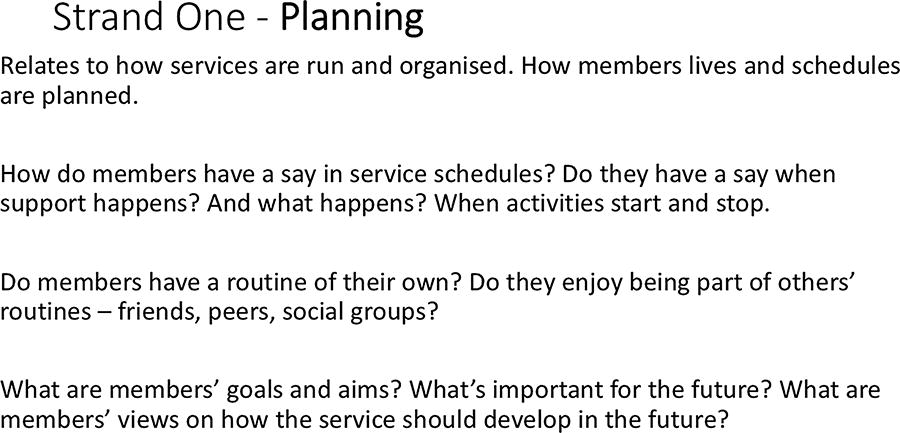
A workshop slide describing the “Planning” strand.
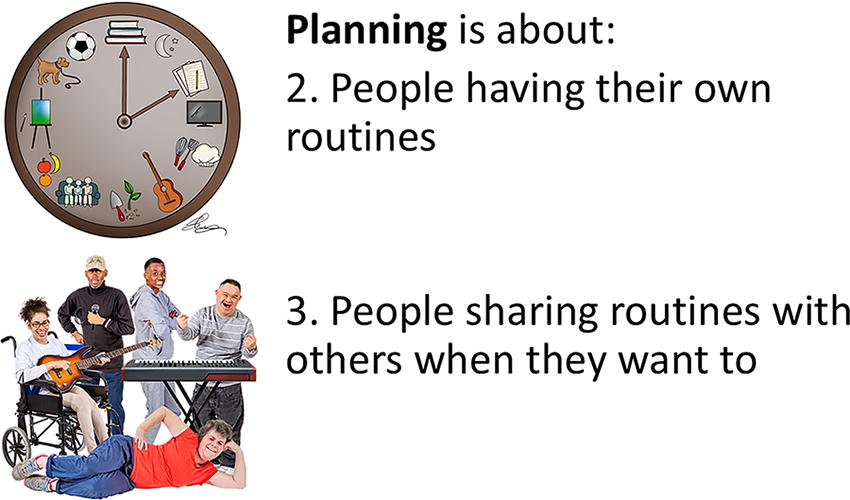
An Easy Read slide describing part of the “Planning” strand. Easy Read is a method of using standardized images and straightforward sentences to provide accessible information and resources for people with learning disabilities.
During the course of the activities, participants expressed that the “place” and “planning” strands were overly similar and recommended for them to be combined.
Analysis
Data from all research activities were transcribed, including comments typed during workshop discussions and emails sent to us by participants after workshops. We analyzed them with the qualitative analysis software NVivo, following a template analysis approach, 33 which, aligning with our epistemological stance, enables exploration of themes across large amounts of data arising from different methods and participant groups. We began by developing a template based on the adapted at-homeness strands, which we used to semantically code data, beginning with interviews and creating subthemes within the four template categories. We then used this template and its subthemes across further data, iteratively adapting until a final template was developed. We revisited the entire data set using this template, creating the final thematic results.
Findings
Place and planning
Environmental customs and ownership
Place and Planning was adapted from the at-homeness characteristics of rootedness and appropriation, which refer to how people can experience places as belonging to them and helping to organize their lives. Participants suggested this strand would be significant to day-service members, pointing to how environments can have a significant impact on this group’s physical and emotional experiences and their abilities to do the things they care for: I love swimming, but there are hours which are much busier and I can get over stimulated and have a bad experience (autistic person).
Support workers argued that day-service environments are beneficial as their designs can take into account the priorities of service members, who often have a diversity of sensory preferences. Having a say in defining environments could provide members with a sense of autonomy, which participants thought members would value and could reduce the challenges uncomfortable sensory environments bring:
… it’s about if I’m in control of my situation. I don’t like busy, noisy places, but if I’m in control … I’d be ok (autistic person).
People with learning disabilities suggested members would value having a place they saw as their own, which they could “just chill out and relax when they need to,” while an autistic participant emphasized the need to experience privacy, “you’re happiest in that space where no one can see and hear you.” Autonomy over environments could lead members to feel a sense of ownership of their day-services, which participants thought would promote confidence and help members to develop in ways important and personal to them:
… she experienced really awful stuff, she was in a room with a mattress … she had nothing. So it’s really important for her to have a space where things aren’t taken away (support worker).
Developing, exploring, and adapting routines
Participants suggested service members value developing individual routines as they help establish areas and occupations significant to their day-to-day schedules. Such routines can be highly rigid, quite flexible, or somewhere in between, involving important interests but also smaller, subtler activities and customs that have personal meaning:
I noticed they wanted to take their time tidying the trolley without people saying sit down or leave it alone … that’s a positive thing (support worker).
An autistic parent said, “a strong association with a place and a setting could determine members’ willingness to follow structure,” reflecting other participants’ suggestions that members may view the consistent nature of day-service settings as key to developing routines important to them. All participant groups highlighted how members would find it significant to have a choice over and within their routines, and that this could help “you feel liberated” (autistic person), although suggested that members may find this difficult to exercise:
My son is so complex, sometimes he will just repeat the last thing that someone says as if it was his choice … or he’ll say no and then days afterwards he asks to go (parent).
Routines may be significant to members experiencing safety and security, participants reported, arguing that day-services need to develop a strong understanding of what routines mean to members and to know how to respond if a person seeks to step outside or remain within their routine:
… it’s taken years for her to feel comfortable in her environment and she doesn’t like change. But management are trying to force through changes, and I can see there’s something negative happening … (support worker).
All participant groups argued that members would place importance on including people in their routines whom they valued and got along with, as a support worker noted of one service member, “… if he’s with someone that he doesn’t want to work with, he’ll go to sleep” (support worker). Emphasized also was the significance of members having the opportunity to access and experience local areas, nature, and places which they might find fulfilling:
… going to a theme park, well, I think my son would hate that. But taking him round a lake, he’s happy (parent).
Some parents had concerns that while routines were important, they could also be difficult to fulfill, as one participant said of their son, ‘he’ll make routines out of routines. So, if you start, you have to carry on doing it for the rest of your life…’ (parent). This was similarly emphasized by support workers, who also drew attention to the often hostile or inaccessible nature of local areas and places:
… we took them out for a meal, we bring our blender … but some restaurants won’t blend food or let us blend it ourselves (service manager).
Being yourself
This strand was drawn from the at-homeness characteristic of at-easeness, which refers to how places can help us to experience a sense of freedom in ourselves. All participants suggested that members would find it important to feel as though they can be themselves, to act, communicate, and behave in ways important to them, although many raised concerns that discourse around autism or learning disabilities could impact how support staff understand and respond to them. “It’s about not making assumptions” said an autistic person, rather to understand individuals’ ways of being:
… people thought that autistic people need this mad structure, rather than seeing the person … (support worker).
Negative aspects of members’ histories could lead to a narrow understanding of what they are interested in or capable of, reported support workers and parents, suggesting that new experiences could provide an opportunity to challenge such assumptions:
… the family had fears of taking them out … So when we tried, we tried not to talk. We just guided them, walked side-by-side with them, let them sit down and whenever they felt like standing, we carried on (support worker).
Members may have different views on what is positive or appropriate behavior, which may be integral to them feeling themselves and challenged if services attempt to change this or “turn a neurodivergent person into a neurotypical person” (autistic person). There was though, an acceptance among participants that members’ actions could cause issues for themselves or others, and that members may not always understand the implications of their actions:
She doesn’t know anything about possession, so she’ll reach out and take somebody else’s meal … that’s being yourself, but it’s also not great (parent).
It is thus vital, participants argued, for day-services to explore reasons why a person may be acting as they are, to try to understand what their actions express about their experiences, and to explore this within the context of their lives. Subsequent decisions about members’ lives and behavior need to prioritize the person’s preferences, views, and experiences, with all participant groups, including some parents, expressing worries that the perspectives of family members’ or service managers may override that of members:
The family is not the best ones to be involved because they take over. I’ve experienced that (person with learning disabilities).
Cultural and religious customs are areas that require sensitive consideration, argued support workers and autistic people, “wondering how you ensure that someone is at peace with themselves, spiritually, morally, culturally” (autistic person). While they recognized that such customs may have a significant role in service members being themselves, they also thought members may view them less significantly as their family emphasize. While complex, religious, and cultural customs were seen as potentially important to members as they could promote experiences of belonging or a sense of familiarity:
… one of our people whose mother tongue is Turkish, you can say good morning in Turkish and they respond, they’re saying good morning, it’s fantastic (support worker).
Social customs
Participants suggested members would place a high value on others respecting their social customs and etiquette as it is essential to them feeling able to “express how they’re feeling” (person with learning disabilities) and communicate about important aspects of their lives and identities. Such customs may be different to support workers, who spoke of the need to adapt their etiquette to conform with what members thought polite and courteous:
… me being from Africa, we have this kind of voice, loud vocals … it’s our way of communicating, but this person doesn’t like people being loud, so you have to minimise your tones … you need to fix yourself (support worker).
There was a recognition among participants that day-services may be one of the few places that members’ social customs can be recognized, valued, and responded to. An autistic person spoke of how having their communication preferences valued would mean “everything and can’t be underestimated,” while a support worker highlighted how training and bespoke environments in day-services helped to promote social experiences members might appreciate:
I am a quiet kind of person and I’m realising that she needs that in her life. Her family are very supportive, but because they are not trained in autism, they are loud and engage her so much. When I’m around her, I just want her to release what’s going on in her head, to feel calm and safe and comfortable (support worker).
Autistic participants drew attention to the meaning of social engagement for members and how they may experience closeness and support from staff in ways that may not initially appear significant:
Sometimes I need somebody just to sit with me, and not to say anything, just be by me (autistic person).
This notion was supported by parents who argued it was important for day-services not to have a fixed idea of what positive social engagement is, that members would have individual social preferences.
… he doesn’t like watching telly with his peers.
But they ring me and say it’s great, he sat for 10 minutes with his peers. But I know he wouldn’t have liked that. He would have preferred to be on his own.
Rest and stressors
Encountering and responding to day-to-day stressors
This strand was adapted from the at-homeness characteristic of regeneration, which refers to how places can engender the experience of physical and mental rest. Participants suggested this strand would be significant to day-service members who they thought would often experience worries, stress, and intense emotions in their day-to-day lives, including through environmental or sensory triggers or overwhelming social interactions:
My daughter’s profile is extremely spiky, either sensation seeking or very sensitive … and that’s often going to make her feel a lot of emotions as a result (autistic parent).
Such stressors can result in members experiencing distress, anxiety, shutdowns, and meltdowns. Autistic participants and people with learning disabilities emphasized the significance of these experiences, reporting that members may find it hard to express this, thus requiring consideration and recognition by support staff:
… when I get tired, I don’t notice it but other people notice it, they tell me ‘rest’. So it’s really important that that happens (person with learning disabilities).
While stressful experiences were recognized as important to members by support staff, they also discussed how members’ communication about stressors can be subtle and appear similar to other expressions:
She has a sound … it goes high in her voice. And then sometimes she starts making a noise as if crying, and I’m like OK, I need to do something (support worker).
Autistic participants and parents reported that members’ sensory experiences will likely play a significant part in their levels of rest and stress and can impact on whether they are confident and able to go about their daily pursuits, again reaffirming the intricacies of these experiences:
… you could put me in a bed and a lovely, weighted blanket and nice calming music, but if the carpets red, I’m not gonna be able to rest (autistic person).
Members views on what makes them well, as well as what may cause anxiety or stress, were therefore considered vital, extending to experiences at their day-service, outside of the day-service such as at home, and historical experiences:
… we are really aware of certain times for certain families that are not the best times (support worker).
Promoting rest
Due to concerns about everyday stressors, participants thought members would prioritize restful practices and experiences: “it’s about learning techniques you feel are gonna help …” (autistic person). Support workers gave many examples of how members would show these experiences were important:
… if he gets a little bit stressed he just lies on the mat next to the radiator, and I’ll put a blanket on him. He’s not having any pressure put on him, emotional or mental (support worker).
Autistic participants and parents stressed the importance of members having autonomy within stressful situations, suggesting that this would help them to cope and feel in control. This autonomy can be exercised in subtle ways, such as through engagement with important items or activities, although some participants had concerns that services may see such items or activities as unimportant:
… they were saying he’s always got his iPod, as though they needed to get it off him … But that’s his comfort, his way of coping (parent).
Parents and support workers suggested members would often take “a long time to build up trust with someone” (parent), but that once developed could open them up to experiencing personal and personalized forms of rest:
… when she’s agitated … she’s calling for attention … she likes head massages, her shoulders … that helps her come down (support worker).
Many participants emphasized how important areas and places would provide experiences of rest for members, representing places of sanctuary away from day-to-day stresses and difficulties and needing to be understood within this context:
… they like sightseeing, like going to the city, just to look around. An environment that is quiet, just to walk around, just to feel the atmosphere (support worker).
Community
This strand was adapted from the at-homeness characteristic of warmth, which refers to how we experience places as friendly and supportive and how they encourage us to nurture them. Participants emphasized that while they thought community would be significant to members, it was important to understand it from their perspectives. They said, for example, that socializing in groups may have little meaning for some members, whereas most would find it important to have their practices, customs, and values accepted and appreciated:
It’s important to have responsibilities within your community, to feel like it’s not only you benefiting and being supported, but you are able to support others and are able to take roles that have value (autistic person).
This experience of community may include having a role in teaching others service practices and customs, because “being part of a community involves helping each other” (person with learning disabilities). A support worker discussed how a member taught them how to act and communicate:
One guy is so smart, to the extent that he even teach me that if I do this sign, they’re telling me, let’s go (support worker).
A key part of experiencing community was having a positive impact on other members of the group, suggested participants, as this “will help both feel appreciated and enjoy the service. It’s a symbiotic thing” (autistic person). Participants thought that creating a positive atmosphere and culture would be valued by members as it would engender positive engagement with those they were supported by, which support workers often spoke about:
You will see it all over them. Like when I’m coming to support a client and they see my car outside? They are jumping … It’s the thing that gets us moving (support worker).
Participants suggested members often experience unwelcoming places and environments in their day-to-day lives, and so helping to contribute to “a wider idea of trying to improve acceptance” (autistic person) may be viewed as an important aspect of their role in the community. It was suggested members do this by venturing into places that may not be previously accepting of them, requiring support staff who can encourage and champion this endeavor:
… we went to a restaurant … and the so-called normal people were like, what are these guys doing here? So we reassure them. You got your right to be here, you paid your money (support worker).
The importance of day-services and their communities
Participants highlighted how members often view and experience day-services as important and integral parts of their lives, with participants providing tales of members refusing to leave their day-service despite the need for emergency plumbing, members turning up on bank holidays, and mirthful weekly events:
Friday afternoons we have grooves with DJ Ben and a member Makaton signs for dancing every day, and on Fridays they’re just so joyful. They’ll sit by the amp … Maybe they don’t get to hear music at home or on that quality of a speaker, with such banging booming bass (support worker).
Support workers suggested members often treat day-services as “their place, they care, they know it’s for them” (support worker). They may disparage holidays, weekends, and periods often experienced as positive to nonservice members, experiencing them as occurrences that disrupt their lives and prevent them from doing what is important to them:
… sometimes on the weekend, they don’t want the weekend. They want Friday to go straight till Monday. And Christmas, those are good holidays for us, but our PMLD clients, they find it difficult (support worker).
As participants thought day-services were an important part of members’ experiences of community, they suggested that there is a need to recognize and celebrate what day-services mean to members, and vice versa, as this will help to embed their values, outlooks, and histories in their service organizations:
You connect with people when you’re celebrating things … it helps people remember the good times you’ve had with them, and it helps you feel part of a community (person with learning disabilities).
Engaging with wider society about the positive impact and roles of service communities may also be an important part of members’ experiences, suggested participants, who reported it might help them to feel “that they belong to the community and feel accepted” (parent). Autistic participants noted how much of society share their stories on a regular basis, through social media, for example, but that we rarely hear from day-service members, while support workers discussed ways they, their service, and its members do this already:
… we’ve had open days. The coffee morning. The drama production. A big fashion show, that was good, hundreds of people came … (support worker).
Discussion
In this research, we explored with community members and day-service staff how and whether at-homeness might represent a framework of views and experiences important to The Day-Doc cohort. We adapted the terminology of at-homeness with a steering committee, before working with the study’s participants to explore its potential significance and to contextualize it within the context of day-services and their members. While the four strands were said to likely be important to service members, participants emphasized the need to understand the intricacies and individuality that would be inherent in each person to respond to them in helpful and supportive ways.
In the Place and Planning strand, it was suggested that members would view shaping environments and routines as important to developing day-services that were fulfilling, aligned with their sensory preferences, and which they felt they had some ownership of. Research has shown ways autistic adults with profound learning disabilities can contribute to the designs and landscapes of places where they live, 34 which, although likely more complex within shared day-service spaces, suggests service members could be included in the shaping and development of service environments. Participants in our reported study felt this could help members experience a sense of autonomy and ownership, which, research indicates, services can often struggle to promote. 20
The Being Yourself strand related to members feeling able to act, socialize, and communicate in their own personal ways, which participants thought would be important to service members while expressing concerns that day-services may misunderstand people due to assumptions around diagnostic labels and behavior. Generalized assumptions around autism and learning disabilities can have a harmful impact on The Day-Doc cohort 35 and there is evidence that such assumptions are strengthened by support approaches, such as the predominant positive behavior support, 36 as well as the management cultures within some services. 21 This emphasizes the importance of day-services making efforts to understanding what peoples’ actions, customs, and habits mean to them and their ability to experience themselves in ways in which they feel confident, open, and fulfilled.
The Rest and Stressors strand was reported to likely have significance for members as participants thought they potentially encountered many stressful experiences on a day-to-day basis. What appear to be minor events to support staff, such as small changes to schedules 2 or sensory stimuli, 37 may have a significant detrimental impact on The Day-Doc cohort and their ability to feel safe and secure. Participants advocated, as have previous researchers, 38 the need for support services to work with members to develop practices and strategies that they view as restful and promote feelings of control over everyday circumstances.
Although participants suggested that the Community strand would be important to members, they stressed the importance of defining community from their perspectives. Reflecting research in learning disability and dementia day-services, 39 participants highlighted the likely significance members would place on having the opportunity to contribute to and shape service practices, as well as helping others to understand how to be part of their service and the events and activities they prioritize, such as weekly music get-togethers. As Murray notes, 40 day-services are often places where The Day-Doc cohort share their adult lives, so the types of communities they wish to create within them will likely be important to their personal and social identities.
Limitations
We first identified the at-homeness framework as having potential importance when we explored the experiences of The Day-Doc cohort in a single UK-based day-service, 2 so its relevance may not be as significant for other people in this group or within other day-service or geographical contexts. We suggest further research in a greater number of day-services and with a greater number The Day-Doc cohort may help to develop a more robust framework of views and experiences important to this group.
There were disparities in the participant groups that provided their perspectives in this study, with particularly lower numbers of people with learning disabilities than other groups. We acknowledge such a disparity can create a hierarchy of perspectives although note that these groups shared broad views on the relevance of at-homeness to The Day-Doc cohort.
Conclusion and Practical Implications
In this study, we worked with community members and day-service staff to explore how an adapted at-homeness 1 framework may represent views and experience significant to The Day-Doc cohort. Our aim was to develop a framework to help day-services focus on and respond to views and experiences important to this group. The study’s participants signaled the likely importance of the framework and its strands to service members, discussing how their capabilities can be nurtured when they have the opportunity to contribute to day-services that value and incorporate their views.
The contextualization of the strands within day-services and the lives of The Day-Doc cohort provide a frame of reference with which to help day-services understand how to explore and consider members’ views and experiences. We have used them to develop a practical tool for day-services, The Day-Doc, with its purpose being to help day-services to respond to this group’s views and experiences in decision-making, support planning, and service evaluation. As this study’s participants suggested, developing day-services through the views and experiences of their members can have a range of benefits for them, their services, and society more broadly. We intend for The Day-Doc to help day-services to:
Better involve The Day-Doc cohort in the ways they develop and evaluate provision. Document and evidence service members’ views and experiences to inform decision-making and support planning. Consider how their organizational values and perspectives may or may not align with service members.
Day-services are one of the few places The Day-Doc cohort has the opportunity to shape a small area of society according to their views and experiences; such an opportunity should not be missed.
Footnotes
Authorship Confirmation Statement
This study was designed by N.R. and E.T. The advisory committee was led by N.R. with E.T.’s involvement. Research activities were led by N.R., as was the analysis, with E.T. reviewing and providing feedback on thematic development. This article was drafted by N.R., with contributions, feedback, and editing from E.T.
Author Disclosure Statement
No interests to disclose.
Funding Information
This study was funded through an Autistica grant, reference no. 7290.