




Abstract
Community Brief
Why is this an important issue?
Autistic adults experience high unemployment. One explanation has been the different ways that autistic people socialize and cope in the workplace compared with non-autistic people. A lack of understanding of autistic social behavior and workplace challenges may lead to them being seen as less competent and being socially excluded at work. Negative perceptions of autistic employees can affect their quality of life and employment success.
What was the purpose of this study?
This study asked if the following factors were related to more favorable perceptions of an autistic employee’s competence, suitability for their job, and social acceptability as a coworker in the workplace: Accurate understanding the thoughts, feelings, and intentions behind an autistic adult’s workplace behavior; participant’s level of autism knowledge; participant being autistic; and participant having experience with autism. Knowing what is related to more favorable perceptions of autistic employees helps plan effective autistic adult employment supports.
What did the researchers do?
We had participants read a story about a fictional autistic employee at work having a difficult workday. We asked participants to rate the employee on how competent and suitable the person seemed to be for their job and their attitudes toward socially including them if they were a coworker. Participants answered other questions about their knowledge and experience with autism. We then examined what might be related to more favorable perceptions of the autistic employee.
What were the results of the study?
Increased knowledge about autism, particularly knowledge autistic people think is important, was related to more favorable perceptions of an autistic employee’s competency and attitudes toward socially including them. Autism knowledge was especially related to favorable perceptions if the participant did not understand the autistic employee’s behavior.
What do these findings add to what was already known?
Autistic adults report working very hard to appear non-autistic in their workplaces to avoid negative attitudes about their competency, being socially excluded and jeopardizing their employment. Trying to hide being autistic in the workplace is highly stressful and exhausting. Rather than expecting autistic people to change to fit in, findings of this study support educating workplaces about autism to increase understanding of autistic employees’ characteristics and challenges.
What are potential weaknesses in the study?
Because this study used social media, it may have left out people who rarely or never use social media, including autistic adults with higher support needs. While the story about the fictional employee was written based on experiences reported by autistic adults, it does not capture all positive and negative autistic employment experiences.
How will these findings help autistic adults now or in the future?
Coworkers and supervisors with better understanding of autism and autistic traits may also be more likely to recognize competence in autistic employees and more likely to include them socially at work. Being perceived as competent and being socially included at work can improve autistic employees’ workplace quality of life and help them to survive and thrive in the world of employment.
Background
Autistic adults experience high unemployment rates.1B2 -7 Employed autistic adults often work fewer hours than the amount required to support financial independence or are employed in ways not commensurate with their skills, education, and abilities.8-10 Autistic adults’ successes in finding and maintaining employment are impacted by challenges they encounter with social interactions in majority non-autistic workplaces.1,11B12 -14
Conventional thinking is that autistic challenges with social functioning in non-autistic spaces arise from assumed deficits in theory of mind (ToM).15,16 ToM is the ability to observe and interact with another person and in so doing successfully theorize as to the thoughts, feelings, and intentions behind the other’s behaviors and communication.15,17,18 However, researchers have had difficulty explaining why a subset of autistic individuals pass traditional ToM tests when the assumption is that they would demonstrate ToM deficits. 16 Additionally, researchers have criticized ToM assessments for their lack of connection to real-world social functioning of autistic individuals and autistic persons’ experiences and expressions of empathy.19,20
The double empathy problem (DEP) challenges the ToM impairment explanation of autistic social functioning. Milton 21 proposed the DEP, which posits that autistic individuals may struggle to read and understand the behavior of non-autistic others but demonstrate social reciprocity, have effective communication with, and understand the behavior of autistic persons. Conversely, non-autistic individuals have difficulty understanding autistic others and mistakenly overestimate their ability to do so. 22 Therefore, according to the DEP, autistic social challenges in non-autistic spaces arise not from deficits that lie within the autistic person but in the interaction between autistic and non-autistic persons.21,22
Consistent with the DEP, autistic individuals have demonstrated social rapport and effective communication with each other and often prefer each other as social partners.23,24 Additionally, non-autistic individuals have had difficulty understanding the behaviors of autistic individuals when observing them on video or in interpreting autistic emotion-related movements.25,26 Compared with non-autistic participants, autistic participants were more likely to accurately interpret the behavior of an autistic employee in a hypothetical workplace vignette. 27
As an emerging theory, the DEP has been critiqued. Proposed concerns include the lack of well-defined central assumptions, poor conceptualization of the nature and measurement of empathy, and poor linkages to traditional methods of theory development and the building of theory-supporting evidence. 28 While this study does not undertake a full review of the critique and counter responses, there is notably much debate on the measurement of empathy as a neuro-normative construct that does not account for or value autistic persons’ ways of experiencing and demonstrating empathy. 29 Emerging evidence indicates neurological differences in empathic experiences between autistic and non-autistic persons. 30 These findings are consistent with the DEP’s assertion that the problem is a clash of neurologically different social cultures. 22
Notwithstanding the debate, studies have demonstrated competent communication and understanding between autistic persons and difficulties non-autistic persons have in communicating with and understanding those who are autistic.23B24 -27,31B32 -34 The DEP is also worthy of consideration given it is consistent with the lived experience of autistic people in autistic/autistic versus autistic/non-autistic social interactions.22,31,34,35 Therefore, it is important to continue to study the DEP as an emerging and critiqued area of work in multiple contexts. Furthermore, research should continue to investigate the potential implications of the DEP 29 including within the context of employment. 27 Autistic adults are at risk of the non-autistic majority misunderstanding their autistic characteristics, behaviors, and challenges, increasing the likelihood of others holding negative perceptions of them,23B24 -27,36 and potentially jeopardizing their ability to obtain and retain employment.2,11,37-39
Perceptions of competency and attitudes toward social acceptability in employment
Autistic employees report experiences of stigma, negative perceptions of their competence and suitability for their work, and social exclusion in the workplace.1,2,11,13,38B39 -43 According to the Stone and Colella 44 model of factors affecting treatment of disabled individuals in organizations, coworkers and employers make assumptions about the competency and suitability of a disabled employee for their job based on their beliefs about the employee’s skills and abilities and perceptions of the employee’s disability characteristics. Rates of pay, training opportunities, opportunities for growth and advancement, and the willingness of others to mentor someone at work can all be impacted by negative perceptions of the competency and suitability for work of a disabled employee. 44
Coworkers’ and supervisors’ affective reactions toward disabled employees are also impacted by negative perceptions. Affective reactions influence the degree to which others will find an employee socially acceptable as a workplace colleague and therefore the extent to which they are willing to socially include them in the workplace. 44 Negative affective reactions or unfavorable attitudes toward the social acceptability of a disabled employee can result in exclusion from collaborations on projects and work groups and from workplace social activities. 44
When studying first impressions of autistic individuals, non-autistic participants rated those who exhibited autistic characteristics less favorably, especially in the absence of diagnostic information. 45 In their study of impressions of college students, Gillespie-Lynch et al. 46 demonstrated that autistic college students face stigma from others, especially if they display disruptive behaviors (speaking loudly, interrupting, laughing when others are not, and monopolizing conversations). Autistic job candidates in job interview vignettes had lower positive ratings compared with candidates with other medical diagnoses. 47 Autistic employees report negative perceptions of their competence and value at work and connect negative perceptions with poor employment outcomes.39,48,49 Studies have examined impressions of autistic persons in social situations45,50 and job interviews. 47 However, factors associated with general public perceptions of competence and suitability for work and attitudes toward the social inclusion of autistic employees given information about their traits and challenges in the workplace have not been examined.
Potential factors associated with positive perceptions of competence and social acceptability
Autism knowledge
Since the first identification of autism, knowledge of autism and autistic experiences continues to evolve. 16 Autistic persons co-designed an updated participatory autism knowledge questionnaire, which measures general knowledge of autism; studies have shown a link between the latter and reduced stigma toward autistic college students.51,52 Following a brief autism acceptance training, non-autistic college students demonstrated more socially inclusive attitudes and reduced negative explicit bias toward autistic persons. 53 Non-autistic males who completed a brief autism training followed by engaging in a 5-minute conversation with a previously unknown autistic male indicated more social interest in their conversation partner compared with those who did not receive the autism training. 54
Within the context of employment, studies associate autism knowledge with more favorable ratings of autistic job candidates. 47 Employers participating in autism hiring initiatives that included autism education reported that education about autism was beneficial to them in developing more positive attitudes toward hiring autistic employees and in promoting inclusivity in the workplace. 55 Similarly, studies identify a lack of autism knowledge on the part of employers as a barrier to intentions to hire autistic employees. 56 Prior knowledge of autism contributed to the quality of the relationship between autistic employees and non-autistic supervisors, which facilitated better employment outcomes for autistic employees. 57 Our previous work strongly associated autism knowledge with accurately understanding the behavior of an autistic employee in the workplace. 27
Conversely, autistic job candidates have reported that employer lack of knowledge of autism led to misunderstanding and stereotyping of them as well as assumptions of them being less competent. 40 Autistic employees have reported that a lack of knowledge and understanding of autism in the workplace contributed to their experiences of negative social interactions with coworkers, 39 being socially excluded in the workplace, and facing inaccurate beliefs and stereotypes about autism.49,58 Qualitative studies have examined the impressions of employers and autistic employees. Autism research has yet to study the association between autism knowledge and public perceptions of autistic employee competence and attitudes toward socially including them at work, given information describing ongoing challenges of an autistic employee throughout their workday.
Autism experience
Familiarity with autistic persons from past or present experiences, such as having autistic family members, autistic acquaintances, or autistic coworkers, may influence perceptions of the competence and social acceptability of an autistic employee at work. Regarding disabilities in general, research participants who had previous positive experiences working with someone who was disabled had more favorable perceptions including more positive affective reactions toward disabled coworkers. 59 Similarly, participants who reported past positive experience with bipolar disorder had more positive perceptions of the competency and social acceptability of a hypothetical coworker with bipolar disorder. 60
Regarding autism research with higher education students, studies associate greater quality of previous autistic person contact with reduced autism stigma. 52 Similarly 4-year college students with more frequent and higher quality contact with autistic persons rated autistic peers as more socially acceptable. 61
Regarding autism research in the workplace, employers (involved in autism hiring initiatives) have reported that having experience with an autistic employee increased their appreciation for autistic skills and productivity within the organization, their patience and respect for their needs, and their willingness to provide accommodations. 62 While there is some qualitative information from employers, research has yet to study the association between general public perceptions of and attitudes toward autistic employees in the workplace based on different ways the public may have experience with autism such as having had a past or present autistic coworker, autistic family member, or autism being the focus of their work or study.
Interpretation of autistic behavior
Effective social interaction and communication involves being able to observe the behavior of others and then based on observation interpret what the behavior is indicating about the thoughts, feelings, and intentions of the person. 15 Accurate understanding or interpretation of the behavior of another person guides appropriate social responses toward that person. The skill of “behavior interpretation” is one aspect of ToM.15,17 However, non-autistic individuals often misinterpret the thoughts, motivations, and meanings behind the behaviors of autistic others, despite mistakenly believing they are accurately interpreting or understanding autistic behavior.22,35
“Quality of work life” refers to an employee’s overall well-being in the workplace, factoring in the work environment, job satisfaction, and workplace social culture. 63 The consequences of coworkers’ and supervisors’ misunderstanding autistic employees can include mistaken impressions of their competency and suitability for work or workplace social exclusion,2,48,49,64 which can reduce their quality of work life, ability to remain successfully employed, and advance in their careers. 39 However, if supervisors and coworkers accurately interpret and understand the autistic employee’s traits and behaviors in the workplace, they may view them more positively in terms of their competency and suitability for their jobs and have more positive attitudes toward socially accepting and including them in the workplace. We are unaware of studies that have examined the association between the ability to interpret the behavior of autistic employees at work and perceptions of their competence or attitudes toward socially including them at work as a potential coworker.
Neurotype (autistic/non-autistic)
Consistent with the DEP, autistic individuals report greater rapport and ease of communication with autistic others compared with non-autistic others.23,24 Autistic persons have also been more likely to demonstrate accurate interpretation of the behavior of a hypothetical autistic employee in a workplace vignette compared with non-autistic persons. 27 Autistic individuals have indicated being more comfortable and preferring social interactions with other autistic individuals compared with non-autistic others. This finding held regardless of their ratings of the person’s social awkwardness or attractiveness. 32 Autistic adults report greater comfort and ease in the presence of other autistic friends and family. 31 Autistic employees report fewer social challenges and anxiety from social interactions in workplaces where autistic coworkers are the majority compared with majority non-autistic workplaces. 14 Studies have not shown if autistic persons perceive autistic employees as more competent in their jobs and would be more willing to socially include them at work compared with non-autistic persons.
The present study
Perceptions of an autistic employee’s competence and willingness to socially include them are important contributors to autistic adults’ employment success and thriving in the workplace.1,2,11,13,37,39B40 -43 Employment support programs can be guided toward effective strategies to assist autistic adults with employment by identifying factors associated with perceptions of competence and attitudes toward social inclusion. The present study is the first to examine factors associated with perceptions of competence and attitudes toward social inclusion of autistic and non-autistic participants regarding a hypothetical autistic employee throughout their workday in a workplace vignette.
This study drew data from a larger dataset in which autistic and non-autistic participants read a vignette written about a hypothetical autistic employee and completed several measures. From that dataset, the study created a measure of the ability of participants to accurately interpret the behavior of the autistic employee in the vignette and used the measure to compare autistic and non-autistic performance. Accurate “behavior interpretation” involved demonstrating understanding of the thoughts, feelings, and intentions of the autistic employee in the vignette. Further descriptions of the behavior interpretation measure and scoring are provided in the present study Methods section and in Szechy et al. 27
The present study substantially builds on the previous work with a unique subset of the data and new analysis of predictors of outcome variables that measured participants’ perceptions of the hypothetical autistic employee’s competence and suitability for their job, as well as attitudes toward socially including them as a potential coworker. Hypotheses were planned for the present study prior to the original data collection. The hypotheses are as follows:
Given previous findings, we expected that neurotype (autistic/non-autistic), possessing greater autism knowledge, having more experience with autism, and accurately interpreting the behavior of a hypothetical autistic employee portrayed in a workplace vignette would all be associated with more favorable participant ratings of perceptions of competence/suitability and attitudes toward workplace social inclusion. Consistent with the DEP, we expected that autistic participants would give more favorable ratings on measures of attitudes towards and perceptions of the autistic employee portrayed compared with non-autistic participants, due to the greater likelihood of autistic participants accurately interpreting autistic behavior and challenges in the workplace.
27
Therefore, we hypothesized that accurate interpretation of the autistic employee’s behavior would moderate the relationship between neurotype (autistic/non-autistic) and ratings of perceptions of competency/suitability and attitudes toward social inclusion. We hypothesized that participants more knowledgeable about autism and more experienced with autism would give more favorable ratings of attitudes towards and perceptions of the autistic employee portrayed due to being more likely to accurately interpret autistic employee behavior compared with those with less knowledge and experience.
65
Therefore, we hypothesized that accurate interpretation of the autistic employee’s behavior would moderate the relationship between autism knowledge and ratings of perceptions of competency and attitudes toward social inclusion. In addition, we hypothesized that accurate interpretation of the autistic employee’s behavior would moderate the relationship between autism experience and ratings of perceptions of competency and attitudes toward social inclusion.
Methods
Sample
The sample from this study (N = 229) is a subset of the sample used in Szechy et al. 27 (N = 254) and differs from Szechy and O’Donnell 65 (N = 213). Differences in sample size are due to this study involving different a priori hypotheses, unique analyses, and unique variables compared with the previous work. The sample consisted of 77 autistic and 152 non-autistic adult participants aged 18 or older. We recruited participants through online advertisement on a Listserv of autistic and non-autistic academics and higher education advisors, the University Centre for Excellence in Developmental Disabilities, university social media, and general social media (see Szechy et al. for additional information on sampling). 27 While most of the sample identified as cisgender woman (65%) followed by cisgender man (24.5%), over 10% of the sample identified as nonbinary, gender nonconforming, transgender, or other. Consistent with prior findings, autistic participants were significantly more likely to identify as nonbinary/gender nonconforming/transgender or other (χ2 = 29.2, Holm–Bonferroni adjusted p < 0.001, d = 0.76, 95% confidence interval or CI [0.48, 1.04]).66-68 Autistic participants were also significantly less likely to be in higher income categories compared with non-autistic participants (χ2 = 18.2, Holm–Bonferroni adjusted p < 0.01, d = 0.59, 95% CI [0.32, 0.86]) and were significantly younger than non-autistic participants (t[192.1] = 3.1938, Holm–Bonferroni adjusted p = 0.028, d = 0.41, 95% CI [2.1, 8.8]). Table 1 presents additional demographics of the sample by neurotype.
Description of the Sample
p < 0.05, **p < 0.01, ***p < 0.001.
RAADS, Ritvo Autism and Asperger’s Diagnostic Scale.
Community involvement
Workplace challenges self-reported by autistic adults from multiple sources1,13,41,69B70 -75 served as input in writing the vignette describing a hypothetical autistic employee. Several autistic autism researchers from the College Autism Network Virtual Association of Scholars (CANVAS) consulted on study measures and reviewed three iterations of versions of the vignette describing the hypothetical autistic employee.27,76
Study measures
Behavior interpretation scoring
Szechy et al. 27 previously published the vignette, six open-ended questions, and scoring system for behavior interpretation scoring for this sample. The vignette was created from many different sources describing the first-person lived experiences of autistic adults in the workplace including books, interviews, blog posts, and qualitative studies.1,13,41,69B70 -75 Several autistic autism researchers from CANVAS 76 consulted on the vignette and scoring through several iterations to reach the final version. All original scoring was done by two dyads of independent scorers who scored while blind to the neurotype of participants and all other data. The study team calculated Cohen’s κ values measuring agreement between the two scorers in each dyad (dyad 1, κ = 0.659, dyad 2, κ = 0.704) followed by discussing and resolving scoring discrepancies between scorers in each dyad. Participants received a behavior interpretation score of either “0” (inaccurate or off-topic answer—inaccurate behavior interpretation), “1” (partially accurate answer but missing an important component—partial behavior interpretation), or “2” (accurate behavior interpretation). 27 The scoring approach adopted the scoring system of Happé’s strange stories ToM measure. 77 See Szechy et al. 27 for additional details on the development of the vignette, questions, scoring system, and scoring process.
Only 10 autistic participants scored a “1” for behavior interpretation. Therefore, for group comparison, behavior interpretation scores were dichotomized into a score of the combination of “0” (inaccurate) and “1” (partially accurate), versus a score of “2” (accurate interpretation). A score of “1” indicated one of two important components of understanding the hypothetical autistic employee’s experience was still missing from the participants’ response. Therefore, combining behavior interpretation scores of “0” and “1” into “0/1” versus “2” distinguished between those that had fully accurate explanations of the autistic employee’s behavior and responses and those that did not. This binary scoring of behavior interpretation is consistent theoretically and statistically with previous analysis. 65
Scales measuring perceptions of the autistic employee
The outcome measures for this study are the competency/suitability and social acceptability scales previously used by O’Donnell et al. 60 to measure perceptions of and attitudes toward an employee with bipolar disorder. They contain items from the Job-Related Expectancy and Affective Reaction scales developed by Popovich et al. 78 and Scherbaum et al. 59 The competency/suitability scale is a 4-item Likert scale asking participants to choose from a range (1–7) that describes opposite characteristics of the employee in the vignette such as 1 = incapable to 7 = capable and 1 = unqualified to 7 = qualified. Higher scores indicate more positive perceptions. The scale measures the extent to which the participant views the hypothetical autistic employee in the vignette as someone who is competently performing their job and suitable for that job in their workplace. The social acceptability scale is a 6-item Likert scale with participants indicating “1” (not at all likely) to “5” (very likely) for items such as “How likely is it that you would get along with John?” and “How likely is it that you would be willing to work on a project with John?” a The scale is intended to measure the extent to which a participant would see themselves in workplace collaborations and social activities with the hypothetical autistic employee.
Based on the previously developed factor structure from O’Donnell et al., 60 the study conducted a two-factor confirmatory factor analysis (CFA) on both scales using R version 4.2.1 79 and the lavaan R package. 80 Robust unweighted least squares (RULS) estimation was used given the CFA was conducted with noninterval Likert ordinal data. Using the RULS estimator is optimal for a CFA with noninterval ordinal data while considering lowest type 1 error, statistical power, applicable sample size for this study, and correct standard errors.81,82 The resulting model fit was within an acceptable range (χ2 [scaled] = 45.85 df = 26, p = 0.009, CFI = 0.998, TLI = 0.998, RMSEA = 0.04, SRMR = 0.037); however, the item “How likely is it that John will maintain positive relationships with coworkers?” was removed due to a factor loading of 0.30 and R2 value of 0.092. The resulting CFA indicated very good model fit with the remaining four items of each scale (χ2 [scaled] = 32.1 df = 19, p = 0.03, CFI = 0.999, TLI = 0.998, RMSEA = 0.038, SRMR = 0.030) and with good reliability for both scales (social acceptability: α = 0.81, ω = 0.82; competency/suitability α = 0.89, ω = 0.89).
Results from Little’s MCAR (data “missing completely at random”) tests were not significant for both the social acceptability scale (χ2 = 11.8, df = 15, p = 0.69) and the competency/suitability scale (χ2 = 14.7, df = 12, p = 0.26). However, we imputed items for eight cases that were missing data to maximize the sample size. Multiple imputation was conducted using predictive mean matching 83 from the mice (multivariate imputation by chained equation) 84 package for R version 4.2.1. 79
Raw scores from items of each scale were summed together to create a scale score for each participant for each scale. Scores on the competency/suitability scale ranged from 10 to 28, and scores on the social acceptability scale ranged from 9 to 20.
Autism knowledge measure
The Participatory Autism Knowledge-Measure (PAK-M) was developed by Gillespie-Lynch et al.52,85 They adapted the PAK-M from the autism knowledge survey 86 to create a participatory measure of autism knowledge as it was updated in a collaboration with autistic and non-autistic contributors.52,85 Szechy et al. 65 describe in detail the psychometric analysis of the PAK-M scale including the resulting 22-item scale with high scale reliability (α = 0.911, ω = 0.914). The PAK-M asks participants to rate factual statements about autism on a Likert scale of 1 = strongly agree to 5 = strongly disagree. The study summed together raw scores for the PAK-M items for a participant total score that ranged from 60 to 109 for this sample. This study reversed items such that higher scores indicated greater autism knowledge.
Measure of autistic characteristics
The study asked participants to complete the Ritvo Autism and Asperger’s Diagnostic Scale-Revised 14-item version (RAADS-14) 87 adapted from the original 80-item Ritvo Autism and Asperger’s Diagnostic Scale-Revised (RAADS-R). 88 The RAADS-14 is a feasibly administered self-report measure of autistic characteristics with similar robust psychometric properties compared with the original RAADS-R. 87 See Szechy et al. 27 for a full report of the psychometric analysis of the RAADS-14. Raw scores for each item were summed to create participants’ scores that ranged from 0 to 34. Autistic participants had significantly higher RAADS-14 scale scores (mean [M] = 23.5, standard deviation [SD] = 7.1; greater number of Autistic characteristics) compared with non-autistic participants M = 9.5, SD = 8.3) (t[175] = 13.4, p < 0.001), distinguishing autism traits between the two neurotype (autistic/non-autistic) groups as expected.
Demographics and measures of autism experience
Participants self-identified as either autistic or non-autistic with the following questions: “Do you have an autism diagnosis?” and “Do you self-identify as autistic or a person on the autism spectrum?” Participants completed demographic questions about their age, race, gender identity, education level, income, and percentage of time employed in adulthood. Participants also answered in a “yes” versus “no” format if they had a first- or second-order relative who was autistic, if they had a past or current autistic coworker, and if autism was the focus of their work or study.
Procedure
This study was a cross-sectional anonymous online survey 27 hosted by Qualtrics. The survey began with a vignette describing a hypothetical autistic employee at a fictional manufacturing company facing a series of social and vocational challenges throughout a workday. Following reading the vignette, participants answered the six open-ended behavior interpretation questions, 27 the items from the competency/suitability and social acceptability scales, 60 autism knowledge items, 46 self-reported autism characteristics, 87 experience with autistic persons, and demographic questions. The Wayne State University Institutional Review Board (IRB-22-02-4403) approved this study.
Data analysis
The study conducted bivariate analysis and hierarchical multiple regression analyses using R version 4.2.1. 79 Correlation analysis examined the association between each of the attitude scales (competency/suitability scale and social acceptability scale) and PAK-M scores. One-way analysis of variance examined the bivariate relationships between each of the attitude scales and the three gender groups. t-Tests examined the bivariate relationships between each of the attitude scales (dependent variables) and behavior interpretation scores, neurotype, and autism experience variables (grouping variables). Hierarchical multiple regressions examined predictors of each of the attitude scales. Holm–Bonferroni correction in Microsoft Excel 89 accounted for family wise error rate (probability of making at least one type I error across multiple hypothesis tests) while preserving statistical power of the analyses. 90
Results
Bivariate analysis for the competency/suitability scale
Autism knowledge scale scores (PAK-M) were significantly correlated with competency/suitability scale scores (r = 0.46, Holm–Bonferroni adjusted p < 0.001, 95% CI [0.36, 0.56]). Participants who had a behavior interpretation score of “2” had significantly higher mean competency/suitability scale scores (M = 21.5, SD = 4.6) versus participants who had a behavior interpretation score of “0/1” (M = 18.8, SD = 5.2) (t = 3.9, Holm–Bonferroni adjusted p = 0.019, d = 0.53, 95% CI [1.32, 4.02]).
Mean competency/suitability scale scores of participants were not significantly different for neurotype or gender. Additionally, they were not significantly different for the following participant grouping variables: Those that had a history of having an autistic coworker versus those that did not, those who indicated autism was the focus of their work or study compared with those that did not, those who had an autistic relative compared with those that did not, those who read the vignette about the female versus male hypothetical autistic employee, and those who had higher income.
Bivariate analysis for the social acceptability scale
Autism knowledge scores (PAK-M) were significantly correlated with higher social acceptability scale scores (r = 0.44, Holm–Bonferroni adjusted p < 0.001, 95% CI [0.33, 0.54]). Participants who had a behavior interpretation score of “2” had significantly higher mean social acceptability scale scores (M = 14.9, SD = 2.7) versus participants who had a behavior interpretation score of “0/1” (M = 13.1, SD = 3.3) (t = 4.52, Holm–Bonferroni adjusted p < 0.001, d = 0.59, 95% CI [1.05, 2.68]).
Mean social acceptability scale scores of participants were not significantly different for neurotype or gender. Additionally, they were not significantly different for the following participant grouping variables: Those that had a history of having an autistic coworker versus those that did not, those who indicated autism was the focus of their work or study compared with those that did not, those who had an autistic relative compared with those that did not, those who read the vignette about the female versus male hypothetical autistic employee, and those who had higher income.
Multiple linear regressions
Predictors for the regressions were chosen based on theory (hypotheses), statistical significance in the bivariate analyses, overfitting concerns, and multicollinearity. Given the sample size and for more parsimonious regression models, some demographic, behavior interpretation (as noted above), and autism experience variables were dichotomized. The analysis included the demographic variables of gender, age, and income (statistically different between neurotypes in the sample) in the models.
Model 1 regression predictors included behavior interpretation score, neurotype (autistic/non-autistic), gender (three categories), income, gender of hypothetical autistic employee in the vignette, and autism experience variables. Given autism knowledge as measured by PAK-M scores has previously been considered a significant predictor of perceptions,47,51,53,55,57 model 2 introduced autism knowledge as measured by PAK-M scores. Per study hypotheses, model 3 predictors were the interaction terms of behavior interpretation score by neurotype, autism knowledge, and autism experience. Examination of tolerance and variance inflation ruled out multicollinearity of predictors. Given high multicollinearity between RAADS-14 scale scores and neurotype (autistic/non-autistic), the analysis excluded the RAADS-14.
Predictors of competency/suitability scale scores
Model 1 was significant (F[10,202] = 3.71, p < 0.001, adjusted R2 = 0.11), with behavior interpretation scores of “2” (b = 0.193, p < 0.01), and having an autistic relative (b = 0.172, p = 0.01) as significant predictors of higher competency/suitability scale scores. Higher income was associated with lower competency/suitability scale scores (b = −0.159, p = 0.02).
Model 2 added in PAK-M scores, which resulted in significant improvement in model fit (F[11,201] = 7.86, p < 0.001, adjusted R2 = 0.26) and negated behavior interpretation scores as a significant predictor. Having an autistic relative remained a significant predictor (b = 0.156, p = 0.01). Higher income was a significant predictor of lower competency/suitability scale scores (b = −0.208, p < 0.01). Higher PAK-M scores were a significant predictor of higher competency/suitability scale scores (b = 0.473, p < 0.001).
For model 3, predictors were mean centered for the interaction terms and the interactions were entered into the model. This resulted in a significant change in model fit from model 2 (F[16,196] = 6.45, p < 0.001, adjusted R2 = 0.29). PAK-M scores continued to be a highly significant predictor (b = 0.581, p < 0.001). Interactions between behavior interpretation scores and neurotype and behavior interpretation scores and the autism experience variables of having an autistic relative or autism being the focus of work or study were not statistically significant. However, with their inclusion in the model, the main effect of having an autistic relative was no longer significant. Having an autistic coworker had a significant inverse association with higher competency/suitability scale scores (b = −0.172, p = 0.03) as did being of higher income (b = −0.211, p < 0.01). However, the interaction between having an autistic coworker and an accurate behavior interpretation score was a significant predictor of higher competency/suitability scale scores (b = 0.194, p = 0.04). The interaction between PAK-M scores and behavior interpretation scores was a significant predictor of higher competency/suitability scale scores (b = −0.243, p = 0.02). To illustrate this significant interaction, regression predicted values of competency/suitability scale scores were graphed by behavior interpretation score and PAK-M score in Figure 1. Table 2 presents the results of the hierarchical regression predicting competency/suitability scale scores.
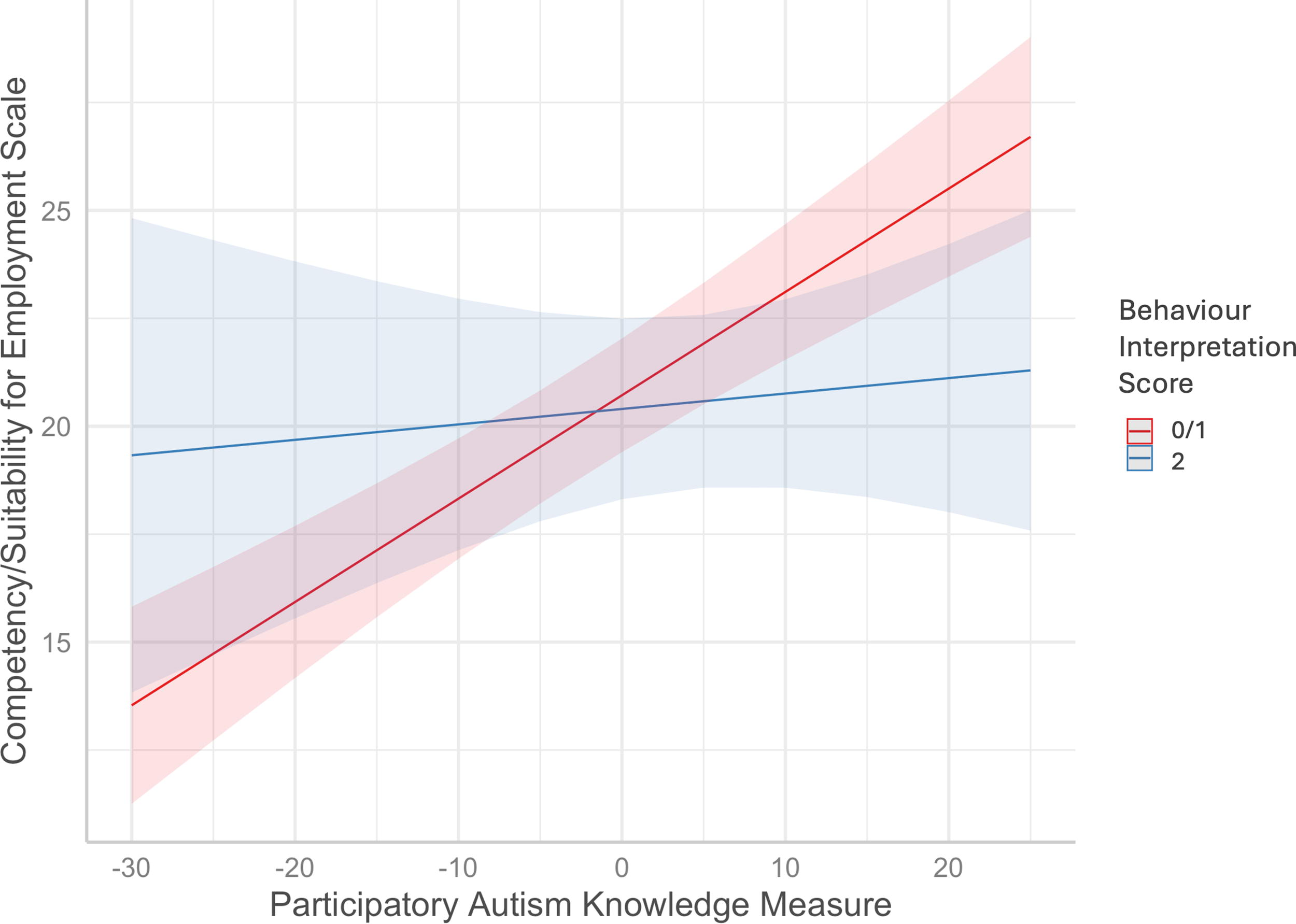
Regression predicted values of the competency/suitability scale by behavior interpretation score and Participatory Autism Knowledge Measure interaction. X-axis legend: Participatory Autism Knowledge Measure. Y-axis legend: Competency/Suitability for Employment Scale. Regression lines: Behavior interpretation score 0/1 (red color), 2 (blue color).
Hierarchical Linear Regression Predicting Competency/Suitability Scale Scores
Inaccurate or partially accurate interpretation of behavior = 0/1, accurate interpretation of behavior = 2.
Non-autistic = 0 autistic = 1.
Cisgender man is the reference group.
Male = 0 female = 1.
No = 0 yes = 1.
74,999 USD or less = 0 75,000 USD or greater = 1.
p < 0.05, **p < 0.01, ***p < 0.001.
CI, confidence interval; PAK-M, Participatory Autism Knowledge-Measure; SE, standard error.
Predictors of social acceptability scale scores
Model 1 was significant (F[10,202] = 3.08, p < 0.01, adjusted R2 = 0.09) with higher behavior interpretation scores predicting higher (more positive) social acceptability scale scores (b = 0.206, p < 0.01). Having an autistic relative was also a significant predictor of higher social acceptability scale scores (b = 0.16, p = 0.03).
Model 2 was a significant change in model fit compared with model 1 (F[11,201] = 6.19, p < 0.001, adjusted R2 = 0.21) with PAK-M scores as a significant predictor (b = 0.431, p < 0.001), autistic relative remaining a significant predictor (b = 0.143, p = 0.03), and behavior interpretation scores no longer being significant.
For model 3, predictors were mean centered for interaction terms. Adding in the interaction terms resulted in a significant change in model fit with a highly significant main effect of PAK-M scores (b = 0.439, p < 0.001). The interaction between being autistic and having an accurate behavior interpretation score was a significant predictor of higher social acceptability scale scores (b = 0.271, p = 0.02). In addition, the interaction between PAK-M scores and behavior interpretation scores was a significant predictor of social acceptability scale scores (b = −0.282, p = 0.01). Table 3 presents results of the hierarchical regression predicting social acceptability scale scores.
Hierarchical Linear Regression Predicting Social Acceptability Scale Scores
Inaccurate or partially accurate interpretation of behavior = 0/1, accurate interpretation of behavior = 2.
Non-autistic = 0 autistic = 1.
Cisgender man is the reference group.
Male = 0 female = 1.
No = 0 yes = 1.
74,999 USD or less = 0 75,000 USD or greater = 1.
p < 0.05, **p < 0.01, ***p < 0.001.
CI, confidence interval; PAK-M, Participatory Autism Knowledge-Measure; SE, standard error.
Discussion
This study examined factors associated with perceptions of the competency and suitability for work, and social acceptability as a coworker, of a hypothetical autistic employee described in a workplace written vignette.
Factors associated with positive perceptions of competency and social acceptability
Autism knowledge, income, and experience with an autistic coworker
General autism knowledge was strongly associated with higher (favorable) ratings of the hypothetical autistic employee’s competency and suitability for employment and social acceptability as a coworker. Autism knowledge was significantly associated with attitudes and perceptions regardless of neurotype (autistic/non-autistic), gender, income, autism experience (having an autistic relative, past or present coworker, or autism being the focus of participant work or study), and how well participants were able to interpret and understand the behavior of an autistic employee. Furthermore, once autism knowledge was taken into account, neurotype (autistic/non-autistic), autism experience, and ability to interpret the autistic employee’s behavior were not significantly associated with more favorable ratings of competence/suitability and social acceptability of an autistic employee. Study results are consistent with other contexts in which autism education and awareness training have reduced bias against autistic persons.46,53
However, an exception was that participants who reported having had a past or present autistic coworker also gave less favorable ratings of the hypothetical autistic employee’s competency or suitability for their job. The association between having had a past or present autistic coworker and less favorable ratings of competency/suitability toward the autistic employee is a concerning finding. Taken together with the strong association between general autism knowledge and more favorable ratings, study results point to the importance of educating coworkers and supervisors about autism and increasing understanding of autistic employee’s characteristics and challenges in the workplace. Having the experience of an autistic employee or coworker at work without knowledge and understanding of an autistic employee’s behavior and traits may contribute to increased negative perceptions regarding their competency and suitability for their work. Less favorable impressions of autistic employees’ competency and suitability for their work have the potential to jeopardize their employment and career advancement.40,57 Findings of this study also complement a recent survey of employers who identified lack of knowledge of autism as a barrier to hiring autistic employees and therefore recommended autism education for employers. 56
Considering all other factors, having had an autistic coworker was not associated with attitudes toward the social acceptability of the employee in the vignette. For job candidates exhibiting autism characteristics in a job interview vignette, autism knowledge may have contributed not only to more positive ratings but also to more concern about job performance. 47 Perceptions of competency and suitability for a job may involve a different set of beliefs and values compared with perceptions of social acceptability and attitudes toward social inclusion. A fellow employee may be concerned about an autistic coworker’s job performance but still find them acceptable as a social and collaborative work partner.
A surprising finding was that participants from higher income categories were less likely to rate the autistic employee in the vignette as competent and suitable for their job, regardless of autism knowledge, autism experience, and understanding of autistic employee behavior and traits at work. Individuals of higher income may also be those who are in leadership or supervisory positions within organizations and therefore may be more likely to be in the role of an employer. From a supervisor position perspective, the struggles of an autistic employee to cope in a non-autistic workplace may be of greater concern in terms of their competency and suitability. Employers have expressed concern about autistic employees’ competence including employers involved in disability hiring initiatives. 55 However, they also report benefiting from autism education in increasing their understanding of autistic traits and challenges at work.11,55 As we did not collect information on each participant’s occupation, the role of occupation in the association between higher income and less favorable perceptions of autistic employees remains a question for future studies to explore.
Neurotype and interpretation of autistic behavior
Autistic participants (compared with non-autistic) who also accurately interpreted the behavior of the autistic employee in the vignette had more positive perceptions of the hypothetical employee’s social acceptability. No significant relationship was found between neurotype and perceptions of the autistic employee’s competence based on accurate or inaccurate behavior interpretation. Once again perceptions of competency and suitability for a job are not the same as willingness to socially interact with and include someone. One might be uncertain or negative about a coworker’s competency on the job but still view them as socially acceptable.
This may be the case with autistic adults in the workplace favoring social interaction with autistic colleagues, 14 particularly those with whom they share an understanding. Previous findings have indicated that autistic participants who self-report more autistic characteristics also demonstrate more accurate behavior interpretation of an autistic employee. 27 The more an autistic person has insight into their own autistic experience the more they understand both autism and other autistic individuals, 91 and the more socially close and comfortable they feel with autistic others. 31 Autistic adults report feeling much more comfortable and free to be their authentic selves when with autistic others compared with being with non-autistic others.31,34 Such findings are consistent with the DEP, which posits that autistic persons communicate well with each other and understand each other as their own equally valued social culture.21,22,35
Autism knowledge, autism experience, and interpretation of autistic behavior
Hypothesis 3 of this study expected that the association between autism knowledge and autism experience and favorable ratings of competency and social acceptability would depend on the participant’s ability to accurately interpret the thoughts, feelings, and intentions of the autistic employee described. Once again, autism knowledge in and of itself was an influential factor associated with favorable ratings of competency/suitability and social acceptability regardless of all other factors studied. However, consistent with Hypothesis 3, the degree to which autism knowledge was associated with perceptions and attitudes also depended on (moderated) the interpretation of the autistic employee’s behavior (thoughts, feelings, and intentions behind behavior). For those with inaccurate or only partially accurate interpretation of the autistic employee’s behavior, having general autism knowledge was significantly more strongly associated with favorable perceptions of the employee compared with those who demonstrated accurate interpretation of the autistic employee’s behavior. For those who accurately interpreted the behavior, or in other words understood the thoughts, feelings, and intentions behind the autistic employee’s behavior, autism knowledge was less influential on favorable ratings of competence/suitability and social acceptability. More knowledge of autism was especially important regarding more favorable attitudes and perceptions of an autistic employee if participants did not interpret well or understand the autistic employee’s behavior and characteristics.
General autism knowledge and interpretation of autistic ways of being and behaving are different constructs. A coworker or supervisor may have substantial autism knowledge but still struggle to intuitively understand the behavior and communication of an autistic individual. However, despite that inaccurate understanding of the thoughts, feelings, and intentions behind autistic employee behavior, autism knowledge may contribute to more positive perceptions of the employee’s competence and social acceptability as a coworker. More favorable perceptions of competence and attitudes toward socially including an autistic employee can have significant benefits on workplace thriving, quality of work life, and sustaining employment.37,39,41-43,64 This finding is consistent with feedback from employers and autistic employees on the importance of knowledge of autism in the workplace for their employment success.39,40,47,48,55B56 -58
The concerning association between having had an autistic coworker and rating the autistic employee portrayed in the vignette less favorably on competency/suitability was still present when accounting for behavior interpretation ability. However, there was a significant finding indicating that behavior interpretation partially moderated the relationship between having had an autistic coworker and ratings of competency. For those with accurate autistic employee behavior interpretation, having the experience of a past or present autistic coworker was significantly associated with more favorable ratings of competency and suitability. Perhaps further study, including with a larger sample size of those with a history of an autistic coworker and more detailed data on the context and nature of past autistic coworker relationships, would contribute further clarity to both findings. Regardless, taken together, these findings continue to emphasize the importance of autism education and of promoting understanding of autistic employees’ behaviors, traits, and challenges at work. 27
Participatory autism knowledge and autism employment supports
This study highlights the importance of understanding the consequences at work for autistic employees who are misunderstood or who have employers, supervisors, and coworkers who lack knowledge of autism and the autistic workplace experience. Study findings point to autism employment supports that target educating coworkers and supervisors about autism and autistic employee behavior and challenges, as a path to improving attitudes toward and perceptions of autistic employees. Perceptions of autistic employees’ competency and favorable attitudes toward their social inclusion in the workplace have the potential to improve their quality of work life, their mental health, stability of employment, and even advancement at work.37,39,41-43,64
Many employment interventions are from the perspective of viewing autistic characteristics as impairments to be corrected rather than addressing how non-autistic workplaces can be unfriendly and unaccommodating to autistic differences.14,92-94 While some impairment-focused interventions have been successful in placing autistic individuals in employment, many remain unemployed or underemployed. 92 Focusing on assumed autistic impairments is not only ineffective in creating significant and lasting improvement in autism employment rates, 92 it negates the growing evidence for the DEP. Rather than assuming autistic employees have social deficits that need to be “fixed,” the DEP paradigm highlights mutual misunderstanding between autistic and non-autistic persons and recognizes the autistic community as a marginalized neurologically different social culture.21,22,35 Therefore, developing understanding and appreciation for different ways of being and socializing in the world, including the workplace, is a mutual autistic and non-autistic responsibility.22,35
Despite the effort put into building work readiness skills in themselves, autistic adults indicate that barriers to employment include coworkers being apprehensive about their competence and social acceptability in the workplace.13,39,42,95 Many face social challenges in non-autistic workplaces and resulting overwhelming job stress.42,43,95 Autistic individuals who need to expend excessive amounts of energy trying to manage ongoing and cumulative stressors in non-autistic spaces can eventually experience a shutting down of skills and coping abilities, defined as an “autistic burnout.” 96 Autistic adults from the interview and recruitment phase of employment 40 through ongoing coping in the workplace37,39,43 feel pressure to mask their autistic characteristics in order for their colleagues to perceive them as competent, to be socially accepted, and to remain employed. 43 An ongoing need to “mask” or camouflage autistic characteristics in an attempt to appear non-autistic can result in autistic burnout.96,97 Masking or camouflaging autistic characteristics is associated with poorer mental health, especially when it requires frequent self-monitoring and significant effort to appear as non-autistic to others as possible.98,99
In addition, autistic employees express the desire for the education of coworkers about autism but also tend to mask to avoid the burden of needing to provide that education. 43 This study’s findings point to providing accurate autism knowledge to coworkers and supervisors as a promising environmental workplace support for autistic adults, which also relieves the burden on them to explain themselves and educate others. The autistic community has identified a significant need for the development and evaluation of programs that educate and train workplaces on how to understand, embrace, and accommodate autistic employees37,39 including employment support services being knowledgeable about autism. 42 Such programs may contribute to greater understanding of autistic employees’ behaviors, 65 more favorable perceptions of autistic employee competence, and greater willingness to collaborate with them and facilitate autistic employee social inclusion at work.
Additionally, autistic adults advocate for a “nothing about us without us” approach to research and autistic adult supports 70 and the importance of participatory methods with the autistic community.37,100,101 Developed as a participatory measure with autistic collaborators, the PAK-M encompasses autism knowledge autistic researchers consider to be important in educating the non-autistic community about autism. 85 As an employment environmental support, autism education programs should be provided to employers, supervisors, and coworkers in collaboration with autistic individuals as experts on autism and autistic lived experience.
Future directions for research and practice
While teaching both job readiness and on-the-job social and vocational skills can be helpful to anyone regardless of neurotype, teaching autistic adults to act and behave as though they are non-autistic is of limited usefulness to their employment success and detrimental to their mental health.37,39,42,43,92 However, educating coworkers and supervisors about autism and the lived experience of autistic employees is one way to promote acceptance, understanding and flourishing of autistic adults at work. Such education programs, cocreated with autistic adults, should continue to be developed and studied for their effectiveness on improving attitudes and perceptions of autistic employees as well as promoting long-term employment success.
In conducting this work, there are other important aspects to consider. For example, are their additional employment challenges and barriers for those with intersecting marginalizing identities such as autism, race, gender, and membership in the 2SLGBTQIA+ community?102B103 -105 And if so, autism workplace education should address those intersecting disadvantages. As well, specific workplace education programs should consider the challenges associated with the diverse support needs of autistic adults including those with higher support needs at work. Further, researchers and autism support planning services should investigate the areas of employment and workplace roles that are the most crucial to target for workplace autism education.
Limitations
This study used a nonprobability convenience sample including research team social media followers and a Listserv of autism researchers. Sampling bias may exist with a greater proportion of participants in the sample with autism experience compared with the general population, including those who focus on autism in their work or study. The autistic sample may also be biased with a greater proportion of autistic participants who use social media or are autism academics and researchers. Therefore, autistic adults who are not social media users or have different support needs may be under-represented. 106 This sample also has an overrepresentation of cisgender female participants and white participants. Other unknown sampling biases may be present.
Participants’ reporting of autism experience by way of “yes” or “no” responses to questions about having an autistic relative, coworker, or autism being the focus of work or study is an imprecise measurement of the quantity and quality of autism experience, which likely has larger true variation. However, the factual and binary presentation of experience may reduce bias from participants’ estimation of the magnitude of their autism experience.
This study did not control for bias from social desirability responding. In addition, while reading the vignette, participants may guess that the hypothetical employee is autistic leading to several possible response biases on survey items. This may particularly be the case for those who have autism knowledge and experience, including autistic participants.
In developing the vignette used in this study, we strove to provide a description of a hypothetical autistic employee who captured the lived experience of many autistic adults and did so with consultation from the autistic community. However, this study used only one vignette that describes only one autistic person in one context and therefore does not capture the breadth of experience of autistic employees in the workplace. Additionally, by using a single vignette and only representing an autistic employee versus also comparing attitudes and perceptions toward a non-autistic employee, we were not able to account for variation and potential bias in responders, which may have influenced study results.
Although this study involved input from autistic autism researchers and scholars regarding the content of the vignette and study measures, it does not reflect the growing call for the importance of participatory research cocreated with the autistic community.37,100,101
Conclusions
High unemployment rates for autistic adults make it imperative that we understand the barriers and facilitators to their success in obtaining and retaining employment. Autistic employee workplace challenges, social differences, and characteristics may lead to negative impressions of their competency and suitability for work and negative attitudes toward socially including them in the workplace. Negative perceptions have the potential to significantly jeopardize their employment success and workplace quality of life.41-43 Accurate autism knowledge, especially when autistic workplace behaviors are not intuitively understood by others, was associated with more favorable perceptions of an autistic employee. Autism knowledge on the part of non-autistic workplace colleagues, especially knowledge contributed by autistic individuals, is a promising environmental support to promote autistic adult surviving and thriving in employment.
Footnotes
Acknowledgments
The authors would like to thank members of CANVAS who provided consultation on study measures including Dr. Kristen Gillespie-Lynch, Dr. Dave Caudel, Dr. Brett Nachman, Dr. Michele Marjason, Dr. Hannah Morton, Michelle Reed, Kelly Searsmith, Jeff Edelstein, Val Irwin, and Jessica Miles.
Authorship Confirmation Statement
K.A.S. conceived this study, designed, and developed the methodology. She oversaw data collection, planned and conducted the data analysis, and wrote the bulk of the article. L.A.O. provided resources, consultation, guidance, and direction to the project and edited much of the original article. All authors reviewed and approved the article before submission. The authors have submitted this article solely to this journal, and it is not published, in press, or submitted elsewhere.
Author Disclosure Statement
The authors declare no potential conflicts of interest with respect to the research, authorship, and/or publication of this article.
Funding Information
A dissertation award from the Wayne State University Graduate School provided funding for this project.