




Abstract
Background:
Emerging research suggests that puberty and adolescence may be particularly difficult for autistic people assigned female at birth (AFAB), but there is currently very little exploration of this transition from a lived experience perspective. In this study, we aimed to retrospectively examine firsthand accounts of puberty and adolescence among AFAB autistic people, the first study to our knowledge to broadly do so.
Methods:
We conducted semi-structured interviews with 17 autistic people AFAB about their personal experience of puberty and adolescence. We used reflexive thematic analysis to generate themes from the data.
Results:
We developed three main themes from the data. Theme 1, “The overwhelming nature of puberty,” focused on issues such as distressing bodily changes and sensory discomfort (e.g., menstruation). Theme 2, “Navigating the adolescent world,” focused on the experience of feeling different, trying to cope with not fitting in, and finding support in others. Theme 3, “Victimization experiences,” highlighted the prevalence of social and sexual violence against our participants.
Conclusions:
Overall, our findings suggest that puberty and adolescence can be an especially difficult time for autistic people AFAB. In addition to bodily changes such as menstruation, dealing with sensory discomfort and a rapidly changing social landscape can result in extreme distress.
Community Brief
Why is this an important issue?
Many autistic people assigned female at birth (AFAB) may have trouble managing the demands of puberty and adolescence. Such demands involve the sensory load associated with pubertal development (e.g., menstruation) and navigating an increasingly complex social world. It is important that we understand autistic people AFAB’s lived experiences of puberty/adolescence, to better improve the support and care they receive during this time period.
What was the purpose of this study?
The purpose of this study was to better understand the social and emotional impact of puberty and adolescence on autistic people AFAB from a lived experience perspective.
What did the researchers do?
We interviewed 17 autistic people AFAB about their experiences of puberty and adolescence. We used a reflexive thematic analysis to develop three themes from the data. Reflexive thematic analysis is a form of qualitative analysis where a researcher develops patterns and meaning from what participants say and uses this to form common themes.
What were the results of the study?
Theme 1, “The overwhelming nature of puberty,” focused on issues such as distressing bodily changes and sensory discomfort (e.g., menstruation). Theme 2, “Navigating the adolescent world,” focused on the experience of feeling different, trying to cope with not fitting in, and finding support in others, such as friends and family. Theme 3, “Victimization experiences,” highlighted the prevalence of social and sexual violence against our participants.
What do these findings add to what was already known?
Our findings suggest that difficulties in puberty are multifaceted and include sensory and social challenges that can have an incredibly negative impact on mental health. They also suggest that autistic people AFAB may be at higher risk of being sexually exploited during adolescence. Interestingly, our participants reported parents being supportive of their sexual and romantic development, helping them to access contraception.
What are potential weaknesses in the study?
Our participants consisted of mostly White, English-speaking people recruited online. Our participants were also adults reflecting on their experience of puberty. It is possible that autistic people currently going through adolescence and puberty may highlight different issues.
How will these findings help autistic adults now or in the future?
Our findings help us to better understand the kind of support that autistic people AFAB might need to make puberty and adolescence less distressing. This includes targeted education about sexual exploitation and help with choosing sensory-friendly sanitary products.
Introduction
There is currently a considerable lack of lived experience-informed research exploring the impact of puberty on autistic people assigned female at birth (AFAB). 1 Puberty is defined as a biological process where an individual undergoes physical and sexual maturation, marking the transition from childhood to adulthood. 2 The onset of puberty and menses is an important and often challenging transition in any person AFAB’s life but may lead to additional challenges for autistic people, who may experience these processes differently and more negatively compared with their neurotypical counterparts. 3
The transition from childhood to adulthood (adolescence) involves the development of secondary sexual characteristics, including hair growth and breast development. Such changes may promote negative feelings, with some autistic adolescents AFAB showing symptoms of depression and anxiety immediately after the onset of breast development. 4 Likewise, extant evidence suggests that menstruation for autistic people AFAB can be a difficult and distressing event. Preexisting challenges are reported to be exacerbated, predominantly sensory hypersensitivities and difficulties with emotion regulation and behavior. 3 This may be explained by autistic people’s increased sensitivity to the menses and associated body changes.5,6 Limited research examining the impact of the menses on autistic people is overwhelmingly negative and suggests it results in often-serious consequences. These include shutdowns, withdrawal, and heightened anxiety, leading to a reduced participation in work, social, and community life. 3
Alongside physical and sexual maturation, adolescents are also faced with complex changing social dynamics and social interactions. 7 During adolescence, the social ecology becomes increasingly complex, with social and communication difficulties becoming more overt and prevalent. 8 Autistic youth AFAB often face many challenges, including social victimization and exclusion, which consequently may have a detrimental impact on their mental health and well-being.8,9 Autistic adolescents AFAB often develop coping strategies such as camouflaging to mask their social difficulties. 10 However, despite the potential social benefits of masking, research exploring social coping strategies used by adolescent people AFAB found that such strategies had negative repercussions on their psychological well-being, relationships, and educational achievement.11–13 Despite implementing such social strategies, autistic adolescents AFAB report feeling different and out of place in social settings 14 and in some cases feeling at a loss with their identity. 15 In addition to social exclusion, autistic people AFAB may experience increased incidents of bullying and peer conflict when compared with their neurotypical peers and autistic male counterparts. 16
The emergence of sexual and romantic interest associated with adolescence may also be associated with unique challenges for autistic people. 17 Sexual development among autistic people in general has received sparse interest, partially due to stereotypes of autistic people as childlike and aexual.18,19 Consequently, it has been viewed as a “nonissue”; however, autistic young people do engage in romantic relationships 20 but may fail to obtain sufficient knowledge and support regarding sexuality due to stereotypical perceptions. 21 This is concerning given research suggesting that high numbers of autistic people AFAB experience sexual assault and exploitation. 22
Thus, the aim of current study was to address gaps in literature, examining the social and emotional impact of puberty on autistic people AFAB using a retrospective, lived experience approach. The study sought to answer the research question: “What is the social and emotional impact of puberty and adolescence on autistic people assigned female at birth?”
Methods
Participants
We recruited 17 autistic people (see Table 1) AFAB using social media (e.g., “X,” formerly Twitter) and word of mouth (e.g., sharing links with local autism networks). Our inclusion criteria stated that participants had to be (a) AFAB and (b) older than 18. All participants were aged 19–50 (mean = 30.7, SD = 8.86). The majority were from the United Kingdom (N = 13), three were from the United States, and one was from Denmark. Thirteen participants identified as female, one as gender-fluid, one non-binary, one was “questioning,” and one was gender nonconforming. One participant was mixed race (White/Asian), and the rest were White. Sixteen participants had a formal clinical diagnosis and one self-identified as autistic. Participation in the study was anonymous with no incentives offered. The study received ethical approval from the University of Portsmouth Department of Psychology Research Ethics Committee.
Information for Each Participant, Identified by Pseudonym
Interviews
We developed a semi-structured interview schedule that had 26 questions, including prompts (see Interview Questions in the Supplementary Data). We based the interview questions on existing literature and the lived experiences of B.F. and A.P. We chose semi-structured interviews due to their flexibility, enabling participants to focus on issues that are meaningful to them. A semi-structured format meant that participants could raise other issues that they felt were important and provide details where comfortable. B.F. piloted the interview protocol with an autistic friend before starting data collection to ensure questions were accessible and appropriate. The study involved questions about sensitive topics around puberty and adolescence, which had the potential to raise traumatic and emotionally charged memories. We asked all participants to complete a safety plan 23 so that we knew how to support them if they became distressed and whether they had any particular access needs. Although none of the participants became distressed during the interviews, we believe that safety plans are an incredibly useful tool when discussing sensitive topics.
For accessibility purposes, we gave participants the option to complete interview questions via video call Zoom (n = 14) or by email by completing written responses (n = 3). We did not give participants the option to complete the interview via phone call. Zoom interviews lasted between 40 and 80 minutes. Email responses varied between 1343 and 12,783 words (one interview was shorter, and two were a similar length to the Zoom transcripts).
Procedure
We invited participants to take part via a Zoom interview sent via email link or providing a written response by email or word document. We presented participants with an information sheet detailing the aims of the study and asked them to provide consent with either a digital or a written signature. We then proceeded with the questions and ended the interview by thanking participants for their time and giving them the opportunity to ask any questions or provide further comments.
Research positionality
B.F. is a neurodivergent cisgender woman whose experience working with neurodivergent young people helped guide her interest in this study. S.K.K., an autistic cisgender man with expertise in autism and supporting autistic people, supervised the project for B.F.’s master’s thesis. Early during project design, B.F. and S.K.K. invited A.P. to join the team as a co-designer because of her experience as an autistic cisgender woman with expertise in sensitive issues of relationships and identity. This research design combined experiential and academic expertise, improving scientific rigor, accessibility, and relevance to the autistic community.
Data analysis
We used reflexive thematic analysis to analyze the data, following Braun and Clarke’s approach.24,25 We chose thematic analysis due to its suitability for flexible qualitative data gathering (e.g., interviews and textual data collection). We coded the data inductively, in an open and organic way (although not free of preconceived potential areas of interest), through noting salient concepts and phrases within the data and creating codes to capture these. We used a critical realist epistemology, which aligns with the aim of bringing about social change through acknowledging the role of lived experience in accessing a particular phenomenon (i.e., memories as data, providing access to an understanding of an event or occurrence [e.g., puberty], and the causal mechanism that influences it [biology, social structures]). 26 B.F. started by transcribing the interviews and proofreading these for accuracy. She read all interviews several times, noting content, context, and initial interpretations. Once familiarized with the dataset, she generated initial codes based on both semantic (e.g., Ivy: “I had quite low self-esteem”) and latent (e.g., Anne: “I thought I was very plain looking, nobody liked me that sort of thing”) content and developed rough themes. She then met S.K.K. and A.P. to discuss organizing the codes and themes. This was done through group discussion of how we could use the codes to form key concepts, which we then refined into themes, ensuring that overlapping themes were integrated into each other as we went.
Results
We developed three superordinate themes in the dataset (Fig. 1), centered on the impact of puberty, navigating puberty and adolescence, and victimization experiences.
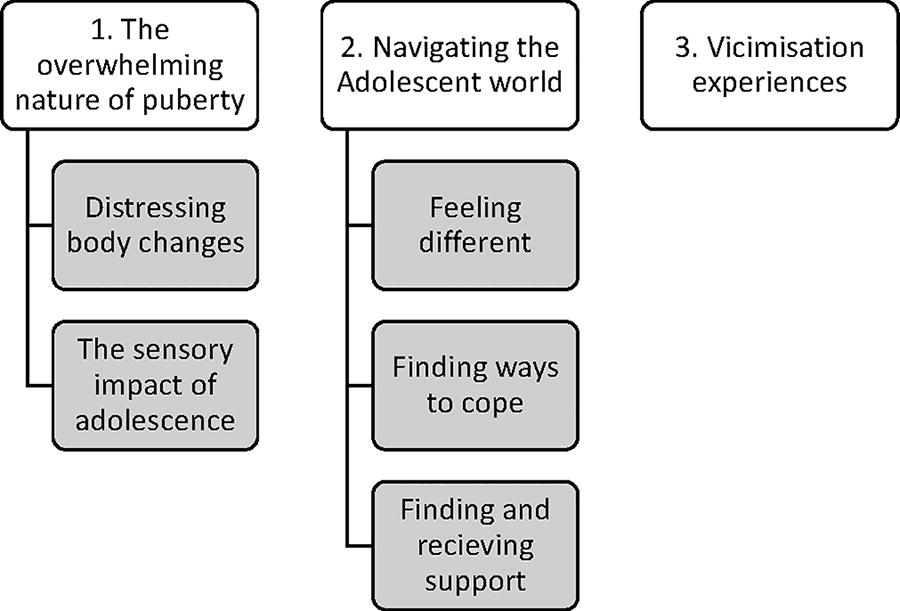
Map of themes and subthemes.
The overwhelming nature of puberty
The emergence of puberty was identified as a challenging time for participants, with many reporting having a precocious or delayed puberty. Regardless of timing, the beginning of puberty had a negative impact on mental health and emotion regulation. Participants reported feeling anxious and in denial about the changes happening within their body and had difficulty managing such changes, describing them as “overwhelming” and “distressing.” The emergence of puberty also had a significant sensory impact, including the substantial body changes, menstruation, and associated menstrual care products.
Distressing body changes
The physical change to the body was hard for participants, with these changes labeled as “uncomfortable,” “embarrassing,” “distressing,” and “awkward.” Some reported feeling unprepared for the onset of puberty and expressed difficulty coping with the new demands associated with body changes, such as an increase in hygiene rituals and washing. Lola stated:
Hygiene was one of the hardest bits for me like suddenly going from you know, getting away with not showering that often to suddenly like, actually, you do really need to shower more.
However, discomfort with bodily changes was also related to perceptions of developing a more “feminine” body. While both Emmy and Lynette were “excited” about these changes, and “blossoming,” Karla spoke of how “becoming curvier” was a “real issue,” and Lola explained how she had “never wanted breasts at all,” with their growth leading her to feel a deep sense of shame and feeling like people were “looking at them.” Similarly Ruby expressed disliking how the emergence of puberty impacted how others would view and treat them, responding as if they were a “woman” when they still felt like and were “legally a child.”
Some participants went as far as to say that they preferred their previous prepubescent body. Maggie explained how the start of puberty and body changes created gender roles that they felt disconnected from:
I’d always been quite happy as projecting myself as being quite androgynous. And I didn’t really like the fact that it was creating a gender role that I had always been quite disconnected from when people used to call me a girl.
This disconnection led to a sense of denial among some, for example, Karla reported trying to convince herself that she might have cancer instead of her period, saying:
I’d convince myself I’d got cancer or something else.
Discomfort with bodily changes was particularly amplified when it came to menstruation. Carol described her experience of her first period:
So, I was panicking and screaming and saying to my mum, like I’m bleeding, I don’t know what’s going on.
Participants reported feeling “nervous” about not knowing when their period might start. Not being able to predict the start of menstruation led some like Emmy to worry that they might “never develop,” whereas others like Tracey reported precocious menstruation making them feel “awful” when their peers had no idea what they were going through. The unpredictable nature of periods themselves also led to anxiety about bleeding through clothes, with Carol stating that she wore sanitary towels “every single day because of the fear.”
In addition to feelings of anxiety about the timing of menstruation, participants reported feeling significant emotion dysregulation during menstruation that they attributed to hormonal changes. Ruby and Tracey described an onset of feelings of anger, mood swings, tearfulness, and frustration, with Ruby remembering being “more erratic, very irritable” and Tracey describing how their “emotions got way too big.” The onset of menstruation was also associated with “meltdowns,” which for some led to interpersonal difficulties that felt beyond their control, as outlined by Holly:
I would hit them, but it was when I was really frustrated and yelling, this deep kind of yelling would come out of me that would change into this spiral of viciousness.
These intense emotional experiences could be difficult for others to understand. Mia recalled being told “you’re dramatic, and these little things don’t matter.” Her comments suggest that both triggers of dysregulation and the intensity of the associated response that autistic people experience during adolescence may be a source of invalidation from those around them.
Some participants also described experiencing a “lot of anxiety, lowered self-image, low mood” (Ivy) and feeling “depressed” (Lola) around the time of their period. Others expressed extreme impacts on mental health such as increased feelings of self-harm and suicidality. Gabby described how menstruation:
enhanced my negative emotional feelings…my intrusive thoughts, suicidal thoughts, thoughts of hurting myself, or actually hurting myself were much more likely.
Together these experiences paint a picture of puberty that is fraught with distress and disturbance to both the body image and mental state of the autistic young person.
The sensory impact of puberty: A lot to deal with
Physical changes during puberty had a significant impact on the sensory comfort of the participants. They described how the increase of body sweat was hard to deal with because it made them feel “sticky” and that they preferred “to feel dry and clean and like fresh all of the time” (Lynette). The development of body hair and body hair removal was also a named issue. Mia said she “hated the feeling of prickly hair on legs” and Lynette outlined how “shaving pubic hair felt uncomfortable, because it was quite hard to do.”
Menstruation in particular was a sensory minefield. The feeling of menstrual blood itself was described as “a lot to deal with” (Lola) and “nasty and sticky and messy and smelly” (Tracy). Carol likened it to feeling like they had “wet themselves.” Similarly to issues with sweat, participants described how menstrual blood made them feel unclean, with Ruby recounting feeling the need to wet-wipe or shower frequently “which was a problem when out and about or at school.”
Items to manage menstruation also had a significant sensory impact. However, there was a mix of preferences, with some participants preferring tampons and others favoring sanitary towels. Participants preferring tampons expressed that sanitary towels felt less hygienic, for example, Anne said that she “didn’t like the feeling of kind of like sitting in my own blood” and Ivy described feeling irritated “everywhere…just because of the material my brain was like no.” Lola even explained that using tampons helped them forget about being on their period. Those who preferred sanitary towels expressed difficulties, mainly anxiety, with using tampons. Mia explained that the thought of inserting something into their body was too much and “freaks me out.”
In addition to sanitary items, wearing bras created problems for participants due to being “restricting” and “uncomfortable.” Anne described preferring non-wired bras due to finding the wire “really bad.”
Overall the comments of the participants painted puberty as sensorily stressful, fraught with bodily changes and new demands that increased sensory load and made them difficult to manage.
Navigating the adolescent world
Adolescence was a challenging time for participants. The emergence of complex social rules and trying to fit in was difficult, with many participants experiencing problems coming to terms with the self and feeling different to their peers. We developed three subthemes here, based around strategies used to navigate adolescence, the impact of adolescence on identity, and the role that outside information (e.g., from peers, or the media) played in traversing this new world.
Feeling different
Adolescence is a critical time for the development of self-concept and identity; however, our participants struggled to understand themselves particularly with relation to their peers. They felt different from their peer group, as Karla explained: “I just always felt like I had different interests, and I was a bit boring…I thought I was just weird or too picky, or there’s something wrong with me.” Mia recalled realizing that her sexuality might differ from her peers, and that it made her feel like she was “not normal.” Likewise, Holly outlined how finding other “neuro-queer people” made her realize that she might find “sameness” and friendship in those also considered other. Such feelings led to participants feeling isolated from their peer group; Emmy described this as feeling “sort of left out and quite sad.”
Many participants also experienced a mismatch with their identity and their developing adolescent bodies. A significant number of participants expressed that they felt at a mismatch with their age, with participants feeling younger and having more “childish” interests compared with their peer group. Tracy explained: “I just wanted to play with my Pokémon figurines and draw comics. I just wanted to be a kid.”
Although many participants experienced challenges and difficulties coming to terms with their authentic selves, they explained that such feelings often subsided in later life and that they finally came to terms with themselves. Gabby explained: “I have since come to realise that having ASD isn’t a bad thing and being able to think outside of the box and bring a different perspective to the table is well-needed and useful to society.”
Findings ways to cope
To cope with their shifting place in the social sphere, our participants developed several coping mechanisms. While some of these coping mechanisms were interest-based (e.g., playing games, or creating art) and rejuvenating in nature, many were focused on fitting in even if it was harmful to the participant. Participants said that they would often copy the behaviors of their peers to fit in and appear “normal.” Lola used their best friend as a social model: “I would kind of copy her and see how she interacted with people, then I’d copy that in a later situation.” More generally, Carol explained how she would mimic “the way people behaved, facial expressions, things that people said as well.” In addition to social behaviors, participants would copy the style and dress sense of their peers to fit in. Mia recalled, “being in high school it was trendy to wear Converse. I got a pair of Converse. Little things like that, because I wanted to fit in.” However, camouflaging went beyond the use of mimicry and was also associated with repressing their true feelings and emotions in front of peers, Gabby explained: “I felt like I had to hide every negative emotion, my anger, frustration and feeling like I would burst into tears at any moment.”
Consequently, participants struggled further with their own identity. Tracy said that by age 9 she was making herself “as small and quiet as possible,” which led to difficulties knowing who she was. Similarly, others recalled trying not to stand out by “not talking about things such as my special interests and things like that” (Emmy) and “keeping my head down” (Abigail), to avoid being a target for bullies.
Many participants also reported engaging in harmful or risky behaviors in attempts to fit in, even if they had no desire to do so. Sadie described engaging in underage drinking “because that was cool, apparently” but said that it became “a little bit of a coping strategy after a while.” Likewise, Gabby disclosed that she would experiment with illegal drugs to “be the social person I wanted to be.” These behaviors had unforeseen consequences, for example, Sadie described how engaging in drinking would place her in uncomfortable situations:
I was quite naïve as well, because I would get very drunk sometimes without realising the extent of what I was drinking and what it was going to do.
Self-injury was another commonly cited coping strategy used by participants to deal with social pressures of adolescence. Gabby described “retreating to a cubicle in the girls’ toilets, to cut myself, to find some relief.” Similarly, Ivy recalled “making myself too sick so that I didn’t have to go into school…that was a result of anxiety. And that was partially due to my hormones and not fitting in.” These comments suggest that autistic young people AFAB may turn to harmful coping mechanisms to deal with having to navigate a hostile social world.
Finding and receiving support
The complexities of navigating puberty and adolescence were eased when participants felt adequately supported by those around them (e.g., friends and family members). Support from others helped participants to understand their changing bodies. Anne spoke about having the support from her mother, who was “very happy to answer my questions,” which made feel like it was ok to talk about puberty, and ask for help when needed. Likewise Emmy described how her mum demonstrated how to use sanitary towels so that she knew what she was doing. In addition to parents, many participants learned from their friends. Aimee described how one of their friends helped them to manage body hair: “I didn’t shave my legs and I went to a girl’s house, and she basically showed me.” Maggie and Karla explicitly spoke of how a lack of support around hygiene made them feel like they had no “guidance” or “understanding of how to make it all better.” Likewise, some of the participants felt like their families did not teach them how to “deal with [my] emotions” which caused “big fights” (Holly) with family members.
For people like Holly, the internet and “online friends” provided a place to learn about sex and relationships. Holly described “seeing discussions that initially surprised me” that made them realize the things they were experiencing were normal or “ok.” Gabby also emphasized how the internet could remove the difficulty experienced in face-to-face interactions, “People on the internet can give me that advice without the emotional baggage of having to engage with others about any concerns.”
Others described how their friends would look out for them in person, pointing out when people were “flirting” with them (Lynette) or treating them “very badly” (Anne). In-person support appeared important, as some participants spoke about how using media (e.g., TV shows) to understand relationships could be dangerous. Emmy described having “quite a romanticised view of it [romantic relationships] really, because I had lots of different like, expectations of what romance and sex were meant to be like.” Parents were also active in supporting participants’ romantic relationships. Aimee described how her mum brought up the topic of contraception when she had her first “proper” romantic relationship and took her to get it.
Victimization experiences
Participants expressed having experienced victimization from a range of different sources throughout adolescence, including peers and romantic partners. Participants described being “bullied quite a lot” (Maggie) throughout puberty, mainly in school. Gabby recalled being targeted about her “special interests” and that this led to learning “not to rely on anyone.” Others said that they were targeted when others noticed external indicators of puberty itself, for example, Abigail described “shaving my legs when I was quite young, because again, teasing from some of the girls.” Bullying went beyond verbal abuse, with some describing physical violence from peers: “He just saw me as a target, he used to trip me up and send me flying, things like that. He was awful to me quite a lot” (Mia).
In addition to bullying, participants felt pressured by their friends to act and behave in a certain way. For example, Aimee spoke of how a friend “became an ‘it’ girl” and started trying to control the way she looked, including telling her she was “weird.” Similarly, Abigail recalled how a friend “got into like, the crowd of popular girls” and started to exclude her from social events: “for her 16th birthday she was having a party, and she didn’t invite me.”
With regard to romantic relationships, while Ruby and Gabby described having “some consensual experiences,” several participants (including Gabby) disclosed experiencing unhealthy romantic/sexual relationships during adolescence. They described having limited understanding of relationships, which made it difficult to recognize what was unacceptable. Anne’s first relationship was “very, very bad, very full of red flags…I was just very naïve to that.” Some participants had experienced manipulation and emotional coercion that led them to feel unable to leave the relationship. Mia described an ex who “became more emotionally abusive” and explained how when she tried to leave “he threatened to tell my parents [that I was mentally ill] and force me into an inpatient psychiatric hospital,” adding another layer of manipulation and control. Others outlined the experience of sexual coercion and violence. Aimee recalled “waking up in the middle of the night” to a partner “doing stuff” to her, and him forcing her to “get high” on a trip so that he could assault her. The experience of sexual violence made it harder for participants to “gauge relationships” (Ivy), as they were unsure of whether what had happened was normal.
Some participants also recalled being sexually exploited. Sadie described engaging in sexual activity with “some of the boys at school” to “try and fit in and be popular” and that this led to other boys seeking her out and then ignoring her until they wanted to engage in sexual activity again. Participants also described being pursued by older men. While some of the participants were above the legal age of consent in their country when this happened, others were not and described being “groomed.” Gabby gave a particularly harrowing account of being sexually exploited by an older man who “shared me with his friends” and described how these experiences “had a massive impact” on her “self-worth and self-esteem.”
Together, these incidents suggest that the social difficulties our participants faced went beyond navigating the increasing complexity of adolescent social interactions and indicate a disturbing pattern of violent experiences during their formative years.
Discussion
In this study, we aimed to examine the social and emotional experience of puberty and adolescence among autistic people AFAB using a qualitative approach. Participants reflected on this time in their lives as being incredibly challenging, with both physical and socioemotional development creating an intense source of difficulty. Many participants had experienced victimization and violence from others, including romantic and sexual partners. However, encouragingly participants also reported having sources of support such as friends and family, who helped them to cope with these difficulties. Our findings go beyond extant literature on experiences of menstruation to suggest that other aspects of puberty/adolescence may be especially difficult for autistic people AFAB.
The onset of puberty itself was distressing, particularly the development of adult body features that other people labeled as “womanhood.” Some participants related this to the experience of being sexualized and no longer being treated like a child, which is consistent with the literature on non-autistic people AFAB. 27 Research suggests that sexualization and the associated objectification can lead to feelings of shame among young people, 28 which aligns with the accounts of our participants. This sexualization can also be internalized, leading to self-sexualization (viewing oneself as a sexual instrument). Self-sexualization can be empowering and a normal part of development for people AFAB. 29 However, self-sexualization can also be exploited by others (higher risk of sexual exploitation is seen among AFAB people with low social status, who are also more likely to be exploited without gaining social favor) and is associated with an increased likelihood of engaging in risky behavior such as excessive alcohol consumption. 30 Concordantly, our participants recounted using alcohol and drugs to cope in social situations 31 and engaging in sexual behavior to try to increase their social status, which peers exploited. Our findings suggest that the emerging non-native social rules of adolescence may be particularly confusing for autistic young people and that attempts to reduce stigma through gaining social favor may instead result in vulnerability to exploitation from others.
Some participants also discussed experiencing gender dysphoria from the discrepancy between how others perceived their bodies and feeling a lack of connection to that perceived gender identity as their body started to change. Autistic people experience a higher prevalence of gender dysphoria, 32 and there are more non-binary and gender nonconforming people in the autistic population. 19 These findings suggest that it might be important to take an especially sensitive approach to autistic young people in adolescence and support them to explore their gender identity in a way that feels comfortable and safe.
Menstruation also had significant impact on participants, both in terms of emotional dysregulation and sensory stress. Participants expressed feelings of anxiety, depression, and suicidality and experienced interpersonal difficulties while struggling to cope with intense emotional dysregulation. Feelings of anxiety were often associated with a lack of control over menstruation; however, other mental health difficulties also appeared to be related to the menstrual cycle itself. Emerging evidence has suggested that neurodivergent people (including autistic people) may be more likely to experience menstrual disorders such as premenstrual dysphoric disorder. 33 This is an important avenue for future research as menstruation may exacerbate already acute mental health difficulties that autistic young people experience. Sensorily the feeling of menstruation itself was distressing, as was the use of sanitary products. While previous research has highlighted that many autistic people may dislike tampons due to the feeling of having to insert them into the body, 3 our findings suggest that some participants may prefer them due to finding the sensation of sanitary towels and their own menses uncomfortable. Although there is likely an immense variation between people, our findings highlight the importance of ensuring that autistic people AFAB are educated about a range of sanitary products and how to use them at an early point during puberty. 6
Our findings regarding navigation of the social world aligns with previous research. 4 Participants described feeling different from their peers, and engaging in impression management, masking, and camouflaging to fit in, and avoid bullying and victimization.11,34,35 The strategies used also align with those reported in previous studies with both young people and adults, including mimicking the clothing or facial expressions of others, and minimizing emotional responses.35–37 Engaging in camouflaging led to difficulties with identity, although some found that this eased as they got older and came to be more accepting of being autistic.
The use of coping strategies to navigate the social world unfortunately did not result in lowered harm for the participants. They reported a range of victimization experiences during adolescence, including peer bullying, intimate violence, and sexual abuse and exploitation. The findings align with emerging evidence that autistic people are more likely to experience violence and victimization38,39 from early in the lifespan and that these instances tend to be repeat events (i.e., polyvictimization) rather than one-off instances. 40 These experiences had an impact on both self-esteem and mental health. Our findings add weight to a growing demand for better relationship education for autistic people during the formative years that acknowledges the additional complexities of navigating a social world whose rules may be especially unclear. We specifically recommend that autistic young people are explicitly taught about grooming and sexual exploitation, as they may be at a heightened risk of being targeted.
Although the descriptions of adolescence and puberty were overwhelmingly negative, participants did report having good sources of social support. Friends and family provided a sounding board for new challenges and provided knowledge and insight into new feelings and bodily functions. Some participants reported their friends supporting them with hygiene, in addition to helping them to identify unhealthy relationships. This has not been highlighted in previous research, with most studies focusing mainly on parental support.1,32 Interestingly, parents were reported to be supportive of romantic and sexual development, helping their young person to access contraception, which is also a novel finding. 41 Participants also recalled using the internet (including their online friends) to develop their own knowledge and seek advice. This aligns with suggestions that access to anonymous resources can be an important part of adolescent education and that some autistic people may find it easier to communicate virtually. 42
Limitations
Our study had several limitations. First, the majority of our participants were White British and diagnosed in adulthood, and their experiences might not reflect the experiences of autistic people with different cultural or racial backgrounds, or who have higher support needs. We recruited participants using word of mouth in person and online; however, due to the online component of participation (i.e., online interview), our study may also not reflect the experiences of those who are digitally excluded or do not engage in online research. Finally, our interviews were retrospective and it is possible that interviewing autistic adolescents during adolescence itself may introduce other salient experiences. More research on autistic puberty is needed to enhance our knowledge on how best to support autistic young people during this sensitive period.
Future directions for research and practice
Our findings highlight several important issues for future research and practice. First, our work adds to a growing body of research suggesting that there may be additional considerations needed to support autistic people AFAB during puberty. Further research is needed to explore issues around puberty (e.g., emotion regulation and how to best support challenges, sources of sensory distress, and how to reduce them) in a more diverse range of autistic young people (including autistic people assigned male at birth).
From a practical perspective, autistic young people AFAB may need additional support from caregivers and other supporters in choosing suitable sanitary products, and navigating new sources of sensory discomfort. Our participants also highlighted the need for support around their emotion regulation skills as an adolescent. Psychoeducation may provide useful insight and tools for autistic young people to learn about their own emotions, without pathologizing or invalidating their distress responses.
Our findings also highlight the need for high-quality, neurodiversity-informed sex education to be provided to autistic young people. Our participants’ reports of sexual victimization and exploitation during adolescence are particularly concerning, and immediate intervention is needed to minimize risk among the young people in our community.
Conclusions
To our knowledge, this study is the first to broadly explore the experience of puberty and adolescence from a lived experience perspective. Overall, the results of this study have important implications for supporting autistic people AFAB through puberty and adolescence. It is evident from the findings that puberty is a difficult and challenging time, causing a range of emotional and social difficulties for participants. Further and more targeted support may be needed to ensure that autistic young people can recognize abuse and exploitation and are knowledgeable about their own needs and the potentially unique challenges that autistic young people AFAB might face. Our novel findings have important implications for the development of personal, social, and relationship education that takes autistic young people into account.
Footnotes
Acknowledgments
The authors thank everyone who took part in this research for sharing their experiences with them. B.F. would like to thank her fiancé Kane for his constant motivation and support throughout this project. She would also like to thank all the neurodivergent young people she has worked with and supported over the past few years.
Authorship Confirmation Statement
B.F.: Conceptualization, methodology, investigation, formal analysis, and writing—original draft. A.P.: Conceptualization, methodology, and writing—review and editing. S.K.K.: Conceptualization, methodology, writing—review and editing, and supervision. The article has been submitted solely to Autism in Adulthood.
Data Availability
The data from this project are not available open access.
Author Disclosure Statement
The authors declare the following potential conflicts of interest with respect to the research, authorship, and publication of this article: A.P. has accepted speaker fees to discuss her work on autism, neurodiversity, relationships, and inclusivity at conferences and training events. She has received royalties from Pavilion Publishing for a book on autistic masking and stigma. S.K.K. has accepted speaker fees to discuss his work on autism and neurodiversity.
Funding Information
This project did not receive any funding.

References
Supplementary Material
Please find the following supplemental material available below.
For Open Access articles published under a Creative Commons License, all supplemental material carries the same license as the article it is associated with.
For non-Open Access articles published, all supplemental material carries a non-exclusive license, and permission requests for re-use of supplemental material or any part of supplemental material shall be sent directly to the copyright owner as specified in the copyright notice associated with the article.
