




Abstract
Community Brief
Why is this an important issue?
Historical research has suggested that Autistic individuals are uninterested or incapable of forming relationships with others; however, this is now known to be untrue. In fact, many Autistic people are interested in forming relationships and experience a range of different relationship types. We also know that Autistic individuals may view and approach their relationships differently than non-autistic people. It is important to understand these different views and approaches in order to identify gaps in the literature, as well as provide specific support to help maximize positive outcomes for Autistic people.
What is the purpose of the review?
This review aimed to explore and summarize the relationship perceptions and preferences of Autistic adults.
What did the authors do to review the literature?
We created a protocol outlining our review questions, inclusion and exclusion criteria, and search terms. We then conducted an online search of five electronic databases using our search terms. These database searches were uploaded into Covidence, an online screening tool.
What studies did the authors find?
Using Covidence, we screened 1477 articles against the inclusion criteria. Of these, 98 studies met the review criteria and were moved to full-text screening. Upon completion of full-text screening, 14 studies met the inclusion criteria and were included in the review.
In summary, what did those studies show?
The articles we reviewed covered friendships, romantic relationships, and mentoring relationships. We found that Autistic adults experience a range of different relationship types, and their preferences and perceptions for these relationships are often different to non-autistic people. Across relationship types, many Autistic adults expressed a preference for interacting with other Autistic individuals. Additionally, many Autistic adults also indicated a preference for online interactions or connections based on shared activities and interests. Furthermore, it was common for Autistic adults to report social and communication challenges across all types of relationships.
What are the remaining gaps in the literature?
We found that most research exploring the relationship perceptions and preferences of Autistic adults was mainly focused on friendships, leaving other socially significant relationships underexplored.
Based on this review, what do the authors recommend?
We recommend that more research is taken to explore Autistic adults’ experiences of a range of different relationship types, including romantic/intimate and mentoring relationships. This would provide a more detailed understanding of their social needs and preferences. Future research could also explore the relationship perceptions and preferences of those Autistic adults with complex support or communication needs, as this population is frequently overlooked in the literature.
Introduction
Autism is a form of neurodivergence characterized by differences in the areas of social communication and interaction, along with the presence of focused interests and a preference for predictable routines. 1 Due to differences in social interaction, a long-standing assumption in both literature and lay settings posits that Autistic individuals prefer solitude and are not interested in forming social relationships.2-4 As a result of these misconceptions, the study of social relationships for Autistic individuals has been deficit focused, with researchers often neglecting in-depth investigations into Autistic peoples’ experiences. Instead, much of the published research on the topic of autism and socially significant relationships has largely focused on delineating the differences, usually referred to as “deficits” in skills that Autistic people have, and the “difficulties” they experience in making and maintaining relationships.4,5
The recent birth of the neurodiversity movement has begun to challenge these perceptions. It is now known that many Autistic individuals are interested in social relationships, often to a similar degree as their non-autistic peers.4,6,7 A neurodiversity framework acknowledges the differences that characterize Autistic people, which, in turn, influence the way they see the world and interact with others. Consequently, the nature and dynamics of relationships may appear different for Autistic individuals. 8 Contemporary researchers and advocates within the Autistic and autism community have begun campaigning for further shifts in the conceptualization and description of Autistic relationships. This entails moving away from a deficit-focused discourse toward a discussion that focuses on differences in relationship practices.7,9
The need for social connection is fundamental to all human experiences. 10 As social beings, humans strive to form connections with others and have an intrinsic need for interaction with others and belonging. 11 Having positive, close relationships with friends, family members, romantic partners, and other significant individuals is beneficial to one’s subjective well-being12,13 and can serve as an important source of life satisfaction.11,14 This is reiterated by the World Health Organization 15 who states that “high-quality social connections are essential to our mental and physical health and our wellbeing.” Friendships can aid in the development of social communication, provide emotional and instrumental support, and offer companionship.16,17 Similarly, romantic and intimate relationships during adulthood foster a sense of well-being and contribute to improved mental and physical health.18,19 In contrast, loneliness has been associated with poor physical health and mental health issues, including depression. 20
Social relationships are equally important to the well-being of Autistic individuals, as they are to others. However, Autistic people often report higher levels of loneliness compared with their non-autistic peers. 21 Loneliness among Autistic adults has been found to be significantly correlated with increased levels of depression and anxiety, along with decreased life satisfaction and self-esteem. 10 Given that Autistic individuals may be more likely to experience loneliness, social relationships may alleviate the negative impacts of loneliness and reducing social challenges.10,21
There is a growing body of research indicating that Autistic individuals exhibit diverse preferences for how they wish to conduct their relationships and behave as friends, 22 and their views may differ from those of non-autistic people. For instance, Autistic children have been found to define friendship more in terms of companionship, whereas their non-autistic peers tend to include additional components such as emotion, loyalty, and helpfulness.23,24 Finke 22 argues that this evidence is robust enough to warrant the exploration of Autistic friendships as a distinct group, and there have been calls to reformulate the meaning of friendship based on an Autistic perspective. 25 Researchers have also begun exploring romantic relationships from the perspective of Autistic individuals, emphasizing their individual understandings and experiences. 4 Their research contributes to more accurate views of Autistic relationships and provides a framework for Autistic people to better understand their own experiences. 26
It is widely acknowledged that Autistic people often encounter challenges in their social relationships. 27 Studies indicate that Autistic adults experience less frequent contact with friends and report more dissatisfaction with their current number of friendships. 28 Additionally, Autistic adults are less likely to be involved in romantic relationships,29,30 report shorter relationship duration, 6 lower relationship satisfaction, 29 and have fewer opportunities to meet romantic partners 6 compared with their non-autistic peers.
It is also important to recognize that Autistic relationships may be influenced by demographic and identity-related factors such as culture, language, race, ethnicity, and gender. While limited empirical research has explored the intersections of these factors, some studies have examined the experiences of Autistic individuals who identify as sexual minorities. Findings suggest that Autistic sexual minorities may face challenges with self-acceptance and integrating multiple aspects of their identities but may find acceptance and comfort with others who share aspects of their identity.31,32 Additionally, research has explored how Autistic men 31 and women 33 experience intimate and social relationships. However, these studies have not included gender comparison samples, limiting the ability to draw conclusions about gender differences and the role of diagnostic status in relationship experiences.
Recently, Black et al. 34 conducted a scoping review exploring Autistic individuals’ experiences of friendship. This review of 22 articles encompassed all age-groups, though most of the included studies focused on adolescents, with only a few involving adult participants. The authors found that many Autistic people desired friendships built on shared interests, reciprocity, and trust and befriended others who were similar to themselves (e.g., people who were also Autistic or who were “different” in some way). Many Autistic individuals also reported challenges associated with developing friendships due to social and communication differences. Similarly, Yew et al. 7 published a systematic review examining the factors influencing the initiation and maintenance of romantic relationships among Autistic adolescents and adults. The authors identified factors that contributed to both the successes and challenges of these relationships. They found that social difficulties were associated with fewer intimate relationships and a greater likelihood of being single. They also found communication differences were associated with reduced relationship satisfaction. Partner characteristics associated with successful relationships included reciprocal liking, partner support, and being able to meet the Autistic person’s needs.
While relationships are known to be beneficial, most of our knowledge has emerged from research conducted with non-autistic adults. 35 Furthermore, the small body of research that does exist has largely focused on the experiences of friendships, often from the perspective of Autistic children and adolescents.36B37 -39 Consequently, a scoping review to collate research, which explores Autistic adults’ views of their friendships and other socially significant relationships, is an important first step to understand this relatively neglected area of research.
Objectives
Our scoping review aims to examine a range of relationship types with a specific focus on Autistic adults’ perspectives. Understanding these perspectives is essential for identifying gaps in the literature, addressing specific support needs, and maximizing positive outcomes for Autistic individuals. 26 The objective of this scoping review is, therefore, to explore key aspects regarding the nature of these relationships and synthesize the relationship perceptions and preferences of Autistic adults.
Methods
To address the aims outlined above, we conducted a scoping review of published literature. Scoping reviews are a type of approach used to review literature in a field of interest that helps us “map” key concepts in a specific research area, summarize and disseminate research findings, and identify gaps in existing literature. 40 Scoping reviews provide a broader overview of a topic compared with other types of knowledge synthesis, such as systematic reviews, and are designed to collate and describe an evidence base. 41
This scoping review is based on the Preferential Reporting Items for Systematic Reviews and Meta-Analysis extension for Scoping Reviews guidelines (PRISMA-ScR 42 ). We included the 20 essential reporting items outlined in the PRISMA-ScR guidelines; however, the two optional items regarding critical appraisal of the included studies were excluded, as this was beyond the scope of the present review. A review protocol for the study was developed and pre-registered with Open Science Framework (https://osf.io/ctxer/).
Eligibility criteria
For this review, we sought studies focusing on Autistic adults’ perceptions, preferences, experiences, attitudes, and/or perspectives of their socially significant relationships. Given the limited research on the current topic, the types of relationships to be included were not specifically defined; however, different relationship types were included as keywords in the search terms. Studies were included if participants were over the age of 18 years and were either professionally diagnosed or self-identified as Autistic. English-language, peer-reviewed studies published in the past 10 years (after November 1, 2015) were included if the study primarily focused on Autistic adults’ relationship perceptions, preferences, and/or experiences. We selected this time frame to ensure the inclusion of relatively recent studies that were in line with the shifting landscape of research exploring Autistic social relationships. Comparative studies (Autistic vs. neurotypical and/or non-autistic participantsa), or those including participants whose age fell outside of the eligible range, were included provided that the data for Autistic adults could be analyzed separately. Qualitative, quantitative, or mixed-methods studies were included, provided that an empirical research design was employed.
We excluded studies if they focused on the social participation/interaction of Autistic adults with no reference to their relationship perceptions, experiences, attitudes, perspectives, or preferences. We also excluded studies if the sole focus was on family relationships between children, parents, and siblings, as we wanted to focus on relationships that are often formed in adulthood.
Information sources and search strategy
In January 2024, a mixed neurotype research team convened to discuss the current study and the need to conduct this scoping review. Electronic database searches were conducted by the first author later that month using PsychINFO, Scopus, PubMed, CINAHL, and MEDLINE. The following search terms were used in all databases: (Autis* OR ASD OR Asperger*) AND (Relationships OR Friend* OR Romantic OR Intima* OR Partner* OR Dating OR Mentor* OR Mentee* OR “peer support”) AND (Perception* OR Preference* OR Perspective* OR Attitude* OR Experience*) AND (Adult*). In April 2024, the first author conducted an additional search using Google Scholar. Keywords were the same listed for the database searches, and results were limited to the first 100 results written in English. In addition, ancestral searches were conducted by screening the reference list of each included study.
Selection of sources of evidence
The process of study retrieval and selection is outlined in Figure 1. The first author (H.M.) uploaded database searches into Covidence, an online systematic review management platform. After duplicates were removed, the titles and abstracts of 1477 articles were screened against the inclusion criteria. Of these, 98 studies appeared to meet the review criteria and were moved to full-text screening. Upon completion of full-text screening, 14 studies met the inclusion criteria and were included in the review. The fourth author (W.J.S.) independently screened titles and abstracts of 20% of the studies, along with full texts of 20% of the studies. The first and fourth authors had an agreement rate of 100% for title and abstract screening and 88% when screening full texts. Disagreements were resolved through discussion and input was sought from the sixth author (H.W.) when needed.
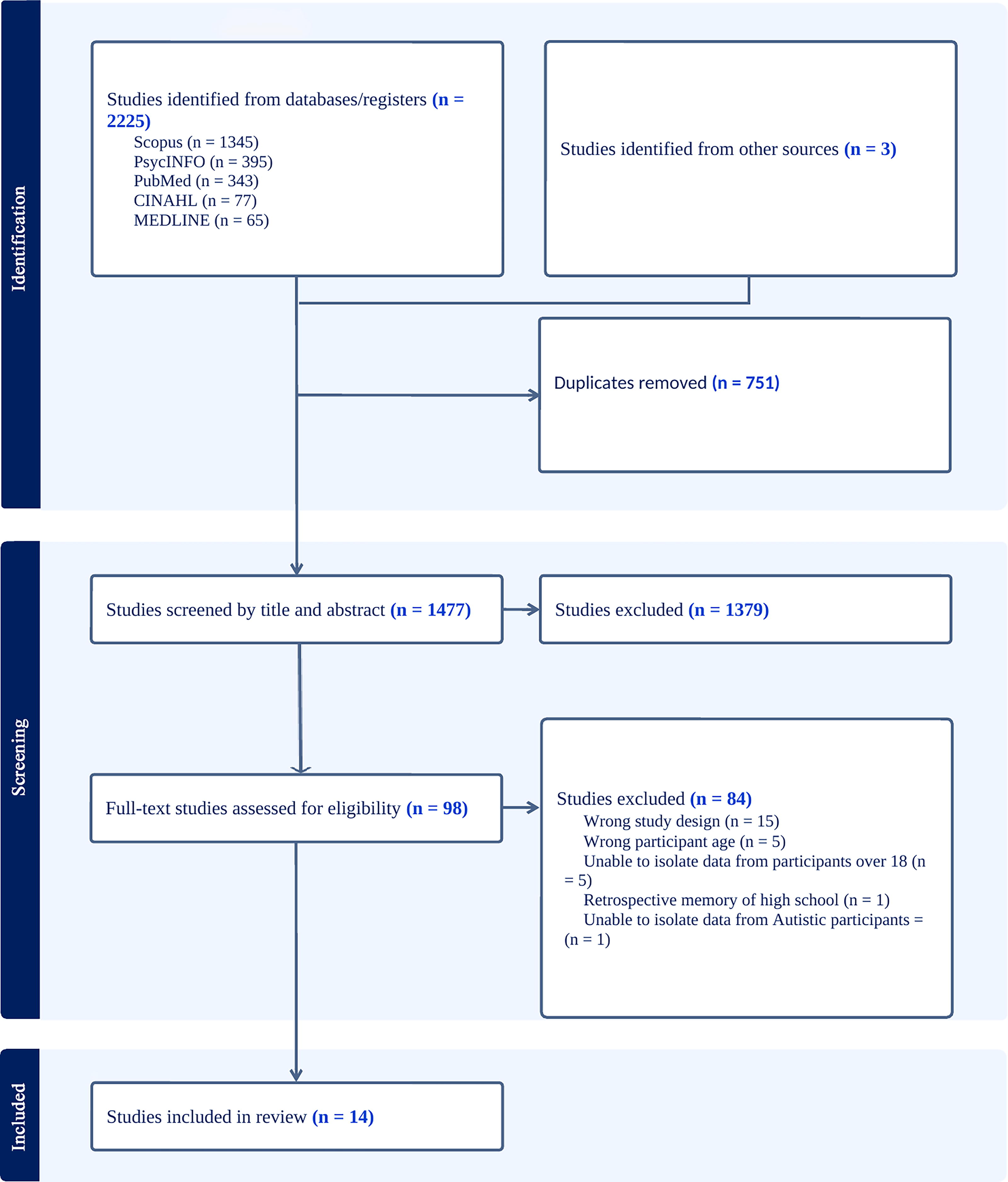
Flow chart of search strategy based on PRISMA flow diagram. PRISMA, Preferred Reporting Items for Systematic Reviews and Meta-Analyses.
Data items and charting process
In consultation with the second and sixth authors, the first author created a data extraction chart using Excel. The following information was extracted from all studies included in this review: (a) bibliographic details (author, year); (b) study aim; (c) study design (i.e., qualitative, quantitative, or mixed methods); (d) data collection method; (e) data analysis method; (f) geographical location; (g) relationship type; (h) sample characteristics (i.e., age, gender, ethnicity); (i) study aim/s; and (j) key findings pertaining to Autistic adults’ perceptions, preferences, experiences, attitudes, and/or perspectives of their socially significant relationships. The fifth author (S.G.) checked the accuracy of the details (e.g., study design, relationship type) of 20% of the included studies and identification of key findings. There was 100% agreement that these details were accurate and in the correct column.
We took an exploratory content-driven approach to qualitative analysis. 43 This was similar to qualitative content analysis 44 where specific codes were not predetermined; rather, codes are derived from the data collected from the selected articles. The first author looked for keywords in the reported findings of each article and gave these words codes that captured key attributes. 45 She then logged the codes in a table and applied these codes to similar quotes. New quotes were added as the analysis progressed. Codes and text with similar meanings were grouped together into thematic categories/broader themes and named. The coding, categorization, and themes were reviewed and checked by the second (C.J.B.) and sixth (H.W.) authors, and the findings from each theme were synthesized. This was a more blended or hybrid approach to traditional content analysis and thematic analysis. 46 This approach was both practical and pragmatic, as it allowed us to look for both the frequency of content and the significance of patterns within the data.
Results
Characteristics of included studies
In total, 14 studies met the inclusion criteria. Table 1 summarizes the details of each study (e.g., aim, participant information, relationship type), while Table 2 summarizes the key findings. The publication year of the included studies ranged from 2017 to 2023. Of the included studies, the majority (n = 10) employed qualitative methods with the remaining studies using either quantitative (n = 3) or mixed-methods (n = 1) designs. The studies were conducted in the United Kingdom (n = 6), the United States (n = 3), Canada (n = 1), and Germany (n = 1). The remaining studies (n = 2) did not report a geographical location. Friendships were the most common relationship type covered in this review, followed by romantic/intimate relationships and mentoring relationships. A thematic map of the findings is provided in Figure 2.

Thematic map of data synthesis.
Summary of Study Details
ASD, autism spectrum disorder; F, female; M, male.
Summary of Key Findings for Included Publications
A total of 582 participants were represented across the studies. Two studies5,52 included the same participant sample; these participants’ characteristics were therefore only reported once in this review. The participants in Finke 22 and Finke et al. 47 were collected as part of a wider study sample and therefore might have been the same or similar across the two studies; however, this was unclear. Thus, participants for each study were reported independently. Among participants, 301 identified as male, 272 as female, and the remaining nine as gender non-binary. Participant age ranged from 18 to 59 years, with nearly half the studies (n = 7) only including participants under the age of 30.
Friendships
Eight of the 14 included studies reported on friendships.2,22,35,47B48 -50,53
Friendship quality
While some participants desired more friendships, there was an emphasis on friendship quality over quantity. Several participants noted they would rather have no friends than low-quality friendships. 50 Autistic adults often described having fewer, more intense friendships, rather than a wider circle of friends that they found stressful.35,53 Participants also identified certain personal qualities that were important in a potential friend, including trustworthiness, authenticity, and non-judgmentalism. 50
Like-minded friends
Making and maintaining friendships was important to many Autistic adults,48,49 and they preferred interacting with people with similar interests and experiences. Finding friends who were accepting of social differences was important for some participants. Within these socially accepting friendships, participants felt comfortable and did not need to adhere to social “norms,” with being Autistic viewed by their friends as a difference rather than a deficit. 53
In several studies, participants preferred interacting with other Autistic individuals. A common finding was that participants found it easier to engage with fellow Autistic people due to shared understanding, experience, and a sense of belonging.2,48,53 Conversely, some participants also reported feeling accepted by non-autistic friends who appreciated their “atypical” personalities. 53
Shared interests and activities
Shared interests were described as a “gateway” to friendships, serving as initial points for conversation and supporting ongoing connections. 53 Various activities helped foster friendship development such as virtual gaming environments and special interest societies.49,50 Autistic adults indicated a preference for their friendships to be based around shared interests and activities rather than casual socializing or being friends with someone who feels the same way about life.22,47
Physical and emotional distance
Autistic participants reported a preference for keeping both physical and emotional distance from their friends 47 and preferred having someone to have fun with over having someone to confide in. 47 Some participants indicated that they would rather meet their friends online than have a face-to-face interaction, 50 further underscoring the desire for physical distance in their social relationships.
Online friendships
Online friendships were reported in three studies.48,49,53 Participants explained how developing friendships online was “easier” and more comfortable than in face-to-face settings.48,49 Online environments reduced social stigma and alleviated constraints imposed by social norms such as eye contact and nonverbal cues. Some participants felt they could maintain friendships without ever meeting the person face-to-face.49,53
Challenges in friendships
Some participants reported feeling overwhelmed and anxious when spending time with others, with these feelings being exacerbated when they spent time with non-autistic friends and family.2,48 These interactions often led to feelings of exhaustion and emotional fatigue, leading some participants to prefer infrequent communication with their friends.48,50 Consequently, some sought “low maintenance” friendships with people who understood the toll that social interactions can have. 48
Romantic relationships
Five of the included studies explored romantic/intimate relationships.5,33,35,52,54
Romantic relationship involvement
Across various studies, 44%–53% of Autistic participants reported current involvement in a romantic relationship,5,35,54 with an additional 29% indicating past relationship experience.5,54 Findings regarding romantic relationship involvement varied when compared with non-autistic samples. Sala et al. 5 found that Autistic adults were significantly more likely to have no relationship experience, whereas Sedgewick et al. 35 reported similar relationship status among Autistic and neurotypical women. Many single Autistic adults expressed a desire for a romantic relationship, with only a small minority reporting no desire at all. 54
Partner characteristics
Some participants described their romantic partner as their primary social relationship. 35 These relationships were often intense, with partners acting as “social gatekeepers” and providing a pathway to a social life that participants found difficult to establish on their own. 35 Several studies also highlighted the benefit of having an Autistic partner.5,54 Participants who were in a romantic relationship with an Autistic partner reported greater satisfaction compared with those with non-autistic partners. 54 Similarly, some participants reported that having a partner who was also Autistic, neurodivergent, or had similar experiences such as social anxiety helped build mutual understanding. 5
Sex/intimacy experiences
Autistic adults had a variety of perspectives regarding the role of physical intimacy in romantic relationships. Many felt that physical intimacy was important, noting that without it, these relationships may feel too similar to friendships. 52 However, some participants preferred nonsexual contact such as cuddling as a form of intimacy and comfort within relationships. 52 Sex was sometimes viewed as a symbol of connection and bonding within romantic relationships, yet discrepancies in libido and differing attitudes toward sex between partners were also reported. Some participants engaged in consensual non-monogamous relationships, whereas others, despite desiring a romantic partner, expressed little interest in sex. 52
Challenges in romantic relationships
Across several studies, participants described challenges associated with developing and/or maintaining romantic/intimate relationships. These included difficulty understanding partners and their differing perceptions/interests, difficulty managing the spontaneous nature of relationships, finding contact with another person too exhausting, and feeling as though a lack of sexual interest restricted potential romantic relationship involvement.33,54 Communication difficulties were also cited, particularly relating to flirting, courtship, and gauging others’ interest. 5 Additionally, some participants found it difficult to maintain romantic relationships, with love and empathy considered “hard work.” 5 Some Autistic adults also expressed concern regarding future relationships, including increased intimacy, dependency, and the expectation to have children. 33 In two studies, participants reported experiencing interpersonal violence/victimization within their romantic relationships, including abuse, rape, sexual assault, exploitation, and manipulation.33,35
Mentoring relationships
Two of the included studies reported on mentoring relationships.51,55
Social connectedness
Both studies explored the impact of mentorship on Autistic individuals, revealing benefits for both Autistic mentors and mentees. Autistic adults who mentored Autistic adolescents reported an increased sense of social connectedness. They enjoyed acting as both role models and friends and valued the opportunity to give advice and make a meaningful impact. 55 Autistic university students who were mentored by neurotypical peers felt that their mentors fostered a supportive connection that they could rely on while also providing a combination of friendship, peer support, and guidance. 51
Shared experiences
Some Autistic mentees noted the benefit of connecting with Autistic mentors, due to shared experiences. 55 However, shared experiences were not always limited to being Autistic, as having shared university experience and/or shared gender with mentors was also noted as being important. 51 Furthermore, some Autistic mentees felt that it was important for their neurotypical mentors to have an understanding of autism. 51
Challenges in mentoring relationships
Challenges within mentoring relationships were noted in both studies. Several mentoring relationships broke down due to mentors and mentees not knowing how to initially approach the relationship, failure to build sufficient rapport, not “being on the same page,” and when the mentor acted with too much authority to start. 51 Additionally, some Autistic mentors reported challenges in their communication and interactions with Autistic mentees, particularly when trying to engage in “deeper” conversations. 55
Discussion
The aim of this scoping review was to explore and synthesize the research to date on relationship perceptions and preferences of Autistic adults. The 14 included studies provided insight into this topic, and the analysis identified key themes within friendships, romantic relationships, and mentoring relationships. Our results demonstrate that Autistic adults experience a range of socially significant relationships; however, their perceptions and preferences for these relationships may differ from non-autistic adults. Friendships, often based on shared interests and activities, were highly valued by many Autistic adults. These relationships frequently occurred online, with many participants preferring to keep physical and emotional distance at times. Involvement in romantic relationships was common among Autistic adults, with shared experiences of being Autistic enhancing satisfaction and understanding. Mentoring relationships were also valued for the social connectedness they provided, and shared experiences helped build connection.
These findings contrast with earlier theoretical work that framed Autistic individuals as withdrawn, isolated, and having diminished social motivation.56,57 Instead, our results support a growing body of research that indicates many Autistic people are motivated to have friendships, romantic relationships, or other meaningful social connections.6,36,37,58
Our review demonstrated that within friendships and romantic relationships, Autistic individuals enjoyed, and often preferred, interacting with other Autistic people. Participants reported feeling better understood, more comfortable, able to be more authentic, as well as experiencing less anxiety or stress and greater overall satisfaction in these relationships.2,54 Furthermore, shared autism experience helped build understanding and connection.5,48,53
These findings are supported by a growing body of literature suggesting that Autistic individuals often prefer interacting with fellow Autistic people.59,60 The double empathy problem may help explain this preference. Milton 61 suggests that communication gaps between Autistic and non-autistic individuals arise from differences in social expression, understanding, and experiences. Consequently, Autistic individuals are better able to empathize with other Autistic people, while non-autistic individuals are better able to empathize with non-autistic people. The social challenges experienced by Autistic individuals may therefore stem from a mismatch in neurotype, rather than inherent deficits, and may not exist when both individuals are Autistic.7,62
Some participants within this review preferred to interact with their friends online rather than face-to-face. 49 These online connections were described as “easier” because they reduced the prominence of social difficulties and facilitated a more comfortable and authentic engagement, free from social norms such as eye contact and body language.48,49 This finding is consistent with existing research that has found that Autistic adults use the internet to meet others with similar interests more frequently than their non-autistic peers. 63 Previous research reports that Autistic adults have found online social media platforms helpful for improving their social lives, meeting others with similar interests, and maintaining friendships. 64 Exploring online friendships allows us to challenge the neurotypical bias in research, which has predominantly focused on face-to-face interactions. 25 Our findings, alongside broader research, demonstrate that many Autistic individuals actively engage in, and often prefer, meaningful relationships through online avenues.4,25
Our review indicated that Autistic adults varied in their preferences for how they like to spend time within their relationships. Participants preferred friendships to be based around shared interests and structured or planned activities rather than meeting to spend time in an unstructured setting.22,47 This preference is congruent with the literature showing Autistic individuals often prefer to engage in activities with their friends rather than simply “hanging out.”8,24,65 Chan et al. 8 argue that these activity-based interactions may be preferred because they are “more scripted and require less verbal communication” (p. 426). Given that these relationships are focused on a shared activity or topic, social differences are often less of a concern. 53 These preferences may explain why online platforms could provide the ideal setting to form and maintain friendships for many Autistic adults.
We found physical intimacy to be an important aspect of Autistic adults’ romantic relationships, and without this, these relationships might feel too similar to friendships. 52 This contrasts with earlier research that framed Autistic individuals as predominantly “asexual” and disinterested in intimate relationships. 5 We also found that reasons for not engaging in romantic relationships included the exhaustion caused by interpersonal contact and uncertainty around the nature of dating.33,54 Recently, Beato et al. 66 reported that many Autistic young people included in their study did not know how to express attraction, show interest in another person, and struggled with the flirting process. Several of their participants highlighted the benefits of using social networks to communicate online, as such methods reduced pressure to interpret nonverbal communication.
We also found that some Autistic adults experienced interpersonal violence and victimization within their romantic relationships. Research indicates that this is a common experience for Autistic individuals67,68 and is particularly prevalent among Autistic women and individuals assigned female at birth. Some studies suggest that nearly 90% of participants in these groups have experienced some form of sexual violence. 69
Within mentoring relationships, we found Autistic adults enjoyed the opportunity to socially connect with others. This finding reflects previous research indicating that mentoring can enhance social connectedness among Autistic individuals.70,71 Although mentoring is an important nonfamilial relationship, it has received relatively little attention in autism research. While some additional literature on mentoring exists beyond our review, these studies primarily focus on outcomes for Autistic individuals rather than their experiences of the mentoring relationship itself. For example, Buckley et al. 72 assessed the feasibility and acceptability of a mentoring program for Autistic professionals in the performing arts while also exploring mentors’ and mentees’ perspectives on its impact on occupational self-efficacy. Autistic mentees reported increases in perceived occupational self-efficacy and valued the relationships they formed with their mentors, which helped alleviate feelings of isolation within the industry.
Across relationship types, many Autistic adults reported challenges, particularly in relation to social interaction and aspects of communication. It has been well discussed within the literature that many Autistic individuals experience difficulty initiating, maintaining and navigating socially significant relationships due to differences in Autistic social cognition. 2 However, Sedgewick et al. 35 emphasize the importance of studying the many positive social experiences Autistic individuals have, as these are equally as important as the challenges they face. Furthermore, from a neurodiversity perspective, the challenges faced by Autistic individuals can be understood as arising from a lack of congruence and mismatch between Autistic characteristics and society’s expectations and biases of what relationships should look like and involve. 73
Limitations
Several factors should be considered when interpreting these findings. First, the scoping nature of this review limits the ability to draw definitive conclusions; rather, readers should view this review as an overview of the current literature, which is currently in its infancy. Second, we did not include the optional quality critique items from the PRISMA-ScR framework, because critiquing the quality of included articles was beyond the scope of the present review. Therefore, our findings should be interpreted within this context. Third, it is possible that there is unpublished literature, or gray literature that is relevant to this review, that has not been included. Finally, the current review did not discuss how race, ethnicity, sexual orientation, gender, or other demographic and identifying factors impacted Autistic adults’ relationship perceptions and preferences.
Implications for future research
Much of the previous literature exploring the relationship perceptions and preferences of Autistic adults has focused on friendships, leaving other socially significant relationships underexplored. Future research could focus on perceptions and preferences for romantic/intimate and mentoring relationships to provide a more comprehensive understanding of the social needs and preferences of Autistic adults. This would not only address current gaps in the literature but also inform the development of more targeted support programs that better reflect the diversity of relationships preferred by Autistic individuals. Additionally, it is critical that future research explores the relationship perceptions and preferences of Autistic individuals with complex support and/or communication needs, as this population is frequently overlooked in the literature. A recent study conducted by Darvell and Bradshaw 74 used Talking Mats® to interview adults with intellectual disabilities (many of whom had a co-occurring autism diagnosis) regarding their social care–related quality of life. While this study did not solely focus on relationships, it included aspects of social participation and involvement, with some participants mentioning their friendships. Future research may consider using similar approaches to gather a more in-depth understanding of the views and experiences of this population regarding their socially significant relationships. Additional research should be conducted to examine the influence of important factors such as race, ethnicity, sexual orientation, and gender on Autistic adults’ relationship preferences and perceptions. Investigating these factors and their intersections would provide valuable insights into how diagnostic status and demographic variables interact to shape relational experiences. Finally, insight into Autistic adults’ relationship perceptions and preferences can inform the development of support programs aimed at facilitating, strengthening, and/or maintaining a range of nonfamilial relationships. As noted in this review, and other supporting literature, many Autistic adults express interest in forming relationships, particularly with fellow Autistic individuals. Autistic adults have indicated that autism-specific peer support, particularly in school settings, is desirable and may be beneficial. 75 Our findings support the value of autism-specific social environments and offer important perspectives for shaping future support programs.
Conclusion
This scoping review demonstrates that Autistic adults experience a variety of socially significant relationships, often preferring connections with fellow Autistic individuals due to shared understanding and a sense of belonging. Friendships were often preferred to be activity-based and occurring online. Romantic relationships were enhanced by mutual understanding, especially with Autistic partners, while mentoring relationships fostered social connectedness. These findings are important as they provide a more accurate understanding of Autistic adults’ relationships and offer valuable insights to help Autistic individuals, their friends, families, and loved ones better understand and support these relationships. Future research should explore underrepresented relationship types and include individuals with complex support and/or communication needs.
Footnotes
Authorship Confirmation Statement
H.M., C.J.B., and H.W. contributed equally to the conceptualization of this article. H.M. is the lead author and led implementation of the search strategy and analytic efforts. C.J.B. and H.W. provided supervision throughout the project. W.J.S. and S.G. worked on data extraction agreement. H.M. wrote the original draft, and all remaining authors provided reviews and editing and approved the final version for publication. This article has been submitted solely to Autism in Adulthood and is not published, in press, or submitted elsewhere.
Author Disclosure Statement
The author(s) declared no potential conflicts of interest with respect to the research, authorship, and/or publication of this article.
Funding Information
Preparation of this article was supported in part by a Victoria University of Wellington PhD scholarship awarded to H.M. and S.G.

References
Supplementary Material
Please find the following supplemental material available below.
For Open Access articles published under a Creative Commons License, all supplemental material carries the same license as the article it is associated with.
For non-Open Access articles published, all supplemental material carries a non-exclusive license, and permission requests for re-use of supplemental material or any part of supplemental material shall be sent directly to the copyright owner as specified in the copyright notice associated with the article.
