




Abstract
Community Brief
Why is this an important issue?
Autistic and non-autistic adults often communicate in different ways, which can lead to misunderstandings that negatively affect autistic people. There is limited research on how autistic and non-autistic people work together in group settings. Gaining information about how autistic and non-autistic people collaborate may help improve autistic people’s well-being in educational, professional, and social settings.
What was the purpose of this study?
We compared how autistic and non-autistic people talk while collaborating on a group task. We also explored whether autistic people talk differently when collaborating with other autistic people compared with when they are collaborating with non-autistic people.
What did the researchers do?
We put autistic and non-autistic participants into groups of four. Sometimes these groups consisted of all-autistic people, sometimes all-non-autistic people, sometimes one autistic person with three non-autistic people, and sometimes one non-autistic person with three autistic people. Each group built a tower using Jenga blocks while being video recorded. We analyzed participants’ speech from the video recordings.
What were the results of the study?
Groups with all-autistic or all-non-autistic members had less negative speech than mixed groups. Autistic adults expressed more positivity than non-autistic participants but expressed more negativity when in groups with non-autistic participants.
What do these findings add to what was already known?
This is the first study examining autistic and non-autistic collaboration in group settings. Findings show us that autistic people communicate differently in mixed groups and feel more comfortable with other autistic people. This could mean that autistic people just enjoy interacting with other autistic people more, or they might have tried to fit in with a more negative tone to match the group norm in mixed groups.
What are potential weaknesses in the study?
The researchers did not have a large enough sample size to explore differences based on other factors such as gender or race. We also did not examine nonverbal behaviors, such as facial expressions or body language, which can differ between autistic and non-autistic people and could have affected how people collaborated.
How will these findings help autistic adults now or in the future?
Autistic people often interact personally and professionally with non-autistic people, and these results can help create more inclusive environments by promoting strategies for better communication, respect, and teamwork between autistic and non-autistic people.
Introduction
Autism is clinically characterized in part by challenges in social interactions. 1 Researchers have traditionally explored these social difficulties under the assumption that autistic impairments in social cognition (e.g., the disproven belief that autistic people have a universal theory of mind impairment) negatively impact their interactive abilities, a process that may contribute to stigma.2B3 -5 This “deficit model,” which posits that autistic people have inherent social deficits, is increasingly challenged by a broader interactionist view emphasizing interaction as a dynamic, relational process between people. 6 Supporting an interactive model, social cognitive alignment rather than individual ability predicts social outcomes of interactions between autistic and non-autistic people. 7 Social cognitive training programs for autistic adolescents and adults have demonstrated poor generalization to real-world social improvements,8-10 and autistic people often have more enjoyable and successful interactions with autistic relative to non-autistic partners.11,12
The Double Empathy Problem (DEP) 13 builds on this relational view by suggesting that social misunderstandings between autistic and non-autistic people are reciprocal rather than situated within the autistic person alone. Research on cross-neurotype interactions supports the DEP, indicating that differences in communication styles contribute to misunderstandings between autistic and non-autistic adults 14 that can negatively affect autistic people.15-17 For instance, autistic people often face hiring biases and are frequently overlooked due to poor interview evaluations, regardless of their skills, qualifications, or job-related knowledge.18B19 -24 Additionally, in criminal justice settings, they are often misperceived as less competent and more deceptive 25 and are frequently viewed as noncompliant during police encounters. 26
Misinterpretations between autistic and non-autistic people may stem in part from differences in communication styles 27 that can contribute to errors inferring communicative intent. 28 Non-autistic people often communicate indirectly, using jargon, metaphors, or implied meanings, which can confuse some autistic people who may prefer clear, literal language. 29 Some autistic people communicate more directly and literally, although communication profiles and preferences are heterogeneous29B30 -32 and can differ from non-autistic people in aspects of nonverbal communication, including facial expressivity 33 that often is perceived by non-autistic people as blunt, rude, or unnatural.25,34 These differences in verbal and nonverbal communication may contribute to misinterpretations and negative judgments by non-autistic people17,35 but are often valued within autistic communities, 11 in which shared communication preferences and understanding can foster positive social evaluations among autistic peers. 36 Autistic people frequently feel more comfortable and establish better rapport with others who share similar communication styles, as these interactions can reduce the need for masking behaviors and promote genuine understanding.7,11,33,36-38 That said, sociality in autism is notoriously heterogeneous,39,40 and the comfort and rapport that autistic people experience often vary greatly by context. 41
Up to this point, communication differences and breakdowns in understanding and rapport between autistic and non-autistic people in experimental settings have exclusively been studied dyadically.12,14 However, autistic and non-autistic people often interact in group environments, such as educational institutions, workplaces, and social events, where outcomes may depend upon collaboration between more than two people. Collaboration involves combining ideas to produce outcomes that exceed individual efforts 42 and often requires alignment of behaviors and communication styles among group members to achieve common goals. 43 Disagreement can sometimes lead to better collaborative outcomes, although its impact largely depends on the nature of the task. For instance, in certain learning activities, disagreements may prove beneficial as they provide opportunities for individuals to encode new information and develop solutions. 44 One study by Zentall et al. 45 found that in a problem-solving task involving students, groups that included one neurodivergent student with high attention-deficit/hyperactivity disorder (ADHD) traits solved the problem faster than groups composed entirely of neurotypical students. However, in tasks requiring group consensus for success, disagreements are often less advantageous. 46
Autistic and non-autistic individuals often differ in various communication aspects relevant to collaboration, such as preferences for literal versus figurative language, 30 social expressivity, 33 problem-solving approaches,47,48 conversational backchanneling, 49 and turn-taking. 50 These differences can create tensions in collaborative environments, where social and cognitive alignment is crucial for success, 51 presenting a pragmatic barrier to collaboration. Furthermore, teams lacking shared identities are more likely to dismiss differing perspectives, 52 which can undermine effective information integration and reduce motivation and enthusiasm for teamwork. This dynamic can present an emotional barrier to collaboration, further impeding success.53-55
One approach to studying these differences in group settings is by measuring “verbal collaboration”—a form of speech focusing on collaborative intentions that involve both generating task-related solutions and managing social engagement and cohesion.56,57 These processes are key to successful collaboration as they shape how information is shared, understood, and built upon.58B59 -61 Verbal collaboration may therefore provide unique insight into how communicative exchanges between autistic and non-autistic people can promote or undermine collaboration.
The present study aims to investigate verbal collaboration between and among autistic and non-autistic adults in a group setting. We explore whether autistic and non-autistic peoples’ verbal collaboration differs depending on whether they are in the diagnostic minority or majority of the group, and whether aspects of verbal collaboration relate to rapport with other group members. Based on prior evidence indicating that autistic but not non-autistic people experience reduced rapport in mixed group settings, 41 we hypothesize that autistic participants will demonstrate less collaborative speech than non-autistic participants. We also hypothesize that both autistic and non-autistic participants will engage in more collaborative speech when in the majority than the minority. For the purposes of this study, participants diagnosed with or identifying as autistic were considered to be in the majority when they outnumbered non-autistic participants, whereas non-autistic participants were considered to be in the majority when they outnumbered autistic participants. Finally, we explore whether aspects of verbal collaboration between autistic and non-autistic people relate to their perceptions of group rapport. A previous study found that rapport for autistic participants was highest in all-autistic groups and declined as more non-autistic participants were in the group. 41 Here, we explore whether these patterns relate to verbal collaboration during the group interactions. Due to the lack of prior studies investigating the relationship between verbal collaboration and rapport in autistic populations, we did not form a priori hypothesis concerning whether this relationship would differ for autistic and non-autistic participants.
Methods
Participants
A total of 136 adults (73 autistic and 63 non-autistic) participated in this study across three sites: The University of Texas at Dallas (n = 48), The University of Nottingham (n = 48), and The University of Edinburgh (n = 40). Autistic and non-autistic participants did not significantly differ in ethnicity (p = 0.417) or age (p = 0.302) but did on intelligence quotient as measured by the Wechsler Abbreviated Scale of Intelligence-II 62 and on self-identified gender (p < 0.001). We included only autistic participants with full-scale intelligence quotients above 70 on the Wechsler Adult Intelligence Scale II (WASI-II) to ensure comparability with non-autistic participants. All participants completed both the verbal comprehension and matrix reasoning subtests in person with an experimenter on the day of testing. The autistic group scored higher on the WASI-II and included more participants who identified as non-binary. See Table 1 for sample demographics.
Descriptive Statistics (Mean and Standard Deviation) and Group Comparisons for Participant Demographic Variables, IQ, and Autistic Traits
IQ, intelligence quotient; RAADS, Ritvo Autism Asperger Diagnostic Scale-Revised; WASI-II, Wechsler Adult Intelligence Scale II.
We recruited participants from mailing lists, local charities, social media, university research pools, a study website, and through word of mouth across the three sites, representing both students and community members. Eligibility requirements included being 18 years or older, a native or native-level English speaker, and having normal/corrected normal sight and hearing. We also excluded participants if they self-reported a diagnosis of social anxiety or uncontrolled epilepsy. Participants in the autistic group had a formal diagnosis (n = 46) or self-identified as autistic (n = 17). The self-identified group completed the Ritvo Autism and Asperger Diagnostic Scale, 63 and we only included participants in the study if they scored 72 or above, indicating a level of autistic traits above a diagnostic threshold. 63 All participants completed the 14-item Ritvo Autism and Asperger Diagnostic Scale,63-65 and we excluded non-autistic participants with scores indicating elevated autistic traits (scores >14). Self-identified autistic participants and autistic participants with a formal diagnosis did not significantly differ in autistic traits measured with the Ritvo-14 (p = 0.104). All-autistic participants communicated verbally.
The study was approved by The University of Texas at Dallas Institutional Review Board, The University of Nottingham’s Psychology Research Ethics Committee, and The University of Edinburgh’s Ethics Committee, and all participants provided informed consent prior to participating and received monetary compensation for their time.
Measures and procedures
We randomly assigned the 136 participants to one of four group types, each containing four members: all autistic (N = 13), all non-autistic (N = 10), majority non-autistic (3 non-autistic, 1 autistic; N = 6), and majority autistic (3 autistic, 1 non-autistic; N = 5), resulting in a total of 34 groups. Due to a technical error affecting videos from two additional groups (a non-autistic majority group and an autistic majority group), the researchers excluded these videos from the analysis. Furthermore, because this study was part of a larger project involving autistic and non-autistic adults in both same- and mixed-neurotype groups, 66 some mixed-neurotype groups participated in an alternate task, which reduced the number of mixed group interactions available for this study. Additionally, a non-autistic participant withdrew before the group interaction started, resulting in one of the non-autistic majority groups having only three participants. However, the final sample size was supported using the Monte Carlo simulation capabilities of the mlmpower package 49 in R to determine the minimum effect-size values for the group actor–partner interdependence models (GAPIMs) that we could detect with power = 0.80 and intraclass correlation coefficients (ICCs) for the outcome variables of 0.10 and 0.25. Each analysis used 2000 simulations and assumed a sample size of 34 groups with four people within each group. Simulations showed that we have adequate power (0.78) to detect small-to-medium effect-size values (i.e., R2 = 0.03) for the actor and partner effects when the ICC is as low as 0.10 (power = 0.86 when ICC = 0.25). In contrast, we only have sufficient power (0.83) to detect a medium effect-size value (i.e., R2 = 0.05) for the actor–partner interaction term when the ICC is 0.25.
During recruitment, the experimenter informed participants that the study aimed to explore how autistic and non-autistic adults learn from one another. To eliminate the potential confounding effect of selective participants disclosing their diagnostic status during the interaction, the experimenter informed participants of the diagnostic composition of their group (“everyone in the group is autistic/non-autistic” or “one person in the group is autistic/non-autistic”) prior to the start of the study, but individual diagnostic statuses were not disclosed.
An experimenter began the study by guiding groups of four participants into a room where they received the following instructions: “You’ll be playing Jenga together as a group of four. I need to step out for a couple of minutes to grab the Jenga set. Feel free to chat amongst yourselves while I’m gone.” This allowed group members 3 minutes to introduce themselves informally before the task began. When the experimenter returned, the groups built Jenga towers for 5 minutes while the experimenter video recorded them. A Panasonic high-definition model camera mounted about 6 ft away on a tripod at eye level with participants recorded the group activity at all three sites.
Jenga task
The experimenter returned with a large Jenga set (54 blocks measuring between 15–16.5 cm × 3 cm × 4.9–5.3 cm) and said, “Your group’s task is to build the tower as tall as possible before it falls. I’ll wait outside and return in five minutes. If the tower falls before then, you’re welcome to try again.” The experimenter deliberately made the instructions open-ended, allowing participants to decide whether to approach the task cooperatively or competitively. After building for 5 minutes, participants individually assessed their perceived rapport with the group.
Rapport
We assessed rapport using a five-item rating scale developed for studies of autistic and non-autistic interactions.11,14,67 Participants evaluated the interaction based on their perceived enjoyment, ease, success, friendliness, and awkwardness with the group on a scale from 0 to 100. No participants reported any difficulties providing exact scores on the scale. Higher scores reflected a more positive experience, with the “awkward” item reverse-scored to maintain consistent directional alignment across items. The five items on the scale yielded a Cronbach’s alpha of 0.819 in this study, indicating interitem consistency in the measurement of rapport with some between-item distinctions. To build on previous item-level findings of the rapport scale in group interactions between autistic and non-autistic adults, 68 exploratory analyses in the current study also assessed associations between rapport and verbal collaboration at the item level.
Speech coding
To analyze verbal collaboration during the Jenga task, we adapted a coding scheme based on a validated assessment of speech utterances used in a collaborative, computer-supported problem-solving task. 69 While the original coding scheme encompassed seven broad collaborative processes, we focused on one—argumentation management—as it most directly aligned with our research objectives. Argumentation management refers to processes by which people in an interaction agree and disagree while pursuing a shared activity. This process offers insights into how groups resolve (or fail to resolve) conflicts, a key factor in fostering positive social interactions in collaborative settings. 70 It includes codes for proposed, elicited, supported, and enriched ideas, agreements, contradictions, and proposed and elicited opinions, 70 with additional categories added to distinguish between self- and other-directed opinions. Two coders refined the scheme using transcripts from the group activity, independently tested it, identified ambiguities, and reached consensus on adjustments. The nine items achieved a Cronbach’s alpha of 0.645, demonstrating acceptable reliability in capturing our primary variable of interest, argumentation. Each code and its operational definition can be viewed in Table 2.
Verbal Collaboration Coding Scheme, Including Nine Collaborative Acts with Their Operationalized Definitions and Examples from Transcripts
Researchers used Media Hopper Create 71 to transcribe the recordings. Two trained research assistants cross-checked verbal content from the 5-minute interaction for accuracy and segmented speech into utterances when there were pauses in participant speech. They then coded the transcripts with NVivo 12, 72 a qualitative analysis software used to reliably code speech. Here, the software organized codes, parsed text classified under certain codes, and provided frequency outputs. The first coder, an autistic researcher, categorized the speech content from 17 transcripts, whereas the second coder, a non-autistic researcher, coded the remaining 17 transcripts. Both coders were trained for reliability using standardized procedures, clear operational definitions, and ample practice with feedback before coding independently and assessing intercoder reliability. Two coders calculated intercoder reliability for the nine collaborative acts in the 34 group interaction videos using Cohen’s kappa coefficient, based on 10% of the transcripts (3 or 4 transcripts per coder). They achieved substantial inter-rater reliability (κ = 0.81).
Analytic strategy
The researchers preregistered all aspects of this study, including the desired sample size, targeted variables, a priori hypotheses, and planned analyses, on the Open Science Framework (osf.io/bzvfk). Analyses were performed using SPSS v. 29. A preliminary one-way multivariate analysis of variance showed that none of the nine collaborative acts differed significantly between the three sites (all ps > 0.247), so the researchers combined data across sites for all further analyses. To test our first hypothesis that autistic participants would demonstrate less collaborative speech than non-autistic participants, we conducted an independent sample t-test to examine differences in the nine codes of argumentation management between autistic and non-autistic participants. To test our second hypothesis that both autistic and non-autistic participants would engage in more collaborative speech when in the majority (one autistic participant with three non-autistic participants) than the minority (one non-autistic participant with three autistic participants), we utilized multilevel models (MLMs) with restricted maximum likelihood estimation. MLMs were also used to specify the GAPIM. 73 In this model, the term “actor” represents the autistic or non-autistic participant, whereas the “partner” denotes the diagnostic makeup of the other group members. Participants’ collaborative speech with the group was predicted as a function of the participants’ diagnosis (coded as −1 for non-autistic and 1 for autistic), the diagnostic composition of the other group members (coded as −1 for all non-autistic, −0.33 for a non-autistic majority, 0.33 for an autistic majority, and 1 for all autistic), and the similarity between the participant’s diagnosis and the diagnostic composition of the group (represented by the actor–partner interaction term). Additionally, a random group intercept was included to address non-independence of observations. Finally, to explore whether collaborative speech is associated with rapport, we conducted Pearson correlations between the collaborative speech types and rapport items for the two diagnostic groups and in the different group types.
Results
Table 3 displays the results from an independent groups t-test. Autistic participants expressed more positive opinions about the group, t (134) = 0.894, p = 0.039, and about their own contributions during the task, t (134) = 1.53, p = 0.002, compared with non-autistic participants. In contrast, non-autistic participants expressed more negative opinions about the group t (134) = 1.02, p = 0.003 than autistic participants and tried more often to elicit ideas from other group members t (134) = 2.29, p < 0.001. The four group types (all autistic, all non-autistic, autistic majority, and non-autistic majority) did not significantly differ in the height of the towers they produced, F(3, 135)= 1.33, p = 0.267.
Means (the Average Number of Each Code per Participant), Standard Deviations, t-Values, and p-Values from Independent Samples t-Tests Between Autistic and Non-Autistic Participants for the Nine Collaborative Acts
denotes a significant difference between groups at p < 0.05.
denotes a significant difference between groups at p < 0.001.
Verbal collaboration for the four group types can be seen in Figure 1. MLMs revealed a significant effect of negative opinions directed at others, F(2, 61.99) = 4.62, p = 0.013. Pairwise comparisons showed that single-neurotype groups reported significantly fewer negative opinions (M = 1.14, 95% confidence interval [CI] [0.800, 1.49]) compared with mixed groups. Specifically, participants who were in the majority in mixed groups reported more negative opinions than those in single-neurotype groups (M = 1.87, mean deviation [MD] = −0.733, 95% CI [−1.37, −0.092], p = 0.026), and the same was true for minority participants in mixed groups (M = 2.35, MD = −1.21, 95% CI [−2.16, −0.265], p = 0.013). MLMs also revealed that this effect was primarily driven by autistic participants, and that the effect of participants’ diagnosis on “other-directed negative opinions” was dependent on the diagnostic composition of the group (F [1, 72.68] = 7.71, p = 0.007). Autistic participants tended to express more negative opinions toward other group members as the proportion of non-autistic participants in the group increased.
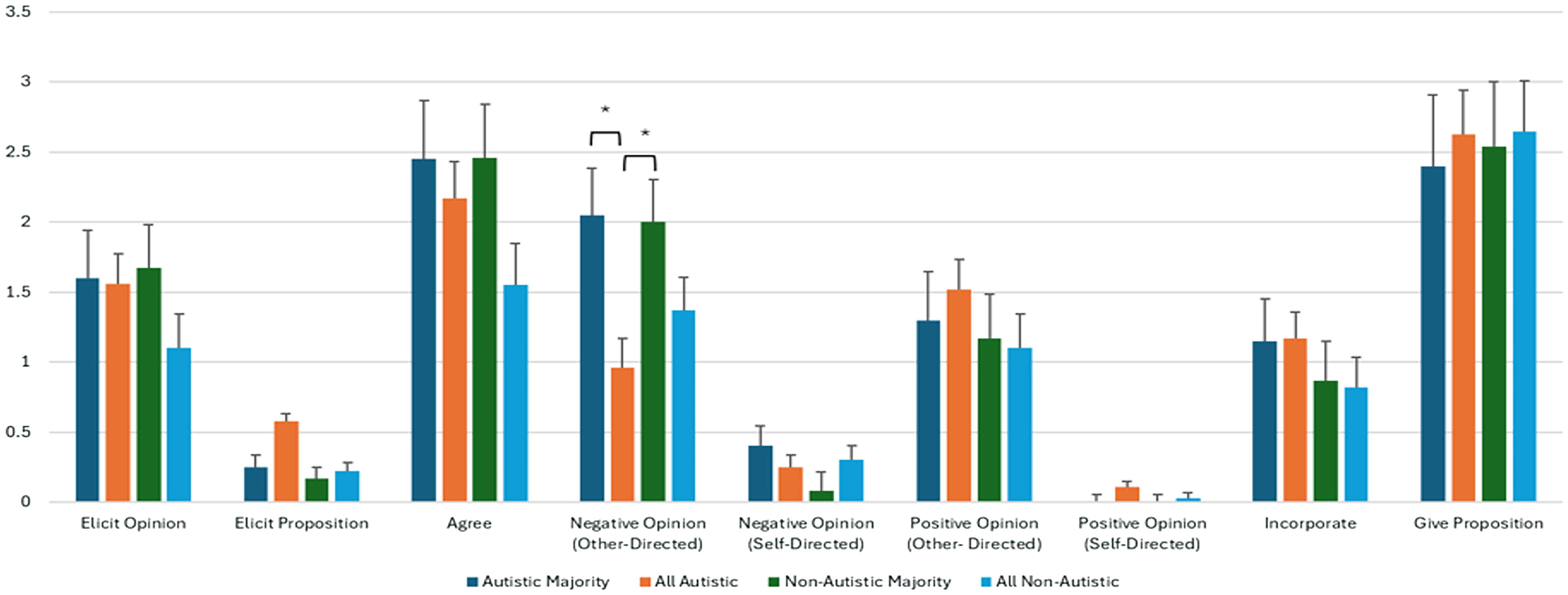
Estimated marginal means (and standard errors) for collaborative speech for each group type. * denotes a significant difference between groups at p < 0.05.
Simple slope computations revealed a significant effect of diagnostic composition for autistic participants (b = −0.86, standard error [SE] = 0.31, p = 0.006), such that autistic participants directed increasingly more negative opinions toward the group as more non-autistic members were present (no non-autistic members: M = 1.04, 95% CI [0.61, 1.47]; one non-autistic member: M = 1.62, 95% CI [1.19, 2.04]; and all other members non-autistic: M = 2.78, 95% CI [1.68, 3.86]). In contrast, there was no significant effect of diagnostic composition of the group for non-autistic participants (b = 0.43, SE = 0.34, p = 0.20).
Exploratory analyses revealed that more positive opinions directed toward the group by autistic participants were associated with lower feelings of group awkwardness (r = −0.232, p = 0.048), whereas among non-autistic participants, directing more negative opinions at themselves was associated with worse rapport ratings for group ease (r = −0.283, p = 0.025) and friendliness (r = −0.270, p = 0.032). Eliciting more opinions in the all-autistic groups was associated with worse ratings of group awkwardness (r = −0.276, p = 0.048), and greater negative self-talk in the all-non-autistic groups task was associated with lower group enjoyment (r = −0.322, p = 0.043), ease (r= −0.358, p = 0.023), and friendliness (r = −0.379, p = 0.016). In the non-autistic majority groups, greater agreement about how to complete the task was correlated with higher perceptions of task success (r = 0.522, p = 0.009), and positive opinions directed at others were associated with less group awkwardness (r= −0.408, p = 0.048).
Discussion
The current study examined verbal collaboration between autistic and non-autistic adults during a tower-building task and explored their associations with group rapport. During the group task, autistic participants spent more time expressing positive opinions about themselves and others and were less critical of others than non-autistic participants. Mixed groups generally produced more negative opinions directed at others than in the single-neurotype groups. Consistent with our hypothesis that autistic participants would engage in more collaborative speech in the majority than the minority, autistic people directed the fewest negative opinions toward others when in all-autistic groups, but these incidences increased as more non-autistic participants were present. However, contrary to our hypothesis, this did not extend to non-autistic participants, who demonstrated similar levels of negative speech regardless of group composition. Finally, verbal collaboration for both autistic and non-autistic participants showed some associations with group rapport.
Contrary to a social deficit model of autism, autistic adults did not significantly differ from non-autistic adults on several aspects of verbal collaboration—proposing, agreeing with, or enriching ideas, and eliciting opinions from others—and expressed significantly more positive opinions during the group activity than their non-autistic counterparts. Representative examples of positive opinions by autistic participants included “Yeah, that’s a good idea,” “Good thinking,”, “Wow, that was fun,” and “This is teamwork.” Although speculative, autistic adults may find positive language more conducive to problem-solving as it aligns with a constructive, solution-focused mindset and has been known to improve problem-solving performance in chronically stressed adults, 74 a characteristic many autistic people share. 75 Autistic people may also be more inclined to prioritize maintaining positivity and social cohesion due to a greater history of negative social experiences.76-78 Additionally, the increased positivity among autistic participants may indicate a prioritization of teamwork and collective goals over individual achievements, which may be beneficial to group success in professional and educational settings. Furthermore, for autistic people who may feel isolated in neurotypical spaces, promoting solution-focused, affirming language may reduce social stress and improve participation, problem-solving, and overall well-being.
In contrast, non-autistic participants directed more negative opinions toward others in the group than autistic participants. Examples of these statements include saying things like: “Y’all are underachievers,” “Are we allowed to be content with mediocrity?” and “This is not needed,” which may suggest that non-autistic participants approached the task more competitively than the autistic participants. Such statements may reflect self-enhancement bias often found among non-autistic adults 79 in which they overestimate their own abilities and contributions relative to others, a bias that is not shared to the same degree among autistic people who may actually self-diminish their social abilities. 80
Differences in collaboration may also be tied to different approaches to problem-solving. Non-autistic adults may view negative or critical speech as beneficial for identifying and addressing potential problems, which could foster a more analytical problem-solving approach. 81 While this is a valid strategy, encouraging autistic people to use their natural inclination for positive speech could complement this analytical approach, creating a balanced dynamic where both problem identification and team cohesion are prioritized. This balanced communication model could be particularly useful in environments such as workplaces and classrooms, where diverse problem-solving strategies are crucial for success.
Collectively, these findings suggest that autistic and non-autistic participants approach group tasks differently, shaped by distinct communication styles. While past research has shown that communication between autistic and non-autistic individuals differs in terms of literalness and directness, 30 our new data reveal differences in the valence of speech used to foster collaborative success. Broadly, autistic individuals tended to use more praise and celebratory language, whereas non-autistic participants in our study were more critical. These differences may influence group dynamics, with positive straightforward language fostering collaboration82,83 and critical speech aiding problem identification. 80 For instance, non-autistic participants elicited more propositions, possibly reflecting attempts to identify problems for the group to address. However, it is also possible that autistic individuals refrained from expressing more negative speech due to perceiving greater social risk in behaving authentically. Future research, potentially using participatory or qualitative methods, should explore this further. 81
Differences in communication styles may have contributed to breakdowns in collaboration in mixed groups. Prior findings showed that mixed groups demonstrated less cohesion on this task, with more instances of group members working alone, rebuilding towers, or disengaging from the task. 41 Such behaviors by group members may reflect disagreement or tension, perhaps from attempts to reconcile conflicting ideas. It is also possible that autistic and non-autistic participants differed in nonverbal collaborative behaviors that influenced group dynamics, although these were not assessed in the current study. Nonverbal cues, such as gestures, facial expressions, and body language, can differ in autism and significantly support rapport and collaboration.34,41,84-86 Future research should examine how verbal and nonverbal communicative behaviors influence collaboration and problem-solving in mixed-neurotype groups.
Overall, the four group types did not significantly differ on eight of the nine aspects of verbal collaboration examined here, nor did they differ on tower heights. This is contrary to a social deficit model, which would imply that a group of four autistic people, and maybe also a majority-autistic group, should be less verbally and objectively collaborative than any other group. Research shows that the mechanisms driving task outcomes can vary significantly based on the specific context and interpersonal dynamics of collaboration.87,88 Task success and collaborative quality are influenced by factors such as communication norms and team culture, which may not always align with traditional outcome metrics such as task performance (e.g., tower height). 88
In line with this, we found that the four group types differed significantly in how often they directed negative opinions at others. Specifically, these negative opinions occurred more frequently in the mixed-neurotype groups compared with the same-neurotype groups. This suggests that, consistent with the DEP, tension and disagreement were more prevalent when autistic and non-autistic participants interacted with each other. Interestingly, it was the autistic participants, not the non-autistic ones, who expressed more negative opinions in mixed groups, with negative opinions increasing as the number of non-autistic participants grew. Their negative statements were lowest in the all-autistic groups, a finding that aligns with prior studies indicating enhanced communication and rapport for autistic adults in autistic spaces.11,14,49 In mixed settings, autistic adults may be inclined to mask their natural communication styles to conform to group norms, which may include adopting some non-autistic aspects of verbal collaboration. They may also express more negative opinions due to greater discomfort or disconnection when interacting with non-autistic groups members. Doing so might help autistic people strengthen their group membership to protect against feelings of rejection, a common coping mechanism for chronically rejected groups. 89 Meanwhile, non-autistic participants appeared relatively resilient to group composition effects, displaying a more consistent pattern of negative and positive verbal behavior across all group types in which they participated. These findings mirror previous research showing that autistic people are more sensitive to group composition than their non-autistic counterparts, reporting greater rapport in autistic-majority groups and less rapport in mixed-neurotype groups. 41 The current study suggests that these fluctuations in rapport may extend to verbal collaboration.
Indeed, exploratory analyses revealed that some aspects of verbal collaboration were linked to participants’ perceptions of group rapport. Positive opinions among autistic participants were related to perceiving the group interaction as less awkward, indicating that when autistic participants felt more comfortable and less self-conscious, they were more likely to express favorable opinions about the group dynamic. In contrast, negative self-directed opinions among non-autistic participants were linked to perceiving the interaction as less easy and friendly, suggesting that non-autistic participants may have been more likely to express negativity about their contribution when they felt the interaction was difficult or unfriendly. These findings suggest that non-autistic participants may have interpreted negative aspects of the interaction as a reflection of their own experience or role in the group, or alternatively, they may have become more self-critical when they perceived difficulties in the group interaction. In either case, it appears that non-autistic participants’ perceptions of the interaction related to their personal experience and feelings were associated with how they assessed the overall group dynamic. However, causality and direction of effects cannot be determined from these exploratory correlations. Future research may seek to examine rapport at multiple time points to tease apart how rapport and collaboration affect one another, and how these associations may differ for autistic and non-autistic people.
Readers should consider several limitations when interpreting the findings of this study. First, our focus on argumentation management also precludes broader conclusions about other forms of verbal collaboration. As such, findings may not generalize to verbal collaboration more broadly and should be considered preliminary. Next, the small number of minority groups (11 total) limited statistical power, particularly in detecting group differences and interactions, including the effects of diagnosis and minority group membership, differences in tower heights across groups, and the potential moderating role of other participant characteristics. Furthermore, the sample also lacked diversity and does not represent heterogeneity in the entire autism spectrum, which limits the generalizability of the findings. None of the participants had intellectual disabilities and were nonspeaking, and few came from racial minority backgrounds. Furthermore, the sample was predominantly White, in their 20s, and female. Demographic factors such as race, gender, and age also influence social dynamics, as individuals often identify more strongly with in-groups based on these characteristics. 90 Members of minority groups, including gender and racial minorities, often experience heightened cognitive focus on their group membership, which can lead to lower levels of positive affect in group settings compared with majority members. 91 Future studies with larger, well-powered samples should investigate how multiple minority statuses interact in shaping collaborative speech between autistic and non-autistic people.
We also did not assess communication preferences, vocal prosody, or ADHD traits in the autistic and non-autistic samples, even though these factors can vary significantly among individuals and influence collaborative outcomes. Additionally, there may be cultural differences in how groups are organized, as well as variations in the typical size of groupings across cultures. It is also possible that a longer task duration may influence collaborative outcomes differently. Researchers may consider these factors important for guiding their future work.
Furthermore, we disclosed the diagnostic composition of each group to participants. Previous studies have shown that diagnostic disclosure improves non-autistic individuals’ impressions of autistic adults 92 but does not influence impressions formed by other autistic individuals. 36 Due to our diagnostic disclosure procedure, the participant with a different neurotype from the others in a mixed group could infer the neurotypes of the other group members, whereas the rest were unaware of each other’s neurotypes. This could have influenced how participants in the group minority interacted with the group, and future studies should explore different diagnostic disclosure conditions and procedures in group settings. Finally, we cannot rule out the possibility that some participants may have known one another beforehand. While we made efforts to recruit from diverse locations and sources to minimize this likelihood, and we have no reason to believe that familiarity varied systematically across the four group types, future studies should address this limitation.
Despite these limitations, the findings offer valuable insights into how autistic and non-autistic adults collaborate verbally in group settings, enhancing our understanding of these dynamics. This knowledge can inform the creation of more inclusive environments. By embracing differing communication styles, mixed-neurotype groups may benefit from a more well-rounded approach to collaboration that values diverse methods of engagement. For autistic people, this could reduce the pressure to conform to neurotypical communication standards, allowing for more authentic expression in group interactions. For non-autistic people, a better understanding of these communication differences may lead to improved support structures for autistic people. Educating and training non-autistic people to recognize, appreciate, and understand neurodiverse communication patterns may help promote inclusion and mutual respect. In sum, these results underscore the importance of recognizing neurodiverse communication styles as valid and situating impairments in the intersection of autistic and non-autistic interactions, rather than solely within the autistic person.
Authorship Confirmation Statement
The lead author, S.J.F., an autistic adult, used their lived experience to shape the research questions, analyses, and interpretation of findings. The authors (S.P., C.E.H.W., M.D., R.C., D.R., S.FW., R.A.A., C.J.C., and N.J.S.) included both autistic and non-autistic researchers with backgrounds in psychology and speech language pathology, all of whom contributed to the study’s development, design, analysis, and article preparation. The article has been submitted solely to Autism in Adulthood.
Footnotes
Author Disclosure Statement
No competing financial interests exist.
Funding Information
The author(s) disclosed receipt of the following financial support for the research, authorship, and/or publication of this article: This project was funded by the Templeton World Charity Foundation (grant no. TWCF-2020-20442).