




Abstract
Community Brief
Why is this an important issue?
Social media is used for many purposes, including entertainment, sharing experiences, building communities, and information seeking. Many neurodivergent users may also use social media to connect with communities, explore identity, and find support. Some prior research has looked at the types of content shared on social media using neurodivergent hashtags but has mainly focused on the accuracy of videos or explored the potential for misinformation. No previous research has looked at both autism and ADHD content together.
What was the purpose of this study?
This study explored content in highly viewed TikTok videos using popular neurodiversity-related hashtags. We wanted to understand what was shared by creators in videos and develop themes about what was found across these.
What did the researchers do?
Our research team consisted of diverse individuals with varied experiences within the neurodivergent community. We used 10 popular hashtags to search for videos on TikTok and identified 500 videos to review. We then watched, coded, and discussed as a team.
What were the results of the study?
Most videos shared personal experiences from the perspective of neurodivergent creators. Videos using autism hashtags more commonly showed experiences of family members (parents or siblings). About half of the videos had humorous intent, with many sharing challenges and sensory difficulties. We developed four themes that described what videos depicted, including (1) personal lived neurodivergent experiences (including subthemes related to invisible or hidden presentations, community support and accommodations, celebrating strengths, navigating challenges, and the impact of co-occurring challenges); (2) sensory differences and experiences; (3) the importance of family and relationships (including supportive loving relationships and misunderstandings); and (4) portrayals of neurodivergence in videos. These themes explored a rich array of experiences related to autism and ADHD, including those from neurodivergent people’s perspectives, as well as from their community and supporters, showcasing everyday experiences alongside the strengths and challenges of neurodivergence.
What do these findings add to what was already known?
Our findings provide new insights into the types of neurodiversity-related content shared on highly viewed TikTok videos. The videos included in this study explored a rich array of neurodiversity-related content, with many videos focused on sharing experiences, fostering community, and offering strategies for support.
What are potential weaknesses in the study?
This study relied on our observations and interpretations of video content and may not always accurately reflect the creator’s purpose for sharing or creating videos. Additionally, social media platforms constantly change and update, which may mean that some content or features contained within videos may no longer be available.
How will these findings help autistic adults now or in the future?
These findings help us understand how video-sharing platforms such as TikTok share knowledge and experience and build communities through neurodiversity-related hashtags. The content in these videos may help understanding, awareness, and acceptance of neurodivergence through normalization of experiences. Future research could explore how users interpret neurodiversity-related social media content and whether these videos influence public perceptions and acceptance of neurodiversity.
Background
Social media platforms have an enormous role in public understanding and acceptance of neurodiversity, providing opportunities to connect with others’ experiences and points of view. While foremost platforms for entertainment, users upload content on social media for many different purposes, with powerful and influential effects in information sharing, peer support, and a sense of community, 1 with corollary risks associated with the spreading of health-related misinformation 2 and harmful content. Social media platforms are also increasingly a primary source of engagement for mental health help-seeking behaviors, exploration of identity, and self-understanding. However, there have been escalating concerns about the influence of social media on children and young people’s mental health, although the current quality of causality evidence for this is mixed. 3 While adolescents and young people increasingly report using social media as a primary source of obtaining news and factual content, 4 research has linked greater social media use with poorer mental health outcomes. 5
Among all social media platforms, TikTok has exhibited the fastest growth and popularity worldwide, with extremely high use among children and young people. Although public data on use in children and adolescents are not available, high use in adults has been reported. Locally, more than 9 million adults in Australia use TikTok, 6 with a reported global ad reach of more than 1.6 billion people in 2024. 7 In younger users, a survey of Australian adolescents found that 93% use social media regularly, with two-thirds engaging in daily TikTok use. 4 TikTok’s increasing popularity, particularly during the COVID-19 pandemic, and high user base in children and young people, has caused increasing concerns over the types of health-related content engaged with online. Reports have emerged about the potential for increased health anxiety and self-diagnosis of medical and psychiatric conditions, given the volume of user-generated content with limited mechanisms within the platform for fact-checking or moderation. 8
Neurodiversity-related hashtags on TikTok, including #adhd and #autism, rank among the highest-viewed health or medical-related hashtags. 9 Prior social media analyses of autism content have included YouTube,10,11 X/Twitter,12-14 and TikTok,15B16 -18 with most focusing on investigating misinformation or accuracy. For example, Aragon-Guevara et al. 15 examined #autism TikTok videos identified as “informational” (n = 133), classifying most as inaccurate or containing overgeneralized content. Similarly, Brown et al. 16 found that, among 100 TikTok videos queried for the term “autism spectrum disorder,” a quarter were classified as useful and two-fifths as misleading, with most videos from non-health-care provider accounts sharing personal perspectives. In a study of attention-deficit/hyperactivity disorder (ADHD) TikTok content, 19 psychiatrists rated 100 videos reporting that just over half were classified as “misleading,” describing transdiagnostic traits not specific to ADHD. In another recent study of 50 videos using the hashtag #adhdtest, used for self-identification of ADHD, 92% were classified as misleading. 20 Only two prior studies have explored the type of autism-related content shared on TikTok. A content analysis of 678 #autism videos reported that most were from an autistic person’s perspective, describing diagnostic features or sharing experiences related to marginalization (e.g., lack of access, stigma, inspirational content). 17 Through a thematic analysis of 30 #actuallyautistic videos, Berg Egge and Gabarron 18 developed several themes relating to stigmatization, sensory difficulties, masking, stimming, and communication differences.
To date, most prior neurodiversity-related social media research has focused on the accuracy of user content and the potential health-related harms or impacts on users. However, the nature of social media, comprising entirely user-generated and unmoderated content, means that the content of videos and the purposes for sharing can be multifaceted. Additionally, no prior social media research has considered the intersection of autism and ADHD-related content. As autism and ADHD frequently co-occur, exploring content across ADHD and autism-related hashtags may provide greater clarity around the types of content that users share.
Methods
Ethical considerations
The data used in this study comprised publicly available user-generated content on TikTok. The University of Western Australia’s Human Research Ethics Committee (ref: 2022/ET000058) provided an ethical exemption for obtaining individual consent. Due to ethical concerns about using public content on social media for research purposes, 21 we ensured that the results described below do not include individual creator data to maintain privacy, and password-protected folders were used to store screenshots, accessible only by the research team during coding.
Video selection
We selected and coded videos (n = 500) using an established protocol, 22 developed as part of a wider research collaboration to establish standardized methods for investigating TikTok content for health research questions. Potentially relevant videos and hashtags were first explored to define content-specific coding and identify hashtags with high engagement. We identified and discussed iteratively the most viewed and widely used hashtags within videos. We then agreed on 10 highly viewed hashtags that spanned autism and ADHD-related content, including 2 hashtags that generated content related to both autism and ADHD: #actuallyautistic, #autism, #autismawareness, #autismacceptance, #adhd, #adhdtiktok, #adhdcheck, #adhdawareness, #neurospicy, #audhd.
At the time of searching, entering a hashtag on TikTok using a web browser displayed the number of collective views for that keyword or phrase; view counts for the selected hashtags ranged from 1 to 30 billion collective views (Table 1). The view count of retrieved videos ranked videos in order, with the highest appearing first. The exception was the hashtag #autismacceptance, with a small number of videos highly ranked, despite much smaller engagement metrics; content displayed under this hashtag had a message from the platform stating that videos had been curated to celebrate creators, related to Autism Acceptance Month. Although view counts and engagement for some videos under this hashtag tended to be low, we still included videos due to their high ranking within the platform when searched.
Engagement Metrics by Hashtag
Cell values are medians (interquartile range). Hashtag views were retrieved in January 2024; video engagement metrics were retrieved in December 2023.
ADHD, attention-deficit/hyperactivity disorder.
The first round of video selection and initial data coding to define and begin qualitative analysis began in July 2023. An updated search and data extraction for content coding occurred from December 2023 to January 2024. Using a desktop computer and a guest account, we searched hashtags on the TikTok website, with browsers set to incognito/private. As TikTok uses search history, engagement, and location to determine what users see, this method ensured similarity of search results unbiased by prior searches or personal accounts. 22 We selected the top 50 videos displayed for each hashtag, captured a screenshot (for engagement metrics), and saved the URL for later content and qualitative coding. We initially checked videos for duplication with other hashtags, and if duplication or reposting of videos was identified, we selected the next video in the search. We retrieved five additional videos within each hashtag to replace videos deemed unsuitable for inclusion during coding.
Coding and analysis
Quantitative coding of each video followed a pre-established codebook, 22 with additional content-specific codes developed during initial searches (see Supplementary Table S1). The research team initially trialed the codebook on a random sampling of 15 videos, refining the codes through discussion for relevance and suitability. Three researchers (including E.M. and R.P.) tested the final codebook on a random sample of 15 videos. Two authors (A.W. and G.A.A.) subsequently coded all videos between December 2023 and January 2024 using Research Electronic Data Capture, a secure web-based software platform. 23 Where a video was queried for inclusion, the second coder reviewed the video and discussed; if deemed unsuitable (n = 19, 3.8%), a replacement video was selected. Reasons for replacement included unrelated content, duplicated or reposted content, or very low view counts (indicative of content that the platform had potentially ranked to appear higher in searches for an autism awareness initiative). A codebook was developed to assist in coding. Coding involved researchers watching the video several times, capturing audiovisual information observed, and adding in further contextual information by inspecting the video caption, hashtags, audio track, and creator bio.
We used SPSS (version 29) to conduct descriptive analyses of engagement metrics and content. Comparisons between hashtags used analyses of variance and Chi-squared analyses. Significance was set at p < 0.05, with Bonferroni corrections applied for multiple comparisons.
Qualitative analyses were conducted using reflexive thematic analysis 24 with a collaborative approach to inductively generate themes. The authors involved (C.E., C.M., G.A.A., and L.S.) reflected a diverse range of ages, genders, lived experience, and research/clinical backgrounds. Twenty percent of videos (10 per hashtag) were randomly selected for qualitative analysis by author E.M. for coding (25 videos per coder). We transcribed each video verbatim, including nonverbal cues (such as facial expressions, emotion, tone), text overlay and captions, and the coder’s reflections on what the video depicted. Information about the hashtags used and creator profile provided additional contextual information. Each coder watched each video multiple times to familiarize themselves with the video, first noting initial impressions and then obtaining interpretations of how the creator portrayed autism and/or ADHD (e.g., from their lived experience, or in depicting neurodivergence in others), to subsequently derive potential themes. The group met multiple times to discuss themes and subthemes. Illustrative quotes for relevant themes were extracted from transcribed videos, including nonverbal cues or audiovisual content, to illustrate the theme/subtheme. Quotes are reported verbatim, which sometimes include content that is potentially offensive or uses upsetting language.
Positionality statement
We bring diverse professional and lived experiences to this study, which shaped our analysis and interpretation of the data. Several authors identify as neurodivergent (autistic and/or ADHD), and one or more are practicing psychologists. All authors have varying degrees of engagement with neurodiversity-related content or communities on TikTok (ranging from no use to daily/regular use). All researchers work in academic or research institutions, with most early-career researchers (including students, research staff, and postdoctoral researchers).
Results
Engagement metrics
Very high engagement was observed across all videos, with high view counts (median = 7.7 million; range = 8000–78,600,000), likes (1.2 million; 245–14,600,000), comments (7544, 0–124,100), and shares (18,000; 2–287,000); see Table 1. The median age of videos was about a year (median = 393 days; range = 13–1498).
Videos with #adhd or #autism tags had the highest engagement, with significantly higher views and likes than other hashtags; see Figure 1. The #adhd hashtag also had significantly higher numbers of comments and shares. Six accounts generated 86 videos (17%); one of these was a meme account, two were relationship accounts (siblings, a couple), two creators only posted content related to sharing ADHD characteristics or traits, and one neurodivergent young person posted mostly about their interests and strategies to meet sensory needs.
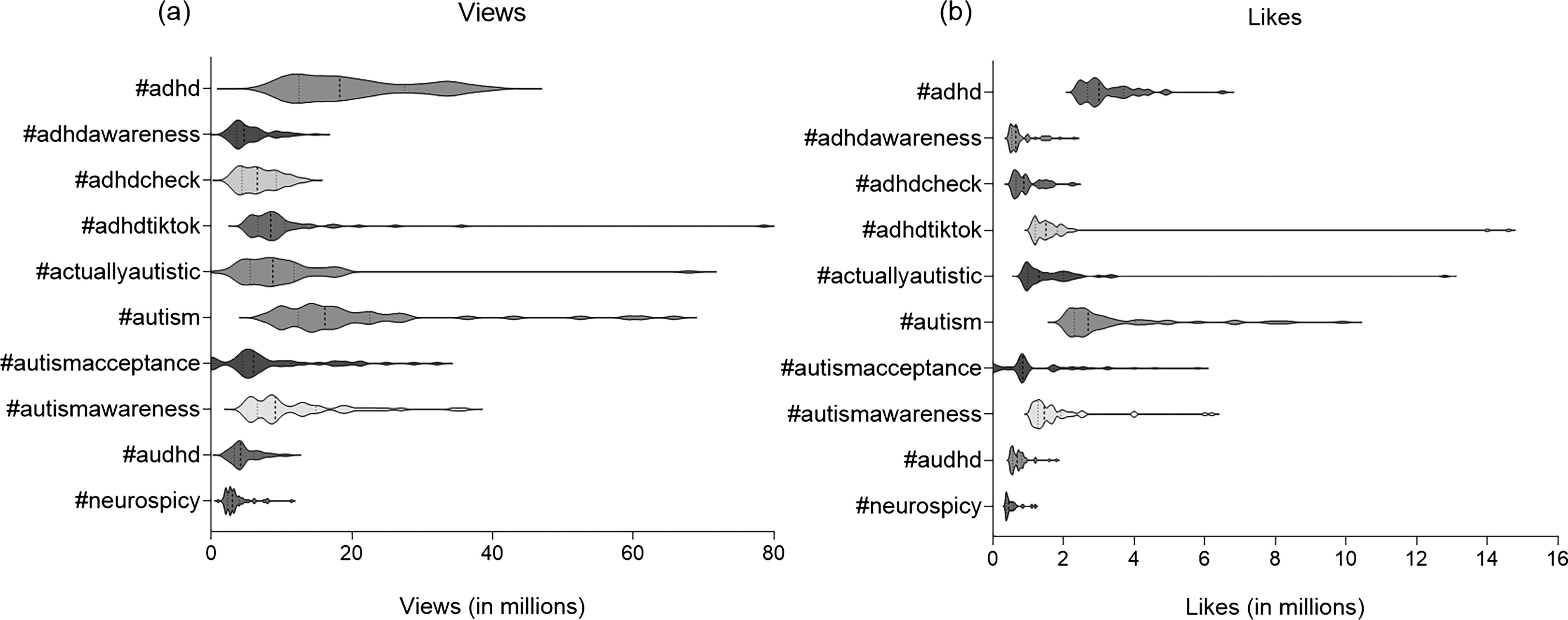
Number of
Content analysis
Social media features
TikTok-specific features were rarely observed (duets, green screen, stitches, reply boxes; <3% of videos). Disclaimers (trigger warnings) were also used infrequently (n = 6, 1.2%). Products were mentioned in some videos (n = 29, 5.8%), but almost none were sponsored content. About one-fifth (n = 103, 20.6%) featured skit-style content, where creators played multiple versions of themselves or others. This format was much more commonly seen with ADHD hashtags (χ2 [2, N = 500] = 26.21, p < 0.001).
Characteristics of individuals in videos
Most videos featured people (n = 453, 90.6%), with the majority including only one person (n = 335, 74.0%); 79 videos (n = 17.4%) included children, a third of whom were young children (n = 27, 34.2%). Videos with autism hashtags were more likely to have children present (n = 62) compared with those with ADHD hashtags (n = 16; χ2 [1, N = 359] = 29.38, p < 0.001).
Most videos shared creators’ lived experience (n = 412, 82.4%), either explicitly stated (n = 219, 53.3%) or inferred from creator bios or context (n = 192, 46.7%). Lived experience perspectives were not more engaged with, relative to videos without lived experience (all p-values >0.05). Additional perspectives included parents (n = 62, 12.4%), partners (n = 29, 5.8%), or other family members, mostly siblings (n = 26, 5.2%). Parental and sibling perspectives were more common in videos using autism hashtags (p’s < 0.001). Fewer videos included professional or expert perspectives (n = 33, 6.6%), coworkers (n = 5, 1%), or others (n = 31, 6.2%; e.g., strangers, actors at amusement parks, hairdressers). Professional perspectives, often self-described or unspecified experts (e.g., lifestyle mentor), were more frequently observed in ADHD-related videos (χ2 [2, N = 500] = 10.42, p = 0.005).
Types of content shared
Half of the videos had a humorous or satirical intent (n = 251, 50.2%), often using self-deprecation or sharing humorous experiences. Videos coded with potential humorous intent were more likely in ADHD (58.5%) or neurodivergence (63.0%) hashtags, compared with autism (35.5%) hashtags (χ2 [2, N = 500] = 29.35, p < 0.001). These videos were also more likely to be shared (F[1, 498] = 15.28, p < 0.001) and commented on (F[1, 498] = 9.59, p = 0.002), but not more liked or viewed (p’s > 0.05).
Few videos referred to diagnosis (n = 16, 3.2%) or gender-specific differences or traits (n = 13, 2.6%). Specific conditions or diagnoses in videos or captions, hashtags, or creator bios included ADHD (n = 275, 55.0%), autism (autism, autism spectrum disorder, autistic; n = 263, 52.6%), “AuDHD” (referring to autism and ADHD; n = 76, 15.2%), anxiety (n = 17, 3.4%), trauma (including trauma, [complex] post-traumatic stress disorder, dissociation; n = 12, 2.4%), language difficulties (n = 9, 1.8%), physical health conditions (e.g., chronic pain; n = 9, 1.8%), borderline personality disorder (n = 6, 1.2%), and sensory processing difficulties (n = 15, 3.0%). Other conditions mentioned infrequently included depression, Tourette’s syndrome, pathological demand avoidance, and avoidant restrictive food intake disorder.
Some videos contained advice (n = 38, 7.6%), with two-thirds describing coping strategies, meeting sensory needs, or accommodations (n = 23). Traits of autism or ADHD were described in a few videos, to explicitly promote understanding and acceptance (n = 8), with a few discussing ADHD supports (n = 2) or diagnostic signs (n = 5).
A small proportion of videos (n = 18, 3.6%) exclusively focused on memes, pop culture references, or Autonomous Sensory Meridian Response content (i.e., a pleasurable tingling or relaxing sensation induced by specific auditory stimuli, e.g., whispering voices or tapping sounds).
Thematic analysis
Four themes were developed that emphasize the diversity across neurodivergent experiences depicted in videos, including varied lived experiences, sensory differences, the importance of family and relationships, and portrayals of neurodivergence.
Theme 1: Lived neurodivergent experiences
This theme highlights common experiences shared within the neurodivergent community. It emphasizes the importance to neurodivergent people of connection, advocating for increased awareness and understanding, and addressing the challenges and misunderstandings faced. The theme also touches on the impact of diagnosis/es and the ongoing process of learning about oneself.
Invisible or hidden presentations
Creators shared experiences and challenges of masking—consciously or unconsciously hiding behaviors, feelings, or sensory perceptions—and addressed misconceptions about ADHD or autism, including traits that viewers might not typically associate with neurodivergence.
Autistic creators often highlighted the invisible nature of autism, with one stating, “I am so good at masking, no one would ever realize I was autistic if I didn’t say anything” (actuallyautistic_V29). Similarly, creators described how ADHD traits can be overlooked or minimized due to preconceived notions, with one explaining: “People say ‘You don’t have ADHD, I would have seen the signs,’” with subsequent clips illustrating “signs” others did not observe or recognize, including “watching the same shows over and over,” “loves to try new things,” “messy,” “very self aware,” and “easily distracted” (adhdcheck_V30).
Some ADHD-related videos listed experiences tied to diagnostic criteria, with the perceived intent of educating or raising awareness about unknown traits associated with ADHD. One creator visually demonstrated “ALL 14 Official ADHD Behaviours You Need for a Diagnosis,” including “1. Trouble sitting still,” “2. Quickly distracted by different, stimulating things,” “7. Often knowing the answer to a question before someone finishes asking it,” “8. Trouble fulfilling tasks,” “11. Often loosing things” [sic]. The caption for this video included a call to action that “if you have over 8, u might want to look to get officially diagnosed” (adhdawareness_V35).
Community support and accommodations
Creators shared instances of kindness, understanding, and accommodations. One video depicted a sister thanking a stranger for their compassion toward her autistic brother, saying, “I just wanted to give you a hug because not a lot of people understand my brother and stuff … but like you did” (autism_v13). In another, an inclusive barber made simple accommodations to meet the sensory needs of an autistic boy who “doesn’t like loud noises or hair to touch him … instead of getting frustrated … she turned it into a game, look at that smile” (autismacceptance_V13). Positive experiences with strangers were frequently highlighted, such as a touching interaction between a nonverbal autistic young man and a costumed person at an amusement park. The character engaged with him warmly, allowing the young person to explore his face with his fingers and offering a photo together, creating a moment of genuine connection (autismacceptance_V39).
Celebrating strengths
The remarkable skills and strengths of neurodivergent people were often celebrated. One video featured an autistic savant who could rapidly calculate the day of the week for historical dates (autism_V38). Another video featured an autistic person who could emotively “sing in front of a crowd but not talk to one stranger” (autism_V32). Other videos shared individuals’ interests, such as “hyper focus on his special interest (photography) … autism give him the attention to detail … autism has everything to do with these photos” (autismacceptance_V30) or recalling facts about a favorite fictional character (autismacceptance_V49). Some creators also reflected on how strengths in hyper-focus, attention to detail, and motivation for novelty could have beneficial effects in some contexts: “[person 1] wow did you clean your room? [person 2] uh yeah, I couldn’t bring my new Lego set into a dirty room…[person 1] are you studying right now? [person 2] yeah, I got really motivated after I bought this new pencil.” (adhdtiktok_V07).
Many videos sharing and celebrating strengths were from the perspective of loved ones: “he sometimes draws the most random things…he amazes me!!” (autism_V28). Other videos explicitly referenced neurodivergent people having significant strengths, despite challenges in other domains: “[caption]: I asked him how can he sing in front of a crowd but not talk to one stranger… he said ‘I’m not myself on stage I’m acting as someone else and I can be anyone up there.’” (autism_V32). Other creators affectionately shared their loved one’s humor, such as a mother illustrating their autistic child’s blunt and observational style of humor: “the time we were all discussing who the greatest villains in literary history were and my seven-year-old went ‘he he he, God.’” (neurospicy_V05).
Navigating challenges
Communication challenges or unintended interactions in social contexts were commonly shared, with many creators employing humor to depict these. For example, a couple account shared: “Partner 1: Hey babe I’m gonna have some cookies. [no response from partner]. Voiceover: *Oh I guess she doesn’t want cookies, I—wait a second—the hell kind of neurotypical communication was that??* Partner 1: Hey babe I’m gonna have some cookies, you want any? Partner 2: Oh yes please.” (audhd_V22). One creator shared their realization about eye contact: “[text]: me when I discovered that eye contact literally doesn’t mean staring into the retina of people’s eyes, it just means generally looking at someone’s face (I’m autistic and took it literally)” (audhd_V01). In another video, an autistic creator described how literally interpreting autism screening questionnaires “clearly made by allistics” could lead to not answering items as they were intended (neurospicy_V49).
Use of memes and pop-culture references dominated, sharing challenges in humorous, but often self-deprecating, ways: “[text]: My ADHD brain if I’m not immediately good at something: Video scene of a man and women from a TV show. Man walks through set and says: ‘Yeah right, f**k this’ and walks off screen.” (adhdcheck_V37). Other challenges were described neutrally or in ways that could elicit sympathy. For example, one creator described “ADHD paralysis,” to demonstrate how their challenges about being stuck in one task or activity could leave them paralyzed and not able to do anything else because “my brain physically won’t let me do anything,” which may be perceived as “lazy” by others (adhd_V10). Another creator visually illustrated how their house was full of incomplete projects or hobbies, with the caption: “Being called a “Jack of all trades” is more a hint at an invervention [sic] than a compliment at this point.” (adhdtiktok_V18).
Impact of co-occurring conditions
The increased likelihood, and impact of, co-occurring mental, medical, or health challenges were sometimes directly referred to or inferred through content or hashtag use. These included sleep difficulties (neurospicy_V47), anxiety (adhdcheck_V50), sensory processing conditions (adhdtiktok_V02), communication differences (actuallyautistic_V17), motor coordination (adhdtiktok_V36), tic disorders (adhd_V04), and gastrointestinal difficulties (neurospicy_V02).
Sleep challenges related to ADHD included difficulties with sleep initiation due to mental hyperactivity, sensory sensitivities, or “because my ADHD medication wears off by then” (adhd_V22), and difficulty in waking up due to fatigue and task initiation difficulties (adhd_V42). One creator also demonstrated a range of “spicy neurodivergent sleep habits” including “wrist protecting neck + uncomfortably curled up” and “cold. side. of. blankie.” (actuallyautistic_V19).
Other creators highlighted co-occurring mental health challenges. Creators with ADHD depicted disordered eating habits such as “binge eating without realizing what you’re doing…” and impulse control problems such as “impulsively buying things you don’t need” (adhd_V42). One creator also described the impact of intergenerational trauma (actuallyautistic_V2).
While challenges were often conveyed humorously, feelings of empathy and concern were also elicited. For one creator, sharing their lived experience of Tourette’s syndrome and ADHD elicited both humor and empathy, with the creator displaying potential embarrassment of his noticeable physical tics: Video depicts creator doing a handstand and dunking their head in the bucket of soapy water while washing their car outside. Creator: “I’ve just spotted the neighbor stood in his drive looking right at me lol….Sh&t” (adhd_V04).
Theme 2: Sensory differences and experiences
This theme focuses on sensory-related experiences, including acknowledging sensory differences and sensitivities, accepting stimming, the challenges of managing sensory differences, and sharing strategies for support.
Creators provided diverse insights into their own sensory-related experiences. Some centered on the challenges associated with sensory sensitivities, illustrating how certain situations can be overstimulating and/or unpleasant. For instance, one creator described their relief when they “finally get to turn off the extractor fan (cooking) that had been insanely overstimulating me for the last 20 minutes” (audhd_V27). Sensitivity to sensory input was depicted, including being able to “tell when one shoelace is tighter than the other” and hearing “the buzzing of electricity” (adhdawareness_V13). Another described their sensory sensitivities as “The 6 Sensory Sins,” including: “twisted socks, unexpected food textures, touching wet food, hearing someone chew/slurp, touching something sticky, [and] loud/competing/chaotic noise.” (adhdcheck_V03).
Stimming (i.e., repetitive self-stimulatory behaviors) was explicitly mentioned by creators, including demonstrations of these: “7yo me…not knowing I was stimming” (adhdtiktok_V10). Others shared experiences of their stims: “things I didn’t know where autistic stims until I started to learn that I was autistic…*people with ADHD can have these to[o]—I have both,” visually illustrating “rubbing my feet in bed” and “twirling hair in circles” (actuallyautistic_V41). Other creators were observed stimming when expressing their emotions, such as in excitement or joy during an unboxing video: “I think it’s another insect … Oh my gosh I’m so excited” (autismawareness_V51). Another creator was observed spinning their rings as a tactile and visual stim when describing anxiously waiting for a package to arrive (adhd_V10). Some creators referred to the calming, satisfying, or beneficial effect that certain sounds can have for neurodivergent people (auditory stims), such as the rippling sound made by flicking a plastic garden plant rod (adhd_V51) or “white noise” (adhd_V50).
A sense of community support was evident, with creators sharing advice and positive experiences with items or strategies to meet sensory needs. One creator (audhd_V45) demonstrated stim tools they had found useful in response to a request for advice. Other videos showcased how items could be utilized; one creator demonstrated how sensory swings can be “used in all types of therapies and aren’t just for autistic people” (autism_V18), and in another video the same creator showcased the use of a body sensory sock to help them process a change in their environment: “It’s surprisingly helpful and it makes me laugh so that’s great” (autism_V35). Autistic creators also talked about their shared sensory stims with their friends as a way of bonding: “I love these things (sensory item). I used to just stare at them forever when I was a kid and she (autistic friend) was like, yeah same” (actuallyautistic_V42). Creators also shared strategies to help manage sensory overload or executive functioning difficulties. For example, the use of “body doubling” or “having their friend come over and sit while they clean” to “enhance executive functioning of tedious and sensory overload tasks such as cleaning or organizing” (adhdcheck_V20).
Theme 3: Family and relationships
This theme revolves around the role of family and relationships in the lives of neurodivergent individuals, including the importance of family support, and the challenges within neurodivergent relationships. The theme also emphasizes the active participation of individuals in family dynamics.
Supportive and loving relationships
Some videos showcased loving and supportive partners, as exemplified by a “sweet husband offering solutions” (audhd_V11) during a meltdown. In another heartfelt video, an autistic individual depicted their partner as their “whole world” (actuallyautistic_V16), highlighting their relationship’s depth of emotional connection. Another autistic creator shared insights into intimate relationships, dispelling misconceptions and emphasizing that “Autistic people have human urges like the rest of you!” (actuallyautistic_V25), in reference to sexuality and consent.
Parents of autistic children also shed light on the complexities of parenting. Some videos conveyed challenges, illustrated by a parent trying to support their child to sleep in their own bed: “it’s time for you to go to bed. Goodnight. You can’t stay in the bed with Mommy tonight” (autism_v14). Other parents shared insights into their everyday lives, offering a holistic view of the parenting journey; for example, one creator shared how her child’s stepfather provided an invaluable source of support for her autistic child (autism_V06).
Loving family relationships were also prominent. In one instance, a sibling duo used dance videos to convey their fun dynamic (autismawareness_V05). The same account showcased their family’s everyday experiences, such as joy in opening Christmas presents, while in other videos shared the creator’s personality: “[creator] woke up today and chose sass” (autismawareness_V34). Love, patience, and understanding were also prominently displayed by creators with a neurodivergent sibling: “[caption]: My Autistic Brother ALWAYS tries to steal my food” (autismawareness_V18) and “things in my autistic brother’s room that just make sense…thanks for coming on this tour please do not move anything” (autismawareness_V23).
Challenges and misunderstandings
Challenges with how family members understand and accept neurodivergence were frequently shared. One account used a movie scene meme to illustrate disclosing their ADHD diagnosis to their family, with the overlaid text “‘My family after the psychologist diagnoses me with ADHD’: Family: You actually were telling the truth. Me (Captain Jack Sparrow): I do that quite a lot, yet people are always surprised.” (adhdawareness_V36).
Creators also reflected on being misunderstood in social and professional relationships. For example, one shared workplace difficulties, depicting a coworker reacting with annoyance as the creator shared their unrelated thoughts during a meeting (adhdawareness_V14), captioning: “Things people with ADHD have a hard time explaining.” Use of humor was also used to illustrate challenges in the workplace using memes: “text: ADHD people messing up at work” *Person 1 presses a few buttons and asks: ‘how many missiles did I actually launch one or 10?’ Person 2: You launched 50. Person 1: I launched 50?!” (adhdcheck_V39).
Theme 4: Portrayals of neurodivergence
This theme explores how neurodivergent individuals are portrayed, by themselves or others, emphasizing a need for accurate and diverse representations and how such content can play a crucial role in understanding and acceptance.
Some videos explicitly discussed negative representations of neurodivergent individuals. One creator pointed out how poorly autism is portrayed in films and television shows, equating it to a crime in terms of representation quality: “if being bad Autism representation was a crime *a set of jail bars sliding down to indicate that these autism representations (The Good Doctor, Atypical, Music, What’s Eating Gilbert Grape?, Molly, The Boy Who Could Fly) were a crime*” (actuallyautistic_V39). Based on these specific references, the creator implies that the crime is the use of neurotypical individuals to portray neurodivergent characters.
Other videos depicted neurodivergence in problematic ways for the purposes of humor, using neurodivergent traits as a punchline for comedic effect. A stand-up comedian’s routine discussed a nonverbal autistic child’s savant skills with numbers in a disrespectful manner for humorous intent: “F**k, yeah. That dude about to rob a casino … You’re gonna be a very rich Mom someday (audience laughs)” (autism_V01). Another stand-up comedian, who has a stutter, described an interaction with his wife, who has ADHD, where his difficulty initiating a word resulted in a melodic beat, with the punchline: “…yeah, we should start a band and not finish it.” (adhd_V34).
Behaviors ascribed to ADHD or autism diagnoses were often explicitly described in videos. Videos listing behaviors or traits were most apparent in videos related to ADHD; for example, one creator listed a range of traits they ascribed to signs of ADHD, including “loves trying new things … self-aware … being a] people pleaser” (adhdcheck_V30). One self-described health care professional listed a range of ADHD traits in women, including “lower self esteem … likely to be daydreamers … deal with odd eating habits or binge eating … have a serious case of imposter syndrome.” (adhdcheck_V50). Such videos tended not to align with current diagnostic criteria, may convey inaccurate messages about diagnoses, pathologize individual differences or experiences, and exacerbate stereotypes.
Discussion
Individuals and communities use social media platforms such as TikTok to share experiences, connect, and influence societal discourse on neurodiversity. This study illustrated the richness and diversity of these portrayals, blending humor, introspection, and self-awareness, to depict personal narratives that encompass challenges and strengths of neurodivergence. The findings reveal how social media can amplify marginalized voices, fostering belonging and collective identity within the neurodivergent community. However, social media’s powerful influence on public understanding about neurodiversity calls for a critical examination of the impact of this content in shaping narratives and discourse on neurodivergence.
About half of the videos analyzed had a perceived humorous intent, many using self-deprecating humor to share challenges, strengths, and sharing of resources, particularly for sensory sensitivities. Young people increasingly use social media as a primary source of news and information, with TikTok frequently used by young people to engage with mental health help-seeking behaviors and explore identity. 25 As illustrated in our findings, neurodivergent content on TikTok can foster positive communities and shared experiences and highlight areas of challenge to find support or resources that may not be as easily accessible in other online forums. However, while humor can connect and destigmatize, some content observed in this study risks perpetuating stereotypes when traits are oversimplified or exaggerated for comedic effect.
Previous studies of ADHD and autism content on TikTok have reported that many videos using similar hashtags contained inaccurate or misleading health content.15,16,19,20 By contrast, we observed very little content related to claims regarding treatment, medication use, or inaccurate content. We did observe a set of videos, predominantly using ADHD hashtags, which listed behaviors, traits, or characteristics attributed to an ADHD diagnosis. While we did not intend to investigate the potential accuracy of any claims or perspectives in videos, many listed characteristics or experiences may be inconsistent with current diagnostic criteria. These kinds of videos, some of which encouraged seeking out a diagnosis (e.g., “ALL 14 Official ADHD Behaviours You Need for a Diagnosis”), in the absence of any evidence-based information, have the potential to cause confusion or distress in users, particularly children or adolescents. The potential for social media content to facilitate self-diagnosis and seek out diagnostic services has been raised as a concern for some, increasing diagnostic wait times and service costs. 8 Others have speculated that diagnoses sought through engaging with TikTok content may be attributable to the Barnum effect, 26 where more generalized statements about behavior or traits are given more personal meaning about oneself. Although engaging with diagnostic content on social media could facilitate self-discovery and validation of one’s internal experiences, unknowns about a creator’s credibility and accuracy of information remain an ongoing concern. Improving digital literacy, particularly for young people, 27 is crucial for safely navigating social media and addressing misinformation.
The present study uniquely highlighted the high proportion of videos discussing or referring to the co-occurrence of autism and ADHD (“AuDHD”). Prior research estimates the prevalence of ADHD in autistic individuals as high as 38.5%, 28 with higher rates in autistic individuals without co-occurring intellectual disability. 29 In children, co-occurring ADHD and autism are associated with elevated mental health difficulties 30 and greater use of psychotropic medication. 30 In the present study, we observed that many videos retrieved under autism or ADHD hashtags also included #audhd or mentioned it in creator bios. The growing recognition of the co-occurrence of ADHD and autism underscores an urgent need for further research on how to recognize, identify, and support multiply neurodivergent individuals.
A noted strength for the present study was the collaborative design of the research and team. The research questions, methods, data collection, analysis and interpretation were all conducted collaboratively by a research team intentionally comprised of various experience levels (student, research staff, early career researchers), intersectional perspectives (lived, clinician, researcher), and geographic locations. The reflexive thematic analysis was also conducted collaboratively and iteratively across four authors and multiple coding meetings, designed to reflect on our respective perspectives in shaping how we weighed and interpreted video content. This study is also the first to consider multiple hashtags, as well as the intersection of autism and ADHD, in exploring neurodivergence portrayals on TikTok from multiple perspectives and from those who identify as multiply neurodivergent.
As the present study was an observational study of publicly available TikTok content, our conclusions have noted limitations. First, social media platforms evolve iteratively and dynamically based on user engagement and changes in technology. Across the period of data collection and coding (2023–2024), we noted that features initially available on TikTok and TikTok’s policies around using videos for research purposes changed after we completed feature extraction and analysis. While analyzing social media can yield significant and interesting insights into understanding social phenomena or behaviors, our observations are inherently locked to the transient nature of the platform and the time in which the study was conducted. Therefore, the findings we report here and our subsequent interpretations may not be reproducible. Second, we selected videos based on ranking in searches of each hashtag, which ranked videos by view count at the time of conducting searches. View count is not necessarily a good indicator of whether content is engaging or liked by users, nor the type of content shared, as social media videos can have high view counts but not necessarily correspondingly high likes. For example, we observed that videos coded with humorous intent had more comments and shares but were not liked or viewed more often. Further research could explore the nuanced content contained in videos within each of these hashtags and any associations with engagement metrics to understand whether certain types of hashtags yield more positive or neuroaffirming content and the impact of this on user engagement metrics. Third, some countries have sought to impose limits on TikTok use; for example, in December 2024, the Australian government passed legislation to ban all social media use in children, while in January 2025, there was a brief ban on TikTok use in the United States. The changing role of governments in influencing how social media is used will likely impact how content is produced or shared on TikTok in the future. Fourth, we did not assess the quality or accuracy of videos, as this was not a prespecified aim for this study. Although previous studies have sought to explore the quality of information related to autism, 18 ADHD, 19 and health-related information 31 on TikTok, current tools available for assessing social media content quality are not ideally suited for TikTok content, 31 which encompasses unique features not represented on other platforms, and is designed for sharing of shorter and memetic content. While we did observe some content that potentially could be classified as inaccurate, as we did not seek to interrogate this, we do not make any claims regarding the accuracy or veracity of content; instead our intended purpose was to explore what content was being shared and highly engaged with and explore the perspectives and experiences of creators sharing autism and ADHD-related content and how this shapes narratives on neurodivergence. Lastly, although our qualitative analyses were robust and afforded a rigorous exploration of the included videos, our findings may not be generalizable to the broad range of neurodiversity-related TikTok content and neurodivergent experiences. While our hashtags focused on autism and ADHD-related content, other kinds of neurodivergence were not captured within this analysis. Furthermore, the ability to access and produce social media content inherently requires minimum cognitive and executive functioning abilities, which limits the perspectives of those with higher support needs or with co-occurring conditions that significantly impact functioning and participation (e.g., those with co-occurring intellectual disabilities, epilepsy and seizure disorders, or with physical disabilities). Although we did observe content within our video set that depicted the perspectives of individuals with minimal or no spoken language and creators with co-occurring conditions (e.g., Tourette’s syndrome), these were less frequently observed. While our analyses suggest that sharing content on TikTok may have an important role in amplifying the voices of marginalized groups, such as the neurodivergent community, communities experiencing additional challenges limiting their participation in social media platforms risk being further excluded from these online spaces and contributing to users’ understanding of the broader spectrum of neurodiversity and neurodivergence.
In conclusion, our study of ADHD and autism-related content on TikTok revealed that highly engaged content primarily reflected experiences and perspectives of neurodivergence, highlighting shared challenges and fostering community amongst creators and users. Future research should focus on content authenticity, how users engage with and interpret videos, creators’ motivations, and social media’s potential for positive impact. Digital narratives reflect and shape societal perceptions; this research helps deepen our understanding of how society accepts and celebrates neurodiversity.
Footnotes
Acknowledgments
The authors acknowledge the collaborative research team for their work in developing the methodology described in the present study (Karen Lombardi, Joelie Mandzufas, Gina Trapp, Shelley Gorman, Gail Alvares, Jetro Ang, Mary Brushe, Melinda Edmunds, Tess Fletcher, Melissa Licari, Helen Monks, Emily Munro, Jacinta Saldaris, Francesca Sanna, Alanna Sincovich, Daniel Ta, Hannah Thomas, Gabriella Wells, Nicole Wickens, Alix Woolard). The authors also acknowledge Nicole Wickens’ contributions in refining and testing the codebook for this project.
Authorship Confirmation Statement
Conceptualization: G.A.A., C.E., M.L., L.M., C.M., E.M., R.P., L.S., D.T., and A.W. Methodology: G.A.A., C.E., M.L., C.M., E.M., L.S., and A.W. Software: E.M. Formal analysis: G.A.A., C.E., C.M., E.M., L.S., and A.W. Investigation: G.A.A., C.E., M.L., C.M., E.M., L.S., and A.W. Data curation: G.A.A. and E.M. Writing—original draft: G.A.A., C.E., C.M., E.M., L.S., and A.W. Writing—review and editing: G.A.A., C.E., M.L., L.M., C.M., E.M., R.P., L.S., D.T., and A.W. Visualization: G.A.A. and C.E. Project administration: G.A.A. and E.M., Funding acquisition: G.A.A., M.L., and A.W. The article has been submitted solely to Autism in Adulthood.
Author Disclosure Statement
The authors declare no relevant conflicts of interest for this study.
Funding Information
Funding for this study was provided by an internal collaboration grant awarded by The Kids Research Institute Australia to a wider research team, including authors G.A.A., M.L., and A.W.

References
Supplementary Material
Please find the following supplemental material available below.
For Open Access articles published under a Creative Commons License, all supplemental material carries the same license as the article it is associated with.
For non-Open Access articles published, all supplemental material carries a non-exclusive license, and permission requests for re-use of supplemental material or any part of supplemental material shall be sent directly to the copyright owner as specified in the copyright notice associated with the article.
