Abstract

—Renay D. Tyler, MSN, ACNP, CNSN
Associate Editor
Participants:
Associate Editor
Bariatric Nursing and Surgical Patient Care
Executive Director
Sit and Be Fit
At a certain point, I had the opportunity to design a program for seniors at a community college, and one thing led to another. I became a certified instructor through the American College on Exercise and started to take part in continuing education courses. Interestingly, the people joining my classes seemed to be getting older and older, and I realized I could help them in ways that other exercise classes couldn't. My classes taught ways to become functionally fit, and I was really zeroing in on that aspect of exercise.
I began to see people leaving class refreshed, relaxed, and with remarkable outcomes, like being able to use their arthritic hands to write. It was a great beginning but I knew I could help so many more people if the program were televised.
So, I went to all the television stations in my area. They all thought it was a great idea, but there was only one network, PBS, that actually shared my vision. I wanted to come into people's homes and not just be a friend to them, but show them how they could make their lives better, how movement was going to really help them feel better.
During our first year on public television, the program went national. The testimonials we received were unbelievable, and it was the primary reason I began to renew the program year after year.
Each year, to keep the program fresh, I consult with a number of physical therapists, doctors, and exercise physiologists. I attend conferences and participate in continuing education programs to learn what is new and how I can use the information to make my message clearer. The program has evolved, and I still love doing it. I love seeing the improvement in people's health. I know that if we can send a clear message that the movements we are asking them to do are easy, simple, and so important, it will encourage more people to do them. I like them to feel they have a friend and encourage them in a fun way. I do everything to music on my program, and that seems to make the time go quickly; people have fun, and they feel good. The proof is in the pudding, you know.
I just recently had a friend who passed away. She was ready to go home from the hospital, and she had a pulmonary embolism before she could even get out the door. So, patients need to realize that the first month after discharge is still a critical period. They need to be aware of the importance of movement, stretching, and staying well hydrated throughout that time.
It's also important to know that certain individuals may be at increased risk for developing DVT; however, it can occur in almost anyone. When someone has three or more risk factors, it should serve as a warning that the person could develop a DVT. Obesity and restricted mobility are two DVT risk factors.
I believe that sometimes adherence is hindered by a patient's misunderstanding of what can happen if you do develop a DVT. In other words, what is a pulmonary embolus? What is the incidence of death related to a pulmonary embolus, and what is the treatment?
Approximately 600,000 Americans are hospitalized each year for DVT and its primary complication, PE. Approximately 300,000 die from PE, the majority of which result from DVT.
DVT is truly a public health crisis, and movement is just one way to prevent the condition. There are other things people can do to help reduce the risk for developing a DVT, such as avoiding smoking and staying hydrated. The hope is that healthcare providers address some of these preventative measures beforehand so complications following a surgery can be prevented.
Also, shortly after the coalition was formed, in 2003, Melanie Bloom suffered a tragic event when her husband, former NBC correspondent David Bloom, died from a pulmonary embolus while traveling with a military convoy in Iraq. The following year, in 2004, Melanie came on board as the National Patient Spokesperson for the coalition and has worked to create an awareness of DVT risk and prevention.
As mentioned earlier, this year the coalition is adding a special piece, DVT Awareness in Motion. The program will include simple movements that may help reduce the risk of DVT by improving blood circulation with exercises that can be done anywhere, anytime—standing, sitting, or lying down. For example, if you are hospitalized you can help reduce your risk by turning over in bed frequently, wiggling your toes, lifting your legs, among other simple exercises. An educational video will be available in the spring on our website, www.preventDVT.org, that features some of these movements.
We are also encouraging people to take an online DVT risk assessment and learn as much as possible about their personal risk factors. We want to encourage everyone to talk to their doctor about DVT, especially if they are going to have surgery.
The coalition wants to make sure everyone is aware of the different environments where a DVT can occur. In addition to the hospital, there are other places, such as an office setting where people are spending long periods of time at their computers and are unknowingly at risk. There are many things office workers can do to help themselves. For example, while engaged in a phone conversation they can wiggle their toes and do some ankle circles. It would be a good idea to get up every hour, walk around the office, and do a few stretches before sitting back down.
Another critical setting to keep in mind is when you are traveling by car, bus, train, or plane; it does not really matter the type of vehicle. The issue is that you are seated for a long period of time. Just standing up and sitting down will be a big help, but there are so many exercises that you can do right there without disturbing the person sitting next to you. For example, simply sitting up tall and taking several deep belly breaths will improve circulation. Rocking the toes forward and back is another easy way to get the blood pumping.
It is also important to remember there are risks of developing a DVT in assisted living settings and in retirement homes. There are many programs for patients or residents, yet many are seated activities—playing cards, doing puzzles, or playing some other type of game. It is important to remember to incorporate movement into these sedentary activities. It could be as simple as taking time before breakfast, lunch, or dinner to stand up and sit down five times. Stretching your legs under the table or pumping your toes are good exercises to incorporate anytime, anywhere. Stretching alone is going to relax the muscles and improve circulation. The coalition has many different ideas to share about how to get people moving. I am just excited to be included in this wonderful venture.
Doing onsite in-services, displaying posters, wearing the DVT pins—I think these things go a long way to knowing that people are supporting the mission. If we can help prevent the tragedy that happened to David Bloom and his family, we have done a great thing.
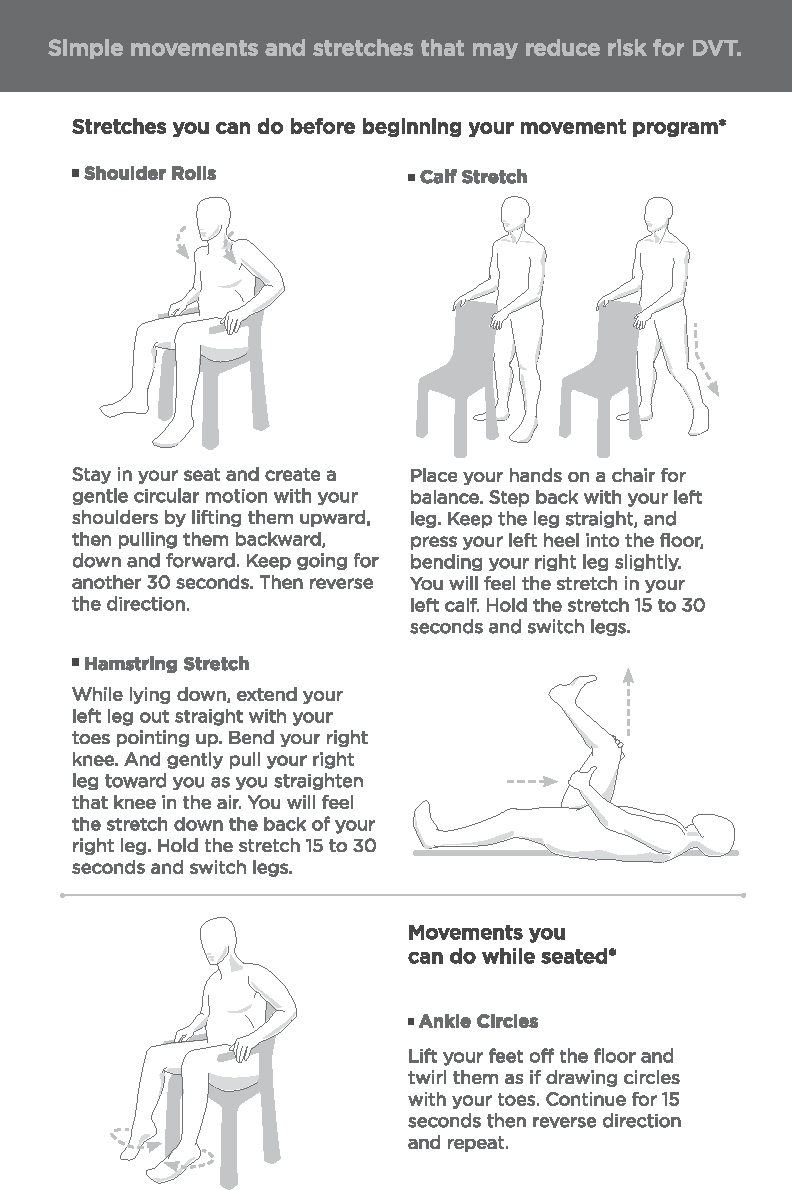
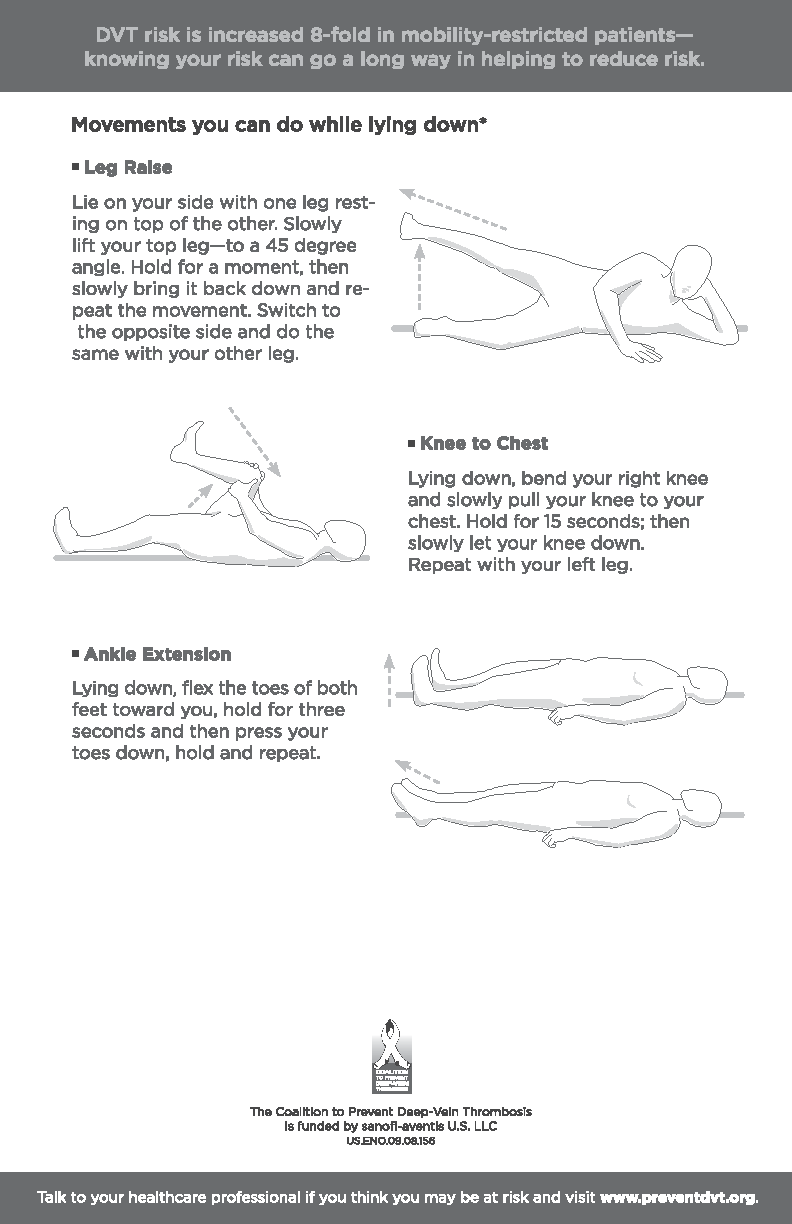
Sample exercises to help reduce the risk of deep-vein thrombosis.