




Abstract
Abstract
This article describes how a college of nursing created a realistic bariatric patient scenario for student evaluation. The decision to develop this scenario, in which the patient develops progressive dyspnea, came out of discussions with leadership from the nearby tertiary care hospital. Recognizing and responding to respiratory emergencies in the morbidly obese patient can prove challenging for nurses at all levels of expertise, but especially for new graduate nurses. This scenario provides graduating senior nursing students with the opportunity to develop critical thinking skills around care of this patient population.
Introduction
This was a scenario developed at East Carolina University College of Nursing (ECU CON) for graduating senior evaluative simulations. The objective for this scenario was to have the student experience a clinical situation as it could take place in the real world. With that in mind, the goal was for the simulation to be as realistic as possible.
The purpose of this article is to describe how ECU CON designed a scenario for and “built” a bariatric patient using one of our high-fidelity human patient simulators. Ideas for the scenario came from discussions with the nearby tertiary care hospital, which commonly performs gastric bypass surgery and other types of bariatric patient care. Many nurses, particularly new nurses, are not knowledgeable about caring for the bariatric patient population. The creation of this scenario began with an extensive literature review.
According to the Webster's New College Dictionary, 1 bariatrics is defined as “the branch of medicine concerned with the treatment of obesity.” According to the Centers for Disease Control and Prevention (CDC), obesity has become a major health concern in today's society. 2 In the hospital setting, obesity is managed not just in areas where gastric bypass or banding surgeries are done, but also on the general medical-surgical and intensive care units. Nurses must also manage typical comorbid conditions of bariatric patients, including cardiovascular, respiratory, gastrointestinal, musculoskeletal, and dermatologic diseases. Even as students, nurses must be prepared to care for bariatric patients every day and must understand that a medical complication in a bariatric patient is not always addressed in the same way as it would be in another type of patient. For example, even the type of equipment customarily used to perform a nursing assessment may be different. Obtaining the correct assessment of a bariatric patient may mean using a larger size blood pressure cuff, a certain type of scale to weigh accurately, or a specific bed that enables the patient to be more comfortable and helps prevent skin problems. Not only will student nurses need to be familiar with the appropriate equipment, but they will also need to know correct patient positioning to facilitate optimal function of the bariatric patient's cardiovascular and respiratory system.
Bariatric patient simulator, “Elizabeth Hunt”

Scenario Planning
After completion of the necessary research, the “patient” diagnoses, past medical and social history, and home medications for the bariatric patient simulation had to be created. Comorbid conditions that typically affect the bariatric population were also reviewed and included to create realistic conditions for the “patient.” Decisions then had to be made about what was actually going to happen with the “patient” while she was in the “hospital,” how she would be affected, and how students were going to be able to recognize the signs and symptoms of any “complications” that might occur. The CON simulation laboratory team decided to create a bariatric “patient” with respiratory problems, since this had been identified as a real issue for bariatric patients at our nearby tertiary care hospital. However, other complications that the students learned about in didactic content and during clinical assignments also had to be tied in to make the “patient” realistic. The first draft of the patient scenario was not as complex as the course faculty wanted, so additional research was completed and revisions made. Finally, we settled on the scenario that begins this article.
Creating the Bariatric Patient
Since our “patient” needed to be created from a SimMan (Laerdal, Norway), a good deal of creativity was required to have the “patient” appear to be morbidly obese. The goal was to have the effect of increased body size during the assessment process, as would be the case if the student were assessing a bariatric patient in the hospital; lung, heart, and bowel sounds are fainter but still audible, due to the amount of body tissue. The Empathy Belly (Birthways, Inc.), commonly used for obstetrical teaching, was first considered to create the effect of increased body mass. However, it was very heavy and did not allow for the creation of normal or abnormal assessment findings. In addition, the “patient's” arms and chest needed to mimic the appearance of an obese person. A picture of a vest with a 20 lb. piece of “tissue” around the midsection that could be purchased from a vendor was identified. A seamstress (Carolyn's Alterations) was able to make a suit that was comparable to the vest to fit our SimMan. An opening in the back that could be closed with velcro allowed the suit to be slipped on the mannequin. Openings in the sleeves and abdomen made it possible to make it as big as we needed it to be for the simulation. We stuffed the suit with Poly-Pellets® to give it more weight and Poly-Fiber® to increase the appearance of weight and cellulite on some parts of the mannequin. The seamstress was able to come to the lab to actually see the “patient” and take the measurements needed to make the garment. She was also able to see exactly what it was going to be used for to help her understand the need for the garment and to determine exactly how it would be constructed.
“Patient” Sound Volume Modification
After the bariatric suit for SimMan was made, laboratory testing of the scenario ensured that everything worked properly. Some modifications were required, with the mannequin sound volume for the “patient” assessment findings to be made accurately by the students. Initially, we tried having the vocal, lung, and heart sounds at levels typically used for other scenarios; however, all of these sounds had to be adjusted to accommodate the bariatric suit. For every bariatric patient scenario we ran, the mannequin sound volume had to be at the maximum level for the student to be able to make an accurate assessment. A high-volume control for vocals with our bariatric “patient” still yielded only a muffled sound. This gave us a somewhat realistic volume for a bariatric patient. We had to rerecord some vocals that were difficult to distinguish. Since this “patient” was an agitated, frustrated woman who did not want to be in the hospital, the volume of the vocals had to be consistent with the patient's emotions. However, we also had to make sure the students were able to hear the “patient” when she spoke.
Programming of the Computer
Once the scenario was on paper, it was placed in the National League for Nursing (NLN) Simulation Scenario Design template (see Appendix, Simulation Design Template (Patient Information) and Simulation Specifics for Scenario Template). 3 Props and accessories were assembled, and scenario programming was begun to run the simulator. This was done with the help of the Instructional Technology (IT) at the CON. Physiologic trends within the simulation software were developed to show the patient's status declining (see Appendix, Scenario Progression Outline). The faculty had predetermined that, regardless of what action was made by the student nurse, the patient's condition would continue to deteriorate. Our simulation laboratories primarily use Laerdal products. In the SimMan software, “handlers” can be used as templates for processes or events that occur frequently, such as medication administration, nursing assessments, or skills such as handwashing. 4 The handler can be used at any time during the scenario just by clicking on the appropriate action performed. Handlers within the software were also used for the patient's vocalizations. Any student action or inaction can be documented within the simulation software and can cue a vocal response from the “patient.”
Expectations for Students
Before this scenario or others begin, students are referred to specific learning objectives to help them prepare for their evaluation (see Appendix, Simulation Learning Objectives). Designated class time is allotted for discussion of scenario goals. Students are encouraged to refer to materials, such as DVDs, provided in the Learning Resource Center; textbooks; and standardized testing materials when preparing for their senior evaluations. Students are also encouraged to refresh their skills by practicing in the labs. To familiarize the student with the simulation area, the faculty provides orientation and a practice scenario for small groups of three to four students at a time.
Bariatric “patient”
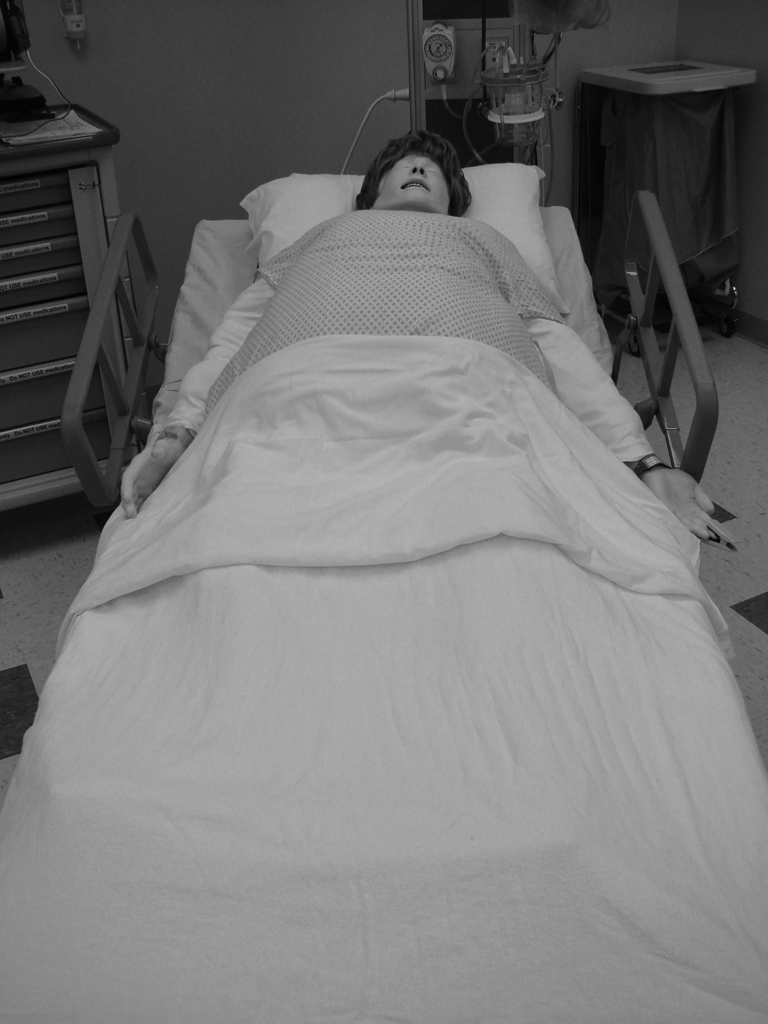
Bariatric “patient”
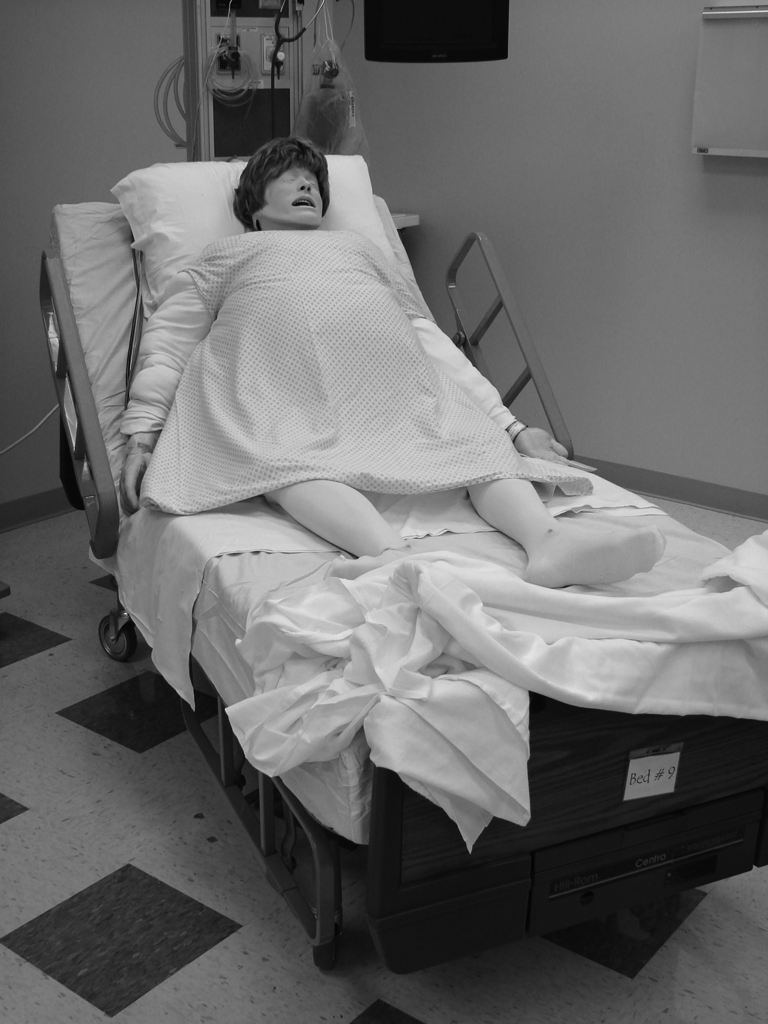
During the scenario, faculty members use an evaluation rubric, which includes patient assessment, history gathering, lab data and diagnostic studies collection, patient teaching, and communication. The students review the evaluation tool during class and are given the opportunity to ask questions.
Students are expected to begin the scenario with an initial health assessment as they would with a new patient coming to an inpatient unit from the Emergency Department (ED). The “patient” who has just arrived from the ED comes with the ED record, but no physician orders. The “patient” has a chest tube inserted to the right side that is connected to a drainage unit and low wall suction. The student nurse should notice, upon entering the room, that the patient is lying supine and that the chest tube is not hooked up to suction. If the chest tube problem is not noticed right away, a verbal cue will be given from the “patient.” As the “patient” is being assessed, the “patient's” oxygen saturations begin to decline. The student nurse should recognize the need to raise the head of the bed and place oxygen on the patient. A nasal cannula, non-rebreather face mask, and a bag-valve-mask (Ambu bag) device are readily available at the bedside. If the student chooses the nasal cannula, the oxygen saturations will increase slightly and then begin to fall again. With each step the student nurse takes to ensure the patient has enough oxygen, the oxygen saturations will rise and then fall, ultimately requiring the use of the Ambu bag and the need to call another person for help. The student must also call the physician for any orders and to provide updates on the condition of the patient. At the end of the scenario, the correct student action should be to place the patient in the reverse Trendelenburg position and to prepare for intubation.
Student Responses to the Scenario
After each scenario, the course faculty had a short debriefing with the student to answer questions and provide feedback (see Appendix, Debriefing/Guided Reflection Questions for This Simulation). The students were then sent to a proctored room outside of the simulation laboratory and given an assignment to document their “patient” care; during this time, the students also completed an electronic evaluation form of their experience in the simulation lab.
There were approximately 14 students who participated in this scenario during the Fall 2008 semester. Forty-two percent agreed that the environment of care was realistic. Fifty-seven percent agreed that they were able to identify the “patient's” problems and were able to incorporate theory into hands-on practice. Fifty percent agreed that the experience had enabled them to identify areas of practice in which they needed more practice. Forty-two percent agreed that the simulation was a valuable learning experience and that they were more confident to practice in an actual clinical environment.
Here are two student comments about the scenario:
This is a completely appropriate expectation. It is important that we feel challenged to perform these skills in a setting where right and wrong actions/interventions may be discussed. A couple of weeks before the scenarios, I brainstormed each potential scenario. Also, I asked my preceptor her opinion about the situations, and that was a great help! The staff was receptive to practice times, and this also contributed to my confidence. Keep doing the scenarios! I thoroughly enjoyed the scenario. It was indeed a fundamental learning opportunity for me. I was able to identify strengths and weaknesses with my clinical skills. Positive feedback was given, which will be implemented during my future nursing career. Thank you for the experience.
Although students generally dislike being observed in situations in which they may not perform perfectly, the scenario challenged the students and gave them a realistic view of being a registered nurse in a hospital setting where things can happen quickly and without warning.
This scenario was intended to help prepare the student for those types of situations. Our bariatric simulation scenario is, in no way, the perfect scenario. We will continue to improve it to facilitate student learning and optimal patient care.
Footnotes
Acknowledgments
We would like to thank Matt Wright (IT) for his help in the development of the technological portion of the simulation. We would also like to thank Carolyn Moore for the creation of the “bariatric suit.”
Disclosure Statement
No competing financial interests exist.
Appendix
Simulation Learning Objectives
| Safe, Effective Care Environment | ||
| Management of Care | ||
|
○ Advanced Directives |
Clients Rights | Collaboration |
|
○ Advocacy |
Confidentiality | Delegation |
|
○ Case Management |
Establishing Priorities |
Informed Consent |
|
○ Legal Rights and Responsibilities |
Performance Improvement | Referrals |
|
○ Staff Education |
Resource Management | Supervision |
| Safety and Infection Control | ||
|
○ Accident Prevention |
Disaster Planning | Error Prevention |
|
○ Emergency Response Plan |
Handling Hazardous and Infectious Materials | |
|
○ Injury Prevention |
||
|
○ Reporting of Incident Event |
Medical and Surgical Asepsis | Security Plan |
|
○ Standard/Transmission-Based Precautions |
Safe Use of Equipment |
Restraints |
| Health Promotion and Maintenance | ||
|
○ Aging Process |
Ante/Intra/Postpartum and Newborn Care | |
|
○ Developmental Stages |
||
|
○ Expected Body Image Changes |
Disease Prevention | Family Planning |
|
○ Health and Wellness |
Family Systems |
Growth and Develop |
|
○ High-Risk Behaviors |
Human Sexuality | Immunizations |
|
○ Lifestyle Choices |
Self-Care |
Physical Assessment |
| Psychosocial Integrity | ||
|
○ Abuse/Neglect |
Behavioral Interventions | Crisis Intervention |
|
○ Chemical Dependency |
Coping Mechanisms | Cultural Diversity |
|
○ End of Life |
Family Dynamics | Grief and Loss |
|
○ Mental Health Concepts |
Psychopathology | Stress Management |
|
○ Religious and Spiritual Influences |
Sensory/Perceptual Alterations | Support Systems |
|
Situational Role Changes |
Therapeutic Communications |
|
|
○ Therapeutic Environment |
Unexpected Body Image Changes | |
| Physiologic Integrity | ||
| Basic Care and Comfort | ||
|
○ Alternative and Complimentary Therapies |
Assistive Devices | |
| Rest and Sleep | ||
|
○ Elimination |
Mobility/Immobility | Personal Hygiene |
|
○ Nonpharmacologic Comfort |
Palliative/Comfort Care | |
|
○ Nutrition and Oral Hydration |
||
| Pharmacological and Parenteral Therapies | ||
|
○ Adverse Effects/Contraindications and Side Effects |
Dosage Calculation | |
|
○ Blood and Blood Products |
Central Venous Access Device |
Intravenous Therapy |
|
Expected Outcomes/Effects |
Medication Administration | Parenteral Fluids |
|
○ Pharmacologic Interactions |
Pharmacologic Pain Management | TPN |
| Reduction of Risk Potential | ||
|
○ Diagnostic Tests |
Laboratory Values |
Vital Signs |
|
○ Monitoring Conscious Sedation |
Potential for Alteration in Body Systems | |
|
○ Potential for Complications from Surgical Procedures and Health Alterations |
Therapeutic Procedures | |
|
○ System Specific Assessment |
||
| Physiologic Adaptation | ||
|
○ Alteration in Body Systems |
Infectious Diseases | Hemodynamics |
|
Illness Management |
Radiation Therapy |
Medical Emergencies |
|
Unexpected Response to Therapies |
Fluid and Electrolyte Imbalances |
Pathophysiology |
(Remember to identify important concepts or curricular threads that are specific to your program.)
1. What were your primary concerns in this scenario?
2. Did you miss anything in getting report on this patient?
3. Did you have sufficient knowledge and skills to manage this situation?
4. What were your primary nursing diagnoses in this scenario? What nursing interventions did you use, and what outcomes (NOC) did you measure? Where is your patient in terms of these outcomes now?
5. What did you do well in this scenario?
6. If you were able to do this again, what would you do differently?
Complexity—Simple to Complex
Suggestions for changing the complexity of this scenario to adapt to different levels of learners: