




Abstract
The number of surgical weight-loss procedures performed on adolescents with morbid obesity continues to increase. The adolescent presenting for surgical weight-loss services offers unique challenges for the healthcare team. A developmental approach is necessary to provide effective care and will assist the young person to integrate the lifestyle changes necessary for achieving and maintaining maximum weight loss.
The first element of adolescent-friendly services is the office environment itself. The waiting room and some of the exam rooms should be styled to look appealing to young people with pictures, posters, and magazines that reflect the culture of adolescents. Flexible scheduling that includes appointments after school hours is ideal. Handout materials should include topics that reflect health issues specific for teenagers. In general, educational materials for adults do not meet the needs of the adolescent client; the content and style should be reviewed and rewritten with an adolescent consumer in mind.
In addition to the physical space, attention should be given to the training needs of the staff. The first impression an adolescent has about a practice begins at appointment check-in. Everyone from the check-in staff to the surgeon should be friendly and welcoming to the teenager as well as the parents. A review of the unique developmental and communication styles of the adolescent population can prevent frustrations on the part of staff and the young patients. 3
In order to assist adolescents effectively with lifestyle changes, healthcare providers must be able to communicate well with young people and their families. This requires a staff with genuine interest in teens. It takes time to establish rapport and build trust with teens. It is ideal for the teen to have at least one consistent member of the interdisciplinary team that he/she sees at every visit. The parameters of the treatment plan process should be clearly explained so the adolescent and family understand what will be required to meet the team expectations for readiness for surgery. Each visit should begin with a description of what will happen that day including who the teen will meet with and how long the visit should take.
Unique Aspects of Adolescents
Effective communication with adolescents requires an understanding of adolescent development. During adolescence, the young person experiences a complete restructuring of biological, cognitive, and emotional functioning with the goal of emerging as a socially competent adult. The biological changes comprise the physical changes of puberty, including growth in stature and the development of secondary sexual characteristics. Cognitively, the adolescent moves from concrete thinking to the ability to understand and think abstractly. During times of stress, such as making decisions about surgery or experiencing complications after surgery, the adolescent usually falls back on concrete thinking. Abstract concepts or explanations will be difficult for the adolescent to understand and incorporate.
An appreciation of the unique characteristics of adolescent cognitive development is helpful to work effectively with teens. Adolescents are egocentric or consumed with thoughts of themselves. This results in several unique characteristics that can make teens both fun and challenging to work with. The first of these is the imaginary audience—everyone is thinking about the same thing that they are, namely themselves. Adolescent have a sense of always being on stage. This can make adherence to some recommendations particularly challenging. For example, if everyone in the cafeteria at school is watching you, it is very difficult to drink a protein shake for lunch every day after surgery. This sense of being on stage may make exercising in public particularly challenging for some teens as well.
Another characteristic of egocentrism is the personal fable—the laws of nature apply differently to teens, giving them the sense that bad things cannot happen to them. Therefore, after surgery, nutritional deficiencies will not happen, even if they do not take their vitamins. As teens develop their new cognitive skills, they have a tendency toward overthinking—making things more complicated than they really need to be. This over-analysis can leave them trapped in thought and unable to seek solutions. Adolescents benefit from adults who can help them with problem solving when they get stuck. The final characteristic is apparent hypocrisy—rules apply differently to the adolescent than they do to others. This is demonstrated when a teenager is shocked that he is not able to see the doctor when he arrives very late for an appointment.
Lack of empathy and understanding of the egocentrism of adolescence can lead to frustration among healthcare providers. This may result in unconsciously projecting an attitude that there is something wrong with the teen or his/her behavior. Rather than labeling the behaviors as rude, noncompliant, foolish, or disrespectful, healthcare providers need to be sensitive and accepting of the developmental characteristics that cause these behaviors, and work with the teen and family to find mutually agreeable solutions.
Balancing the Needs of the Parent
Providing healthcare to adolescents requires a careful balancing act in order to meet the needs of the teen and the parents. Assisting teens with dietary and lifestyle changes requires a family approach, which means everyone needs time to be heard. The majority of the education should be conducted with the adolescent and parents present. An aspect of this education should be helping the parent to begin to allow and encourage the adolescent to take more control and responsibility for his or her own care as developmentally appropriate. One important goal of adolescent health is to assist the parent in moving from the role of the healthcare decision maker to the consultant (Fig. 1).
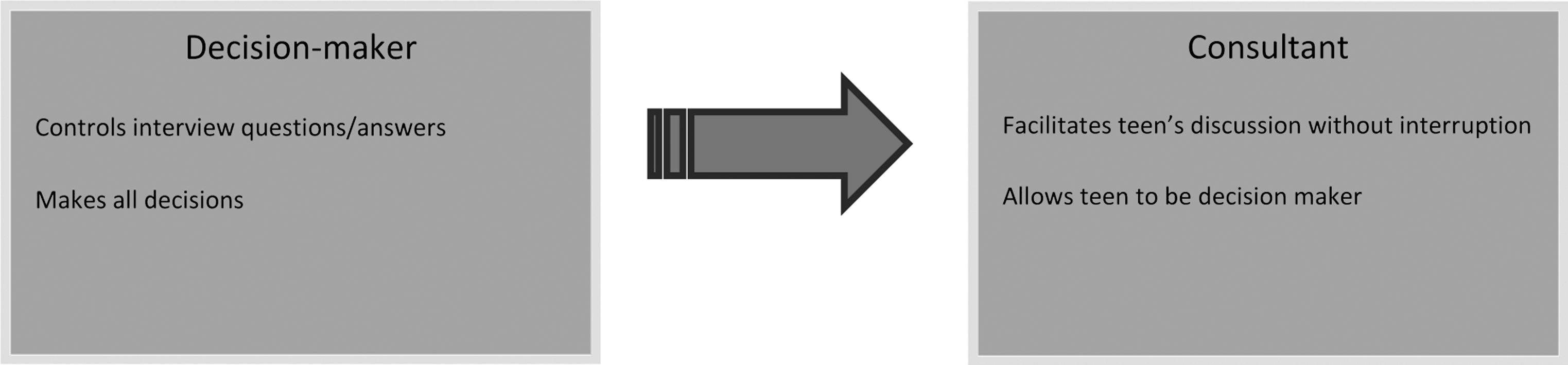
Parental role in adolescent health.
In order for the adolescent to become more proficient at meeting his/her own healthcare needs, the adolescent should spend some time alone with the healthcare provider. This provides an opportunity for the adolescent to speak for him/herself without a parent present and to explore risk-taking behavior. It is essential to handle this separation in a sensitive manner to maintain trust and rapport with both the parent and the adolescent. The concept should be introduced early and emphasized as an opportunity to foster growth and self-reliance. The healthcare provider can say to the parent, “I would like to spend some time speaking with your child alone. I am going to ask you to go the waiting room now. Our team feels that it is helpful for teens to have the opportunity to have some time alone. This gives them a chance to practice asking us for what they need and answering our questions on their own.” It is important to reassure the parent that the provider will reunite with the parent after the individual time with the teen.
Confidential care facilitates communication between the adolescent and the healthcare team. Opportunities must be taken to ask the adolescent about risk-taking behavior including sexual activity, smoking, alcohol, and other substance use. Confidential interviews facilitate accurate diagnosis, as well as fostering maturity and independence. 4 For example, an adolescent with abdominal pain after surgery may not disclose that he/she has been drinking alcohol if the parent is present in the room. Adolescent girls not only need to be educated about the rationale for the recommendation to prevent pregnancy until 12–18 months after surgery, 5 they also need to understand that after weight loss their fertility may be enhanced, requiring effective contraception to avoid unplanned pregnancy after surgery.
Assent
The separate interview time with the adolescent also provides an opportunity to work on the assent process. Until the adolescent is an adult, the parent must sign the consent for surgery. However, it is imperative that informed assent is obtained from the teen. Informed assent is a process of shared decision making that evolves over time, optimally with the adolescent, parent, and healthcare team. The minimum requirements for assent for weight-loss surgery include a developmentally appropriate explanation of obesity, treatment options including nonsurgical options, an assessment of the minor's understanding of the information and how his or her decision was made, and an expression of the minor's willingness or unwillingness to allow treatment. 5
The decision for weight-loss surgery is typically the first major healthcare decision the young person has ever had to make, and it carries lifelong lifestyle ramifications. The surgical team is ethically required to obtain the adolescent's assent carefully. The team must consider the adolescent's cognitive, social, and emotional development and support his or her independent role in making this decision. 6 One obstacle to voluntary assent for adolescents is overt or subtle coercion that may be exerted by the referring healthcare provider, parents, or the social environment. The goal is for the adolescent to be able to review and understand factual information within the context of his or her own value system. The adolescent must be able to apply normative judgment: X is better than Y for this reason. This judgment is developmentally appropriate; adolescents often place more value on immediate rather than long-term outcomes. The assent process requires more than one or two visits and necessitates a good relationship between the adolescent, the family, and the healthcare team.
Adherence Concerns
The lifestyle changes required for successful surgical weight loss are challenging for a person of any age. For adolescents, as with all postoperative patients, the healthcare team should anticipate adherence issues and be proactive in prevention. The normal transition periods during adolescence are risky time periods for adherence problems. Some examples of important adolescent transitions are outlined in Table 1. Preplanning with the teen and family for each of these life events will assist in preventing relapse and unwanted weight gain.
Adolescents have many competing demands that invade all aspects of their life while they have limited skills at negotiating these demands. The adolescent may deem nonadherent activities, such as eating pizza with peers at a school event, as more important than faithfulness to the dietary recommendations. In addition, since adolescents with morbid obesity have not been successful with weight loss in the past, they lack experience in the positive aspects of adherence. Success is more likely to be achieved when the healthcare team recognizes the real life priorities and assists with modifications in the treatment plan to accommodate the individual teen's lifestyle.
The adolescent must be involved in defining goals from the beginning. The healthcare team must meet the teen where he/she is, which may mean that these goals are lower than the normative ideals. Consider this example: 16-year-old Patty presents early in the preparation phase prior to surgery. She is struggling with her parents over increasing her physical activity. Her mother reports frustration that Patty will not walk on the running track at her high school after school. Her mom has offered to pick her up from school 30 minutes later so that she can get this daily exercise. When the healthcare team asked why she doesn't want to do this exercise, the teen states she does not want the other kids at school to make fun of her for walking on the track and she thinks walking is boring. She is willing to use an interactive video game and agrees to 15 minutes three times a week. The healthcare provider discussed with her mother that allowing Patty to commit to what she defines as achievable will end the power struggle and provide her some control. Successful achievement of this goal provides a foundation to build upon for additional lifestyle changes at future visits.
Adolescents often feel that parents and healthcare providers only recognize what they are not doing well. When negotiating behavior change, it is important to begin with positive feedback about what is going well and build from there. Modeling positive feedback for parents is also important. Parental involvement and monitoring are associated with effective self-management and may be particularly challenging during adolescence. Adherence is compromised when the responsibilities for self-management outweigh the intellectual capacity or maturity level of the adolescent. Interventions to reduce conflict and improve family communication may help improve adherence and health outcomes among adolescents. 7 Careful assessment for mental health issues is also important, as difficulties in this realm may disrupt self-management behavior. For example, depressive symptoms may result in decreased motivation to carry out tasks or diminished attention and concentration skills.
Transition to Adult Care
A thoughtful transition to an adult care model is an important aspect of healthcare for adolescents. Ideally, as the adolescent becomes developmentally capable, he or she begins to take more responsibility for the management of his or her health at home and in the medical office. If the surgical weight-loss services are offered in a pediatric setting, the care will become more appropriate in an adult setting when the young adult reaches their early twenties. The primary care provider in partnership with the adolescent and family should be an important part of this transition. 8 If the young adult chooses to have follow-up through the primary care provider (PCP), a summary of supplement recommendations and laboratory follow-up should be reviewed with the young adult and forwarded to the PCP. Programs that provide surgical weight-loss services to young people as well as adults still need to transition the young person to the adult model of care. Families need to be made aware of this transition plan so they can become comfortable with their decreasing role in the care.
Conclusion
Adolescents present unique challenges to the surgical weight-loss team. The process for obtaining informed assent must be carefully considered to assure the adolescent understands the surgical options and commits to the lifestyle changes necessary for success. In addition to a family-centered approach, effective care for teens requires a team that includes a pediatrician and other specialists with training in adolescent development to address the unique needs and the issues that arise when caring for adolescents.
Footnotes
Disclosure Statement
No competing financial interests exist.