




Abstract
Abstract
Objective:
This study examined infant feeding methods in hepatitis B-positive mothers in Zhejiang Province, People's Republic of China.
Methods:
A cohort study was undertaken in Hangzhou in Zhejiang Province. A sample of 638 mothers was recruited at birth from the city of Hangzhou and was followed up until their infants were 6 months of age.
Results:
Chronic hepatitis B is a continuing public health issue in pregnant women. Breastfeeding is the foundation of infant nutrition, sets the scene for lifetime health, and is important for all mothers. In the Hangzhou cohort of 638 mothers, 38 were identified as hepatitis B positive, a rate of 6.0%. All of the infants of the hepatitis B-positive mothers were fed on formula immediately after birth while their breastmilk was tested for virus transmission and their infants were vaccinated. At 1 month of age 61.8% of the hepatitis B-positive mothers were breastfeeding compared to 92% of the remainder of the cohort. The rates at 3 months were 60.6% and 89% and at 6 months were 45.5% and 64%, respectively. The hazard ratio for hepatitis B-positive mothers discontinuing breastfeeding before 6 months was 3.69 (95% confidence interval, 2.28, 5.98).
Conclusions:
The World Health Organization recommends that all mothers who are hepatitis B positive breastfeed their infants and that their infants be immunized at birth. In this study breastfeeding rates of hepatitis B-positive mothers were substantially less than those of the other mothers.
Introduction
By the end of 2006, 164 countries had introduced programs to vaccinate infants against hepatitis B. The World Health Organization (WHO) has set a goal that by 2010 all countries will have routine immunization coverage at 90% nationally with at least 80% coverage in every district. China has set hepatitis B prevention as a major public health goal. 2 Overall, more than 95% of Chinese infants are now vaccinated, although in some rural areas coverage may be a little below this level. The chronic hepatitis B carrier rate in children <10 years of age decreased from 10.0% before the mass vaccination began in the 1990s to 1.0–2.0% in 2006. The national rate of chronic infection has been reduced from 10.0% to 7.2%, a reduction of 30 million cases of chronic hepatitis B infections as well as in serious long-term health consequences. 2 Yet, because of the underlying infection rate, hepatitis B is frequently found in pregnant women and is routinely tested for nationwide.
Breastfeeding is the basis of health and nutrition during infancy and childhood and into adult life. The benefits of breastfeeding have been widely recognized, and many national and international organizations strongly advocate breastfeeding as a major public health initiative. This includes WHO and the Chinese Ministry of Public Health, and both organizations recommend exclusive breastfeeding to 6 months of age. After then, breastmilk can continue to provide up to half or more of an infant's nutrients during the second half of the first year of life and up to one-third during the second year of life. 3 The WHO Western Pacific Region summarized the importance of breastfeeding in infant nutrition policy: “Breastfeeding exclusively for the first six months of life has the potential to avert 13% of all child deaths in the region. Apart from reducing under-five child mortality, breastfeeding confers several other advantages to both mother and child. More effort is needed in the Region to ensure that infants are not denied the benefits of exclusive breastfeeding.” 4
The Zhejiang Provincial Child Development Action Program set a target for the province of an exclusive breastfeeding rate of 85% at 4 months of age by the year 2005. 5 Published studies have shown that this has not yet been achieved, but it remains the objective of the Health Department.6–8 Social, economic, cultural, and hospital factors and the early introduction of infant formula are the common barriers to achieving these goals. The objective of this study was to document the prevalence of HBV infection in mothers delivering infants in Hangzhou, Zhejiang Province, China and the impact of current policies on the management of hepatitis on breastfeeding performance.
Materials and Methods
A cohort study of infant feeding was conducted in Hangzhou during 2005–2006. Hangzhou is a prosperous city of 8 million people and the capital of Zhejiang Province, located 170 km south of Shanghai. A cohort of 638 mothers were recruited from the First Affiliated Women's Hospital of Zhejiang University and interviewed before discharge and at regular intervals until their infants were 6 months of age. The questionnaire included full details of infant feeding methods and factors likely to influence the initiation and duration of breastfeeding. 8 The questions were based on those extensively used in breastfeeding cohort studies undertaken in Australia, Vietnam, and Kenya.9–12 Information was collected on the feeding method and factors associated with breastfeeding. After translation into Mandarin the questionnaire was tested in focus groups to ensure cultural appropriateness.
All mothers who are delivered in the Women's Hospital are tested for hepatitis B (hepatitis B surface antigen [HBsAg]). In most cases the testing is done before 12 weeks. In women who test positive further testing is then undertaken for hepatitis B
The project was approved by the Zhejiang local research authorities (Zhejiang University, First Affiliated Women's Hospital) and the Human Research Ethics Committee of Curtin University, Perth, WA, Australia. Mothers who agreed to participate in the study signed the consent page of the questionnaire and were informed of their rights to withdraw from the follow-up process at anytime without prejudice. All of the personal data collected were kept confidential.
Survival analysis was carried out on those women who were still breastfeeding at the discharge time. Cox proportional hazard regression was applied to determine the risk factors affecting the duration of breastfeeding and the final model was obtained using backward elimination procedure. Definitions used in this study were from Xu et al. 13 and the WHO definition of exclusive breastfeeding 14 : “any breastfeeding” was defined as the child has received breastmilk (direct from the breast or expressed) with or without other drinks, formula, or other infant food, and “exclusive breastfeeding” was defined as breastfeeding while giving no other food or liquid, not even water, within 24 hours of interview, with the exception of drops or syrups consisting of vitamins, mineral supplements, or medicine.
Results
The response rate of the mothers approached to participate in the study was 96%. The incidence of cesarean section was high at 77%, although this is not unusual for the larger Chinese cities, where it can reach 90%. 15 The mean age of the mothers in the study was 28.5 years (SD = 3.3), which is typical of urban China, and almost all mothers were having their first baby. In Zhejiang Province it is government policy for all babies to be born in a health facility, and particularly in the city of Hangzhou almost all babies are born in a hospital. In this study the median length of stay was 5.6 days. Table 1 provides the descriptive statistics and characteristics of the sample participants.
NICU, neonatal intensive care unit.
All of the infants of hepatitis B-positive mothers were given infant formula for the first 3 days. The use of prelacteal feeds for all infants in Hangzhou is high; 26% did not receive breastmilk as their first feed, and by the time of discharge from hospital, 64% had received some food other than breastmilk. 6
There was no significant difference between hepatitis B-positive mothers and the other mothers for most demographic variables, including age, education, health insurance, and residence status. However, there were fewer cases of hepatitis where the mother had regular employment (Table 2).
TAFE, technical and further education.
Percentages were calculated for within hepatitis group.
Significant at 5%.
A positive association was found between the status of hepatitis and the “any breastfeeding” duration using logistic regression of breastfeeding at 3 and 6 months after birth (Table 3). Mothers who were diagnosed with hepatitis had a higher risk of discontinuing “any breastfeeding” before 6 months (hazard ratio = 3.695, 95% confidence interval =2.283, 5.981), compared with those who were not diagnosed with hepatitis. Fewer mothers who were hepatitis B positive were still breastfeeding at 3 months and 6 months after birth. The “any breastfeeding” rates for hepatitis B-positive and -negative mothers are significantly different and are shown in Figure 1.
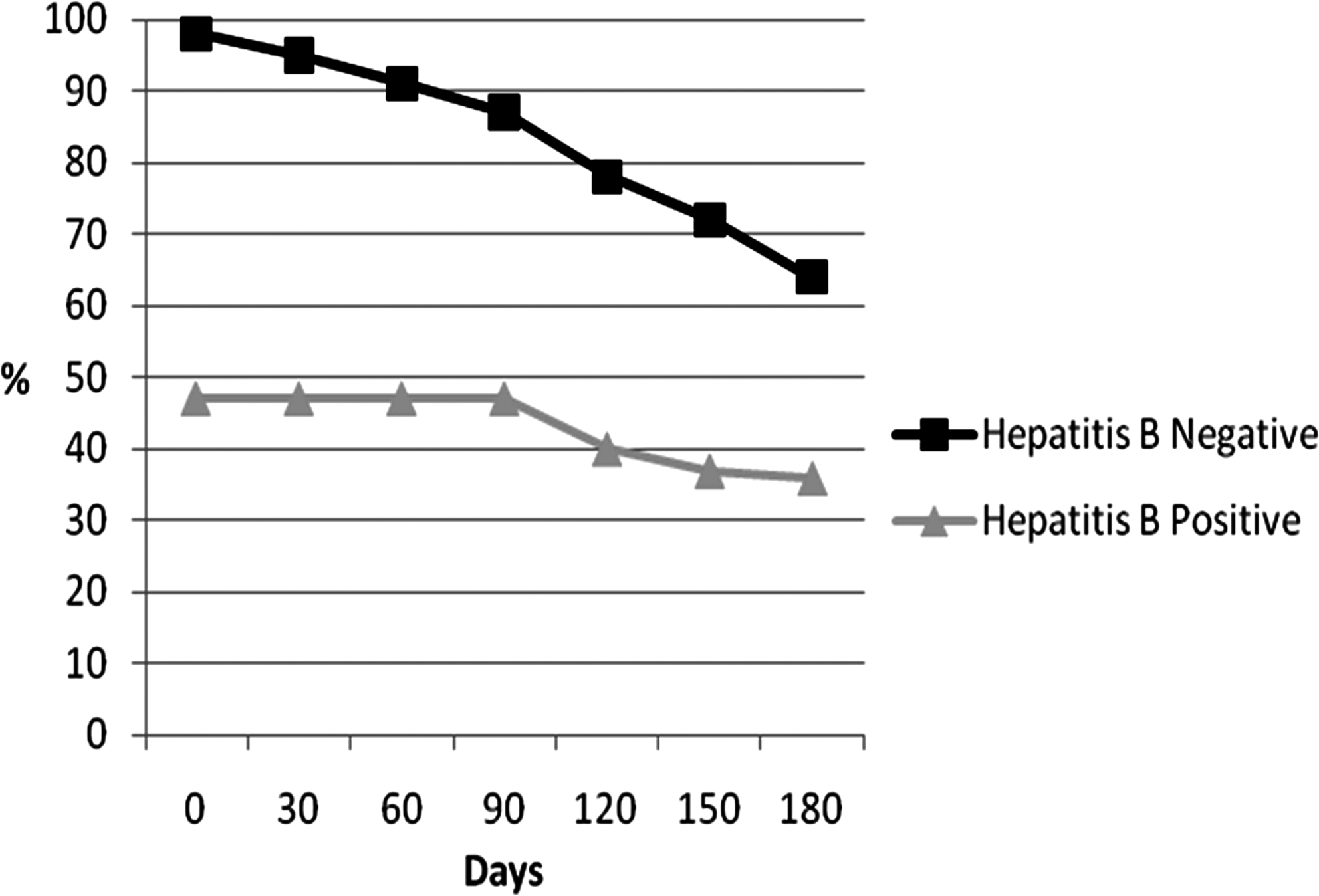
“Any breastfeeding rates” for hepatitis B-negative and -positive mothers.
All variables of interested were included in the full model in the initial step, and then the backward elimination procedure was applied to obtain the final model, using the 5% critical value of the χ2 test for the appropriate degrees of freedom: −2 log likelihood (deviance) 1653.227, df = 11. Nonsignificant variables were mother's job, gestation week, cesarean section, parity, mother attended antenatal classes, infant's gender, and infant birth weight, when the breastfeeding decisions were made. CI, confidence interval; TAFE, technical and further education.
On discharge from the hospital the overall rate of “any breastfeeding” was 91% of all infants who were receiving some breastmilk, but only one-third of the hepatitis B-positive mothers were breastfeeding. Exclusive breastfeeding rates were low in the total sample (36% of mothers) but was zero for the hepatitis B-positive mothers.
Discussion
The objective of the management of mothers with hepatitis B is to reduce the possibility of infants developing hepatitis. But, this must be balanced against the risk to the infant of not having the benefits of breastmilk. The policy in Zhejiang Province reflects Chinese policy to reduce vertical transmission, but it may be more conservative than necessary.
In one of the first studies of breastfeeding by hepatitis B-positive mothers, de Martino et al. 16 found that breastfeeding did not increase the risk of vertical transmission of hepatitis B. WHO recommends that all infants receive hepatitis B vaccine as part of routine childhood immunization. Where feasible, the first dose should be given within 48 hours of birth or as soon as possible thereafter. This will substantially reduce perinatal transmission and virtually eliminate any risk of transmission through breastfeeding or breastmilk feeding. Immunization of infants will also prevent infection from all other modes of HBV transmission. Routine vaccination of all infants against HBV infection and should become an integral part of national immunization schedules worldwide. 17
WHO and UNICEF also recommend that all infants be exclusively breastfed for at least 4 and if possible 6 months and that they continue to breastfeed up to 2 years of age or beyond. There is no evidence that breastfeeding from an HBV-infected mother poses an additional risk of HBV infection to her infant, even without immunization. Thus, even where HBV infection is highly endemic and immunization against HBV is not available, breastfeeding remains the recommended method of infant feeding. 18
Before the advent of routine hepatitis B vaccination programs in the United States it was estimated that 30–40% of chronic infections resulted from perinatal or early childhood transmission. 19 In the United States the Centers for Disease Control and Prevention gives the following counseling message: “Hepatitis B virus is not spread by breastfeeding, kissing, hugging, coughing, ingesting food or water, sharing eating utensils or drinking glasses, or casual contact.” 20 However, in the United States in the case of hepatitis B-positive mothers routine administration of immune globulin is given with the infant hepatitis B vaccine.
The outcome of the present policy on the management of hepatitis B-positive mothers in Zhejiang Province is the very low rates of breastfeeding. This has the potential for serious consequences for the infants who miss out on the benefits of breastfeeding. This includes the risk of a lower IQ and increased mortality and morbidity.21,22
There are several limitations that need to be considered when interpreting the results of this study. The sample used for this study was restricted to the city of Hangzhou and may not be generally applicable to elsewhere in Zhejiang Province. Although the response rate was high, the actual number of cases was small. In the future if a change in policy is made to follow the WHO recommendations it would be useful to conduct a larger study to monitor the impact on breastfeeding rates.
Conclusion
The policy of managing the breastfeeding of hepatitis B-positive mothers in Zhejiang Province differs from WHO recommendations and the policies of many other countries. Infants of HBsAg-positive mothers may be breastfed beginning immediately after birth.
Footnotes
Disclosure Statement
No competing financial interests exist.