




Abstract
Abstract
Background:
Occurrences of flat or inverted nipples are not uncommon problems, and although they should not preclude breastfeeding, they often seriously hamper initiation and continuation of breastfeeding. Various therapies including nipple exercise, breast shells, inverted syringes, or surgical corrections have been reported with varying success rates.
Subjects and Methods:
A new method has been devised by the authors that consisted of tying a rubber band around the base of the nipple, with the help of a syringe applicator, to make it prominent. Latex rubber bands cut from condom rims were used in this study. The band had to be worn only during feeding. This method was tested on 19 mothers with flat, inverted, or otherwise deformed nipples. The babies were born in hospitals and were between 9 and 38 days old, mostly fed by bottle feeding, at the time of presentation. The mothers had been counseled about the importance of good attachment during breastfeeding and shown the new method. They were instructed to use the method at home and attend follow-up on day 3, day 7, and day 28.
Results:
Sixty-three percent of mothers could achieve latching at the breast with good attachment within 3 days, and all did by the end of the month, as nipples no longer remained a problem. The insufficiency of milk was gradually taken care of by frequent suckling with time. No complications like pain or slipping of the band were reported.
Conclusions:
This simple method may be a good bedside solution for flat/retracted nipples. The authors strongly believe that if the new method is applied immediately after birth under supervision, no mother with nipple problem will be required to feed nonhuman milk to her baby.
Introduction
It was estimated by Alexander et al. 4 that about 10% of pregnant women have inverted or non-projectile nipples, which hinder breastfeeding. Apart from flat and retracted nipples, they also documented other anatomical problem of nipples that they had observed.
Various methods to correct flat and inverted nipples with varying degrees of success and complications have been reported in the literature. Some of them were prenatal exercises like Hoffman's exercise, 5 nipple stimulation techniques, 6 and postnatal use of the Nipplette™ (Philips Avent, Andover, MA) 7 as well as using breast shells to make the nipple prominent. A multicentric study of the different methods showed that sustained improvement is more common in the untreated group 8 and that the difference in the shell/no shell was 52% versus 60%, which is not significant. 4 Surgical correction had also been advised in some cases. 9 Chen et al. 10 have used endoscopic surgical correction of inverted nipples with excellent projection and preservation of breastfeeding as well as normal breast sensation, except in grade IIIB inverted nipples. The best simple method to date had been reported by Kesaree et al. 11 : the inverted syringe method to pull out the flat or retracted nipple.
A new method was devised by the authors using elastic rubber bands as described below. Inspired by the initial results the authors decided to systematically apply apply the method for mothers with flat, inverted, or other nipple problems and document the outcomes.
Subjects and Methods
The study was conducted among postnatal mothers attending the pediatric outpatient department in a district hospital over a period of 6 months. The mothers with feeding problems were assessed for positioning and attachment according to standard criteria of the Breastfeeding Promotion Network of India. 12 Those who reported suckling problems even after correcting the position and achieving proper attachment of the babies were examined for presence of any nipple problem. In this way 19 mothers with nipple problems were enrolled in the study following counseling with the explanation of potential benefits and risks and obtaining informed consent. The mothers were divided into three groups based on the type of nipple problems: inverted nipples, flat nipples, and others. The last category contained cases of ill-defined issues, i.e., very large breasts with atypical nipple location, cauliflower-shaped nipples, and post-burn breast deformity.
The mothers were clearly instructed to use rubber bands during each feeding until they became confident of the babies latching without rubber bands. The mothers were given the option to feed expressed breastmilk if they had difficulties in feeding the baby at the breast even after using the bands. Each mother was provided with a syringe applicator and a latex rubber band. Follow-up was done at day 3, day 7, and 4 weeks. During each follow-up, information was collected about feeding practice, any complication (e.g., pain, slipping of band, etc.), and whether the mother was still using the method or not.
Description of the new rubber band method
The process essentially consists of putting a rubber band around the base of the nipple, thus making it prominent so that the newborn is able to suckle. The band can be applied by hand, but it was found to be more convenient using a syringe applicator. The latter device can be made by cutting the front side of a 10-mL syringe and smoothing the cut surface. Smoothing the cut surface is extremely important to avoid injuries to the breast. The band is firmly put around the barrel of syringe. The cut end of the syringe is applied around the base of the nipple, and the plunger is gently pulled to raise the nipple within the barrel of the syringe. Then the band is pushed over the barrel to be ultimately placed at the base of nipple. The syringe is removed, and the child is put to the breast with the band in place. Latex rubber bands are more convenient than ordinary rubber bands and can be prepared by cutting through the rim of a latex condom. The standard circumference of the rim of a condom is around 10 cm, and that of a 10-mL syringe is around 5.7 cm. Three turns of the rubber band was used initially and was adjusted based on the mother's feedback, if necessary. Tension in the band was not measured so no benchmark could be developed as such. Figure 1 gives details of the method.
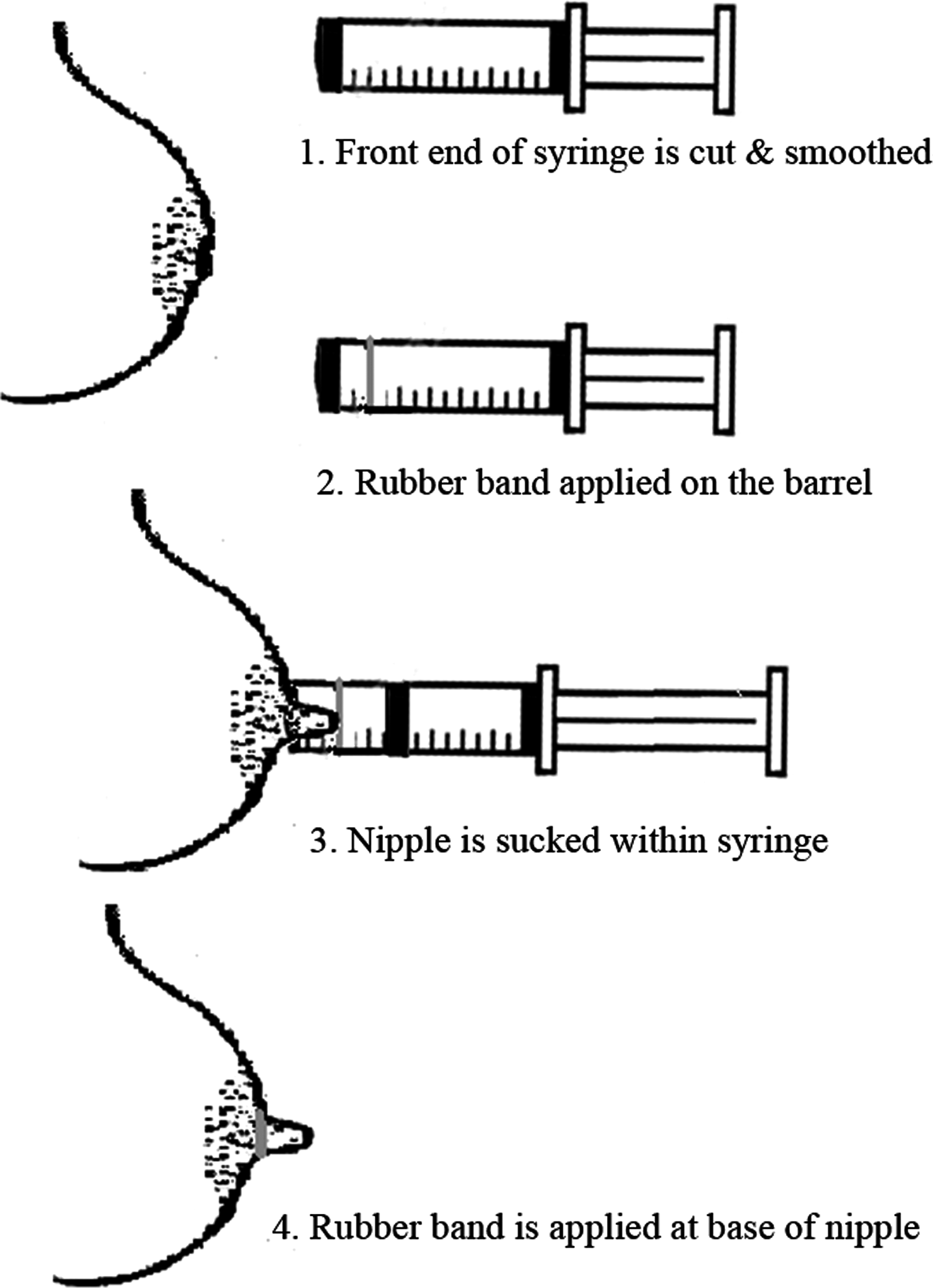
The steps of applying the rubber band with the syringe applicator.
Results
Table 1 tabulates and evaluates the usefulness of using the rubber band. A typical problem nipple is shown in Figure 2, and the successful use of our new method is shown in Figures 3 and 4. At the first follow-up, latching with good attachment could be achieved in eight (42%) cases without the use of rubber bands and in four (21%) with the use of the bands, accounting for a total of 63%. Such success was found in the inverted nipple (Group 1) and the flat nipple (Group 2) groups. In the other nipple problem group none of the mothers could achieve proper latching without the band, and only one mother could succeed with the band attached at the first follow-up. All mothers of all categories could breastfeed without bands at the third follow-up. It was found that all babies could suckle at the breast when the new method was applied under supervision. No case of pain, local irritation, or slipping of the band was reported during the three follow-ups. Flat nipples showed a quick response: All seven mothers could achieve feeding their babies at breast with good attachment and discontinued using the band by the second follow-up.

Appearance of the nipple at the time of enrollment.
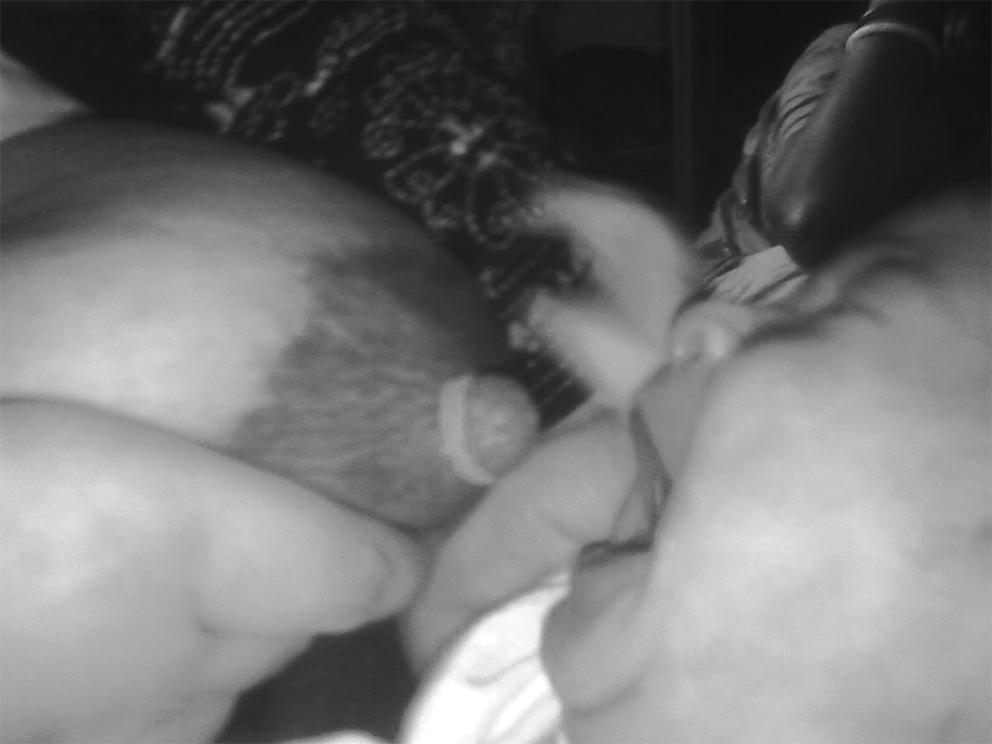
Appearance of the nipple with the band attached.

Feeding with the band attached.
Percentage approximated to the nearest whole number.
The age distribution and pre-enrollment and post-enrollment feeding practices of babies are tabulated in Table 2. Of the 19 babies, the largest number (nine [47.4%]) were between 8 to 14 days old. All of the babies were being exclusively bottle-fed formula at the time of enrollment with one exception, who was being fed with expressed breastmilk. At the first follow-up all the babies were breastfeeding as well as being fed formula using cups with one exception, who was having pre-enrollment expressed breastmilk. At the third follow-up, babies with the age of 28 days or less were feeding at the breast with only one exception, who, along with breastfeeding, was still being fed with formula from a cup.
Percentage approximated to the nearest whole number.
The mothers were between 21 and 32 years old. Breastfeeding was tried soon after birth by everyone without success. No mother was counseled about this during pregnancy or after birth, nor did any of them use a breast shell or do any antenatal breast exercise. All mothers had delivered in the hospital, and initiation of breastfeeding was delayed. All babies received prelacteal feeds. Most of the babies developed some degree of nipple confusion and breast refusal.
Discussion
In present times, most mothers know the benefits of breastfeeding, and they feel dejected when they cannot nurse their newborns, especially if the cause lies with their body parts. They require special counseling and skilled help from experts. Unfortunately, in spite of monumental work done on this, the real solution for abnormalities of the nipple and difficulties of breastfeeding thereof is still elusive. The authors tried to find a simple yet effective method for solving the problem of breastfeeding due to nipple abnormalities, especially inverted and flat nipples. All the mothers in this study faced some amount of distress at not being able to breastfeed their babies due to nipple problems. They were also eager to adopt any method that would help their babies to feed at the breast and were quite motivated to practice exclusive breastfeeding.
The complete antenatal and birth histories were obtained along with feeding history of the babies. The mothers were shown the new method, i.e., the rubber band method, fed their babies under supervision, and were left to practice it on their own. All the mothers were advised to avoid bottle feeding completely as it would aggravate the degree of breast refusal and interfere with positioning at the breasts. They were also shown how to express breastmilk and encouraged to put the babies as long as and as frequently as possible to the breast, especially at night, as the pituitary gland secretes more prolactin at night and produces more milk. 12 It was made clear to them that the key to production of milk is adequate suckling in the proper position and expression of milk. All of them were advised not to feed formula straight away, but to put the babies at the breast and only after the babies had completed feeding at the breast to give extra amount of formula, if required at all. After an initial demonstration the mothers were able to practice the method at home. By day 3 of the study, 63% of the mothers could achieve latching their babies at the breasts with good attachment; most could discard the rubber bands by day 7 of the study and all within 1 month. Nipple confusion and breast refusal were the problems in most of the babies due to bottle feeding. Had the method been applied earlier, all mothers could have breastfed successfully soon after birth. Because there was a delay in initiation (all babies were >8 days old, and five babies were >29 days old at study enrollment) and poor or no suckling at the breast, the adequacy of breastmilk was a problem. However, as all the mothers were carefully counseled and motivated, most of them could achieve production of an almost adequate amount of milk very quickly. Those who failed to do so were advised to breastfeed as frequently as possible and give extra amount of formula as per the demand of their babies. All mothers were advised not bottle feed the babies straight away and not to omit any session of feeding at the breast.
Although the process was a simple one, with the exception of cutting a disposable syringe, and can be done with readily available items, the authors were apprehensive of complications like nipple injury or slipping of band. Latex rubber bands made from condom rims were used after thorough washing with soap and water, to minimize any chance of infection. Each mother had been advised to use the band only during feeding and to discontinue it once the nipple problem was solved. It was observed that flat nipples responded to the intervention earlier than other categories. The condom rims are of much better consistency with circular cross-section and tensile strength compared with ordinary bands, which are square in cross-section and of irregular elasticity.
Of the different methods, both invasive and noninvasive, the most simple and effective method to evert nipples appears to be the inverted syringe method of Kesaree et al. 11 But, this method is not without limitations. The nipple, which is raised with the help of a syringe, has a tendency to revert back to original position. As most of the babies are usually bottle fed before any nipple raising procedures are applied, they develop some degree of breast refusal. These babies take a lot of time before they can be finally latched on to the breast, and by this time nipples go in. Rooting of the babies before starting to feed also consumes a good amount of time. The present method, offering a simple yet unique solution by application of the rubber band at the base of the nipple, was developed to help maintain nipple eversion. The procedure uses the principle of suction to raise the nipple and applies the band to sustain it. The syringe, which is used to evert the nipple, performs as a convenient applicator for the rubber band as well.
Although not reported within the study, there is the possibility of complications like pain in the nipple, which may be caused by applying the band too tightly or using it for too long a period of time. Pain may also occur if the cut end of the syringe is not smoothened enough. The band may not hold the nipple everted and may slip off if it is too loose, perhaps into the baby's mouth. Usually the nipple problem is corrected once the baby suckles regularly, and the band need not be used any more. However, the use of the band should be demonstrated to the mother by experts, who should initially supervise her application; once she has learnt the method, she should be encouraged to practice it regularly on her own.
Conclusions
This study successfully demonstrated the effectiveness of the simple procedure of using a rubber band to treat problems of flat or inverted and some other deformities of nipples. It can help in the early initiation of breastfeeding by being applied immediately after delivery, when needed, and to boost the mother's confidence to breastfeed successfully.
Footnotes
Disclosure Statement
No competing financial interests exist.