




Abstract
Dear Editor:
There are over 4 million infants born in the United State each year, 1 and approximately 70% of mothers feed their infants breastmilk. 2 Instead of putting their infants to the breast only to feed, more commonly mothers are pumping their milk, and infants are subsequently fed breastmilk via a bottle or cup. In the recent Infant Feeding Practices Study II, the largest study to date that includes information on pumping, 85% of over 1,500 breastfeeding mothers of healthy infants expressed their milk by 4 months postpartum. 3 Recently the Academy of Breastfeeding Medicine has updated its “Clinical Protocol #8: Human Milk Storage Information for Home Use for Full-Term Infants,” which summarizes what is known about pumped milk transport and storage. 4 The protocol does acknowledge that a great deal of more research is needed to better understand outcomes related to this practice because tens of thousands of infants are now being fed pumped breastmilk in the United States each year.
Those of us working in the Cincinnati (OH) Children's Center for Breastfeeding Medicine have a particular interest in breastmilk storage as almost all mothers of patients in the hospital and those referred to our outpatient clinic pump their milk. We were curious to know under what conditions mothers pumped, transported, and stored their milk with the intent of feeding this milk one day to their infants. Thus, I wrote a letter to 54 mothers who recently had been seen in our Breastfeeding Medicine Clinic asking them to send pictures of their milk on a “typical day.” Twenty-five mothers sent in 127 pictures total. The Cincinnati Children's Hospital Medical Center Institutional Board reviewed this protocol and gave permission to do this study.
As seen in the images shown here in Figure 1, despite recommendations from the Academy of Breastfeeding Medicine, guidelines for the manipulation of breastmilk are not always followed. There was a wide variety of locations where the women pumped their milk, particularly those who had gone back to work. Pumping in bathrooms was a repeatedly common theme. There was no uniform method by which women transported their milk. Often there was not a “cool pack” surrounding the milk as recommended. In many of the images, milk was shown in a car. It is not known if women leave milk in cars to run errands or take it with them in a more climate-controlled environment, although we did receive images of milk in shopping and recreational locations. Several mothers reported to us how they pumped their milk while driving to and from work in the interest of saving time.
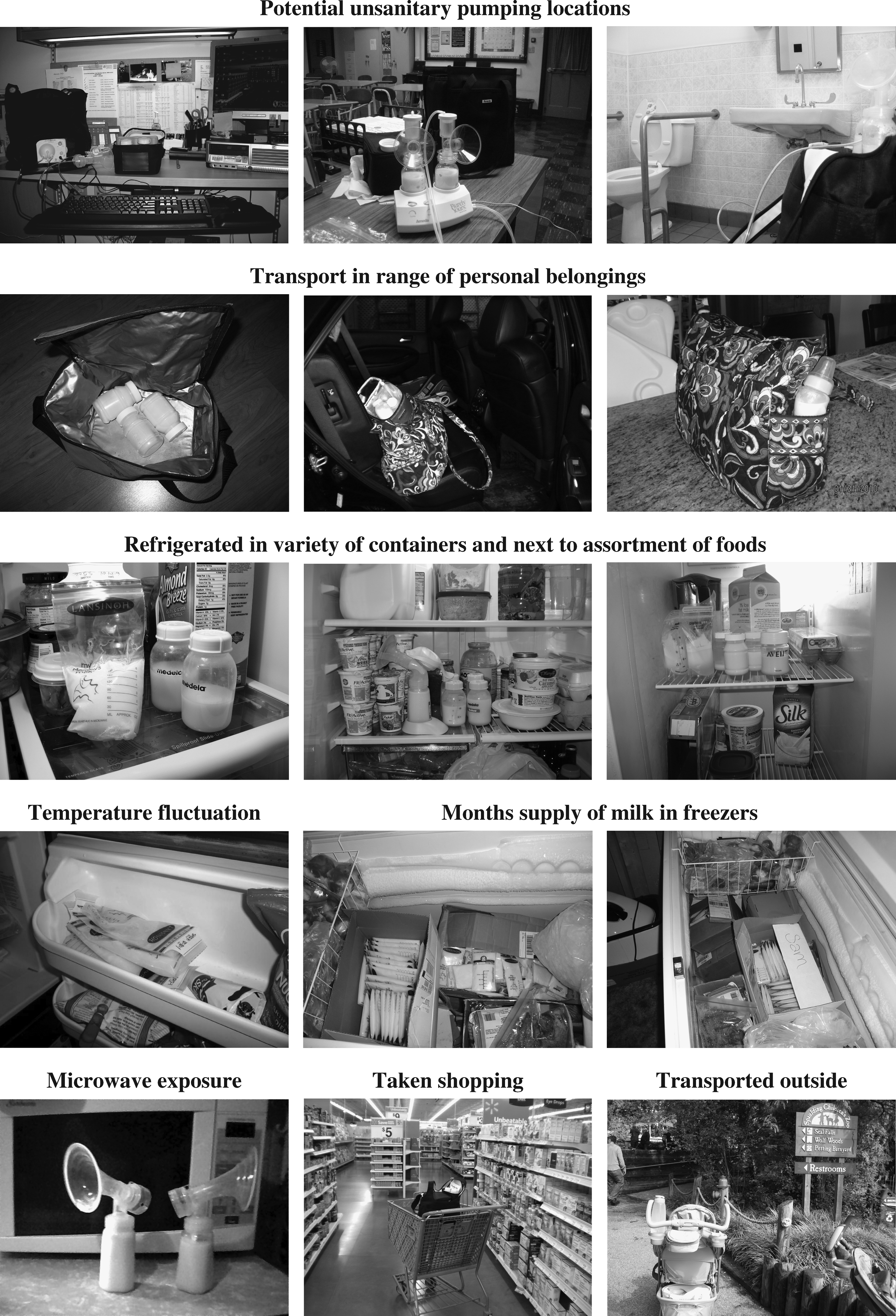
Examples of the location, transport, and storage of pumped breastmilk.
Milk was stored in refrigerators in assorted plastic containers next to raw foods. None of the images sent to us showed milk in glass. Milk was often stored on the door of the freezer, which is known to be the location of the most highly variable temperature, and we were repeatedly sent pictures of large quantities of milk in deep freezers. This would indicate that infants are fed milk that is stored for long periods of time. Milk thawing was usually shown in warm water, but microwave exposure was evident as well.
Through this visual inspection, we can readily see that from the time milk leaves the mother's breast it is exposed, transported, poured, stored, and thawed—often several times. The seminal studies that established the benefits of “breastfeeding” compared outcomes for mothers and children who were engaged in the act of feeding breastmilk directly at the breast. These old definitions and conclusions about “breastfeeding” do not consider pumped breastmilk feeding. There is an urgent need for rigorous research to determine the safety and efficacy of pumping and pumped milk feeding for both mothers and infants.