




Abstract
Abstract
Objective:
To investigate the dynamics of milk removal during breast expression.
Subjects and Methods:
This study used a continuous weighing balance to determine changes in milk flow rate and their relationship to the proportion of milk removed over time and the percentage of the available milk removed during simultaneous expression (15 minutes) of the left and right breasts in 34 mothers of healthy, term, breastfeeding infants.
Results:
Multiple milk ejections (5.1±2.0; range, two to 14) were detected as increases in milk flow rate. A larger total expression volume was associated with a higher maximum milk flow rate (p<0.001). However, 14% less of the available milk was removed for a 100 g increase in available milk (p<0.001). After 2.9±1.4 and 6.0±2.5 minutes, 50% and 80%, respectively, of the total expression volume was removed. Milk flow was more active in the first 7 minutes than the last 7 minutes. At the eighth minute (midpoint), 54±25% of the available milk and 86±9% of the total expression volume were removed.
Conclusions:
The maximum milk flow rate was predictive of the total volume expressed. After the eighth minute of expression the milk flow rate was reduced. Increasing volumes of milk in the breast were associated with less complete breast emptying. These data suggest that long expression sessions are not required for mothers who are not pump dependent and that extending intervals between expressions results in less effective milk removal.
Introduction
Most breast expression studies have been performed with mothers of premature infants and measure only the total milk volume expressed,2–4 do not specify the expression duration,2,3 or have short expression durations of 5 minutes.5,6
It is common for the left and right breasts to differ in total milk output during breast expression 3 and breastfeeding, 7 but it is not known whether variation in the oxytocin response or the amount of milk available in the breast contributes to these differences. Using a continuous weighing balance it is possible to measure the dynamics of milk removal (cumulative volume and changes in the rate of milk flow) during breast expression, as well as milk ejections that coincide with increases in the rate of milk flow.5,6,8–10 However, previous studies have only expressed one breast with the assumption that both breasts respond similarly. Recently Prime et al. 11 studied the expression of both the left and right breasts simultaneously and validated the potential of a purpose-built continuous weighing balance (Showmilk, Medela AG, Baar, Switzerland) to identify milk ejections as transient increases in the rate of milk flow during breast expression.
This study used the Showmilk device to determine changes in milk flow rate and their relationship to the proportion of milk removed over time and the percentage of the available milk removed during simultaneous expression of the left and right breasts in mothers of healthy, term, breastfeeding infants.
Subjects and Methods
Subjects
A total of 34 mothers were recruited through the Western Australian branch of the Australian Breastfeeding Association and through Child and Adolescent Community Health Nurses in the Oceanic Health Region. Mothers provided written, informed consent before participation and could withdraw from the study at any time. The study was approved by the Human Research Ethics Committee of The University of Western Australia, Crawley. Experimental visits were completed at the Breastfeeding Centre of Western Australia at King Edward Memorial Hospital for Women, Subiaco, WA, Australia.
Milk production and available milk
The mothers measured their 24-hour milk production in their homes under uncontrolled conditions by test weighing their infants using electronic scales (BabyWeigh Scale, Medela AG). Infants were weighed before and after each breastfeed from each breast for a 24–28-hour period, and measurements were normalized to a 24-hour period. 12 Mothers collected and froze 1–2-mL milk samples before (fore) and after (hind) each test weighing. One mother was exclusively expressing and followed the same protocol but recorded the weight of the milk expressed minus the bottle weight.
Cream content of milk samples was analyzed using the creamatocrit method 13 on the Creamatocrit Plus™ device (Medela Inc., McHenry, IL). Because the cream content is related to the degree of breast fullness, 14 the changes in degree of fullness and the breastfeeding storage capacity of the breast were calculated as described by Kent et al.10,15 During the experimental sessions, the cream content of the first and last 1–2 mL of expressed milk was measured. Expression data were then combined with the 24-hour milk production data, allowing determination of the potential breast storage capacity and the degree of breast fullness before each expression session. 10
The effectiveness of expression for each breast was categorized by a modification of a previously published method. 6 To determine an effectiveness ratio, the percentage of available milk removed during the expression session was divided by the average percentage of available milk removed by the infant during the period of measurement of 24-hour milk production. From this ratio, each breast was categorized as having a low (<0.5), medium (0.5–1), or high (>1) ratio of expression effectiveness. Thus, for a breast with a high expression effectiveness ratio, a greater percentage of available milk was removed during the breast expression session than the average percentage of available milk removed by the infant during the 24-hour milk production measurements, and for a breast with a low effectiveness ratio, the percentage of the available milk removed during the breast expression session was less than half the average percentage of available milk removed by the infant during the 24-hour milk production measurements.
Protocol
The experimental protocol has been described previously. 11 Mothers expressed their left and right breasts simultaneously with two separate electric breast pumps (Symphony, Medela AG). No guidelines were given for breast fullness upon arrival. Expressed milk of each breast was collected onto separate Showmilk devices, recording the cumulative weight (g) of the milk and the rate of milk flow over time (g/second). Breast pump vacuum was recorded by the Showmilk via pressure transducers (Carag AG, Baar). The stimulation pattern was applied until the first milk ejection (first jets of milk from the nipple). Breast expression then continued for 15 minutes using the expression pattern. The stimulation and expression vacuums were adjusted for each breast separately to the mother's maximum comfortable vacuum. 10 The first and last 1–2-mL samples of milk were retained for analysis, and the remaining milk was returned to the mother. The number of milk ejections was determined manually by identifying increases in milk flow rate as described previously 11 (Fig. 1).

Typical Showmilk data output indicating cumulative weight (g) on the left y-axis and milk flow rate (g/second) on the right y-axis. Milk ejections are indicated (
Statistical methods
Univariate comparisons of all variables were performed using paired t tests to determine if there were systematic differences between breasts or milk removal methods. Where data were not normally distributed, the Wilcoxon signed rank test was used. These analyses were done in Sigmastat (version 3.11, 2004) (Systat Software, Inc., San Jose, CA), with subsequent analyses done using the R analysis package. 16
A linear mixed effects model approach16,17 was used to model relationships between the variables with repeated measures. Of particular interest was identifying which variables were predictors of percentage of available milk removed, total volume removed, and time until onset of milk flow. For each of the dependent variables of interest each of the possible predictors was considered with and without effects of available milk and initial degree of fullness included in the model. In analyses where data were available from more than one study, the source study was also included as a possible predictor.
Volume expressed per minute dropped rapidly across the 15-minute period, in a nonlinear manner. A square root transformation was considered to be appropriate because of the difference in magnitude between minutes 1 and 15 and the presence of zeros in the data. Fitting of a regression line to the transformed data was found to be inadequate, so a loess curve was fitted.
Data for time until first milk ejection and onset of milk flow were omitted for one individual as there was a difference between the breasts in response to expression due to a large difference in available milk (left breast, 178 g; right breast, 53 g), leading to a low expression volume in the right breast (left, 99 g; right, 12 g).
Results are presented as mean±SD values for normally distributed data and as median (interquartile range) otherwise. Values of p<0.05 were considered statistically significant, and values smaller than 0.001 have been reported as p<0.001.
Results
Participants
Thirty-four mothers took part in this study. Breastmilk was the predominant source of nutrition 18 for the 34 infants with a mean age of 2.5±1.6 months (range, 0.9–6.5 months) and who were mostly male (n=24). The majority of mothers were primiparous (n=22) and had a mean age of 33.4±3.4 years. Of the 34 mothers, 28 measured their 24-hour milk productions, and the breastfeeding and breast expression results for these mothers have been published. 11 The six mothers not completing a 24-hour milk production had healthy infants and had no concerns about the amount of milk they were producing. Mothers were producing 781±188 g during the 24-hour period. There was no significant difference between the left and right breasts for either milk production (408±129 g and 373±132 g, respectively) or breastmilk storage capacities (177±63 g and 151±53 g, respectively), and all mothers were within the normal range for these measurements. 7 In 46% of mothers, one breast produced at least 25% less milk than the higher-producing breast.
Comparison of breast expression and breastfeeding
For the 27 breastfeeding mothers who measured their 24-hour milk production, breastfeeding durations were significantly longer (p=0.02) on the right (17.5±12.2 minutes) than the left (16.0±10.0 minutes) breast. During breast expression the amount of milk available at the beginning of milk removal (left, 98.5±67.0 g; right, 90.0±57.9 g), the total volume of milk removed (left, 62.9±42.1 g; right, 53.7±34.0 g), and the percentage of the available milk removed (left, 63.8±29.3%; right, 62.2±27.4%) were similar to the average (over the 24-hour period) breastfeeds for the entire group of mothers: breastfeeding available milk in the left and right breast, 105.9±40.0 g and 91.6±35.9 g, respectively; total breastfeed volume in the left and right breast, 64.2±19.4 g and 60.3±22.0 g, respectively; and percentage of available milk removed in the left and right breast, 65.0±13.4% and 69.3±12.4%, respectively. During both breastfeeding and breast expression a significant negative relationship (p<0.001) was found between the amount of available milk and the percentage of available milk removed (14% less milk removed per 100 mL increase of available milk).
Analysis of the effectiveness of the breast expression compared with the average breastfeed showed that for 16 of the 27 mothers (59%) the breast expression effectiveness ratio of their left and right breasts was the same: Two mothers had a low effectiveness ratio, five mothers had a medium effectiveness ratio, and nine mothers had a high effectiveness ratio. Eleven of the mothers had their left and right breasts categorized differently: Four mothers had one breast with a medium and the other breast with a low effectiveness ratio, whereas five mothers had one breast with a medium and the other breast with a high effectiveness ratio; two mothers had one high and one low effectiveness ratio breast. These breast differences were not associated with either the degree of fullness or total milk production from that breast.
Milk ejection and maximum milk flow rate
Milk ejection and milk flow rate variables were the same for the left and right breasts (Table 1). The number of milk ejections ranged from two to 14 during an expression. Neither the time until first milk ejection nor the time until onset of milk flow recorded on the Showmilk was different between the breasts (Table 1). The lag time between the observation of milk ejection and the onset of milk flow recorded on the Showmilk was recorded (median, 28 seconds; interquartile range, 10–56 seconds).
Data are average±SD values (n=34). No statistically significant differences were observed.
The maximum milk flow rate (Table 1 and Fig. 1) occurred during either the first or second milk ejection 94% of the time, and in 79% of the time the maximum milk flow rate occurred at the same milk ejection for both the left and right breasts. The time of the maximum milk flow rate was not different for the left (65 [27–136] seconds) and right (51 [24–124] seconds) breasts.
A significant relationship was found between the maximum milk flow rate and the total expression volume, with the maximum milk flow rate being predictive of the total expression volume (p<0.001). Analysis of this relationship was repeated in a larger data set available in the research group that contained these particular variables of interest (n=244 breasts). This larger data set confirmed that the maximum milk flow rate significantly predicted total volume expressed (p<0.001). This relationship was not affected by the initial degree of fullness, the study the mother was participating in, or which study session if there were multiple days. An inverse relationship (p<0.001) was found between the maximum milk flow rate and the time that the onset of milk flow occurred.
Milk removal during breast expression
The average initial degree of fullness was the same for the left and right breasts (0.56±0.30 and 0.58±0.33, respectively). The chosen maximum comfortable vacuum for both stimulation and expression patterns was similar for both breasts (Table 1). There was no difference between breasts in terms of total volume removed, the percentage removed at 5 and 10 minutes after the onset of milk flow, or the time taken to remove 50% and 80% of the total volume (Table 1). However, the rate of breast emptying varied among mothers (Fig. 2a).

Cumulative weight of expressed breastmilk during breast expression.
When comparing each minute of expression, on average neither the volume nor the proportion of volume removed per minute differed between the left and right breasts. However, the amount of milk removed per minute from left and right breasts of an individual mother differed according to the degree of fullness of each breast (Fig. 2b). Also, variation in the proportion of the volume removed per minute was observed among the different mothers. This can be seen in Figure 3, which shows the distribution of the proportion of total milk volume removed per minute, with the spread of the data decreasing over the expression period but the number of extreme values increasing throughout the expression period. These extreme values included 19 mothers with substantially larger than average values for at least 1 minute of the last 8 minutes of expression. The rate of breast emptying can be observed in the normalized (square root transformation) volume per minute data (Fig. 4). An approximately linear decrease can be observed in the volume removed per minute between 1 and 7 minutes. The linearity is lost between minutes 7 and 9; however, an approximately linear decrease is then observed between minutes 9 and 15, with a shallower gradient than the first 7 minutes. The two linear curves cross at minute 8 of expression, when 54±25% of the available milk had been removed.
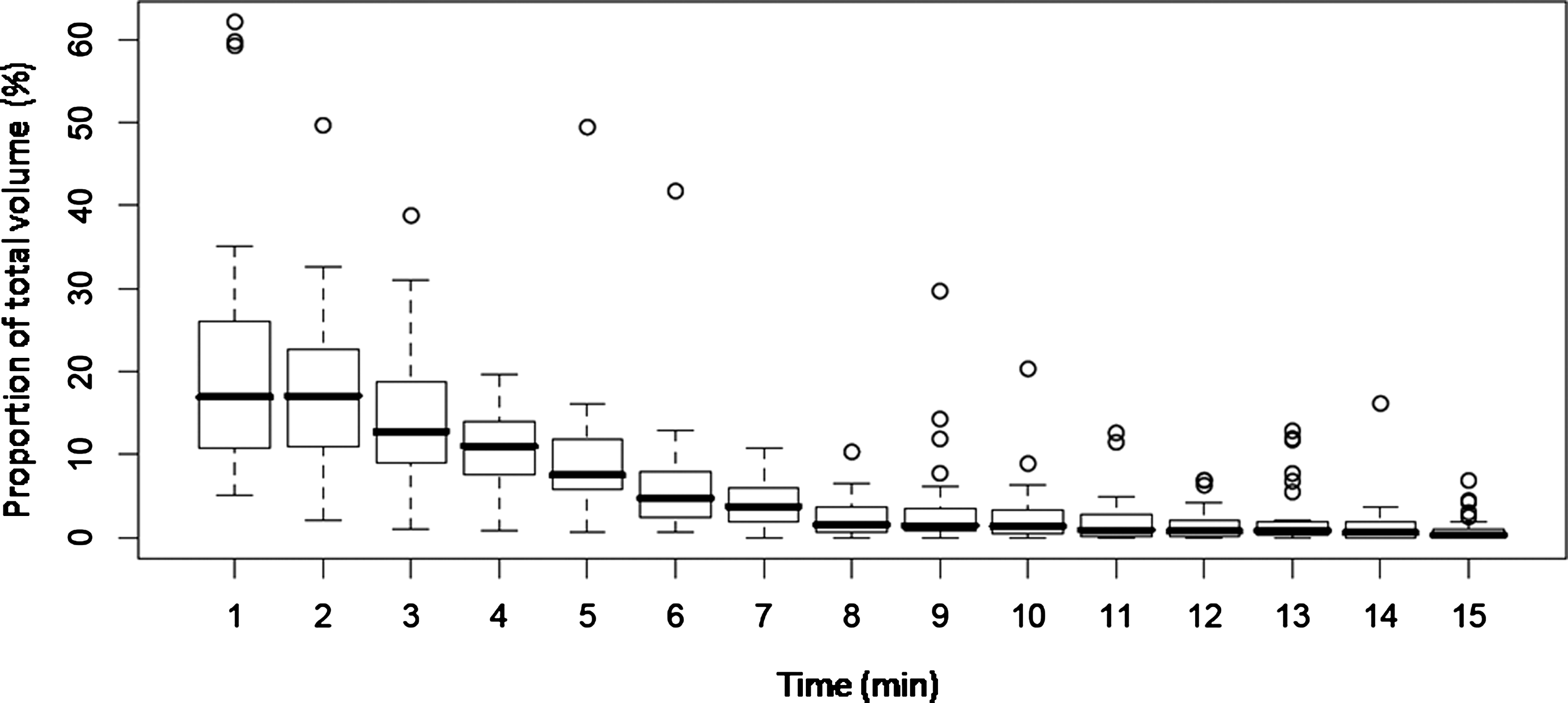
A distribution of the proportion of total expression volume removed per minute (left breasts only, n=34). Extreme values (ο) represent values that were more than the third quartile + (1.5×the box width) or less than the first quartile − (1.5×the box width).
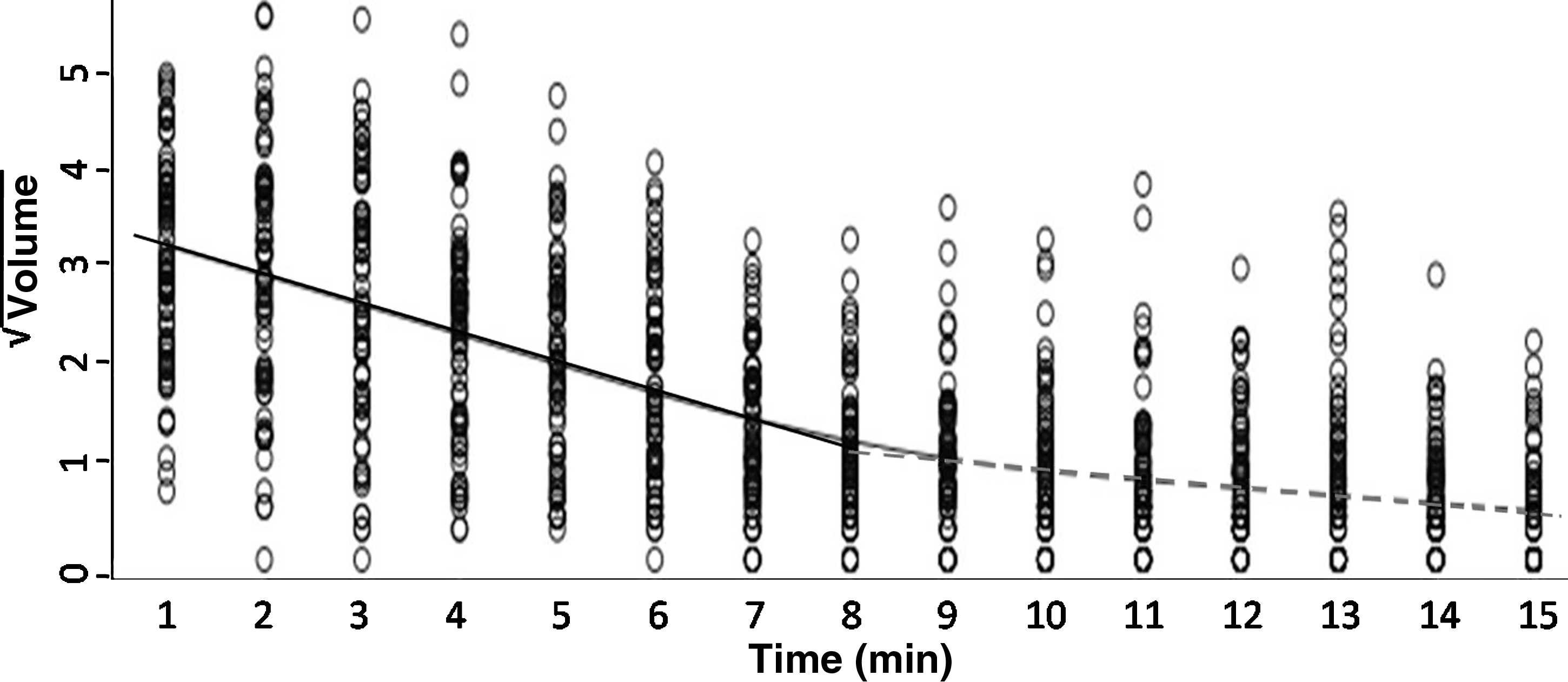
The square root transformation of the volume expressed per minute of expression. The fitted loess curve shows an approximately linear decrease in the volume removed per minutes 1 and 7 with a steep gradient (—). Linearity is lost between minutes 7 and 9, with a subsequent low gradient linear decrease between minutes 9 and 15 (- - -). The two lines cross at 8 minutes, at which time 54±25% of the available milk and 86±9% of the total expression volume have been removed.
Discussion
There was a significant relationship between the maximum milk flow rate and the total volume of milk obtained during expression. We found that the maximum milk flow rate occurred at either the first or second milk ejection 94% of the time. Previous studies have shown that the first milk ejection was associated with stronger increases in intraductal pressure 19 and produced the largest milk volumes.8,10 Taken together, these findings demonstrate the importance of the first milk ejections and provide a method for predicting, within the first few minutes of expression, the total volume that will be removed over a 15-minute expression session. Mothers should be advised that the first two milk ejections are the most important in terms of milk removal, and therefore they should ensure adequate preparation prior to initiating expression.
We identified two distinct emptying gradients during the 15 minutes of breast expression. A higher rate of milk removal was observed during the first 7 minutes than during the last 7 minutes (Fig. 4). The midpoint between the two emptying gradients identified a critical point of reduced milk flow during breast expression and coincided with the removal of both 54±25% of the available milk and 86±9% of the total expression volume. It has been shown in animals that full mammary glands respond more rapidly to oxytocin. 20 It has been suggested that the contraction of myoepithelial cells stretched over the distended alveoli mechanically stimulates neighboring lactocytes to release ATP. 21 Oxytocin and ATP increase calcium release from intracellular stores, potentiating myoepithelial cell contraction. 22 Furthermore, as intracellular calcium stores are depleted, reduced contractility of myoepithelial cells has been demonstrated in vitro. 22 Although this effect has not been demonstrated in vivo, it is plausible that as the alveoli are drained of milk the myoepithelial cells may become less responsive to oxytocin. This may explain the decreased emptying rate observed after minute 8 of expression, even though there is still approximately half of the available milk remaining in the breast. However, milk ejections of varying milk output were observed late in the expression period (Fig. 3), and the consistency of these late milk ejections and their implications for the physiology of milk removal require further investigation.
There was no significant difference between the proportions of available milk removed during breast expression compared with the average proportion of available milk removed by the infant at each breastfeed during the 24-hour period. Although it is not possible to measure the rate of milk removal during a breastfeed, it is of interest that the infants removed 67±13% of the available milk, in agreement with our previous finding that infants do not remove all of the available milk at every breastfeed. 15 The removal of this proportion of the available milk was sufficient to maintain normal levels of milk production (781±188 g/24 hours). Few mothers have all of their available milk removed during breast expression.5,10 It would be expected that removing a comparable proportion of the available milk during breast expression would also maintain milk production. Furthermore, our data suggest that long expression sessions (15 minutes or more) may not be required for most mothers who are expressing to maintain rather than increase milk production. Clinically, this information can be used when recommending expression durations for mothers; however, exclusively expressing mothers require further investigation. Although there was variation in the rate of milk removal among mothers (Fig. 2), on average 50% of the total expression volume was removed at 2.9±1.4 minutes of expression and 80% at 6.0±2.5 minutes (Table 1). It is interesting that these findings parallel those of breastfeeding investigations that report rapid milk flow in the first minutes, with half of the milk volume transferred after 2 minutes and 70–80% of the milk volume removed after 5 minutes of feeding.23,24
For one-third (n=8) of mothers less of the available milk was removed during breast expression than during an average breastfeed (low effectiveness ratio), indicating that these mothers remove milk less effectively with a breast pump. This may be attributed to the breast anatomy of the mother limiting the amount of milk removed with an electric breast pump (low effectiveness ratio). 10 Conversely, more milk may be removed during pumping (high effectiveness ratio) because multiple factors influence infant milk intake during breastfeeding, including infant appetite, 25 rather than the volume of milk contained in the mother's breast. In addition, conditioning 26 and inhibition27,28 of the milk ejection reflex may affect the response of mothers to different milk removal techniques. The left and right breasts of 59% of the mothers had similar effectiveness ratios. Of the remaining mothers, only two had one breast with a high effectiveness ratio and the other with a low effectiveness ratio. This variation was not associated with degree of fullness, total milk production, or any clinical indication. In preterm mothers, between-breast variation is not uncommon, 29 and differences in breast and nipple anatomy have been shown to account for milk production differences within an individual mother. 30
The left and right breasts of mothers had similar rates of milk removal and responded similarly to systemic oxytocin with an average of five milk ejections over 15 minutes of expression (Table 1). However, the rate of milk removal was influenced by the initial degree of fullness of the breast (Fig. 2b). Furthermore, although there was no overall difference between the 24-hour milk production of the left and right breasts, 46% of mothers had one breast that produced at least 25% less milk than the other breast. In this connection, different milk productions between the left and right breasts are not unusual.7,31,32
The amount of milk available in the breast may also be a contributing factor to the effectiveness of expression. There was an average reduction of 14% in the proportion of the available milk that was removed from a breast during a 15-minute expression session for each 100 mL increase in the volume of available milk (n=68). Analysis of similar data for breastfeeding mothers (n=65,762 breastfeeds) in a study by Kent et al. 7 demonstrated a similar relationship (14% decrease in breastfeed volume for each 100 mL increase in available milk). It follows that less frequent removal of milk will result in an increase in the fullness of the breast and more available milk and, therefore, less complete emptying of the breast at each breast expression. These findings suggest that lower milk productions associated with less frequent removal of milk from the breast33,34 can be explained, in part, by the autocrine inhibition of milk synthesis35,36 that occurs as the breast fills with milk.
From the results of this study, clinicians can tell mothers who are occasionally expressing their breasts that most of the milk will be removed in the first two milk ejections and that milk flows more quickly in the first 7 minutes of expression with 80% of the milk volume removed in the first 6 minutes. Finally, although there is a stronger flow of milk from fuller breasts, a larger proportion of milk remains in these breasts after expression; therefore, for increased effectiveness mothers should avoid long intervals between milk removal.
Conclusions
This study suggests that long expression sessions are not required for mothers who are not breast pump dependent and that extending intervals between expressions results in less effective milk removal.
Footnotes
Acknowledgments
Thank you to the mothers and infants participating in the study, the Australian Breastfeeding Association, and the Child and Adolescent Community Health Nurses in the Oceanic Health Region. The study was funded partly by a research grant from Medela AG (Baar, Switzerland) and by the Women and Infants Research Foundation.
Disclosure Statement
No competing financial interests exist.