




Abstract
Abstract
Background:
Dornic acidity may be an indirect measurement of milk's bacteria content and its quality. There are no uniform criteria among different human milk banks on milk acceptance criteria. The main aim of this study is to report the correlation between Dornic acidity and bacterial growth in donor milk in order to validate the Dornic acidity value as an adequate method to select milk prior to its pasteurization.
Materials and Methods:
From 105 pools, 4-mL samples of human milk were collected. Dornic acidity measurement and culture in blood and McConkey's agar cultures were performed. Based on Dornic acidity degrees, we classified milk into three quality categories: top quality (acidity <4°D), intermediate (acidity between 4°D and 7°D), and milk unsuitable to be consumed (acidity ≥8°D). Spearman's correlation coefficient was used to perform statistical analysis.
Results:
Seventy percent of the samples had Dornic acidity under 4°D, and 88% had a value under 8°D. A weak positive correlation was observed between the bacterial growth in milk and Dornic acidity. The overall discrimination performance of Dornic acidity was higher for predicting growth of Gram-negative organisms. In milk with Dornic acidity of ≥4°D, such a measurement has a sensitivity of 100% for detecting all the samples with bacterial growth with Gram-negative bacteria of over 105 colony-forming units/mL.
Conclusions:
The correlation between Dornic acidity and bacterial growth in donor milk is weak but positive. The measurement of Dornic acidity could be considered as a simple and economical method to select milk to pasteurize in a human milk bank based in quality and safety criteria.
Introduction
Human milk is a perfect culture medium for a large variety of microorganisms and is contaminated relatively easily. Holder pasteurization is a thermal process by means of which most of the pathogenic microorganisms present in human donor milk and the saprophyte flora are inactivated. Some authors have suggested that pasteurization efficacy is reduced if the milk is highly contaminated.12–17 Therefore, not all the milk that arrives at the bank is suitable for pasteurization and hence to be consumed.
Dornic acidity is a way of expressing the acidity degree of milk by measurement of the titrable acidity. The overall acidity of milk is influenced by natural acidity (casein, salts, phosphates, carbon dioxide, organic acids present in the milk) and the acidity developed following acidification of the medium due to lactose fermentation, because of excess bacterial growth. Lactose is the main disaccharide in milk; fermenting bacteria 18 transform this into lactic acid during a process called lactic fermentation, which acidifies the medium. The bacterial flora in milk depend mainly on the hygienic conditions in which this was expressed, handled, and preserved.
Dornic acidity may be an indirect measurement of the degree of the milk's contamination, which also provides us with information on quality. It is used widely in the food industry and is one of the methods to select milk in the network of human milk banks in Brazil. 19 We also decided to use Dornic acidity at the Hospital 12 de Octubre human milk bank (Madrid, Spain) because this seemed to be a useful, reliable, and cheap way to select milk, even though there is only one publication in this regard for human milk. 18
The more acidic milk is, the worse is its quality, as the acid produces protein destabilization, increases osmolarity, and reduces the bioavailability of the phosphocalcium product.11,18 In addition, it reduces the content of the disaccharide lactose, which is present in the milk with various functions: it has a nutritional function as a carbohydrate, participates in the process of absorbing calcium and phosphorus, 11 lends intestinal protection as it transforms into lactic acid, and reduces intestinal pH, which hinders the growth of pathogenic microorganisms. 18
The aim of this study is to relate Dornic acidity with the quantity of bacterial growth in donor milk, with the purpose of validating the measurement of Dornic acidity as a method to select milk prior to its pasteurization, based on two criteria—physicochemical quality and microbiological safety.
Materials and Methods
This is a cross-sectional observational study with prospective data collection. Samples (n=105) of donated milk were obtained from the pools made daily by the human milk bank technicians for their pasteurization. These pools are from milk from the same donor on dates as close together as possible. From each pool, 4 mL was sampled: 3 mL was used to measure Dornic acidity, and 1 mL was used for culture.
To measure Dornic acidity we added a drop of alcoholic solution of 1% phenolphthalein as an indicator of the color change point in 1 mL of milk. We titrated 0.01 mL of sodium hydroxide N/9 (NaOH), until the sample changed color from white to light pink and the color change was maintained. Each 0.01 mL of NaOH necessary for the sample to change color accounts for 1° of Dornic acidity (°D). Based on the degrees of Dornic acidity, milk is classified into three categories: top quality milk, which has Dornic acidity below 4°D; intermediate quality milk, 4–7°D; and milk unsuitable to be consumed and that is therefore disposed of, ≥8°D. 18 Acidity under 8°D is considered a cutoff point established to accept milk for pasteurization.
Subsequently, 10 μL of human milk was inoculated in blood agar and 10 μL in McConkey's agar. The plates were incubated for 48 hours in an aerobic setting at 37°C, after which the colony-forming units (CFU) per milliliter were counted. The reason for inoculating milk samples in two kinds of media was to try and quickly and simply differentiate what kind of bacterial growth is present in milk. Blood agar medium is an enriched medium in which any kind of bacterial growth is observed. McConkey's agar contains biliary salts (an inhospitable medium for the growth of Gram-positive bacteria, except Enterococcus and some species of Staphylococcus), crystal violet coloring (inhospitable for some kinds of Gram-positive bacteria), neutral red coloring (which indicates lactose-fermenting microorganisms), lactose, and peptone; therefore, we can assume that bacteria that grow in this medium are fundamentally Gram-negative.
Spearman's correlation coefficient was used to perform statistical analysis of the data. Logistic regressions were performed for predicting bacterial growth, in blood agar and Gram-negative, for three different CFU cutoff values, with dornic acidity. Sensitivity and specificity values are reported with 95% confidence intervals for two dornic acidity values: 4°D and 8°D.
Results
Seventy percent (73/105) of the samples analyzed had Dornic acidity under 4°D, and 88% (92/105) showed acidity under 8°D; mean acidity was 4.4°D (±2.9°D). The bacterial growth in relation to Dornic acidity in each sample is shown in Tables 1 and 2.
Data are frequency (%).
CFU, colony-forming units.
Data are frequency (%).
CFU, colony-forming units.
We observed bacterial growth in milk with acidity under 8°D on blood agar and McConkey's agar plates in 98% and 46% of the samples, respectively. When we analyzed samples with acidity over 8°D, there was bacterial growth on 100% and 61% of blood agar and McConkey's agar plates, respectively.
Sensitivity and specificity estimates for different cutoff values in CFU/mL and acidity are presented in Tables 3 and 4. The overall discrimination performance of Dornic acidity was higher for predicting Gram-negative bacterial growth. In milk with acidity ≥4°D the category has a sensitivity of 100% (94–100%) for detecting all the samples with growth of Gram-negative bacteria over 105 CFU/mL.
Sensitivity and specificity are presented as point estimates (95% confidence intervals).
CFU, colony-forming units.
Sensitivity and specificity are presented as point estimates (95% confidence intervals).
CFU, colony-forming units.
A poor positive correlation was observed between the bacterial growth in milk and Dornic acidity (Fig. 1).
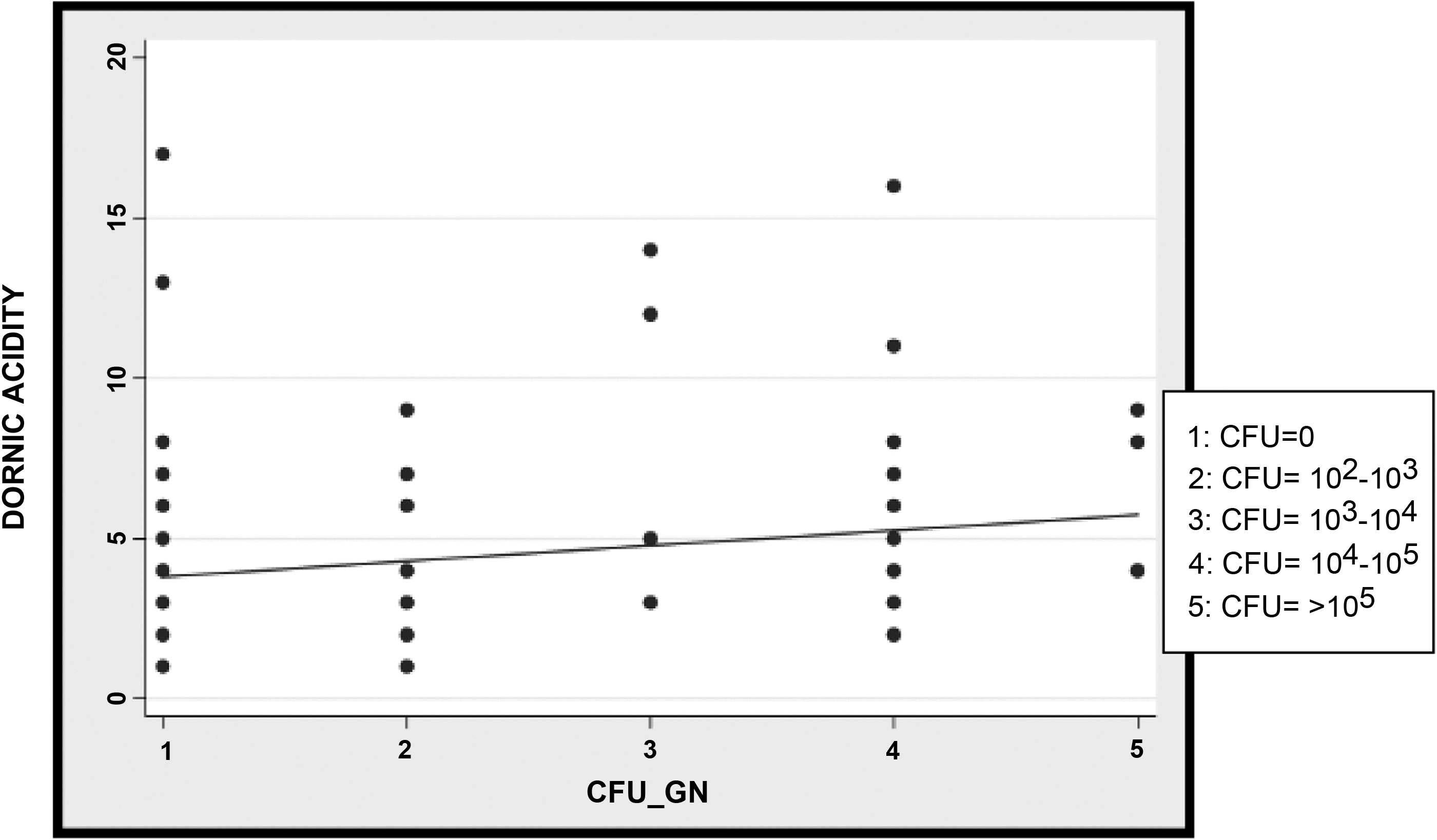
Spearman relationship between Dornic acidity (°D) and Gram-negative (GN) microorganisms. CFU, colony-forming units.
Following pasteurization, a sample was taken from each batch for culture using blood and McConkey's agar cultures and phenotypic identification in case of any growth. Bacillus cereus grew in just four samples (4.5%), and the others were sterile.
Discussion
The measurement of Dornic acidity is a way of classifying donor milk before its pasteurization based in two criteria: quality and safety. Although the correlation between the bacterial growth in milk and Dornic acidity is weak (r=0.20, p=0.0381), it is greater when analyzing growth of Gram-negative bacteria in the selective McConkey's agar medium (r=0.34, p=0.0003) as the lactose-fermenting bacteria are mainly Enterobacteria. The sensitivity of this screening method also increases when analyzing milk with a high content of Gram-negative bacteria (Tables 2 and 3).
In milk with acidity ≥4°D this screening method has a sensitivity of 100% for detecting all the samples with Gram-negative bacterial growth over 105 CFU/mL. Most of the milk processed daily in a milk bank has <4°D. In 2011 mean acidity at the Hospital 12 de Octubre milk bank was 3°D (±1.1°D), and in 2010 it was 3.1°D (±1°D).
If based on this study we would have changed our acceptance criteria in the years 2011 and 2010, we would have discarded 10-fold more milk than with the criteria we actually have at the milk bank (discarding milk with acidity over 8°D) (Table 5). But, perhaps after this study and its results we should think about changing our criteria. There are no uniform criteria in the different human milk banks13,21,22 or associations of banks on milk acceptance criteria, and in the end each bank acts in the most effective way for its situation.14,22–24 By opting for this method when selecting milk we are at an intermediate point between those banks in which the microbiological criteria to accept milk are very strict, and therefore large volumes of milk are disposed of, and banks that do not perform any kind of microbiological control or those that do so at random and therefore pasteurize virtually all the donated milk. Holder pasteurization eliminates most of the pathogenic bacteria; even in this way, performing a control culture to detect contamination during this or defects in the procedure is recommended. 12 In the Hospital 12 de Octubre milk bank we perform analysis of all pools of pasteurized milk; if any bacterium grows, this pool is disposed of because it is not considered suitable for dispensing to recipients. During the 3 years of the Hospital 12 de Octubre human milk bank's operation 2,039 samples of pasteurized milk were analyzed: B. cereus grew in 101 samples (4.9%), Staphylococcus coagulase-negative bacteria grew in four samples (0.2%), and a Escherichia coli isolate grew in one sample (0.04%). Bacillus sp. are sporulated germs whose spore is highly resistant to heat and disinfectants, for which reason it may remain as a surface contaminant in laboratories that is difficult to eradicate. 25 Occasional contamination of pasteurized milk with Bacillus sp.25,26 is a problem common to virtually all milk banks and the food industry. In prior works published from other milk banks 12 the percentage of samples contaminated by this bacterium is similar to that found in this study. Therefore, the main concern when processing highly contaminated milk27,28 is its lower quality from a nutritional point of view.
However, the main advantage of Dornic acidity as a method to select milk prior to pasteurization lies in the fact that it not only quantifies the degree of bacterial contamination, but also provides information on the quality of the milk. Human milk has less calcium than other milk, but its greater bioavailability compensates for this deficit.11,19,29 The proportion of calcium to phosphorus is 2:1, which favors calcium absorption. In addition, there is a relation with casein forming a stable micelle. In an acid medium the casein micelle destabilizes, releasing the calcium.11,19,29
This work reveals how a simple technique that saves money and time enables selecting milk pasteurized in the human milk bank. Performing cultures prior to pasteurization hinders defrosting the milk, taking the amount necessary for seeding, and here we can act in two ways: either we pasteurize this pool without waiting for the result of the culture, although if it is highly contaminated we will have to dispose of a preprocessed pool with the unnecessary expenditure this entails, or we can wait for the result of the culture with the milk in refrigerators at 4°C, which considerably increases bacterial growth, meaning the culture will be invalid. However, Dornic acidity testing is performed at the time of the decision to pasteurize; otherwise the milk can be consumed in situ.
Excluding personnel, the cost of the cultures is greater than that for the determination of Dornic acidity, for which a calibrated burette is required for 0.01 mL, a pipette with pipette tips (€0.01), three test tubes (€0.012 per tube), sodium hydroxide (€24 a pool for 1 L), and phenophthalein (€19 for a pool of 100 mL). This means an approximate cost of €0.057 per determination excluding the nonfungible material. Each milk sample was cultured with one aliquot onto a blood agar plate and another onto a McConkey's agar plate, incubated in an oven at 37°C for 48 hours; the cost of one of the plates is €0.20, that is, it would be €0.40 for each sample analyzed, to which we would have to add the cost of the pipettes, inoculating loop, 30 and oven. Determinations of bacteria are panels that cost between €8 and €10 per sample.
Conclusions
The correlation between Dornic acidity and bacterial growth in donor milk is weak but positive. The sensitivity of the screening method is maximum when analyzing milk with more than 4°D and more than 105 CFU/mL Gram-negative bacteria. The measurement of Dornic acidity could be considered as a simple and economical method to select milk to pasteurize in a human milk bank based in quality and safety criteria.
Footnotes
Acknowledgments
We are grateful to María Luisa Durán and Victoria Franco, technicians from the Hospital 12 de Octubre human milk bank, because without their invaluable help this work could not have been carried out. This study was supported by Instituto Carlos III Spanish Health Research Funding (grant number FIS PI 09/00040).
Disclosure Statement
No competing financial interests exist.