




Abstract
Abstract
Background:
This study investigated the association among breastfeeding, serum zinc levels, and nutritional status of children.
Subjects and Methods:
One hundred healthy infants were included in the study. Anthropometric measurements of the children were taken, and their plasma zinc levels were determined. The mothers were interviewed about the duration of breastfeeding and nutrition pattern of the children at the time of zinc measurement.
Results:
Low zinc levels were associated with lower weight measurements (r=0.49, p<0.001), but the association between height and zinc level was not statistically significant (r=0.18, p>0.05). There was a negative correlation between breastfeeding duration and weight-for-age percentile (r=−0.2, p<0.05), height-for-age percentile (r=−0.3, p<0.05), and serum zinc level (r=−0.3, p=0.002). The pattern of nutrition correlated only with the weight of the infant (r=0.2, p<0.05) and not with either height or serum zinc levels (p>0.05).
Conclusions:
Exclusive breastfeeding beyond 6 months of age has negative effects on serum zinc levels and can be associated with low weight gain, which will be especially important in developing countries.
Introduction
In this study, we measured the serum zinc levels of children between 6 months and 5 years of age and compared these levels with the duration of breastfeeding, pattern of nutrition at the time of measurement, height and weight for age, and number of siblings. To our knowledge, this is the first study showing the relationship among breastfeeding, serum zinc levels, and growth of healthy Turkish children.
Subjects and Methods
This study included 100 infants who were selected at random from the outpatient clinics of Zeynep Kamil Maternity and Children's Diseases Training and Research State Hospital in Istanbul, Turkey, between April and June 2009. All of the children were free of symptoms and were brought to the hospital for routine childhood vaccinations.
All of the mothers and children included in the study live under similar socioeconomic conditions based on income and employment status of the family head. All of the children were born full-term and were free of any chronic or acute disease at the time of evaluation. No child was receiving any zinc supplement. The same physician took anthropometric measurements of all of the children. Nude weight was measured with an electronic scale with an accuracy of 2 g. The heights of children less than 2 years old were measured with the child in the supine position and lying on the scale with a fixed headpiece and movable footboard with an accuracy of 0.1 cm (model 7725 baby scale, medically approved; Soehnle® Professional GmbH, Backnang, Germany). Children older than 2 years were measured in the standing position with a stadiometer (RP Series®; TESS) manufactured in Istanbul, Turkey. The height- and weight-for-age values were evaluated on the basis of anthropometric standards. 10
The mothers were interviewed about the duration for which they breastfed their child, the child's nutrition pattern at the time of measurement, and the mother's parity (number of live births). Information about the duration for which the mothers exclusively breastfed was difficult to pinpoint because they all introduced semisolids during breastfeeding. The duration of breastfeeding was defined as the age at which breastfeeding was completely stopped. The children were divided into three groups based on the duration for which they had been breastfed: Group 1, 0–6 months; Group 2, 6–12 months; and Group 3, >12 months. There were four types of nutrition patterns at the time of measurement: breastfeeding+complementary food, breastfeeding+formula+complementary food, formula+complementary food, and complementary food only.
Blood was collected with fasting for zinc analysis by venipuncture from the antecubital vein or dorsum of the hand into glass tubes. Serum was separated immediately and studied within 24 hours. Plasma zinc levels were determined with the deproteinization and (2-5-bromo-2-pyridylazo)-5-(N-propyl-N-sulfopropylamino) phenol methods. Serum zinc levels were considered low when under 70 μg/dL (BT products®) (normal range, 60–110 μg/dL; minimum detection limit, 5 μg/dL; intra-observer coefficient of variance, 2%, 95; interobserver coefficient of variance, 1%, 46) (manufactured by Bilimsel Medical Ltd., Izmir, Turkey).
The study was approved by the ethical committee of Zeynep Kamil Maternity and Children's Diseases Training and Research State Hospital. Written informed consent was obtained from the parents of the children.
Statistical analysis
The t test was used for the evaluation of continuous parameters. To analyze the relationship between grouped variables, the χ2 test and analysis of variance were used. Correlations were made by Pearson's product moment correlation coefficient. Spearman's ρ was used for the nonparametric correlations between height and weight percentiles, nutrition pattern, duration of breastfeeding (three groups), and serum zinc levels (two groups).
A value of p<0.05 was considered significant. The analysis was carried out by SPSS software (release 16; IBM®, Armonk, NY).
Results
The study included 100 children between 6 and 28 months in age (62 boys and 38 girls). The median age was 16.5 months. There were six infants who had never been breastfed and 14 infants who were breastfed for the longest duration of 24 months. Distributions of the children according to the duration of breastfeeding, serum zinc level, nutrition pattern, and height and weight percentiles are given in Table 1. In addition, 42 children were still being breastfed at the time of study, in combination with complementary food or formula.
The p values for group comparisons are given.
By χ2 test. A value of p<0.05 was considered significant.
BF, breastfeeding; CF, complementary food; F, formula.
There was no relation between the serum zinc levels and age, sex, and number of siblings (p>0.05).
Serum zinc concentrations of the infants
The median zinc concentration was 68 μg/dL (minimum, 38 μg/dL; maximum, 289 μg/dL). There were 56 children with serum zinc levels under threshold (<70 μg/dL). Levels of zinc concentration based on the duration of breastfeeding and nutrition pattern are given in Table 2. Statistically significant relationships between type of nutrition and serum zinc level were found between the breastfeeding+complementary food and the complementary food groups (p<0.05). Breastfeeding duration was negatively related to serum zinc level groups (p=0.01; 95% confidence interval, 0.8–6.4).
The p values for group comparisons are given.
By χ2 test. A value of p<0.05 was considered significant.
BF, breastfeeding; CF, complementary food; F, formula.
Growth of the infants
Boys had higher weights and heights than girls (p<0.05). There was strong positive correlation between weight and height (r=0.8, p<0.001). Low zinc levels were associated with lower weight measurements (r=0.49, p<0.001), but the association between height and zinc level was not statistically significant (r=0.18, p>0.05).
There was negative correlation between breastfeeding duration and weight-for-age percentile (r=−0.2, p=0.015) (Fig. 1a), height-for-age percentile (r=−0.3, p=0.001), and serum zinc level (r=−0.3, p=0.002) (Fig. 1b).
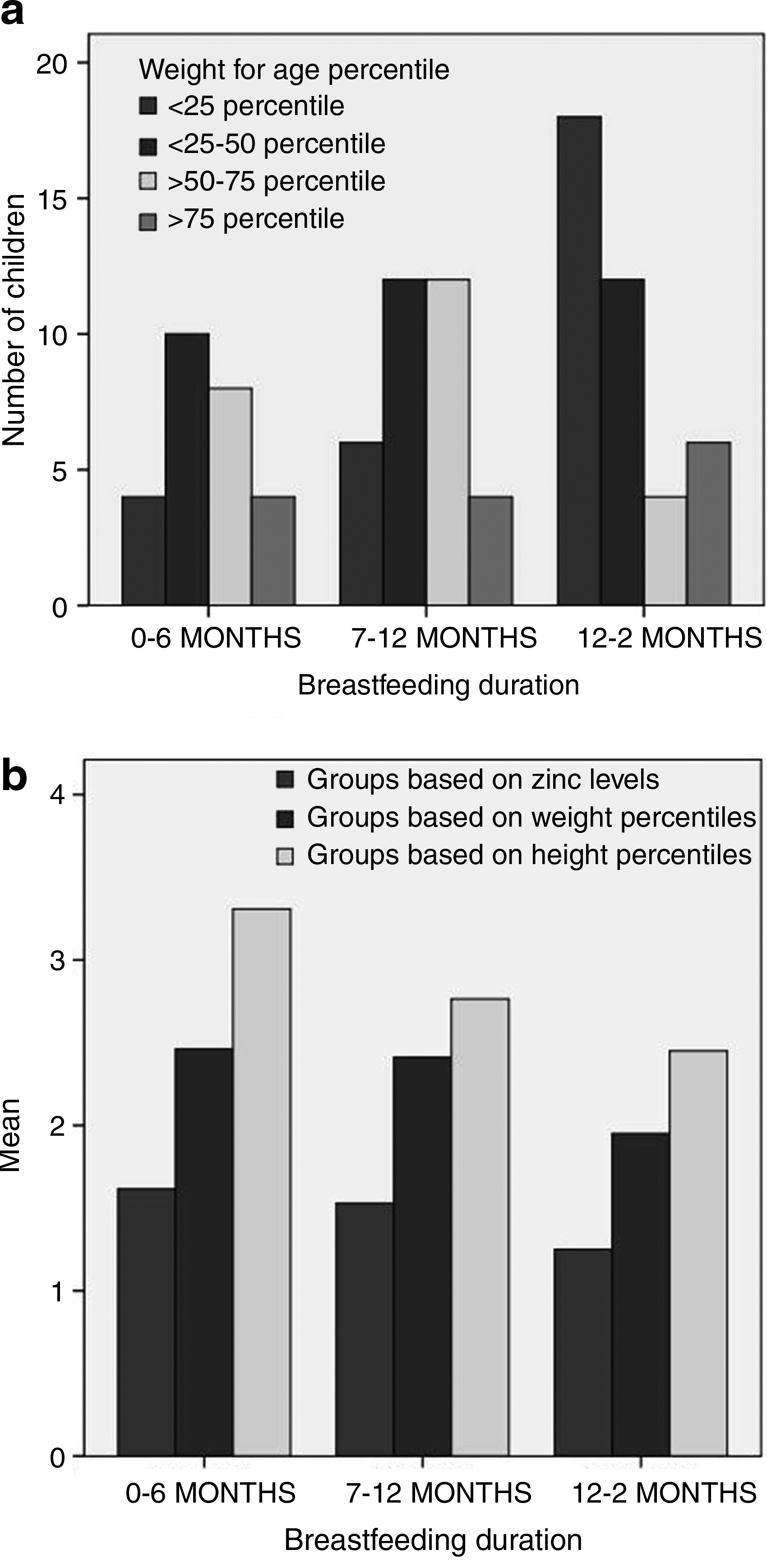
Distribution of
The pattern of nutrition correlated only with weight of the infant (r=0.2, p=0.04) but not with either height or serum zinc levels (p>0.05).
Low zinc concentrations were associated with impaired growth based on weight-for-age percentiles but were shown to have no effect on height-for-age percentiles. Breastfeeding for longer periods was associated with impaired weight- and height-for-age percentiles and low serum zinc levels.
Discussion
To our knowledge, this is the first study from Turkey investigating the relationship among breastfeeding duration, serum zinc levels, and growth of healthy infants. In this study, there were 56 children with serum zinc levels under threshold, and breastfeeding duration was negatively related to serum zinc levels and growth in healthy children.
Zinc in human milk is very important for the growth and development of newborns.3,4 Deficiency of zinc may lead to adverse effects on growth, motor development, and immunity, especially in preterm infants.3,5,6 Growth velocity is the main determinant of infant zinc requirements. 11
The zinc level in breastmilk at the first month was found to be significantly higher than the level at the third month. The concentration of zinc in breastmilk dropped by 40% between the first and third months of lactation. 2
The growth rates of infants slowed down as the infants approached the age of 3 months from that at 1 month. 2 This study showed the relationship of the growth rate of the infant and the zinc level in breastmilk. 2 Human milk zinc levels fall as lactation continues.12–14 In a study from Finland, zinc concentrations in serum of infants did not correlate with the changes in the length or weight SD scores; however, infants with the lowest zinc concentrations had the highest rates of growth. 15 This result is contrary to ours and to general knowledge about the action of zinc on growth.
Nutritional status may become marginal in infants who are exclusively breastfed beyond 3–6 months of age. 16 Analysis of nutritional status against duration of breastfeeding from Brazil revealed that children who were breastfed for 3–6 months presented with better nutritional status than those who were breastfed for either less than or more than 3–6 months. 16 Breastfeeding infants after 6 months of age may be associated with a higher risk for malnutrition than the situation that exists in non-breastfed children. 16 These studies were small studies in single populations; also, our study was a retrospective study, and the findings may or may not be generalizable to other populations. These results are consistent with the results of our study, as we also conclude that the weight-for-age percentile decreases significantly as the duration of breastfeeding increases.
Okolo et al. 17 found low levels of zinc in milk specimens of 15 mothers, whereas the levels in sera of exclusively breastfed infants were within normal limits. The levels of zinc were approximately the same in maternal serum and milk, whereas the infant serum levels of zinc were 21% greater than the maternal serum levels. 17
Although numerous studies have reported the nutrient composition of human milk around the world, little is known about the levels of zinc in the milk of Turkish women.2,3,13,17 A study from Turkey comparing the zinc levels in breastmilk from mothers of term and preterm infants clearly showed that zinc levels were significantly lower in milk from mothers of preterm infants compared with those in mothers of term infants. 18 Studies agree that premature infants especially should be supplemented with zinc when breastfeeding.3–6,18 Insufficient zinc intake from breastmilk can lead to severe zinc deficiency syndrome.4–7 Full-term and exclusively breastfed infants can show severe clinical symptoms.7,19,20 Premature infants can exhibit zinc deficiency symptoms by the age of 9–13 weeks.8,20,21
Using the published data about the content of human milk from populations worldwide as a point of reference, we mainly aimed to show the effect of breastfeeding on children concerning their heights, weights, and serum zinc levels.2,3,12–14,17 It seems that breastmilk early in pregnancy has high zinc content, but later in pregnancy the zinc content is lower.
Studies are in agreement about the decrease of zinc level in breastmilk with increasing postpartum interval.2,12 Second, the oral intake of zinc-containing foods could decrease in children as they continue to be breastfed.
The limitation of this study is that the serum zinc level may not be an indicator of long-term zinc status of the body. Also, breastfeeding duration was determined by retrospective report only. There is no demonstration of any functional significance of low zinc levels to the degree reported in our article. Although longer breastfeeding is correlated with low weight and low zinc levels, that correlation does not prove causation. Duration of breastfeeding could be a surrogate for another factor associated with low zinc levels and low weight that tracks with longer breastfeeding.
Our results of low serum zinc levels in healthy children suggest that zinc deficiency exists as a subclinical biochemical finding. Exclusive breastfeeding beyond 6 months of age can be associated with low weight gain, which will be especially important in developing countries. According to this finding, it should be emphasized that the addition of complementary foods to the diet, especially of foods that are rich in zinc, should not be delayed beyond 6 months of age in infants and, in particular, in preterm babies. Also, zinc-binding phytates play a role in zinc absorption. It was shown early in animal studies that phytate has an inhibitory effect on zinc absorption. 22 The addition of phytate to milk formula reduced zinc absorption to a level similar to that from milk formula, supporting the belief that the low zinc absorption from soy was due to its phytate content. When the phytate was removed from soy protein isolate by a precipitation process, zinc absorption was significantly improved. 23 Thus, any reduction in dietary phytate content is likely to result in an improvement in zinc absorption.This would be a reason to not introduce zinc-binding phytate solids such as grains or pulses to infants too early.
Zinc deficiency and supplementation should be considered in children presenting with failure to thrive, especially those who had exclusively breastfed for a long time.
Footnotes
Disclosure Statement
No competing financial interests exist.