




Abstract
Abstract
Objective:
Black tea is associated with antioxidant properties. The objective of this study was to investigate the effect of the amount of black tea consumption during pregnancy on the oxidant/antioxidant status of breastmilk.
Subjects and Methods:
Breastmilk was obtained from 30 mothers and analyzed for lipid peroxidation based on levels of malondialdehyde (MDA) and of reduced glutathione (GSH). In a survey completed by all participants, daily black tea consumption during the pregnancy was reported.
Results:
No correlation was found between the amount of black tea consumed and levels of MDA (p=0.401) and/or GSH (p=0.473). The results of this study indicate that consumption of varying amounts of black tea does not affect the oxidant/antioxidant status of breastmilk.
Conclusions:
The insensitivity of breastmilk to antioxidant contributions by black tea reflects the capacity of breastmilk to be resistant to the myriad of factors that otherwise affect a pregnant woman.
Introduction
Disruptions in the balance of oxidants and antioxidants can also affect newborns because this phase of development is a more sensitive period of life with a low antioxidant capacity. 3 Moreover, for many newborns, their primary source of nutrition is breastmilk, which is directly affected by the mother's diet.4–6 Human milk contains many bioactive compounds that are part of the defense system against the action of different free radicals.7–9 Correspondingly, many mothers significantly modify their diet during pregnancy out of consideration for the health of the baby. 10 For some mothers, their consumption of tea is modified during pregnancy. Different types of tea, particularly black tea, contain naturally occurring antioxidants. 5 Correspondingly, higher levels of antioxidants have been detected in blood samples obtained from mothers who consumed black tea versus those who did not. 6 However, antioxidant levels have not been assayed in breastmilk obtained from mothers who consumed black tea. Therefore, the objective of this study was to determine whether the levels of oxidants and antioxidants present in the breastmilk of mothers who recently gave birth were affected by the levels of black tea consumption during pregnancy.
Subjects and Methods
Informed consent was obtained from 30 postpartum who agreed to complete a survey reporting dietary habits in order to define the homogeneity of the study population and the amount of black tea consumed during pregnancy and to provide a sample of breastmilk 2–3 days after giving birth at Baskent University Hospital (Ankara, Turkey). They were all healthy, well-nourished women who were routinely followed by a obstetrician during pregnancy. None of them was a smoker, all performed at least a low level of physical exercises, and there were no major pregnancy problems. This study was approved by the local ethical committee and conducted according to the Declaration of Helsinki.
The participants were asked to indicate how many cups of tea per day were consumed, as well as the size of the cup used and whether the tea consumed was “concentrated” or “dilute.” For statistical convenience, 2 cups of tea were considered to be equal to 1 cup of coffee, and two light teas (dilute) were considered to be equal to one strong tea (concentrated).
Breastmilk (10 mL) was collected from study participants using a breastmilk pump between 7:00 a.m. and 8:30 a.m. (because of the higher density of milk obtained during this time period) 11 between 2 and 3 days after birth. Samples were stored in sterile test tubes at −80°C, in accordance with previous studies. 12 Levels of GSH (e.g., GSH analysis) and levels of lipid peroxidation (e.g., MDA analysis) were detected in these samples of breastmilk using the methods of Ellman 13 and Buege and Aust, 14 respectively.
Levels of MDA were detected to obtain a lipid peroxidation index value according to the thiobarbituric acid reaction previously described. 14 In brief, 1 volume of breastmilk was combined with 2 volumes of a stock reagent (14% trichloroacetic acid, 0.375% thiobarbituric acid, 0.25 N HCl). After samples were heated for 15 minutes in boiling water, samples were then cooled and centrifuged at 1,000 g for 10 minutes. The absorbance of each supernatant was measured spectrophotometrically (Shimadzu 1600 spectrophotometer; Shimadzu, Tokyo, Japan) at 535 nm against a reagent blank. Quantitation of MDA was performed using an MDA calibration curve determined from serial dilutions of a stock MDA standard (1,1,3,3-tetraethoxypropane) solution, and results were expressed as nanomoles of MDA per milliliter. The measurement range for MDA in breastmilk was found to be between 2.00 and 20.00 nmol/mL. Method reproducibility was evaluated as within-run, between-run, and between-day precision for milk samples and detected as, respectively, 2.16%, 1.17%, and 11.40% in terms of coefficient of variation. For recovery analysis, seven samples were spiked with 2.5 nmol/mL 1,1,3,3-tetraethoxypropane calibrator, and the recovery was measured as 125%.
Levels of GSH were determined according to the method of Ellman. 13 In brief, after deproteinization of milk samples, supernatants were combined with Ellman's color reagent (40% [wt/vol] 6,6'-dinitro-3,3'-dithiodibenzoic acid in 1% sodium citrate) to react with any sulfhydryl groups present. The resulting color generated was measured immediately at 412 nm against a reagent blank. Quantitation of GSH was performed using a GSH calibration curve, and results were expressed as nanomoles of GSH per milliliter. The GSH measurement range for breastmilk was determined as between 16.27 and 976.15 nmol/mL. For reproducibility analysis, within-run, between-run, and between-day precision values for milk samples in terms of percentage coefficient of variation were calculated as, respectively, 10.50%, 12.08%, and 7.05%. Recovery analysis was performed in seven samples spiked with GSH calibrator (32.54 nmol/mL), and the recovery was measured as 76%.
Statistical analysis was performed using Statistical Package for the Social Sciences, Windows version 10.1 (SPSS Inc., Chicago, IL). Nonparametric correlation analyses of the amount of tea consumed, as well as of the amount of MDA and GSH in each of the samples, were performed. Spearman rank correlation coefficients and p values were obtained. A p value of <0.05 was considered statistically significant.
Results
The study group consisted of 30 nonsmoking mothers who were willing to donate breastmilk between 2 to 3 days after giving birth. The mean age of the cohort was 25.3±5.4 years (range, 18–38 years). Daily tea consumption through the pregnancy period was reported to range from 1 to 10 cups (mean, 3.1±2.2 cups), and the mean MDA (Fig. 1) and GSH (Fig. 2) levels detected in the breastmilk samples analyzed were 6.45±1.85 nmol/mL (range, 3.03–11.25 nmol/mL) and 135.15±79.7 nmol/mL (range, 29.28–344.94 nmol/mL), respectively.
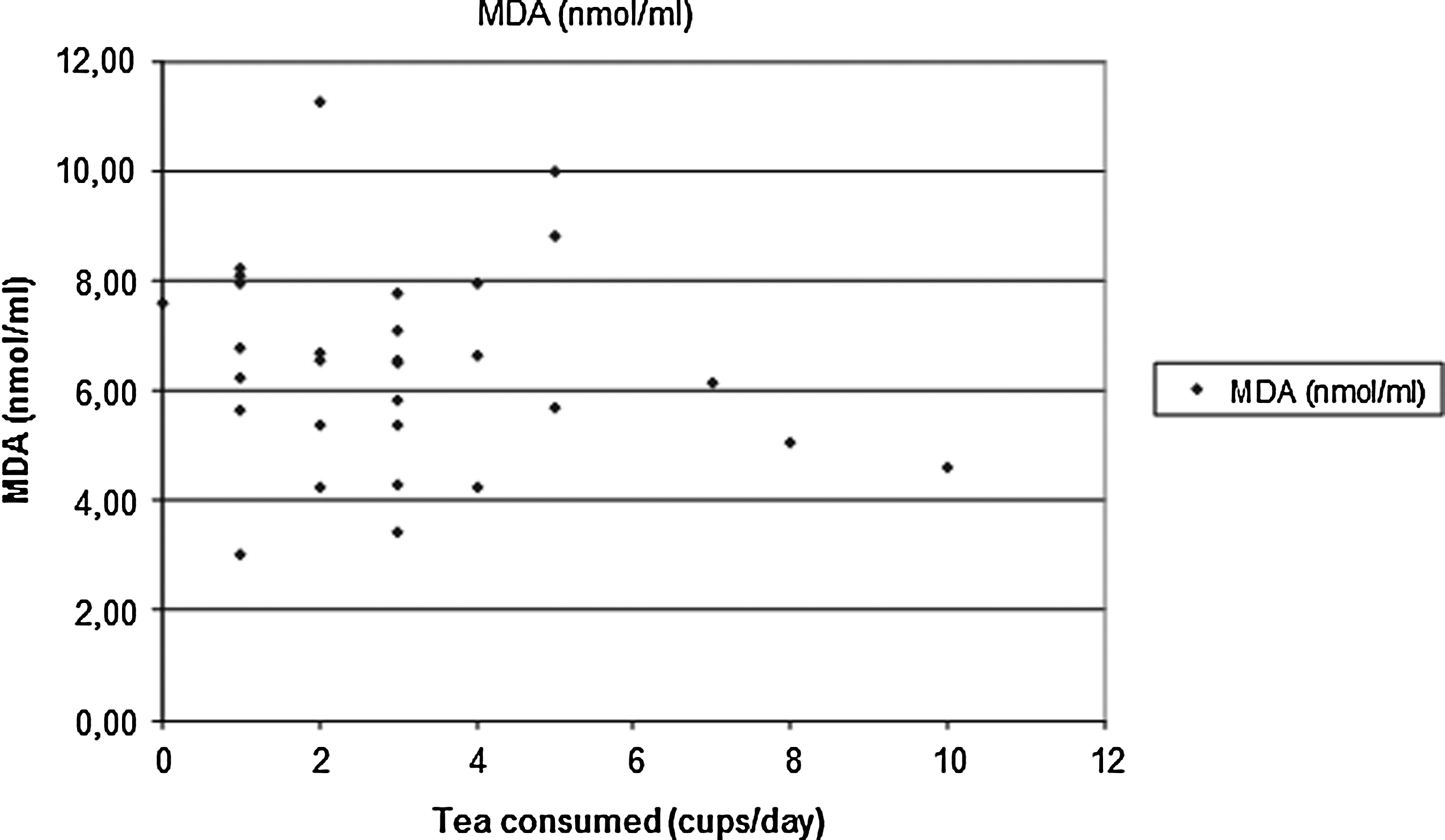
Rate of tea consumption and the corresponding malondialdehyde (MDA) concentration for each breastmilk sample collected and analyzed (n=30).
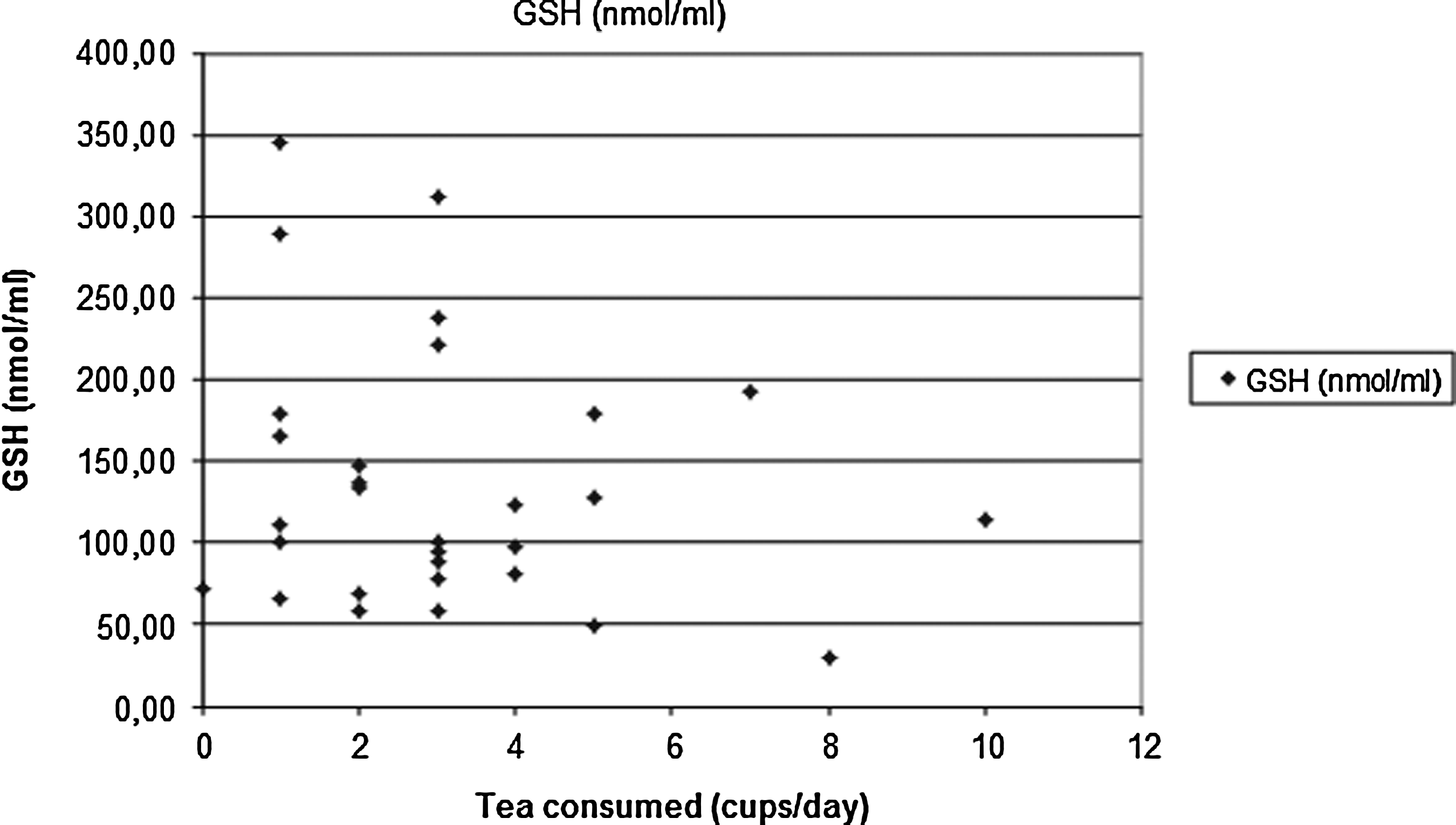
Rate of tea consumption and the corresponding reduced glutathione (GSH) concentration for each breastmilk sample collected and analyzed (n=30).
The highest level of MDA detected was 11.25 nmol/mL. The corresponding participant indicated that she consumed 2 cups of tea per day. The lowest level of MDA detected in a breastmilk sample was 3.03 nmol/mL, which was associated with consumption of 1 cup of tea per day.
The highest level of GSH detected was 344.94 nmol/mL, associated with a mother who reported consumption of 1 cup of tea per day, whereas the lowest level detected was 29.28 nmol/mL, associated with consumption of 8 cups of tea per day.
Discussion
The present study focused on two parameters of breastmilk relevant to the oxidant/antioxidant properties: (1) GSH, a tripeptide that is very sensitive to free radical attack, 11 and (2) the concentration of MDA, which is a last-step lipid peroxidation product and therefore a good marker of the degree of the oxidation process. 15
For this cohort, no correlation between the amount of black tea consumed during pregnancy and the levels of GSH (p=0.473) and MDA (p=0.401) detected in breastmilk samples collected 2–3 days after birth was found (Figs. 1 and 2). The highest levels of GSH were associated with a consumption level of 1 cup of black tea per day, and the lowest levels of GSH were associated with the consumption of 8 cups of black tea per day. Similarly, the highest levels of MDA were detected in breastmilk obtained from a participant who reported the consumption of 2 cups of black tea per day, and the lowest levels of MDA were associated with the consumption of 1 cup of tea per day. Thus, the hypothesis that mothers who consume a high amount of black tea have higher levels of antioxidants and lower levels of oxidative damage in their breastmilk was not supported. However, the average GSH and MDA values obtained in this study (135.15–79.70 and 6.45–1.85 nmol/mL, respectively) were similar to those of another study where levels of GSH and MDA were assayed in stored breastmilk (192.2 and 5.8 nmol/mL, respectively).11,15 In fact, the current literature does not appear to be sufficient, in view of the great disparity of reported levels. Moreover, the heterogeneity of the study methods used (including sample collection protocol, study parameters, measurement units used, etc.) makes it impossible to establish comparisons among the different studies. 6
There were limitations associated with the present study. Given the sensitivity of the oxidant/antioxidant system in vivo, the approximate amount of tea consumed may not be adequate to represent such a delicately balanced system. Because many factors can systemically affect the oxidant/antioxidant system, medications or any diseases present in study participants might have influenced the results. However, all the women were apparently healthy, well-nourished breastfeeding mothers. Analyses for other dietary sources have not been performed as in many similar reports.6,7,11,15 Although green tea has been shown to have a greater antioxidant capacity than black tea, 15 because the most consumed tea product in Turkey is the black one, we investigated its consumption in this study. Similarly, the effects of other beverages, such as wine and fruit juices, could be also evaluated, as well as the method of beverage preparation and its effects on antioxidant activity. Another important aspect of this study is that it included participants from Turkey, and the preparation of tea in this region differs from that of other countries. For example, boiling water is added to the tea for it to brew, while a more common method is to use packed teas, which have a higher antioxidant content. 16 Correspondingly, although the antioxidant property of both black and green tea has been demonstrated in many studies, the method for preparing the teas evaluated in these studies is not specified.17,18 Currently, there are no published Turkish studies regarding the antioxidant properties of tea; thus, the effects of the Turkish method of preparing tea is not known. Furthermore, the boiling of tea may also affect the flavonoid content to decrease the activity of these compounds, which are known to mediate antioxidant effects. In combination, these factors suggest that the method for boiling tea and its effects on the antioxidant properties of tea need to be investigated.
Conclusions
To the best of our knowledge, this is the first study to investigate the relationship between the oxidant/antioxidant content of breastmilk and black tea consumption, and no correlation was found. In conclusion, we think that our results indicate that not every factor that affects the mother also affects breastmilk oxidant/antioxidant status. New studies with higher numbers of patients regarding the role of black tea to the antioxidant system of breastmilk, or additionally regarding its influence on offspring, will be important to elucidate this topic.
Footnotes
Disclosure Statement
No competing financial interests exist.