




Abstract
Abstract
Exploration of the Medici Chapels in the Basilica of San Lorenzo in Florence, Italy, revealed the burials of nine infantile members of the Medici family. Eight children were found in the intact tomb of the last Grand Duke GianGastone (1671–1737), and another child was exhumed from the Chapel of Grand Duke Ferdinando I (1549–1609). Skeletal ages ranged from newborn to 5 years, suggesting an identification with infantile members of the family. A paleonutritional study has been performed on the bone samples of all members of the Medici family exhumed so far. Carbon and nitrogen stable isotope analysis of bone collagen was used to detect the timing of the weaning process in this population. The 15N values of the Medici children are significantly higher than those of adults, indicating that these infants were breastfed for a long time period. In particular, the levels of 15N are high before the second year but decrease in older children, evidently after weaning, reaching the levels of adults. During the Renaissance, it was the common opinion that children should not be weaned before the second year of life. Archival documents suggest that the Medici children were never weaned before that age and, in most cases, even some months later. Combination of paleonutritional data and historical sources allowed reconstruction of the breastfeeding and weaning patterns of this aristocratic Renaissance class.
Introduction
The members of the Medici family were buried under the crypt floor of the Basilica of San Lorenzo in Florence. Since the onset of the “Medici Project” in 2004, the remains of the family members belonging to the branch of the Grand Dukes of Tuscany, which started with John of the Black Bands (1498–1526) and ended with GianGastone (1671–1737), have been investigated from both an anthropological and paleopathological point of view.1,2
Some burial sites had already been explored after the Second World War. 3 Therefore we decided to begin our examination with the tomb of GianGastone, the last Medici Grand Duke, which was intact. Removal of a marble disk in the floor of the chapel, initially considered only a simple floor decoration, displayed a secret opening with a small stone stair leading to a hidden crypt. The small funerary crypt revealed a low raised plank, which supported a large sarcophagus containing the intact funerary deposition of the last Grand Duke. Other small coffins, distributed irregularly on the floor and on the plank of the crypt, as a consequence of the Arno flooding of 1966, contained the remains of children (Fig. 1). The presence of water in the crypt also caused large bone movements, so that the remains of many individuals came out of the coffins and were scattered in different positions, resulting in some cases in a bone mix. A layer of dry mold still covered the floor and the plank, enveloping also the bones outside the coffins. Furthermore, there was no element either outside or inside the crypt that could help with the identification of the children's remains.
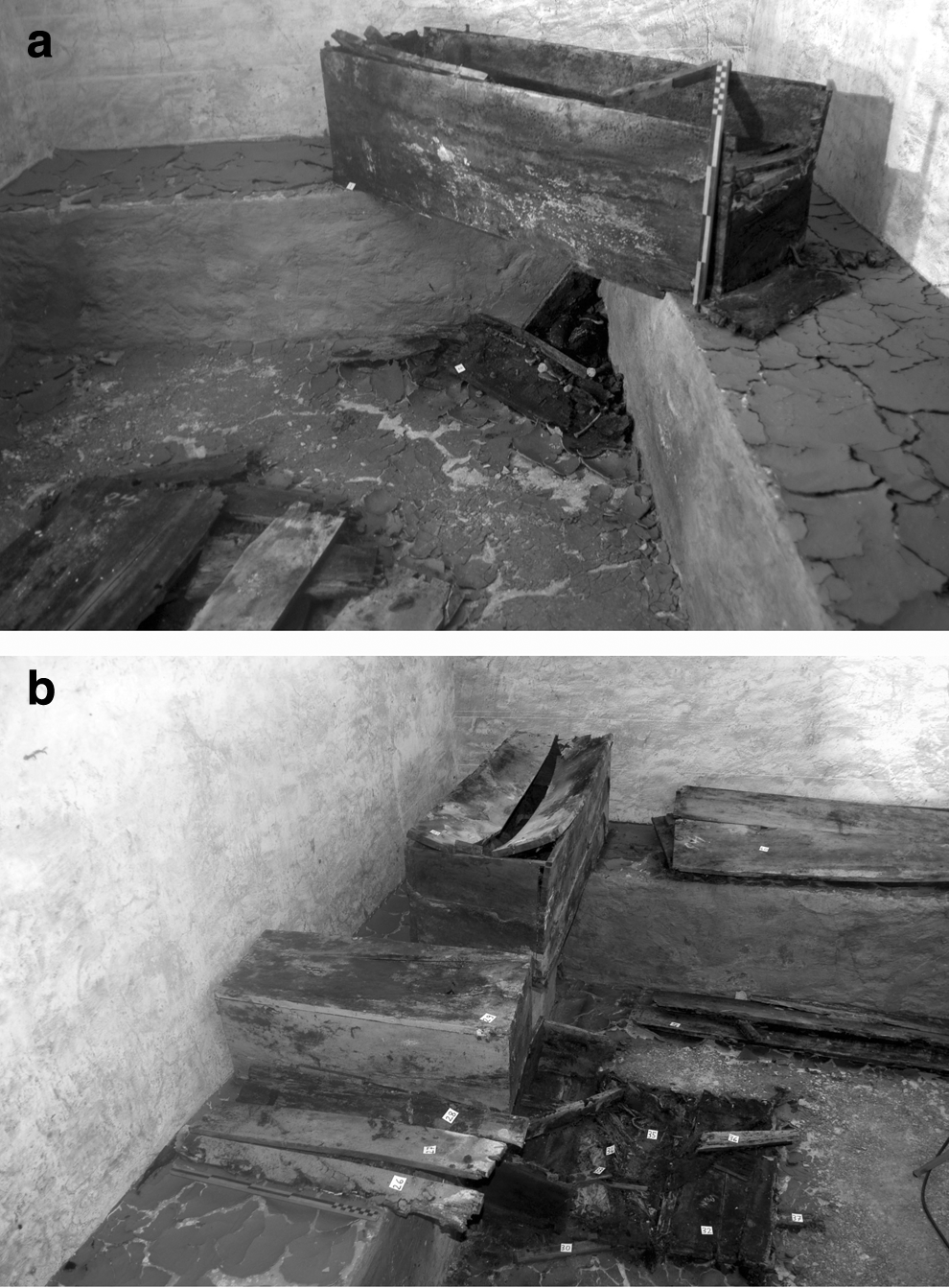
The crypt of GianGastone, with the small coffins containing the children's remains, collapsed to the floor or randomly distributed on the raised plank:
Another infantile member of the family was buried in the Chapel of the Grand Duke Ferdinando I (1549–1609); the skeletal remains were contained in a zinc box including an epigraph that reported the name of Filippo (1598–1602), sixth child of Ferdinando and Cristina.
The excellent state of preservation of the skeletal remains of the Medici children, whose bone remains were subjected to anthropological examination, offered a unique opportunity to study this Renaissance high social class sample. Paleonutritional analysis was carried out with stable isotopes, in order to evaluate the alimentary patterns of this infantile sample belonging to the Renaissance aristocracy. The results of paleonutritional data were compared with the information about breastfeeding and weaning patterns in the Renaissance, as provided by historical sources.
Materials and Methods
The anthropological study of the Medici children allowed reconstruction of the single skeletons and identification of the bones scattered in the crypt. There turned out to be eight infants buried in the GianGastone crypt, in addition to the child (MED9) deposited in Ferdinando's lateral chapel. The children's skeletal ages range from newborn to 5 years. The results of the anthropological study were compared with the information supplied by archival and documentary sources regarding the children of the family who died at infantile age (Fig. 2). In this respect, an identification of the children was proposed. 4
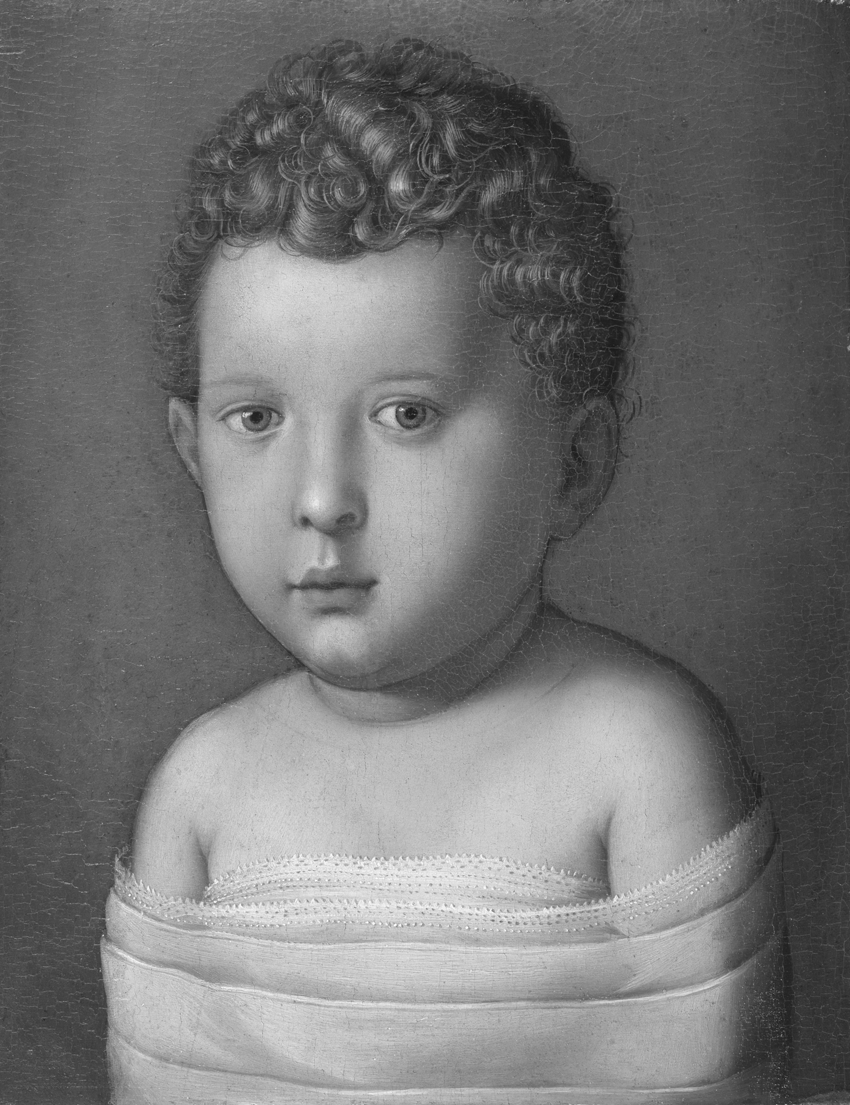
Portrait of an unidentified child of the Medici family. By Bronzino, in the collection of The Walters Art Museum, Baltimore, MD.
The child labeled MED40.2 is a male with a dental age of 4 years±9 months and a diaphyseal age of 5–6 years. He can be identified as Filippo (April 9, 1598–April 3, 1602), sixth child of Ferdinando I and Cristina of Lorena, who died at nearly 4 years of age.
MED40.22/42 showed an anthropological age slightly older than 1 year and was identified as Anna (March 10, 1552–August 6, 1553), daughter of Cosimo I (1519–1574) and Eleonora of Toledo (1522–1562), who died at nearly 18 months of age.
The child labeled MED40.29/31 showed an age at death of 9 months±3 months, on the basis of dental development, and of 6 months, on the basis of diaphyseal length. The child could be identified as one of three possible members of the family: Don Pietro or Pedricco (August 1546–June 9, 1547), son of Cosimo I and Eleonora of Toledo, who died at 10 months of age; Isabella (September 30, 1571–August 8, 1572), daughter of Francesco I (1541–1587) and Giovanna of Austria (1547–1578), who died at 11 months of age; or Antonio (July 1, 1548–?), eighth son of Cosimo I and Eleonora of Toledo, whose date of death is unknown.
MED40.34 is a newborn who could be identified as Romola (November 20, 1568–December 2, 1568), daughter and second child of Francesco I and Giovanna of Austria, who survived only 12 days after birth, or as an unnamed daughter (May 31, 1641) of Ferdinando II (1610–1670) and Vittoria della Rovere (1622–1694), who died on the same day of her birth.
MED40.39 revealed a diaphyseal age of 6/7 years and a dental age of 5 years±16 months and can certainly be identified as Don Filippino (May 20, 1577–March 29, 1582), son of Francesco I and Giovanna of Austria, who died at nearly 5 years of age.
MED40.40 was 24 months±8 months old on the basis of the dental maturity levels and 18 months on the basis of the length of the long bones and could be identified as Lucrezia (November 7, 1572–August 14, 1574), daughter of Francesco I and Giovanna of Austria, who died at the age of 22 months.
MED40.45 and MED40.34 are both newborns and can therefore be identified in the same way.
MED40.48 shows a dental age of 9±3 months and a diaphyseal age of 6–12 months, like MED40.29/31, and could therefore be identified as Don Pedricco, son of Cosimo I and Eleonora of Toledo, as Isabella, daughter of Francesco I and Giovanna of Austria, or as Don Antonio, son of Cosimo I and Eleonora of Toledo.
Finally, MED9 revealed an anthropological age very similar to that of MED40.29+31 and MED40.48, and therefore the same possibilities of identification are suggested.
A paleonutritional study has been carried out on all the members of the Medici family so far exhumed. Isotope analyses were performed on bone samples by Arthur C. Aufderheide (University of Minnesota, Duluth, MN) and by Carmine Lubritto (2nd University of Naples, Naples, Italy) according to standard methods. 5
Carbon and nitrogen stable isotope analysis of bone collagen represents a routine method for determining past diets in archaeological populations. The two most common stable isotope ratios used for paleodiets are 18C and 15N. Stable isotope ratios are presented as delta (δ) values in parts per thousand (‰) relative to international standard reference material. δ13C and δ15N values in the organic protein portion of bone (collagen) are directly related to dietary intake; therefore, collagen in the ancient human bone makes it possible to reconstruct the local dietary systems and to interpret human diet and subsistence patterns.
Stable carbon and nitrogen isotope ratios can also be used to detect the timing of the weaning process in past populations.6–14 Breastfeeding and weaning patterns can be reconstructed by measuring isotopic ratios in bone collagen from infants and children of known age.
Breastfed infants are one trophic level above their mothers in the food chain because they are essentially consuming their mother's tissue through the ingestion of breastmilk.15,16 Thus, when an infant is breastfeeding, his or her δ15N values are elevated by 2–3‰ compared with the mother12,17; this is the pattern one would expect in exclusively breastfed infants.
At and prior to birth the δ15N values of the infants should be equivalent to those of their mothers because the tissues of the infant are formed by the constituents of the same foods consumed by the mother. During the weaning process, the introduction of supplementary foods is signaled by a gradual decline in infant δ15N values. After the cessation of breastfeeding, the infant protein δ15N values reach adult values, as children are expected to consume foods that are similar to those of adult females after the weaning period.8,18,19
Results
The results of the paleonutritional study carried out on bone collagen samples of the members of the Medici family so far exhumed are presented in Table 1. 20
δ15
Overall, δ15N values in the Medici children range from 11.45‰ to 16.6‰, with a mean value of 14.7‰. The mean δ15N value for all individuals ≤2 years of age is 14.85‰, whereas the mean δ15N for individuals over 2 years of age is 11.5‰.
Discussion
The δ15N values of the Medici children are significantly higher than those of adults, indicating that these children were breastfed. In particular, the level of nitrogen is high before the second year but decreases in older children, evidently after weaning, reaching the levels observed in adult subjects. δ15N values are higher at 0.9–2 years of age, during which time children must be gaining all or most of the proteins in their diets from breastmilk. In the child of 4 years the values decrease, approaching the adult mean, as expected after weaning. The relatively high value of the 5-year-old infant identified as Don Filippino cannot be explained by the exclusive breastfeeding, considering the advanced age. Historical sources refer to a weak and unhealthy Filippino, who suffered from recurrent illness episodes. Because of the child's frail status, he is likely to have had a rich alimentation, particularly abundant in meat; alternatively, breastfeeding might have been prolonged beyond 2 years of age, even if probably combined with the introduction of solid foods. The high values of the two Medici newborns indicate that the mothers' diets had high average nitrogen concentrations during pregnancy. A 9-month-old child shows low δ15N values, suggesting that this individual was weaned earlier and that supplementary foods were probably introduced into the diet starting at around 6 months of age.
The 15N analysis confirms that weaning of these high social class children took place around 2 years of age, as shown in Figure 3. 21
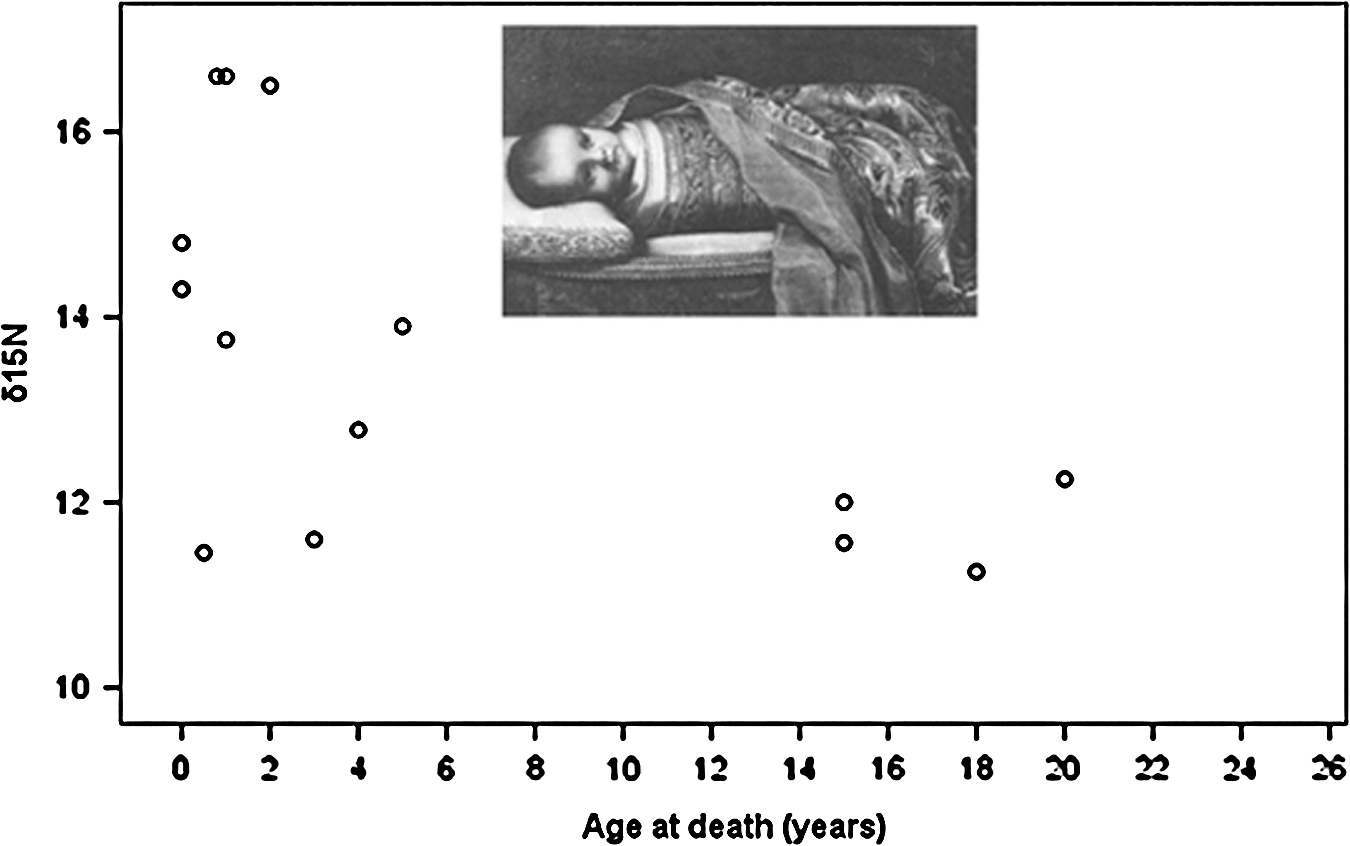
δ15N analysis of the youngest members of the Medici family.
During the Renaissance it was the common opinion that children should not be weaned before the second year of life; for this reason, mercenary breastfeeding (employing wet nurses) was very widespread among élite classes. Furthermore, in the royal families of the Renaissance, this custom allowed queens and princesses to quickly become pregnant again and provide sons for political alliances, shortening the inter-birth intervals. Wet nursing was diffused also among the middle classes because the wives of merchants, lawyers, and doctors considered it to be less expensive to employ a wet nurse than to hire a woman to perform household works in their place or to help their husbands in their business. 22 In the lower classes children were most commonly breastfed by their mothers because the family could not afford the costs of engaging a wet nurse. 23 However, wet nursing was a well-paid occupation, and therefore many poor women would often get rid of their children to seek employment as wet nurses; the children were left in foundling hospitals, such as the well-known Spedale degli Innocenti in Florence, where they were breastfed by wet nurses recruited and paid by the institution. In some cases the mothers expressed the intention of taking back the children once their role of wet nurse was concluded, and therefore abandonment of their children was only temporary. 24
Following the costume of the aristocratic classes, the women of the Medici family did not usually breastfeed their children, but engaged wet nurses to whom the infants were committed. They chose the wet nurses among the servants of the house, preferably among women from the countryside, who offered more guarantees of health and robustness; the same wet nurse generally took care of a child until weaning was completed, and a wet nurse could be recalled for more than a child, when the family was satisfied with her work. 25
Documentary sources from the Late Middle Ages onwards attest that weaning was a gradual process, and several authors advised waiting until the child was healthy and able to eat solid food before weaning was attempted. 23 Francesco da Barberino 26 in his Reggimento e costumi di Donna of 1348 recommends waiting 2 years before introducing other food in the diet of children. Paulus Bagellardus, 27 author of the first printed book dealing exclusively with children's diseases (in 1472), suggests waiting until the child's body is well formed and sturdy for the introduction of solid food. In his studies of the family in Renaissance Florence, deriving from the Ricordi and Ricordanze, Klapisch-Zuber 28 found that the average age for weaning was 18.7 months.
As for the weaning modalities, in the 14th century Paolo da Certaldo 29 suggests that wet nurses should only breastfeed for the first year of life and then “begin to give, aside from the breast, other things to eat, little by little”; this suggestion is repeated by Francesco da Barberino. 26
The composition of these foods is variegated. In the 13th century, Aldobrandino from Siena suggested preparing paps with soft parts of bread and apple, 30 while Francesco da Barberino 26 reported use of bread soaked in milk or apple juice. Paulus Bagellardus 27 prescribed honey water by itself or mixed with solid food and suggested diluted wine as liquid. Alberti 31 mentioned cereal and soup as first solid food, and nurses were also encouraged to prechew a baby's first food. 32
The lives of the members of the Medici family are well known from the extremely rich archives, although details about the infants are frequently limited to the dates of birth and death. More details are known about the children who reached adolescence or adult age. Archival documents suggest that the Medici princes were never weaned before the second year and, in most cases, even some months later, although women's milk was integrated with paps starting from the infant's eighth or ninth month of life. 25
The written sources provide several details about the infancy of Maria (April 3, 1540–November 19, 1557), daughter of Cosimo I and Eleonora from Toledo. It is stated that Maria was still being breastfed at the age of 1 year 10 months; when her wet nurse fell ill on February 23, 1542, another nurse was called at court, but Maria refused to eat from her breast. Maria “does not want other breasts, which she calls poo, and does not want any paps,” allowing us to suppose that she was not used to eating other food besides breastmilk. 33 In a letter dated November 5, 1542 Maria Salviati (1499–1543) suggested to Eleonora to wean her niece Maria, who was 2 years 8 months old, considering that all her deciduous teeth had broken out and that it was the appropriate season for weaning. Ten days later, it is stated that Maria was quiet at night but sometimes cried during daytime, when she thought about her nurse. 33
As for Don Garzia (July 5, 1547–December 6, 1562), seventh son of Cosimo and Eleonora, we know that at 9 months of age his wet nurse was changed as she was indisposed. Change of the wet nurse also occurred for the brother of Garzia, Ferdinando, at the age of 20 months; this detail confirms that the child was still breastfed at nearly 2 years. 33
On May 16, 1578 it is stated that Don Filippino (MED40.39), who was nearly 1 year old, “sucks very well and is fine for the rest,” confirming that the child was still being breastfed. 33
On February 6, 1591 it is stated that Cosimo (May 12, 1590–February 28, 1621), son of Ferdinand I and Cristina, is “lively in eating the pap, in having breast milk, in sleeping and in the rest…,” 33 giving evidence that he was still being breastfed at the age of 9 months, but some other food was introduced. His brother Lorenzo (August 1, 1599–December 15, 1648) had a mercenary wet nurse and was definitively weaned on October 23, 1601, when he was 2 years 3 months old. Similarly, the third male son of Ferdinando and Cristina, Carlo (March 19, 1595–June 17, 1666), had a mercenary nurse, who was changed in April 1597, to continue breastfeeding. 33
Finally, still in the 17th century, prolonged breastfeeding within the Medici family is confirmed for Leopoldo (November 6, 1617–November 10, 1675), last son of Cosimo II (1590–1621) and Maria Maddalena (1589–1631), as he was still sucking from the nurse at 2 years 3 months of age, on February 12, 1620. Ferdinando (August 9, 1663–October 31, 1713), son of Cosimo III (1642–1723) and Marguerite d'Orléans (1645–1721), was weaned at 18 months. 33
Historical sources concerning breastfeeding and weaning patterns in the Renaissance age and archival data about the Medici family support paleonutritional data demonstrating that weaning took place around the second year of age.
Conclusions
Nitrogen and carbon isotope data have been used in conjunction with historical documentation to obtain a picture of infant breastfeeding and weaning in an aristocratic class of the Renaissance period. Paleonutritional analysis attests that infants belonging to the Medici family were breastfed for at least 2 years after birth. The long period of breastfeeding observed for these children corresponds to the information derived from documentary sources, attesting that weaning occurred at about 2 years of age, although other food was introduced with breastmilk from the eighth to ninth months of age.
