




Abstract
Abstract
Objective:
The most common reason given for discontinuation of exclusive breastfeeding is perceived insufficient milk supply. Breastfed infants show more variation in feeding frequency than bottle-fed infants, and this may lead to a mother lacking confidence in her milk supply if the frequency of breastfeeding sessions does not match expectations based on bottle feeding. We aimed to assist clinicians in supporting breastfeeding mothers by providing evidence-based information on expected changes in breastfeeding patterns and milk intake during exclusive breastfeeding for 6 months.
Subjects and Methods:
Mothers and their healthy infants who were exclusively breastfeeding (total 24-hour milk intake within the normal range) were studied during two to five 24-hour periods between 1 and 6 months of lactation.
Results:
Between 1 and 3 months of lactation, the frequency of breastfeeding sessions decreased, whereas both the median and maximum breastmilk intakes during each breastfeeding session increased. These parameters remained constant between 3 and 6 months. The duration of each breastfeeding session decreased steadily from 1 to 6 months, but the total 24-hour milk intake remained constant.
Conclusions:
Breastfeeding becomes more efficient between 1 and 3 months of lactation, although milk intake remains constant. Clinicians can give mothers confidence that these changes in breastfeeding behavior do not indicate insufficient milk supply, but may be a result of the increase in the stomach capacity of the infants and are an expected outcome of a healthy, normal breastfeeding relationship.
Introduction
Reference ranges for breastfeeding behavior (frequency and duration of breastfeeding sessions), milk intake at each breastfeeding session, and the total 24-hour milk intake are based on cross-sectional data of mother–infant dyads who breastfeed exclusively “on demand” in developed countries.15–17 A common misconception is that changes in behavior, such as either feeding more often or taking less time to feed, are indications of insufficient milk supply. 18 Therefore, evidence-based information about the changes in breastfeeding patterns from 1 to 6 months of exclusive breastfeeding may prevent a mistaken perception of insufficient milk supply. 11 Several longitudinal studies have recorded frequency and/or duration of breastfeeding sessions, longest interval between breastfeeding sessions, milk intake at each breastfeeding session, and/or total 24-hour milk intake during exclusive breastfeeding.19–23 However, there has been no longitudinal analysis of all of these parameters in a single study. The validity of comparison of these parameters at different stages of lactation depends on the reproducibility of each measurement, but there has been no assessment within dyads of the reproducibility of any of the above-mentioned parameters of breastfeeding behavior.
The aims of this study were (1) to assess the reproducibility of measures of breastfeeding behavior and breastmilk intake and (2) to provide clinicians with evidence-based information to inform parents' expectations of their infants' breastfeeding behavior and breastmilk intake from 1 to 6 months of exclusive breastfeeding.
Subjects and Methods
Participants
Data were collected from women who were exclusively breastfeeding singleton, healthy, term infants on demand. Participants were involved in one of four longitudinal studies conducted in this laboratory on the energy balance of lactating women (n=18), 24 the effect of the progesterone-only contraceptive pill (norgestrel [Microlut®; Bayer, Pymble, NSW, Australia]) on lactation (n=18), 24 prolactin concentrations in milk and blood and the rate of milk synthesis (n=10), 25 and breast volume and milk production during exclusive breastfeeding (n=6). 26 Participants were studied at home over two to five 24-hour periods between 1 and 6 months of lactation. Data were collected from the participants in the Microlut study on two occasions before starting Microlut and three occasions after. Microlut was shown to have no significant effect on 24-hour milk intake. 24 All participants supplied written, informed consent to participate in the studies, which were approved by the Human Research Ethics Committee at The University of Western Australia.
Breastfeeding behavior and breastmilk intake
A breastfeeding session (hereafter called a feeding) comprised feeding either from one breast or from both breasts if the baby commenced feeding from the second breast within 30 minutes of finishing feeding from the first breast. This definition of a feeding is similar to that of Hörnell et al. 17 of one breastfeeding episode. We recorded for each 24-hour period the number of feedings, and for each feeding the duration (from the time of weighing before to the time of weighing after the feeding) and the interval until the start of the next feeding. The infant's breastmilk intake during each feeding was measured by test-weighing the mother (Sauter balance model EC 240 weighing platform and model ED 3300 evaluator unit with data output printer [F.S.E. Scientific, Perth, Australia]). The difference in body weight (in g), corrected for insensible water loss, is equivalent to the infant's milk intake (in mL) during the feeding. From these data the total 24-hour milk intakes were calculated. 27
Reproducibility of measures
Measurements from participants for two 24-hour periods within 2.1 weeks were used to investigate the reproducibility of the measurement of parameters of breastfeeding behavior. When more than one pair of suitable measurements was available, the later pair was chosen to provide the maximum spread of stage of lactation.
Statistics
Analysis used R version 2.13.0 (Mac OS X version) 28 with the base package and the libraries nlme 29 and lattice 30 for linear mixed effects models and lattice plots, respectively. Differences were considered to be significant where p<0.05.
The four study groups were compared on available demographic data and for total 24-hour milk intake data. Maternal age, infant age at recruitment (first measurement session), and total 24-hour milk intake at recruitment were compared using one-way analysis of variance, parity was compared using Fisher's exact test, and total 24-hour milk intake from all sessions was compared using a linear mixed effect model (study group as the predictor and baseline intake as the random effect) and Tukey's multiple comparison of means.
Reproducibility of parameters of breastfeeding behavior was tested using linear mixed effects models with the first or second 24-hour period as a categorical predictor as the fixed effect versus random effects of different baselines. Coefficients of variation were calculated using the mean intercept and variance components calculated from an intercept-only linear mixed effect model.
Changes in breastfeeding behavior and breastmilk intake during the exclusive breastfeeding period were tested for using linear mixed effects models with infant age as the fixed effect. As graphical exploration (lattice plots with linear regression lines and loess smoothers) indicated possible nonlinear relationships for some variables, linear, quadratic, and cubic relationships were considered as possible models for data from 1 to 6 months, and piecewise linear trends were examined for data between 1 and 3 months (≤13 weeks, early lactation) and between 3 and 6 months (>13 weeks, later lactation). Cubic terms were used in order to model asymmetric as well as S-shaped curves. Random effects were modeled as either different baselines (intercepts) or differential effects of infant age, and models with the same fixed effects were compared using analysis of variance, which allowed identification of when different age effects existed between dyads. Highest-order polynomial terms and random effects were omitted where p>0.05. Because of the uneven demographic data, no covariates were included in the models. For later lactation, random effects were limited to baseline differences as there were few repeat measurements in this time period. Appropriateness of the final models was checked by visual inspection of a standardized residuals versus fitted values graph. Individuals with significant longitudinal changes in total 24-hour milk intake were identified by fitting simultaneous individual linear regression models.
The relationship between number of feedings and median milk intake at a feeding was investigated by adding a fixed effect of number of feedings to the previous median milk intake models, with and without an interaction effect between the infant age and the number of feedings.
Results
Participants
The characteristics of the 52 mothers in the four study groups are presented in Table 1. Demographic data for the prolactin study were not recorded, but all participants were within the age and parity ranges of the other study groups, and there were no significant differences in available data for these parameters among the study groups. Where data were recorded, the mean body weight of the mothers was 63 kg (range, 51–83 kg), the mean birth weight of the infants was 3,459 g (range, 2,475–4,830 g), and 33 of the infants were female. All participants were white. When total 24-hour milk intake was below the normal range (440 mL; one first and three last 24-hour periods), the data were excluded from analysis. Data were collected for 24-hour periods as shown in Table 2. Total 24-hour milk intake at ≤6 weeks was 795 (SD, 192) mL, and no significant differences were seen among groups (p=0.09).
Data are mean (SD) or median (range [minimum to maximum]).
p value is for differences between the study groups.
NA, data were not recorded.
Reproducibility of measures
Seventeen of the participants performed test-weighing for two 24-hour periods within 2.1 weeks with the first 24-hour period between 4.3 and 9.9 weeks of lactation. The coefficient of variation within dyads was less than between dyads for all parameters except for maximum duration of a feeding and longest interval between feedings (Table 3). Within dyads there were no overall significant differences between the two 24-hour periods despite occasional large individual differences (Table 3). On two occasions, the mother noted that either she or her infant fell asleep during a feeding, and this introduced variability in the measurement of maximum duration of a feeding that was not associated with actual feeding time. Even when these two data points were omitted, there was a large range of differences in this parameter between the two 24-hour periods, and consequently this parameter was omitted from further analysis.
Differences are calculated as value at second measurement minus value at first measurement, so that positive values indicate increases over time and negative values indicate decreases over time. The range of differences is minimum to maximum.
CV, coefficient of variation (calculated as described in Subjects and Methods); IQR, interquartile range.
Frequency and duration of feedings
Feeding frequency, median feeding duration, and the longest interval between feedings all changed over the course of the exclusive breastfeeding period (Table 4 and Fig. 1). The frequency of feedings showed a cubic relationship with age (p=0.040), median duration of feedings decreased linearly (p<0.001), and longest interval between feedings showed a quadratic relationship with age (p<0.001).
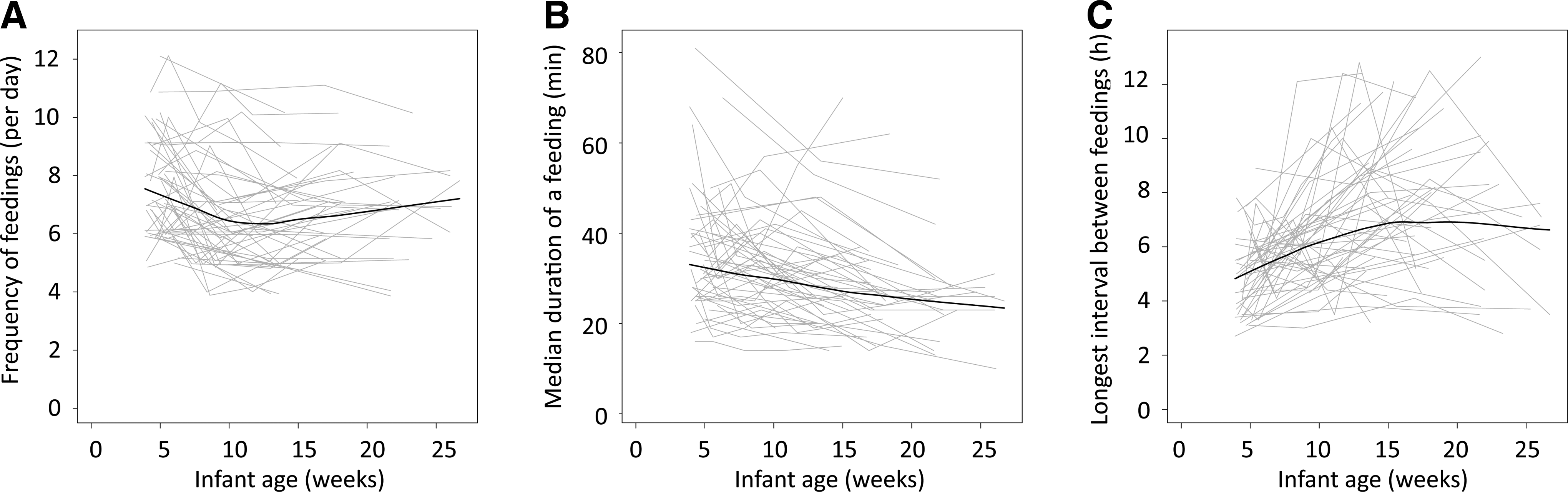
Breastfeeding behavior from week 4 to week 26 of exclusive breastfeeding:
n represents the number of measurements.
Pattern is the best mathematical fit for the data.
Where the individual pattern is significant, significant values here indicate that there is an overall pattern that is significant even when the individual unusual patterns are accounted for.
Individual patterns not tested for in weeks 13–26, as few dyads had repeated data during this time frame (Table 2).
NA, model for individual effects of age did not converge.
For the average dyad at 1 month of age, there were 7.6 feedings, of median duration 36 minutes, and the longest interval between feedings was 4 hours 45 minutes (Table 5). During early lactation (1–3 months), the frequency of feedings decreased by 0.2 each week (p<0.001), and the longest interval between feedings increased by 19 minutes each week (p<0.001). In later lactation, although the loess lines indicate changes (Fig. 1), these are not statistically significant. From 1 to 6 months the median duration of feedings decreased by an average of 0.6 minute each week (p<0.001).
Calculated from all data from 4 to 13 weeks (n=123 measurements) by the piecewise-linear mixed effects model.
Differences in individual rates of change were seen only during early lactation, with a strongly significant pattern for longest interval between feedings (p=0.008).
Breastmilk intake
The median and maximum milk intake during a feeding both changed over the course of the exclusive breastfeeding period (Table 4 and Fig. 2). The median intake showed a cubic relationship with age (p=0.02), and the maximum intake showed a quadratic pattern (p=0.04). The change in total 24-hour milk intake was not significant (p=0.07).
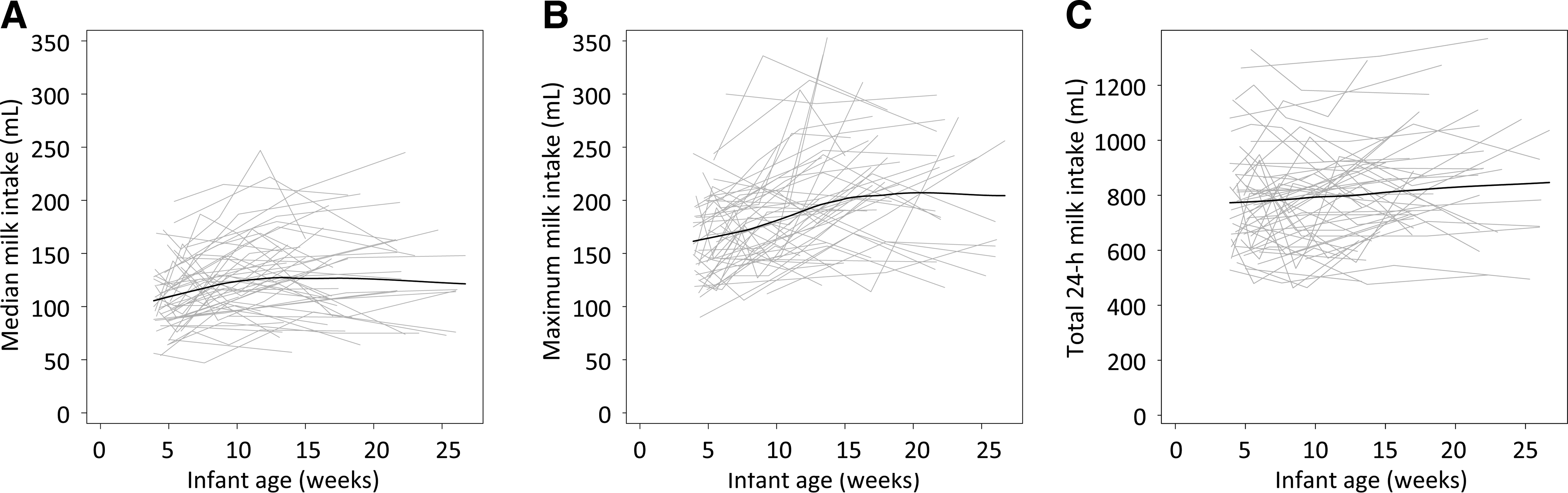
Milk intake from week 4 to week 26 of exclusive breastfeeding:
At 1 month of age, the median milk intake during a feeding was 106 mL, and the maximum milk intake during a feeding was 162 mL (Table 5). The patterns of change in early and later lactation were very different. In early lactation, the median milk intake increased (p<0.001) on average by 4.1 mL each week, and the maximum milk intake increased (p<0.001) on average by 4.4 mL each week. In later lactation, there were no significant changes. Individual differences in change over time were seen overall for both median (p=0.007) and maximum (p=0.04) milk intake during a feeding.
The total 24-hour milk intake from 1 to 6 months showed a normal distribution with a mean of 808 (SD, 192; range, 463–1,370) g. Individual differences between dyads were seen over the exclusive breastfeeding period (p<0.002) (Table 4 and Fig. 2). The total 24-hour milk intake of 44 dyads was constant. Eight dyads showed increases of between 17 and 37 mL per week, averaged across the exclusive breastfeeding period. Of these, six had initial measurements more than 130 mL below the population mean. 15 The remaining two, while having initial measurements of 875 mL and 886 mL, both increased to over 1,100 mL.
Relationship between number of feedings and median milk intake during a feeding
The median milk intake during a feeding was associated with the frequency of feedings (p<0.001) after accounting for infant age (p=0.05) and allowing for significant individual rates of change with age (p=0.002). For each additional feeding there was an average decrease of 10.4 mL, and for each additional week of age there was an average increase of 0.7 mL. The combined effect of the decrease in frequency and increase in infant age explains the increase in median milk intake during a feeding. Although the effect of age is only seen in early lactation (p<0.001), the effect of number of meals is seen for both early (p<0.001) and later (p=0.005) lactation.
Discussion
This longitudinal study showed that within breastfeeding dyads, changes occur in the frequency, duration, and milk intake during feedings in early lactation (from 1 to 3 months). After 3 months the breastfeeding behavior remains stable for the remainder of the exclusive breastfeeding period up to 6 months. This study confirms that there is no significant change in the total 24-hour milk intake from 1 month to 6 months of exclusive breastfeeding. We have shown that measures of breastfeeding behavior and milk intake over one 24-hour period during the second month of lactation are reproducible in the short term within dyads. We would expect the reproducibility to be similar for the duration of exclusive breastfeeding. In practice, repeated measurement would not normally be required, but may be considered if the results were inconsistent with the clinical assessment of the lactation.
Frequency and duration of feedings
The frequency of feedings at 1 month was within the range of previous studies.17,19,20,22,31 The decrease in frequency of 1.8 feedings per day that we observed from 1 to 3 months is similar to that observed when the initial frequency was ≥7.1.17,20 Previous studies showed no change when the initial frequency was ≤6.1.17,22 Thus, our findings support those of other studies indicating that mothers should expect the frequency of feedings to decrease in early lactation, unless the initial frequency is very low, and then remain stable for the remainder of the exclusive breastfeeding period.
The duration of each feeding reported here is the time between weighing the infant before the breastfeeding session and weighing the infant after the breastfeeding session. This may include non-nutritive “comfort sucking,” burping, settling or soothing time, changeover from one breast to the other if the breastfeeding session comprised feeding from both breasts, or feeding to sleep. When women keep detailed records of the timing of every suckling episode over a 24-hour period, likely to include only time spent at the breast, shorter durations have been reported (16–20 minutes at 2–4 weeks 22 ). Despite the initial wide variation between dyads in the duration of feedings (also noted by Hörnell et al. 17 ), the current data are in agreement with the previously reported decrease in duration of feedings between 1 and 5 months of lactation. 17 Therefore, our data support a reduction in time spent breastfeeding and settling as infants get older.
On average, the longest interval between feedings of 4 hour 45 minutes at 1 month increased by nearly 3 hours to 7 hours 35 minutes at 3 months, after which it remained unchanged. This finding is consistent with that of Hörnell et al. 17 and confirms that infants cue to breastfeed regularly and frequently in early lactation. As infants get older, they breastfeed less frequently and extend the longest interval between feedings.
Breastmilk intake
The median milk intake during each feeding was higher than that reported in the study by Butte et al., 20 where there was a higher frequency of feedings. Thus, the data are consistent with the demonstrated relationship between the frequency of feedings and the median milk intake during a feeding. We observed an increase in the median milk intake during a feeding between 1 and 3 months consistent with reported increases of from 95–102 mL at 1 month to 113–135 mL at 3 months.11,20,32 The maximum milk intake during a feeding also increased significantly between 1 and 3 months. This is the first time that, for a 24-hour period, the maximum milk intake during a feeding has been reported. It may reflect increases in infants' stomach capacities as they grow and may also contribute to the increase in longest interval between feedings as infants mature.
The consistency of total 24-hour milk intake from 1 to 6 months concurs with nine longitudinal studies that did not indicate increases between 3 and 6 months (reviewed by Reilly et al. 33 ). A more recent longitudinal study by Nielsen et al. 23 confirmed a constant feeding frequency between 15 and 25 weeks of lactation but showed a small (8%) increase in total 24-hour milk intake during this period of later lactation. Although eight of the mothers in the current study also showed an increase in total 24-hour milk production from 1 to 6 months of lactation, the remainder of the mothers and the previous longitudinal studies show that an increase from 1 to 6 months is not required for successful exclusive breastfeeding to 6 months. The consistency within mothers of the total 24-hour milk intake can be attributed to the inverse relationship between the frequency of feedings and the median milk intake during a feeding in early lactation, followed by consistent frequency and milk intakes in later lactation.
Limitations
The participants in this study were drawn from a homogeneous white population, and the majority were members of the Australian Breastfeeding Association. As such, they were likely to be motivated and well informed with respect to breastfeeding, and we consider the breastfeeding behavior of these dyads to be optimal. It would be interesting to study the breastfeeding patterns of mothers from other cultures.
Conclusions
Clinicians can advise parents that when their breastfed infants take fewer, faster feedings at 3 months compared with 1 month, there is an increase in the milk intake during the individual feedings, and the change in behavior is an indication of an increased efficiency of breastfeeding and not an indication of insufficient milk supply. After 3 months the duration of each feeding continues to decrease, but all the other parameters of breastfeeding behavior stabilize, and total 24-hour milk intake remains constant. This evidence-based reassurance should prevent the unnecessary introduction of complementary feeds with infant formula.
Footnotes
Acknowledgments
The authors thank the mothers and infants who participated for their time and commitment. Financial support was provided by unrestricted research grants from Medela AG, Family Health International, and the National Health and Medical Research Council (Australia). The studies were conducted while J.C.K., J.L.S., D.B.C., and L.R.M. were undertaking PhD studies at The University of Western Australia.
Disclosure Statement
No competing financial interests exist.