




Abstract
Abstract
Breastfeeding protects the neonate against pathogen infection. Major mechanisms of protection include human milk glycoconjugates functioning as soluble receptor mimetics that inhibit pathogen binding to the mucosal cell surface, prebiotic stimulation of gut colonization by favorable microbiota, immunomodulation, and as a substrate for bacterial fermentation products in the gut. Human milk proteins are predominantly glycosylated, and some biological functions of these human milk glycoproteins (HMGPs) have been reported. HMGPs range in size from 14 kDa to 2,000 kDa and include mucins, secretory immunoglobulin A, bile salt-stimulated lipase, lactoferrin, butyrophilin, lactadherin, leptin, and adiponectin. This review summarizes known biological roles of HMGPs that may contribute to the ability of human milk to protect neonates from disease.
Introduction
HMGPs vary in size, structure, and abundance. More than 400 proteins, most of which are glycosylated, have been identified in human milk by mass spectrometry. 3 Some of these HMGPs have shown activity that might protect infants against pathogens. In many cases, glycoproteins with reported activities were isolated from milk of other species, especially cows. Glycosylation of human milk proteins differs from that of glycoproteins from other milks. Therefore, only published data regarding HMGPs were selected in this review. Much of the published evidence for biological activities is for those molecules present in milk at relatively high concentrations. Of these, the HMGPs whose activities are most widely recognized in the literature include mucins, secretory immunoglobulin A (sIgA), xanthine dehydrogenase/oxidase, bile salt-stimulated lipase (BSSL), lactoferrin, lactoperoxidase, butyrophilin, lactadherin, adiponectin, β-casein, κ-casein, leptin, lysozyme, and α-lactalbumin, and these are included in this review. The molecular sizes and concentrations of these HMGPs are presented in Table 1. Major HMGPs protect against microbial infection 4 and excessive inflammatory responses in vitro. 5 This suggests that HMGPs may be important for the nursing mother to protect her immature infant against pathogen infection and other pathologies. HMGPs that are known to modulate human pathophysiology are described herein.
BSSL, bile salt-stimulated lipase; sIgA, secretory immunoglobulin A.
Mucins
Mucins are high-molecular-mass glycoproteins ranging from about 200 kDa to 2,000 kDa in size. Mucins are major components of the extracellular matrix and are involved in diverse functions, including shielding the epithelium against pathogenic infection, regulating cellular signaling, and transcription. 16 The mucin family of large, heavily glycosylated proteins are characterized by a variable number of tandem repeats termed the mucin domain, which makes up much of the protein component of mucus. At least 16 mucins have been identified in humans, and the expression profile of the mucins varies among tissues, with the gastrointestinal tract showing the highest and most diverse expression. The mucin family can be divided into three subfamilies according to their location relative to the cell surface: (a) gel-forming (secreted) mucins, such as mucin 1, mucin 4, and mucin 16; (b) cell surface (transmembrane, membrane-tethered) mucins, such as mucin 2, mucin 5, and mucin 6; and (c) secreted non–gel-forming mucins, such as mucin 7. 17 The physical characteristics of the mucins (i.e., their large size and hydrophobicity) can make them difficult to isolate and purify, especially from the complex matrix of milk. That notwithstanding, the major human milk mucins have been identified, initially as mucin 1 and a higher-molecular-weight electrophoresis band,18,19 designated mucin X.20,21 Recently our laboratory purified mucin 4 from human milk and identified it (Fig. 1) 22 ; mucin 4 seems to be the band previously designated mucin X. We observe another band that runs between mucin 1 and mucin 4 (Fig. 1), which is currently under investigation. Other types of mucins have not been isolated from human milk to date, but our research indicates that some others may be present in minor amounts.

Sodium dodecyl sulfate–polyacrylamide gel electrophoresis analysis of human milk mucins from a pool of 20 human milk donors. The 4–12% gradient sodium dodecyl sulfate–polyacrylamide gel–electrophoresed gel was stained with periodic acid–Schiff reagent. Mucin 1 and mucin 4 were identified by western blot. The arrows indicate mucin 1, mucin 4, and an unknown band.
Mucin 1 and mucin 4 are dimers; each dimer is formed by cleavage of an intact single peptide product of a single gene (Fig. 2). The larger subunit is wholly extracellular, heavily glycosylated, and almost entirely composed of a variable number of tandem repeats. 16 Mucin 1 and mucin 4 can interact with microorganisms (Table 2). The most commonly studied mechanism is a sialic acid moiety of mucin 1 interacting with the pathogen, thereby inhibiting the ability of the pathogen to bind to its infant host cell surface glycan receptor. Thus, mucin 1 plays a role in innate immune defense of the infant against invading microorganisms. However, other human milk mucins, like mucin 4, have only begun to be investigated for their role in interaction with microorganisms. These data would help understand the full biological role of human milk mucins in protecting infants.
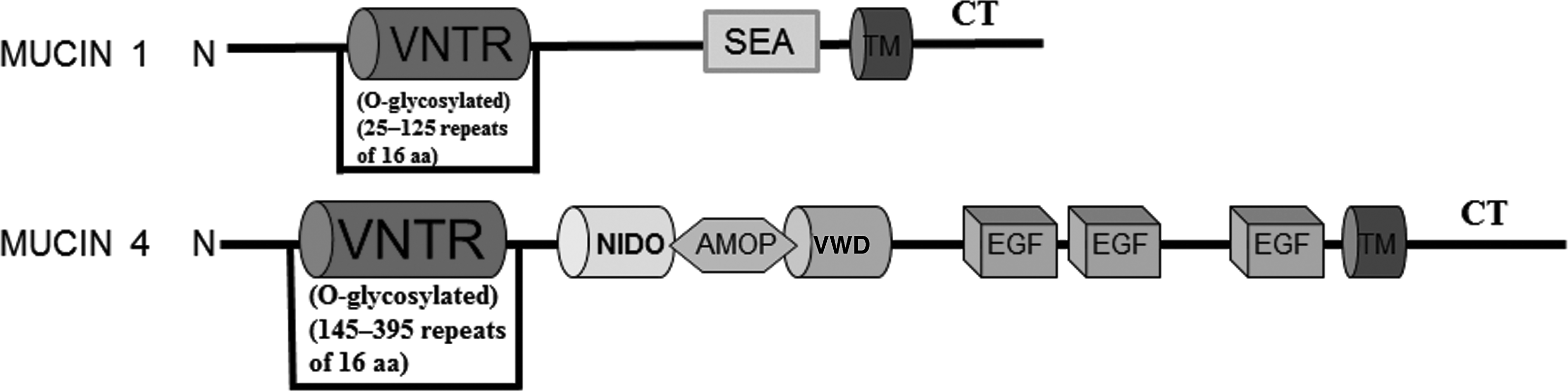
Structural motifs of mucin 1 and mucin 4. Key domains include the following: a variable number of tandem repeats (VNTR); sperm protein, exterokinase, and agrin (SEA) modules; transmembrane (TM) domains; cytoplasmic tail (CT); nidogen homology sequence (NIDO); adhesion-associated domain in mucin 4 and other proteins (AMOP); von Willebrand factor D sequence (VWD); and epidermal growth factor (EGF)-like regions. aa, amino acids.
HIV, human immunodeficiency virus.
sIgA
sIgA is the principal immunoglobulin in human milk. Typical sIgA consists of two monomeric IgA units and two additional polypeptide chains: the J chain and the secretory component (SC). The heavy and light chains in plasma cells assemble into IgA, which on association with J chain become polymerized; subsequently, SC is added during transport across the epithelium. 26 sIgA is present at quite high concentrations in colostrum and is consistently present at substantial concentrations throughout lactation. However, only 72% of sIgA activity survives pasteurization at 62.5°C for 30 minutes. 27 When first detected in human milk, sIgA was considered the first protective line of defense against pathogens because of its involvement in extracellular neutralization of pathogen infectivity and its intracellular neutralization of bacterial lipopolysaccharide and viruses within epithelial cells. Human milk sIgA protects infants against human pathogens (Table 3); when sIgA specifically binds to a pathogen antigen, it renders the pathogen less infective. In contrast, the sugar on sIgA plays more general structural and functional roles. 28 sIgAs are resistant to proteolytic digestion in the gut, and this resistance is most often attributed to the glycan sugar moieties attached to secretory antibodies. These glycans also participate in intracellular trafficking of the antibodies in the cell. As with some other glycoproteins, the glycans of sIgA containing galactose, sialic acid, mannose, or fucose can act as decoys to prevent binding by pathogenic bacteria to their glycosylated targets on mucosal surfaces in the gut. 28 For example, the mannose-containing oligosaccharides of sIgA can inhibit Vibrio cholerae biofilm formation. 29 The glycosylation of sIgAs in general (irrespective of the antigen specificity of the antibody) may provide a broad-spectrum antipathogen activity that complements the very specific antigen binding inhibition by the protein portion of specific antibodies.
HIV, human immunodeficiency virus.
BSSL
BSSL, a major glycoprotein in human milk, functions in milk lipid digestion. 48 BSSL is present in human milk at a concentration of between 100 and 200 μg/mL. 49 Human milk BSSL migrates as a heterogeneous protein with an apparent molecular size of 120–140 kDa on sodium dodecyl sulfate–polyacrylamide gel electrophoresis (conditions that disaggregate proteins). 50 BSSL contains 722 amino acids and an N-glycosylation site at asparagine-187. The catalytically active site of BSSL is located at serine-194. 51 BSSL exhibits a triglyceridase activity that may aid in the fat digestion in newborns, particularly in preterm infants who have low lipase activity and poor lipid utilization. 52 Heating human milk to 40–55°C for 39 minutes (typical pasteurization conditions for donor human milk is 65°C for 30 minutes) destroys the activity of BSSL and results in decreased lipid absorption in premature infants. 53 BSSL may have essential functions in lipid digestion in term infants, as this enzyme has uniquely wide substrate specificity. It hydrolyzes mono-, di-, and triacylglycerols, cholesterol esters, and diacylphosphatidylglycerols and can hydrolyze these lipids in both micellar and water-soluble forms. 52 Human milk BSSL has other nonenzymatic functions: it binds dendritic cell-specific intercellular adhesion molecule-3-grabbing non-integrin and inhibits human immunodeficiency virus type 1 transfer to CD4+ T cells. 54 Human milk BSSL inhibits the binding of Norwalk virus capsids to their carbohydrate ligands; the tandem repeat O-glycosylated sequences of BSSL may act as decoy receptors for the Norwalk virus. 55 Thus, human milk BSSL is an example of an HMGP with multiple functions: it degrades a large spectrum of lipids, which is an essential role in nutrition, and also inhibits virus invasion.
Lactoferrin
Lactoferrin, an 80-kDa iron-binding glycoprotein, was first isolated from bovine milk and subsequently from human milk.56,57 It is abundant in colostrum at up to 7 g/L, and its concentration declines sevenfold as lactation progresses.58–60 After pasteurization at 62.5°C for 30 minutes, only 39% of the original lactoferrin remains in the milk. 27 This major protein of human milk chelates free iron, which may assist in iron absorption by the infant, and iron chelation also inhibits bacterial growth. Thus, its biological functions range from antimicrobial activities against a large panel of microorganisms, including bacteria, viruses, fungi, and parasites, to regulation of cellular proliferation and differentiation, as well as anti-inflammatory and anticancer activities. 61
Lactoferrin is a polypeptide chain of about 700 amino acids and forms two homologous globular domains: the N-and C-lobes. The N-lobe corresponds to amino acid residues 1–333, and the C-lobe corresponds to positions 345–692; the ends of those domains are connected by a short α-helix. 62 Each lobe can reversibly bind one ferric ion. Lactoferrin exhibits bacteriostatic activity against a wide range of bacteria because of its ability to chelate iron, which is essential for microbial growth. Lactoferrin also displays innate antibacterial, antivirus, antifungal, and antiprotozoan activity that may be independent of iron chelation, for example, through disruption of the bacterial cell membranes or blocking of cell–virus interactions63,64 (Table 4).
HIV, human immunodeficiency virus.
Moreover, lactoferrin is a key modulator of inflammatory and immune responses, 88 revealing host-protective effects not only against microbial infections but also in inflammatory disorders such as cancer, allergies, and arthritis. 89 These activities may be mediated through modulation of the immune system, such as binding to lipopolysaccharide, inhibition of several cytokines (tumor necrosis factor-α and interleukin-1β), or binding to bacterial nonmethylated cytosine–guanosine motifs. 64 Lactoferrin elevates the number and the activity of T and B lymphocytes and natural killer cells, stimulates the release of several cytokines, accelerates the maturation of T and B cells, and elevates the expression of several types of cellular receptors. 80 Moreover, lactoferrin protects against chemically induced carcinogenesis, tumor growth, and/or metastasis in several animal model experiments. It targets tumors of specific organs, such as the esophagus, tongue, lung, liver, colon, and bladder. 64
Butyrophilin
A major feature of milk is the specialized structure that allows the stable dispersion of fat droplets, denoted the milk fat globule. It is surrounded by the milk fat globule membrane, which is derived from the maternal mammary epithelium, and contains a large and complex glycocalyx (i.e., its extracellular matrix). When isolated, this membrane exhibits four major protein bands on gel electrophoresis: butyrophilin, mucins, lactadherin, and xanthene oxidase. Butyrophilin is the prominent band of apparent 66 kDa in Coomassie Brilliant Blue–stained gels.90–92 It is a type I transmembrane glycoprotein with a cytoplasmic C-terminal tail. 93 Butyrophilin is expressed only during lactation and appears to be essential for milk fat globule production. Butyrophilin may function as an integral receptor for cytoplasmic fat droplets; budding of the droplets at the cell surface is initiated by interactions between the cytoplasmic tail of butyrophilin and other proteins, notably the redox enzyme xanthine oxidase. 93 Butyrophilin functions in vivo to stabilize the association of xanthine oxidase with the milk fat globule membrane by direct interactions through the PRY/SPRY/B30.2 domain. 94 The autoimmune encephalomyelitis that follows immunization with myelin/oligodentrocyte glycoprotein is prevented by butyrophilin treatment, which also improves the clinical manifestations of preexisting disease. 95
Lactadherin
Lactadherin is the 46-kDa glycoprotein of the human milk fat globule membrane, which is also known as PAS-6/7, indicating the two glycosylation variants on sodium dodecyl sulfate–polyacrylamide gel electrophoresis analysis. 96 Human milk lactadherin binds specifically to rotavirus and inhibits its replication, thereby protecting human milk-fed infants against symptomatic rotavirus infection. 97 Human lactadherin inhibits rotavirus infection of MA 104 and Caco-2 cells by direct interaction between rotavirus and the oligosaccharides of the lactadherin molecule. 98 Removal of sialic acid from lactadherin results in loss of this inhibitory activity. 99 The protein core also exhibits specific biological activities: lactadherin exhibits a vascular endothelial growth factor pro-angiogenic effect in adult neovascularization, 100 suggesting a use in modulating blood vessel growth in a pathological setting. Lactadherin has EGF1–EGF2 domains (epidermal growth factor homology) at the amino-terminus and C1 and C2 domains that share homology to the phosphatidylserine-binding domains of blood coagulation factors V and VIII96,101; lactadherin can mediate clearance of phosphatidylserine-expressing procoagulant platelet-derived microvesicles. 102 Milk lactadherin is present in the intestines of breastfed infants before the tight junctions of the intestinal epithelium close and when fat complexes can cross the mucosa by bulk transport. Thus, human milk lactadherin could gain access to the circulation of the neonate, where its strong anticoagulant effects (half-maximal concentration is 1–4 nM) would be mediated through modulating factor V and VIII activities and through microvesicle clearance. Although the potential function of lactadherin is not understood, it may participate in early homeostasis of circulating cells; also, many diseases induce strong procoagulation processes, including sepsis, suggesting other possible domains of protective activity. Indeed, a recent report indicates that recombinant lactadherin may attenuate sepsis-induced apoptosis. 103 Lactadherin interacts with damaged intestinal epithelium in vivo and plays an important role in stimulating growth of intestinal epithelial cells in vitro. 104 Thus, orally ingested lactadherin could have potential in the prevention and treatment of intestinal injury in infants.
Leptin and Adiponectin
Leptin and adiponectin are members of adipose-secreted glycoprotein metabolic regulators known as adipokines 105 that are present in human milk.11,106,107 Various adipokines have pro-inflammatory or anti-inflammatory activities and have potential as regulators of metabolic function. 108 Leptin is a 16-kDa glycoprotein hormone that regulates energy intake and energy expenditure, including appetite and metabolism. 109 In experimental studies on animals, leptin is transferred from the maternal circulation to breastmilk and then passes to neonatal blood, suggesting that maternal leptin may exert biological effects on the infant. 110 Adiponectin is a 30-kDa glycoprotein produced primarily in adipose tissue and participates in several physiologic processes that may affect human development. 11 Human milk adiponectin was first reported in 2006, and it seems to play a role in the early growth and development of breastfed infants. 11 Furthermore, adiponectin inhibits the proliferation of myelomonocytic progenitor cells and induces apoptosis, and this may contribute to the anti-inflammatory effects of this adiponectin. 111 Immunoreactive adiponectin was detected in skim milk at concentrations significantly higher than those of milk leptin. 110 The leptin/adiponectin ratio in mid-infancy correlates with weight gain in healthy term infants. 112 Thus, leptin and adiponectin in human milk may play a role in growth and development of infants.
Other Glycoproteins in Human Milk
For those with sufficient data, a section is dedicated to reviewing their activities (above); those with limited published data on antipathogen activity are summarized in Table 5.
HIV, human immunodeficiency virus; HMGP, human milk glycoprotein.
Future Directions and Implications
Described above are many examples of HMGPs that inhibit the pathobiology of human diseases. Prevalent among these inhibitory processes is the ability to competitively bind to the pathogen or pathogen receptor, thereby interfering with the essential first step of pathogenesis, the binding of the pathogen to its host cell surface receptor. Even this most widely recognized bioactive mechanism requires elucidation. For example, glycan moieties of different HMGPs can show similar protection against the same pathogens. Mucin 1 and lactoferrin inhibit Escherichia coli and Salmonella infection in vitro. However, it is not known if only the carbohydrate moiety is responsible for the inhibition, which carbohydrate moiety inhibits each pathogen, or whether two or more specific carbohydrate moieties act together to inhibit pathogen infection. With the involvement of multiple glycan moieties, would inhibition be additive or synergistic? These questions beg for research on the relationship between structural features of a biologically active molecule and its activity. Such structure–function research requires pure compound and robust, sensitive bioassays.
The relationship between structure and functional glycobiology of HMGPs is now ripe for fruitful human milk research. The difficulties of glycan analysis are now yielding to sophisticated new separation and analytic technologies, obviating preparation of pure compounds. Progress had been hampered by the enormous complexity of glycoprotein–ligand interactions, which can now be measured by nano-surface plasmon resonance (SPR) and other emerging techniques 121 and efficient high-throughput screening methods, now possible with shotgun glycan microarray 122 and robotic technology.
Recent developments in SPR are quite promising. Nano-SPR is a surface-sensitive optical method to study molecular binding events on a functionalized biosensor. SPR can be used to study both protein–carbohydrate interactions and carbohydrate-mediated inhibition of protein–protein interactions. SPR represents a powerful, high-throughput approach to defining the relevant carbohydrate moiety of an HMGP that is responsible for binding inhibition. 123
In addition to the aforementioned inhibition of binding by pathogen adhesins or host cell receptors, other mechanisms for protection of the infant by HMGPs are possible, including a prebiotic affect. In 1905, Tissier 124 described the distinctive microflora (now microbiota) of breastfed infants as containing more Lactobacillus bifidus (now classified as Bifidobacterium bifidum). A molecule in human milk was hypothesized to be responsible for this bifidus growth activity and designated as the “bifidus factor.” After approximately 70 years of research, the “bifidus factor” was isolated and identified as a glycan moiety of an HMGP. This should be considered the prototype of a family of glycans now known as prebiotics, which are indigestible dietary glycans that promote proper colonization of the gut. After birth, the vacant infant gut undergoes colonization by a succession of microbes, resulting in the complex stable microbiota of the more mature child. 125 Human milk glycans that stimulate growth by mutualist bacteria 126 are now defined as prebiotics: indigestible dietary glycans that stimulate colonization by beneficial bacteria and provide a health benefit. Typical prebiotics enhance growth of bifidobacteria and lactobacilli, are fermented to produce organic acids, lower intestinal pH, 127 suppress potentially harmful bacteria in the microbiota, and confer other health benefits to the host. The human milk oligosaccharides have already been demonstrated to be prebiotic. However, the HMGPs, which are also indigestible by the human gut enzymes and therefore move into the colon during intestinal transit and provide bacteria access to a potential carbon source, are essentially untested. Prebiotic HMGPs could also contribute toward the lower risk of morbidity and mortality in breastfed infants.128,129 We hypothesize that the glycans of milk could work in concert with glycoconjugates expressed on the surface of the intestinal mucosa to direct initial colonization leading toward a normal, beneficial gut microbiota.
Another function of prebiotics is their use as substrates for bacterial fermentation that results in small organic acid metabolites, such as short-chain fatty acids and other small acids, like acetate, lactate, butyrate, succinate, valerate, propionate, etc. Some of these acids have strong metagenomic effects in intestinal epithelial cells at biologically relevant concentrations. Different microbes of the microbiota produce different complements of organic acids. 130 It follows that a prebiotic effect by HMGPs could have profound influences on some aspects of cell signaling and control and therefore contribute to modulation of intestinal response to injury and other types of intestinal inflammation conditions. This could contribute to the known reduction of risk of necrotizing enterocolitis and other inflammatory conditions in premature infants fed human milk.
HMGPs could also directly affect inflammation of the intestinal mucosa. This is discussed above for lactoferrin but is largely unexplored for other of these human milk molecules.
The importance of the human milk oligosaccharides, another major family of complex glycans in human milk, is increasingly recognized as clinically relevant to neonates and term infants alike. The higher-molecular-weight glycoproteins are more difficult to isolate and test, which accounts for the relative lack of definition of their structures and of their biological functions and clinical relevance. The confluence of newly emerging technologies for the isolation, purification, identification, and biological testing of these molecules creates the promise of newly recognized glycans becoming sources of novel prophylactic and therapeutic agents that inhibit diseases caused by a variety of pathogens.
Footnotes
Acknowledgments
This study was supported by grants HD013021, HD059140, HD061930, and AI075563 from the National Institutes of Health.
Disclosure Statement
D.S.N. owns stock in Glycosyn, LLC, whose purpose is synthesis of bioactive human milk glycans. B.L. declares that no competing financial interests exist.