




Abstract

AMCHP's mission is to support state MCH programs and provide national leadership on issues affecting women and children. AMCHP envisions a society where healthy children and healthy families live in healthy communities. AMCHP's advocacy efforts are focused around Title V of the Social Security Act, the Maternal and Child Health Services Block Grant. Title V is the only federal program of its kind devoted solely to improving the health of all women and children, and it is the nation's oldest federal program, authorized in 1935. It was converted to a block grant in 1981, and states receive funding through Title V based on a formula that is based on population size and need. Under AMCHP's strategic plan effective for 2012 through 2015, the role of the organization is outlined in three goals: (1) advance the nation's health by improving MCH outcomes and achieving health equity, (2) strategically communicate the critical importance of MCH issues, and (3) be the lead organization in supporting and representing state and territorial MCH programs. AMCHP works toward accomplishing these goals to build successful MCH programs by disseminating best practices, advocating on behalf of our members in Washington, providing technical assistance, convening leaders to share experiences and ideas, and advising states about involving partners to reach our common goal of healthy children, healthy families, and healthy communities. Examples of AMCHP's work to support breastfeeding at the national level include collecting and sharing best practices from state Title V programs that promote breastfeeding and signing on in support of key legislation, such as funding for Supplemental Nutrition Program for Women, Infants and Children (WIC) peer counselors, who work to support and promote breastfeeding among WIC program recipients.
An example of how AMCHP approaches issues of national significance can be found in our work to pull together initiatives focused on reducing infant mortality. In the summer and fall of 2011, AMCHP staff heard from many partners, including the Association of State and Territorial Health Officials, the CMS Center for Medicare and Medicaid Innovation, the March of Dimes, the Health Resources and Services Administration's Maternal and Child Health Bureau, the National Governors Association, The Secretary's Advisory Committee on Infant Mortality, and the W.K. Kellogg Foundation, of intentions to focus resources and energy on infant mortality in the coming months. These conversations were the beginning of multiple, simultaneous, exciting initiatives on infant mortality. As we heard of and participated as partners in these initiatives, we brainstormed what sort of information our members, Title V programs, and all the MCH partners would need in order to meet the goals of these initiatives. Among AMCHP staff, there was an agreement that our best, most effective role would be to provide a consolidated resource of actionable recommendations and specific steps programs and MCH stakeholders could take to advance initiatives to improve birth outcomes.
The resulting document, Forging a Comprehensive Initiative to Improve Birth Outcomes and Reduce Infant Mortality (the “Compendium”), 1 was AMCHP's effort to give states resources and tools to begin addressing or revitalizing efforts to coordinate and build comprehensive initiatives to reduce infant mortality. Overall, the Compendium offers seven recommendations, 60 action steps, and over 180 specific strategies stakeholders can use when developing, enhancing, and implementing comprehensive approaches to improve birth outcomes and reduce infant mortality. One of the recommendations from the compendium was to “Develop Data Systems to Understand and Inform Efforts.” Within this recommendation, one of the action steps is to publish data regularly through reports, and we highlighted an example from Oklahoma, which was a Pregnancy Risk Assessment Monitoring System (PRAMS) brief 2 discussing the available data on duration and exclusivity of breastfeeding in Oklahoma.
AMCHP also works to improve health outcomes by supporting the spread of innovative, promising, and best practices. AMCHP collects, reviews, and disseminates emerging, promising, and best practices from public health programs across the United States so that effective models can be shared and replicated among the MCH community. These are made available through an online, searchable database called Innovation Station (www.amchp.org/programsandtopics/BestPractices/InnovationStation/Pages/default.aspx), which currently features three breastfeeding programs. In Arizona, an emerging practice called “Baby Steps to Breastfeeding” promotes five breastfeeding-friendly hospital practices that improve breastfeeding duration and exclusive breastmilk feeding. The Virginia Department of Health's emerging practice for breastfeeding promotion (breastfeedingtraining.org) is a Web-based training course on breastfeeding that helps healthcare workers better understand the potential impact that they have on the health of the community and educates them on the basics of successful breastfeeding. A promising practice called “Birth and Beyond California” is a Hospital Breastfeeding Quality Improvement and Staff Training Demonstration Project focused on hospital staff adoption of policies that improve exclusive breastfeeding initiation.
Through our membership publications, Pulse and Member Briefs, as well as our Web site and social media outlets, AMCHP works to raise awareness of current national initiatives around breastfeeding support with our members, including “text4baby,” “Best-fed Beginnings,” and “It's Only Natural.” “Text4baby” (https://text4baby.org/templates/beez_20/images/HMHB/bf_factsheet.pdf) is a project of the National Health Mothers Healthy Babies Coalition through which pregnant women and their partners can receive health-related text messages that are timed to be relevant to the stage of pregnancy or child's development. “Text4baby” sends up to seven breastfeeding-related messages during pregnancy (depending on delivery date) and eight messages during an infant's first year of life that are medically accurate, positive, and encouraging. “Best-fed Beginnings” (www.nichq.org/our_projects/cdcbreastfeeding.html), led by the National Initiative for Children's Healthcare Quality with funding from the Centers for Disease Control and Prevention (CDC), has recruited 89 hospitals from across the country to participate in a 22-month learning collaborative to make system-level changes to maternity care practices in pursuit of Baby-Friendly designation. “It's Only Natural” is an education campaign led by the U.S. Department of Health and Human Services' Office on Women's Health, whose purpose is to help African American women and their families understand the health benefits of breastfeeding while providing practical tips and dispelling myths. The Web site (www.womenshealth.gov/itsonlynatural/) also features stories of encouragement and inspiration from African American mothers.
AMCHP's National Center on Health Reform Implementation provides state MCH leaders and their partners with the information, tools, and resources to optimize the opportunities presented by the Patient Protection and Affordable Care Act (ACA) for improving services, systems, and health outcomes for MCH populations. In July 2012 the National Center published a fact sheet, Health Reform: What Is in It to Promote Breastfeeding, 3 highlighting provisions in the ACA around promoting breastfeeding, which include requiring lactation support for new health insurance plans through the Women's Preventive Service Regulation, support for community efforts to promote breastfeeding through the Prevention and Public Health Fund, and protection of the rights of nursing mothers in the workplace. The brief included the following strategies MCH can use to maximize the opportunities presented by the ACA to promote breastfeeding, including the following: (a) use the Surgeon General's “Call to Action” to help guide efforts to promote and strengthen breastfeeding efforts and strategic initiatives among public health agencies and partners; (b) develop partnerships with hospitals to promote Baby-Friendly designations using the “Ten Steps to Successful Breastfeeding” and Baby-Friendly Hospital resources; (c) partner with colleagues in chronic disease to apply for and use Community Transformation Grant funding to develop and strengthen community-level activities and initiatives to promote breastfeeding; (d) work with partners to develop and implement statewide maternity care quality standards for hospitals to support breastfeeding; and (e) provide resources to employers to help guide implementation of regulations on reasonable break time for nursing mothers.
In addition to AMCHP's efforts to support our members, there are numerous ways that Title V MCH Block Grant Programs keep breastfeeding on the radar. One of the essential public health services is the surveillance or monitoring of health conditions, and the Title V MCH Block Grant supports surveillance, needs assessment, and evaluation activities for breastfeeding in part through support of the state-implemented CDC PRAMS surveys of postpartum women, which includes breastfeeding questions. States using the 2003 revision of the birth certificate have information from this source on breastfeeding initiation, and newborn metabolic screening often includes information on intention to breastfeed as well. In addition to these sources of data on breastfeeding, the CDC-sponsored National Immunization Survey (NIS) includes breastfeeding questions and is a major source of data on breastfeeding initiation and duration for states that do not have the PRAMS survey (PRAMS currently includes 40 states and New York City). The Title V Block Grant annual report includes a performance measure on breastfeeding duration and the percentage of mothers who breastfeed their infants at 6 months of age, and the Title V Information System includes reports from each state on this measure, generally using PRAMS or NIS as the data source. Figure 1 displays the national data for this performance measure from the NIS for children born between 2000 and 2009.
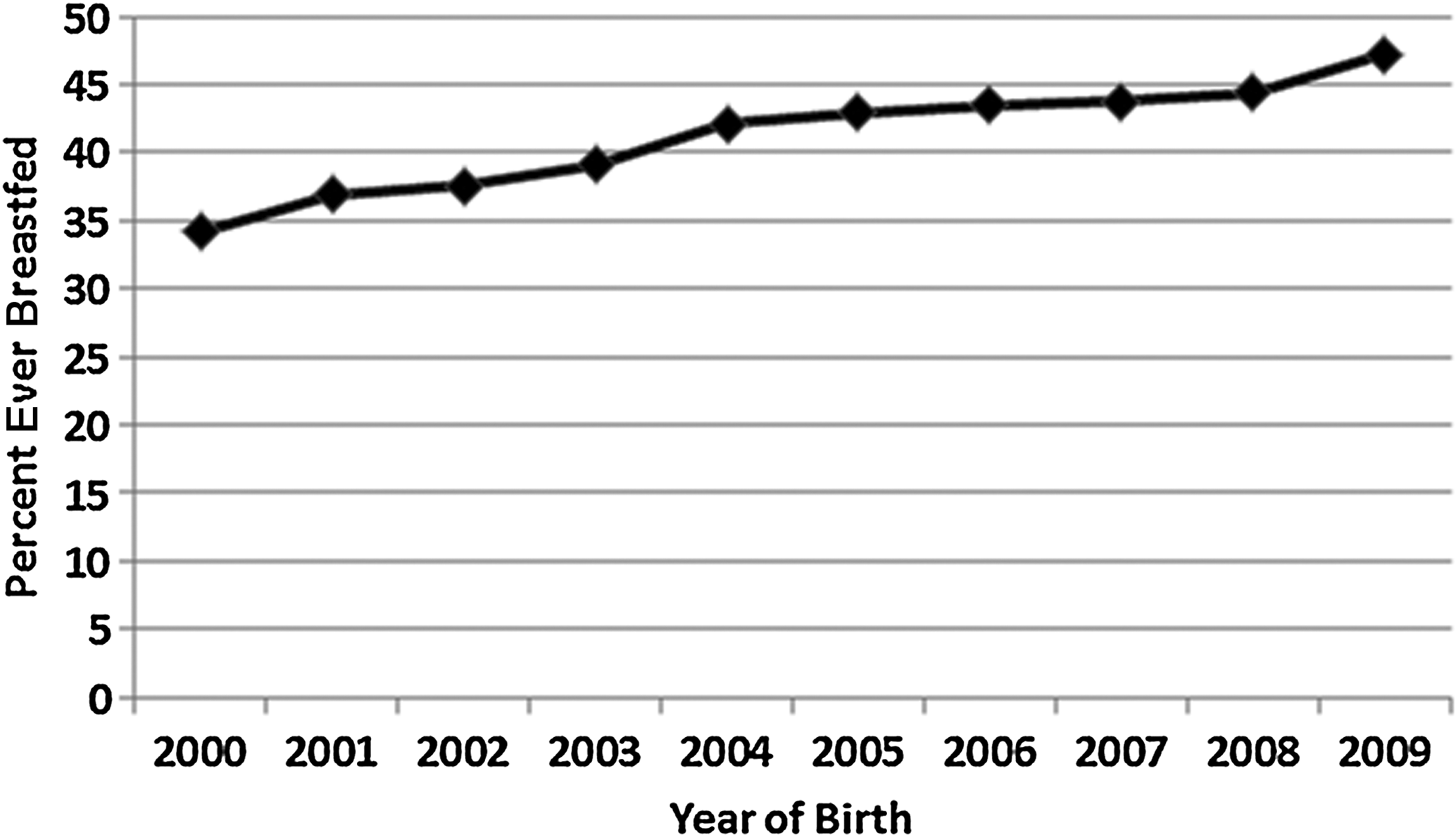
Percentage of U.S. children who were breastfed, by birth year, at 6 months of age, from the U.S. National Immunization Survey.
A recent AMCHP publication, Promoting Healthy Weight: The Role of Title V, 4 features state examples of breastfeeding support and promotion. Selected examples are highlighted here. In California, one of the priorities for the Title V program is to “promote healthy nutrition and physical activity among MCAH [Maternal, Child, and Adolescent Health] populations throughout the life span beginning with exclusive breastfeeding of infants to six months of age.” California's MCAH Division is a leader in California Department of Public Health lactation accommodation, including establishing department lactation rooms, signage, and an employee policy. MCAH and WIC partnered with the California Breastfeeding Coalition to host the Third Annual Breastfeeding Summit in January 2013, which brought together hospital and public health staff to strengthen breastfeeding support throughout the continuum of care. In addition, MCAH is collaborating with the California Obesity Prevention Program to increase breastfeeding duration rates in California communities of color by enhancing the capacity of 15 community safety-net clinics to develop “breastfeeding-friendly” clinic policies and practices to promote and support the decision of the mother to breastfeed.
In Massachusetts, the Department of Public Health is including training in healthy weight and breastfeeding as part of the core competency for the Maternal Infant and Early Childhood Home Visiting program, to share with all home visiting programs. In 2009, Massachusetts launched the Mass in Motion obesity prevention and wellness initiative, and in 2012, Mass in Motion communities had the opportunity to apply for catalyst grants aimed at improving breastfeeding support post-hospital discharge.
In New York, all hospitals in the state are encouraged to promote exclusive breastfeeding. The Breastfeeding Quality Improvement in Hospitals (BQIH) learning collaborative engaged 12 low-performing hospitals in testing and implementing recommended maternity care practices to increase the proportion of women exclusively breastfeeding at hospital discharge. Based on the success of the first cohort, the BQIH will be spread to all New York State hospitals providing maternity care. Additionally, the New York State WIC program, in addition to implementing the Breastfeeding Peer Counselor Program in all 94 local agencies, also provides breastfeeding resources through the expansion of its Web site, breastfeedingpartners.org
In Virginia, the Commonwealth's Healthy Approach and Mobilization Plan for Inactivity, Obesity, and Nutrition (CHAMPION) program includes a strong focus on breastfeeding support and promotion. Through a partnership with the Virginia Breastfeeding Advisory Committee, CHAMPION selected, promoted, and provided training for the Business Case for Breastfeeding, which offers resources to help lactation specialists and health professionals educate employers in their communities and teaches them how to successfully present the need for lactation programs to businesses.
Title V supports a wide variety of breastfeeding promotion programs in state MCH programs, which are often implemented in partnership with other public health programs such as WIC and nutrition, chronic disease prevention, and home visiting, as well as key partners such as breastfeeding coalitions, hospitals, and businesses. On the national level, AMCHP advocates for continued Title V funding, shares best practices, and works with other national partners to support a public health system that promotes breastfeeding and supports efforts that will bring us closer to achieving the Healthy People 2020 goals to increase breastfeeding initiation, duration, and exclusivity.
Footnotes
Disclosure Statement
No competing financial interests exist.