




Abstract
Abstract
Objectives:
The Food and Drug Administration discourages the casual sharing of human milk because of the risk of pathogen transmission. No information is currently available on the prevalence of this practice. The purpose of this mixed-methods observational study is to describe the size and activity of online milk sharing communities.
Materials and Methods:
Data for 3 months were extracted from nine public Facebook pages that facilitate the exchange of human milk. The numbers of participants, interactions, and comments were analyzed.
Results:
We observed 954 individuals participating in milk sharing. The number of interactions per individual ranged from none to 16 (mean, 1.74±1.65). Top reasons that participants requested milk included “lactation problems” (69.4%) and “child health problems” (48.5%). Nearly half of donors were offering 100 ounces or more, which is the minimum to be eligible to donate to nonprofit milk banks.
Conclusions:
Milk sharing networks in the United States are active, with thousands of individuals participating in the direct exchange of raw human milk. Public health issues include increasing the supply of pasteurized donor milk for fragile infants, increasing breastfeeding support, and helping milk sharing families appropriately manage risks.
Introduction
H
Pasteurized milk from nonprofit milk banks and fortified milk products from for-profit companies are primarily sold to hospitals to serve critically ill infants, with costs reported from an average of $4.01 per ounce 9 to in excess of $180 per ounce, 10 respectively. For families with nonhospitalized infants, these options for human milk are often cost-prohibitive when health insurance does not reimburse, leaving milk sharing as their primary channel for accessing human milk. A survey of milk sharing recipients supports this conclusion, with participants expressing their belief that banked donor milk was for “preterm or sick babies and even if I could obtain it, it was very expensive.” 11
Although the sharing of human milk is a practice that has been around for centuries in the form of wet nursing, the Internet has greatly expanded the ability to reach beyond familiar circles via online communities that facilitate the exchange of human milk. The Food and Drug Administration 12 and La Leche League International 13 have expressed concern with online milk sharing due to the risk of pathogen transmission. There are risks associated with feeding infants formula, the alternative when human milk is not used.2,14,15 Given the increased awareness of the importance of breastfeeding, it is easy to understand why parents may seek human milk for their children via online communities.
No information currently exists regarding the size of online milk sharing communities in the United States or the nature of milk sharing transactions. The purpose of this mixed-methods observational study was to use qualitative template analysis and quantitative descriptive analysis to describe the size of online milk sharing communities and to evaluate the nature of the communication among participants. A secondary purpose was to compare this information with donor volumes at nonprofit milk banks in order to begin to quantify the different segments of the U.S. human milk market.
Materials and Methods
Human Milk 4 Human Babies 6 (HM4HB) and Eats on Feets 7 (EOF) were selected for our initial analysis because they operate global, commerce-free milk sharing networks. Both organizations use Facebook to facilitate these communities, which are typically organized by state or country. On a single day in May 2013, the Facebook search engine was used to identify HM4HB and EOF groups in the United States. HM4HB Facebook communities existed for all 50 states, whereas EOF Facebook communities existed for 47 states. The number of Facebook “likes” was extracted as an initial measure of community size. The median number of “likes” per state was 680 (interquartile range, 379–1,151) for HM4HB groups and 288 (interquartile range, 164–495) for EOF groups. HM4HB communities were selected for our observational study because they had a larger fan base. We selected nine different HM4HB communities to analyze based on the quartile they fell into for Facebook “likes” with the objective of studying small, medium, and large milk sharing communities: three in the first quartile (small), three in the second or third quartile (medium), and three in the fourth quartile (large). HM4HB communities were further selected by geography so that we were able to observe Eastern, Central, and Western states within the small, medium, and large communities to look for potential regional trends.
Data extraction
A database was developed by retroactively extracting the following information from the HM4HB Facebook communities for original posts for a 3-month period in 2013: name of the poster, date of post, verbatim text of post, name of the responder to original post, date of response to original post, and verbatim text of response to original post. A codebook was developed to establish rules for extracting and classifying posts. The four classifications of posts were as follows: original offer (an original post by an individual offering her milk), an original request (an original post by an individual asking for milk), a reply offer (a reply to an original request indicating an interest in giving milk), or a reply request (a reply to an original offer indicating an interest in receiving milk). To ensure no double counting, posts by the HM4HB Page Administrator were not extracted because administrators often repost an individual's request. Similarly, posts that did not have to do with the exchange of human milk (e.g., “I've got a free pump available”) were not extracted. Multiple reply posts from the same user that had to do with the logistics of the exchange (e.g., “Can you meet on Tuesday?”) were excluded from our analysis. If information regarding the reason for the exchange or the volume of the exchange was provided in multiple reply posts, this verbatim information was combined with the data from the user's initial comment so that transactions would not be double counted. Interactions per participant were determined by computing the number of unique individuals who a participant engaged in a discussion with regarding the exchange of milk. For example, if Participant A posted a request for milk, and Participants B and C replied that they had milk available, we computed two interactions for Participant A and one interaction each for Participants B and C. Likewise, if no one replied with offers of milk, we computed zero interactions for Participant A.
Using the codebook, the primary researcher extracted and categorized data for the entire study period, while a second researcher repeated the data extraction process for a random sample of 20% of the study dates. Cohen's kappa 16 was calculated to determine inter-rater reliability for data extraction and classification. The kappa value was 0.91, suggesting high reliability. 17 Upon completion of data extraction, each unique poster to the group was assigned an identifier, and all identifying information was removed from the dataset.
Comment coding
The content of the Facebook comments were qualitatively evaluated18,19 to explore the type of information that was shared by requesters and donors within the milk sharing communities. The comment fields were read by the primary researcher, and a codebook was developed based on the two primary themes that appeared in the verbatim comments: (1) requesters often described the reason they were seeking milk, and (2) donors often described items related to the quality of their milk. When information from neither of these themes was provided, the post was classified as “no additional information.” Table 1 lists major codes and examples. One researcher applied codes to the entire dataset, and a second trained researcher independently coded a random sample of 20% of the posts for agreement with the primary researcher's coding. Cohen's kappa was calculated to measure inter-rater reliability for comment coding, and a kappa value of 0.87 was achieved, indicating excellent agreement between coders. 17 Discrepancies in coding were resolved by discussion and consensus between the two researchers.
NEC, necrotizing enterocolitis; NICU, neonatal intensive care unit.
Analyses
In a survey of milk sharing participants, Gribble 11 found that donors wanted to know why their milk was needed. Although this is primarily an observational and descriptive study of online milk sharing communities, we also hypothesized that requests that included information regarding why the participant was seeking milk would have a higher response rate than requests with no information. A Student's t test statistical analysis comparing the number of responses to original requests with and without a reason was performed to test this hypothesis. SAS (Cary, NC) software version 9.3 was used to perform analysis. This study received Institutional Review Board exemption from North Carolina State University.
Results
Covering a 3-month period in 2013, we extracted 1,492 milk sharing posts from the public HM4HB's Facebook sharing communities for nine states, including 333 original offers (22.3%), 360 reply offers (24.1%), 329 original requests (22.1%), and 470 reply requests (31.5%). We observed 954 individuals participating in the milk sharing communities, with 532 (55.8%) of the participants offering milk, 413 (43.3%) participants requesting milk, and nine (0.9%) participants offering and requesting milk. In all milk sharing communities, the number of donors exceeded the number of requesters (Fig. 1). The minimum number of interactions per individual was zero in all communities, whereas the maximum number of interactions per individual across the nine communities ranged from four to 16. The majority of participants (68.8%) interacted with one to two people, whereas 5.2% of participants interacted with five or more people, and 11.2% had no interactions (Fig. 1). The mean number of interactions was 1.74±1.65, and the median was 1. Of the 52 participants who interacted with more than five people, the majority (69.2%) were seeking milk. One participant described her adopted son as receiving donations from “20 milky mommas so far!”
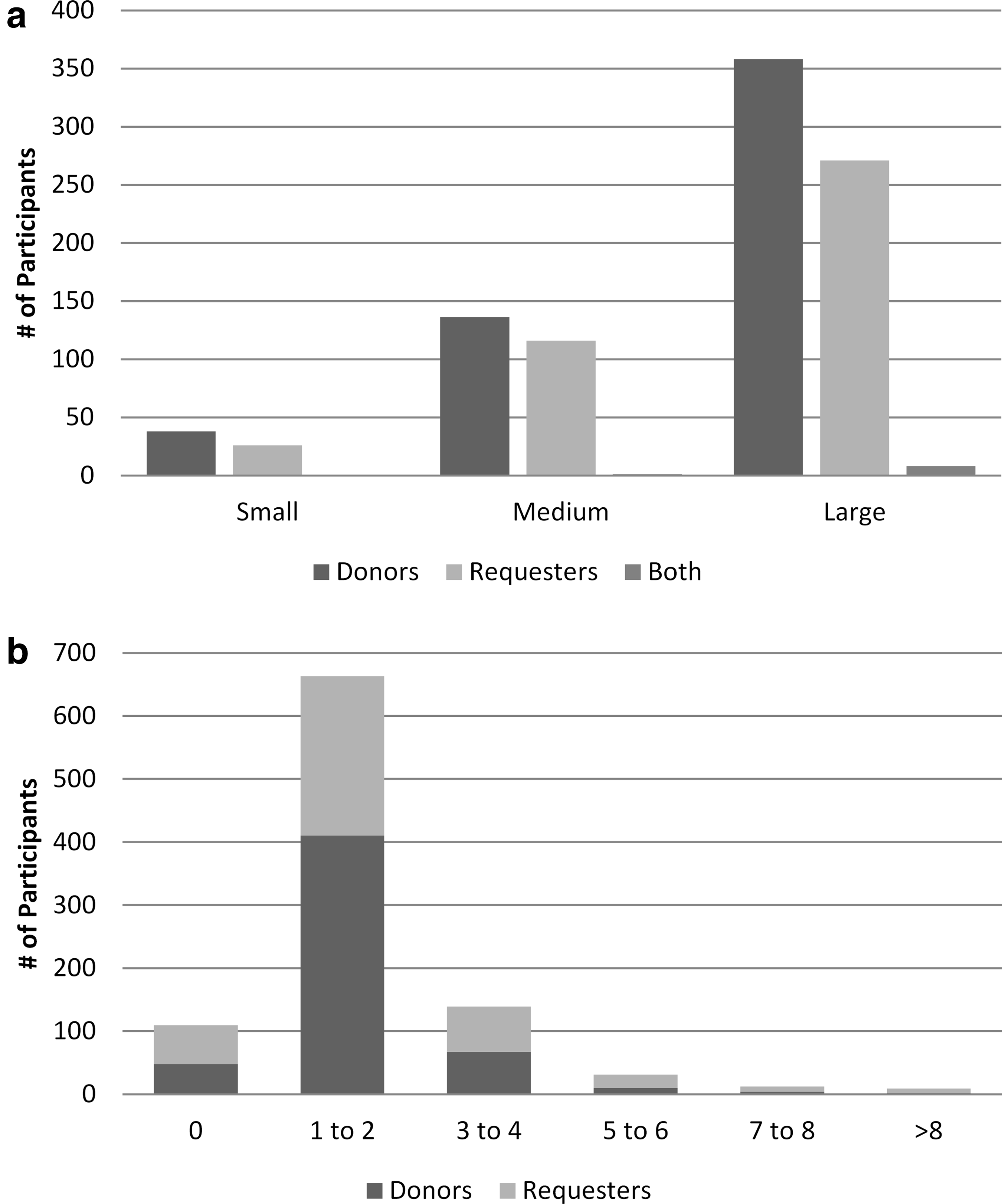
Distribution of 954 milk sharing participants was assessed by
Figure 2 provides a distribution of observed milk sharing posts, observed milk sharing participants, and actual births 20 for the states in our study, summarized by geography. Communities in the Central geography had a greater proportion of milk sharing activity (both posts and participants) compared with their proportion of total births, whereas communities in the East geography had a lower proportion of milk sharing activity compared with their proportion of total births, suggesting that milk sharing may be more popular in some areas of the country than in others.

Distribution of the 1,492 milk sharing posts, 954 milk sharing participants, and 1,202,615 births 20 was assessed by geography (each totals 100%).
Insights into milk requests
Of the 422 participants who requested milk, 235 of these individuals (55.7%) provided comments regarding why they were seeking milk. Participants often cited more than one reason for seeking milk; therefore, the cumulative frequency for all reasons exceeds 100%. The top reasons cited for seeking milk were lactation problems (69.4%), child's health (48.5%), adoption/fostering (13.5%), and mother's health (11.9%). Lactation problems included low milk supply, tongue-tie, pediatrician recommendations to supplement, and more. Child's health comments ranged from mild problems, including colds and general immunity, to more severe problems, including necrotizing enterocolitis complications and terminal illness. Similarly, mother's health problems ranged from mild, including food poisoning, to more severe, including breast cancer. Table 1 provides a frequency of requester reasons and example comments.
There were 81 original requests that provided no additional information on why the participant was seeking milk and 248 original requests where additional information was provided. Original requests that provided information regarding why the requester needed milk received significantly more reply offers than those where no additional information was provided (1.21±1.39 vs. 0.74±1.01; p=0.0059).
Insights into milk offers
Of the 693 posts where milk was offered, 365 of these offers (52.7%) provided additional information about the milk being offered. Participants often referenced multiple codes; therefore the cumulative frequency exceeds 100%. When additional information about the milk was provided, 87.9% of the donors commented on milk attributes, 33.7% commented on donor lifestyle, and 8.5% provided medication/supplement information (Table 1). Milk attribute comments included information about the stage of lactation based on child's age, length of storage, and whether the donor had been certified by a nonprofit milk bank. Donor lifestyle comments included information on mother's diet and use of alcohol, caffeine, cigarettes, and prenatal vitamins. Medication/supplements comments included information about maternal use of prescription medication, over-the-counter drugs, vitamins, minerals, or herbal supplements. Two drugs cited—metformin and citalopram (Celexa®; Forest Laboratories, New York, NY)—were listed in LactMed, the National Library of Medicine's drug and lactation database, with recommendations of caution or monitoring when used while breastfeeding.
Of the 693 posts where milk was offered, 283 of these offers (40.8%) described the volume of milk available. Offers ranged from 10 ounces to 700 ounces, with a median offer of 90 ounces (interquartile range, 50–150). Forty-seven percent of offers that identified volume were donating 100 ounces or more of milk. Figure 3 provides a summary of the frequency of milk volumes offered.

Distribution of the 283 offers that described the volume of milk available was assessed by volume.
Discussion
Our observational study of online milk sharing networks suggests that these communities are active, with thousands of individuals across the United States participating in the direct exchange of human milk. Other segments of the U.S. human milk market include the HMBANA nonprofit network of milk banks, which approved 3,641 donors in 2012 (Pauline Sakamoto, HMBANA Board Member, e-mail communication, July 2013) and has been experiencing ongoing shortages of milk, 21 and for-profit companies, where no information is available on the size of their donor base, and more research is needed to establish strong scientific evidence for the use of their products. 22
In contrast to the fragmentation seen in the U.S. human milk market, Brazil has an extensive public milk banking system that provides pasteurized donor milk at no cost to infants with medical needs including preterm infants and those with nutritional disorders and allergies.23,24 In 2011, Brazil's milk banking network collected almost five times the volume of donor milk per preterm birth compared with volumes collected by the HMBANA network. 25 Neither HM4HB nor EOF operates milk sharing communities in Brazil, and we were unable to locate other online sharing communities that operate in Brazil.
The existing fragmentation of the U.S. human milk market creates several public health challenges: how to ensure there is an adequate supply of human milk to meet the needs of neonatal intensive care units (NICUs), where the use of human milk has been shown to improve health outcomes and lower costs26,27; how to expand coverage of breastfeeding support so more mothers can meet their breastfeeding goals while also expanding insurance coverage of pasteurized donor milk beyond the NICU; and how to promote informed decision making and safety for the thousands of individuals who currently do not have access to pasteurized donor milk and who seek the benefits of human milk through online milk sharing.
Ensuring adequate supply for NICUs
In 2011 there were over 460,000 preterm births (<37 weeks of gestation) in the United States. 20 The American Academy of Pediatrics outlines the importance of human milk for preterm infants and states that “if mother's own milk is unavailable despite significant lactation support, pasteurized donor milk should be used.” 2 Recent studies on the prevalence of the use of pasteurized donor milk showed that between 22% and 42% of maternity hospitals in the United States were using it in advanced care units,28,29 suggesting that the existing supply is far short of what is needed to meet the needs of all fragile infants.
During our study period we observed 532 individuals offering their milk in online milk sharing communities, with the largest state having 197 donors. Mothers' Milk Bank, in San Jose, CA, is the largest of the HMBANA banks in the United States, and it received milk from 259 California donors during our study time period (Pauline Sakamoto, Executive Director of Mothers' Milk Bank, e-mail communication, June 2013). The number of peer-to-peer donors is substantial in relation to the number of donors who provide to the 13 HMBANA milk banks in the United States. Almost 50% of the milk sharing offers we observed met the 100 ounce minimum requirements necessary to be eligible to donate to many nonprofit milk banks. 4 Gribble 11 found that the top reason donors in milk sharing communities did not donate to nonprofit milk banks was because there was no local milk bank. Given that most of the HMBANA banks accept donors from out of state and will pay the costs for shipping the milk, these findings by Gribble 11 suggest that many donors may be unaware of all of their options regarding where they can donate surplus breastmilk. Shortages of pasteurized donor milk in the NICU is a public health issue, and it is not likely that the HMBANA network of nonprofit milk banks will have the resources to undertake a large public awareness campaign to bridge the gap in donors needed to supply milk to all NICUs.
Expanding coverage and support
Approximately two-thirds of participants (69.4%) cited lactation problems as the reason for seeking milk. Lactation problems are discussed as barriers to breastfeeding in The Surgeon General's Call to Action to Support Breastfeeding. 30 Women who are faced with lactation problems such as mastitis, sore nipples, engorged breasts, insufficient supply, and latch issues are less likely to continue breastfeeding if they are not provided with adequate support.31,32 Successful initiation and continuation of breastfeeding are more likely when the mother–baby dyad has access to breastfeeding support in the early postpartum period.33,34 The risks of not breastfeeding are well known, 35 yet only a small percentage of infants are breastfed according to World Health Organization and American Academy of Pediatrics recommendations. In 2010, the U.S. breastfeeding initiation rate was 76.5%, and only 37.7% and 16.4% of children were exclusively breastfed through 3 and 6 months of age, respectively, and 27.0% of children were breastfeed for 1 year. 3
Almost half of participants (48.5%) cited issues related to the child's health as the reason for seeking milk, which suggests that there may be medical needs beyond the NICU where access to and insurance coverage of human milk can improve health outcomes. The Affordable Care Act requires coverage of preventative health services for women including “breastfeeding support, supplies, and counseling.” 36 As a guide to help payers in determining insurance coverage for this provision, the United States Breastfeeding Committee and the National Breastfeeding Center jointly issued The Model Policy: Payer Coverage of Breastfeeding Counseling Services, Pumps, and Supplies. 37 This policy encourages insurance coverage of pasteurized donor human milk when prescribed by a licensed healthcare provider for conditions including formula intolerance, maternal illness, and other medical needs.
Informed decision making and safety within peer-to-peer sharing communities
As long as there is a shortage of pasteurized donor milk and minimal insurance coverage for its use, it is likely that a large number of families will continue to seek human milk via online milk sharing communities. There are risks associated with all forms of infant feeding. The main risks of sharing unpasteurized human milk are related to pathogen transmission associated with donor disease or improper handling. 38 A recent study found significantly higher bacteria levels in milk purchased on the Internet compared with unpasteurized milk samples from a milk bank, although the method of milk acquisition in this study did not mirror the real-life process of acquiring milk within commerce-free milk sharing communities, which may have impacted results. 39 We did not observe any comments suggesting adverse effects in this observational study. There are also risks associated with using infant formula, including greater incidence of numerous illnesses and diseases, as well as pathogen transmission.2,40 Infant feeding decisions require a risk–benefit analysis on a case-by-case basis. Instead of outright condemnation of milk sharing, the public health system should proactively help families evaluate and manage the risks of milk sharing while working to increase access to pasteurized donor milk.
Conclusions
This observational study showed that online human milk sharing is a prevalent activity in the United States. The fragmentation of the human milk market creates public health challenges associated with expanding the supply, coverage, and safety of human milk. More research is need on the experiences and knowledge of both milk donors and milk recipients. We recognize that there are nonpublic ways of communicating on Facebook such as sending a direct message to an individual or using the HM4HB administrator to post anonymous requests, and therefore the posts we extracted from Facebook are likely to underrepresent actual peer-to-peer milk sharing activities. Also, given that this was an observational study that only looked at nine states within the United States, it is possible that milk sharing behaviors may be different in other geographies.
Footnotes
Acknowledgments
We thank Lily Yang and Pauline Sakamoto for their time and assistance.
Disclosure Statement
No competing financial interests exist.