




Abstract
Abstract
Economically disadvantaged minority mothers with limited proficiency in English show suboptimal breastfeeding rates. In the present survey, the knowledge and perception of Hispanic mothers regarding their breastfeeding practices were analyzed in association with their language preference for communication. Among the mostly Hispanic-origin Special Supplemental Nutrition Program for Women, Infants, and Children–eligible mothers surveyed at our pediatric clinic, 109 were Spanish-respondent Hispanics (Group 1), 31 were English-respondent Hispanics (Group 2), and 56 were U.S.-born non-Hispanics (Group 3). Overall, 70–90% of mothers reported understanding the beneficial effect of breastmilk, thought breastfeeding was good to do, and had discussed breastfeeding with their obstetricians and pediatricians. Groups 1 and 2 mothers were more likely to have predecided to breastfeed their infant, to feel comfortable about breastfeeding at the doctor's office, and to have discussed with their mothers about how they had been fed. However, they were less likely to be able to identify who to approach for breastfeeding advice. A higher proportion of the Group 1 mothers admitted to inadequate breastfeeding knowledge, unfamiliarity with “latch on,” and inability to identify who had educated them about breastfeeding. We conclude that in economically disadvantaged Hispanic mothers, a preference for communication in Spanish is associated with limited breastfeeding knowledge and lack of breastfeeding-related educational networks. Language preference should be addressed while providing breastfeeding education and support for Hispanic mothers to help improve their understanding and breastfeeding networks.
Introduction
D
In the present study, we attempted to identify whether the knowledge and perception of breastfeeding practices in Hispanic mothers are associated with their preferred language for communication. Awareness regarding the factors that influence breastfeeding knowledge and perception is important for developing and implementing educational programs to improve breastfeeding practices in the vulnerable population of Hispanic-origin mothers with LEP.
Subjects and Methods
A nonprobability sample of mothers was surveyed during their child's visit to the Pediatric Clinic at Jersey Shore University Medical Center. The study was approved by the Jersey Shore University Medical Center Institutional Review Board. The survey questionnaire that was translated from English to Spanish included questions regarding demographics (maternal age, race/ethnicity, marital status, education, and place of birth, participation in WIC program, and number and age of each sibling) and those designed to identify maternal knowledge and perception regarding breastfeeding practices. The study coordinator was responsible for the distribution of breastfeeding surveys to potential participants, giving mothers the option to answer the survey questionnaire in English or in Spanish. Mothers more than 18 years of age, non-Hispanic mothers born in the United States, and Hispanic mothers born in the United States or elsewhere were eligible for inclusion in this study. Included mothers were stratified into three groups: (1) mothers of Hispanic origin who responded to the Spanish version of the survey questionnaire (Group 1); (2) mothers of Hispanic origin who answered the English version (Group 2); and (3) non-Hispanic mothers born in the United States who responded to the English version (Group 3). Inclusion of Group 3 allowed the distinguishing of responses associated with Hispanic origin irrespective of the preferred language.
Statistical analyses
Continuous and categorical data were compared between groups using the χ2 test and analysis of variance, respectively. A difference was considered statistically significant with a value of p<0.05. Statistica version 10.0 software (StatSoft Inc., Tulsa, OK) was used to analyze the data.
Results
Among the 202 mothers who responded to the breastfeeding survey, 196 were identified for inclusion in Group 1 (n=109), Group 2 (n=31), and Group 3 (n=56). Six respondents were excluded from the final analysis because of missing responses to most of the questions. In Groups 1 and 2, 95.4% and 71.0% of mothers, respectively, were born outside of the United States (p<0.01). Mexico was reported as the place of birth by 89.4% and 22.7% of the mothers in Groups 1 and 2, respectively (p<0.001). Among the mothers included in Group 3, 59.0% were black, and 41% were white. Maternal age, marital status, and age-based distribution of the number of siblings at home were comparable between the mothers included in the three groups (Table 1). Compared with mothers in Groups 2 and 3, the mothers in Group 1 were less educated and were more likely to report more than two children in their family. The majority of the respondents were WIC participants. Among surveyed mothers with children younger than 12 months old (n=98), 85.7% reported participation in the WIC program, compared with 60.2% of the 98 mothers whose children were older than 12 months old at the time of the survey (p<0.01).
Group 1 included Spanish-respondent Hispanic mothers, Group 2 included English-respondent Hispanic mothers, and Group 3 included U.S.-born non-Hispanic mothers.
p<0.01, bp<0.001.
WIC, Special Supplemental Nutrition Program for Women, Infants, and Children.
We found that 11% of Group 1 mothers categorized their knowledge regarding breastfeeding as “a lot” compared with 45.2% and 30.4%, respectively, in Groups 2 and 3 mothers (Fig. 1).
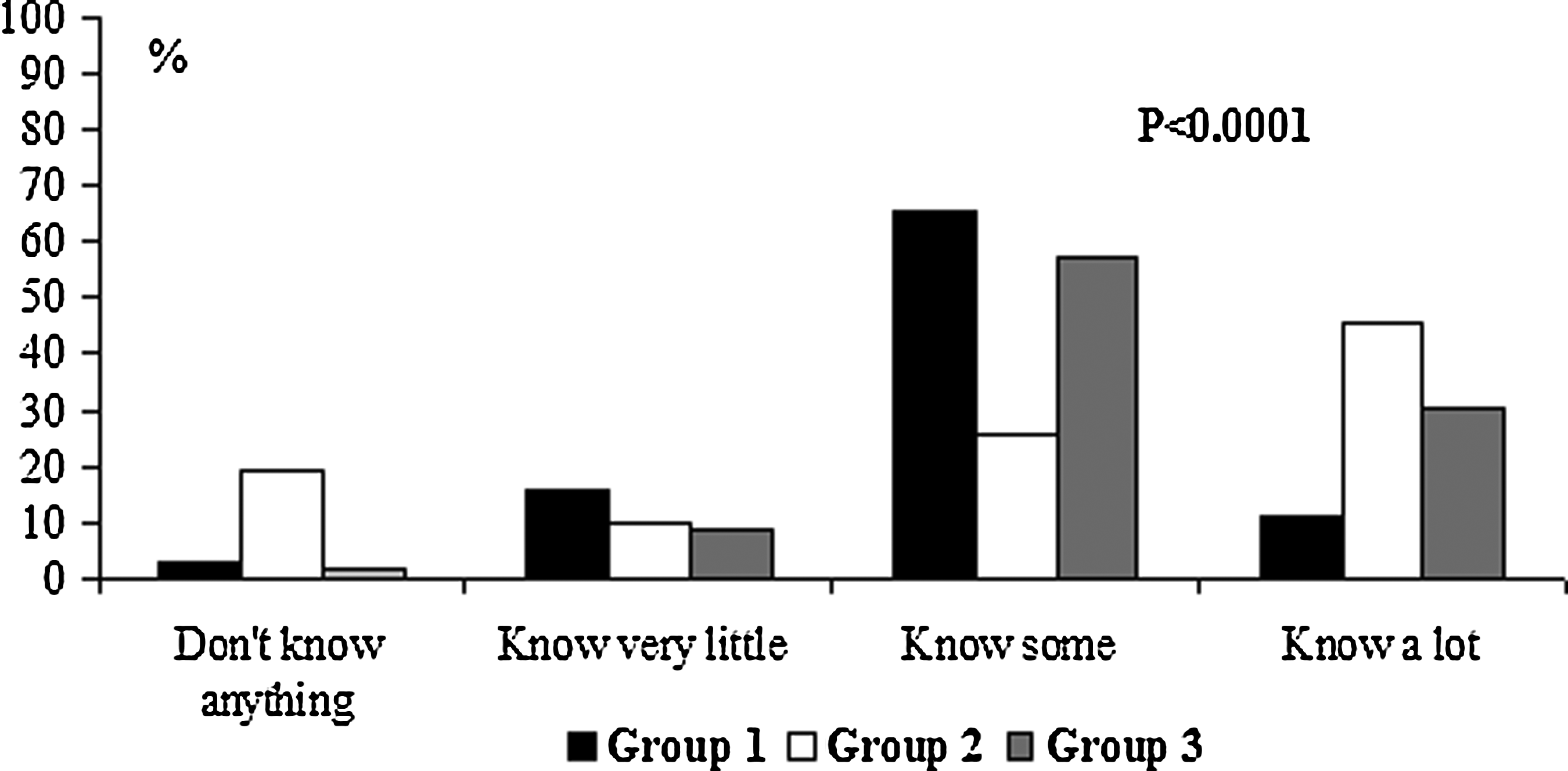
“How much do you think you know about breastfeeding?” Comparison of responses included in Group 1 (Spanish-respondent Hispanic), Group 2 (English-respondent Hispanic), and Group 3 (English-respondent non-Hispanic).
As shown in Table 2, overall, the majority of mothers recognized the difference between breastmilk and formula, thought that breastfeeding is good for the mother to do, and believed in the beneficial effect of breastfeeding for maternal health, and around 60% of the mothers reported knowledge regarding the meaning of colostrum. Hispanic mothers (Groups 1 and 2) were more likely to report planning breastfeeding before delivery, having discussed their own feeding with their mothers who more likely breastfed them, and feeling comfortable breastfeeding in the doctor's office, but less likely to be able to identify whom to ask if they wanted to learn more about breastfeeding than the U.S.-born non-Hispanic mothers. Hispanic mothers who had answered the survey in Spanish (Group 1) were significantly less likely to identify the meaning of “latch on.” Around 80% of mothers in all groups reported having conversations with their obstetrician and child's pediatrician regarding breastfeeding. Mothers in Group 1 were less likely than those in Groups 2 and 3 to report that somebody had educated them regarding breastfeeding.
Group 1 included Spanish-respondent Hispanic mothers, Group 2 included English-respondent Hispanic mothers, and Group 3 included U.S.-born non-Hispanic mothers.
p<0.03, bp<0.01, cp<0.001.
As shown in Figure 2, only 13.8%, 16.1%, and 21.4% of the mothers from Groups 1–3, respectively, reported breastfeeding education by the pediatrician. Also, only 5.5% of mothers in Group 1 recognized the involvement of obstetricians in breastfeeding education compared with 25.8% and 33.9% of mothers in Groups 2 and 3, respectively (p<0.01). Irrespective of language preference, more mothers of Hispanic origin reported being educated by their mothers how to breastfeed but were less likely to report participation of relatives other than their mothers in their breastfeeding education (Fig. 2).

“Who taught you how to breastfeed?” Comparison of responses included in Group 1 (Spanish-respondent Hispanic), Group 2 (English-respondent Hispanic), and Group 3 (English-respondent non-Hispanic). OB, obstetrician; Ped, pediatrician.
Discussion
Breastfeeding education is recognized as an important aspect for the improvement of breastfeeding practices in low-income and less-educated minority women. 14 It has been shown that the ability to communicate in English plays a significant role in the delivery of health-related educational services to Hispanic populations15,16 with a high prevalence of LEP.17,18 To our knowledge, this is the first study that attempted to address the association between language preference for communication in economically disadvantaged groups of Hispanic mothers and their knowledge and perception about breastfeeding practices.
In general, 70–90% of the study respondents reported that they understood the difference between breastmilk and formula, believed in the benefits of breastfeeding, thought that breastfeeding is a good thing to do, and had discussed breastfeeding with the obstetrician and pediatrician. Irrespective of their language preference, Hispanic mothers, compared with non-Hispanic mothers, reported breastfeeding planning prior to delivery, had discussed their own feeding with their own mothers, and felt comfortable about breastfeeding at the doctor office. However, despite demonstrating familiarity surrounding breastfeeding knowledge and practices, Hispanic mothers were less able to identify people who could answer questions to help improve their breastfeeding knowledge. Although low-income Hispanic women have shown strong positive views regarding breastfeeding19,20 and although maternal intention to exclusively breastfeed is associated with comfort regarding breastfeeding in social settings, 21 breastfeeding practice in low-income mothers has not been correlated with their positive perception about breastfeeding.22,23 In the present study we also showed that less educated, mostly Mexican-origin, Spanish-speaking respondents were more likely to report insufficiency in breastfeeding knowledge, unfamiliarity with the meaning of “latch on,” and inability to name those who taught them about breastfeeding. We assumed that LEP in association with low education may compromise Hispanic mothers' ability to use the widely displayed Spanish educational material regarding the different aspects of breastfeeding, including those discussing a correct on “latch-on.” Inadequacy of breastfeeding-related social networks as reported by Spanish respondents may also affect their ability to improve their breastfeeding knowledge. Humphreys et al. 24 reported on the less influential role of health professionals compared with members of women's social support networks in low-income mothers. Moreover, breastfeeding knowledge, self-efficacy, and perceived social support were identified as independent predictors of intention to breastfeed in WIC program participants. 25
We would like to acknowledge and discuss the potential limitations of the present study to prevent misinterpretation of our findings. First, we did not directly assess the English proficiency of the surveyed Hispanic mothers but categorized Hispanic mothers by their language preference for answering the breastfeeding questionnaire. We believe that language preference while answering the survey questionnaire reflects preferences for language-related communication. This concept has been has been used to categorize Spanish-speaking Hispanics and English-speaking Hispanics in a national survey designed to identify the role of spoken language on differences in health-related domains among U.S. Hispanics. 26 Second, this study has not been able to distinguish entirely the language proficiency component from other social determinants, including income, education, and place of birth. However, a direct relationship between LEP and level of education of the Hispanic population that is also associated with place of birth outside the United States has been reported. 18 Although we did not collect data regarding income to control the impact of the socioeconomic determinants, the majority of the surveyed mothers were enrolled in the WIC program. Finally, the use of a single Spanish variant such as sujeción del pezón for the translation of the phrase “latch on” is a limitation of our survey instrument because there is wide variability in how this word is expressed in the Spanish language. However, the anonymous nature of our survey did not allow the asking of personal information-related questions during the recruitment of the participants. Hence, the use of different versions of questionnaires translated into Spanish would have been problematic.
Conclusions
Preference for communication in Spanish among economically disadvantaged Hispanic mothers is associated with limitations in their breastfeeding knowledge and a lack of breastfeeding-related educational networks. Hence, language preference should be addressed while providing breastfeeding education and support for Hispanic mothers in order to help improve their understanding and build breastfeeding support systems that include health professionals.
Footnotes
Acknowledgments
We would like to thank the women who voluntarily participated in this breastfeeding survey. This project was supported through a grant from the Community Access To Child Health Program, a division of the American Academy of Pediatrics.
Disclosure Statement
No competing financial interests exist.