




Abstract
Abstract
Background:
Human milk contains leukocytes expressing brain-derived neurotrophic factor (BDNF), which may facilitate epileptogenesis. Our study aimed to estimate levels of BDNF in the sera of breastfed infants with idiopathic epilepsy and in breastmilk of their mothers and to assess its value as a marker of epilepsy severity.
Patients and Methods:
Thirty breastfed infants <2 years of age with idiopathic epilepsy and 15 control healthy breastfed infants were recruited for the study. Patients were subjected to thorough medical history, clinical examination, and assessment of disease severity. Routine laboratory and radiological investigations, including, liver, renal, and thyroid screen, brain magnetic resonance imaging, and measurement of serum and breastmilk BDNF levels, were performed.
Results:
Serum BDNF levels of epileptic infants and milk BDNF levels of their mothers were significantly higher than values for controls (p=0.0001). They were positively correlated with age, weight, length, and head circumference of epileptic children. Also, serum and milk BDNF levels were significantly increased with increased duration of illness and frequency of seizures. There was a significant positive correlation between serum and breastmilk levels of BDNF and significantly higher levels in severe cases of epilepsy.
Conclusions:
Serum and milk BDNF levels are higher in epileptic infants than in controls and may be used as a marker of disease severity.
Introduction
E
Brain-derived neurotrophic factor (BDNF) is a small dimeric protein belonging to the neurotrophin family that is expressed throughout the mammalian adult brain, particularly in the cerebral cortex and hippocampus.4,5 BDNF plays an important role in the development and maintenance of the nervous system, as well as in neuronal survival and proliferation,6–9 and it has been implicated in the modulation of learning and memory.10,11 It has been shown that acute application of BDNF in in vitro and in vivo models increases neuronal excitability, suggesting that BDNF facilitates epileptogenesis.12,13
Recent evidence has implicated BDNF in the pathophysiology of epilepsy.14,15 Human milk modulates infants' immune function and affects their overall development. 16 Studies suggest that human milk for breastfeeding infants may serve potential neurotrophic functions and the integrity of the gastrointestinal tract17,18 and may exert a stimulating effect on neurodevelopment during breastfeeding or long afterward. 19 BDNF can be added to the list of bioactive factors (e.g., interleukin-1β, interleukin-2, interleukin-4, interleukin-5, lactoferrin, and transferrin) present in breastmilk. 20
We aimed to estimate the level of BDNF in the sera of breastfed infants with idiopathic epilepsy and in breastmilk of their mothers and to assess its value as a prognostic marker of epilepsy severity.
Patients and Methods
This cross-sectional case control study included a total of 30 breastfed infants younger than 2 years of age who presented with idiopathic epilepsy, recruited from pediatric departments and outpatient pediatrics neurological clinics at Minia and Qena University Hospitals in Egypt. Fifteen healthy breastfed infants matched by age and sex were enrolled as controls during the period from October 2013 to November 2014. Diagnostic criteria of epileptic infants included at least two unprovoked seizures 21 and confirmation by electroencephalogram monitoring that was performed under basal conditions by the use of chloral hydrate. A Nihon Kohden (Tokyo, Japan) eight-channel conventional electroencephalographic machine had been used by the 10–20 international system of electrode placement and unipolar and bipolar montages. We excluded infants with a history of previous neurosurgical intervention, presence of an active neurological disorder or major neurological disabilities, and psychiatric disorders like autism or attention deficit hyperactivity disorder, as well as children whose mothers had gestational hypertension, diabetes, infection, fever, or chronic or neurological diseases. Written informed consent was obtained from the parents of participating children. The study was approved by the local ethical committee of the Faculty of Medicine of Minia and Qena Universities.
A thorough medical history was obtained for all patients, as well as sociodemographic data and history of epilepsy (duration, age of onset, recent seizure and its type, history of antiepileptic medications, frequency of use and response to antiepileptic, and history of hospital admission). Clinical examination included general examination, neurological examination, and assessment of the severity of epilepsy (according to duration of illness and maximal number of seizures per month). 21 Routine laboratory and radiological investigations, including a complete blood count, random blood sugar level, electrolytes, liver, renal, and thyroid screen, and brain magnetic resonance imaging, were performed.
Measurement of serum and breastmilk BDNF
Venous blood (5 mL) was collected from patients and controls in the afternoon to limit any potential circadian fluctuation of blood proteins and metabolites. The blood samples were centrifuged and aliquoted, and serum was stored at −20°C. Breastmilk samples (about 5 mL) were collected from mothers by hand expression just before suckling in sterile test tubes and were stored at −20°C. Before analysis the milk samples were thawed and centrifuged at 10,000 g for 30 minutes at 4°C. The aqueous layer beneath the floating lipid layer was used for assay of BDNF by the enzyme-linked immunosorbent assay technique. Assessment of serum and milk BDNF levels was done by using a commercially available quantitative enzyme-linked immunosorbent assay kit in accordance with protocols provided by the test manufacturer (R & D Systems, Inc., Minneapolis, MN) for the quantitative determination of human BDNF concentrations in serum and breastmilk.
Statistical analysis
The data were statistically analyzed using Student's t test, one-way analysis of variance, and chi-squared (linear by linear correlation) tests, as applicable (with a preset probability of p<0.05). Experimental results are presented as arithmetic mean±SD values. Statistical tests were conducted using the SPSS software package (version 16; SPSS Inc., Chicago, IL) on a personal computer.
Results
Our study included 30 breastfed infants with idiopathic epilepsy ranging in age from 10 to 24 months, and the normal control group included 15 breastfed infants ranging in age from 10 to 22 months. All patients and controls had been breastfeeding since birth; they began weaning after 6 months of age and still breastfeeding until the time of study. Patients' and controls' demographic data showed no significant difference between epileptic patients and controls regarding age, sex, weight, and height or head circumference.
In the epileptic group, the age at onset of epilepsy ranged from 8 to 16 months, with a mean±SD of 11.10±2.50. The duration of illness ranged from 2 to 10 months, with a mean±SD of 5.90±2.60 months. The seizure frequency per month ranged from none to five times, with a mean±SD of 2.50±1.70. Twelve cases (40%) had a positive family history of epilepsy (second- and third-degree relatives): seven patients (23.3%) on the maternal side and five (16.7%) on the paternal side. Their ages ranged from 9 to 22 months.
All the 30 epileptic infants enrolled in our study had normal perinatal history, as well as normal general and neurological examinations, and all had normal levels of laboratory investigations: complete blood count, random blood sugar, electrolytes, and liver, renal, and thyroid screen, as well as normal brain magnetic resonance imaging scans. Electroencephalography was done for all of them and revealed epileptic discharges. Clinically and according to the type of epileptic seizure, we found that 20 infants presented with generalized seizures (generalized tonic clonic in 12 cases, generalized tonic in five cases, and atonic in three cases) and 10 patients presented with partial seizures (complex partial in seven cases, simple partial in three cases). All of them are receiving regular antiepileptic medications with one or two antiepileptic drugs (including valproic acid, carbamzepine, phenobarbitone, and oxacarbamazepine), and all epileptic infants are followed up in pediatric neurology outpatient clinics.
Serum and breastmilk levels of BDNF (Table 1) were significant higher in epileptic infants than in the control group (p<0.0001).
By independent Student's t-test.
BDNF, brain-derived neurotrophic factor.
We found positive correlations between age, weight, length, and head circumference and levels of BDNF in both serum and breastmilk (Table 2). The levels of serum and breastmilk BDNF were highly significantly increased with increased duration of illness and frequency of seizures per month. Levels were higher in male infants than in female infants but without statistical significance between them (Table 3).
Pearson's correlation coefficient.
Significance of difference (two-tailed).
BDNF, brain-derived neurotrophic factor.
By independent Student's t test.
BDNF, brain-derived neurotrophic factor.
The severity of illness was assessed according to duration of illness, frequency of seizures per month, and frequency of hospital admission. Epileptic infants were grouped into mild, moderate, and severe disease categories. Among the epileptic infants we found 12 cases (40%) of severe disease, six (20%) of moderate disease, and 12 cases (40%) of mild disease. Serum and milk BDNF levels were significantly higher in severe forms of epilepsy than in mild and moderate forms of the disease (p<0.0001 (Table 4).
For comparison of mean values by analysis of variance.
There was a positive correlation between serum and breastmilk levels of BDNF as shown in Figure 1.
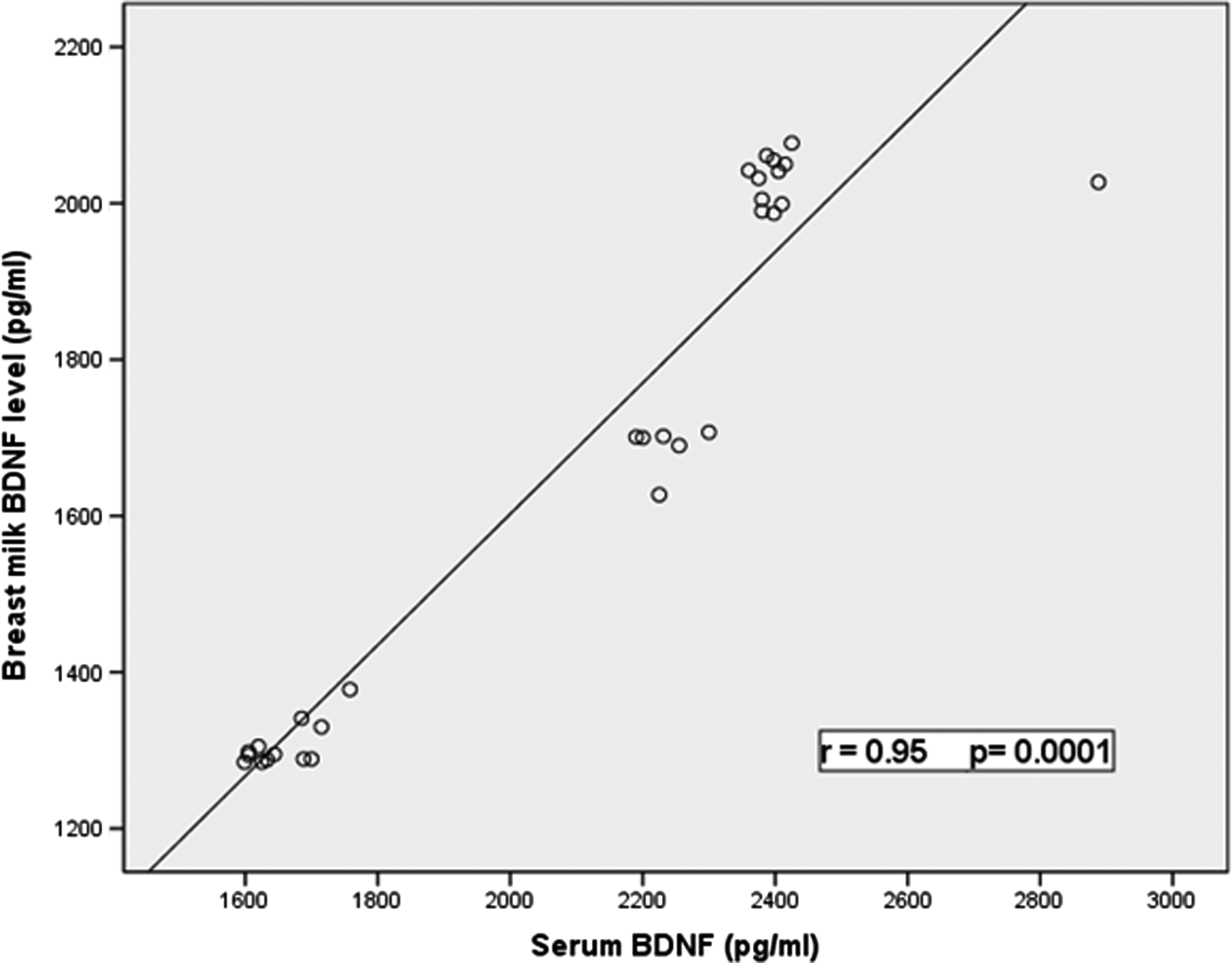
Correlation between infant serum and maternal breastmilk levels of brain-derived neurotrophic factor (BDNF) for epileptic infants.
Discussion
Research suggests that breastfeeding is associated with improved cognitive development. 22 Human milk is known to contain leukocytes expressing BDNF, 23 which plays a role in the growth and development of the central nervous system. 24 Epilepsy has a serious impact on cognitive development and social activities, and a recent study carried out in upper Egypt found the highest prevalence rate of epilepsy recorded in the early and late childhood period (70/100,000 and 44/100,000, respectively). 25
There are no studies that have examined the levels of BDNF in the sera of epileptic infants and breastmilk of their mothers simultaneously. To the best of our knowledge the present study is the first to estimate the BDNF level in the serum of epileptic infants younger than 2 years of age and in breastmilk of their mothers. Our study included 30 breastfed infants with idiopathic epilepsy and another 15 healthy, age- and sex-matched breastfed infants as a control group. According to the International League Against Epilepsy, 26 our epileptic infants were diagnosed as having idiopathic epilepsy, which was then classified into generalized and partial types. Jankowsky and Patterson 27 reported that experimental evidence supports the role of BDNF in aspects and pathology of seizures and that its level increases as high as 40-fold after a seizure.
In the present study, we found significantly higher levels of serum and breastmilk BDNF for epileptic infants than in the control group (p<0.0001). For serum BDNF our results agree with those of a study carried out by Connolly et al., 28 who directly examined serum BDNF levels in children with epileptic seizures, and their results revealed that serum levels in children with epilepsy were elevated compared with healthy controls (p=0.02). In contrast, LaFrance et al. 29 concluded that unlike children, adults with epilepsy appeared to have decreased levels of serum BDNF. But in another study carried out by Hong et al., 30 they found that BDNF levels in adult epileptic patients were not different from those of controls.
Our study revealed an important association between serum BDNF levels of epileptic infants and levels of BDNF in breastmilk of their mothers, as there was a significant positive correlation between them (p=0.0001, r=0.95).
Very limited reports are available on the levels of BDNF in human milk, and the first study, carried out by Li et al., 31 estimated the BDNF level in breastmilk of lactating women and investigated changes in concentrations during lactation; they concluded that BDNF is present in human milk and suggested that it has a physiological function, including a trophic role, and may be responsible for the long-term effects of breastfeeding. Furthermore, in another study carried by Danget et al., 32 they reported that levels of breastmilk BDNF are highest at Day 3 after birth, then decrease at 1.5 months of age, and then increase until 6 months; they explained these significant differences in BDNF levels at several time points during lactation as due to the adaptive changes of the preeclamptic mothers, and they suggested that neurotrophin is altered in preeclampsia.
By using the Bayley Scale of Infant Development, Second Edition (BSID-II) cognitive assessment, Nassar et al. 33 found that breastfed infants had higher Bayley Scale scores, followed by mixed-fed and then formula-fed infants, and the serum BDNF levels were significantly higher in breastfed infants compared with infants who received formula milk. They found also a distinct positive correlation between BDNF values and all studied BSID-II parameters, and they hypothesized that BDNF could be one of the causative factors of higher cognitive functions in breastfed infants. Also, Malamitisu-Puchner et al. 34 found higher serum levels of BDNF in mothers than in their infants, as well as full-term infants presented with higher levels than preterm ones, and explained the difference between mothers as well as pre- and full-term infants by their differential degree of peripheral and central nervous system maturity.
Our study included 12 infants with a positive family history of epilepsy: seven of them from the maternal side and five from the paternal side, with a varying wide range of age. The mothers of the studied epileptic infants were normal, but they may have carried a maternal trait that increases risk of epilepsy, as mutations and chromosomal defects underlying many inherited symptomatic epilepsies have now been identified, and several genes have been associated with idiopathic epilepsies. 35
In our study within the epileptic group, we found significant positive correlations between age, weight, length, and head circumference and levels of BDNF in both serum and breastmilk, as they were increased with the increase of these variables, but this is not consistent with data obtained in a meta-analysis of 11 studies that examined the differences in serum BDNF content between depressed and nondepressed subjects and found no age dependence. 36 Another study reported a decline in serum BDNF levels with increasing age, but this study only recruited people in old age. 37 Our epileptic patients are all in the first 2 years of life, the period of rapid brain growth spurt, and during this period there was a rapid increase in head circumference and brain development, so the different age group and different disease may explain the differences in results. Serum and breastmilk BDNF levels were higher for male infants than female infants but without statistical significance between them; this agrees with another study 37 that reported that BDNF levels did not show any significant gender differences, but, in contrast, one study reported that women have lower BDNF serum levels than men. 38 However, the different adult age group of their patients with mature women and a high estrogen level may explain the difference.
We found a highly significant difference in the levels of serum and breastmilk BDNF in relation to duration of illness and frequency of seizures per month; this agrees with Hong et al., 30 who found significant negative correlations between seizure frequency and disease duration with serum BDNF levels. One of the objectives of our research was to assess the BDNF value as a marker of epilepsy severity, and we found significant differences in serum and breastmilk BDNF levels for epileptic infants with different disease severity, as the levels were significantly higher in the severe form than in the mild and moderate forms with a p<0.0001. So, serum and milk BDNF levels for epileptic infants are associated with disease severity and may be used as a helpful marker of severity, and this agrees with the results obtained by Hong et al. 30
Conclusions and Recommendations
We conclude that serum and milk BDNF levels are higher in epileptic infants than in controls. There was a positive correlation between serum and breastmilk levels of BDNF. Serum and milk BDNF levels of epileptic infants are associated with disease severity and may be used as a helpful marker of severity. We hope that understanding the association between BDNF and epilepsy will lead to novel antiepileptic therapy. More research should be carried out to obtain more information and to clarify the role of BDNF in human milk of epileptic infants' mothers.
Footnotes
Acknowledgments
We owe a great thanks to all the children participated in our study and their families for their cooperation.
Disclosure Statement
No competing financial interests exist.