




Abstract
Abstract
Background:
There are no randomized trials comparing early exclusive hand expression (HE) with early exclusive electric pump expression (electric expression [EE]) for milk removal in mothers of very low birth weight (VLBW) infants.
Subjects and Methods:
Mothers of VLBW infants were randomized to exclusively HE or EE for the first 7 days postpartum. Daily volumes of milk were compared between groups for the first 28 days, adjusting for repeated measures.
Results:
The HE (n=12) and the EE (n=14) groups did not differ with respect to age, parity, single versus multiple gestation, or number of expression sessions per day. There were 728 values for daily milk volumes in the first 28 days, including 105 HE and 623 EE. Mothers using exclusive HE had significantly (p<0.05) less cumulative daily milk production throughout the first 7 days postpartum compared with exclusive EE. Mean cumulative milk production among mothers using HE in the first postpartum week remained approximately half that of those using the electric pump throughout the first 28 days, without evident catch up. In multivariable analysis, each postpartum day was associated with an adjusted increase of 50 mL of human milk/day during the first 7 days postpartum and an increase of 13 mL/day between postpartum Days 8 and 28. After adjusting for repeated measures, number of expression sessions per day, and postpartum day, EE was associated with an advantage in milk production of 119 mL/day during the first 28 postpartum days compared with HE.
Conclusions:
Compared with mothers using EE, mothers using HE had significantly less cumulative daily milk production during the first 7 days postpartum. This trend continued after the intervention had been discontinued, and the great majority of expressions in both groups were with EE. Further research to confirm and expand these findings is warranted.
Introduction
E
Despite the advantages of an early human milk diet, mothers of preterm infants often struggle with delayed lactogenesis and inadequate milk volumes.5,6 Subsequently, insufficient production is the most common reason these mothers discontinue lactation. 7 In order for VLBW infants to receive mother's own milk during their hospital stay and beyond, mothers must express their milk very soon following delivery and frequently thereafter.6–8 Current recommendations for mothers who are separated from their infants include pumping within 6 hours of delivery and then every 3 hours (eight times in 24 hours). 7
For mothers who deliver their preterm infant in a hospital setting in a developed country, the current standard of practice is to use a hospital grade (multi-user) electric breast pump. 9 Research regarding milk expression in this population has focused on comparing types of electric pumps10,11 or methods of electric expression (EE).12–14 A recent Cochrane Review observed 15 out of the 25 (60%) studies that evaluated pumps or products had support from the manufacturers. 15 This suggests that research regarding milk expression has been largely industry driven and therefore focused on electric pumping. However, mothers separated from their infants often have difficulty removing colostrum from the breast with an electric pump. 16
Hand expression (HE) may be an alternative means of expressing colostrum while at the same time providing stimulation to the breast similar to breast massage. HE may also be an option for mothers who do not have access to electric pumps or for women who do not want to be dependent on technology to express milk for their infant.
Mothers of preterm infants can achieve high levels of milk production by combining the use of EE and HE 16 or by alternating between HE and EE in the first 24 hours after delivery. 17 However, we were unable to locate studies comparing exclusive HE with exclusive EE in mothers of VLBW infants.
The purpose of this study was to compare 28 days of milk volumes yielded from exclusive HE and exclusive EE during the first week postdelivery in mothers of VLBW infants. We hypothesized that there would be no difference in daily mean volume in the first 28 days of life between mothers who use exclusive HE and exclusive EE in the first week postpartum.
Subjects and Methods
The study settings were a postpartum inpatient floor located in an inner-city regional care center and a Level IV inner-city neonatal intensive care unit located within the same building. In the neonatal intensive care unit setting, if no contraindication to feeding is present, VLBW infants are fed gut-priming feeds by 48 hours of life at 10 mL/kg/day. Advancement of feedings begins on Day 3 or 4 (depending on birth weight) to 20 mL/kg/day and increasing by 15–20 mL/kg/day every 24 hours as tolerated.
Mothers 18 years of age or older who delivered infants weighing ≤1,500 g and at gestational age ≤32 weeks were eligible to participate in this study. Mothers were not eligible to participate if they spoke a language other than English or Spanish, were too ill to express milk, had prior breast surgery, had a recent history of substance abuse, or if their infant was moribund or transferred to another facility. Informed consent was obtained from all participants. This study was approved by the Institutional Review Boards of Hartford Hospital and the Connecticut Children's Medical Center. As this was a pilot/feasibility study, no sample size calculations were performed.
Participants were randomized to either the HE group or the EE group. All participants began milk expression using the assigned method within 6 hours of delivery. An International Board Certified Lactation Consultant/neonatal intensive care unit registered nurse instructed each mother on the proper technique for milk expression relative to her randomized allocation. International Board Certified Lactation Consultants used an educational video, 18 verbal instruction, and hands-on support to guide subjects through the first milk expression. Participants were asked to exclusively use the assigned method of expression for the first 7 days postpartum, after which they could use either or both methods. Members of the research team instructed mothers to express milk every 3 hours for 15–30 minutes and to maintain a written log documenting the time of expression, method of expression, and the milk volume obtained at each expression through 28 days postpartum. All mothers were seen daily by an International Board Certified Lactation Consultant for the first postpartum week to review milk expression techniques and to answer questions.
Statistical analysis
Descriptive analyses were performed using SPSS version 17.0 software (IBM, Armonk, NY). Univariate comparisons of independent data were performed with Student's t or the Mann–Whitney U test for continuous variables and the chi-squared or Fisher's exact test for categorical variables. Nonindependence occurred in the data due to repeated daily measures of milk volume for each participant; therefore analyses of nonindependent data were performed with univariate or multivariate hierarchical linear regression using HLM version 7.0 (Scientific Software International, Inc., Lincolnwood, IL). Median milk production increased quickly over the first 7 days, whereas thereafter the slope of median production increased at a slower rate (Fig. 1). Accordingly, multivariate regression analysis used a mixed-model spline regression approach 19 in which the relationship between postpartum day and breastmilk volume was modeled with continuous but separate lines for postpartum Days 1–7 and Days 8–28. All statistical tests were two-tailed with p<0.05 considered significant.
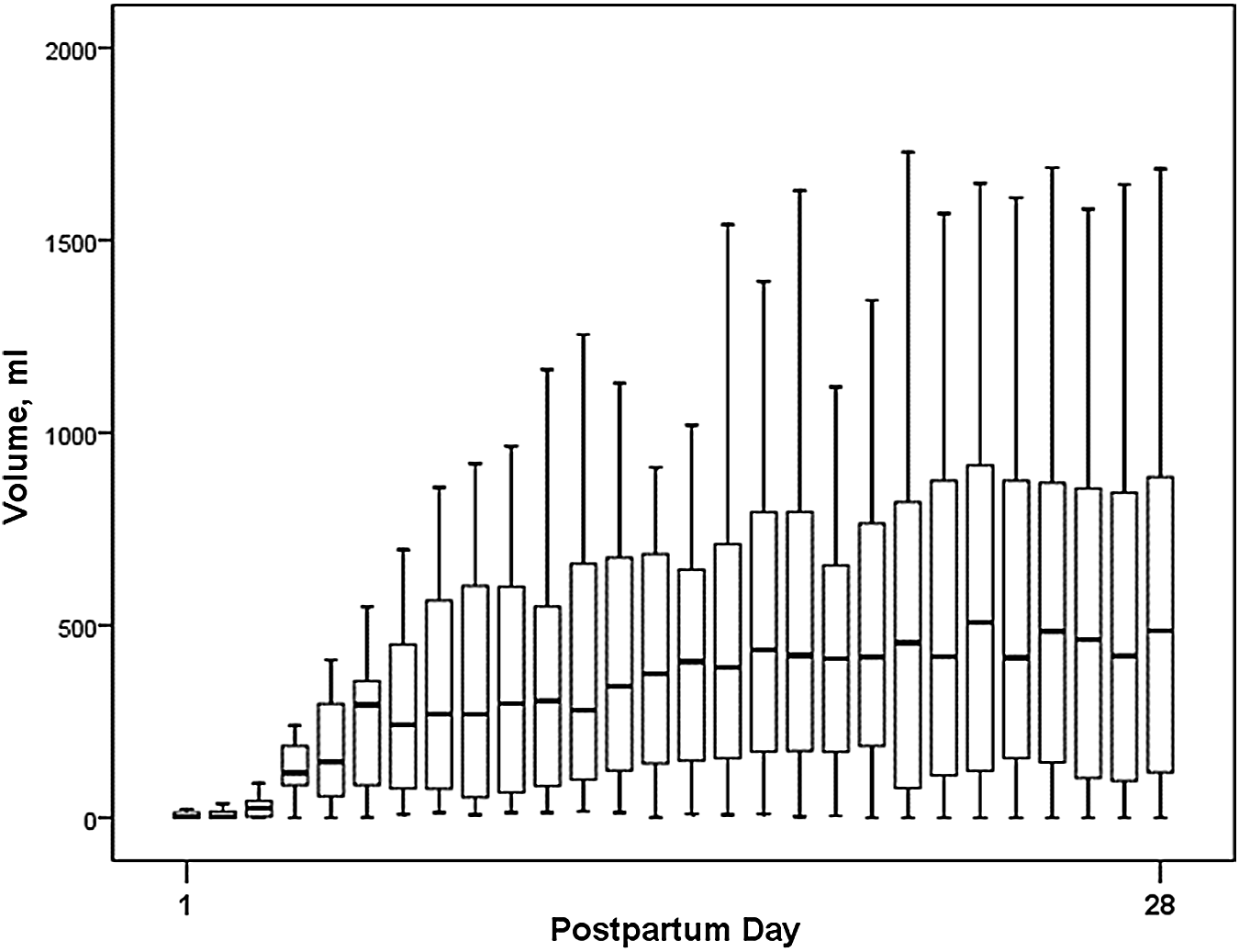
Milk production (in mL/day) for the entire study cohort (n=26).
Results
Forty mothers consented to participate in this study. Twenty mothers were randomized to the HE group and 20 to the EE group. There were no significant differences between the two groups with respect to age, parity, primigravida status, or multiple versus singleton gestation. Method of expression for each session, number of expression sessions per day, and volume of mother's milk obtained per session were reported for each of the first 28 postpartum days by 26 participants, yielding 728 values for daily milk volume; these formed the cohort for analysis. All participants in the analyzed cohort adhered to the study protocol and exclusively expressed milk by only their assigned expression method for the first 7 days. Thereafter, all participants in the EE group chose to continue using an electric pump for expression. In the HE group after the first 7 days, two mothers continued to use HE through 21 days, whereas the remaining mothers did their sessions were with the electric pump. In total, 105 (14%) of sessions in the first 28 days were by HE, whereas 623 (86%) used electric pump expression. For each individual mother, the expression sessions per day ranged from one to 10.
In univariate analyses, participants in the HE (n=12) and EE (n=14) groups did not differ detectably with respect to age, parity, or number of milk expression sessions per day (Table 1). However, compared with mothers using EE, mothers using HE had significantly less daily milk production (Fig. 2) and cumulative milk production (Table 1) throughout the first 7 days postpartum. Cumulative volumes at 14 and 28 days were not statistically different between the two groups. However, median cumulative milk production among mothers using HE in the first postpartum week remained approximately half that of those using the electric pump throughout the first 28 days.
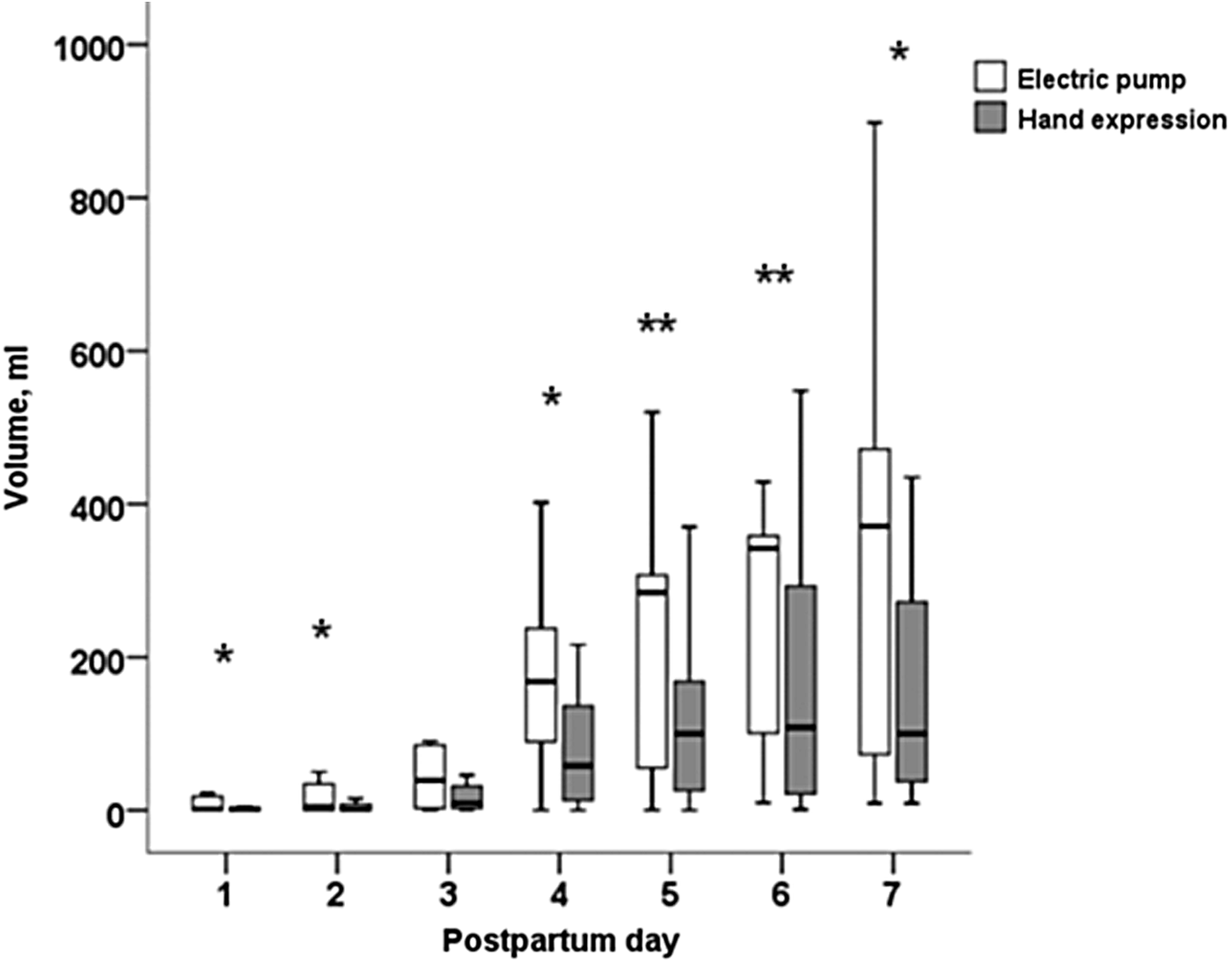
Daily milk volumes (in mL/day) for mothers in the electric pump group (n=14) and the hand expression group (n=12). *p<0.05, **p<0.01.
Data are median (interquartile range) values or n (%) as indicated.
By Mann–Whitney U test.
By chi-squared test.
By univariate hierarchical linear regression.
In multivariate hierarchical spline regression adjusted for repeated measures, interval since birth was strongly associated with milk production, as each postpartum day was associated with an adjusted increase of 50 mL of human milk/day during the first 7 days postpartum and an increase of 13 mL/day between postpartum Days 8 and 28. Daily milk volume was also significantly associated with number of expression sessions per day, with each session adding an adjusted 25 mL to daily volume. After adjusting for these factors, EE was associated with an increase in milk production of 119 mL/day compared with HE (Table 2). Primigravida status, multiple gestation, and maternal age were not associated with daily milk volume in multivariate analysis.
Results were not significantly different for primigravida status, multiple gestation, or maternal age.
CI, confidence interval.
Discussion
This randomized controlled trial (RCT) study found that, compared with mothers using exclusive EE, mothers using exclusive HE had significantly less cumulative daily milk production throughout the first 7 days postpartum. Moreover, the deficit in milk production among HE mothers continued after postpartum Day 7, when the study intervention had been discontinued and the great majority of expressions in both groups were with EE. Although cumulative volumes after postpartum Day 7 were not statistically different between the two groups, median cumulative milk production among mothers using HE in the first postpartum week remained approximately half that of those using EE throughout the first 28 days, a difference of potential clinical importance that showed little evidence of correction during Days 8–28. In multivariable analysis, EE was associated with a significant advantage in daily milk production during the first 28 days postpartum compared with HE, after adjusting for other important factors including number of expression sessions.
Mothers who experience a complicated peripartum course, such as mothers of VLBW infants, are more likely to experience a delayed onset of milk production. 20 Early initiation of milk expression and frequent milk removal are important factors in the development of an adequate milk supply in this population.6–8 One pilot study demonstrated that initiating milk expression within the first hour after birth is more effective than expressing between 2 and 6 hours. 21 Although future studies may corroborate these findings and inform changes to clinical practice, the present standard of care is to begin milk expression within 6 hours of delivery, as was done in this study. Initiation and frequency of milk expression were similar between both the HE and EE mothers and therefore did not influence our results. Despite the differences we report, most mothers in both study groups were able to provide enough milk for gut-priming and early enteral feeding advancement.
Several investigators have studied the use of HE as a method of milk removal. Zinaman et al. 22 examined the effects of various pumping methods on milk yield and prolactin and oxytocin release when compared with infant suckling in term healthy infants. They documented lower prolactin responses in the HE group compared with the EE group and, as in our study, observed significantly lower milk volumes in the HE group; oxytocin levels were not significantly different between groups. 22 Flaherman et al. 23 measured milk volumes immediately after breastfeeding in mothers of term infants randomized to either an electric breast pump or HE. The median volume of expressed milk was 0.5 mL for mothers who used HE and 1.0 mL for the EE group, although the difference in volume between the groups did not reach statistical significance. However, at 2 months, mothers assigned to the HE group were more likely to be breastfeeding than mothers who used the EE method. 23
Morton et al. 16 investigated whether the use of two manual techniques, HE of colostrum and “hands on pumping” (breast compression and HE combined with electric pumping), could promote establishment and sustainability of a sufficient milk supply in NICU mothers. Their results demonstrated that mothers of preterm infants can achieve high levels of milk production by combining the use of EE and HE. 16
Larkin et al. 24 demonstrated that mothers of preterm infants can establish a full milk supply (>700 mL/day) by combining HE after electric pumping during the first 3 days postpartum and hands-on pumping after lactogenesis II.
Two studies compared milk volumes in mothers of premature infants using HE and EE. Ohyama et al. 17 studied HE versus electric pumping in 11 mothers of infants in a tertiary perinatal center in Japan. Mothers alternated HE with EE during the study. Mothers yielded twice as much milk when using the HE technique compared with sessions using the electric pump in the first 48 hours. 17 It is unclear whether or not the differences in volumes between groups would have continued beyond the 48-hour period. Slusher et al. 25 compared EE and HE techniques in mothers of infants admitted to a special care nursery in Uganda. Any mother of an infant admitted to the special care nursery who was too ill to breastfeed but not on ventilator support was eligible to be included. No weight or gestational age criteria were used for study recruitment. Slusher et al. 25 used nonrandom, sequential assignment to allocate mothers to one of three groups: Group 1, double electric breast pump; Group 2, single nonelectric manual pump; and Group 3, HE. Maternal milk volumes were measured each day over a 7-day period. Group 1 produced the highest daily milk volume (mean, 647 mL), followed by Group 2 (mean, 520 mL); Group 3 (mean, 434 mL) produced the lowest daily milk volume of the three expression methods. 25 Our study is similar in methodological approach in that mothers were allocated to either exclusive HE or exclusive EE; no subjects used a combination of milk expression techniques during the study period.
Our study is subject to several important limitations. First, observations lost to follow-up resulted in missing data. However, we were unable to detect significant differences between mothers excluded due to lack of complete data and those included in the analysis with respect to age, parity, multiple versus singleton gestation, or expression method. Given the small sample size, we acknowledge the potential for group differences between those with and without follow-up with respect to unmeasured factors.
Second, we did not collect data on subjects who were approached but did not consent to participate in the study. Mothers consenting to participate in this study may have been more familiar or comfortable with the nonstandard method of milk expression (HE), thus potentially creating a selection bias.
Lastly, we did not include a measurement of maternal comfort or preference in the design of this study. Flaherman et al. 23 found that although differences in milk volumes between the HE and EE groups were not significant, mothers in the HE group were more comfortable expressing milk with others present and also showed a trend toward increased comfort breastfeeding with others present. Furthermore, mothers in the HE group were more likely to still be breastfeeding at 2 months than mothers in the EE group. 23 Because we did not measure this in our study population, we cannot ascertain whether or not mothers were more comfortable with one method versus another or if maternal comfort/preference affected daily volumes. Despite the absence of a direct measurement of comfort and/or preference, it is notable that most mothers (77%) chose to use EE as their expression method after the 7-day exclusive expression period ended.
This study has several important strengths. The first involves study design. This was an RCT; therefore the distribution of both known and unknown potential confounders was likely to be similar between the HE and EE groups. Second, we used rigorous statistical methodology in our analysis, and although there were only 26 subjects included in the analysis, this was a repeated-measures dataset that included 728 outcomes. Lastly, all subjects adhered to the study protocol of 7 full days of their assigned expression method with no protocol violations, further strengthening our study results. The willingness of mothers to use HE for the full 7 days is notable as the electric pump is believed by most mothers and health professionals to be the superior if not only option for milk removal in this patient population in developed countries.
Conclusions
These results suggest that exclusive EE is superior to exclusive HE for establishing milk supply in mothers of VLBW infants. Further research is needed to confirm and expand upon these findings. Studies may be warranted examining the role of HE as an adjunct method in combination with EE for the VLBW infant in the early postpartum period.
Footnotes
Disclosure Statement
No competing financial interests exist.