




Abstract
Abstract
Background:
Little is known about circadian variations of macronutrients content of expressed preterm human milk (HM). This study evaluated diurnal variations of macronutrients and energy content of preterm HM over the first 7 weeks of lactation and tested the hypothesis that values obtained during a morning sample are predictive of those obtained from an evening sample.
Materials and Methods:
Expressed HM was obtained from 32 mothers of preterm infants (26–33 weeks in gestational age), who routinely expressed all their milk every 3 hours from the beginning of the second to the seventh week after delivery. One aliquot was obtained from the first morning expression and the second from the evening expression. Energy and macronutrients contents were measured using an HM analyzer.
Results:
Mean fat and energy contents of all samples obtained during the whole period were significantly higher in evening samples (p<0.0001). There were no significant differences between morning and evening carbohydrates and protein contents. Concentrations of protein, carbohydrates, and fat from morning samples were predictive of evening concentrations to different extents (R2=0.720, R2=0.663, and R2=0.20, respectively; p<0.02). The predictability of evening values by morning values was not influenced by the week of lactation at sampling or by individual patients. In repeated-measures analysis of variance performed on 11 patients who completed the whole 7-week period, over time, there was a significant decrease in fat, energy, and protein contents, whereas carbohydrates content remained unchanged. Day–night differences remained significant only for fat content.
Conclusions:
Circadian variations in fat and energy concentrations of HM are consistent over the first 7 weeks of lactation. There are no consistent circadian variations in HM protein and carbohydrates. Over a given day, there are little variations in protein and carbohydrates content, but fat concentrations are more variable, and evening values are less well predicted by morning sample analysis than values for protein or carbohydrates.
Introduction
P
There have been some attempts to make more meaningful calculations using bedside analyses of HM fat (such as through measurements of creamatocrit, a strong predictor of HM energy concentration 6 ). Recently, the technology of mid-infrared transmission spectroscopy has allowed for the development of a bedside analysis of HM macronutrients (protein, carbohydrates, and fat), in addition to energy. In some neonatal intensive care units, such instruments are routinely used, 7 and there is at least one ongoing randomized clinical trial that aims to investigate individualized fortification of breastmilk based on daily milk analysis of carbohydrates, protein, and fat content. 8 We have previously shown that over the first few weeks of lactation, there are significant circadian variations of creamatocrit.4,9
We thus designed the following prospective study in order to examine the diurnal variations of macronutrients (protein, carbohydrates, and fat) and energy content of HM (as analyzed by mid-infrared transmission spectroscopy) expressed from mothers of preterm infants over the first 7 weeks of lactation. We tested the hypothesis that values obtained during a morning sample are predictive of those obtained from an evening sample.
Materials and Methods
Patients and sample collection
We collected samples of expressed HM obtained from 32 volunteer mothers of hospitalized growing preterm infants, recruited between August 2012 and September 2013, with a gestational age at birth ranging from 26 to 33 weeks, who routinely expressed all their milk every 3 hours during the daytime, just before bedtime, and as soon as they woke up, using a commercial breast pump (Medela AG, Baar, Switzerland). Milk samples were collected weekly, on the last day of each week, from the first week of lactation and until the seventh week of lactation. One sample was obtained from the first morning expression (between 0600 and 0900 hours) and the second one from an evening expression (between 2100 and 2400 hours). Each mother contributed one single morning and one single evening sample (obtained on the same day) every week. They were instructed to ensure that their two breasts were thoroughly emptied and to stop pumping whenever there was a feeling of emptiness, as well as 2–3 minutes of pumping without any milk expression. We included only healthy mothers, excluding in particular those with hypertensive disorder of pregnancy or diabetes.
Laboratory methods
Immediately following extraction, samples were stored in a refrigerator at <5°C for a maximum period of 24 hours prior to being stored at −20°C until thawed and analyzed. Just prior to analysis, each frozen sample was initially heated at 40°C in a thermostatic bath. Samples were then homogenized by the MIRIS (Uppsala, Sweden) milk refresher using an ultrasonic technique, as recommended by the manufacturer of the milk analyzer. They were then analyzed using the MIRIS milk analyzer, an instrument based on mid-infrared transmission spectroscopy. 7
Statistical analysis
Statistical analyses were performed using Minitab version 16 software (Minitab Inc, State College, PA). Paired t tests were used to compare macronutrients concentrations between day and night samples. Linear regression analysis was performed to study correlations between macronutrients content in day and night samples, and stepwise multiple regression analysis was performed in order to verify whether the correlations observed in univariate analysis were affected by potential confounders such as patient or week of lactation. Repeated-measures analysis of variance was used to study the circadian differences, while taking into account gestational age, birth weight, and week of lactation (time factor). Continuous variables were expressed as median and range when not normally distributed and as mean±standard deviation when normally distributed. Dichotomous variables were expressed as percentage/ratio. A p value of ≤0.05 was considered significant.
Results
Demographic and maternal characteristics of the participants in this study are presented in Table 1. Twenty-eight mothers were omnivorous, and four were vegetarians. Complete data were obtained for all 32 mothers in Week 1, 22 mothers up to Week 2, 20 mothers up to Week 3, 17 mothers up to Week 4, 15 mothers up to Week 5 and Week 6, and 11 mothers up to Week 7.
Data are expressed as mean±standard deviation (SD) values and range.
BMI, body mass index.
Table 2 depicts the morning and evening nutritional analyses on all 133 paired available samples (total of 266 samples) collected over a period of 7 weeks. In brief, mean fat concentration was 10.9% higher (p<0.001) and mean energy content 6.2% higher (p=0.013) in evening than in morning samples. In contrast, there were no significant differences between day and evening carbohydrates or protein concentrations. Day protein and carbohydrates concentrations were highly predictive of evening concentrations (R2=0.720, p<0.001 and R2=0.663, p<0.001, respectively) (Figs. 1 and 2). Day fat concentrations were also predictive of evening concentrations, but to a lesser extent (R2=0.203, p<0.001) (Fig. 3).

Plot of morning versus evening protein contents (R2=0.720, p<0.001).
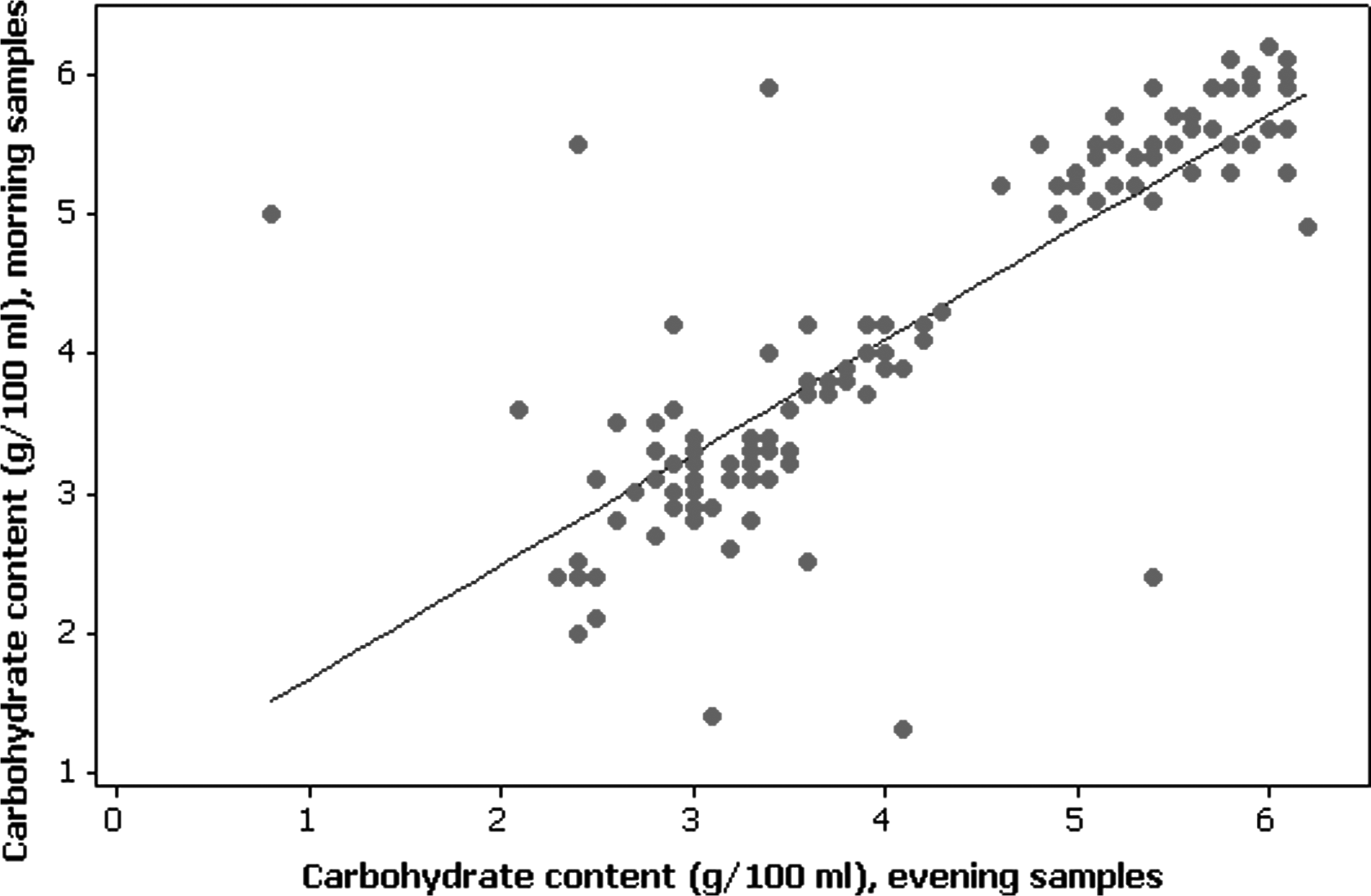
Plot of morning versus evening carbohydrate contents (R2=0.663, p<0.001).
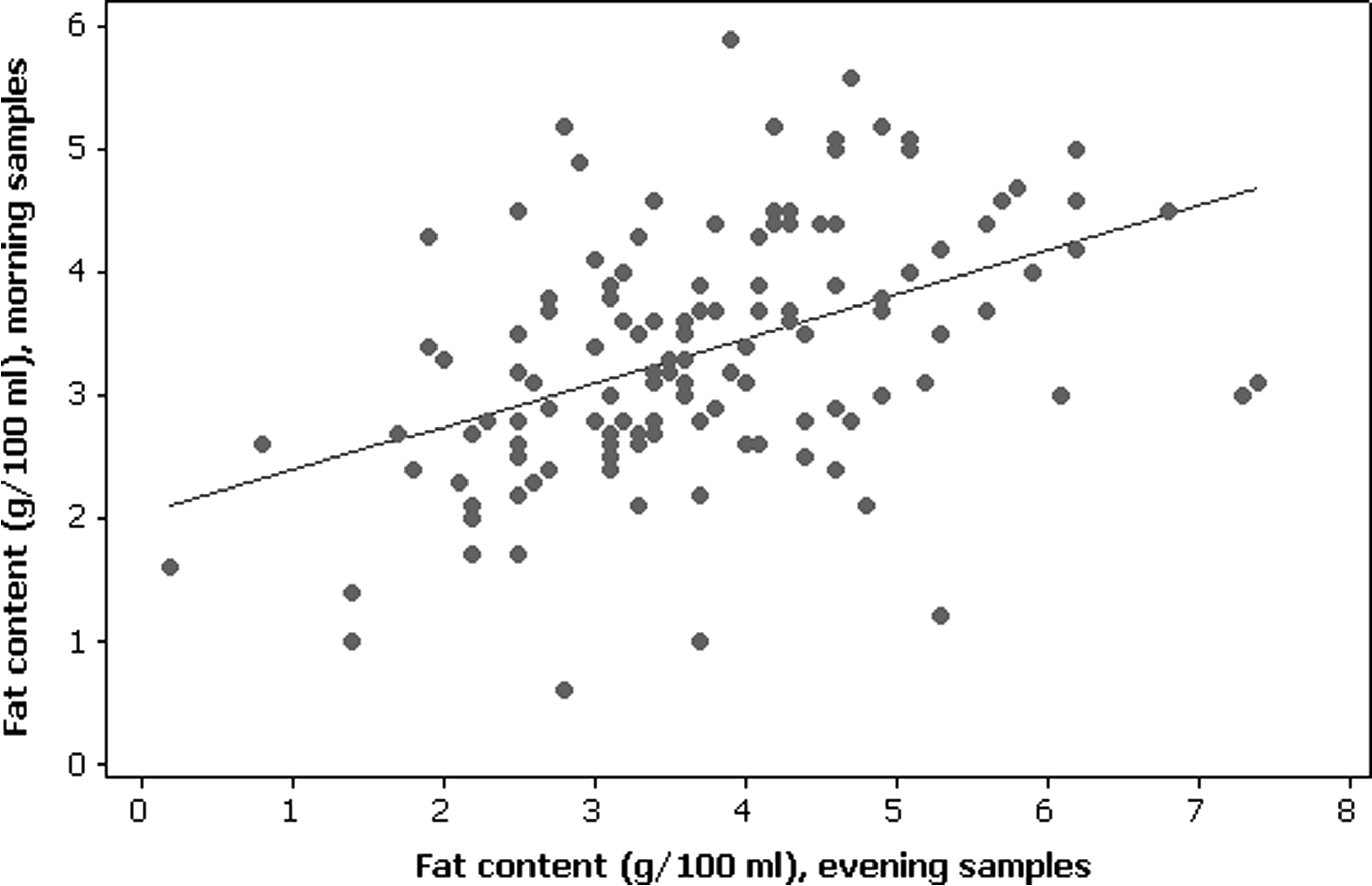
Plot of morning versus evening fat content (R2=0.203, p<0.001).
Data are expressed as mean±standard deviation (SD) values and range.
In stepwise multiple regression analysis, the predictability of evening values of protein content by day values was not affected by a patient or a week factor. The predictability of evening values of fat content by day values was significantly, but very slightly, affected by a week factor (which improved the R2 by less than 2%), and the predictability of evening values of carbohydrates content by day values was affected by a patient or a week factor also to a minimal extent (less than 2% improvement each of the R2). Regression analysis performed over the 11 patients with complete (7-week sampling) showed a significant decrease over time in protein concentration day and night (R2=0.286, p<0.001 and R2=0.336, p<0.001, respectively), compared with a significant decrease in carbohydrates content at night (R2=0.08, p=0.011) but not during day (R2=0.02, p=0.178); fat content increased up to Week 3, followed by a decrease up to Week 7 both day (R2=0.132, p=0.002) and night (R2=0.100, p=0.008).
Repeated-measures analysis of variance conducted for 11 patients with complete 7-week sampling was performed in order to take into account a patient factor and a day versus night factor. This analysis showed that over time, there was a significant decrease in fat, energy, and protein content, whereas carbohydrates content remained unchanged. It is important that, in this analysis, there was a significant patient factor for fat, energy, and carbohydrates content, and day–night differences remained significant only for fat content.
Discussion
In the present study, we have been able to demonstrate that circadian variations in fat content occur consistently over the first 7 weeks of lactation in HM expressed by mothers of preterm infants, with evening values 10.9% higher in evening than in morning samples. In contrast to fat, we found no circadian rhythm in milk carbohydrates and protein concentrations. These results confirmed in a longitudinal manner our previous findings obtained from a cross-sectional study that showed that HM expressed by mothers of preterm infants during the second week of lactation underwent circadian variations in fat content, estimated by the means of measuring milk creamatocrit. 4 They also confirmed the results of our previous longitudinal study that also evaluated fat content by the means of measuring creamatocrit. 9
We also found that morning protein, fat, and carbohydrates concentrations were predictive of evening concentrations, although of variable degrees. This finding could be clinically relevant in settings whereby it is attempted to individualize fortification of breastmilk based on daily milk analysis of its contents. 8 Indeed, whenever there are limitations in the number of caretakers available to conduct such measurements, it would be highly practical and less time consuming to perform individualized fortification based on one single measurement per day, rather than measuring all and every HM sample obtained. This comment may be justified for protein and carbohydrates, but because of the extremely wide range of the actual differences between the paired samples of evening versus morning fat content, making such clinical decisions in relation to fat content would not be justifiable. Nevertheless, the circadian changes of macronutrients concentrations in HM are not fully understood. Theoretically, they could be driven by hormonal changes (such as the night peak of prolactin 10 ), but they could also be driven by the unequal distribution of milk over a 24-hour period because most milk is consumed during the day hours rather than at night.
Contrary to our previous study, where we found that average creamatocrit did not undergo significant changes over the first 7 weeks of lactation, fat content in this study had a small but significant increase up to Week 3, followed by a decrease up to Week 7. 9 The latter finding is consistent with those of the systematic review and meta-analysis recently performed by Gidrewicz and Fenton. 11 Furthermore, there was a significant decrease over time in protein (day and night) and carbohydrates (only significant for night samples) content. In the systematic review by Gidrewicz and Fenton, 11 there was also a significant decrease in protein concentration over time (from 2.7±1.5 g/dL on Days 1–3 to 1.0±0.2 in 10–12 weeks), whereas the issue of carbohydrate was not addressed.
A limitation of our study is that we were able to conduct repeated-measures analysis of variance over the complete 7-week study period only for 11 patients. This analysis showed that over time, there was a significant decrease in fat, energy, and protein content, whereas carbohydrates content remained unchanged. It is important that there was a significant patient factor for fat, energy, and carbohydrates content, and day–night differences remained significant only for fat content. We speculate that the small sample size of patients completing the 7-week period of the study may have not given enough power necessary to detect such time-related differences.
The current study allowed us to shed some additional light on temporal changes in composition of HM obtained from mothers of hospitalized preterm infants. We feel there is a need to further studies that might allow to better understanding the mechanism(s) of these longitudinal changes, in order to determine whether it is possible, through maternal dietary manipulations, to affect the macronutrients content of expressed HM.
Conclusions
Circadian variations in fat and energy concentrations of HM are consistent over the first 7 weeks of lactation. There are no consistent circadian variations in HM protein and carbohydrates. Over a given day, there are little variations in protein and carbohydrates content, but fat concentrations are more variable, and evening values are less well predicted by morning sample analysis than concentrations of protein or carbohydrates.
Footnotes
Disclosure Statement
No competing financial interests exist.