




Abstract
Abstract
Background:
Little is known about the effect of advanced maternal age upon macronutrients of human milk. This study was designed to study contents of macronutrients (fat, lactose, and protein) in human milk collected in the first 2 weeks of life in older (≥35 years) compared with younger (<35 years) mothers.
Subjects and Methods:
Seventy-two lactating mothers (38 older, 34 younger) of newborns were recruited within the first 3 days of delivery. Macronutrient contents were measured at 72 hours, 7 days, and 14 days after delivery using infrared transmission spectroscopy.
Results:
The groups did not differ in terms of maternal prepregnancy weight, height, and diet or infant birth weight or gestational age. They differed significantly in terms of maternal age and maternal weight after pregnancy. Fat content in colostrum and carbohydrate content in mature milk were significantly higher in the older mothers group. Moreover, carbohydrates in mature milk correlated positively with maternal age. Fat content at an infant age of 7 days and 2 weeks was not affected by maternal age. There was no significant relationship between maternal body weight for height (or body mass index) and energy, protein, fat or lactose content at any stage.
Conclusions:
Fat content of colostrum and carbohydrate content of mature milk obtained from mothers with advanced age are elevated compared with those of younger mothers. Moreover, there is a positive correlation between maternal age and carbohydrate content in mature milk. The biological significance of our findings is yet to be determined.
Introduction
I
We therefore conducted this prospective study in a cohort of 72 breastfeeding mothers in order to analyze energy, protein, and carbohydrate contents of HM in older (≥35 years) versus younger (<35 years) women. We tested the null hypothesis that older mothers produce milk that is different in energy, fat, carbohydrate, and protein contents than HM from younger mothers.
Subjects and Methods
Patients
We collected samples of expressed HM obtained from 72 mothers of newborn infants, with a gestational age at birth ranging from 37 to 42 weeks.
Thirty-eight older mothers (≥35 years) were compared with 34 younger (<35 years) mothers. The older mothers were recruited from the delivery room of the Lis Maternity Hospital (Tel Aviv, Israel) and were consecutively approached. Those who intended to breastfeed were recruited after written informed consent was obtained. The study was approved by our local Institutional Review Board. We attempted to recruit the younger mothers group from the mothers <35 years of age who delivered after one specific older mother on the same day. We excluded from both groups all major obstetrical and neonatal complications such as pregnancy-induced hypertension, maternal diabetes, asthma, plastic surgery of the breast, known dyslipidemia, and neonatal asphyxia and/or major neonatal complications. The prepregnancy weight and body mass index of all women were recorded and calculated.
Laboratory methods
After manual expression, each mother contributed three samples of HM: the first sample during the first 72 hours after labor (colostrum), the second after 7 days (transitional milk), and the third sample at 14 days postpartum (mature milk). Although colostrum samples were obtained in the morning (for a convenience reason, while the mother was still in the postpartum ward), the other two samples were obtained from an evening expression (between 21:00 and 24:00 hours).
Immediately following extraction, samples were stored in a refrigerator at <5°C for a maximum period of 24 hours prior to being stored at −80°C until thawed and analyzed. Just prior to analysis, each frozen sample was initially heated at 40°C in a thermostatic bath. Samples of 1–3 mL were then homogenized by the Miris (Uppsala, Sweden) milk refresher using an ultrasonic technique, as recommended by the manufacturer. They were then analyzed using the Miris milk analyzer, an instrument based on infrared transmission spectroscopy,13,14 which provides results with repeatability values of <0.05%. 14
Statistical analyses
Minitab (State College, PA) Statistical Package version 16 software was used for analyses. Variables were tested for normality, and Student's t tests or Kruskal–Wallis tests were used as appropriate to determine the differences between the two groups (maternal age ≥35 years and <35 years), whereas the χ2 test or Fisher's exact test was used for categorical variables as appropriate. Linear regression was used to determine the correlation between maternal age and content of macronutrients in HM. Results are expressed as mean±standard deviation and as median (range).
Results
Demographic and maternal characteristics of the participants in this study are presented in Table 1. The groups did not differ significantly in terms of maternal prepregnancy weight, height, body mass index, diet (most were omnivorous, consuming a Mediterranean-type diet, except five mothers who were lacto-ovo-vegetarians [three in the older mothers group and two in the younger mothers group]), infant birth weight and gestational age. However, they differed significantly in terms of maternal age and maternal weight on the day of labor (Table 1).
Data are mean±standard deviation (range) values except Apgar scores, which are median (range).
BMI, body mass index; NS, not significant.
The mean macronutrient contents of milk collected from the participants are described in Table 2. In brief, fat content in colostrum and carbohydrate content in mature milk were significantly higher in the older mothers group. Moreover, carbohydrates in mature milk correlated positively with maternal age (R 2 =0.07, p=0.04) (Fig. 1). Fat content at age 7 days and 2 weeks was not affected by maternal age, and there was no significant relationship between maternal body weight for height (or body mass index) and energy, protein, fat, or lactose content at any stage.
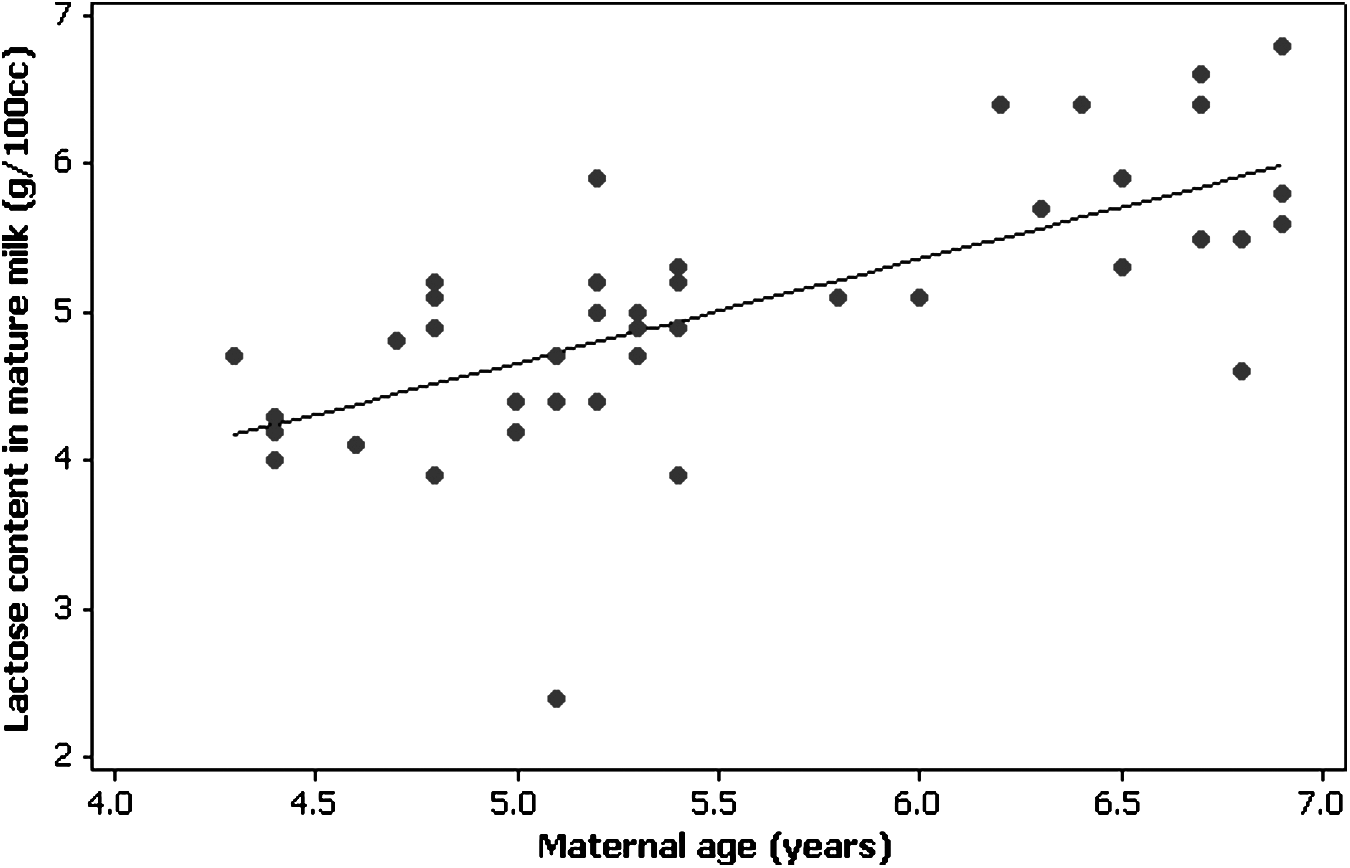
Correlation between lactose in mature milk and maternal age.
Data are mean±standard deviation (range) values.
NS, not significant.
Discussion
In this prospective study of macronutrients content in HM during the first 2 weeks of lactation, we demonstrated that fat content in colostrum and carbohydrates in mature milk are higher in milk samples obtained from older mothers (≥35 years) compared with younger mothers (<35 years). In addition, lactose content in mature milk correlated positively with maternal age. The results on fat content in the current study are consistent with our previous report 12 in which we demonstrated that creamatocrit values, which highly correlate with total lipid biochemical measurements, 15 are higher in colostrum from older mothers compared with younger mothers.
An obvious limitation of our study is that daily milk volume was not measured, in part because it is extremely difficult, in particular with small volumes of colostrum, to measure accurately the daily output. This limitation is significant in view of the fact that several studies have found an average fall of up to 40% in the yield of breastmilk from the age of 20 to 30 years and above.16,17 Hytten 11 also found a significant negative correlation between maternal age and the yield of breastmilk. Thus, milk production falls with increasing maternal age, which may theoretically lead older mothers to experience difficulties in establishing and maintaining lactation. It is not known whether the decrease in milk production is also paralleled by a change in contents of milk nutrients. In theory, if only milk water was decreased in colostrum samples, we should have also observed an increase in the concentration of all macronutrients in milk, which was not the case. Thus the increase is probably related to a true increase in fat concentration that we had interpreted in our previous study of creamatocrits as possibly due to a decrease in milk volume, 12 an incorrect interpretation in view of the current findings. The mechanisms and the biological significance of this observation is unclear, and it is only possible to speculate whether or not higher fat content in the colostrum of older mothers provides any selective advantage(s) to the infant.
HM from older mothers contained higher concentration of lactose. It is known that glucose availability has the potential of playing a role in the regulation of the rate of lactose synthesis in the second stage of the synthesis of milk-specific components. 18 In view of the fact that older mothers had significantly higher postpregnancy weight compared with younger mothers, we speculate that the “physiological” decrease in glucose sensitivity observed with aging 19 and the higher postpregnancy weight in older women may have contributed to the higher lactose concentrations in the milk of older mothers. Because lactose is the main osmotic constituent of HM, we speculate that higher lactose content in mature milk of older mothers may affect milk volume. 20
Conclusions
We conclude that colostrum fat content and mature milk carbohydrate content are higher in older than in younger mothers. Moreover, there is a positive correlation between maternal age and carbohydrate content in mature milk. We speculate that these biochemical changes in milk composition might be related to differences in carbohydrates and fat metabolism associated with aging. Yet, these age-related changes in macronutrient composition of milk are minor quantitatively, and our observations should reassure older mothers about the quality of their milk. The biological significance and the mechanisms of our findings and the differences at particular stages of lactation are yet to be determined.
Footnotes
Disclosure Statement
No competing financial interests exist.