




Abstract
Abstract
Breastfeeding is well accepted as the optimal nutrition for babies. The American Academy of Pediatrics states that infant feeding should no longer be thought of as a lifestyle choice, but rather as a public health issue. In Shelby County, Tennessee, rates of breastfeeding continue to be disparately low. To address this public health problem, a focus group study was conducted with the Shelby County population least likely to breastfeed. Following participants' suggestion to use a billboard campaign with pictures of local mothers and families, one highway billboard and ten bus stop signs were placed around the city in areas of the lowest breastfeeding rates. Self-administered surveys were completed by convenience sampling in target population areas with women least likely to breastfeed, both before placing the signs and 6 months later. No significant differences were noted in knowledge, attitudes, or practices after the media campaign, but trends toward increased intention to breastfeed were noted among expectant mothers. With collapsed data (pre and post), a majority of participants believed that breastfeeding is the best way to feed a baby and they were significantly more likely to plan to breastfeed if they knew about health benefits to the baby and to themselves. If they had heard about breastfeeding on the TV or radio, they were more likely to believe breastfeeding is important for long-term health. These findings suggest that a media campaign could have a complementary role in promoting breastfeeding among women with low initiation rates.
Introduction
W
Recognizing the significant, well-documented health benefits of breastfeeding,5,6 many organizations encourage breastfeeding, yet large disparities in breastfeeding rates continue, especially in the African American population, with only 66.4% of African American mothers initiating breastfeeding in US hospitals 7 and only about 50% in Shelby County, Tennessee. 8 In areas with highest infant mortality, breastfeeding rates are even lower. This reality is depriving one of the most vulnerable populations of the proven health benefits of breastfeeding and is contributing to disparities in infant morbidity and mortality.
To address this disparity, a focus group study was conducted with low-income mothers in Shelby County to identify barriers to breastfeeding initiation. 9 Part of this focus group research included questions about how to improve local breastfeeding success in Shelby County. One recommendation was to design and post billboards about breastfeeding “everywhere,” which coincided with a planned project by the local Shelby County Breastfeeding Coalition (SCBC). 10 Focus group participants voted on their favorite images that were prepared for the groups and suggested slogans to go with these images. Surveys were first conducted before putting up the images and 6 months after display. This study attempted to assess whether a billboard messaging campaign, with images and slogans chosen by the target population, could affect breastfeeding knowledge, attitudes, beliefs, and practices.
Methods
Creation and design of billboards and bus stop signs
With appropriate consent, a master photographer took pictures of volunteer Shelby County mothers, babies, and families and compiled them into various groupings and images. The SCBC was interested in what the target population preferred, and focus groups were conducted to identify those preferences, with plans to display the images and slogans on local bus stops and billboards.
Nine focus groups (86 participants) were conducted during the fall of 2011 at various community locations in Memphis. All participants were African American except for one Latino and one Caucasian woman. Five groups consisted of mostly adult women of childbearing age (n = 57) 18–54 years, with 59% being in their 20's and early 30's. Two groups were composed of mostly teenage girls aged 11 (never pregnant) to 19 years, with an overall teen participation of 19%. The “father” group (n = 9) ranged in age from 19 to 40 years. The “grandmother” group ranged in age from 27 (one nongrandmother who attended) to 78 years, with 15% in the 40–49-year-old group and 8% in the ≥50-year-old group. All but nine participants already had children; eight of the remaining nine were currently pregnant. Thirteen participants had grandchildren. Most participants were native Memphians.
The focus group participants, recruited from community organizations serving low-income populations with low breastfeeding rates, were asked to view four examples of billboard composite photos and four composite bus stop photos, both on paper and in a large poster format. 9 Participants were asked to rank the pictures in each group, from first to last choice. Votes were compiled from selections among all nine Memphis focus groups, with a total of 86 participants. 9 The winning images for both the highway billboard and the bus stop signs are presented in Figure 1. Based on the consensus winners, one billboard and ten bus stop signs were created, which highlight breastfeeding benefits and practices. These were placed in targeted locations around the county, especially in areas with low breastfeeding rates over a 6-month period.
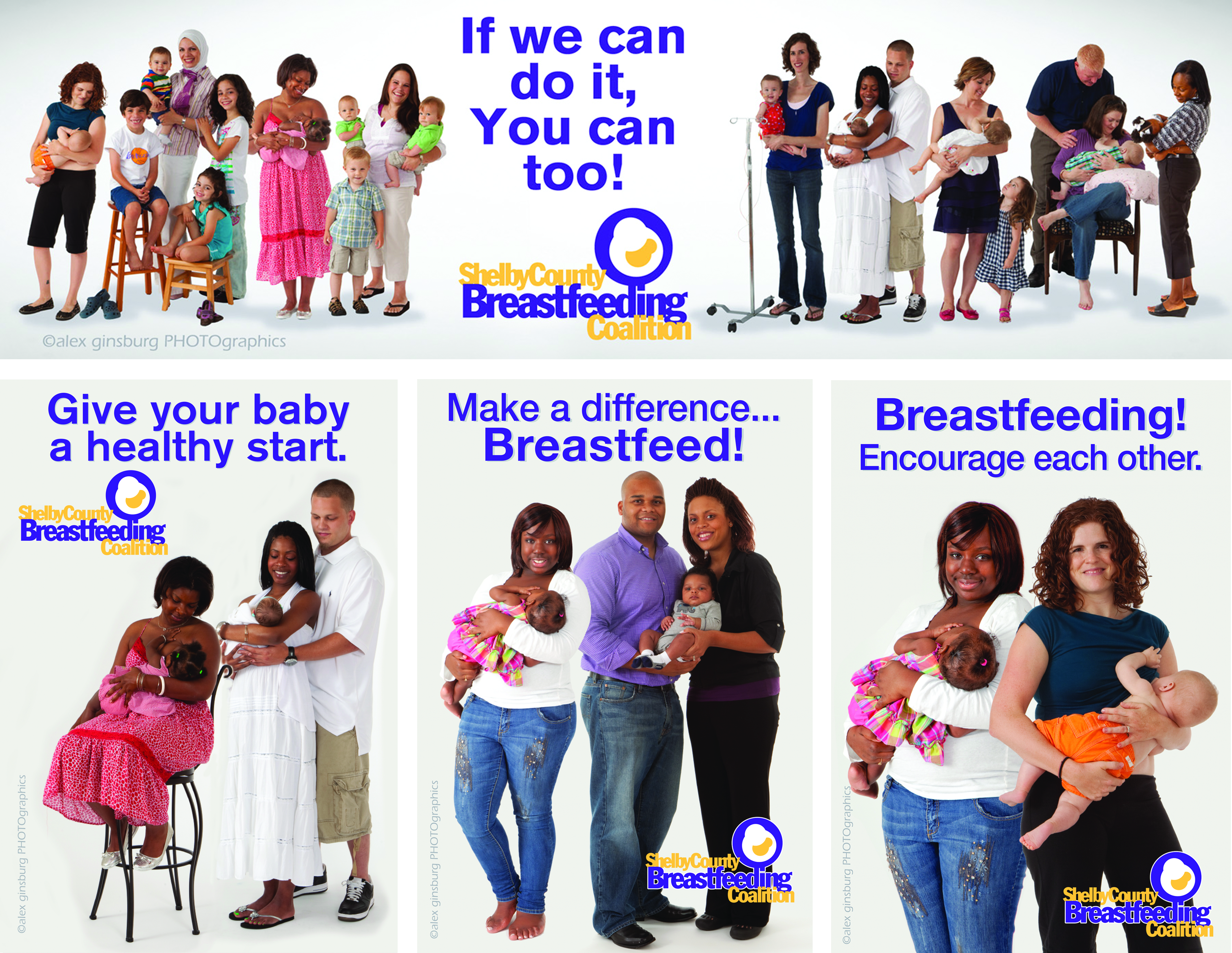
Winning breastfeeding images based on focus group voting. Focus group participants were asked to vote their preferences on different options. The top horizontal image was the clear consensus favorite for the highway billboard. The lower three photos were the winning breastfeeding bus stop images; the photo on the left was the clear winner, followed by the next two in 2nd and 3rd place. Images © by Alex Ginsburg Photographics; used with permission from the Shelby County Breastfeeding Coalition (SCBC). Color images available online at www.liebertpub.com/bfm
Slogans
At the conclusion of each focus group, participants were given the option to participate in the creation of slogans to be placed on the billboard and bus stop photos. A total of 95 distinct slogan suggestions were made cumulatively from focus group participants. Winning responses were determined by consensus of investigators and incorporated into the winning images shown in Figure 1.
Surveys
To assess effectiveness of the media campaign, a self-administered survey was launched in targeted zip codes with the lowest breastfeeding rates, identified by Shelby County epidemiology. 11 The survey was developed using validated questions from prior surveys, including the CDC National Immunization Survey questions about breastfeeding, 12 and included questions based upon input from the previous focus group study. 9 A breastfeeding expert panel reviewed the final 19-item survey for validity and reliability. The questions are listed in Table 1. A pretest survey was administered to a convenience sample from the target population of low-income African American women, recruited from local community organizations in locations serving this population with low breastfeeding rates, to assess their knowledge, attitudes, beliefs, and practices of breastfeeding, as well as whether they were recently exposed to breastfeeding promotional material. The survey instrument was provided on paper, with a clipboard and pen to interested participants at events organized by community partners. Participants completed the survey on their own, but were able to ask for clarification if they had any questions. Surveys were numbered for anonymity, and when completed, participants received a small incentive; subsequently, the surveys were scored by the PI (J.W.) and answers were recorded into a database coded for categorical responses.
One billboard and 10 bus stop signs that promote breastfeeding using the chosen images were then placed in targeted locations, and posttest surveys were administered 6 months later. Community partners servicing at-risk mothers helped to recruit study participants to complete both sets of surveys. Approval was obtained from the University of Memphis Institutional Review Board, and informed consent of participants was obtained. Participants were given $5 cash as a small incentive after survey completion. Funding was provided by an American Academy of Pediatrics Community Access To Child Health (CATCH) grant to the Principal Investigator (J.W.) and the Tennessee Department of Health. All analyses were performed using SPSS statistical package, version 21.0 (SPSS, Inc., Chicago, IL).
Results
There were 132 surveys completed before the media campaign, and 145 surveys were completed 6 months later, for a total of 277 unique and unpaired responses. The overwhelming majority (97.3%) of the combined survey participants were African American, with most (59.7%) between ages 20–40 years (Table 2).
Between the pre- and postsurvey groups, there were no significant differences in responses to questions about “The Best Way to Feed a Baby,” or whether the participant planned to breastfeed if they were to have a new baby, or whether breastfeeding was thought to be important to long-term health (questions 2, 8, and 11), based upon whether or not the participants had seen the billboards or bus stop signs. Some questions had trends toward significance for subsets of survey participants. For example, expectant mothers who saw the media campaign were more likely to “plan to breastfeed” than nonexpecting women who saw the campaign (70% versus 52%, p = 0.10).
To gain as much knowledge and information as possible from the available data about breastfeeding knowledge, beliefs, attitudes, and practices, the responses were then collapsed into one group of 277 participants, since the two samples were composed of different individuals for further analysis. Perhaps the most important question was “What is the best way to feed a baby?” since this query captures the essential attitude toward breastfeeding in this target population. More than half, or 158 (57%) participants, of the combined group responded that breastfeeding was the best way to feed a baby; 70 (25%) thought a mixture of breast milk and formula was best, 28 (10%) thought that formula was as good as breast milk, and 9 (3%) thought formula was the best way to feed a baby.
In response to the question of whether participants had heard or seen information about breastfeeding from other sources, of those who saw breastfeeding ads on television, 94% said that breastfeeding is important for a child's long-term health, compared to 79% of women who did not see breastfeeding ads on TV (p = 0.06). Interestingly, if participants had heard about breastfeeding on the radio, 100% said breastfeeding was important for a child's long-term health, compared to 82% of women who had not heard a radio promotion (p = 0.016).
Expecting mothers who heard about breastfeeding from their doctors were much more likely to plan to breastfeed than mothers who were not expecting who heard about breastfeeding from their doctors (73.4% versus 47.3%, p < 0.001).
Participants who planned to breastfeed were also questioned about the reasons they planned to breastfeed, including health benefits for baby and mother, and friends and family encouragement. Among women who knew the health benefits of breastfeeding for the baby, 72% planned to breastfeed, compared to 16% who didn't know the health benefits of breastfeeding (p < 0.001). Of those who knew the health benefits of breastfeeding for the mother, 77% planned to breastfeed, compared to 46% who did not recognize health benefits to the mother (p < 0.001). If family and friends recommended breastfeeding, 73% of mothers planned to breastfeed, compared to 53% whose family and friends did not recommend breastfeeding (p = 0.057).
Discussion
Previous media campaigns have successfully made an impact on health promotion. 13 The National Breastfeeding Awareness Campaign utilized the media to promote the “Babies were born to be breastfed” message through TV and radio ads, billboards, and print media. 14 Using pre- and postwave surveys, an increase in awareness that breastfeeding is the best way to feed a baby was noted; that infant formula is not “as good as” breast milk; and that if a baby is breastfed, he/she is less likely to get ear infections, respiratory illnesses, diarrhea, or become obese. Several states in the United States have also undertaken breastfeeding awareness campaigns as well, such as the Texas “Every Ounce Counts” campaign, as well as campaigns in Arkansas, Ohio, Massachussetts, 15 and other areas. The “Loving Support Begins with Breastfeeding” social marketing campaign has also been successful in changing knowledge and attitudes about breastfeeding. 16 Most recently, the “It's Only Natural Mother's Love, Mother's Milk” Office of Women's Health campaign has focused attention on African American mothers who are less likely to breastfeed their infants. This campaign was made available to download components through the website, as well as to view uploaded videos and Public Service Announcements. 17
The SCBC distributed some of the National Breastfeeding Awareness Campaign billboards and bus stop signs throughout the city in 2007 and followed this with a SCBC-developed billboard and bus stop sign campaign portraying a local African American family from Shelby County in 2009. 18 The billboard and bus stop campaign described in this study represents a prospective effort to expand the media campaign about the merits of breastfeeding; the images were selected and slogans designed with direct input from the target population of those least likely to breastfeed, through the focus group model. The sites for display of the signs were chosen specifically in areas with the lowest breastfeeding rates and highest rates of infant mortality. 11
No significant differences were noted in the pre- and postsurvey results, with regard to knowledge, attitudes, and practices of the target population, based upon whether they had seen the signs from the current campaign. However, only a convenience sampling of women from the targeted areas could be performed, and no samples were paired. Furthermore, the sample size was relatively small and limited by the available funding. A control group might have strengthened the study findings, but was not possible with available funding. Potential recruitment bias could have occurred since the locations of the survey distribution, although not in health departments or clinics, were at events held by groups promoting better health of the community.
Despite these limitations, important differences were noted. Women who had seen the campaign signs were more likely to plan breastfeeding if they were expecting a child, compared to nonexpecting women. Expecting women who had heard about breastfeeding from their doctors were also more likely to plan to breastfeed than nonexpecting women who had heard about breastfeeding from their doctors. These results emphasize the importance of reaching women in the early part of their pregnancy with multimodal breastfeeding education and promotion strategies, and especially with involvement and recommendations from physicians. 19
Women who knew about health benefits to both baby and mother were more likely to plan to breastfeed. Importantly, friends and family recommendation to breastfeed was very influential for a woman's plan to breastfeed; this observation supports the concept of family and peer-level breastfeeding champions. 20 Although television or radio was not used specifically for this breastfeeding promotion effort, it is notable that 100% of women who said they heard about breastfeeding on the radio also said that breastfeeding was important for a child's long-term health. This may indicate a need to focus attention on media messages that can be delivered in the home or by other social media.
Questions about planning to breastfeed (breastfeeding intention) were asked, but there were no attempts to assess the actual outcomes with measurement of breastfeeding rates in this target population, due to the short 6-month time between surveys. Similar to the “Loving Support” Campaign, the specific impact of increasing breastfeeding rates cannot be assessed based only upon this campaign. 21 However, breastfeeding initiation in Shelby County has continued to rise dramatically in the African American population, with a relative increase of 13.3% (51.2% up to 58%) 7 between 2011 and 2013, and a 116% increase since 2004 when initiation data were first collected. The State of Tennessee has now launched a statewide breastfeeding media campaign to promote breastfeeding, following the efforts in Shelby County. The national, state, and regional focus on the importance of breastfeeding makes it impossible to assign responsibility for any one promotional effort, but all efforts work toward the common goal.
Conclusions
There are many efforts to promote breastfeeding in Shelby County, the State of Tennessee and the United States. A focus on hospital support, community support, involvement of the church, and working with employers are all ongoing and will hopefully augment changes needed to improve local breastfeeding rates. By addressing many of the Surgeon General's Call to Action steps, 22 these efforts are indeed “Answering the Call” to reach for the Healthy People 2020 goal for breastfeeding initiation of 81.9%. 23 However, the entire social ecological model of influence to mother and baby must be addressed to affect change in breastfeeding in those populations least likely to do so; both microlevel influences of family and friends, the macrolevel influences of national policy, and everything in between. 24 Breast milk, after all, “makes the world healthier, smarter, and more equal,” according to the new Lancet Series on breastfeeding. 25 These results suggest that media campaigns, although difficult to assess in isolation, can be complementary to other efforts ongoing in communities that aspire to increase breastfeeding rates. Future campaigns should include multiple modalities to reach the target population “where they are,” including TV, radio, social media, and billboards.
Footnotes
Acknowledgments
The authors thank Alex Ginsburg of Alex Ginsburg Photographics, who volunteered his time and expertise to photograph the breastfeeding experiences of volunteer Shelby County women and their babies and families (www.alexginsburgphotographics.com/). We also thank the Shelby County Breastfeeding Coalition ( ) for their help in recruiting mothers for the photos and passionate work to promote breastfeeding. We also thank Clear Channel Outdoors for helping us to place the images in the targeted areas. We thank the American Academy of Pediatrics CATCH program and the Tennessee Department of Health for funding of the project.
Disclosure Statement
We do not have financial disclosures. No competing financial interests exist.