




Abstract
Abstract
Introduction:
There is evidence that mother's own milk is the best nutrient in terms of multiorgan protection and infection prevention. However, when maternal milk is scarce, the solution can be represented by donor milk (DM), which requires specific storage procedures such as Holder Pasteurization (HoP). HoP is not free from side effects since it is widely known that it causes qualitative/quantitative changes in milk composition, particularly in the protein content. Therefore, the aim of this study is to investigate the effects of HoP on Activin A, a neurobiomarker known to play an important role in the development and protection of the central nervous system.
Methods:
In 24 mothers who delivered preterm (n = 12) and term (n = 12) healthy newborns, we conducted a pretest/test study where the milk donors acted as their own controls. Each sample was divided into two parts: the first was frozen at −80°C (Group 1); the second was Holder-pasteurized before freezing at −80°C (Group 2). Activin A was quantified using an ELISA test.
Results:
Activin A was detected in all samples. There were no significant differences (p > 0.05) between the two groups, also when the analysis was stratified for gestational age at delivery and milk maturation degree (p > 0.05, for both).
Conclusion:
The present findings on the absence of any side effects of HoP on the milk concentration of Activin A offer additional support to the efficacy of HoP in DM storage. Our data open up to further investigations on neurobiomarkers' assessment in human milk and their preanalytical stability according to storage procedures.
Introduction
T
Activin A is a dimeric protein belonging to the transforming growth factor beta superfamily and its receptors are widely distributed in the brain. 11 Studies in humans and animal model showed that Activin A can play a trophic and neuroprotective role on the CNS. 12 In this regard, increased Activin A levels in different biological fluids have been found in infants presenting perinatal asphyxia, prematurity, and intraventricular hemorrhage.13–15 There is evidence that this protein also exerts a neuroprotective activity (i.e., neuronal recovery, modulation in cellular and tissue growth, and differentiation).16–18 Activin A has been also detected in human milk, supporting its role as a growth factor. 19 Of note, data regarding the variation of Activin A levels in DM after HoP are lacking.
Therefore, the purpose of the present study was to investigate the effects of HoP on Activin A concentration in healthy DM mothers.
Materials and Methods
The study protocol was approved by the local Ethics Committee of the Italian Association of Human Milk Donor Banks (AIBLUD). Mothers admitted into the study gave signed and informed consent.
We conducted a pretest/test study, where the milk donors acted as their own controls. Milk samples (colostrum: n = 12; transition: n = 12; mature: n = 12, respectively) 20 were collected from 24 healthy mothers having delivered at term and preterm of gestational age (GA) (GA >37 weeks and GA <37 weeks, respectively) and coming from consecutive singleton physiological pregnancies (Table 1). 21
We excluded mothers affected by any CNS illness, pregnancies complicated by gestational diabetes and hypertension, multiple pregnancies, fetuses with any malformation and/or chromosomal abnormalities, systemic infection, intrauterine growth retardation, or cardiac or hemolytic disease, malnutrition, and maternal allergy. Standard exclusion criteria for human milk donation set forth by AIBLUD guidelines were also applied. 7
Collection and pasteurization of human milk
Fresh milk samples were collected at the same time (9–10 a.m.) into sterile, disposable, high-density polyethylene sealed bottles (Flormed). The milk was collected by means of an electric breast pump (Medela Symphony) with standard extraction methods. According to current guidelines and to collect full pumping samples, the extraction session was stopped 2 minutes after the outflow of the last drops of milk.7,22 From the total amount of milk of each mother, a sample of 10 mL of milk was collected and then subdivided into two aliquots. The first was immediately frozen at −80°C (NO-HoP), while the second aliquot was pasteurized and then frozen at −80°C (HoP).
HoP was performed with a Sterifeed pasteurizer (Medicare Colgate Ltd) heating milk samples at 62.5°C for 30 minutes and then cooling to 10°C in ∼20 minutes by immersion into cold water. The time interval between freezing and the analysis of the milk samples was less than 6 months (median 4 months).
Activin A measurements
Samples were immediately stored at −80°C until analysis. Activin A levels were determined using a specific ELISA test (ELH-ActivinA-1 Human Activin A ELISA) according to the manufacturer's instructions (RayBiotech, Inc.). Investigators who performed the laboratory tests were blind to storage modalities. The analysis was performed within 2 hours from samples thawing. The assay detection limit is 15.00 pg/ml, the coefficient of variability intra-assay was ≤5.0%, and the interassay ≤10%, respectively. The assay is specific for Activin A, having been tested by the manufacturer for lack of cross-reactivity with other proteins of the Activin family.
Statistical analysis
Demographic characteristics of maternal and neonatal outcomes were reported as mean ± SD. Activin A concentrations were expressed as median and interquartile ranges. Statistical analysis was performed by using two-tiled paired t-test and by Mann–Whitney two-sided U-test when data did not follow a Gaussian distribution. Comparison between groups was performed by using ANOVA one-way test for multiple comparisons. A p < 0.05 was considered significant.
Results
Maternal and perinatal characteristics of milk donors are reported in Table 1. As expected, all mothers were in normal clinical conditions. No overt neurological injury and/or infections were observed at the sampling time points or at discharge from the hospital.
Activin A protein was detectable in all the measured milk samples, either in term or preterm milk samples, before and after HoP. Activin A concentrations were lower in preterm milk with respect to term milk samples, but this difference was not significant (p > 0.05).
Table 2 reports the Activin A levels measured before and after the HoP procedure. As shown in Figure 1, no significant differences (p > 0.05, for both) in Activin A levels were observed in all milk samples before HoP (median: 3,733.5 pg/mL; 25° centile: 1,768.5 pg/mL and 75° centile: 9,379.75 pg/mL) and after HoP (median: 3,083.5 pg/mL; 25° centile: 1,467.2 pg/mL and 75° centile: 5,698.5 pg/mL) process. No significant differences (p > 0.05) were found between groups when Activin A concentrations were compared in subgroups for GA (i.e., term versus preterm) (Fig. 2). Furthermore, Activin A levels did not differ (p > 0.05) in both groups when subgrouped based on the degree of milk maturation.
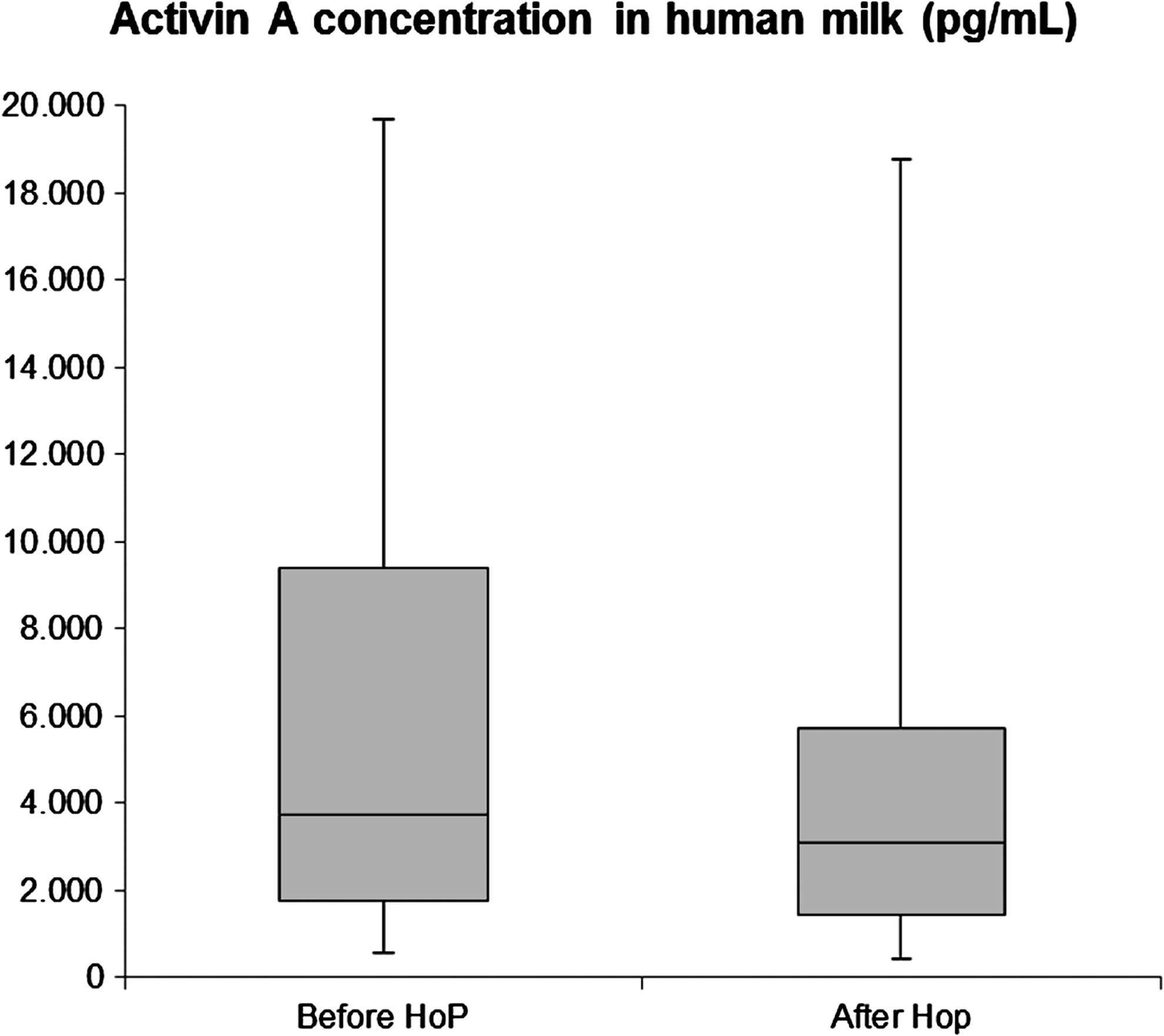
Activin A concentrations (pg/mL) in total human milk samples before and after HoP procedure. The lower and upper bars represent the 5th and 95th centiles, respectively; interquartile range is indicated by the box, and median value is represented by the horizontal line in the box. No significant differences have been found between studied groups (p > 0.05). HoP, Holder Pasteurization.
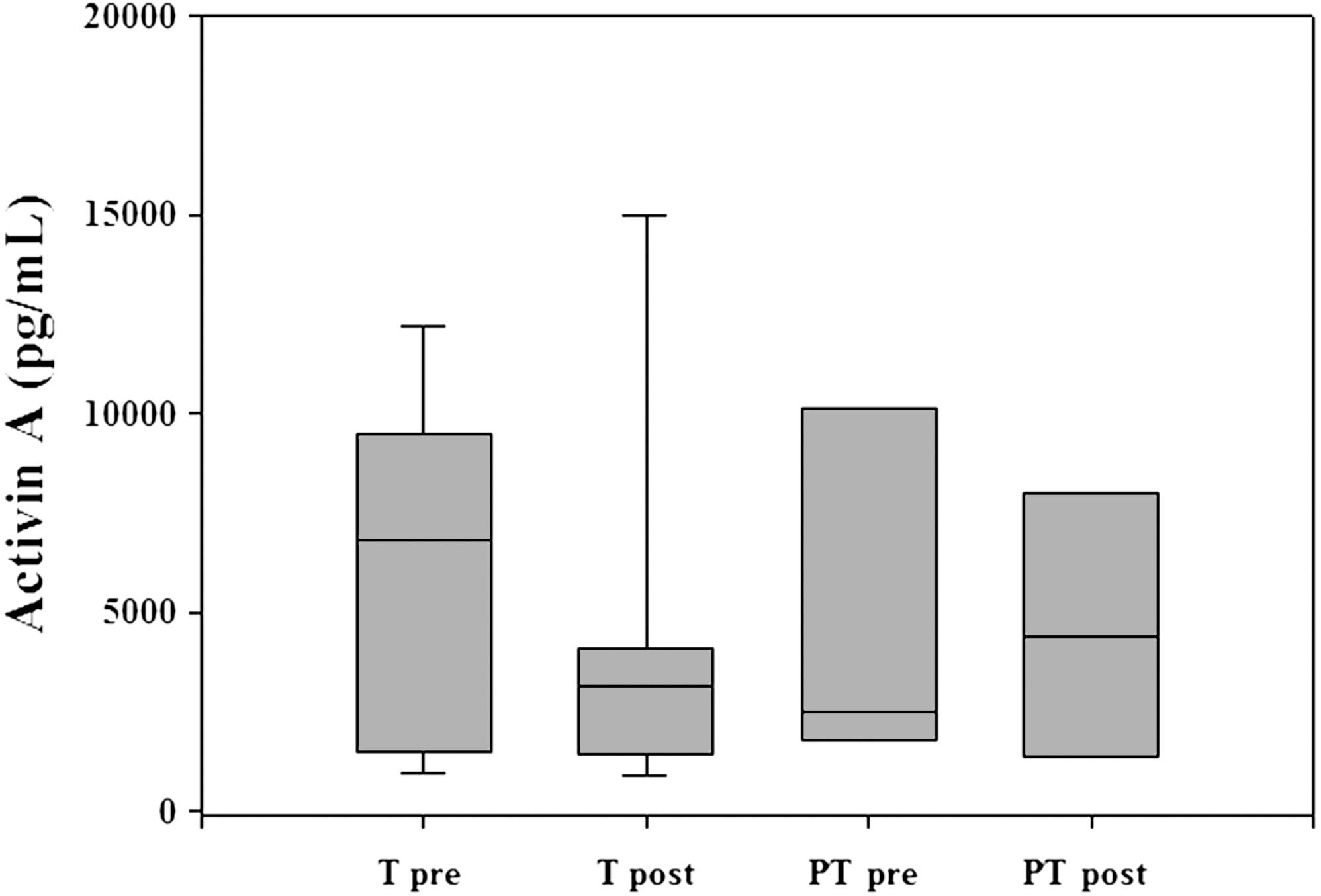
Activin A concentrations (pg/mL) in human milk samples before (pre) and after (post) HoP procedure in term (T) and preterm (PT) infants. The lower and upper bars represent the 5th and 95th centiles, respectively; interquartile range is indicated by the box, and median value is represented by the horizontal line in the box. No significant differences have been found among studied groups (p > 0.05).
Data are expressed as median and interquartile ranges.
HoP, Holder Pasteurization.
Discussion
Current guidelines recommend HoP as the best thermal treatment for storage of DM in HMB since it guarantees protection against infections and contaminations.6–8 On the other side, there is still no conclusive consensus whether this procedure may affect the biological quality of the nutrients in DM.6,9
The present study provides evidences that HoP does not modify milk concentrations of a neurotrophic protein, namely, Activin A. Indeed, no changes in protein' concentrations attributable to HoP procedure were observed throughout the various lactation phases and in correlation with GA. Results are, in part, in agreement with a previous observation by Luisi et al. who detected Activin A in colostrum, transition, and mature milks of mothers having delivered at term of GA. 19 The discrepancy resides in the lack of any differences, observed in our series, among Activin A levels in mature milk versus transition and colostrum milks. The fact can be of relevance, bearing in mind the changes in milk composition and properties throughout its stages of maturation. 23 Anyway, the finding of no significant changes in Activin A levels herein reported warrants further consideration. In addition, the present study identified for the first time dimeric Activin A in milk collected from lactating healthy women having delivered preterm. We observed lower Activin A levels in these mother groups, but no significant differences were found with respect to the milk samples of a mother having delivered at term of GA. In particular, Activin A has been shown to (1) exert a neurotrophic role being involved in growth and differentiations of many CNS target cell types5,10, (2) play, in vitro and in vivo, a beneficial role in recovery and survival of neurogenic cell lines and retinal neurons decreasing ischemic brain injury,24–27 (3) exert CNS protection from antidepressant treatment side effects,28,29 and (4) be a trustable predictor, when measured in different biological fluids (amniotic, arterial cord blood, urine, and cerebrospinal) of cerebral bleeding and damage in fetuses and newborns.5,16 Altogether, it is reasonable to conclude that HoP per se guarantees an unaltered Activin A intake to the newborn and its neurotrophic properties offering additional support to the unique role of human milk. The fact is of relevance taking into account that artificial milk industrial preparation procedures have been shown to affect in a significant manner milk composition and properties. 30
Among the different Activin A functions (to date still a matter of investigation and debate), it has been shown that the protein participates in a cascade of events leading to breast tissue differentiation.31,32 Nonetheless, Activin A pro- and anti-inflammatory effects on human tissues increasing cytokine production from monocytes in normal humans peripheral blood mononuclear cells and regulating T-cell development have also been reported.32–34 The issue highlights the importance of DM administration in the immune protection of preterm infants.
There is also evidence that the protective role of Activin A is also extended to the heart tissue. In particular, it has been reported that the protein can participate in a cascade of events promoting tissue protection and regeneration in patients who have undergone ischemia/reperfusion injury.35–37 Therefore, on the basis of the aforementioned findings, it is reasonable to argue that Activin A is involved not only in the CNS development but can also be considered a multiorgan trophic factor taking part in embryogenesis. The fact that is detectable in a biological fluid at the unique trophic effect such as breast milk corroborates the aforementioned hypothesis.
Bearing in mind that HoP procedures work at a temperature of 62.5°C for 30 minutes, in the present study, we showed first that Activin A includes thermostability among its properties. This finding opens up to further investigations aimed at elucidating the protein stability under different conditions such as freezing and thawing procedures. In this respect, Lev et al. showed that storage at −80° can affect lipids and carbohydrates, while the total protein amount remains unchanged. 38 Finally, the present findings can be also of interest for further studies to investigate Activin A degradation during industrial processes aimed to prepare artificial milks, for which pasteurization and spray drying procedures have been shown to affect milk composition and properties. 28
Conclusion
The present data on the absence of any side effects on Activin A milk concentration suggest the efficacy of HoP procedure in DM storage and preparation. The finding opens up to further investigations on neurobiomarkers assessment in human milk and their preanalytical stability according to storage procedures.
Footnotes
Acknowledgments
This study is part of the I.O. PhD International Program, under the auspices of the Italian Society of Neonatology and of the Neonatal Clinical Biochemistry Research Group, and was partially supported by grants to D.G. from “I Colori della Vita” Foundation, Italy.
Disclosure Statement
No competing financial interests exist.