




Abstract
Abstract
Background:
The aim of this study was to evaluate the freeze–thawing method in reducing viral load of cytomegalovirus (CMV) in breast milk of mothers of preterm infants.
Materials and Methods:
In this study, 169 nursing mothers of preterm infants were evaluated serologically for CMV infection. We found 29 (17.15%) nursing mothers who had serologic evidence of CMV infections consistent with recent infection (N = 2, IgG + IgM +) or prior infection (N = 27 IgG + IgM−). Two to 6 weeks after delivery, breast milk of seropositive mothers (N = 29) was evaluated for CMV load by real-time polymerase chain reaction (PCR) before and after freezing at −20°C for 72 hours. All preterm infants with milk results positive for DNA particles of CMV (N = 25) were followed up for signs and symptoms of CMV infection until 3 months of age, together with urine testing for CMV by real-time PCR.
Results:
Examination of breast milk by real-time PCR of the seropositive mothers showed 25 of them with CMV DNA particles in their breast milk. After freezing and thawing, we found virus DNA in 4 of 25 (16%) of the breast milk samples and there was no CMV DNA particles in 21 (84%) of them. In these samples, mean viral load before freezing was 76.04 ± 34.08 copies/μL (20–135.00 copies/μL) and after freezing it was 6.75 ± 4.34 copies/μL (0.00–13.00 copies/μL). Freezing showed a significant decrease in viral load of the samples (p = 0.001).
Conclusion:
The study showed that the freeze–thawing method is an effective method in reducing the CMV load in breast milk samples.
Introduction
C
There are several methods for reducing the risk of transmission. Pasteurization of breast milk is an effective method, but unfortunately there is no breast milk bank to facilitate this process in Iran. Freezing–thawing method is a simple and low-cost method for reducing the viral load of CMV in human milk. 6 The efficiency of this method is controversial. Regarding the importance of the prevention of CMV transmission through breast milk to premature infants, the aim of this study is to evaluate the effect of freeze–thawing method in reducing CMV load on breast milks in the largest perinatal center in northwest of Iran.
Subjects and Methods
This study was a single-blind clinical trial that was carried out on lactating women in Al-Zahra Hospital of Tabriz University of Medical Sciences, Tabriz, northwest of Iran. The study was approved by the Ethic Committee of Tabriz University of Medical Sciences and written informed consent was obtained from subjects before participating in the study. This study was registered in the Iranian Registry of Clinical Trial (www.irct.ir) with registration number ID: IRCT201310164113 N6.
The inclusions criteria of the study were as follows: nursing mothers of premature infants (less than 32 weeks of gestation or weight less than 2000 g), CMV seropositive mothers (IgG positive and IgM positive), or mothers with acute cytomegalovirus infection (IgG positive and IgM negative). Exclusion criteria were as follows: gestational age more than 32 weeks, mothers with infants of weight more than 2000 g at birth, and seronegative mothers (IgG negative and IgM negative).
In this study, 169 nursing mothers of preterm infants were evaluated serologically for CMV infection by the radioimmunoassay method. Serological assessments showed 29 (17.15%) nursing mothers with CMV infection (recent infection [N = 2] or prior infection [N = 27]). Two to 6 weeks after delivery, 10 mL breast milk of each nursing mother was collected according to the breast milk collection protocol. The samples of breast milk were divided into two parts. We evaluated the CMV load of these samples by real-time polymerase chain reaction (PCR) kit (Primer Design) before and after freezing at −20°C for 72 hours. The primer sequences are reported in Table 1.
CMV, cytomegalovirus.
After 3 days of storage at −20°C, the samples were defrosted (thawed) at 4°C. DNA extraction was performed using the DNA extraction kit (Biobasic). The extracted DNA was dissolved in nuclease-free water. DNA purification was assessed by Nano Drop Spectrophotometer. A260/A280 and A260/A230 ratios higher than 1.8 and 2 were considered as acceptable purity, respectively. The integrity of DNA samples was assessed using 1% standard agarose gel. To investigate CMV load, specific primers and probes were used.
All preterm infants (N = 25) were followed up for signs and symptoms of CMV until 3 months of age, and CMV DNA extraction was performed by the same method as used for urine samples of the infants.
Statistical analysis was performed by SPSS statistical software. Quantitative data are presented as mean ± standard deviation, and qualitative data were demonstrated as frequency and percentage. Kolmogorov–Smirnov test was used to assess the normality of data. Paired t-test and Chi-square were used before and after intervention comparisons.
Results
Mean age of the mothers was 23.64 ± 2.09 (range 19–28) years and mean gestational age of the infants was 30.64 ± 0.81 weeks (29–31 weeks +6 days). Mean birth weight of the infants was 1746 ± 145 (1400–1950) grams. Among 169 nursing mothers of premature infants (less than 32 weeks of gestation or less than 2000 g) screened for IgG and IgM of CMV after delivery, we found 29 (17.6%) CMV seropositive mothers and that 27 of them had chronic infection (IgG+ and IgM−) and 2 of them had acute cytomegalovirus infection (IgG+ and IgM+). Evaluation of the breast milk of these mothers by real-time PCR showed CMV DNA particles in 25 of them (2 of the mothers with acute infection and 23 out of 27 mothers with chronic infection). Based on real-time PCR finding, mean viral load before freezing was 76.04 ± 34.08 copies/μL (20–135.00 copies/μL) (Table 2). After freezing and thawing, we found virus DNA in 4 of the 25 (16%) breast milk samples and there was no CMV DNA in 21 (84%) of the samples (Table 3). Mean viral load after freezing was 6.75 ± 4.34 copies/μL (0.00–13.00 copies/μL) in these samples. Viral load was decreased significantly after freezing in comparison with that before freezing in CMV-retained samples (p = 0.001) (Fig. 1). CMV DNA particles in the milk samples of the two mothers with acute CMV infection before freezing were 135 and 60 copies/μL, and after freezing, virus was eliminated totally (CMV DNA 0 copies/μL).
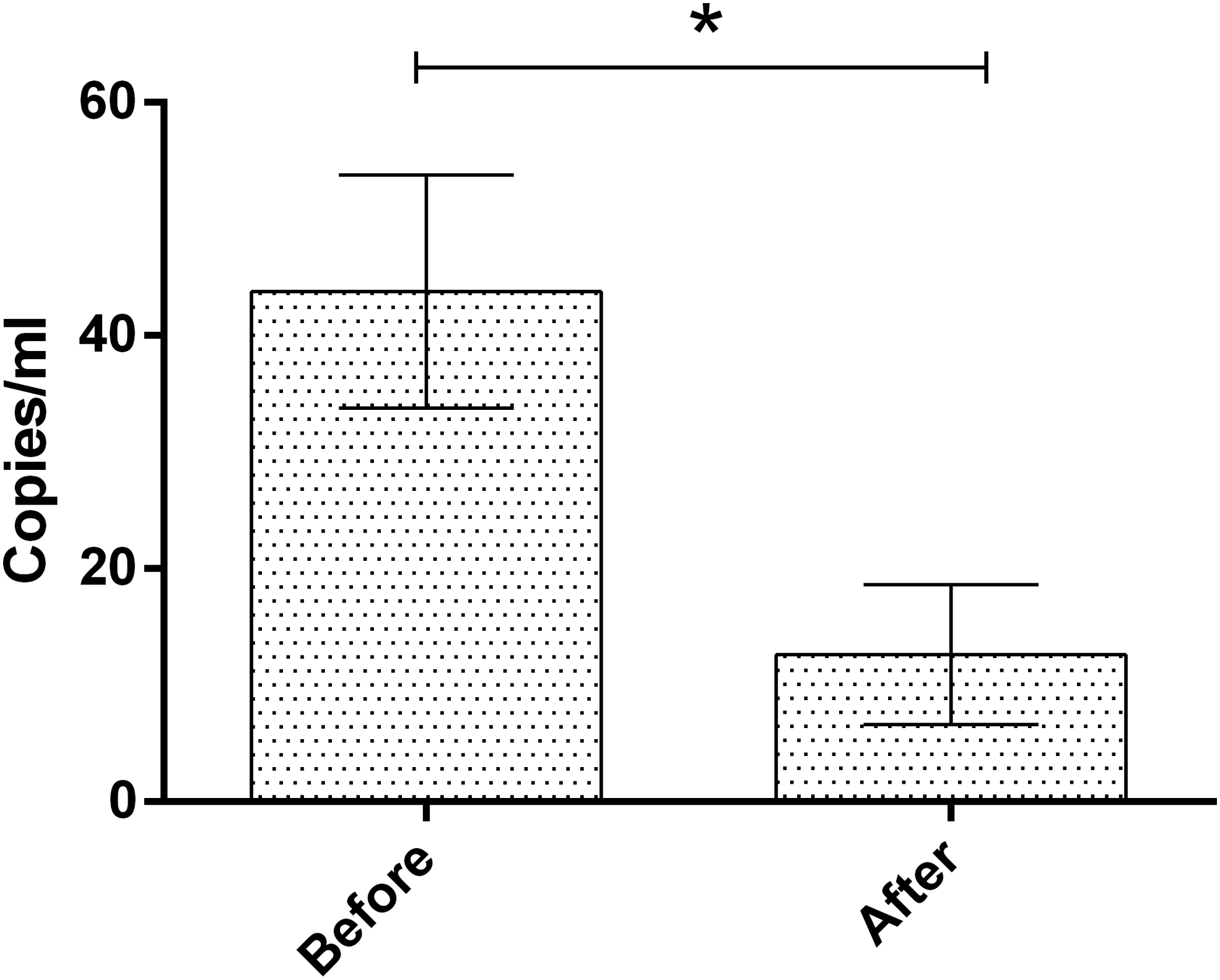
CMV load before and after freeze–thawing. X-axis represents before and after viral load and Y-axis represents the number of copies per milliliter. *p-value <0.05. p-Value reported on paired sample t-test. CMV, cytomegalovirus.
In 2 infants out of 25 (8%) preterm infants, whose mother's milk had CMV particles, CMV DNA particles were detected in their urine. One of the infants was presented with isolated form of prolonged direct hyperbilirubinemia after discharge. He was a preterm of 26 weeks of gestation and 980 g birth weight. The mother had severe preeclampsia without any symptom of acute CMV infection during pregnancy. She was a CMV seropositive mother (IgG positive and IgM negative). There were no other symptoms such as hearing loss during 3 months of follow-up. Another preterm infant with CMV DNA particles in her urine was a 28-week-gestation girl with birth weight of 1200 g. We could not find any sign and symptom of CMV infection during 3 months. She had only showed small increase in liver function test (LFT) in laboratory test.
Follow-up of the infants is being done.
Discussion
The study results showed that the CMV load was significantly reduced and even eliminated in most of the milk samples after freezing. Breastfeeding is an important transmission path of CMV to newborns especially in preterm infants.7–9 Prevention of CMV transmission through tainted breast milk is a challenge for all NICUs; however, it was found that pasteurization reliably destroys virus. Unfortunately, pasteurization also destroys some of the nutritional and immunological factors of milk needed by the preterm baby.10,11 Freezing at −20°C overnight preserved such factors and reduced infectivity by 90%, and freezing for 72 hours reduced infectivity of milked by 99%. 12 Fowler et al. showed that viral shedding in breast milk started as early as 2–3 weeks after delivery, peaked in activity by 3–6 weeks, and usually ended in most individuals by 8–10 weeks. 13 In our study, most of the breast milk samples were collected in the first 4 weeks after delivery because of limitations in accessibility to families and it could affect the results of finding virus DNA in the samples.
Welsh et al. in a study that evaluated the effects of freezing, antibacterial lipids, and pasteurization on CMV activity by cytopathogenic effect showed that only pasteurization could remove CMV infection completely. 14 Current study showed that CMV was completely removed after freezing for 72 h at −20 C in 19 samples. Similar studies showed that the freeze–thawing method could not eliminate breast milk CMV completely.15,16 Ben-Shoshan et al. revealed freezing could not eliminate CMV load in human milk, but their results showed high-power microwave radiation completely removed the viral load. 17 Differences in viral load before freezing may be the cause of differences in the results of studies published in this field. In our study, mean CMV load was 76 copies/mL before freezing, whereas Chiavarini et al. in a similar study reported that mean CMV load in fresh breast milk was 180 copies/mL and freezing significantly reduced CMV load of the milk (not completely eliminated) in seropositive nursing mothers. 5 In a similar study of Hamprecht et al., mean CMV load in fresh milk of seropositive nursing mothers was more than 100 copies/mL and freezing only reduced viral load and did not completely remove CMV from nursing mothers' milk. 15 So it seems that the freeze–thawing method significantly reduces CMV load in the samples with high virus load. According to the study results, the method significantly eliminated CMV load in low virus load samples.
We followed up our patients for a very short time and we found that the transmission rate was 8% in our preterm infants and it seemed to be less than the other researches. In another 3-year prospective study, infants weighing 1500 g exposed to breast milk with CMV yielded a high transmission rate of 38% (33 of 87 infants born at 32 weeks and fed CMV-containing fresh breast milk showed a mean transmission time of 43 days). Half (16 of 33) of the infected infants had symptoms associated with CMV disease: hepatopathy, neutropenia, and thrombocytopenia, and four infants had sepsis-like deterioration in the early phase of the infection. 18 We have the same results as half of our preterm infants (one of two infected infants) showed signs of clinical CMV infection.
We have not done a long-term follow-up in these groups of infants.
Conclusion
The study showed that the freeze–thawing method is an effective method in reducing the CMV load in breast milk samples.
Footnotes
Disclosure Statement
No competing financial interests exist.