




Abstract
Abstract
Background:
The diet of breastfeeding women influences the trans fatty acid (TFA) composition of the milk excreted. However, the effects associated to TFA are isomer-dependent and diverse TFA profiles may have different nutritional implications.
Objective:
The aim of this research was to evaluate whether certain TFA patterns in human milk fat can be used as indicators of TFA intake from different sources.
Methods:
Milk fat from 60 women were examined and classified based on their TFA profile and conjugated linoleic acid (CLA) contents by principal component analysis (PCA).
Results:
The PCA of the data allowed the classification of the women into 3 groups depending on milk TFA content and profile. From the 60 subjects, 19 presented a TFA profile characteristic of ruminant products intake, 10 a typical TFA profile of industrial trans fats consumption and 31 a negligible trans content. Superimposed on this, 21 women presented high amounts of docosahexaenoic acid (22:6 n-3) which was related to fish intake.
Conclusions:
The present research overcome problems associated to heterogeneous groups in nutritional experiments by a statistical classification of lactating subjects based on the TFA composition of their milk. This classification could be extrapolated to other nutritional studies dealing with TFA analysis and samples of different nature as biological samples or foodstuffs.
Introduction
T
In contrast to n-3 PUFA, high concentrations of trans fats could have a detrimental effect in infant development. 6 The negative effects of TFA are mainly associated with isomers from partially hydrogenated vegetable oils (PHVO) or domestic frying, such as 6/7/8 trans 18:1, trans-9 18:1, and trans-10 18:1. 7 However, the effects of TFA of natural origin could be different. Ruminant fats such as meat, milk, or dairy products are naturally rich in trans-11 18:1 (Vaccenic acid [VA]), and higher levels of this VA in the mother's milk has been correlated with lower rates of atopic manifestations and a reduced incidence of infant eczema in small children.8,9 Furthermore, this TFA can be converted endogenously in the human body 10 to rumenic acid (RA, cis-9 trans-11 18:2), a conjugated linoleic acid (CLA) isomer with important biological properties. 11
A few surveys evaluating the effects on TFA profile in human milk that would reflect the type of fats consumed, whether derived from ruminants or PHVO, are currently available from European,12,13 Asian, 7 and American 14 mothers. However, studies examining milk TFA profile of African women are very scarce, and unfortunately, the number of trans isomers reported is limited. 15 To shed more light on this concern, milk fats from African mothers living in rural and urban areas of Northern Nigeria were characterized. FA composition was determined by high-resolution gas chromatography (GC) column paying particular attention to the TFA profile. The aim of this research was primarily to evaluate whether certain TFA patterns in human milk fat can be used as indicators of TFA intake from ruminant products or other sources and, secondly, to provide further information on the African human milk fat composition.
Materials and Methods
Subjects
The study population was composed by 60 lactating women from rural and urban areas of Northern Nigeria. All subjects claimed to be in good health and gave their consent to participate in this study. The study was approved by the Human Ethics Committee of the Jos University Teaching Hospital. This research conformed to the principles outlined in the WMA Declaration of Helsinki.
The 30 rural subjects consisted of Fulani women who were recruited randomly from the rural villages of Bauchi State. They are situated around 40–50 km northeast of Jos, Nigeria. With regard to the urban subjects, 30 consecutive, lactating women visiting the Well-Baby Clinic at the Jos University Teaching Hospital were also recruited into the study. None of the urban subjects were of Fulani ethnicity.
Fulani women are seminomadic pastoralists whose diet is based on dairy products and consequently rich in natural trans fats. Their lifestyle is active, with no smoking and alcohol consumptions, and they commonly nurse their infants for at least 2 years. 16 Women from urban areas are generally more sedentary and with a higher caloric intake. 15 Information regarding age, height, weight, body mass index, parity, and duration of lactation for each subject is presented in Table 1. Anthropometric data were taken before sample collection.
Comparison between rural and urban human subjects: NS (p > 0.05); ***p < 0.001.
BMI, body mass index; NS, not significant.
Approximately 15 mL of milk was collected in the morning (2 hours after breakfast) by manual pumping from each subject, aliquoted 5 minutes after initiation of pumping into 5-mL cryovials, and stored at −43°C until they were transported frozen to Canada for analysis.
Milk FA analysis
One milliliter of milk lipids was extracted with a chloroform/methanol/water mixture (2:2:1.8, v/v/v) according to Bligh & Dyer method. 17 The extracted lipid residue was esterified using NaOCH3/MeOH (Supelco 33080) as proposed by Kramer et al. 18 Fatty acid methyl esters (FAME) were then analyzed using a gas chromatograph (Hewlett-Packard model 5890 Series II; Palo Alto, CA) equipped with an autoinjector, a 100-m CP-Sil 88 fused-silica capillary column (Varian, Inc., Mississauga, ON, Canada). All milk samples were run at two temperature programs as described by Kramer et al. 19 FAME quantification was carried out according to Li et al. 7
Statistical analysis
Statistical analysis was conducted with JMP Version 9 (SAS Institute, Cary, NC). Paired comparisons, using Student's t-test, were used to compare FA profiles. Pearson correlation coefficients (r) were used to investigate the associations for some FA. Significant differences were declared at p < 0.05 and tendencies accepted if p < 0.10. Subsequently, the milk data were analyzed by principal component analysis (PCA) on all the 18:1 isomers and total CLA content of the 60 Nigerian subjects. A direct visual screen test performed on the eigenvalue distribution showed that two factors were sufficient.
Results
Mean values and standard deviations of the different FA quantified in Nigerian human milks are presented in Table 2. Saturated FA represented the primary group of FAME in all subjects, accounting for more than 50% of total FAME. The three major saturated FA, that is, lauric (12:0), myristic (14:0), and palmitic (16:0) acids, showed no significant differences between rural and urban women (p > 0.10). Similarly, no differences were found in branched-chain saturated FA (p > 0.10).
Comparison between rural and urban human milks: NS (p > 0.10); †p < 0.10; *p < 0.05; **p < 0.01; ***p < 0.001.
CLA, conjugated linoleic acid; FA, fatty acid; NS, not significant.
Cis monounsaturated FA content was about 29% of total fat and oleic acid (cis-9 18:1) represented its most part (Table 2). Amounts of total trans monounsaturated FA detected in the present study ranged between 0.46% (rural) and 0.75% (urban). Figure 1 shows the trans 18:1 FA profile determined by GC in three characteristic human milk samples. VA was the most prominent trans monounsaturated FA in lactating rural women (0.17% of total FAME), but its level was not significantly different from those found in urban women (0.20% of total FAME, p > 0.10).
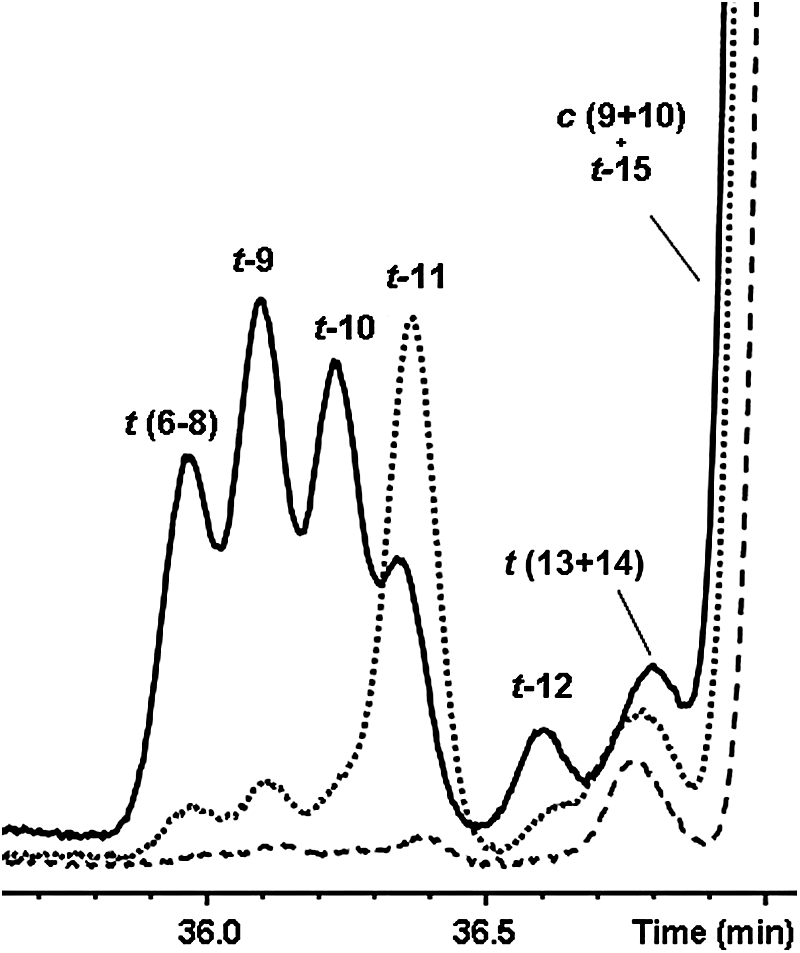
Partial gas chromatographic separation of three human milk samples with a different trans 18:1 profile. Industrial trans consumption
18:2 TFA isomers were found in negligible amounts (Table 2) in both groups, urban and rural women. CLA content was very low for most of the breast milk studied. Its individual values ranged from 0.04% to 0.61%, but only 4 out of the 60 Nigerian subjects presented a level greater than 0.3% of total FAME in milk fat.
Regarding essential FA, no differences were observed for linoleic or α-linolenic acids according to the women origin (p > 0.10, Table 2). Their levels accounted for 13% and 0.6% for 18:2 n-6 and 18:3 n-3, respectively. Arachidonic acid (20:4 n-6) content was also unaffected (0.44% for rural and 0.39% of total FAME for urban subjects). In contrast, an interesting finding in the current survey would be the marked difference of long-chain n-3 FAs between rural and urban lactating women. Compared with Fulani subjects, eicosapentaenoic (EPA, C20:5 n-3) and docosapentaenoic acids (DPA, C22:5 n-3) and DHA contents were significantly higher in urban women from Jos city (p < 0.05, Table 2). The greatest differences were found in DHA, which levels were twice as high in urban mothers (0.27%) than in Fulani women (0.13%) milk fats (p < 0.001, Table 2). From the 60 subjects, 21 women (3 rural and 18 urban) presented a DHA content greater than 0.2% of total FAME.
Discussion
Most milk FA presented large standard deviations and insignificant differences between rural and urban Nigerian areas, which would indicate that they were not two homogeneous groups according to their diet but mixed groups in each region. Lauric, myristic, and palmitic acids contents in milk fat were higher than that seen previously in human milk from different countries, 20 but similar to those obtained previously by Glew et al. in Nigerian women. 15 This finding would not be positive from a nutritional perspective and suggests that the diet of Nigerian women was relatively high in carbohydrate and low in fat, similar to Mexican or Philippine women.20,21
The total TFA levels may not appear to be a major concern compared with the much higher levels found in western countries.13,14,22 Leaving aside VA, all trans 18:1 percentages were significantly greater for urban women (p < 0.05), which would suggest a greater TFA consumption from industrial sources. Nonconjugated 18:2 TFA are mainly produced by frying oil rich in linoleic acid (e.g., soybean, sunflower, or rapeseed oils) at high temperature while cooking. In the current research, 18:2 TFA percentages in human milk were low, which should be considered positive as these FA may result in a greater risk factor for coronary heart disease that monounsaturated TFA. Furthermore, 18:2 TFA have been shown to be metabolized to other trans containing PUFA that interfere with brain and retinal function. 23
RA was quantitatively the main CLA isomer found and its percentages were not significantly different between groups. RA is the most biologically active CLA isomer and its main dietary source is ruminant fat. 11 In addition, a significant relationship was observed between VA and RA (r = 0.83; p < 0.001). Turpeinen et al. 10 indicated that ∼20% of VA is converted to RA by Δ-9 desaturase in human tissues. In the present study, the high correlation observed between both FA would point out in the same direction. Concerning other CLA isomers such as trans-9 cis-11, trans-11 cis-13, cis-9 cis-11, and trans-11 trans-13, quantities were also detected but in very low amounts (Table 2). These minor CLA isomers are currently found in different dairy products24,25 originated in the rumen by enzymatic conversion of dietary FAs.
To obtain a more complete overview of the 60 Nigerian subjects and be able to group them according to their origin (rural versus urban) and their trans fat content (no trans, natural trans versus industrial trans), a PCA was performed on all 18:1 isomers and total CLA milk contents (Fig. 2). In the PCA map, the first two principal components accounted for 43.0% and 26.9% of the variance in the first and second dimension, respectively. No differences were observed among Nigerian women according to their origin confirming previous statements (Fig. 2A). In contrast, subjects were differentiated in three groups according to their trans isomers profile (Fig. 2B). The first group was characterized by samples close to the origin of the PCA system that indicate a low amount of total trans 18:1 isomers and CLA according to a very limited trans fat intake. In contrast, industrial and natural trans fat intakes tended to separate by particular FA mostly in the second dimension of the PCA. Based on the loadings plot (Fig. 2C), natural trans consumption would promote milk fat with higher concentrations of VA, total CLA, trans (13 + 14) 18:1, and trans-16+cis-14 18:1. In contrast, industrial trans consumption would increase milk fat with higher contents of trans (6 + 7 + 8), trans-9, trans-10, and cis-12 18:1 isomers. The three groups differentiated in the present study could be extrapolated to any other nutritional study, but good chromatographic separations of the 18:1 area is needed (i.e., trans (6 + 7 + 8), trans-9, trans-10, and trans-11 18:1 isomers have to be well resolved) (Fig. 1).
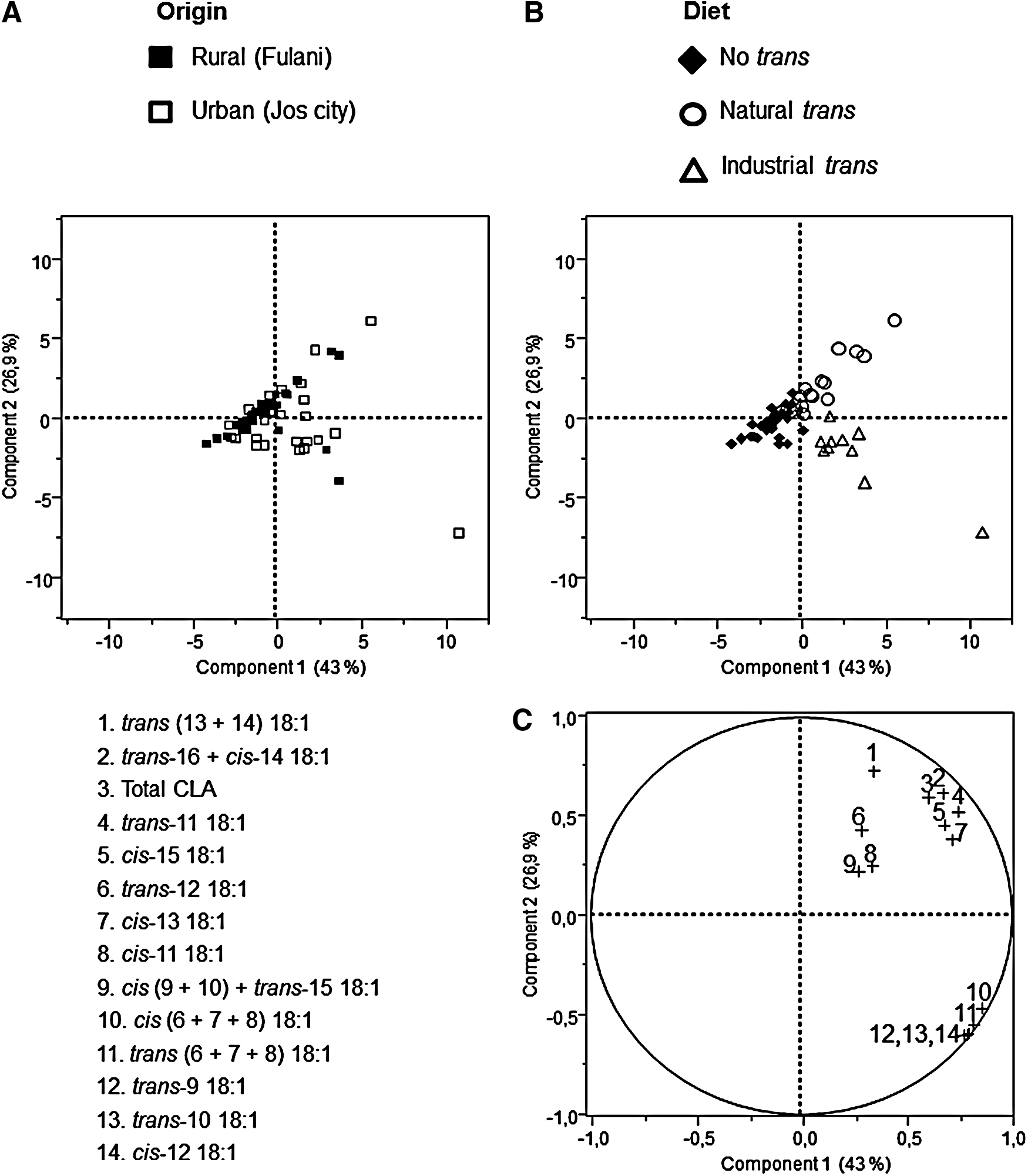
PCA of 18:1 FA and CLA milk percentages of the rural (n = 30) and urban (n = 30) Nigerian women. Scores plot according to
To summarize, a negligible trans 18:1 amount was noticed in 31 women (18 rural and 13 urban) out of the 60 Nigerian mothers studied. The fact that only 10 women had a typical partially hydrogenated trans fat consumption profile (two rural and eight urban) would indicate a low westernized diet in Northern Nigeria. In contrast, it was unexpected that only 10 from the 30 Fulani milks analyzed had a natural trans intake pattern. Fulani are seminomadic pastoralists whose culture and economy are centered on cattle, and their diet is rich in milk, cheese, and other dairy products with high content in natural TFA. 26 Glew et al. speculated with a poor absorption of TFA from the gastrointestinal tract or a specificity of the lipoprotein lipase of the mammary gland of the Fulani women such that it discriminated against triglycerides that contained TFA. 15 However, more research would be needed to clarify this concern.
Conclusions
Although the results of this work confirm the presence of low levels of TFA in Nigerian breast milk, we could sort milk samples into three groups based on their dissimilar TFA profile. The first group would be related to a natural trans fat consumption and high levels of VA, total CLA, trans (13 + 14) 18:1, and trans-16+cis-14 18:1, while industrial trans fat intake would be related with higher contents of trans (6 + 7 + 8), trans-9, trans-10, and cis-12 18:1 isomers. Finally, the third group would be linked to low TFA isomers in breast milk. This classification could be convenient to other clinical studies dealing with TFA analysis and samples of different nature (e.g., biological samples).
Footnotes
Acknowledgments
The authors are indebted to Prof. J.K.G. Kramer for the opportunity to conduct the work in his laboratory at the Guelph Food Research Centre, Canada. The authors also wish to acknowledge to Prof. Robert H. Glew and Dorothy J. VanderJagt for supplying human milk samples. This work was supported by Agriculture and Agri-Food Canada (Project AAFC-253) and the Spanish Ministry of Education and Science (Project AGL2005-04760-C02-01) through a mobility grant to P.G.C.
Disclosure Statement
No competing financial interests exist.