




Abstract
Abstract
Background:
To date there are no clinical studies analyzing potential effects of tocolytics on breastfeeding duration in humans.
Objectives:
The purpose of this study was to evaluate the association between beta 2 agonists prescribed for tocolysis during pregnancy and breastfeeding duration.
Methods:
We conducted a cross-sectional questionnaire study of 114 mothers and filled in the questionnaire developed to directly address the goals of the study.
Results:
There was a statistically significant difference between breastfeeding duration of mothers who were on tocolytics during pregnancy versus those who were not prescribed tocolytics (9.5 ± 5.7 months versus 4.5 ± 2.1 months) p < 0.001. In addition, hypogalactia was statistically significantly more prevalent in mothers with positive history versus mothers with negative history of tocolytic usage p < 0.001.
Conclusion:
The results of our study indicate that tocolytic treatment in pregnancy is associated with shorter breastfeeding duration and hypogalactia.
Introduction
D
Methods
A cross-sectional questionnaire study was conducted on 135 mothers visiting pediatricians for their children routine checkups. This study was done between May 2013 and July 2014 and was approved by the Ethical Committee for Medical Research (protocol number 01-3565-1). The prepared questionnaire aimed to obtain the necessary information on tocolytics exposure (reasons, timing, dosage, and duration of their usage), duration of breastfeeding, reasons for its cessation, as well as certain particulars of sociodemographic and behavioral characteristics.
Results
Altogether we analyzed 135 questionnaires and included in statistical analysis 114 fully completed questionnaires. There were a total of 99 women of mean age 26 ± 4.3 years without history of tocolytic usage and 15 women of mean age 28 ± 5.3 years who were on tocolysis during pregnancy. There was no statistically significant difference in age between the groups (p > 0.05). Of mothers on tocolysis, 12 took Gynipral (hexoprenalinum) and 3 Partusisten (fenoterol), both belonging to β-agonists. In eight cases, the second drug prescribed for tocolysis was verapamil and in three magnesium sulfate. The reasons for introduction of tocolytic therapy were bleeding and/or pain from the genital antepartum in almost all cases except one case with placenta previa. One mother did not know the reasons for being put on tocolytic treatment. In six mothers, tocolysis was initiated in the first trimester of pregnancy, in four mothers in the second, and in five mothers in the third trimester. In all cases, tocolysis was started with oral tocolytics and in three cases it was continued intravenously. The duration of tocolytic therapy ranged from 1 week to 7 months.
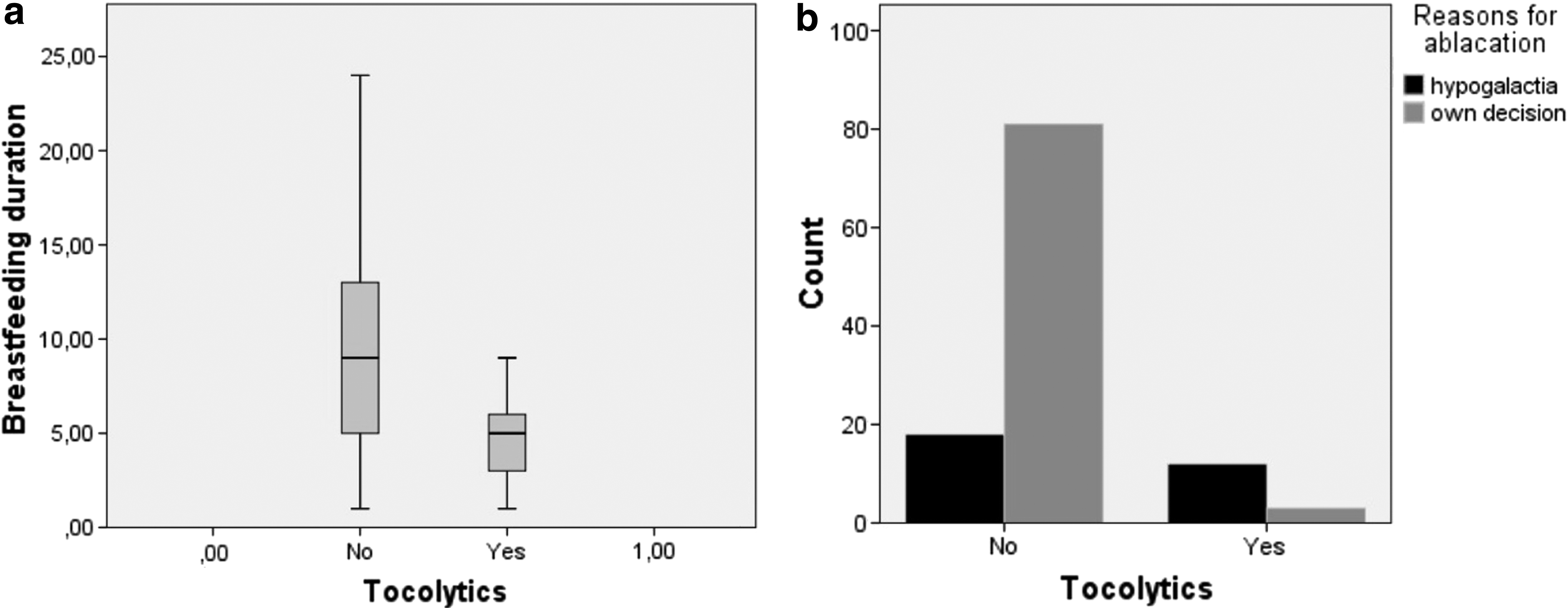
Women on tocolytic treatment breastfed for 4.5 ± 2.1 months, significantly shorter than untreated women, 9.5 ± 5.7 months (p < 0.0001; Fig. 1a). The mothers' self-reported reasons for stopping breastfeeding in the tocolytic group were hypogalactia in 12 cases and other reasons (social, psychological, etc.) in 3 cases. Of mothers without history of tocolytic treatment, hypogalactia was the cause to stop breastfeeding in 18 cases and other reasons were reported in 81 cases. Hypogalactia was statistically significantly more frequent in mothers with positive history versus mothers with negative history for tocolytics usage (p < 0.0001; Fig. 1b).
Discussion
Betamimetics are a type of medication commonly prescribed for tocolysis in developing countries. However, there are only a few literature data confirming the real efficacy of their usage in this clinical setting. 5 Besides, a number of potential side effects of tocolysis on fetus or on pregnant mother make the value and efficacy of this treatment questionable. It is well known that tocolytics with beta-sympathomimetic drugs have significant long-term side effects to the mother's cardiovascular system, carbohydrate metabolism, and the fetal cardiovascular system. In contrast, much less is known about the potential influence and long-term side effects of tocolytics on lactogenesis and breastfeeding duration.4,6
The results of this study indicate that women on tocolysis were associated with significantly shorter duration of breastfeeding than untreated women. In addition, hypogalactia was statistically significantly more frequent in mothers with positive history versus mothers with negative history for tocolytic usage.
According to our knowledge, our study is the first to examine the possible long-term side effects of tocolytic agents on breastfeeding duration in the human population.
After detailed literature survey, we have found only one experimental study of Zhang et al. that documented that β-agonist reduces mammary gland parenchymal tissue and decreases milk yield in ewes. 4 They noted that milk yield tended to increase in ewes fed increased protein and to decrease in ewes fed β-agonist. Other researchers have also shown that physiologic activation of the sympathetic system may inhibit milk yield in rats. 7 Thus by analogy, a potential negative impact of betamimetics on lactogenesis in humans is plausible.
The limitations of our study are clear. This was a preliminary nonrandomized nonprospective nonmatched study population and thus suffers from potential selection and other hidden biases. In addition, the association might reflect reverse causation, that is, the mother receiving tocolytics was more likely to have underlying hormonal or anatomical problems possibly influencing lactogenesis. However, given the data from the already noted animal studies and thus the possibility that tocolysis during pregnancy might influence the lactation process, (milk production and subsequently breastfeeding duration), it is our opinion that this issue should be prospectively studied in a larger population.
Footnotes
Acknowledgment
This work has been supported by the Serbian Ministry of Education and Science, grant No. OI1621984.
Disclosure Statement
No competing financial interests exist.