




Abstract
Abstract
Objective:
The objective was to examine the bacteriological and immunological properties of freshly expressed, previously frozen, and leftover mothers' own milk during storage.
Materials and Methods:
In the first of two pilot studies, 12 mother-infant dyads participated. The milk studied included freshly expressed unfed and freshly expressed leftover milk. Milk samples were stored at 24°C, 4°C, or −20°C. In the second pilot study, 11 mother-infant dyads participated. The milk studied included milk that had been previously frozen, including previously frozen leftover milk. Milk samples were stored at 24°C and 4°C. After storage in both studies, the milk was analyzed for bacteriological and immunological properties.
Results:
Bacteriological and immunological characteristics of freshly expressed unfed and freshly expressed leftover milk and previously frozen unfed and previously frozen leftover milk remained stable during storage at 4°C for at least 6 days. The quality of all groups of mothers' milk declined when stored at 24°C for longer than 3 hours.
Conclusions:
While this study provides evidence that human milk might be safe at longer storage times, storage guidelines should not be revised until more research is performed. This study serves as a call to action for more research on the topic of human milk storage, specifically leftover human milk. The study provides information to inform future study designs on the topic of unpasteurized human milk storage. More research is needed regarding leftover human milk storage with a greater number of participants, determination of the quality of human milk, and the storage of human milk in a real-life setting.
Introduction
G
Published guidelines for storing expressed human milk advise that it should be stored no longer than 4–8 hours at room temperature (between 16°C and 29°C), 4–8 days at refrigerated temperatures (4°C), or 6–12 months in the freezer (−4°C), with appropriate storage times dependent on hygiene conditions during expression and actual storage temperatures.10,11 Human milk storage guidelines may vary depending upon the organization publishing the guidelines. In the United States, many states have licensing guidelines for childcare facilities that require previously frozen human milk to be stored in the refrigerator no longer than 24 hours and leftover human milk be discarded immediately.12–15
Evidence is lacking regarding the storage of leftover human milk, which is defined as milk that has been exposed to the infant's oral microflora through bottle or cup feeding. In the absence of evidence, it is recommended to discard leftover human milk 1–2 hours after the feeding. 10 The objective of this pilot study is to evaluate the bacteriological composition and immunological activity of human milk collected in a home environment during ambient and refrigerated storage conditions. The objective of the first pilot study was to examine changes within freshly expressed unfed human milk (FRESH-UNFED) and freshly expressed leftover human milk (FRESH-LO) during storage. The objective of the second pilot study was to examine changes within previously frozen unfed human milk (FROZEN-UNFED) and previously frozen leftover human milk (FROZEN-LO) during storage. Results from the first study helped to inform the design and storage conditions of the second study.
Materials and Methods
Investigators conducted two pilot studies and received ethical approval from the North Carolina State University Institutional Review Board. Participants provided written informed consent for themselves and their infants. Investigators recruited participants from the Piedmont area of North Carolina through social media and with the aid of healthcare providers. Eligible participants contacted the study coordinator, who described the details of the study and requested their participation. Mothers were asked to express milk (a complete breast expression) at a convenient time. Sample sizes were based on feasibility for the scope of the pilot studies, which involved participation of the mothers and infants. Figure 1 illustrates the design of the studies.
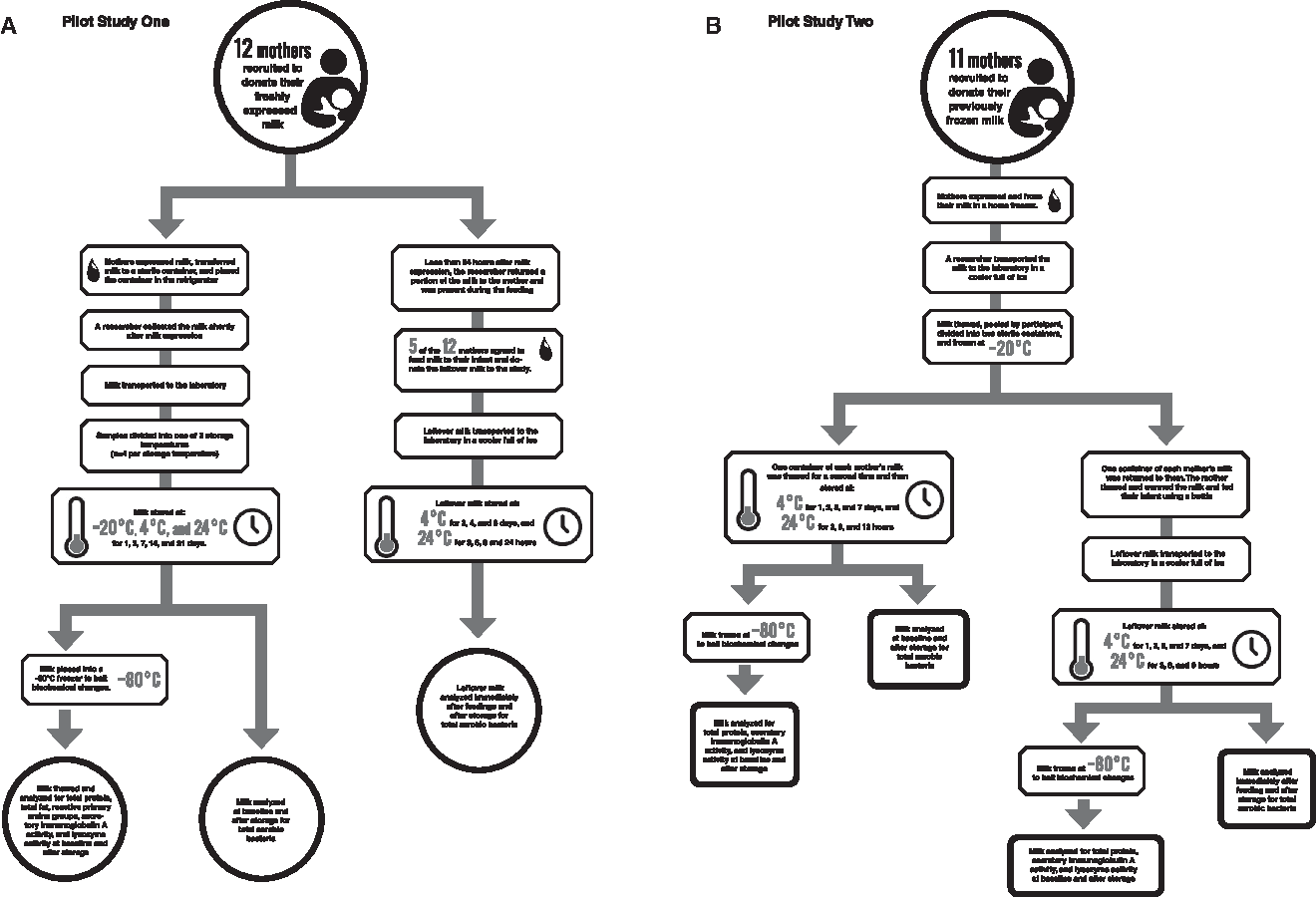
Diagrams to represent the flow of the pilot studies.
Pilot study 1: FRESH-UNFED and FRESH-LO
Subjects
Investigators recruited 12 mother-infant dyads using the following criteria: breastfeeding an infant or child between 2 and 24 months old; expressing milk using their regular expression and pump cleaning routines; and infant capable of drinking from a bottle. Participants did not receive an incentive for participation in study 1.
Sample collection and storage
Participants received a package in the mail containing sterile containers for milk storage and directions for participation in the study. Immediately after expression, the participant transferred FRESH-UNFED milk into a sterile container and placed it in the refrigerator. Within 1–2 hours of expression, the investigator met the mother and transported the milk to the laboratory on ice. The investigator assigned the samples to one of three different storage conditions (−20°C, 4°C, and 24°C; n = 4 per storage condition) and then samples were divided into individual containers for 0, 1, 2, 7, 14, and 21 days of storage. At each storage time point, the sample was removed from the storage condition and placed in a −80°C freezer to limit biochemical changes. All samples were analyzed within 3 months of −80°C storage. All samples were analyzed for total protein, reactive primary amine groups (RPAG) (an indicator of protein breakdown), total fat, total aerobic bacteria (TAB), secretory immunoglobulin A (SIgA) activity, and lysozyme activity.
Out of the 12 mothers recruited for study one, a subset of the participants (n = 5) agreed to feed 1–2 ounces of freshly expressed milk to their infant through a bottle using their normal feeding routine. The bottle originally contained approximately 4 ounces of milk. Therefore, the infants consumed approximately one half of the milk. The mothers expressed milk, transferred it into a milk storage bag of their choice, and stored it in the refrigerator. Less than 24 hours after milk expression, the investigator was present when the mother fed the milk to the infant. Each bottle-feeding process took less than 5 minutes. The investigator transferred the FRESH-LO milk to a sterile container, placed on it ice, and transported it to the laboratory where it was analyzed for TAB within 1 hour of the end of the feeding. FRESH-LO samples were stored at 4°C for 0, 2, 4, and 6 days and at 24°C for 0, 3, 6, 9, and 24 hours. The time points of “0” represent samples taken at baseline (before storage) for analysis. Human milk in the preliminary study was never frozen until it arrived at the laboratory and was assigned a storage condition.
Pilot study 2: FROZEN-UNFED and FROZEN-LO
Subjects
Investigators recruited 11 mother-infant dyads using the following criteria: expressing milk for a healthy full-term (>37 weeks gestation) infant between 2 and 11 months old; expressing milk using their regular expression and pump cleaning routines; and infant capable of drinking from a bottle. Investigators offered participants a gift card for their participation in study 2. In study 2, investigators limited the participation to mothers between 2 and 11 months postpartum because the study required greater volumes of milk; therefore investigators sought participants who were more likely to still be breastfeeding regularly versus in the process of weaning.
Sample collection and storage
Investigators did not provide participants with instructions on how to express milk or clean pump parts so that samples from this study would represent milk collected during their normal routine. Immediately following milk expression, the participants placed the sample in a home freezer. Samples from each pumping session were stored in separate containers.
Once the participant had collected and frozen a total of 8 ounces of milk, the participants notified the investigator, who then picked up the frozen milk. Participants stored samples in the home freezer no longer than 2 weeks before the investigator transported it to the laboratory on ice, where the samples were thawed under running water, pooled by participant, divided into two sterile containers, and frozen at −20°C until further treatment.
Within 1 month of collecting the frozen milk from the mother, the investigator returned 1 container of each participant's frozen milk and instructed participants to thaw the milk and feed their infant using their regular thawing and feeding routines. All participants thawed their milk using warm water. After the infant consumed 1–2 ounces of the thawed milk from a bottle, the investigator transferred the remaining milk to a sterile container and transported it to the laboratory on ice. The bottle originally contained approximately 4 ounces of milk. Therefore, the infants consumed approximately one half of the milk. Each bottle-feeding process took less than 5 minutes, and the milk was plated for TAB within 1 hour of the end of the feeding. FROZEN-UNFED and FROZEN-LO that had been partially consumed by the infant went through two freeze–thaw cycles before storage conditions were applied. Milk from all study participants (n = 11) was subject to all storage conditions and durations.
In the laboratory, FROZEN-LO was divided into sterile containers and stored at room temperature (24°C) for 0, 3, 6, and 9 hours and refrigerated storage (4°C) for 0, 1, 3, 5, and 7 days. Similarly, the FROZEN-UNFED samples (n = 11) were thawed and subjected to storage conditions. Storage conditions for the FROZEN-UNFED samples included the following: 24°C for 0, 3, 9, and 12 hours and 4°C for 0, 1, 3, 5, and 7 days. FROZEN-LO and FROZEN-UNFED were stored at different time intervals in the 24°C treatment because the investigators expected to see a more rapid increase in bacteria counts in FROZEN-LO versus FROZEN-UNFED. The time points of “0” represent samples taken at baseline (before storage) for analysis. Investigators performed bacteriological analysis immediately after each storage period. The remaining samples were frozen at −80°C until further analysis of total protein content, lysozyme activity, and SIgA activity. Samples in this study were stored at −80°C for no longer than 3 months. In one study, storage at −20°C and −80°C for 6 months did not decrease bioactive immunological factors in human colostrum, but storage at 12 months did result in a decrease. 16
Bacterial analysis
Milk samples were assayed in duplicate for TAB using Petrifilm™ Aerobic Count Plates (3M Company, St. Paul, MN), a reliable alternative to standard agar plating methods.17,18 FROZEN-LO samples were assayed for coliform counts using Petrifilm™ Coliform Count Plates (3M Company).
Protein analysis
Total protein, RPAG, lysozyme activity, and SIgA activity were assayed in triplicate. The average intra-assay coefficient of variation (CV) was 4.0%, 4.4%, 5.5%, and 5.2% for total protein, RPAG, lysozyme activity, and SIgA activity, respectively. Total protein was measured by BCA Protein Assay Kit (Pierce Biotechnology, Inc., Rockford, IL) using 96-well plates, 19 which has been validated as reliable in human milk. 20 The concentration of RPAG was measured to determine the extent of proteolysis using o-phthaldialdehyde (OPA). 21 Lysozyme activity was measured by changes in the turbidity of a Micrococcus lysodeikticus suspension as described by Shugar 22 and adapted for a 96-well plate. 23 SIgA activity was determined by a kinetic indirect enzyme linked immunosorbent assay (ELISA) using heat-killed Escherichia coli somatic O antigens as described by Chen and Allen 24 and Viazis et al. 25
Statistical analysis
Linear mixed effects models, appropriate to the repeated measures design of the study, were fit using the MIXED procedure of SAS (Cary, NC). 26 Fixed factorial effects for storage conditions (temperature and time) were included along with random effects for sample and sample-by-treatment interaction. The time points at which the milk was stored were different for the two temperatures; therefore, time effects are nested within temperature. Simple effects of time were investigated using Tukey's procedure to carry out all pairwise comparisons among time points within storage temperature.
Results
Pilot study one: FRESH-UNFED and FRESH-LO
When FRESH-UNFED was stored at −20°C, lysozyme activity increased significantly (p = 0.0001) (Table 1), and pairwise comparison indicates that this increase becomes significant between day 0 and day 1 (p = 0.0286), at which point it decreases between days 1 and 2 and increases significantly at days 14 (p = 0.0371) and 21 (p = 0.0043).
Twelve women were recruited for the study, and each donor's milk was assigned to a specific storage temperature for a total of N = 4 participants per treatment group (−20°C, 4°C, 24°C).
p-Values are for tests of equality across time within storage temperature and reflect the significance of the change throughout the storage period from 0 to 21 days.
The “0 day” time point reflects baseline levels before storage conditions.
SIgA, secretory immunoglobulin A.
At 4°C storage of FRESH-UNFED, increases in RPAG and TAB both became significant at day 14 (p = 0.042 and p = 0.044, respectively) (Table 1).
At 24°C, FRESH-UNFED experienced a decrease in protein concentration (p = 0.0355) and SIgA activity (p = 0.0171) and an increase in RPAG (p < 0.0001) and TAB (p < 0.0001) (Table 1). The increase in TAB became significant at day 2 (p = 0.0021), the decrease in protein became significant at day 7 (p = 0.0331), the increase in RPAG became significant at day 7 (p = 0.0014), and the decrease in SIgA activity became significant at 3 weeks (p = 0.0019).
When FRESH-LO was stored at 4°C, TAB did not significantly change during 6 days of storage (p = 0.5055). At 24°C, TAB in FRESH-LO increased during 24 hours of storage (p = 0.0009), and the increase became significant between 9 and 24 hours (p = 0.0005) (Table 2).
N = 5. p-Values are for tests of equality across time within storage temperature.
The “0 day” and “0 hour” time points reflect baseline levels before storage conditions.
Pilot study two: FROZEN-UNFED and FROZEN-LO
At 4°C, there was no significant change in TAB for FROZEN-UNFED and FROZEN-LO milk during 7 days of storage. There were no changes in coliform counts in FROZEN-LO over 7 days of 4°C storage. Similarly, investigators observed no significant changes in lysozyme activity or SIgA activity in FROZEN-UNFED and FROZEN-LO at 4°C. The total protein content of FROZEN-UNFED and FROZEN-LO showed a small but statistically significant increase over time during refrigerated storage (Table 3).
N = 11. Milk from each mother was analyzed at each time and temperature combination.
Data represent mean ± SEM (standard error of a mean) obtained by milk samples from 11 individual volunteers.
The “0 day” and “0 hour” time points reflect baseline levels before storage conditions. FROZEN-UNFED stored for “0 day” and “0 hour” reflects milk that has not been stored or fed to an infant. FROZEN-LO stored for “0 day” and “0 hour” reflects milk that has been fed to an infant and analyzed for aerobic bacteria within 1 hour after feeding or stored at −80
p-Values for F-tests of the hypothesis of no time effect on each of the responses. FROZEN-UNFED = previously frozen unfed human milk; FROZEN-LO = previously frozen leftover human milk.
At 24°C, a significant increase in TAB occurred in FROZEN-UNFED (p < 0.01) and FROZEN-LO (p < 0.05) (Table 3). To further understand at which time point TAB began to increase, pairwise comparisons between time points were made using Tukey's procedure for multiple comparisons. In FROZEN-UNFED samples, TAB significantly increased at 9 hours of 24°C storage, from 3.8 log CFU/mL at 0 hour to 4.4 log CFU/mL at 9 hours for a difference of 0.6 log CFU/mL. In FROZEN-LO samples, bacteria increased significantly at 9 hours of 24°C storage, from 4.6 log CFU/mL at 0 hour to 5.4 log CFU/mL at 9 hours, for a difference of 0.7 log CFU/mL. A significant increase in coliform counts occurred in FROZEN-LO at 6 hours of 24°C storage. No significant changes occurred in protein content, lysozyme activity, and SIgA activity in FROZEN-UNFED over 12 hours and in FROZEN-LO over 9 hours of storage at 24°C (Table 3).
To understand the effect of partial consumption on the examined components, pairwise comparison was conducted between FROZEN-UNFED and FROZEN-LO at each storage time point. According to the comparison, there was no significant difference in TAB, total protein content, lysozyme activity, or SIgA activity between FROZEN-UNFED and FROZEN-LO at 4°C and 24°C storage at each time point (Table 4).
N = 11. Milk from each mother was analyzed at each time and temperature combination.
FROZEN-UNFED = previously frozen unfed human milk; FROZEN-LO = previously frozen leftover human milk. p-values are for tests that the underlying mean difference being estimated by the data is 0.
The “0 day” and “0 hour” time points reflect baseline levels before storage conditions.
Discussion
Investigators made several important observations in study 1 that informed the storage conditions of study 2: (1) twenty-five percent of mothers had initial bacterial counts that exceeded 4.30 log CFU/mL; (2) storage at −20°C for 3 weeks led to a significant increase in lysozyme activity; (3) when FRESH-UNFED was stored at 4°C for 14 days, there was a significant increase in RPAG and TAB; (4) FRESH-UNFED stored at 24°C begins to degrade in quality at 2 days of storage; and (5) TAB in FRESH-LO did not significantly increase during storage at 4°C for 6 days. Therefore, investigators chose to further study leftover milk in study 2 for 7 days and expanded analysis to include total protein, SIgA activity, lysozyme activity, and coliforms.
Investigators chose the designated storage conditions in study 2 based on results of study 1. In study 1, storage at −20°C did not have a negative impact on the milk; therefore, the investigators did not choose −20°C as a storage condition, except by way of freezing and thawing the milk. During storage at 4°C in study 1, the increases in RPAG and TAB both became significant at day 14; therefore, the investigators studied storage through 7 days at 4°C in study 2. In study 1, storage at 24°C increased TAB at day 2 of storage, followed by a decrease in protein concentration and an increase in protein breakdown at day 7, as well as a decrease in SIgA at 3 weeks. As a result, the investigators studied storage at 24°C only up to 12 hours in study 2. In contrast to study 1, the milk in study 2 was previously frozen in the mothers' homes; therefore, the investigators chose shorter durations of storage, hypothesizing that the freezing and thawing of the milk would negatively impact milk composition.
Study 2 provides important evidence on the storage of previously frozen human milk collected and fed in a home environment using a variety of quality indicators, including bacterial growth, protein content, and immunological activity of lysozyme and SIgA. When discussing the quality indicators, it is important to recognize that there is no consensus regarding a definition for unsafe milk. 10
According to the data collected, if one uses the initial level of bacteria at time 0 as a standard by which to evaluate bacterial growth, the quality of FROZEN-UNFED and FROZEN-LO remains stable when stored at 4°C for at least 7 days. If one uses the Pasteurized Milk Ordinance (PMO) for Grade A pasteurized bovine milk, 27 which provides a bacteriological threshold of 4.3 log CFU/mL for TAB, the quality of FROZEN-UNFED remains stable when stored at 4°C for at least 7 days, but FROZEN-LO would not be suitable for consumption due to TAB greater than 4.3 log CFU/mL. The increase in aerobic bacteria in FROZEN-LO to above the PMO limit of 4.3 log CFU/mL could be due to bacterial contamination of the milk from the infant or from the bottle. Coliforms were present in FROZEN-LO, but did not change significantly during storage. Coliforms did not exceed the 1–2 log PMO CFU/mL threshold when FROZEN-LO was stored at 4°C, but they exceeded this threshold when the milk was stored at 24°C for 3 hours.
A threshold of 4.3 log CFU/mL might be appropriate for pasteurized bovine milk, in which some immune factors are eliminated or decreased, but the immunological properties of pasteurized bovine milk and unpasteurized human milk are different. 24 A more appropriate threshold for human milk might be the bacterial levels immediately after the infant consumes milk from the bottle because the antimicrobial system in unpasteurized human milk is different from that of pasteurized bovine milk. In both studies, bacterial growth was either slow or nonexistent when stored at 4°C and −20°C, which is likely due to the natural antimicrobial properties of human milk. Others have reported stable28,29 or declining 30 bacteria levels in human milk stored at 4°C for 4–5 days and stable bacteria levels in human milk stored for 4–8 hours at 24°C.31,32
Both studies indicate that changes in protein occur during storage. In FRESH-UNFED, total protein significantly decreased during storage at 24°C, and RPAG significantly increased during storage at 24°C and 4°C. No changes occurred in total protein of FROZEN-UNFED or FROZEN-LO at 24°C storage over 12 hours, but there was a small but significant increase in the protein content at days 5 and 7 of 4°C storage. It is unknown why total protein would increase during storage, and the topic of protein in human milk during storage warrants further study. Total protein content of unfed human milk has been reported as stable for 2–4 days at 4°C storage,29,33,34 while Slutzah et al. 28 reported a small but significant decline in total protein over 4 days of refrigeration. These equivocal findings warrant further research into the total protein content in human milk during storage; however, the reported changes were small and may not be nutritionally significant.
Using immunological activity of specific bioactive proteins as an indicator of milk quality, lysozyme and SIgA activity did not decrease over 7 days of 4°C storage and 12 hours of 24°C storage in FROZEN-UNFED and FROZEN-LO and 3 weeks of 4°C and −20°C storage in FRESH-UNFED. Lysozyme and SIgA activity decreased in FRESH-UNFED stored at 24°C for 3 weeks. The data agree with other findings in the literature that SIgA is stable at refrigerated storage for 4 days28,29 and at room temperature storage for 72 hours. 35
Limitations
Future research should examine previously frozen and leftover milk with a greater number of participants. Study participants may have a bias toward more hygienic conditions when collecting and handling their milk compared to general population. To try to overcome this potential bias, investigators asked participants to collect and store milk using their normal routines. This study was limited to healthy infants and would thus not be generalizable to all infants. In addition, bacterial counts were higher at baseline in study 1 than they were in study 2, providing evidence that bacterial counts vary widely between mothers and further supporting the need for larger studies on the topic of human milk storage.
Conclusions
This pilot study fills an important void in the scientific literature regarding storage of freshly expressed, previously frozen, and leftover human milk that has been exposed to the microflora in an infant's mouth through partial bottle-feeding. Future studies concerning the storage of human milk need to include in their design a greater number of participants than the current published studies and should reflect both unfed and leftover conditions to provide practical evidence to families using expressed human milk. The studies should also examine the changes in leftover human milk, including specific pathogens, changes in protein concentration, free fatty acids, rancidity, and mold, as it is unknown which properties should be used to judge the quality of human milk. Future studies need to include other variations of the typical freezer, refrigeration, and room temperatures because many homes around the world may have access to cooler or warmer storage temperatures. In addition, studies need to be designed to reflect real-life milk storage and handling situations. For example, instead of using sterile storage containers, the milk should be stored in containers that the mother would actually use for milk storage.
In regards to the use of previously fed human milk, the Academy of Breastfeeding Medicine's protocol #8 on human milk storage states, “There has been insufficient research done to provide recommendations in this regard. Based on related evidence thus far, it seems reasonable to discard the remaining milk within 1–2 hours after the infant is finished feeding.” 10 This study provides information to inform future study designs on the topic of unpasteurized human milk storage, specifically previously fed human milk. Research is needed regarding (1) leftover human milk storage with a greater number of participants, (2) the determination of the quality of human milk, and (3) the storage and handling practices of human milk in a real-life setting. While this study provides evidence that human milk might be safe at longer storage temperatures, storage guidelines should not be revised until more research is performed.
Footnotes
Acknowledgments
The authors thank the mothers and infants who participated in this study and North Carolina State University for funding this research.
Disclosure Statement
No competing financial interests exist.