




Abstract
Abstract
Background:
The breastfeeding position routinely used following a cesarean section is the side-lying position. However, there have been few studies about the effect of breastfeeding positions, including laid-back position on breastfeeding outcomes.
Objective:
To compare the breastfeeding outcomes between using laid-back and side-lying breastfeeding positions in mothers delivering by cesarean section.
Materials and Methods:
A randomized controlled trial was conducted. The postpartum mothers delivering by cesarean section who delivered term newborns were randomly assigned to learn the use of a laid-back or side-lying breastfeeding position. The breastfeeding outcomes were assessed by LATCH scores at the second day postpartum and exclusive breastfeeding rates during the 6-week postpartum period. The mother's satisfaction of each breastfeeding position was collected before discharge from the hospital.
Results:
The data from 152 postpartum mothers delivering by cesarean section were available for analysis, 76 from the laid-back position group and 76 from side-lying position group. The baseline characteristics of both groups were similar. There were no statistically significant differences of the breastfeeding outcomes, LATCH scores at the second day postpartum and the exclusive breastfeeding rates during the 6-week postpartum period. But the mothers had expressed more satisfaction from the side-lying than the laid-back position.
Conclusions:
Among the mothers who delivered by cesarean section, the use of the laid-back breastfeeding position had not shown different breastfeeding outcomes from the side-lying breastfeeding position. It might be an alternative breastfeeding position, which can be taught for mothers delivering by cesarean section along with the side-lying position.
Introduction
A
The breastfeeding position routinely used following a cesarean section is the side-lying position. The laid-back position is a breastfeeding position which has been demonstrated to support the spontaneous behaviors that help mothers and babies get started with breastfeeding. 7 However, there have been few studies about the effect of each breastfeeding position on breastfeeding outcomes. Thus, we are interested in the comparison of breastfeeding outcomes between the laid-back and side-lying positions, which are commonly used in the mothers who have delivered by cesarean sections in this study.
Materials and Methods
Setting
This study was performed in the Nakhon Nayok province, a rural area in the central part of Thailand. The data were collected during the period from July 2015 to June 2016 at the HRH Princess Maha Chakri Sririndhorn Medical Center, which is a baby friendly hospital. A routine practice in the postpartum ward is breastfeeding education. The 1-hour course in breastfeeding includes latching and is taught on the first day postpartum. One nurse teaches a group of 3–5 mothers. Mothers are encouraged to stimulate their infants to feed 8–12 times per day. At the second day postpartum, the mothers and infants were discharged if they had shown no complications. Before discharge, the breastfeeding-recording notebook was given to the mothers with an explanation of the “breastfeeding type” definition, postpartum symptoms, and complications which may require further clinical counseling.
Design
This study is a randomized control trial. We set it as a single blind. The nurses who followed up with the breastfeeding outcomes did not know the breastfeeding position groups.
Procedure and collection of material
Randomization was done using a computer-generated list with block of four methods. After the allocation sequence was generated, the researcher enclosed laid-back or side-lying in the sequentially numbered sealed envelopes. These envelopes were kept with the nurses who opened each envelope when a new participant was recruited at the time of her cesarean delivery. The primiparous postpartum women who had elective cesarean sections and spinal anesthesia with morphine were enrolled. The mothers were assigned to learn using laid-back or side-lying breastfeeding positions by randomization. On the first day postpartum, the mothers had received 1-hour instruction on breastfeeding positions (laid-back or side-lying position) and were given the opportunity to practice. In laid-back group, the mothers were taught to lean back and put infants on their chest. The infant body might be molded to mothers or rest on the mothers in any position which the mothers liked. In side-lying group, the mothers and infants laid on their sides facing each other with the nipple in line with infant's nose. The mothers may choose to put the infant's head resting on their arm or on the bed. All mothers were encouraged to stimulate their newborns for breastfeeding every 2–3 hours using the assigned breastfeeding position. A visual analog score was used for the mother's cesarean pain assessment at 24–30 hours on the first day and 48–54 hours on the second day postpartum. The LATCH scores and the mother's satisfaction with breastfeeding position were assessed at the second day postpartum before the mothers' discharge. The LATCH assessment team has two nurses who must pass the 12 hours course, 2 hours for the knowledge teaching and the detail of agreement and 10 hours for practice and assessment. The demographic data collected includes the following: age, occupation, income, educational level, gestational age, body mass index, and nipple length. Before discharge, the mothers were taught three additional breastfeeding positions that included the cradle, cross cradle, and football positions. Telephone follow-ups at the 7th day, 14th day, and 6th week postpartum periods were collected and used for the exclusive breastfeeding data.
Inclusion criteria
The primiparous postpartum women who had elective cesarean section deliveries without complications (i.e., multiple pregnancies, preeclampsia, antepartum hemorrhage, and preterm labor) and who intended to breastfeed for at least 6 months were recruited. Their infants had birth weights of more than 2,500 g and were born without complications. The mothers had suffered no acute postpartum hemorrhages and had no contraindications to breastfeeding and this includes the mothers who were HIV positive.
Exclusion criteria
The mothers whose infants were diagnosed with galactosemia were excluded from this study.
LATCH score
Breastfeeding was assessed using the LATCH assessment tool, which looks at five parameters: Latching on, Audible swallowing, Type of nipples, Comfort, and Help (assistance requirement). 8
The satisfaction questionnaire
There were three questions regarding the satisfaction of the breastfeeding position and these inquired on the comfort, ease of positioning, and using the breastfeeding position for a long duration. The format of the satisfaction questions was on a five-level Likert system: (1) very unsatisfied, (2) unsatisfied, (3) adequate, (4) satisfied, and (5) very satisfied. We scored one point for very unsatisfied, two points for unsatisfied, three points for adequate, four points for satisfied, and five points for very satisfied.
Breastfeeding definitions
The outcomes of this study were the rates of exclusive breastfeeding. Exclusive breastfeeding is defined as no other food or drink, including water, other than breast milk, including milk expressed. The infant was able to receive drops and syrups of vitamins, minerals, and medicines and other oral rehydration salts (ORS). The exclusive breastfeeding rates during the 6-week postpartum period were collected by follow-up through telephone conversations. The mother was taught to record breastfeeding and any fluids or foods which were given to the infant on a breastfeeding notebook that was given before discharge. Exclusive breastfeeding and breastfeeding results were answered by the mother consistently with the established definitions.
Sample size
We have hypothesized that a difference of 1.5 point would be clinically significant. We used 0.05 of α error, 0.95 of power, and effect size = 0.6. The calculated sample size numbered 74 cases in each group. The subjects were totaled with an additional 3% for data loss. The total samples collected were 76 for each group.
Ethical considerations
This study was approved by The Ethics committee of the Srinakharinwirot University, Faculty of Medicine and registered with Thai Clinical Trials Registry (registration no. TCTR20161117002).
Statistical analysis
Demographic data are reported in means and percentages. We use the t-test to compare the mean of maternal age, income, gestational age, body mass index, nipple length, pain score, LATCH score, and satisfaction score between the laid-back and side-lying groups. The data of occupation and breastfeeding outcomes were analyzed by chi square. A p-value <0.05 is considered statistically significant. Statistical analysis was performed using SPSS software (version 23.0, SPSS Incorporated).
Results
The postpartum women that had enrolled in our research project totaled 152 cases, 76 cases from the laid-back and 76 cases from side-lying groups. A flow chart of the number of participants is shown in Figure 1. Their occupations were primarily listed as being self-employed or housewives. The mean income was 19,041–19,144 baht per month. The mean of body mass index was within normal limits. The mothers had a normal mean of nipple length. There were no significant differences in the demographic data, pain scores, and LATCH scores between the two groups. The details of demographic data are shown in Table 1. Pain scores and LATCH scores are shown in Table 2.
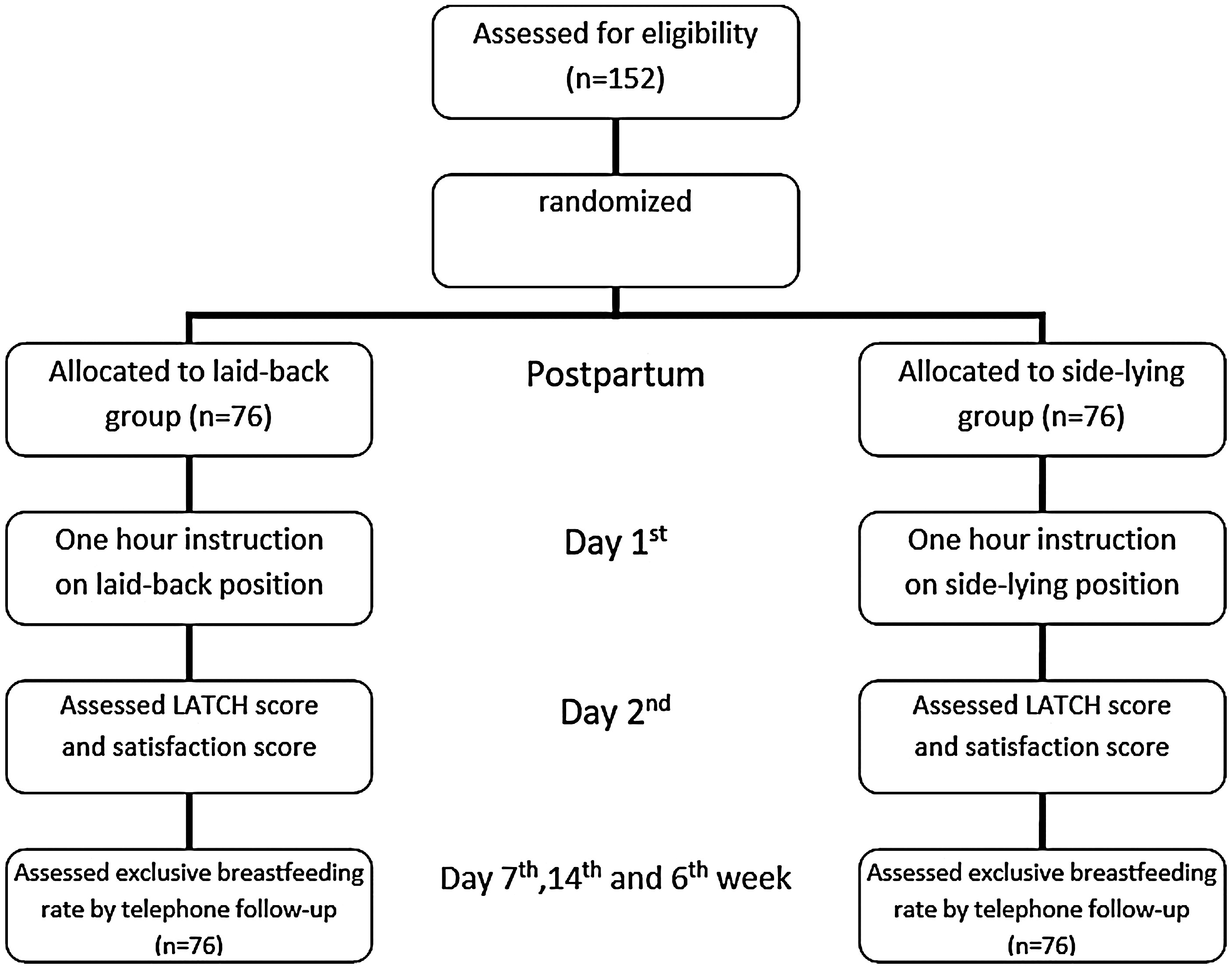
The flow diagram of participants through the study.
baht, currency of Thailand.
The satisfaction scores of the side-lying group were greater than the scores of laid-back group in comfort, ease of positioning, and use of the position for an extended period of time. There were statistically significant differences in the satisfaction scores between the two groups. The details of the breastfeeding position satisfaction levels are shown in Table 3.
Statistically significant p < 0.05.
The exclusive breastfeeding rates of the laid-back group had shown no significant differences from the side-lying group at the 7th day, 14th day, and 6th week postpartum periods. The details of the exclusive breastfeeding rates are shown in Table 4 and Figure 2.
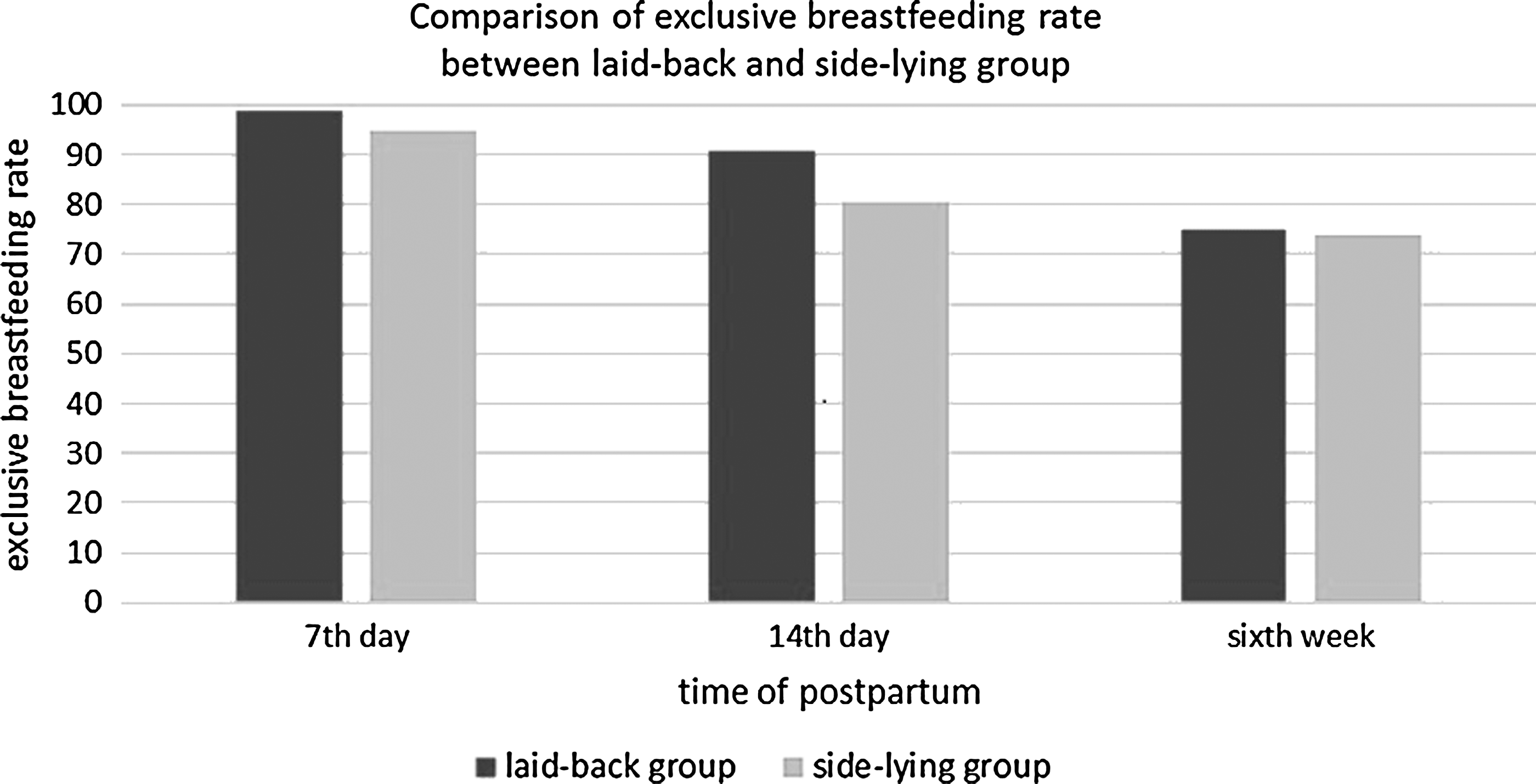
Comparison of the exclusive breastfeeding rates between laid-back and side-lying groups.
Discussion
The demographic data of both groups were similar from that in the randomization. These factors include the following: mother's age, occupation, income, gestational age, body mass index, nipple length, and birth weight that can affect on breastfeeding outcomes.9–16 There were no statistically significant differences of the pain scores between the two groups at the first and second days postpartum. We have collected pain scores in this study as the postoperative pain affects the initiation of breastfeeding. 17 If the mother has severe pain, the breastfeeding positioning is difficult and the breastfeeding initiation starts later. The time to start breastfeeding has effects on latching and breastfeeding rates. 16
The LATCH scores for both groups, second day postpartum, had shown no significant differences. The LATCH scores could have helped us determine appropriate positioning. 10 It has shown that latching in the laid-back and side-lying groups has no significant differences. Furthermore, the LATCH scores could have helped to predict breastfeeding rates at 6 weeks postpartum.18,19
The satisfaction scores in the side-lying group were greater than the scores in the laid-back group. For the satisfaction of comfort, we have hypothesized that the side-lying position likely made the mothers more comfortable and relaxed compared to the laid-back position. The mothers using the side-lying position felt more rested during breastfeeding. Regarding satisfaction for ease of positioning, the mothers preferred the side-lying over the laid-back position. As for the satisfaction for breastfeeding for a long duration, the mothers using the side-lying position often slept during breastfeeding. The mothers have shown greater satisfaction with the side-lying position when breastfeeding for long durations. Of note, although there was a statistically significant difference in satisfaction between the mothers using the two different positions, clinical significance is dependent upon the magnitude of the effect size. In view of the large overlap in the range of satisfaction scores between the two groups, the difference between them may be of little practical clinical significance.
The exclusive breastfeeding rates in the laid-back and side-lying groups have shown no significant differences at the 7th day, 14th day, and 6th week postpartum periods. It has shown that the different breastfeeding positions had no effects on the exclusive breastfeeding rates if the mothers had appropriate latching and breastfeeding positioning. Therefore, the laid-back position or any breastfeeding position that did not interfere cesarean wound pain, including football position, might be an alternative breastfeeding position that can be used beyond the side-lying position as a routine breastfeeding position in cesarean mothers. We suggested that health professionals should teach cesarean mothers more than two breastfeeding positions; let the mothers choose which position they prefer first and try another one. This might increase mothers' satisfaction because one position might be better for one group of mothers and another position might be better for a different group.
The strength of this study is that it is a randomized controlled trial. The breastfeeding outcome assessors were blinded. The definition of exclusive breastfeeding was clarified and recorded daily. It decreased recall bias. However, the continuity of using only the laid-back or side-lying position following discharge had some limitations as a previous study has shown that the mothers would have improved exclusive breastfeeding rates if they could practice two or more breastfeeding positions before discharge. 20
Conclusions
The mothers using the laid-back and side-lying breastfeeding positions had no significant differences of latching and exclusive breastfeeding rates during the 6-week postpartum period. However, there was greater satisfaction with comfort, ease of positioning, and breastfeeding for long periods in the side-lying group compared to the laid-back group.
Footnotes
Acknowledgments
Thanks to the HRH Princess Maha Chakri Sririndhorn Medical Center and the Faculty of Medicine, Srinakharinwirot University, for supporting our research.
Disclosure Statement
No competing financial interests exist.