




Abstract
Abstract
Objective:
To explore Chinese adults’ perceptions and attitudes toward breastfeeding in public places.
Materials and Methods:
This was a web-based survey including 10 items on breastfeeding participants (N = 2,021) who were recruited by convenience sampling.
Results:
Almost 95% believed that public places should have lactation rooms, 86% thought it was acceptable for mothers to breastfeed in this location, and 65% of respondents agreed that it was acceptable for mothers to breastfeed in public. Though 47% believed that viewing women breastfeeding in public was embarrassing, more than 80% felt that breastfeeding in public was appropriate and decent and did not violate social morality. More than 90% of respondents approved of policies supporting breastfeeding in public. Women, married people, those who had children, had some knowledge about breastfeeding, or had the experience of viewing women breastfeeding in public were more likely to hold positive perceptions and attitudes toward breastfeeding in public places.
Conclusions:
Prior experience and knowledge about breastfeeding have a great influence on people's perceptions and attitudes toward breastfeeding in public, so education about breastfeeding is very important. Breastfeeding education should not only include the techniques of breastfeeding practices but also include information policies that support breastfeeding in public, including the importance of lactation rooms.
Introduction
B
There are many postulated factors leading to a low exclusive breastfeeding rate: lack of social and familial support, breastfeeding-related physical problems, and the need to return to work. In addition, discomfort with breastfeeding in public places plays an important role in shaping infant feeding choice and the decision to stop breastfeeding.6,7 Attitudes and perceptions of society members toward breastfeeding in public places influence women's feelings and decisions. A preliminary interview of 27 women's experience of breastfeeding in public places found that the public attitudes toward breastfeeding in public had a negative influence on their breastfeeding duration. Mothers who had negative attitudes toward breastfeeding in public were less likely to breastfeed in public. 8 Other reports have noted that many people are embarrassed or even offended when facing the sight of a woman breastfeeding in public without lactation privacy 9 or even take some actions to stop women breastfeeding in public. 10
Understanding adults’ perceptions and attitudes is helpful for taking better measures to promote breastfeeding. However, few studies focused on Chinese adults’ attitudes toward breastfeeding in public places. Therefore, this study aims at exploring Chinese adults’ perceptions and attitudes toward breastfeeding in public and based on these results provide recommendations promoting changes in public attitudes.
Materials and Methods
Participants
Participants were recruited (N = 2,021) from five distinct geographic regions of China (north, south, east, west, and central China) to complete a web-based survey. These regions selected represent all geographical areas of China. The inclusion criterion was being older than 18 years of age.
Demographic data and basic information
Information regarding gender, age, geographic area, marital status, number of children, education level, household income, knowledge of breastfeeding, and the experience of viewing others breastfeeding in public were included.
Survey of attitudes toward breastfeeding in public places
A web-based 10-item survey was designed for use in the study. Items were developed from the aims of the study and relevant literatures: six items focusing on attitudes toward breastfeeding in public places, two items about lactation rooms, and two items related to breastfeeding policies. For each item, respondents were asked to rate their agreement on a Likert scale of 1 point to 5 points: 1 = strongly agree, 2 = agree, 3 = neither agree nor disagree, 4 = disagree, and 5 = strongly disagree. The Cronbach's α of this questionnaire is 0.753. The items are listed as follows:
1. It is acceptable for women to breastfeed their babies in public places such as shopping centers, workplaces, restaurants and on public transportations. 2. It is embarrassing to view a mother breastfeeding in public places. 3. Mothers who breastfeed should do so in private places only. 4. I believe that women should have the right to breastfeed in public places. 5. I think that breastfeeding in public is inappropriate and indecent. 6. I think that breastfeeding in public is a violation of social morality. 7. It would be acceptable if a room or space were provided for women to breastfeed their babies in public places such as shopping centers, workplaces, restaurants and on public transportations. 8. Public places need to have a room where women could breastfeed and pump milk for their babies. 9. I believe that employers should provide a private room for breastfeeding mothers to pump breast milk at work. 10. There should be laws that protect a mother's right to pump breast milk while at work.
The survey was distributed through web-based social media applications, including WeChat, Tencent QQ, and Micro-Blog from March to June 2016. A brief statement about the purpose of the research and the researcher was included to introduce the survey. Participants were limited to completing the survey one time by using either a mobile phone or a computer. Participants had the ability to share the survey opportunity with others.
Data analysis
Data were analyzed by using SPSS software version 20.0 to obtain percentages of agreement by participants, with each item related to breastfeeding in public. Multiple logistic regression analysis was used to determine agreement related to sociodemographic characteristics.
Ethics principles
This study was approved by the Research Ethics Committee of the researchers’ University. Procedures were followed to maintain confidentiality, and participants’ names were not attached to the survey or included in any reports or publications. Participation was voluntary, and participants could withdraw from the study at any time.
Results
The sociodemographic characteristics of participants
The number of respondents who viewed the survey was 4,210, with 49% completing it. The final number of participants was 2,021, and 42 respondents were excluded since they were younger than 18 years of age. Table 1 describes the participants.
Controversy about the acceptance of women breastfeeding in public places was evident from the percentage of agreement, with items 1, 3, and 4 with a parallel high agreement that it is embarrassing to view breastfeeding in public. However, more than 80% respondents did not agree that breastfeeding in public was inappropriate or indecent or violating social morality.
Items having >90% agreement (items 8–10) were those related to women's employment when breastfeeding and the need for designated locations in public places for breastfeeding and/or pumping. Item 7 also focused on a lactation room, with >80% agreement. Figure 1 showed the percentage of agreement with each item about breastfeeding in public.
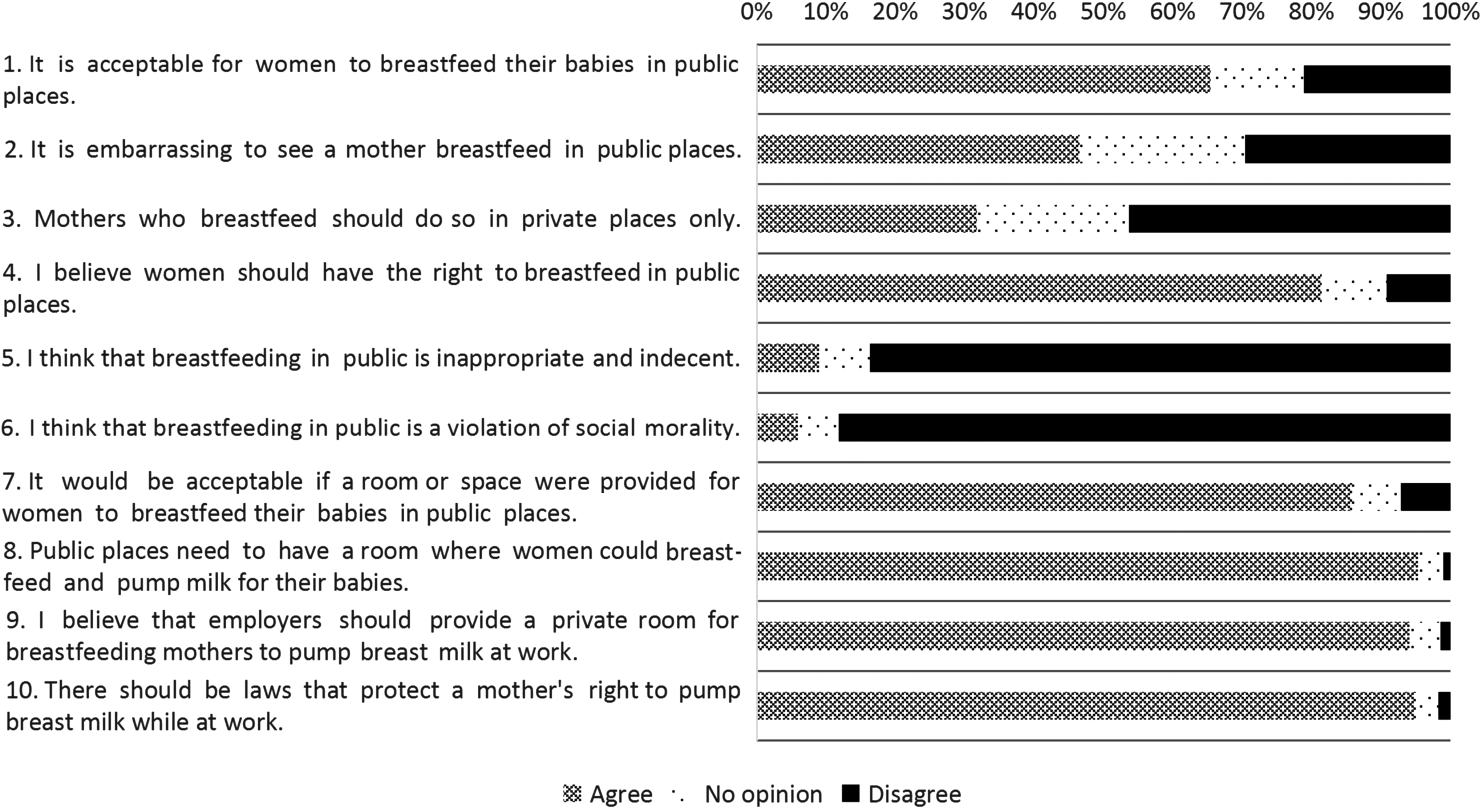
Percentage of agreement with each item about breastfeeding in public.
As shown in Tables 2 and 3, women, married people, those having children, having knowledge about breastfeeding, and having experience of viewing women breastfeeding in public had higher levels of agreement in support of breastfeeding in public places. Men, unmarried people, those having no children, lack of knowledge about breastfeeding, and having no experience of viewing women breastfeeding in public had lower levels of agreement in support of breastfeeding in public places.
p < 0.05, **p ≤ 0.01, ***p ≤ 0.001.
Is reference level.
Indicates that the 95% confidence interval does not include 1.
Discussion
In the current survey, 65% of respondents thought that it was acceptable for mothers to breastfeed in public places and 81% considered that women had the right to breastfeed in public places. In 2012, during International Breastfeeding Week, the Big Latch On was introduced in several large Chinese cities and continues. The program focused on promoting breastfeeding, including breastfeeding in public. 11 This study is the first survey of the public's perceptions of breastfeeding in public places since the introduction of the Latch program.
A survey conducted in Australia showed that 70% of the respondents accepted women breastfeeding in public places. 12 In the United States, from 1999 to 2015, the percentage of people who felt that women had the right to breastfeed in public increased from 37% to 64%. 13 This indicates a significant change in societal attitudes toward the acceptance of breastfeeding in public places.
In this study, 47% of the participants agreed with the statement that they felt embarrassed when viewing breastfeeding women in public areas without lactation privacy (i.e., not in lactation rooms). Previous studies in other countries reported similar results. Approximately 50% of adults agreed that they were embarrassed and uncomfortable when mothers breastfed their babies near them in a public place, such as a shopping center, a bus station, etc.12,14–16 Fifty percent of mothers who breastfed their infants in public report negative experiences such as being asked to leave a cafe, a shop, or a restaurant or just treated in an unfriendly way.10,17 In a phone interview in Australia, 58 out of 68 women made negative comments when breastfeeding in public places without lactation privacy, with results of becoming embarrassed, shy and shamed, scared, and even hated. 18 This may explain the fact that Chinese mothers choose artificial feeding when outside their home or to cease breastfeeding prematurely, resulting in low rates of exclusive breastfeeding or a short duration of breastfeeding.
In this survey, 32% of participants thought that women should breastfeed in private places and a small percentage of respondents felt that breastfeeding was inappropriate or indecent. In Chinese culture, women's breasts are considered sexual organs, and, thus, breastfeeding should be hidden from public view. Other countries share this cultural belief. A previous survey reported that more than one third of Americans thought that breastfeeding should be in private places. 15 Another recent study conducted in New York showed that 50.4% of respondents were not supportive of breastfeeding in public. 16 Similarly, a survey among nursing undergraduate students found that 41.3% of students objected to breastfeeding in public. 19 Previous research has shown that most people accepted breastfeeding in public on the condition that women did it in a discreet manner. Spurles and Babineau 9 noted that more than two thirds of students thought that breastfeeding should be done in either a bathroom or a private place.
Participants who are women, married, having previous children, having some knowledge about breastfeeding, and having experiences of women's breastfeeding in surroundings were more likely to hold positive perceptions and attitudes toward breastfeeding in public places. Prior experience and knowledge about breastfeeding exerted a great influence on people's perceptions and attitudes toward breastfeeding in public. To improve the exclusive breastfeeding rate and prolong breastfeeding duration, public education about breastfeeding is necessary and should include information about breastfeeding techniques, as well as knowledge of sexual and psychological understanding of breasts in the Chinese cultural context.
Of particular interest was the fact that most men accepted the fact of breastfeeding in public places, whereas the majority of women thought that breastfeeding in public places was embarrassing and that breastfeeding should be in private places. In China, in 2015, a highly publicized and widely discussed incident 20 about women breastfeeding in the Beijing subway resulted in many women not daring to continue this practice, because there were some people who quoted that breastfeeding was comparable with exposing sexual organs. Female participants stated that they were afraid of being viewed as uncivilized, because traditional Chinese Confucianism thought expressed that in public settings women should be well dressed, presumably not facilitating breastfeeding.
Even though many people disagree with breastfeeding in public places, most of them (90%) thought that the government should take some measures to support policies and facilities that make breastfeeding in public easier, such as lactation rooms and laws for women's rights. Findings in this study showed higher expectations of policies supporting breastfeeding in public places. The inconvenience of workplace breastfeeding, including the long distance, limited “recess” time, and the lack of facilities, was a major factor for women to give up breastfeeding when going back to work. 17 Efforts throughout the workplace would be required to make breastfeeding commonly accepted. 21 Many studies showed that 10–30% of women quit breastfeeding when returning to work or did not choose to initiate breastfeeding, because they were employed.22–24 As women are important in the labor force, and employees should note that breastfeeding mothers wish to continue breastfeeding after returning to work, this issue should be a major concern.
Ninety-five percent of respondents in our study believed that there should be lactation rooms in public places, and 86% thought that it was acceptable for mothers to breastfeed in lactation rooms. In 2009, UNICEF and the Chinese government launched the “10 Square Meters of Love” campaign to establish more breastfeeding rooms in workplaces and public buildings in China. 25 In 2016, the Chinese government changed the one-child policy, resulting in an increased number of births and increasing the need for enhanced maternal-child services and support. According to a guideline released by the National Health and Family Planning Commission, all major public places in China, such as transportation hubs, large shopping malls, and hospitals, should be equipped with mother-child facilities to be used for breastfeeding or diaper changing by the end of 2020. And also, some provinces such as Guangdong, south of China, have launched a program to build more breastfeeding rooms. 26 Embarrassment and inconvenience of breastfeeding in public places without lactation privacy may lead to the ceasing of breastfeeding. Clearly, if a private place were provided, women would be more likely to breastfeed in public. 12 Surveys done in other countries support this assumption.
This was a web-based survey that was accessed by using a social media application on a mobile phone or computer. Thus, there might be a sampling bias since the use of mobile phones and computers is more common among young Chinese people. It probably explains the fact that 82% of respondents were between 18 and 29 years of age, and only 5% were older than age 40. Random sampling was not used in this survey and respondents were recruited from different geographic areas of China, which may have lead to geographic bias. Replication of this study should be based on random sampling of Chinese of different cultures and geographic designations, such as rural versus urban lifespan.
Conclusions
Prior experience and knowledge about breastfeeding have a great influence on people's perceptions and attitudes toward breastfeeding in public places, therefore public education about breastfeeding is very important. Breastfeeding education should not only include breastfeeding knowledge and practices but also include information about the cultural context, including sexual and psychological understanding of breasts. The inconvenience of breastfeeding in public places is a major factor influencing women's decisions to breastfeed as well as the duration of breastfeeding. It is recommended that the Chinese government promote more favorable policies and provide more lactation rooms to support breastfeeding in public places.
Footnotes
Acknowledgments
The authors thank all participants in this study. This study could not have been possible without their assistance.
Authors’ Contributions
Y.Z.: Research design, data collection and data analysis, and article writing; Y.-Q.O.: Project development, data analysis, and article revision; and S.R.R.: article revision and review.
Disclosure Statement
This research did not receive any specific grant from funding agencies in the public, commercial, or not-for-profit sectors. No competing financial interests exist.