




Abstract
Abstract
Background:
Body position affects the gastric emptying rate and hence the amount of gastric residue.
Objective:
This study aims to analyze the effect of the post-feeding position of preterm infants on gastric residue.
Materials and Methods:
This experimental study was conducted in the neonatal intensive care unit (NICU) of a university hospital (İnönü University Turgut Özal Medical Center) in Eastern Turkey. The study included 40 preterm infants weighing less than 2,000 g, who were fed orogastrically. The preterm infants were sequentially placed in four positions and were fed before each change of position. The infants were sequentially placed in the right lateral, left lateral, supine, and prone positions; their gastric residues were measured with a nasogastric tube. The gastric residue was recorded in percentages at 30, 60, 120, and 180 minutes. Ethical principles were applied in all phases of the study.
Results:
The lowest mean gastric residue level was observed in the right lateral position at 30 minutes (58.16 ± 12.71%) and 60 minutes (33.97 ± 15.00%). The prone position showed the lowest mean gastric residue level (1.74 ± 1.08%), followed by the right lateral (3.06 ± 1.97%), supine (3.53 ± 2.18%), and left lateral position (5.14 ± 1.85%) at 120 minutes. The final measurements were taken at 180 minutes with the right lateral position showing the lowest mean gastric residue level (0.38 ± 0.34%).
Conclusion:
The premature infants had similar lower levels of gastric residue in the right lateral and prone positions and higher levels of gastric residue in left lateral and supine positions. The gastric emptying rate was found to be highest in the right lateral position at 30, 60, and 180 minutes and in the prone position at 120 minutes.
Introduction
O
Another important nursing care practice used for premature infants in neonatal intensive care units is feeding them in the most appropriate way. Gastric residue is an important factor: it affects a premature infant's feeding. It is used as a significant source of data by the nurses responsible for an infant's well-being to decide whether to continue, increase, or end nutrition.8,10 Whereas studies have focused on position and reflux, gastric emptying is quite important for the infant's tolerance for feeding, and only a limited number of studies have been published on this subject. Gastric residue, frequently observed in premature infants, is the most important indicator of abdominal distension and that an infant is have difficulty tolerating enteral feeding; consequently, gastric residue is closely tracked by nurses. 11
Beginning enteral feeding in premature infants is important for the improvement of the immature gastrointestinal system. Beginning enteral feeding at an early stage enables premature infants to tolerate feeding better and ensures that they experience fewer possible complications of parenteral feeding. Conversely, inability of premature infants to tolerate feeding increases mortality and morbidity for different positions. 12
The most important factor affecting nutrition in premature infants is gastric emptying.11,12 Some studies have shown that body position affects the gastric emptying rate and hence the amount of gastric residue.7,8,13,14 Cohen 13 studied the effect at the end of the first hour of four different positions on infants after feeding and found no difference between the gastric residue in infants placed in prone and supine positions. On the other hand, he found a significantly lower level of gastric residue in the infants placed in the left lateral and right lateral positions. Chen 8 analyzed two different positions after feeding (prone and supine) and reported that the prone position was more effective for gastric emptying.
Most of the studies on this subject have shown contradictory results: one study reported that the supine and left lateral positions were not helpful for gastric emptying and recommended that nurses use these positions less often. 12 Some studies showed no difference between breast milk and formula in terms of gastric emptying.15,16 Clearly, the different methods used in previous studies have led to different results.11,12,14 Four different positions are used with preterm infants in neonatal intensive care units; however, there is no clear information on which position is more effective for reducing gastric residue after feeding or at which nutritional stage this position should be used. The present study aims to analyze the effect of position on gastric emptying in premature infants.
Background
Only a limited number of studies have been published that examine the effect of post-feeding body position on gastric residue in premature infants. The first study on this subject was conducted by Yu. 5 In that experimental study, the researcher examined the effect of post-feeding position in four groups (term, preterm, Respiratory Distress Syndrome [RDS] infant, and small-for-age); each group included 12 infants. The results of the study showed that there were no differences between the groups, but it was found that gastric emptying occurred faster with infants in the right lateral and prone positions. 5 Another study, conducted by Malhotra 17 , compared the post-feeding effect of prone and supine positions on gastric residue in infants fed with breast milk and formula. An experimental research design was used in the Malhotra study; it included three groups (newborn [n = 50], size appropriate-for-age [n = 38] and small-for-age [n = 12]). The results of that study showed that the prone position is better than supine position with respect to amount of gastric residue, but there was no difference between feeding breast milk or formula. A study conducted by Sangers 12 examined 147 preterm infants with a gestational age of 28–36 weeks.
The amount of gastric residue for premature infants was monitored during 24 hours in four different positions (right lateral, left lateral, supine, and prone). The residue measurement was performed twice in each position. The lowest residue level was measured in the right lateral and prone positions. A study conducted by Chen et al. 8 examined the post-feeding effect of prone and supine positions with 35 premature infants using a randomized controlled experimental study design. In that study, infants were monitored for three hours, and their gastric residue levels were measured five times (at 30, 60, 90, 120, and 150 minutes). The amount of residue found in prone position was significantly lower than in the supine position. Another randomized controlled experimental study was conducted by Cohen 13 with 31 infants. The gastric residue levels of these infants were measured in four different positions (right lateral, left lateral, supine, and prone) at the first and third hour after feeding, and their gastric emptying rates were examined. The highest gastric emptying rate occurred in the right lateral position, followed by the prone, supine, and left lateral positions in that order.
Materials and Methods
Design
A semi-experimental study design was utilized in this study.
Study sample
This experimental study was conducted in the neonatal intensive care unit of İnönü University Turgut Özal Medical Center in Eastern Turkey. The neonatal intensive care unit was a primary level intensive care unit with 20 beds. A total of 20 nurses work shifts in the clinic. A nurse provides care for three patients during each shift. The study included 40 preterm infants who met the following inclusion criteria: a weight of 2,000 g, being fed orogastrically, being breastfed at 3-hour intervals, being clinically stable, and not having any metabolic problem. The infants were breastfed only and given a minimum 50% of their total daily intake through an oral route; the other 50% was given by parenteral nutrition/glucose solution. The exclusion criteria were: being on mechanic ventilation; needing oxygen to treat bronchopulmonary problems or other indications; having a nutritional problem resulting from necrotizing enterocolitis; not being breastfed only; and any defect that posed a risk to positioning, such as a neural tube defect.
Study procedure
The infants admitted to the clinic were given intravenous glucose solution on the first day of life; they were then provided with parenteral feeding. Parenteral feeding was reduced (depending on their caloric needs) as the infants' daily intake increased. Oral intake by the premature infant depended on the infant's digestion. Feeding was not increased when the infant's gastric residue was above 50%, the infants have abdominal distension, or if green or brown vomit was observed. The oral nutrition food amount can be cut off and delayed depending on the baby's digestion. Daily oral intake in infants without any problem was increased to 10 to 20 mL/kg/day. The infants who started to take half of their daily required feeding through the oral route and who met the other inclusion criteria were included in the study. In the routine practice of the clinic, the nurses fed the infants through an orogastric or nasogastric tube at the start of feeding. Breast milk was obtained from the mothers of premature infants using an electric pump in the clinic, and their breast milk was usually given to the infants on the same day. Breast milk was refrigerated (between −4 and 0°C or −20 and −18°C) when required, for instance, if mothers did not come to the clinic or breast milk produced was more than the infant could consume.
The parents of the preterm infants included in the study were interviewed and their informed consent was received. The preterm infants were sequentially placed in four positions and were fed before each change of position. The infants were first placed in the right lateral position, followed by left lateral, supine, and prone positions, and stayed in each position for three hours. The gastric residue levels were measured at 30, 60, 120, and 180 minutes after each feeding. The amount of breast milk given to the infants, which ranged between 20 and 42 mL, was recorded at each time point. The gastric residue was calculated by comparing the amount given to the infant versus the amount consumed (gastric residue level = amount consumed at the hour of measurement×100/nutrition given + previous gastric residue). 8 Measurement was measured with nasogastric tube. The gastric residue was recorded in percentage. The infants' vital signs during the process were monitored. During the procedure, the process would be ended if any problem occurred. No problems were observed in the infants, and the processes were completed as planned. The entire process was recorded by a researcher and the primary nurse caring for the infant.
Assessment of data
Assessment of data obtained as the result of the study was conducted using the SPSS (Statistical Package for Social Sciences) 18.0 package program. Mean and standard deviation and one-way ANOVA were used to analyze the data. The results were evaluated at the confidence interval of 95% and at the significance level of p < 0.05.
Ethical considerations
Ethical approval of the ethics committee of the university (Number and date: 2015/23), the permission of the clinic, and the informed consent of the premature infants' parents were obtained.
Results
Participants' characteristics
This study aimed to analyze the effect of the post-feeding position of 40 preterm infants on gastric residue. Of the preterm infants, 57.5% were male and 42.5% were female. The mean gestational age of the preterm infants was 30.42 ± 3.62 weeks and ranged from 28 to 35 weeks. The mean birth weight of the infants was 1,231.25 ± 452.3 g; their mean weight was 1,420.56 ± 283.47 g when they entered the study (Table 1).
M ± SD, mean ± standard deviation.
The effects of the preterm infants' position on gastric residue
Four measurements were made at 30, 60, 120 and 180 minutes during each position in which the preterm infants were placed while they were fed to find the position at which the gastric emptying rate was better. The gastric residue level was determined by calculating the proportion of the breast milk given to the infants to the amount of milk remaining in the stomach at the hour of measurement (gastric residue percentage = the amount taken at the hour of measurement×100/(nutrition provided+prior gastric residue). The amount of gastric residue was analyzed for each position at specific time intervals.
The first measurement was taken 30 minutes post-feeding. A statistically significant difference was found between the positions at 30 minutes; Tukey analysis was used to determine which positions caused the difference. The lowest mean gastric residue level was observed in the right lateral position at 30 minutes; the level was almost half of the infants' feeding (58.16 ± 12.71%). No significant difference in residue levels was found between the right lateral and prone positions (p = 0.120); however, a significant difference was found between residue levels in the left lateral (p = 0.000) and supine (p = 0.000) positions. The second lowest mean gastric residue level at 30 minutes was 67.77 ± 10.48% in the prone position, which was similar to that in the right lateral position (p = 0.120). However, the left lateral (p = 0.039) and supine lateral (p = 0.015) positions showed significant differences in residue levels. Althoughh the left lateral (79.46 ± 11.04%) position showed the third lowest mean gastric residue level, and the supine (81.02 ± 10.55%) position showed the highest mean gastric residue level, these mean gastric residue levels were similar; no significant difference was found between the left lateral and supine positions (p = 0.983). The highest gastric emptying rate was found to occur in the first 30 minutes in the right lateral position, followed by the prone, left lateral, and supine positions, respectively.
The post-feeding second measurement was taken at the end of the first hour (at 60 minutes). A statistically significant difference was found between the positions in terms of gastric residue. The lowest mean gastric residue level was found at the right lateral position (33.97 ± 15.00%). The second lowest mean gastric residue level was found at the supine position (36.37 ± 12.94%), which was not significantly different from the right lateral position (p = 0.962). The right lateral position was significantly different from the left lateral and supine positions. In addition, right lateral position was significantly different from the left lateral and prone positions. The second lowest mean gastric residue was observed at the prone position (36.37 ± 12.94%), followed by the left lateral position (58.09 ± 12.91%) and supine position (65.89 ± 11.10%). The order of the positions at 60 minutes was close to the order at 30 minutes.
The gastric residue of the preterm infants was reanalyzed at 120 minutes after feeding. The prone position showed the lowest mean gastric residue level (1.74 ± 1.08%), followed by the right lateral (3.06 ± 1.97%), supine (3.53 ± 2.18%), and left lateral position (5.14 ± 1.85%). The gastric residue level in the right lateral position was not significantly different from levels found in the supine (p = 0.906) and prone (p = 0.227) positions. However, significant differences in the gastric residue level were found between the right lateral and left lateral positions (p = 0.020) and between the left lateral and prone positions (p = 0.000). The order of the gastric emptying rate changed at 120 minutes: the prone position was the most effective for gastric emptying, followed by the right lateral, supine, and left lateral positions, respectively.
The final measurements were taken at 180 minutes after feeding. The right lateral position showed the lowest mean gastric residue level (0.38 ± 0.34%), followed by the prone (0.41 ± 0.38%), supine (1.13 ± 0.90%), and left lateral positions (1.41 ± 1.22%), respectively. The right lateral position was not found to be significantly different from the supine and prone positions in terms of gastric residue. However, significant differences were found between the right lateral and left lateral positions (p = 0.006) and between the left lateral and prone positions (p = 0.008) (Table 2 and Fig. 1).
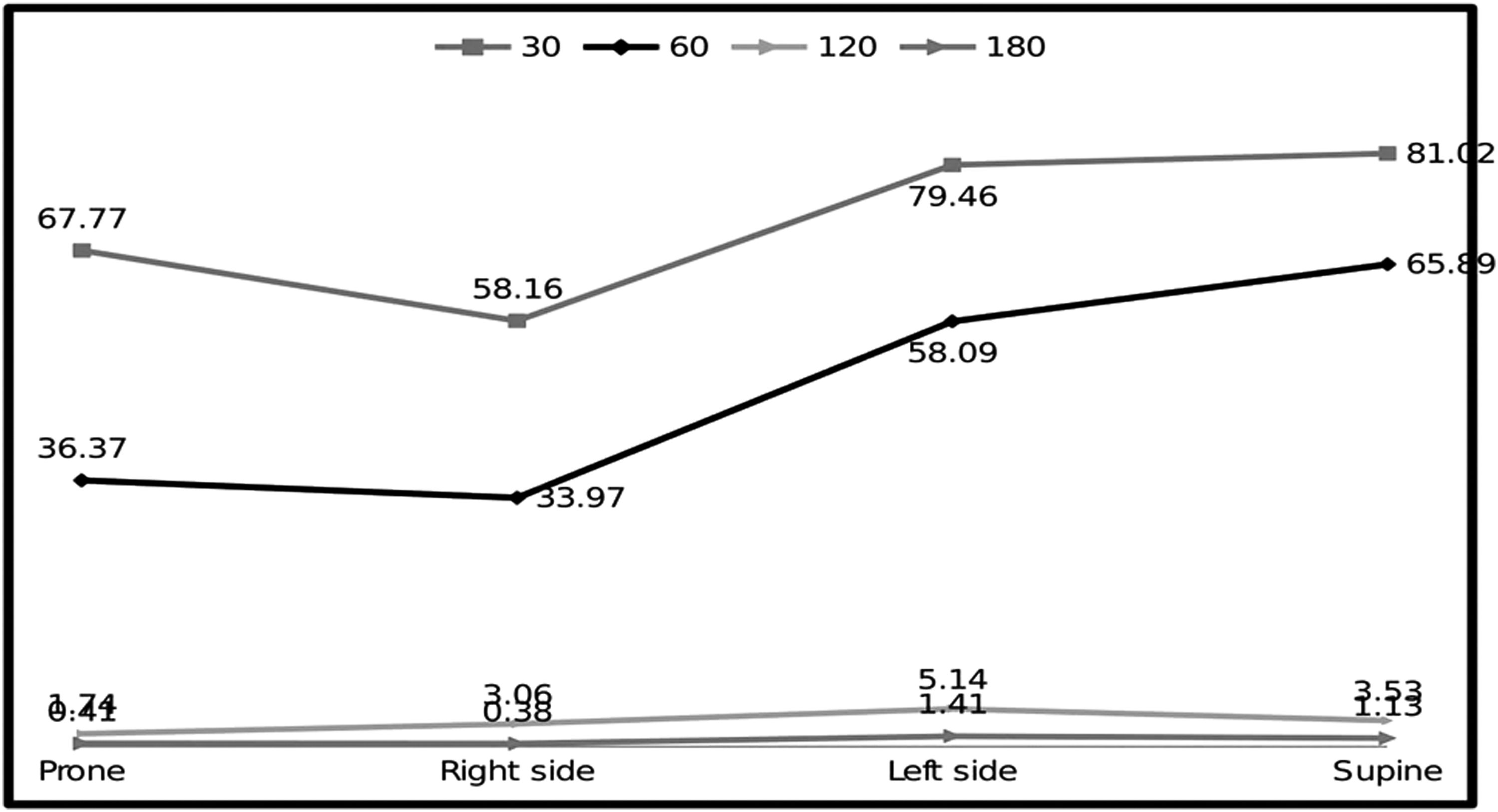
Gastric residues as a percent of feeding volume in preterm infants in four feeding positions.
Mean value was given as percentage.
M ± SD, mean ± standard deviation.
Discussion
This study analyzed the effect of the preterm infants' post-feeding position on gastric residue. Although the literature contains insufficient data on this subject, previous studies have partially analyzed the positional differences. In this study, four measurements were taken at four positions to analyze the effect of positioning on gastric residue.
The most effective position was the right lateral position at 30 and 60 minutes: this position produced the highest gastric emptying rate. Measurements in the prone position were close to those in the right lateral position at both times. The advanced analysis showed no significant difference in gastric emptying between the right lateral position and the prone position. Results in the left lateral position and supine position were similar to each other, both indicating slower gastric emptying. Higher gastric emptying was observed in the first 30 minutes. The above-mentioned results were also observed at the end of the first hour after feeding. The right lateral and prone positions showed faster gastric emptying after feeding compared to the supine and left lateral positions. Cohen et al. 13 analyzed the gastric residue levels of preterm infants at the end of the first and third hours in these four positions. These researchers also found that right lateral position yielded the lowest level of gastric residue and that the volume of gastric residue was significantly different from the left lateral position. They also reported that results in the prone position were similar to those in the right lateral position and that gastric emptying in the prone position was significantly different from that in the left lateral position. In their study, the supine position yielded similar results to left lateral position at the end of the first hour. The first-hour results of the Cohen et al. study 13 were close to the first-hour results of the present study, indicating that the highest gastric emptying occurred in right lateral and prone positions. Another important point here is that the slowest gastric emptying in the first hour occurred in supine position in the present study.
Chen et al. 8 analyzed the gastric emptying rate by measuring the gastric residue in supine and prone positions at 30-minute intervals after feeding was provided in two separate volumes (50 and 100 mL/kg/day). They reported that the gastric emptying rate was higher in the prone position at 30 and 60 minutes, similar to the results of the present study. The other studies also indicated that gastric emptying rate in the right lateral position was not lower than that of the other positions and that the infants seemed more comfortable in this position after being fed.5,13,18,19 The most important finding in this study is that the prone and right lateral positions and the supine and left lateral positions showed similar amounts of gastric residue.
In the present study, the gastric residue levels measured at the second and third hours were similar in the right lateral, prone, and supine positions. Significant differences were found between the left lateral and right lateral positions and between the prone and supine positions. Chen et al. 8 found that gastric residuals were significantly lower in the prone than in the supine position at the five measurement points; measurements were taken at 30, 60, 90, 120 and 150 min. In the present study, however, the advanced analysis showed no significant difference in gastric residue between the supine and prone positions at the second and third hour. Although Cohen et al. 13 did not find a significant difference between the positions at the third hour, the present study revealed significant differences between the positions both at the second and the third hour. Another study on preterm infants, conducted by Sangers et al. 12 , found that, like the results of our study, the lowest amount of residue was observed in the right lateral and prone positions.
Malhotra et al. 17 compared the gastric residue of formula and breast milk feedings in the prone and supine position. The authors reported that the prone position yielded better results than did the supine position; however, they found no difference between the gastric residue of formula and breast milk. 17 Some studies that analyzed the effect of infants fed either breast milk or formula on gastric emptying found no difference between the groups and reported that breast milk or formula feedings did not affect gastric emptying.7,15–17,19 The present study included infants who were breastfed only. It is recommended that the effect of breast milk and formula feedings in the four positions also be analyzed.
Conclusion
This study analyzed the effect of the post-feeding position of preterm infants on gastric residue. The premature infants had lower gastric residue levels in the right lateral and prone positions. The left side and supine positions showed similar results, but the gastric residue level was higher at these positions. Based on these findings, it can be recommended that nurses place premature infants in the right lateral or supine positions for the first 30 minutes or one hour after feeding them. This study may be a guide to neonatal intensive care unit nurses with respect to appropriate positioning of preterm infants. But we recommend that studies be conducted in preterm groups that receive only breast milk or only formula and that the results be compared. Further studies should be conducted to better understand the effect of infant positioning on gastric residue.
Relevance to clinical practice
Nurses can preferably use right lateral and prone positions particularly in the first 30 minutes or one hour when positioning premature infants after feeding. The gastric residue amounts in infants placed in the right lateral and prone positions and in those placed in the left lateral and supine positions after feeding were similar in the present study. This finding suggests that the right lateral and prone positions and the left lateral and supine positions can be used as an alternative to each other when positioning infants after feeding in clinics. However, considering that the number of studies conducted on this subject is limited, it is recommended that the findings of the present study be supported with other studies conducted with larger samples.
Limitations of the Study
A limitation of the study was the inadequate number of infants who met the inclusion criteria. The study was conducted for a longer period than planned because the premature infants were generally admitted to the neonatal intensive care unit with an accompanying problem. Another limitation was the requirement that the infants be breastfed only. In the clinic's routine, infants are supported with formula when breast milk is insufficient, thus excluding these infants from meeting the study criteria.
Authors' Contributions
E.H.Y. conceived of the intervention and its design, was the principal investigator, and directed the writing process. E.H.Y. and S.K. provided the intervention and drafted the initial manuscript. E.H.Y. conducted data collection and analysis, carried out revisions of the manuscript and assisted with the intervention. E.H.Y., Y.S.D and N.K.B contributed to the intervention and interpretation of the work. All authors contributed to the writing process and approved the final manuscript.
Footnotes
Disclosure Statement
No competing financial interests exist.