




Abstract

P
We asked: Could we create a system designed for low-resource settings that empowers women and incentives quality care?
Open Development is a women-led social enterprise committed to improving global population health by reimagining health systems. Using a Seed grant from the Saving Lives at Birth Grand Challenge 2016, we along with our partners D-tree International, and Results for Development, and Liberian stakeholders codesigned and built a digital health solution, P@CCT, that helps governments and third parties engage private health facilities in providing maternal care to vulnerable women. Leveraging near-field communication (NFC) technology, e-decision support, and mobile money, our solution links prenegotiated payments to delivery of quality care. P@CCT is designed to empower women with more choice in where to seek maternal care, provide healthcare workers with e-decision support based on a country's own clinical guidelines, and tie prompt payment to the delivery of quality continuity of care. At the same time, it streamlines and automates the operational functions required to support a pooled purchasing scheme, such as coding care and submitting and adjudicating a claim.
How Does It Work?
Enrolled pregnant women receive an NFC token that is updated throughout her pregnancy, with a record of all her critical medical information. Using NFC technology means that women do not need a mobile phone to participate and information can be retrieved and updated without Internet or mobile connectivity.
When she presents herself to a participating provider, the midwife uses the P@CCT application on her smartphone to read the NFC token. E-decision support then guides the midwife through the visit based on the country's clinical guidelines, reminding the midwife of the right tests to order and drugs to provide, and flagging potential issues and life threatening conditions. At the end of the visit, the midwife again taps the NFC token to the phone to update the birth record.
The data collected during the visit sync to the server, triggering an automatic e-payment to the provider, populating a dashboard of key metrics, and applying algorithms to flag suspicious or potentially fraudulent or wasteful care. Providers receive prompt payment and payers, including governments, receive a rich set of data that can improve strategic decision-making, including identifying comorbidities.
After the woman gives birth and attends postnatal visits, she can return the NFC token and provide feedback on her experience (Fig. 1).
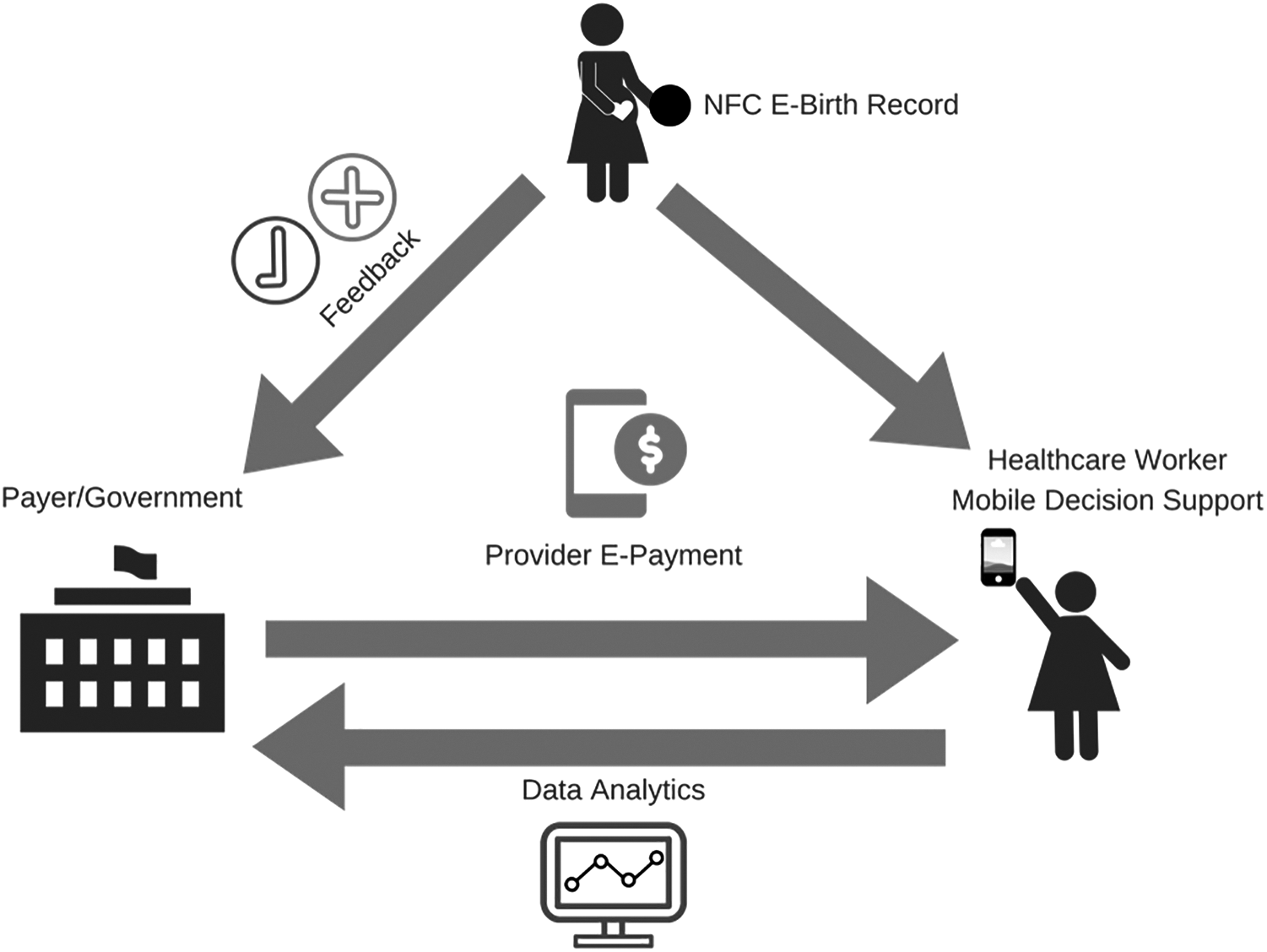
Follow the P@CCT approach as it enables the woman to select where to go, and the provider uses P@CCT to access e-decision support bolstering quality care and collecting utilization data as part of the visit. As soon as there is connectivity, the data sync to the government/payer system and trigger an automatic payment back to the provider. Direct feedback and women's choice foster better and more respectful care.
Our plan is to develop, build, and test the prototype in collaboration with Liberian stakeholders.
Footnotes
Disclosure Statement
Ilyse Stempler is COO of Open Development. Open Development is partners with D-Tree International and Results for Development to develop the approach and technology discussed in the article. This partnership is made possible through a grant from Saving Lives at Birth, a grand challenge launched by USAID, the Government of Norway, the Bill & Melinda Gates Foundation, Grand Challenges Canada, DFID, and KOICA to find the tools and approaches to help mothers and newborns during their most vulnerable hours. Open Development and its partners are also pursuing additional grant financing to expand the work.