




Abstract
Abstract
Introduction:
Mother's own milk has long been accepted as the best source of nutrition for the newborn. In those cases where mother's milk is not available, the best choice is the human milk provided by selected donors. Human milk banks are the most institutionalized method of milk sharing and play a vital role for neonates that cannot be breastfed. This study aims at systematically reviewing factors influencing donation to human milk banks.
Materials and Methods:
A systematic review of the literature was performed on authentic electronic resources, including PubMed, Scopus, Embase, ScienceDirect, and Web of Science with no time limitation. To increase the sensitivity and to find additional studies for systematic review, the reference list of the published studies was examined as well. Data extraction and quality appraisal were carried out by two independent reviewers. The study was qualitatively summarized to generate descriptive and explanatory themes that emerged from the literature.
Results:
From a total of 1,157 articles, 31 met the inclusion criteria in which 64 factors are extracted. From these, 26 factors act as barriers and 38 factors act as facilitators of milk donation. Having excess milk, altruism, and helping other babies are found to be the most important facilitators of milk donation, while the most important barriers are religious and cultural concerns.
Conclusion:
Developing practical strategies to attract milk donors are crucial for successfully establishing human milk banks. These include providing reliable information regarding the milk bank goals and functions and developing breastfeeding polices with regard to differences in countries' contexts and trying to resolve any uncertainties regarding milk donation, especially those arising for religious concerns.
Introduction
Mother's milk has long been accepted as the best source of nutrition for the newborn particularly during the first days of life. 1 The World Health Organization (WHO) recommends breastfeeding as the exclusive nutrition for infants until the age of 6 months. 2 The health benefits of breastfeeding for infants include promoting an improved host defense and gastrointestinal function, reduced acute respiratory infection and diarrhea deaths, improved cognitive and physical development, and reduced risk of infectious diseases in infancy.1,3–6 Although the health benefits of breastfeeding are widely acknowledged, not all neonates are able to breastfeed. Infants such as very preterm (before 37 completed weeks of gestation) and/or very low birth weight, as well as other sick newborns, are at greatest risk of not receiving their own mother's milk. Therefore, in case of insufficient or unavailable mother milk, the WHO and other international scientific societies in the field of Pediatrics recommend that the preferred choice before formula is the donor milk from a human milk bank.1,7 Human milk banks are nonprofit health institutions organized for the collection, processing, and distribution of donated human milk and supporting breastfeeding in preterm infants. 1 The practice of milk banking is well over 100 years old and older than blood banking. 8 In 1909 the first human milk bank was established in Vienna, 8 with the second to follow in the United States in Boston in 1919.7,9 Today, human milk banks have been established throughout the world. It is estimated that the number of human milk banks in Europe increased to 233 active human milk banks in 28 countries within Europe, with 14 more planned as of November 2018, 10 Asia 44, Australia 5, Africa 10, United States and Canada 26, South America 258, and Central America, including Caribbean islands 45, by 2015. 11
To develop and provide high performing human milk banks, it is important to identify the factors that inhibit or facilitate milk donations. Thus, the purpose of this article is to systematically review the factors that affect donations to human milk banks.
Methods
Study search and selection strategy
The systematic review of the literature was performed to identify factors influencing milk bank donations around the world. The search was conducted on five databases, including PubMed, Scopus, Embase, ScienceDirect, and Web of Science, on December 16, 2018. Search terms included: milk bank, human milk, mother's milk, breast milk, donate, milk sharing, breastfeed, and breastfeeding.
The systematic review was conducted using the Preferred Reporting Items for Systematic Reviews and Meta-analysis (PRISMA) guidelines. 12
Extracted articles were screened based on titles, abstracts, and full texts. Afterward, citation search and manual search were performed in Google Scholar. All these steps were conducted by two researchers (L.D. and M.N.). To find relevant studies, reference lists from the selected publications were also screened.
Inclusion and exclusion criteria
English language, peer reviewed published studies were included with no time limitation. Publications of any level of evidence, including abstracts, conference proceedings, commentaries, and editorial articles, and full text of original articles and systematic reviews were included in the review. Other studies that did not focus on the factors related to the donated milk, donors, and the reasons for donation were excluded.
Data extraction
A data-extraction sheet was developed in Microsoft Excel. Characteristics of the studies that were included are as follows: first author of the article, publication year, participants' country of origin, type of participants and their mean age, sample size, and study design.
Quality appraisal
Owing to the wide range of included studies, we used the Joanna Briggs Institute (JBI) checklists according to the type of included studies. Two researchers independently appraised the quality of included studies. All discrepancies were resolved through consultation with the third reviewer.
Data analysis
Facilitators and barriers to milk donation were extracted using content analysis and were divided into individual, systemic, and social factors. In analyzing content of publications we systematically compressed words of text into fewer categories based on explicit rules of coding. Categories were established following some preliminary examination of the data.
Results
From a total of 1,157 articles, after excluding duplicates, a total of 541 studies were screened. Fifty-six full-text articles were assessed for eligibility, of which 31 studies met the inclusion criteria. The flowchart of the selection process in the systematic review is shown in Figure 1. Generally, the included studies were of moderate-to-good quality based on the JBI quality assessment scale. The characteristics of the included articles are presented in Table 1. The articles were published between 2000 and 2018. The mean age of the participants ranged between 24.73 and 42 years. The sample sizes of participants varied from 7 to 1,042, with a total sample size of 6,057 people. The participants of the included studies were from 17 different countries or regions, including United States,13,14 Brazil,15–19 Australia,20–22 France,11,23,24 Kuwait, 25 South Africa, 26 Spain,27,28 Turkey,29–33 India, 34 and Ethiopia. 35 Most of studies used a cross-sectional and a qualitative design.
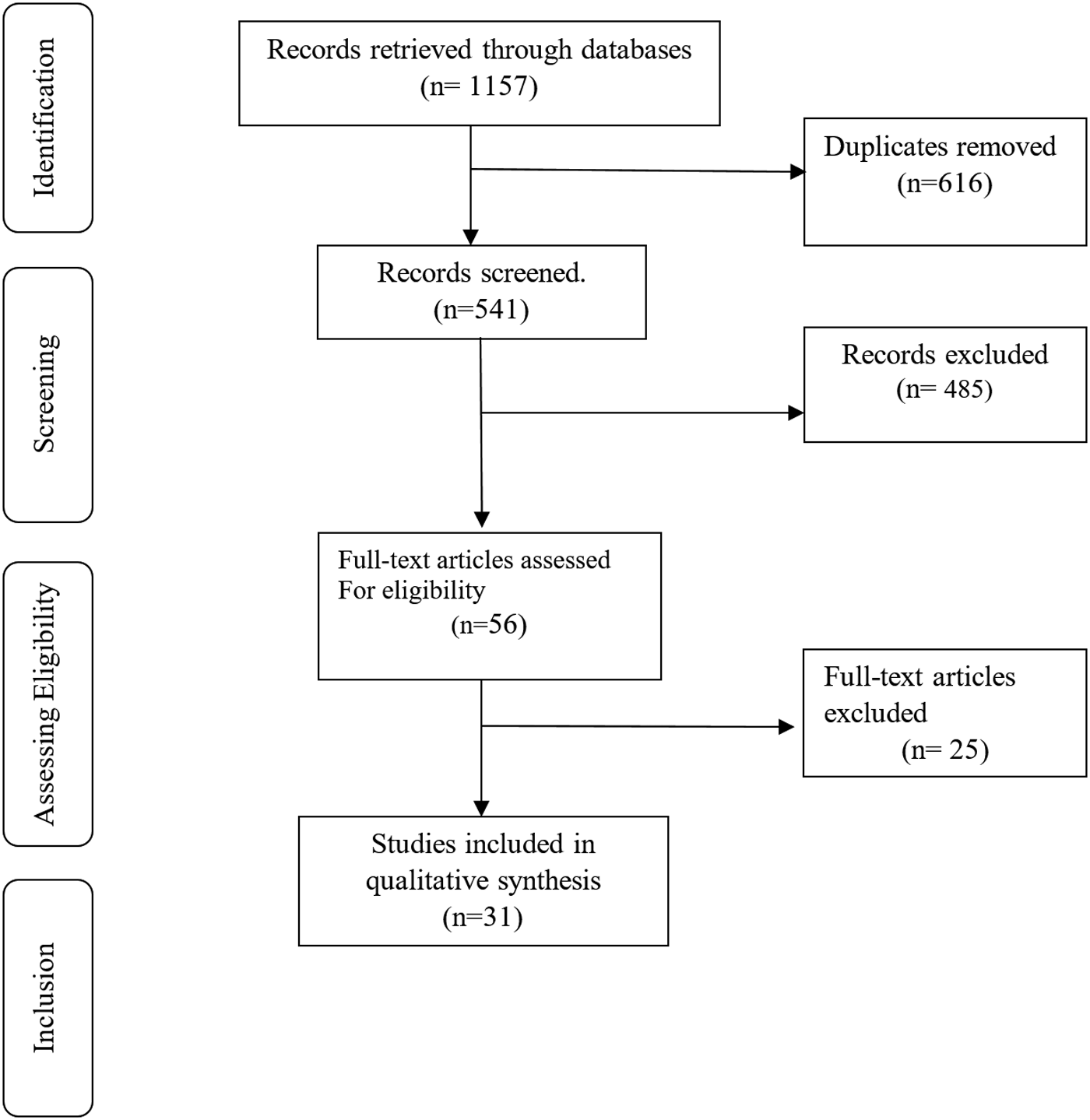
Article search and review flowchart of studies.
Descriptive Statistics of the Included Studies (n = 31)
HMBANA, Human Milk Banking Association of North America; NICU, neonatal intensive care unit.
In all these studies, the donors were highly educated, and the numbers of donors with one to three children were higher than those having more than three children.
With regard to the factors related to milk donation of the participants, based on the predefined criteria, 29 studies were reviewed and 128 factors were identified. Sixty-four factors remained after removing redundant ones: 26 barriers and 38 facilitators of donations to human milk banks (HMBs).
The reviewed facilitators and barriers to milk donation were divided into individual (donor), systemic (health system), and social factors. The list of facilitators and barriers is presented in Tables 2 and 3, respectively. Among individual facilitators, “having excess milk,”11,13,16,17,20–25,27,28,36,37 “hoping someone else will do the same for them if needed,”23,24,27 and “a strong belief in the value of human milk”13,27 were the most frequently cited. In systemic facilitators, “health staff and professionals”15,18,21,27,28,37 and “education”21,25,26,30,33,34 were, respectively, the most important factors. “Altruism”17,22–24,27,28,36,37 and “helping others”13,14,21–24,37 were among the major social facilitators of milk donation. “Religious beliefs”11,16,20,26,30–33 in Islamic countries and “lack of knowledge about milk banking”13,17,20,21,35 were significant social barriers.
Facilitators Influencing Milk Donation
Barriers to Milk Donation
Discussion
The majority of the studies included in this study were a qualitative study and involved both developed (i.e., United States, Spain, France, and Australia) 36 and developing countries (i.e., India, Kuwait, Turkey, South Africa, Ethiopia, and Brazil). 36
The main facilitators of milk donation were individual and social factors. Major barriers to milk donation were systemic and social, the most important of which was religious beliefs. The religious beliefs is an important challenge in Islamic countries, where it is believed that a woman's milk creates kinship and an impediment to marriage.11,33
In preterm infants, physiological functions and behavioral characteristics required to adapt to the environment outside the womb are not fully developed. Neonatal intensive care unit (NICU) provides an environment where the child can develop with minimal damage. 29 One important action taken in NICU is to feed preterm newborn infants with donated human milk.
A study in India showed that the number of deliveries was inversely related to milk donation, and for the donors that have fewer children, milk donation is linearly related to education and was not affected by income. 34
Fluid intake, type of diet, and presence of negative emotions are mentioned in the literature as factors influencing the increase or decrease in milk production, and milk banks can have a positive effect on milk donations by supporting the donors. 19
In a study on 27 donors, most of whom were white, educated, married, and with middle income, 5 reasons were identified as to why women with a surplus of milk come to the decision to share their milk with a peer rather than donate to a milk bank: a strong belief in the value of mother milk, unexpected versus planned donation, sources of information regarding milk exchange, concerns and knowledge gaps about milk banks, and helping and connecting. 13
A study on Spanish milk donors showed that the main motivations to donate were as follows: belief in the benefits of breastfeeding, altruism, hoping someone else will do the same for them if needed, and having milk surplus. 27 Milk bank information and perceived social and family environment were the main factors that influenced the decision to become a human milk donor. Moreover, lack of knowledge of other health professionals, distance from the milk bank, incomprehension at work, and reduction of milk by the process of breastfeeding itself were identified as the main barriers to milk donation. 27
Encouragement of a health professional can be a major reason for donating human milk, as donors come to know of the need for donor milk and feel that it is a social responsibility. 18 Also people who have previously donated their milk can encourage new people to become milk donors. 23
Mothers with perinatal loss can potentially become milk donors if they are well trained and supported by an HMB. By donating their milk, they can identify as a mother again and more easily deal with their loss. 14
It has been shown that there are obstacles to establishing HMBs in Muslim countries. Some mothers refuse to donate their milk due to religious concerns, and even some families avoid receiving donated milk. 11 al-Naqeeb et al. propose a culturally accepted approach to donor milk banking and argue that HMBs in Muslim countries should require the donor and the receiver to know each other's identity. 25
In Turkey, 98% of the population has religious beliefs. 32 In the study of Gürol et al., 90.6% of the 350 nursing mothers had no previous knowledge of human milk banking and, after being informed of such a place, 64% said that they would donate their milk. Of the participants, 36.3% expressed some kind of religious concerns, and 28.9% believed that it would lead to social and moral problems. 31 Turkish people support an HMB that follows a single-donor policy, whereby the child received milk from a single donor, and both the donor and the receiver know each other's identity. 32 In the Ethiopia due to lack of information and misconceptions about the safety of breast milk, the acceptance of breast milk donation for banking and its use for feeding infants is very low. 35
Wet-nursing for full-term babies is a well-recognized practice in Kuwait and Turkey,25,33 but in Kuwait the Western-style milk donation for preterm babies in NICUs is not formally organized. 25
In Sweden, a single-donor policy is in place, and pooling of donated milk is not recommended so as to allow for tracking infection and certain factors. 38
A study on mothers' knowledge of and attitudes toward human milk banking in South Australia showed that the participants unanimously supported donating their milk to a human milk bank, provided it would be easy and not time consuming. Health staff and professionals were identified as an important source of information for donors. This study also recommended extensive advertising to inform the general public, parents, donors, and receivers. 21
Religious beliefs and concerns due to the risk of infectious diseases were found to be the most important barriers to the establishment of milk banking in Turkey, and efforts should be made by health care providers and the media to raise awareness about the importance of mother milk and breastfeeding. 30
Regarding concerns about transmission of genetic material from the donor to the infant that receives her milk, evidence has shown that these materials are removed during the process of pasteurization. 39
Given the difficulties and the complexity of establishing HMBs in Islamic countries, taking certain measures can be effective in the development of milk banking in these countries. The HMB must pasteurize the milk it receives and provide it to newborn infants that are prone to risk, such as preterm babies weighing <2,000 g. Implementing a single-donor policy allows for the donor and the receiver to know each other and pooling milk from at least three donors can help alleviate religious concerns. 11
Conclusion
If the health system of a country has the policy to develop the milk bank, it is necessary to invest on attracting milk donors. Educating mothers during pregnancy and nursing can foster a strong belief in the value of breastfeeding and inform them about the reasons for donating milk and how to donate their excess milk. Promoting altruism and the sense of helping others and educating health staff and professionals could be influential in increasing the number of human milk donors. Families play a key role in encouraging mothers to donate their milk. Religious beliefs in Islamic countries and the lack of enough knowledge about donor human milk banking procedures and processes are the main barriers to milk donation, and the uncertainties and concerns arising from them can be mitigated through education.
Footnotes
Disclosure Statement
The authors declared no potential conflicts of interest with respect to the research, authorship, and publication of this study.